Month: April 2018

  • Revolutionary War Supply Chain

    During the Revolutionary War, when it seemed like momentum had turned from the Continental Army to favor the British, a few things turned the tide.  First, of course, was the support of the French in the war.  Without the French its inconceivable that the Continental Army would have been victorious.  But another huge factor was the Atlantic Ocean.  The sheer distance between American and Great Britain made it challenging to run an efficient supply chain, even for the British.  Without supplies, the British generals were reluctant to spread themselves too thin.  When they did venture out to forage off the land, they were highly vulnerable to gorilla warfare, and also created bad blood with colonists who might otherwise be neutral.  Shipments from Ireland were greatly compromised by the weather and privateers.  The Americans by contrast were using their land to their advantage, running supplies and men from battle site to battle site.  

    The most famous supply chain route was the Henry Knox Trail, or the noble train of artillery, on which the cannons and cannonballs were transported from Fort Ticonderoga to Boston, where they were placed on the heights in the secrecy of darkness, prompting the British to evacuate Boston.  The 59 artillery pieces were hauled on ox-driven sleds in winter from Lake Champlain through New York and Massachusetts to Boston, a massive undertaking for the time.  The arrival of this artillery was surely a shock to the British and one of the first big wins for the Continental Army.

    While the war started in Boston, it was decided in the battles and strategic moves of Washington’s Army in New Jersey.  Key battles in Manalapan, Princeton and Trenton helped swing momentum to the Americans.  Ramapo Valley Road was a key route for the Continental Army during this phase of the war, and was the path that many marched on route to skirmishes throughout the Hudson River Valley and the Delaware River Valley.

    Bergen County, New Jersey has a trail running through it called the Cannonball Trail, which was loosely part of this network of trails and roads that transported and supplied the Continental Army.  One of my goals is to hike portions of both the Henry Knox Trail and the Cannonball Trail.  There’s something about walking in the footsteps of those before you that resonates with me.  When I walk into the Adams House in Quincy, Massachusetts or the Signal Hill barracks in St, John’s, or walk on the battlefields in Lexington and Concord, I feel a connection to the past.  Maybe its the history geek in me, or maybe its the ghosts of those who walked here before me.  Either way the connection is real for me.
  • The Merritt

    The Merritt

    Running from the New York border to the Housatonic River and opened 80 years ago this year, the Merritt Parkway has maintained a nostalgic charm even as the volume of cars traveling on it test its limits.  Sure. I’m talking about a highway, but this one has personality.

    The Merritt was completed in 1938 as an extension of the Hutchinson Parkway.  It officially ends/starts at the Sikorsky Bridge, where the Wilbur Cross Parkway begins.  This is Route 15, but most people just call it The Merritt.  Like most people I have a love/hate relationship with The Merritt, and it’s directly related to the volume of traffic on it at the time.  The Merritt is a great alternative to I-95.  There are no trucks, buses or trailers of any kind on the Parkways in the region, and that makes for a more pleasant drive.  Unless there are thousands of cars jammed on this two lane highway, or there’s an accident that you have to wait out.  Or there’s road work or tree work being done.  Basically there are a lot of variables that make it a roll of the dice as to whether The Merritt is a good choice.

    But a drive down the Merritt Parkway is a time warp to when people viewed a car ride as an adventure.  The journey was as much a part of the trip as the destination.  We’re going out to the country!  We’re going into the big city for the day!  The Merritt wasn’t made for commuters, it was made for adventurers.  And its design makes it a part of that adventure.

    The first thing you notice when you drive the Merritt is the trees, which closely line both sides of the road and for much of it’s length in the median as well.  The trees create a feeling that you’re driving down a country lane to visit your grandparents, not commuting 90 minutes to your job in the Stanford.

    The second thing you notice about the Merritt is the bridges.  Each of the original bridges is unique, mostly in the Art Deco style from the period.  Art Deco was all the rage in the 30’s, and like Rockefeller Center you feel like you’re in a different time when you see the detailing.  That every bridge is different makes them a destination along the way.  They aren’t just another generic bridge that you’re passing under, they have a personality.  Stopping to smell the roses, or at least take notice of the bridge as your driving at highway speed, is a uniquely Merritt experience.

    The third thing you notice, especially if you are entering from one of the side roads or from the rest areas, is that the road was built for cars going a different speed.  Coming from a dead stop to 60 MPH is an adventure when there’s moderate traffic at highway speed.  When it’s busy and the gaps are few and far between it’s a different kind of adventure.  Pulling into one of the rest areas with their old brick facades makes you decompress immediately.  These tight little rest areas burst at the seams on a busy weekend, but during the quiet times you feel like you’ve pulled into the corner store.

    To me the Merritt really starts at the Heroes Tunnel.  Its name, changed from West Rock Tunnel, honors first responders.  West Rock Ridge has some interesting history that warrants its own blog post so I’ll save that for another day.  While technically part of the Wilbur Cross, the tunnel has that mid-19th century feel to it, meaning it’s not a soulless civil engineering project, but has a certain charm to it.  I’ll take that, because I’ve seen plenty of highway in my time traveling the country that has none of that charm.

    Up in Massachusetts, there’s a stretch of Route 3 that runs from Lowell to Burlington that was once very much like the Merritt Parkway.  The bridges were all sided with stone, and the highway itself was two lanes each way with trees tightly lining it, including the median strip.  Like the Merritt it was jammed at rush hour but it felt like you were in the forest anyway.  In the early 2000’s they widened Route 3.  Seemingly overnight the trees were cut down, the median bulldozed, the bridges torn down and wide new bridges replaced them.  Route 3 became another highway, slightly faster but without the soul it once had.

    They say that the Merritt Parkway is an endangered species.  That the fate of Route 3 will befall Route 15 at some point as the volume of cars demands changes.  I’m hoping that doesn’t happen.  There needs to be a place for old charm in our modern world.  And at some point something will replace the infrastructure of roads and gas stations that we’ve built up to support our primary method of transportation.  As our population grows and rents increase, there’s a tendency to expand outward.  Urban sprawl demands taking more of nature to ease our commuting times.  It takes grassroots support and political will to resist those who would bulldoze the old to make way for the new.  With changes in how we work and talk of new mass transit options perhaps the demands for ever expanding roads will ease.  Let’s hope the Merritt remains it’s charming old self.

  • Cod Tongue

    Cod Tongue

    Newfoundland doesn’t waste time flirting with you – its beauty drops your jaw to your chest at first sight.  The flight into St John’s reveals the rugged coastline and the rolling ocean swells that define it.  Cape Spear is easy to find with its old lighthouse and its newer replacement reaching up to the sky to greet us.  Newfoundland is a rocky coast, much like Maine, Ireland, Portugal and other North Atlantic coasts that feel the wrath of the ocean.  I feel at home here immediately.  This is a place I could live in…  or at least return to again soon.

    Newfoundland is strongly associated with the Atlantic Cod, a lovely freckled fish that fed generations and once thrived in the ocean from here to Cape Cod, Massachusetts.  So thick you could walk on them its said.  At least until massive overfishing fueled by highly efficient bottom trawlers scooped up cod by the millions.  Scientists were slow to sound the alarm, but eventually the entire fishing grounds were closed in 1992.  With the closing of the fishing grounds the lives of tens of thousands of fishermen and their families were changed.

    Almost 30 years later the cod are slowly rebounding.  The fishing industry, which shifted to crab and shrimp but never fully recovered, isn’t there just yet.  Cod offers a great lesson in sustainability, responsible self-governing, corporate greed, weak political leadership and tradition that dies hard, even in the face of overwhelming evidence.  The climate change, coal and fracking debaters today would do well to look closely at the Grand Banks to see what happens when you aren’t open to facts that differ from your current point of view.

    Cod tongue is a uniquely Newfoundland treat.  I ordered it at a bar in St John’s Harbor just to try it.  Frankly it was a bit fatty and chewy for my tastes, but I finished the appetizer anyway.  I like to try new things, just as I like to visit new places.  And I don’t like to waste food.  Especially endangered food.  Cod borders on mystical in the land of Alexander’s Map, and by God I was going to give it a go.  It’s not really the tongue, more like the cheek of the fish.  Kids would cut out this throwaway part of the fish to bring home to the family to cook.  Over time it came to identify this place almost as much as the unique Irish-Canadian brogue identifies the people here.

  • Ice Out

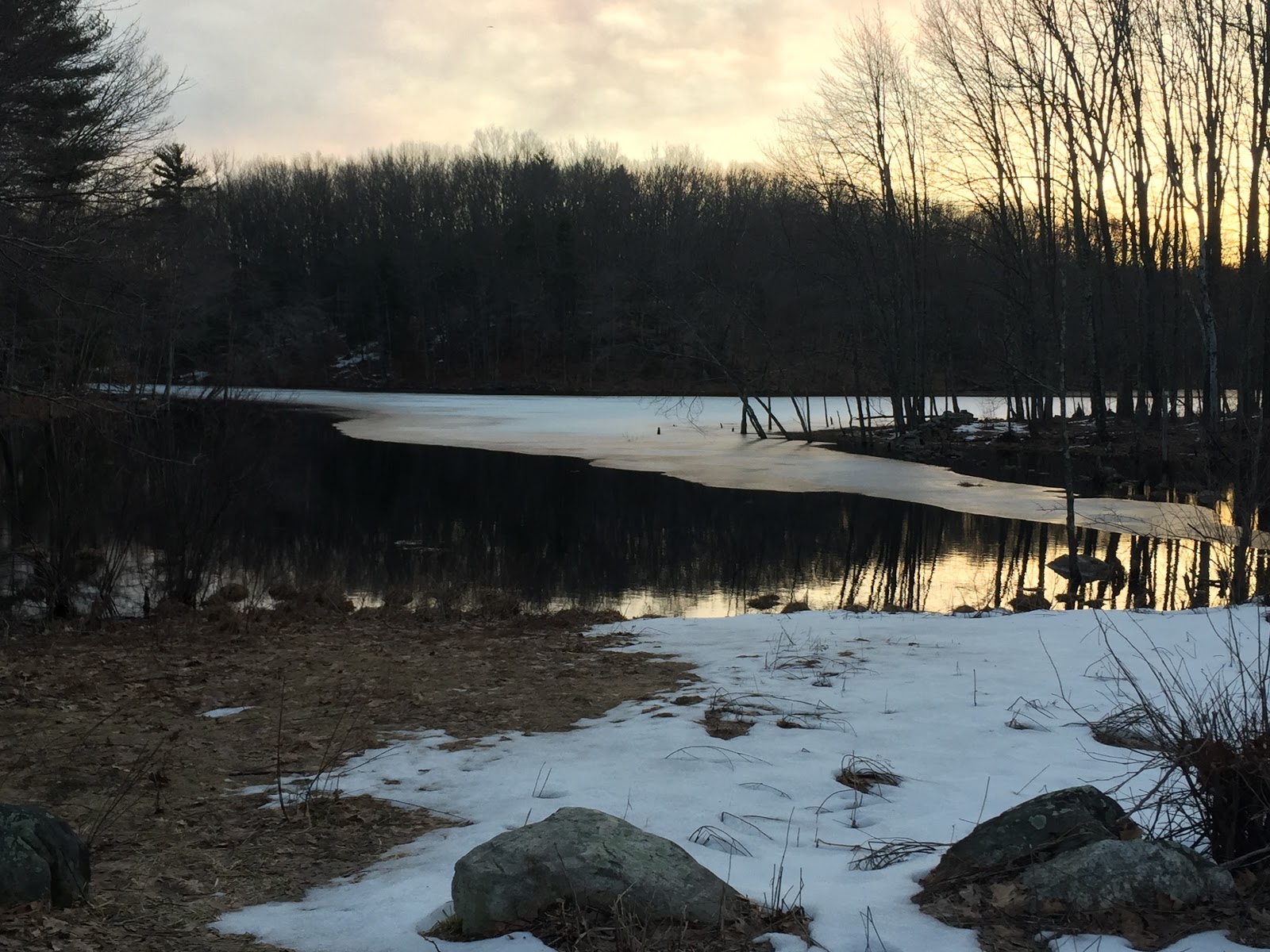
    The changing of the seasons is well underway in the northeast.  While the calendar says spring, Mother Nature decides when it’s really upon us.  In New Hampshire spring is marked by Ice Out; the time when the ice on Lake Winnipesaukee has melted enough that the Mount Washington can sail to all of her ports of call on the lake.  This is determined when one designated guy, currently Dave Emerson, flies over the lake and gives it his blessing.
    In 2017 Ice Out was on April 17th.  The year before it was on March 18th.  Looking at the dates it seems like the average is late April over the last 131 years.  Honestly, it’s a big deal if you’re on the lake, but for the rest of us its check box indicating another winter has passed.  I live in Southern New Hampshire, where the local ponds thaw out a little faster than Lake Winnipesaukee does.  A walk around town over the weekend showed that we’re getting close.
    Back when I rowed, melt off got us out of the weight room and erg room and onto the water.  It was a huge milestone after a long winter.  Being on the Merrimack in college, the melt off meant a swollen river.  The coxswain and coach had to keep a sharp eye out for floating debris.  I recall a few bumps as submerged logs were detected a bit too late.
    They say back in the early days of our country that people would walk across or skate up the river.  That seems insane now.  You never know what the current on a river does to the thickness of the ice, and nowadays you just don’t seem to have that kind of sustained deep freeze that would build up the ice to those levels.
    Climate change is happening, no matter what the fake news crowd says.  Facts don’t lie.  As much as I embrace spring and the chance to be on the water again soon, I wonder what kind of planet we’re leaving for our grandchildren.
  • Sap Moon

    Sap Moon

    Tonight I watched the moon rising through the trees and illuminate the night.  Sometimes the universe gives you just enough.