Month: April 2019

  • Not Today

    I re-watched Game of Thrones Season 8 Episode 3 last night.  Would I have preferred it to be filmed on a brighter set?  Sure.  But did that make me as outraged as the media critics who stir indignant outrage with words?  Not at all.

    This show requires a second and sometimes a third viewing to peel back the layers of meaning in every scene.  If that makes me sound like a GoT fanboy, well, that’s your issue not mine.  People who criticize the show usually don’t take the time to watch and understand the show.  Or they’re the people who read the books and feel that the show strayed from the books too much.  Whatever.

    To me, someone who opts out of mass television hysteria whenever possible, Game of Thrones is the best television show I’ve ever watched.  I’ve enjoyed watching the characters grow and evolve in a complicated, dark and violent world as that world hones who they are.  We all choose how we are going to react to the things that happen in our lives, and each of these characters evolve based on this.  It’s extraordinary long form character development spanning a decade.

    Back in the real world, I do my best to develop and refine my own character.  I write about people who are long dead quite often and I know that.  That’s part of being a history buff I guess.  But there are lessons in history, and it’s worthwhile to know who came before us.  As George Santayana said, “Those who cannot remember the past are condemned to repeat it.”  I see countless people not remembering the past, falling victim to yellow journalism, celebrity gossip, reality television, charlatan evangelicalism and political catch phrases.  That there are people out there who believe the world is flat boggles my mind.  But then there are people who believe climate change isn’t real too.

    Game of Thrones offers welcome relief from reality while borrowing heavily from our dark human past.  It’s no stretch to see the similarities in the treatment of women, slavery, massive military conflict, greed and power struggles it leads to, and the privileged lives of the rich.  What I love about the show is that as the characters evolve, they don’t shrink away from these topics, but use them to catalyze the character of the, well, characters.

    The development of the two Stark girls who accompanied their father to Kings Landing and struggled for years to get back to Winterfell is at the core of the show.  Dark things happen to each of them over the years, and may still happen in the final three episodes.  But watching them grow and evolve has proven immensely enjoyable.  In contrast, I’m re-reading Walden and reminding myself why I loved it so much.  These two quotes seemed to call out to me this morning:

    “There is only one god and his name is Death, and there is only one thing we say to Death: Not today.” – Syrio Forel to Arya Stark, Game of Thrones

    “… I read his epitath in the old Lincoln burying-ground, a little on one side, [it told me], with staring emphasis, when he died; which was but an indirect way of informing me that he ever lived.” – Henry David Thoreau, Walden

    Thoreau was a Transcendentalist who believed in the basic goodness of all people and the divinity of nature.  Thrones is perhaps the most stoic program I’ve watched.  Remembering that we all must die, and every character on this show seems to eventually, allows you to live each day more richly.  And maybe be a badass with a Valaryan steel dagger too.
     

  • The Fulcrum of Isolation and Engagement

    Today I drove three hours from my home to a meeting on the Vermont-New York border, an area I was just in less than two weeks ago.  I have meetings tomorrow in the Albany area so I drove ninety minutes to a hotel Clifton Park, where my first meeting is in the morning.  If you’re keeping score that’s 4 1/2 hours in the car alone, with a 30 minute meeting to break it up.  

    Tomorrow I’m in wall-to-wall meetings all day, with a couple of phone calls in between.  And then I drive to Ithaca to have dinner with Emily before I drive out to my hotel in Buffalo.  Another six to eight hours of isolation in a car with high engagement in between.  I generally make calls or listen to podcasts in the car, but sometimes I just turn off the noise and just drive in quiet…  for hours.

    My business life is a balance of isolation and engagement.  These are deep swings in each direction, and not for the faint of heart.  I’m at once a loner and a social being, and perhaps the thing that saves me is that I enjoy both worlds.  

    Does this make me strange?  Perhaps.  Then again, I feel like a heavy reliance on interaction with others is unhealthy.  Striking a balance is key, and that emotional fulcrum point is very different from one day to the next.
    I drove around Portugal by myself and thoroughly enjoyed the experience.  Would it have been better with Kris or a few friends?  Absolutely.  But it would have been different too.  And the trip I took by myself will be one I’ll remember fondly despite the isolation.
    I take mini side trips to see interesting things.  But let’s face it, visiting an old graveyard in the middle of nowhere is not everyone’s idea of fun.  Best to knock off my flights of historical  fancy whenever I can, but without dragging along people who aren’t as into it as I am.
    There’s another aspect to traveling alone; I notice things more.  Like an old stone pyramid built as a monument to a long-dead Basque explorer in Victor, New York.  Or a monument honoring the Knox Trail near Saratoga this afternoon.  Or an old gravestone marking the final resting place of Jane McCrea, murdered by Native Americans who were accompanying General Burgoyne in his ill-fated march to Albany which sparked a unifying outrage amongst the Colonial Army that helped fuel victory at Saratoga.
    Make no mistake; I thoroughly enjoy the company of others. I find deep conversation with complex, vibrant people as thrilling as any waterfall or vista I’ve chanced upon (My god I love a good conversation!). And I’ve tried to be what Malcom Gladwell would call a Connector in holding together the cast of characters I’ve become friends with, and pulling others in as well. But the many hours alone in a car ahead of me this week don’t fill me with dread either. If I have the chance to reconnect with an old friend during that drive time all the better.
  • The Evasive Groundnut

    “I discovered the ground-nut (Apios tuberosa) on its string, the potato of the aborigines, a sort of fabulous fruit, which I had begun to doubt if I had ever dug and eaten in childhood, as I had told, and had not dreamed it.  I had often since seen its crumpled red velvety blossom supported by the stems of other plants without knowing it to be the same.  Cultivation has well-nigh exterminated it.” – Henry David Thoreau, Walden

    “Hannah Bradley later told her family that “she subsisted on bits of skin, ground-nuts, the bark of trees, wild onions and lily roots” on the trek to Canada.” – Jay Atkinson, Massacre on the Merrimack (endnotes)

    Apios americana, also known as the American groundnut, potato bean and several other names, is an indigenous plant that grows in the forests from Canada to Florida.  I’ve had a strangely compelling fascination with groundnuts since I read a description of Hannah Dustin, Hannah Bradley and other prisoners of the Abenaki who kidnapped them digging around in the woods of New Hampshire wherever they were encamped to find groundnuts to eat.  I live in New Hampshire, I wander about in the woods (though not often enough) and I found the fact that these groundnuts were so readily available to be fascinating.

    Reading about Benedict Arnold’s men starving on their march through the woods of Maine when they invaded Quebec, or Roger’s Rangers starving to death as they evaded the French and Native Americans during campaigns in the Lake George/Lake Champlain region have made me wonder about this evasive groundnut even more.  If this was a staple of the Native American population’s diet, and were known to men like Robert Rogers, why were so many of them starving?

    Henry David Thoreau alludes to one reason in Walden when he writes about discovering a “now almost exterminated ground-nut” someday resuming “its ancient importance and dignity as the diet of the hunter tribe.”  These New Hampshire woods that I like to wander in were once fields as settlers plowed fields and brought in livestock.  The stone fences that criss-cross the forest betrays the history of this land.  So for a farmer from Massachusetts living off the land may have been tougher than it is today.  As ancient forests were cut down and plowed fields took their place the groundnuts became harder to find, just as wild animals who were hunted for food became harder to find.  For the native population who lived off the land as hunter-gatherers, this must have been particularly devastating.

    Over the last few years of gardening I’ve noticed some invasive vines growing into the yard.  I sprayed some of them along with the poison ivy to knock them back, and pulled them off the fence and a spruce tree in the yard.  Imagine my surprise when I realized that the plant I was aggressively expelling from the edges of my yard was the very plant that I’ve been wondering about.

  • Hubbardton

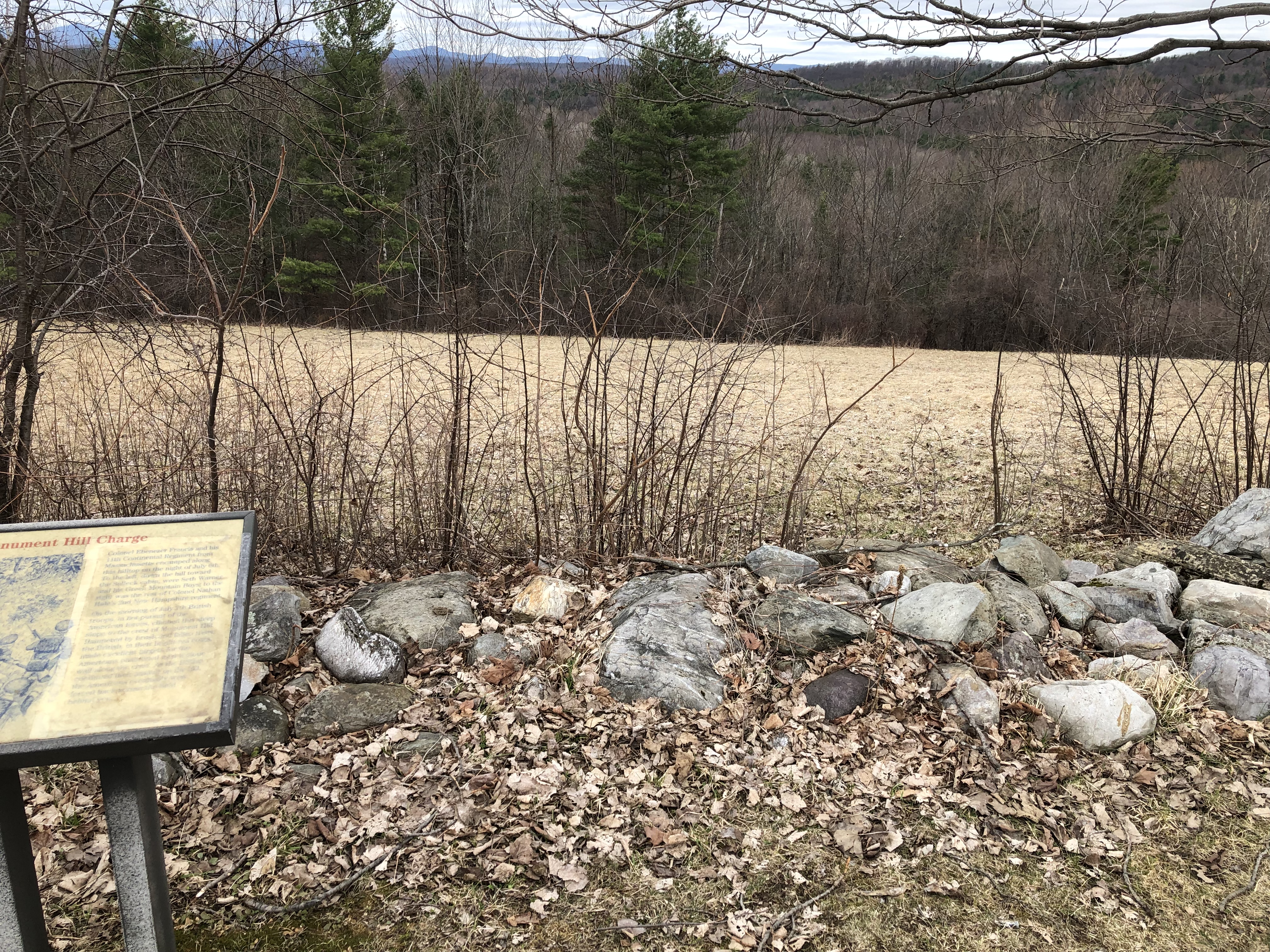
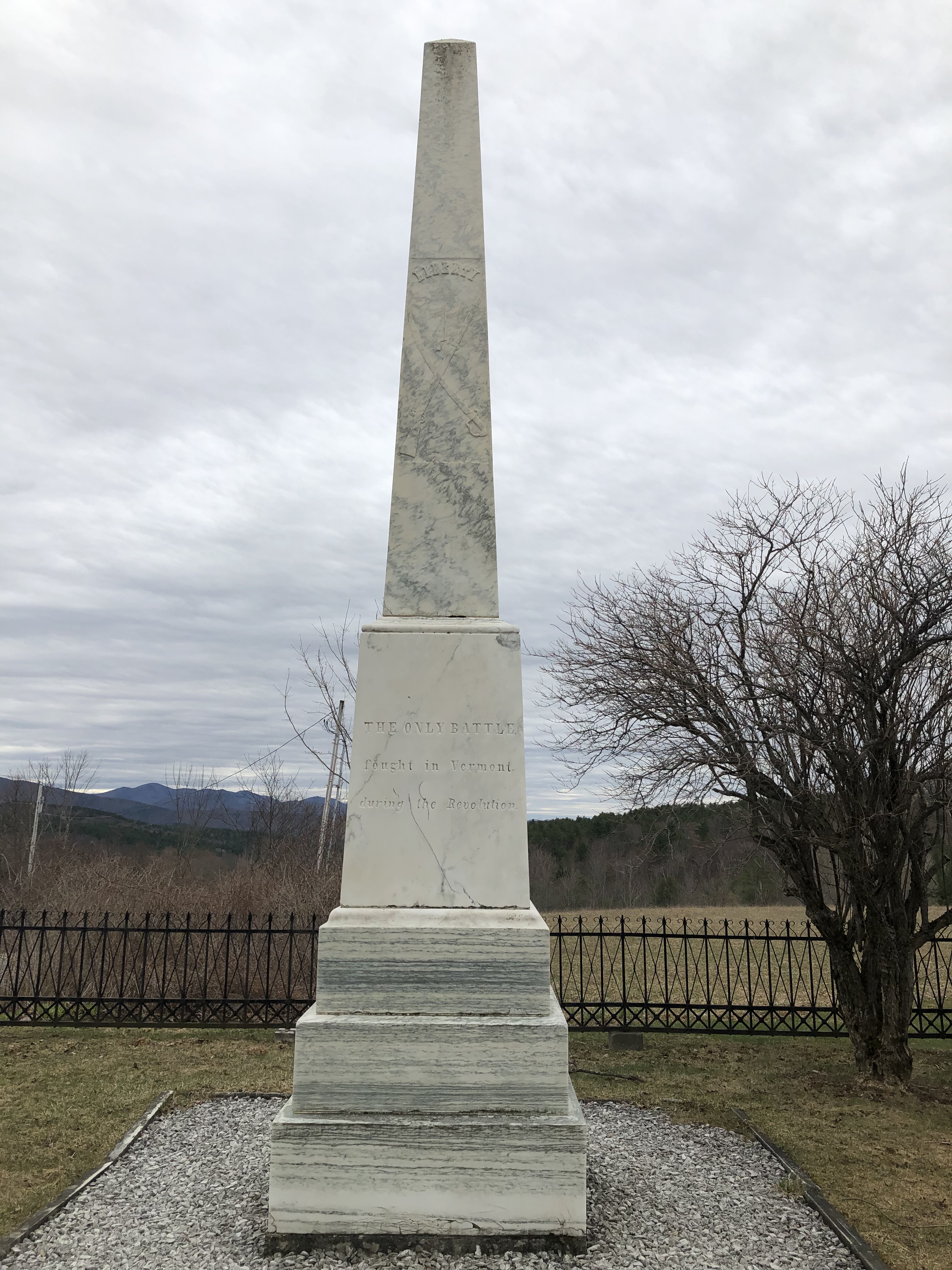
    There was only one battle inside the borders of Vermont during the Revolutionary War.  Many people would point to Bennington as the location, but that battle actually took place in New York.  The Battle of Hubbardton erupted on the morning of July 7, 1777 when the British forces (mostly Hessians) and their Native American allies pursuing Colonial Army forces retreating from Fort Ticonderoga caught up to them on this site.

    The 11th Massachusetts Regiment was the rear guard and were late to join the larger forces commanded by St. Clair, who were marching to Castleton.  Colonel Seth Warner commanded the Green Mountain Boys and Nathan Hale (not the spy) commanded the 2nd New Hampshire Regiment that waited for the 11th to catch up.  Warner decided to spend the night instead of marching on, and the British caught up with them at dawn.  The combined forces of the Massachusetts, New Hampshire Regiments and Green Mountain Boys stood their ground along the top of a ridge and laid fire on the pursuing British forces, retreated further and engaged again.

    Casualties were high on both sides. On the Colonial Army side a combined 370 men were killed, wounded or captured, and New Hampshire’s Nathan Hale was captured in the battle and eventually died in captivity.  On the British side, almost 200 were killed or wounded.  The battle was technically won by the British, but it was a costly battle that, along with battles in Fort Anne and Bennington, were critical delays that helped lead the way to the American victory at Saratoga.  General Burgoyne’s critical mistake was losing focus on the ultimate goal of controlling the British along the water routes from the St. Lawrence to the Hudson River, which would have cut off New England from the rest of the colonies.  Saratoga proved a critical win as it prompted the French to join the Americans against the British.

    I walked around the site of the Battle of Hubbardton on April 18th when I took a quick detour from my business meetings.  Driving out to the battle site is an exercise in faith, as the signage is limited, cellular service ended for both my AT & T and Verizon phones, and you’re driving for what feels like a long time from the highway to the site.  But I’m not easily intimidated by such things.

    The actual battle site looks a lot like it did that day.  If anything, it’s even less developed now than it was then, as the fields once planted with corn, beans or hay have been taken back by the forest.  The battle site remains fields, with mown paths that carry you to signs that tell you where you are and what happened at that location.  This was the moment when I recognized that my old dress shoes were no longer waterproof, as the soggy grass transported water to my dress socks with ease.  I normally keep boots in my car but this side trip wasn’t anticipated and, well, it’s only water.

    The Battle of Hubbardton site is an active museum, but it doesn’t open until May and there’s a sign that let me know it’s okay to walk around the grounds.  There’s a small building that likely offers much more information on the battle and the related action at Lake Champlain, Fort Ticonderoga, Fort Independence and Saratoga.  But that will have to wait for another day.  A white marble monument surrounded by an iron fence offers a stoic tribute to the events of that day, and I spent a few minutes walking around it reading the engravings on each side.  I was alone that day, and that solitude made the experience all the more moving as I reflected on the quiet ground that once roared with violent conflict.

  • Identity

    For all the goals and strategic plans I’ve put together in my lifetime, I don’t believe it all led to a massive leap forward in fitness levels, or weight, or quota attainment, or some other goal I’ve had along the way.  Don’t get me wrong, I’m a big believer in goals and working plans.  But identity trumps all.  And over time, what you identify yourself as is much more critical to who you are in the end.

    “No, that’s not me.” – Arya Stark, Game of Thrones

    “The identity itself becomes the enforcer.  You do it because it’s who you are and it feels good to be you.” – James Clear, Atomic Habits

    Identity changes over time of course, hammered into shape by life experiences, hardships and setback, lucky breaks, being born in the right place at the right time, and the people you surround yourself with.  I grew up thinking of myself as a son, grandson, brother, cousin, nephew, friend.  Later I evolved into a student, athlete, hiker, rower, mountain biker, sailor, salesperson, manager, husband, father.  And along the way I’ve dropped a few things while adding others.  I don’t mountain bike anymore, but I still had my mountain bike from when I was 24 until I was 48.  I kept telling myself I’d get back to it eventually until I told myself eventually wasn’t happening.

    I’ve seen friends go from couch potatoes to avid, frequent hikers and change their bodies and outlook on life in the process.  I’ve experienced and watched others deal with depression, loss of family members and job loss, divorce, health scares and relocation to faraway places.  Ultimately it all impacts your identity – who you believe you are – and changes it.  But identity works the other way too – when you identify yourself as a resilient, disciplined athlete you’re much less likely to react to setbacks with destructive behavior.

    Time and bad habits erode the best of foundations, so reinforcing identity with positive habits is the best way I know maintain a solid base.  I’ve watched my wife run consistently for the entire time that I’ve known her, and it’s a core part of her identity.  We have more 5K t-shirts in this house than I can count, and everywhere I look there’s another road race medal hanging off of something or other.  But it’s an identity that makes her healthier and more resilient than a lot of other people in the same age bracket.  Her consistency of effort is admirable and a source of inspiration for me as I fight year in and year out to build a similar level of consistency in my workouts.

    I’ve been doing the same routine all month, and honestly I’m not making a ton of progress from a weight loss standpoint, but I am getting stronger, I am reading and writing more, I am feeling better about myself and I am reinforcing a new identity as an disciplined person who works out every morning, is an avid reader and consistent writer.  That reading and writing part of my identity has led me to seek out new places on the map, and to chase down long forgotten ghosts and dance with them across history.

    James Clear’s Atomic Habits was a timely read for me, and I’ve referenced it here and in many other blog posts since I read it.  Perhaps the one phrase of his resonates more than any other, and that is in building habits slowly, at a point that feels like it’s not work, we are casting votes for your new identity.  Such a simple phrase, and yet it instantly highlights exactly what daily routines, habits and systems are doing; working in your favor or against you.

    New Years Eve, birthdays, new quarters or months; all offer an opportunity to reflect on the past, determine what went right, what needs to be improved upon, and what changes to your routines and system need to change.  Of course, every moment offers the same opportunity.  What I was five minutes ago impacts who I am now (so don’t eat that donut), and what I do now – this moment – casts a vote for what my identity will be now and in the future.  Simple right?


  • The Rewards of Restless Wandering

    This has been, to now anyway, an unfocused morning.  These are the mornings that test your routine. Something’s off.  It started by waking up twenty minutes earlier than usual, dwelling on that for a moment too long, staring at the reflection of the moon in the pool, then looking up at the moon being tickled by the budding tree branches, then back down to the reflection and so on.

    But I got dressed and did my usual exercise routine.  And yet it too was unusually unfocused.  Not pulling the handle down to the catch position on the erg, not putting my ring back on after rowing, and on and on.  But I made it through the minimum workout unscathed.

    Reading was off too.  My mind wandered to an article I’d read which made me wonder how a certain author I’ve read before would think about that article, which made me search for said author on Twitter instead of pressing ahead with my reading.  This restlessness of mind isn’t uncommon, but perhaps I’m just paying more attention to it given the routine I’m trying to hammer home.  But I did the bare minimum of reading that I wanted to do and set about writing this blog post.  Looking at the time, I’ve realized that in getting up early I’m still way ahead of the game and despite being “off” the day is not at all in jeopardy of spiraling out of control.  Life is full of distractions and unexpected detours.  Following a system allows you to stay on track even when you get pulled off the mark a bit.

    All that restlessness did accomplish a few things.  Instead of reading ten pages of my current book, I looked up Wayne Curtis’ Twitter account and started following him.  I saw a post of his that inspired me to look up a unique travel experience in Edinburgh when we’re there next fall.  I read a Ryan Holiday article on the magic of bookstores that made me want to return to a bookstore on Martha’s Vineyard that I especially enjoy.  I read an NPR article about Nirvana’s Smells Like Teen Spirit that reminded me of my life in 1991 and reflect on that for a moment.  The morning, only 90 minutes old at this point, has not been unproductive at all.  Such is the human experience.

    Through all that unfocused 90 minutes, my routine kept me on track, ensuring that I did the three things I want to do every morning while giving me the flexibility to… wander a bit.  And the wandering is where the magic is.  Yesterday I finished a meeting in the Hancock Tower in Boston and walked back to my car in the garage, threw my bag in the trunk and went for a walk on Commonwealth Avenue.  There was purpose in it too – I wanted to see the John Glover statue there, which I’ll write about sometime soon.  But the wandering served its own purpose as I took the long way back to the car I visited the finish line of the marathon.  If you’re going to pay to park in this part of Boston you might as well get your money’s worth.

    I’ve written the equivalent of a long novel over the last 15 months of blogging.  Last year I lapsed a few times and fell out of the habit of writing.  This year I haven’t missed a day yet, and hope to continue that consistency for the rest of my life.  This morning, as I was fighting through that restlessness, my morning routine served as guard rails to keep me on track.  I still wandered, but managed to get where I was trying to go nonetheless.


  • Seeking Adventures

    “Rise free from care before the dawn, and seek adventures.” – Henry David Thoreau, Walden

    Good old Henry David Thoreau, planting seeds of wisdom throughout Walden.  There are stretches of this book that are tough to digest, but when he’s on point he’s a brilliant sage.  I’m glad that I’ve come back to Walden, and will spend more time on the book overall soon.  For now, there’s this quote to ponder.

    Rise free from care before the dawn…
    I’ve been off and on again with that early to rise thing.  For years I prided myself on getting up very early indeed.  But approaching midlife (for me that meant 50) I started “sleeping in”; not setting my alarm, waking up at 6:30 naturally instead of making myself wake up at 5 or 5:30 AM.  No, I’ve come to value sleep.  But now I just go to bed earlier.  No use staying up late to overindulge myself on television, junk food, alcohol, social media or other nonsense.  No, early morning is my time, and this habit I’m re-establishing (day 23!) of working out, reading and writing is a hell of a lot better than that other stuff.

    … and seek adventures.
    Well, I can certainly embrace that idea.  Adventure means different things to different people of course.  For me it means accepting a little risk in life, seeing new places, trying new things, stretching myself in new ways and generally getting on with the business of living an interesting life.  But life is about balance, or at least that’s what we tell ourselves.  I’m okay with balance, but with the scales tipped towards adventure.  I’ll have time for balance when I’m unable to do the things that must be done.

  • From Bloody Pond to Winter Street

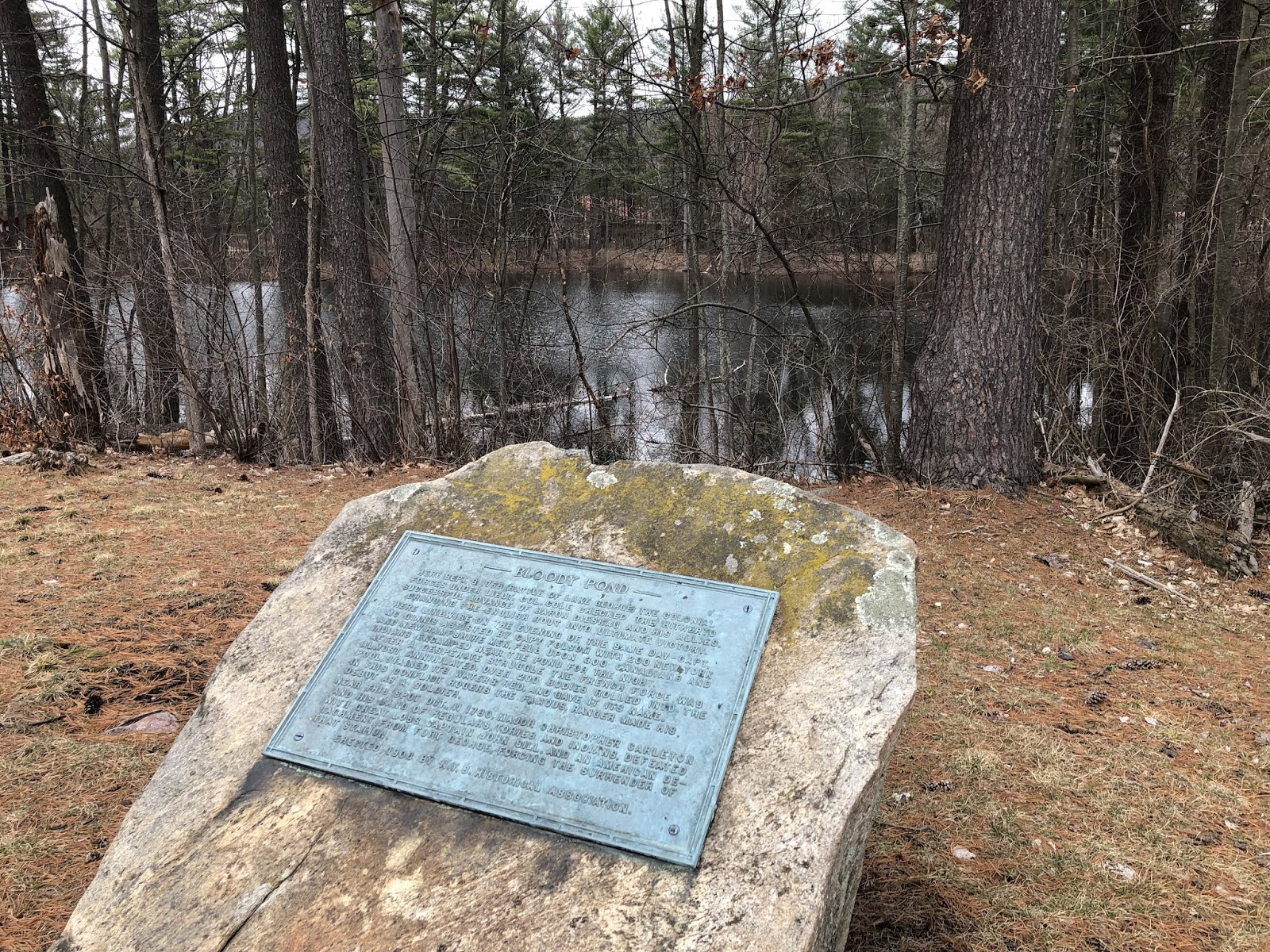
    During the French and Indian War the pristine Lake George saw some horrific battles for control of the lake.  The British and French continued attempts to push each other out of the region with force.  The Battle of Lake George in 1755, the siege on Fort William Henry in 1757, the Battle on Snowshoes in 1758 and countless skirmishes in between let to high body counts on both sides.  One relatively small battle in 1755 illustrates just how bloody the fighting was.

    The New Hampshire Provincial Regiment, consisting of a company of men led by Colonel Nathaniel Folsom (including Robert Rogers in his first battle) plus another 40 New York Provincials under Capt. McGennis came across the baggage and ammunition that the French had left protected with a guard.  They quickly overwhelmed the guard and waited for the larger force of French Canadians and their Indian allies to return.  Late in the afternoon a combined force of roughly 300 returned to the camp and walked into a field of fire from the New Hampshire and New York milita.  In this battle over two hundred men were killed, and subsequently rolled into the pond, which turned red as the blood of the French, Canadians, Native Americans, and colonial militia mixed together in the water.  Enemies returning to the earth together.

    McGennis didn’t survive the battle.  Folsom did, and would go on to participate in other battles of the French and Indian War, and then took up arms in the Revolutionary War.  Folsom and John Stark were both leaders in the New Hampshire Militia.  Folsom  was a delegate representing New Hampshire in the the Provincial Congress and ultimately the Continental Congress.  By all accounts I’ve read he led a life of service to New Hampshire and the country.

    I visited the Winter Street Cemetery to visit Major General Nathaniel Folsom.  I wasn’t sure where his gravestone was when I got there, but looking around I noticed that there weren’t that many that had American flags posted next to them so I used that as my starting point.  I walked around that cemetery for 40 minutes reading each gravestone.  Most of the Revolutionary War veterans had a similar shape and size, with the unique badge carved in the front.  And yet I couldn’t find Folsom’s gravestone.  Folsom was a hero of two wars for the American Colonies, he must have a flag, right?  No flag.  Perhaps it blew over in the wind, or someone took it, or someone forgot to place one next to his gravestone to honor him.  Who knows?

    My time was limited, and I still hadn’t found Nathaniel Folsom.  But I did find the graves of his fellow Revolutionary War veterans, and read the family names of the people who were his neighbors and friends.  And finally it was time to go, and as I stood near the gate I thought I’d just walk down the middle one last time and try an area I hadn’t recalled walking past in my search… and there he was.  His was quite literally one of the very last gravestones I came across.  It’s almost like he wanted me to pay my respects to the rest of the people in the cemetery before coming to see him.

    Like other roadside monuments, the small memorial on Route 9 in Lake George, New York, crowded by motels, auto parts stores and a sushi restaurant, called out to me as I drove by.  It led me to read more about Nathaniel Folsom and eventually to my visit to his home town and final resting place.  For all that he did for his state and his country, his grave is modest – no different than those of other soldiers from the Revolutionary War buried nearby.  If these two modest monuments bookend his life, they served their purpose by helping me get acquainted with this gentleman from Exeter.

  • Finishing What You Started

    This morning I find myself in Hopkinton, Massachusetts for a meeting.  Being typically early offers benefits beyond being late.  Today it meant a quick visit to the starting line of the Boston Marathon, which has been the traditional starting place for the race since 1897.  I’ve watched the finish of the marathon many times, particularly those years when my wife ran the race, but I’ve never seen the start in Hopkinton other than watching it on television.  The race was a week ago so the paint is still fresh on the starting line.  And just like on race day this year, the road is wet from all the rain we’ve had.

    I’ve crossed the starting line and the finish line once in my life, but I wasn’t running.  I did the Jimmy Fund Walk 12 or 13 years ago.  I raised money of course, but otherwise I did the walk with little fanfare and no family or friends lining the course for me.  Young kids at home at the time, soccer game that day, and frankly it’s a walk-a-thon it wasn’t the running of the marathon.  Some things don’t warrant much attention I guess.

    I was commenting on the string of jobs I’ve had since that Jimmy Fund Walk.  Outside of a five year gig at one company, I’ve had two-year stints at three different companies, and I’ve been at my current company for one year.  I like small companies with a level of risk in them.  I also like the flexibility that comes with sales jobs, as I’ve documented recently.  But I always intend to finish what I’ve started and keep pressing ahead trying to make things work wherever I land.  I hope to be at this company until I retire, but you never know.  I have learned from each place I’ve been, even if I haven’t gotten rich at any of them.

    If I wasn’t in Hopkinton today I wouldn’t have sought out the starting line.  I’ve driven by the exit a million times without a thought of stopping in.  But here I was today, thinking about the start, and that walk back in 2006 or 2007.  Hell, I don’t even know where the medal is I got that day.  I’m happy that I finished what I started of course, but for all my ghost dancing I don’t live in the past.  I move along, believing that slow and steady wins the race….  or at least gives you a fighting chance of finishing what you started.

  • John W. Weeks

    Today is Earth Day, and a good opportunity to celebrate the life of John Weeks.  You may not know John Weeks, but if you’ve hiked in the White or Green Mountains in New England you’ve directly benefited from the Weeks Act, which was designed to protect the headwaters of rivers in the eastern United States.

    Weeks made his fortune in banking, became Mayor of Newton, Massachusetts and then steadily advanced in politics first as a United States Representative and then as a Senator.  He became Secretary of War after World War One.  His most notable accomplishment in his political career was the passage of the Weeks Act, which he had introduced to Congress on March 1, 1911.  More than 20 million acres of forest were protected with the passage of this Act, including the White Mountain National Forest, Green Mountain National Forest, Allegheny National Forest and others.  There’s also a State Park named after him near his summer resort in Lancaster, New Hampshire.

    As a rower, I’ve known John Weeks’ name without realizing the things he’d accomplished in his life.  The Weeks Footbridge connects the Harvard University campus at a critical bend in the Charles River.  Critical because if you’re racing in the Head-of-the-Charles Regatta this particular bend in the river combined with the choke point of the bridge arch and some very aggressive coxswains, leads to some notable collisions under the Weeks Footbridge.  It thus became a popular spectator destination.

    So while I know his name from the bridge, I’ve come to appreciate him through his Weeks Act and the preservation of lands that I’ve come to love.  On this Earth Day, with so many weak politicians in Washington doing nothing notable except protecting their careers, it’s nice to reflect back on a different kind of Week.  I’ll be sure to toast the late Senator next time I’m hiking in the Whites.