Month: September 2019

  • The Siren Call of More

    Energy. Vibrancy. Concrete, glass and steel. Traffic. Relentless traffic. Fit achievers marching to close the deal or set a new PR. Steakhouses and pizza and other temptations tip the scale. Look up and you see money reaching for the sky. Look down and you see the homeless trying to get a leg up or having given up. Urine stains on concrete sidewalks. Sewer system reminds you that there’s another world under that sidewalk.

    Taxis and buses and Uber this way and that. Roar of engines, wail of sirens, honking of horns. This world clamors for attention. Like many big American cities Chicago won’t wait for you. “Be better” it calls. “More!” It cries. As the old business cliche warns, “If you’re not moving forward you’re falling behind.” So get moving already. Play the game or get out of the way.

    It’s easy to get caught up in this crazy world of “more”. The siren beckons… But “less” has its own call.

  • The Fate of Trees

    Returning to the poem The Ship and Her Makers this morning as I consider the smoke alarm in my hotel room that chirped all night. Such is the glamorous life of travel. Writing instead of sleeping in is a habit I’ve developed, and there’s no sleeping in with a chirpy roommate.

    Consider:

    THE TREES
    We grew on mountains where the glaciers cry,
    Infinite sombre armies of us stood
    Below the snow-peaks which defy the sky;
    A song like the gods moaning filled our wood;
    We knew no men—our life was to stand staunch,
    Singing our song, against the avalanche.

    – John Masefield, The Ship and Her Makers

    Living in New Hampshire I know the power of trees. The white pines that dominated the forests were cut down for masts and wide plank floors and countless other uses the trees weren’t consulted on, but they’ve grown back, and New Hampshire, just behind neighboring Maine, top the nation in percentage of “above ground woody biomass”, or as we call them around here; trees.

    “Every walk in the forest is like taking a shower in oxygen.” – Peter Wohlleben, The Hidden Life of Trees: What They Feel, How They Communicate—Discoveries from A Secret World

    The irony of writing about trees thirteen stories above the largely treeless Chicago landscape isn’t lost on me. Love the city, but couldn’t live here. Give me trees. Walking amongst the tallest of them certainly brings humans back to earth. Forests are the opposite of cities in that respect too. Skyscrapers race to be the tallest, just as trees do, but they’re all in it for themselves. Not so with trees.

    But isn’t that how evolution works? you ask. The survival of the fittest? Trees would just shake their heads—or rather their crowns. Their well-being depends on their community, and when the supposedly feeble trees disappear, the others lose as well.”

    – Peter Wohlleben, The Hidden Life of Trees: What They Feel, How They Communicate—Discoveries from A Secret World

    There’s an underlying sadness in Masefield’s poem emphasized by the first line. We grew on mountains where the glaciers cry. What a portrait of what once was… we were once this grand forest, now we’re the planks under your feet and the mast above. Such are the sacrifices for mankind. Forests regrow of course, but we all lose something by the loss of old growth trees. Wohlleben wrote that in the quote above; when the supposedly feeble trees disappear, the others lose as well. The others aren’t just the other trees: they’re also us.

  • A Wandering Tenant

    Waiting this morning for a flight to Chicago, and the last line of this poem comes to mind.

    THE SHIP

    I march across great waters like a queen,
    I whom so many wisdoms helped to make;
    Over the uncruddled billows of seas green
    I blanch the bubbled highway of my wake.
    By me my wandering tenants clasp the hands,
    And know the thoughts of men in other lands.

    – John Masefield, The Ship and Her Makers

    Granted, I’m boarding a JetBlue flight with technology not dreamed of in the time of John Masefield, things like iPhones playing music over Bluetooth to my wireless noise cancelling headphones, or the onboard video entertainment 18″ from my face that I try to keep on the tracking map to focus on productivity. Perhaps the vessel has changed over the years, but the adventure of travel hasn’t. Instead of blanching a bubbled highway a pair of contrails mark our previous moments. I surf an aluminum tube skimming 35,000 feet above sea level at 480 miles per hour

    This is a business trip, but as with any trip I try to make the most of the time away from the more familiar. I’ve been to Chicago many times, and look forward to reacquainting myself with people from around the continent attending the same event. And of course a chance to meet new acquaintances as well. Travel offers the opportunity to explore the world one conversation at a time.

  • As the Twig is Bent the Tree Inclines

    “Everything that is printed and bound in a book contains some echo at least of the best that is in literature.  Indeed, the best books have a use, like sticks and stones, which is above or beside their design, not anticipated in the preface, nor concluded in the appendix.  Even Virgil’s poetry serves a very different use to me today from what it did to his contemporaries.  It has often an acquired and accidental value merely, providing that man is still man in the world…  It would be worth the while to select our reading, for books are the society we keep; read only the serenely true; never statistics, nor fiction, nor news, nor reports, nor periodicals, but only great poems, and then they failed, read them again, or perchance write more.” – Henry David Thoreau, A Week on the Concord and Merrimack Rivers

    I keep returning to Thoreau this year.  And he rarely lets me down.  When he wrote these lines he was referencing the poetry of the long dead Virgil, contemplating the power of his words in his time, even as they meant something slightly different to him.  And now I read Thoreau’s words, in turn contemplating the power of his words in the same fashion.      We all are influenced by the collective wisdom of the ages, and if we’re bold write about our own perceptions of the world to in turn influence others.  I’m not so bold as to compare myself to Virgil or Thoreau mind you, but I’ll keep working towards it nonetheless.

    “Your descendants shall gather your fruits.” – Virgil

    I’ll follow Thoreau’s lead and contemplate some of Virgil’s writing for a moment.  Whether my writing amounts to anything more than the ramblings of a restless mind or the beginning of something greater remains to be seen at this point, but those descendants will know a bit more about that mind for having done the writing.  Neither could have envisioned the world as it is today, and who might be contemplating their words.  We all add to the chorus with our voice.

    “As the twig is bent the tree inclines.” – Virgil

    There’s no doubt that blogging has bent the twig a bit, so to speak.  The benefit of this daily writing habit is that the behavior inclines us more towards greater things.  Ultimately that’s the entire point of the exercise (and thank you for being part of the journey), chipping away at it.  Getting that 10,000 hours in.  Refining, building, becoming something better for the effort and consistency.  And maybe add a little great poetry to the world in the process.

  • The Deathbed Question

    “You are 99 years old, you are on your deathbed, and you have a chance to come back right now: what would you do?” – Christopher Carmichael

    No relation to me that I’m aware of, but I love the question. This question is referenced by Jérôme Jarre, a young man with an old soul, in a written interview he’d done in Tribe of Mentors, itself a wealth of information and inspiration.

    The answer should never be “not this” of course, but importantly, what IS that answer? The time travel spin is a variation on the dying wish story: I wish I’d spent more time with my children instead of working, or similar wishes. But it’s easy to separate ourselves from the responsibility of that deathbed moment. There’s still time… Carmichael’s what would you do? question brings the future to NOW. And really, that’s all we have isn’t it?

    So, …what’s the answer to the question? Right now?

  • The Yin and Yang of New Hampshire and Vermont

    “She’s one of the two best states in the Union.
    Vermont’s the other. And the two have been
    Yokefellows in the sap yoke from of old
    In many Marches. And they lie like wedges,
    Thick end to thin end and thin end to thick end,
    And are a figure of the way the strong
    Of mind and strong of arm should fit together,
    One thick where one is thin and vice versa.”

    – Robert Frost, New Hampshire

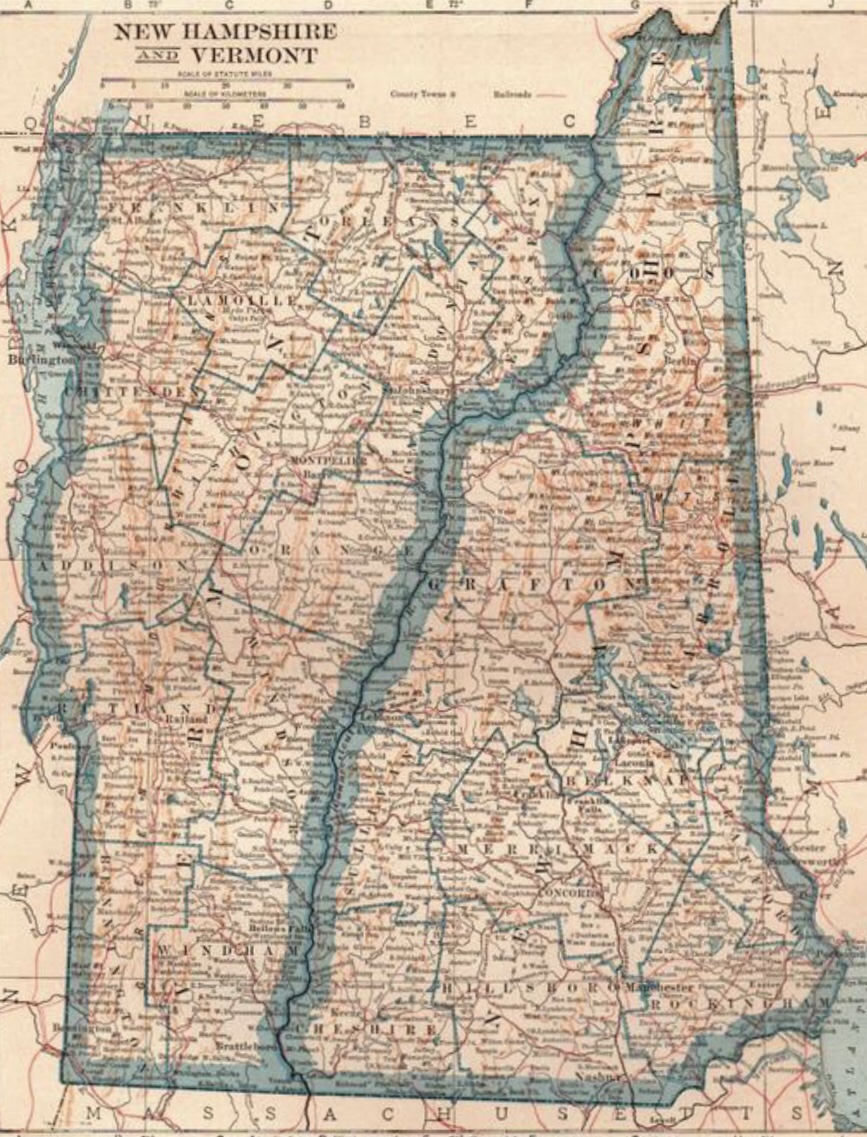
    New Hampshire and Vermont are Yin and Yang.  Almost flipped mirror images of one another, as Frost describes.  The people are similar in so many ways, and different in so many other ways.  Generally, Vermont is a “blue state” while New Hampshire is a “red state”, traditionally voting Republican (much to the chagrin of Vermont and Massachusetts).  New Hampshire has a certain active principle, Live Free or Die vibe going, while Vermont embraces a more receptive, Freedom and Unity vibe.

    The Connecticut River defines the border between the two, as determined by King George III in 1763. Vermont didn’t exist back then, the land was deemed New York’s. But that didn’t last very long; about the time it took for New York to try to collect taxes from the people there. Ethan Allen and the Green Mountain Boys chased the tax collectors right out and Vermont seceded as the American Revolution was ramping up. That’s a very New Hampshire thing to do! And ever since, these two states have been locked in an eternal embrace; interconnected yet independent. White Mountains and Green Mountains, conservative and liberal, two of the smallest states in size and population; wonder twins holding up the northern border and hugging each other for eternity.

  • From Falkirk To Portsmouth

    206 years ago next week, on September 10, 1813, the British brig General Hunter was captured after the Battle of Lake Erie. That battle deserves more attention, which I’ll try to offer on another day. This story is about the journey a pair of cannon took from the banks of the River Carron in Falkirk, Scotland to their current home near the banks of the Piscataqua River in Portsmouth, New Hampshire. The guns are of course inanimate objects, but darn it they’re surely survivors.

    Once a part of the arsenal on the brig Hunter for the British, captured and turned to service for the Americans on the brig USS Firefly, the cannon saw service in the War of 1812, the Second Barbary War of 1815 before being retired from active duty and sold with the Firefly to a wealthy merchant from Portsmouth named John Peirce. The guns were on two of the Peirce merchant ships before finally becoming a family heirloom, donated and placed in their current location more than a century ago. As Portsmouth changed they were moved closer to the building to where they are now.

    I’ve come across the guns a couple of times while walking through Portsmouth. And I’ve done a double-take each time. The ships they were in are long gone, and so are a succession of crew and wealthy owners who once valued the utilitarian efficiency of these weapons. Today they’re no longer lethal, instead standing permanently at attention, muzzles buried in the earth, as tourists, drunkards and businesspeople alike drift past, oblivious to their violent history.

    They flank the entrance to the Portsmouth Athenaeum, itself a curiosity in this modern world. The building is almost as old as the guns, and they guard it like older twin brothers might protect a younger sister. Saved from anonymity by the plaques proclaiming their role in the Battle of Lake Erie. But they’d only part of their story. Imagine all these cannon have witnessed, and the stories they could tell.

  • Now… or Never

    Reading has a way of pulling material out for us.  I fully intended to write about the Battle of Lake Erie today, but it will have to wait just a bit longer.  Instead I came across this poem last night while thinning out the bookshelves.  I have books stacked on books, and it’s time to clean out a bunch of them.  Fall yard sale or donate to a library or sell to a used bookstore?  Their fate is to be determined.  But back to that poem.  It speaks of young lust to be sure, but also calls out across the centuries, warning us to get on with it already (so to speak), for time is short:

    “Had we but world enough, and time,
    This coyness, lady, were no crime.
    We would sit down and think which way
    To walk, and pass our long love’s day…

    But at my back I always hear
    Time’s winged chariot hurrying near;
    And yonder all before us lie
    Deserts of vast eternity.
    Thy beauty shall no more be found,
    Nor, in thy marble vault, shall sound
    My echoing song; then worms shall try
    That long preserv’d virginity,
    And your quaint honour turn to dust,
    And into ashes all my lust.
    The grave’s a fine and private place,
    But none I think do there embrace.”

    – Andrew Marvell, To His Coy Mistress

    Who doesn’t smile at the game old Andrew was playing here?  That the game was played in the 1650’s, but published posthumously, as if our hero were reaching out from the grave to remind us that time is short, and to do what we must do….  now.  Carpe Diem.  Marvell was apparently a real player, and I spent some time getting acquainted with a few of his poems this morning before writing.  I may revisit his work sometime, but I can’t ignore the call.  I dance with a lot of ghosts after all, and so should everyone.  They know things we don’t yet know.  History speaks, and so does literature.

    Interestingly, the first time I read the first and last two lines of the poem wasn’t in some English class, but in a business book written by Felix Dennis called How to Get Rich.  I’d picked up his book back in 2006 at the height of my lust for business success.  Back when I read it the first time I ignored the urgency of his call.  I’m less inclined to do so now.  Dennis died in 2014, joining Marvell in calling out from the grave.  Seize the day!

    The grave’s a fine and private place,
    But none I think do there embrace.”


  • Snatching Necklaces From the Sea

    “The wind freshened, and the Spray rounded Deer Island light at the rate of seven knots.
    Passing it, she squared away direct for Gloucester to procure there some fisherman’s stores. Waves dancing joyously across Massachusetts Bay met her coming out of the harbor to dash them into myriads of sparkling gems that hung about her at every surge. The day was perfect, the sunlight clear and strong. Every particle of water thrown into the air became a gem, and the Spray, bounding ahead, snatched necklace after necklace from the sea, and as often threw them away. We have all seen miniature rainbows about a ship’s prow, but the Spray flung out a bow of her own that day, such as I had never seen before. Her good angel had embarked on the voyage; I so read it in the sea.” – Josh Slocum, Sailing Alone Around the World

    I’ve read that passage a few times over the years since first reading this book, and did so again last night.  There’s magic in setting out on a new adventure, and I feel this paragraph captures that exhilaration.  These are the highlighter moments in the novel of life; the first ride without the training wheels when you have balance and velocity with you and you feel like you’re flying, boarding a plane for a flight overseas to a place you’ve always dreamed of going, or simply the first feeling out steps on a long hike when you realize everything is good to go.  Preparedness meets possibility, and the world is in front of you welcoming you to explore your potential.  Ready?  Go!

    Of course, not every moment is a highlight moment, but there should be something in every day that makes you feel alive.  Every dawn is full of possibility, if we’ll only get out and greet the day.  Over the weekend I re-acquainted myself with my sister’s dog Parker. She’s a yellow lab with a highly expressive face and eyes that tell you everything you need to know.  Reading about Slocum’s boat Spray, I thought of Parker’s expression as she realized she was going for a swim in the bay.  Sheer delight, and a sprint to the water.  May we all have more of that in our time here.

    What shall we make of this day?

  • Great is Today

    If you want to fully feel the urgency of “now” watch a veteran roofing crew begin work on a house. There’s no time to get in touch with their feelings, they pull up, assess and get on with it. Get it done ASAP, and move on to the next house tomorrow.

    It’s the first Tuesday in September, and the first day of school pictures will be snapped all over Massachusetts. New Hampshire went back last week, but really that’s just to get a head start on snow days to come. School begins in earnest this week from kindergarten to college. And so [unofficially] summer ends, Autumn begins, and there’s a heightened sense of the moment.

    I read Leaves of Grass last week. More precisely I finished Leaves of Grass last week. Walt Whitman has some brilliant prose, and some sprinkled liberally throughout this work, but there’s a lot of chewing to get this one down. Lot of Walt getting in touch with his sensuality stuff in there that proved controversial for the time, but this isn’t going to be a post about the work as a whole. Instead, this line jumped out at me:

    Great is today, and beautiful, It is good to live in this age… there never was any better.” – Walt Whitman, Leaves of Grass

    Whitman wrote that sometime between 1850 and 1855, when Leaves of Grass was published. It was before the Civil War and other dark days in Whitman’s life. But there are always dark days, and always vibrant days throughout history. Life is the ebb and flow. Don’t bury your head in the sand when darkness reigns, but don’t ignore the extraordinary gift of now we’ve been given either.

    Look around. Look around. How lucky we are to be alive right now.” – The Schuyler Sisters, Hamilton

    Be alive, right now. That’s all there is. We can’t time travel backwards, and we can’t hit fast-forward.  We all know Aesop’s fable about the ants and the grasshopper, but he wasn’t saying there’s no time for play, he was saying that we need to harvest first, then dance and sing.  So by all means work, and build that nest egg, but don’t lose sight of this magic moment along the way. 

    Do not be concerned with the fruit of your action – just give attention to the action itself. The fruit will come of its own accord.” – Eckhart Tolle, The Power of Now

    I’m weighing that fable as roofers strip the roof over my head and I contemplate Whitman. The irony isn’t lost on me, I’ve been on construction crews and know their world. They don’t stop to smell the roses for very long, but sometimes a moment appears. As I spoke with them before they started I pointed to the ripe grapes they would soon cover over to protect them from debris and told them to help themselves. They savored the sweetness of the grapes with audible pleasure, even as they got on with the work at hand. The fruit came of it’s own accord, then it was time to get back to work.