Month: July 2020

  • Move Out on Faith

    Stay away from people who are world-weary and belittle your ambitions. Unfortunately, this is most of the world. But they hold on to the past, and you want to live in the future.” – Sam Altman, Idea Generation

    Sam Altman is an entrepreneur and 35 years old at the time I write this, so I understand his spin on living in the future. A creative mind must indeed live with an eye on the future, for that is where hope and possibility lie just out of reach. To get anything done in this world we must bridge that gap with work today.

    Avoiding the world-weary seems like a great idea. but there’s just so many of them. Some of my favorite people have a world-weariness about them. Its hard not to get a little worn down by 2020 and some of the maddening missteps of humanity over the last few decades, but even in these strange times there’s always something positive out there if you look for it.

    The larger point, of course, is to avoid those who would undermine your dreams in active or subtle ways because they’ve given up on their own. A voice of reason is often a disguise for a “poisonous playmate” who would kill your dream that you might not rise beyond their own lowly ambitions. Quotations are for a term borrowed from Julia Cameron, who has a few things to say about the creative spirit inside us.

    “It is my experience both as an artist and as a teacher that when we move out on faith into the act of creation, the universe is able to advance.” – Julia Cameron, The Artist’s Way

    When I started writing this blog I did it quietly, just writing in Blogger most days, but with breaks in between. I wasn’t fully invested in myself as a writer yet, but there was a tangible shift when I switched to WordPress. Now I write every day and link to it in Twitter for anyone invested in finding my thoughts. Some people find my blog and support it, while others ignore it completely. I try not to let either dictate my writing or the directions the Muse takes me. Keeping eyes on the task at hand and casting votes in the form of daily blog posts.

    Every action you take is a vote for the type of person you wish to become.” – James Clear, Atomic Habits

    Last night a thick fog swallowed up Buzzards Bay whole. “There will be no sunset tonight, I believe“, I announced to my daughter. And upped the ante by saying I’d give her a dollar if there was. Sure enough, the clouds parted, the fog thinned and we had an epic sunset with dancing fog glimmering in bright orange hues. I gave her a five: a dollar for being right and four for her optimism. Maybe that entire scene foreshadows a brighter future. Wouldn’t that be welcomed?

  • A Perfect Cup of Coffee

    I’m deep into a phase of life where I invest time in the ritual of making excellent coffee. That doesn’t mean investing in expensive coffee making equipment. No, that would be absurd and counter to what a ritual should be. You should be able to make a great coffee anywhere you can boil water – camping, on a boat, in a hotel room, in your office (remember those?), on the side if the road or maybe even at home. And I’ve found the trio of products that make the ritual of making java easy, and dare I say, a meditative experience.

    Readers of this blog know of my affinity for AeroPress. The AeroPress has raised the standard of what great coffee can be. After years of dealing with frustrating French presses, drip coffee makers and slow-as-molasses single serving drip rigs, the AeroPress took the best features of each and rolled them into a highly functional, highly efficient coffee press. Fun fact: the inventor of the AeroPress also invented the Aerobie frisbee. You can see it referenced in the design of the AeroPress.

    I’ve raved about the AeroPress since I started using it.. What makes the experience a ritual is the grinding of the beans while you wait for the water to boil. I use a compact ceramic burr hand grinder made by Hario to do the job. I’ve had this device for a few years, but it was only when I started using the AeroPress that I found it made sense. Since the hand grinder takes one or two scoops of coffee at a time, it pairs well with the AeroPress. Combined with an electric kettle to boil water and you’ve got all the ingredients for a perfect cup of coffee. The water boils in roughly the time it takes to scoop your favorite coffee beans into the grinder, hand grind the beans and set up the AeroPress. There’s no rushing, no loud electric grinder waking up the neighborhood, and simple cleanup afterwards. It’s perfect.

    If it seems I’ve carried on a bit too long about making a cup of coffee in a world of chaos and pandemics and injustice, well, it’s because I have. All that stuff will still be there in your face when you walk out the door or turn on the news (please: don’t), but this perfect ritual of coffee-making zen quiets the mind for a few minutes. And that’s a lovely way to start or re-set your day.

    Okay, who’s ready for another cup?

  • Getting There In Spirit

    “I am alarmed when it happens that I have walked a mile into the woods bodily, without getting there in spirit.” – Henry David Thoreau, Walking

    Rising up before the dawn has its advantages.  Mostly in solitude, but also in that dance with light that happens whether you join in or not.  I prefer to join in.

    I walked down to the water to watch the crescendo before the light washed out with the sunrise.  I was struck by the number of boats moored in the bay.  More than I recall in other summers, but there are more people holing up near the water this year for all the reasons you’re familiar with.

    I come to Buzzards Bay to watch the dance between water and light.  Sometimes the water rises up to meet the light, and sometimes it quietly pulls back and waits for the light to come to it, but the dance is beautiful just the same.  The reunion of the two offers a performance that can take your breath away.  Like a lingering kiss of fire to water, you expect a hiss when they touch.  The moments when the sun is just below the water is the most beautiful time of all, either rising up from its depths or rejoining at the end of the day.

    “As trees evoke sound from the wind, your eyes evoke light from fire.” – Alan Watts, Cloud-Hidden, Whereabouts Unknown

    I haven’t quite immersed myself in the bay yet, but I’m trying to walk that mile.  The restlessness that I’ve felt for days hasn’t subsided, despite time on mountaintops and deep in the woods and now awash in salt water and early morning light.  Perhaps more time swirling about in that salt water would do the trick.  Like the lime in my rum drink at the end of the day.  But I think it comes down to the year we’re living through, where casual escape isn’t as easy as it might have been before.

    I’ve written and deleted more words than I’m keeping in today’s post.  Perhaps letting the picture stand alone as the post would have said more than me jumbling together words.  Surely worth a thousand words?  Its hard to capture light in words when you’re looking inward too much.  The root of restlessness is derived from too much time in one’s own head.  If you look back on this post the last four paragraphs begin with I.  And that “I” needs to be diluted with salt water and sweat and others of consequence.

  • Really Only Words

    “All things are really only words
    in a tongue of endless gobbledygook
    that someone or something is writing in a book
    that is the history of the world. In herds,

    you, I, everyone, Carthage, Rome travel,
    and my unfathomable life too, and this stigma
    of having been an accident, a cipher, an enigma,
    of being all the unmelodious dialects of Babel.

    But behind every name is what has no name.
    Today, I felt its shadow flicker and take aim
    in the blue compass needle, lucid and light,

    that points far away across seas that gleam,
    something like a timepiece glimpsed in a dream,
    or the stirring of a bird in the middle of the night.
    – Jorge Luis Borges, The Compass

    This poem was originally written in Spanish, and I’ve read two versions of it that are completely different from each other, depending on the translation to English.  And such is the challenge of interpreting both language and poetry.  Words mean different things to different people, and I wonder sometimes at the words I’ve read that were interpreted by another and how close to the truth those words truly are.  The better path would be to invest the time to learn to speak Spanish fluently and read the poem as Borges intended.  Instead I rely on the interpretation of others.

    Isn’t that the way it is with the news?  We rely on the interpretation of facts by writers who put their own spin on it, often to feed people what they want to hear.  I’ve stopped watching the news so that I can hear my own voice instead.  And what of hearsay?  You hear a story about someone else from the viewpoint of the speaker and make up your mind about them based on what someone else said about them.  The question is how much do you trust the source of your information?

    The gist of this poem is the mystery of who we are, and our path to figuring that out.  Finding our true north in a jumble of lives and words and interpretation.  And that makes the different versions of this poem somehow appropriate, I suppose.  Brian Doyle called Borges one of the greatest writers in history, but with a limited grasp of Spanish, Borges’ brilliance is largely lost to me as I rely on others to provide meaning to his work.  If ever there was a reason to learn languages its to truly understand and to be understood by others.  I’m just scratching the surface with a writer like Borges in reading an English translation, and you could say the same thing about Homer or Nietzsche or Marcus Aurelius for that matter.  They’re really only words, but the way you put those words together matters.

    Doyle pointed me to Borges, who’s work is frustratingly just out of reach for me in its original form.  I have the same frustration with bird calls and plants in the forest and other such things I can’t figure out given the scope of my current knowledge.  But its all part of the journey, isn’t it?  The unknown is either a roadblock or a welcome sign, depending on your own interpretation.  And there’s that word again.  All forks in the road that lead us down the next path towards a greater understanding of the world and our place in it, should we be so bold as to keep moving forward.

  • Change of State: Crickets & Krummholz

    In late July the crickets start chirping again, announcing the height of summer in New Hampshire. Early mornings just feel different month-to-month.  Sure, temperatures and the progress of the garden are a consideration, but beyond that the soundtrack at 5:30 is completely different in late July than it was in May or June.  Its all different really, beginning with those crickets.  But I’ve been here before, and know the seasons and the changes that will come over the next few months.  Changes come, but its all familiar change.

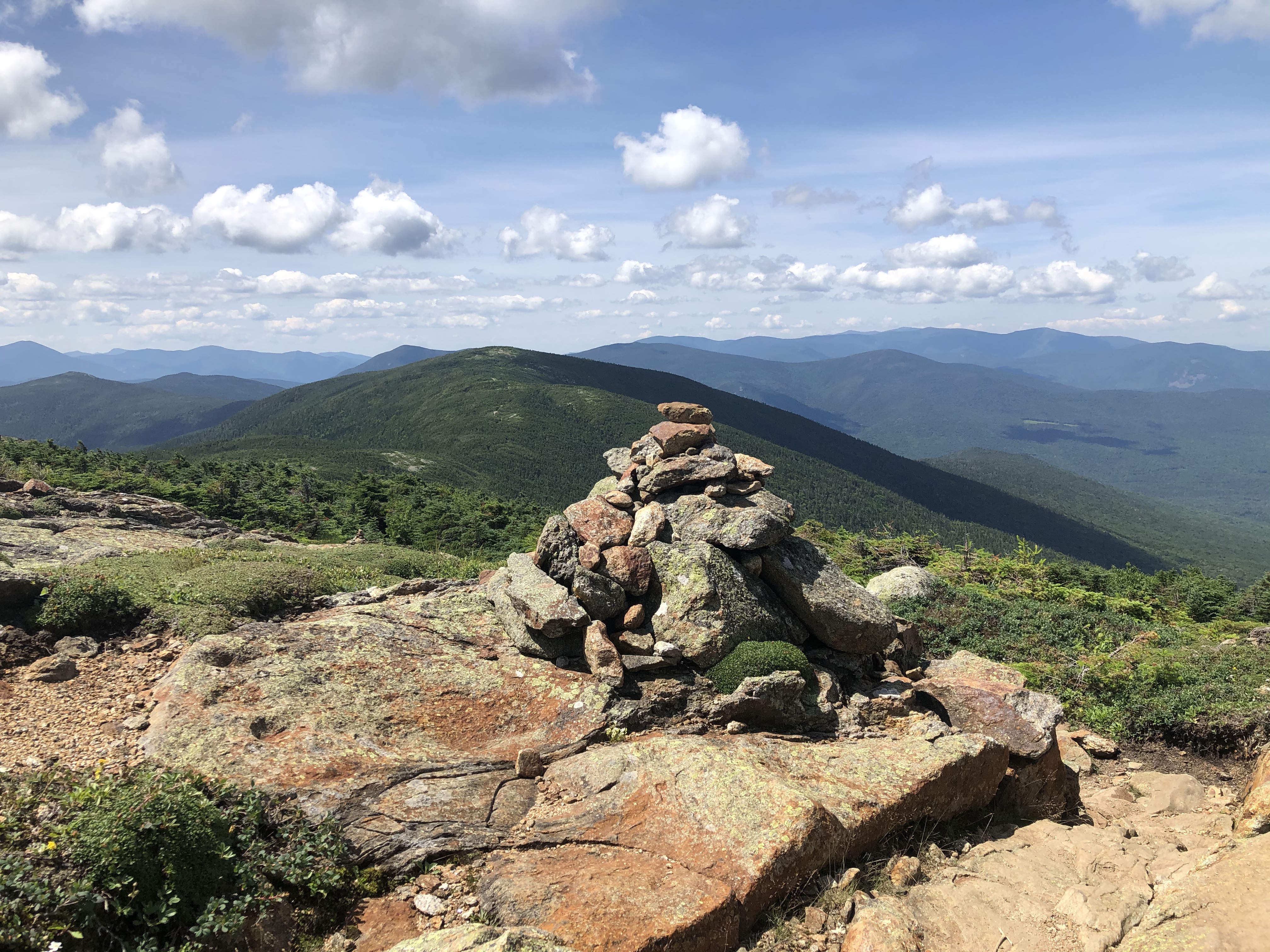
    Saturday, as I began my ascent above treeline, I took a few breaths of Balsam Fir-scented air and thought of Christmas.  When you get up in between the boreal and alpine zones where the 4000 footers dance in the windblown snow and ice, the trees are stunted and twisted and tough as nails.  Trees in this zone are called Krummholz, regardless of the species, and sometimes the term Krummholz describes this in-between zone too.  At treeline they’re typically Black Spruce and Balsam Firs and a few adventurous others like an occasional birch looking for a way out of the madness it rooted itself to.  Spruce are stoic but don’t flavor the air with aroma.  Firs make you feel like its Christmas in July.  Both struggle for footing and survival in the acidic, hard ground.  I’m a guest in their home, and silently offer gratitude for allowing me a visit.

    Hiking reinforces for me what I don’t know.  I can sit in my backyard in New Hampshire and pick out different trees and birds and bugs and generally know what they are because I live with them every day.  I can feel or hear the changes in seasons just by hearing some crickets announcing they’re back.  But my visits to the mountains are infrequent in comparison, and I’m less familiar with the migration patterns of birds and the trees themselves across the northern forest.  I heard a few bird calls on my last few hikes that are unfamiliar.  I looked at the forest and sedges and rushes and Mountain Cranberries and recognize that I don’t really know them all that well and couldn’t tell you one from the other.  I scanned the peaks on a clear day and recognize the famous Presidents, but not many of the others.  I was in the same state (New Hampshire), but in a completely different state (uncertainty).

    I’m feeling restless in the familiar lately – a sure sign that I need to get out and see more.  A few hours in a different zone reminded me that the unfamiliar isn’t all that far away.  And I’m reminded again of something Pico Iyer wrote that I quoted a few posts ago: “ecstasy” (“ex-stasis”) tells us that our highest moments come when we’re not stationary”.  To honor the restless spirit inside of us and just get out there to find our highest moments.  It seems a noble pursuit on this random Monday.  The crickets have announced that time is indeed moving along, and the Krummholz remind us that life isn’t always easy but if you hold on you might just survive long enough to see a few things.  Surely a good reminder for this crazy year when the familiar isn’t all that familiar and we’re all a bit restless.

  • Breathe

    I admit I didn’t think much about breathing until recently when my son strongly recommended a book for the family.  After some due diligence in listening to the author interviewed on a Joe Rogan podcast I was convinced I needed to read the book myself and quietly slid the stack of real and virtual books aside to read Breath: The New Science of a Lost Art before anything else. I’m well into it now, and can tell its one of those transformative books that influences the way you think about many things. And so it was that I hiked two 4000 footers yesterday with these thoughts in my head:

    In a single breath, more molecules of air will pass through your nose than all the grains of sand on all the world’s beaches—trillions and trillions of them.”

    “Nasal breathing alone can boost nitric oxide sixfold, which is one of the reasons we can absorb about 18 percent more oxygen than by just breathing through the mouth.”

    “The greatest indicator of life span wasn’t genetics, diet, or the amount of daily exercise, as many had suspected. It was lung capacity.”

    “Moderate exercise like walking or cycling has been shown to boost lung size by up to 15 percent.”

    “The most important aspect of breathing wasn’t just to take in air through the nose. Inhaling was the easy part. The key to breathing, lung expansion, and the long life that came with it was on the other end of respiration. It was in the transformative power of a full exhalation.”

    With apologies to author James Nestor, I wasn’t going to fully commit to nasal breathing hiking up Crawford Path yesterday. I gave it a try a few times but didn’t feel like I was getting enough air. Something to work on for sure, but I opted for the more familiar mouth breathing for the steepest stretches of the path and reserved the nasal breathing for the descent from Mount Eisenhower. I can tell I’ve got my work cut out for me, but anything worthwhile deserves putting the work in. What’s more worthwhile than breathing?

  • Hiking Pierce and Eisenhower

    201 years ago, in 1819, a father and son team of Abel and Ethan Allen Crawford cut an 8.5-mile hiking trail from what is today called Crawford Notch to the summit of Mount Washington’s summit.  A year later, Ethan Allen would guide an expedition up that trail, which became known then and to today as Crawford’s Path.  That group would name most of the mountains they saw after the early United States Presidents: Washington, Adams, Jefferson, Madison and Monroe. That we hiked on the oldest continuously maintained hiking trail in the United States wasn’t lost on me.  People have been walking or riding horses on this path since many of the Founding Fathers were alive.  The Crawford Path is a bridge of sorts, and 200 years later I hiked part of it to traverse the summits named for two Presidents who came after the trail was first cut: Mount Pierce and Mount Eisenhower.

    Franklin Pierce was the 14th man to be President, and the only one ever born in New Hampshire.  He was President between 1853 and 1857, and was well aware of the threat that the abolitionists from the southern states posed to the young United States of America.  Pierce was a compromise candidate nominated to appease the south, but he wasn’t a particularly popular President, making controversial decisions like nullifying the Missouri Purchase (if we can have anti-slavery Maine be a state we let pro-slavery Missouri be one too) by signing the Kansas–Nebraska Act.  That may be a post for another day, but the act essentially fueled the vigorous anti-slavery movement that led to the Civil War.

    “After the White House what is there to do but drink?” – Franklin Pierce

    Pierce wasn’t a great President when the United States needed one.  He was also a vocal critic of Abraham Lincoln, which didn’t endear him to most northerners then or today.  But he is a native son, and New Hampshire named a 4310 peak in his honor.  It would be the first of two 4000 footers I’d climb for the day.  The second would be the 4780 foot Mount Eisenhower.

    Dwight D Eisenhower was, like George Washington, a great General who became a relatively great American President.  He opposed McCarthyism, promoted civil rights, expanded Social Security and built the nations interstate Highway System.  He was a two-term war hero President who bridged the relatively peaceful decade between the Korean War and American escalation in Vietnam.  When he passed away New Hampshire took an existing mountain in the Presidential Range, Mount Pleasant, and re-named it Mount Eisenhower in his honor.

    “This world of ours… must avoid becoming a community of dreadful fear and hate, and be, instead, a proud confederation of mutual trust and respect.” – Dwight D Eisenhower

    Enough history, let’s get to the hiking.  Hiked up the Crawford Connector Trail to meet up with the Crawford Path, and made a point of stopping for a look at Gibbs Falls. I rarely pass up a visit to a waterfall, and today wasn’t going to be an exception.

    From there we hiked up to Pierce and then Eisenhower. There was a lot of company on each summit (being a beautiful Saturday) but we managed to find a spot to stop for a quick break at each before moving on. Checked two peaks off the list of 48 and had a great day with three great people. We left Crawford’s Path for the Eisenhower Loop, summiting relatively quickly, had our quick lunch and descended via the Edmands Path, a rocky, wet trail that wasn’t a favorite. But it did the job of bringing us back to the quiet road that led to our car and cold beverages and hot showers. A long day, but a heck of a day. And I’ll publish this and enjoy the rest of a great Saturday.

  • All That’s Beautiful…

    “I heard the old, old men say, ‘Everything alters, And one by one we drop away.’
    … I heard the old, old men say, ‘All that’s beautiful drifts away Like the waters.’ – WB Yeats

    Most people don’t like change.  They want to stay in the same comfortable place indefinitely, go to a time share vacation at Disney World every year or to the same beach to have the same experience they had last summer.  Familiar and enjoyable, so why not do it again next year?  And that’s why people buy time shares and beach cottages and permanent camp sites for their Airstream.  There’s a lot to be said for the tried and true.  Immersion for one: Really getting to know a place by going there often.  I’ve really gotten to know a small corner of Buzzards Bay in this way, and find that I still don’t know it as well as I thought I did last time I visited.  Yes, there’s clearly benefit in returning again and again.

    But as Yeats points out, everything alters.  I look at the neighborhood I live in that once had a roving pack of 50 kids riding bicycles and playing games in each other’s yards (a rare phenomenon in the last 20 years).  All those kids are grown up and moved on.  Some new families have moved in, I don’t really know their names, and have started raising the next generation of kids.  Maybe someday the neighborhood will have those packs of kids playing again.  I hope so – otherwise all that Halloween candy goes in my mouth.

    In general I’m a big fan of change.  I’ve changed jobs when it didn’t feel right staying at a place and longer.  I moved primary residences ten times before settling on the place I currently live in, where I’ve been living for 21 years.  But I’ve painted every room in this house a different color at least twice, and some four times.  Change is part of the deal, whether we move or not.  Embrace the changes that happen around us and adapt in ways that make it work for you.  Nobody misses rotary phones, which made your finger numb when you had to dial a long number.  Nobody misses the days when you had to go into a bank to make a deposit or withdrawal instead of using an app on your phone or Venmo to complete a transaction.  Some change is good.  Its progress – the progression of humanity from one stage to another in our technological development.

    “I see my folks, they’re getting old
    And I watch their bodies change
    I know they see the same in me
    And it makes us both feel strange
    No matter how you tell yourself
    It’s what we all go through
    Those eyes are pretty hard to take
    When they’re staring’ back at you”
    – Bonnie Raitt, Nick of Time

    Then there’s the changes that happen with aging.  The progression of decline in our bodies as we grow older.  Aches and pains we didn’t have when we were kids.  Seeing those around us again as well and recognizing the path we’re all on.  I’ve got a heightened sense of awareness of this now more than ever.  We’ve considered moving to a faraway place just to change things up a bit.  Scotland, Iceland, the Azores, the Faroe Islands, Dominica and New Zealand all remain tantalizing places to relocate to for me.  Sailing around the world sounds attractive when the world is open for business, but what do we leave behind when we slip away from the dock?  I think a younger me might have made the leap had the younger me known the stakes.  The me before kids, before aging parents, and such things.  Now I’m not as sure.  But aging doesn’t mean you have to break down quickly.  Fitness is a way to stem the tide and live well in the time we have left.

    All that’s beautiful drifts away, whether we like it or not.  But its replaced by new beauty, if we only open our eyes to it.  We’re all breathing in the dust of eternity, and exhale a part of ourselves back into the universe, which makes us all connected, really.  All part of the timeless wave of humanity, surely, but also all matter.  We all have our minds wrapped around our own mind and body, but we’re just matter and energy with a soul.  The matter and energy move on in time.  Beauty doesn’t disappear, it just moves on down the chain.  We’re just links trying to jealously hold onto to it as long as possible.  But the soul is ours alone, here today, but where will it be tomorrow?  Time will tell.  Anyone who tells you they have the answer is conning you.

    My wife got a call from her mother yesterday, telling her the bad news about one of their neighbor’s kids who has cancer all over their body and isn’t expected to live more than another 18 months.  I suppose that got me thinking about old Mr. Yeats and his poem.  We’re all drifting away eventually, and sometimes much sooner than we’d prefer.  A good reminder to get on with living already, changes and all.  Life is more than a weekly paycheck and a house with a pool in the backyard and a familiar spot on the beach every summer.  Life is about making the most of ourselves in the time we have left.  Live beautifully alive, changes and all.

  • To Visit All the Celebrated Places

    “Now is the time to visit all the celebrated places in the country, and fill our heads with what we have seen, so that when we become old and bald we will have something to talk about over the teacups.” – Jippensha Ikku

    Credit to Smithsonian Magazine for the Ikku quote, for it made me smile when I read it.  Ikku lived in Japan during a fairly important period in American history (1766-1831) so its easy to overlook what might have been happening in other places in the world.  The quote reminds me that our feelings about travel and aging are timeless.  We all hope to see the world while we’re young and full of vigor, that we might have epic stories to tell over a favorite beverage when we’re older and less mobile.

    The travel list of celebrated places is ready, and all earnest travelers wait for the starting gun to set us free to explore once again.  We’re all rooting for a vaccine and some level of herd immunity, some measure of personal responsibility from society at large and perhaps stronger political leadership to set policy that makes sense.  May we see it sooner than later.  But in the meantime, I’m traveling as Thoreau traveled: exploring the place where I am in ways that I hadn’t before.  Walking fully aware in the woods, or the mountains and shores of New Hampshire, stopping at local landmarks previously unknown to me, and exploring space  while looking up at the stars to pick out planets and constellations.  For the adventurous spirit, there’s no shortage of opportunities to explore, even in a pandemic.

    “Travel spins us round in two ways at once: It shows us the sights and values and issues that we might ordinarily ignore; but it also, and more deeply, shows us all the parts of ourselves that might otherwise grow rusty. For in traveling to a truly foreign place, we inevitably travel to moods and states of mind and hidden inward passages that we’d otherwise seldom have cause to visit.

    All [great travel writers]… believed in “being moved” as one of the points of taking trips, and “being transported” by private as well as public means; all saw that “ecstasy” (“ex-stasis”) tells us that our highest moments come when we’re not stationary, and that epiphany can follow movement as much as it precipitates it.

    Travel, then, is a voyage into that famously subjective zone, the imagination, and what the traveler brings back is — and has to be — an ineffable compound of himself and the place, what’s really there and what’s only in him.” – Pico Iyer, Why We Travel

    While nice on the surface, I chafe when spending too much time at resorts because I’m not looking for pampering or losing myself in a cartoon world.  Travel at its best isn’t distraction, but exploration.  It isn’t running away from ourselves, but finding ourselves.  And that can happen anywhere if we let it.  Our highest moments come when we’re not stationary…  and so we hear the call to explore.  I’m conspiring to travel locally over the next couple of weeks to places near, while foregoing far.  At least for now.  For there’s so much to see right in our own backyards that we rarely celebrate.  Over the next few weeks I’ll explore some of those places in New Hampshire and Massachusetts.  And as you might expect having read any of this blog, explore hidden inward passages too.

  • A Shelf Full of Worthy Pursuits

    “We are our choices.”  – Jean-Paul Sartre

    I found myself in a store that specializes in astronomy-related equipment like higher end telescopes and the like. I was there to upgrade my binoculars, which left a lot to be desired when hunting down that elusive Comet NEOWISE. While there he showed me a stunningly gorgeous Questar Standard 3.5 telescope that would only set me back $5000 dollars.  It was breathtaking in its detail, and I could imagine myself having it set up on the deck gazing in wonder at the universe with a glass of scotch in my hand conversing astronomy tidbits with adoring family and friends.  Enticing?  No doubt.  But I stuck with the binoculars and kept my savings account and marriage intact.  I also took his brochure on the local astronomy club and tucked that away safely on a shelf with my other worthy pursuits.  Life is about the choices we make, and Lord knows there’s an abundance of choices we can make in this country.

    “You can’t always get what you want
    But if you try sometime you find
    You get what you need”
    – The Rolling Stones, You Can’t Always Get What You Want

    You may recall a recent post about getting back into scuba diving.  I had almost the exact interaction with the dive shop I visited as the one I had at the astronomy shop, complete with cutting edge dive gear, underwater photography equipment, and that special pricing that comes when you’re in a pandemic and concessions need to be made to keep business flowing.  I’ve shelved that indefinitely as I tackle other projects, and added the brochure about scuba certification to the shelf to revisit another day. Such is the way with worthy pursuits: you can’t have it all. But you just might find you get what you need.

    “Books are like imprisoned souls till someone takes them down from a shelf and frees them.” – Samuel Butler

    Those shelves that imprisoned books also hold those brochures with unfulfilled dreams of adventure travel, cooking with fire, sailing around the world, hiking the Appalachian Trail, gardening, sea kayaking and other pursuits waiting to break free, or dare I say, mastered.  Life is chock full of worthy pursuits, and full of experts to guide you down the path.  But life isn’t full of enough time to master every pursuit that strikes a fancy, and so we must choose what to live with and what to live without.  Something has to give, and the shelf is stacked with victims of the time, money and focus equation not working in their favor.  I’m very interested in astronomy, but I’m not quite there yet for jumping into the deep end on astronomy club activities and diverting $5K towards a telescope…  No, not just yet.  But hey, if we’re both still around in ten years let’s get reacquainted.

    In the casual pursuit of Comet NEOWISE, the binoculars made all the difference.  Even with wispy clouds threatening to mask the view, I was able to see the comet clearly with the new binoculars.  And here’s the reason I chose those binoculars (besides the price tag relative to the telescope of my dreams): the binoculars are small enough to fit into a backpack or a sailing bag or brought outside with a cup of coffee for backyard bird-watching.  And thus combining multiple worthy pursuits with one modest purchase.  Is that the answer when choosing the worthiest of pursuits – what offers the best bang for the buck?  Not necessarily, but surely it helps justify the initial financial step into the new-to-you.

    I may not own the title of the most interesting man in the world, but who has time to do everything anyway?  Follow your passions where they might lead you, but do it responsibly.  The world has enough attention deficit disorder with Twitter and YouTube and sound bite news.  Keep trying new things and you never know what rises to the top of the priority list.  I’m a jack-of-all-trades, who invests time to eventually master some. Or not master some but enjoy the ride anyway. I’ve seen friends drift further and further into pursuits as diverse as sailing and hiking and photography, and I recognize and admire the passion of pursuit and growing expertise within them.  Everything has its time, and some pursuits will be there when the time is right… or perhaps not at all.   There’s joy in focusing on the singular pursuit of something, and happily living with the sampler pack with other, otherwise worthy pursuits.   There’s freedom in learning to say no, not now.