Month: July 2020

  • The Methodical Hunt of Red-Tailed Hawks

    Treading water on an early morning swim and looking up to sky, I observed a pair of red-tailed hawks moving across the landscape in a coordinated hunt.  It was an impressive display, with one hawk working to spook prey into revealing themselves and the other perched nearby ready to pounce on the unsuspecting victim.  A methodical dance of deadly consequences for some prey yet to be determined.  This was clearly part of the act I saw last week when a hawk landed on the umbrella, but I’d only seen half the story then.  I was grateful I was a bit larger than they felt they could take on.  When you see a pair of hunters working the neighborhood, you wonder how any squirrel, chipmunk or rabbit survives long enough to reproduce.  This was a highly coordinated, efficient operation in action, and I came away deeply impressed.

    Red-Tailed Hawks are also known as “chicken hawks” because they wreak havoc on chickens, ducks and other domestic birds.  The name is a bit of a misnomer, but makes me think of the cartoon character I grew up watching, always trying to take on the much bigger rooster Foghorn Leghorn.  But watching them hunt made me realize they’re much more like the Velociraptors hunting the kids in Jurassic Park.  But then again, they’re direct descendants of dinosaurs, so it makes sense they’d hunt in such a way.  Velociraptors were the most bird-like of all the dinosaurs, and I saw the similarity immediately watching that pair of hawks (at least to the movie version).

    Red-Tailed Hawks tend to hunt solo most of the time, but when you see a pair hunting together it generally means that they’re mates or siblings or its a parent teaching the kiddos to kill their own meals.  These were adults, so I’m guessing they were mates.  What’s more romantic than hunting small animals together in a choreographed dance along the edge of the woods?  If you read about these hunters, the details of the prey can be gruesome, which I’ll spare you from here.  They live a life of noble pursuit, not killing for sport but for food.  Humans could learn a few things watching them.

    When my dog was younger we had this game of hide and seek we’d play, where I’d take his favorite fuzzy dice and throw them into a different room for him to fetch.  While he was chasing them down I’d quickly run out of the room and hide.  He’d come back, realize I was gone and excitedly bounce up and down like a reindeer, and the hunt would be on.  He’d check room after room looking for me, and when he found me we’d celebrate with a big human and Labrador hug.  Those games of hide and seek would get my heart rate way up into anaerobic territory and I’d find myself out of breath when the game went on for any length of time.  I was the “prey” in those games, but all in fun.  I can’t imagine being prey in a real life and death hunt, and I’m grateful to live in a time when I can casually observe the hunt of hawks.  With a few notable exceptions that quickly make the news, we generally don’t have to worry about animals hunting us down.  More often than not its other humans we have to worry about, and even then its becoming increasingly safe to coexist in the world with others.  I took a moment to appreciate that as I watched the methodical dance of Red-Tailed Hawks.
  • Sailing the Gulf of Maine

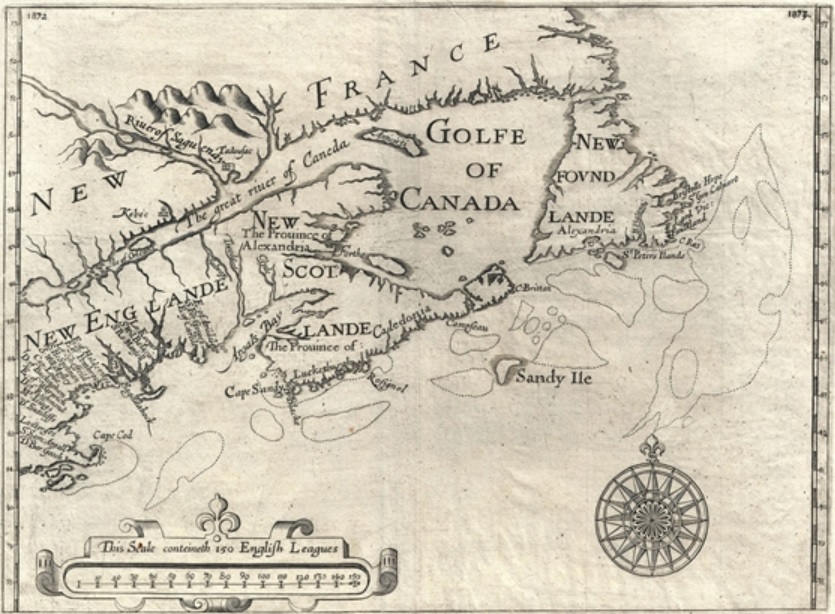
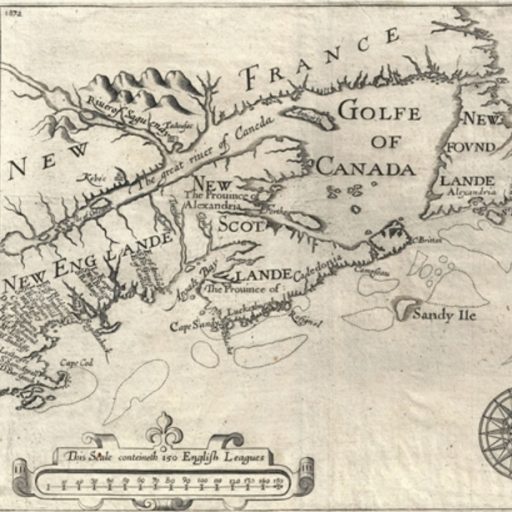
    The Gulf of Maine is a corner of the Atlantic Ocean embraced by Cape Cod to the South and Nova Scotia to the Northeast.  The longest stretch of land in between is part of Maine, which gives the gulf her name.  If you look at Alexander’s map, which this blog is named for, the body of water is just below the land described as “New Englande” and “New Scot Lande”.  A land mass that I’ve grown to love, that I declared I’d explore more, and that I need to return to in earnest once this pandemic is behind us.

    cropped-54b94-alexander2527s2bmap.jpg

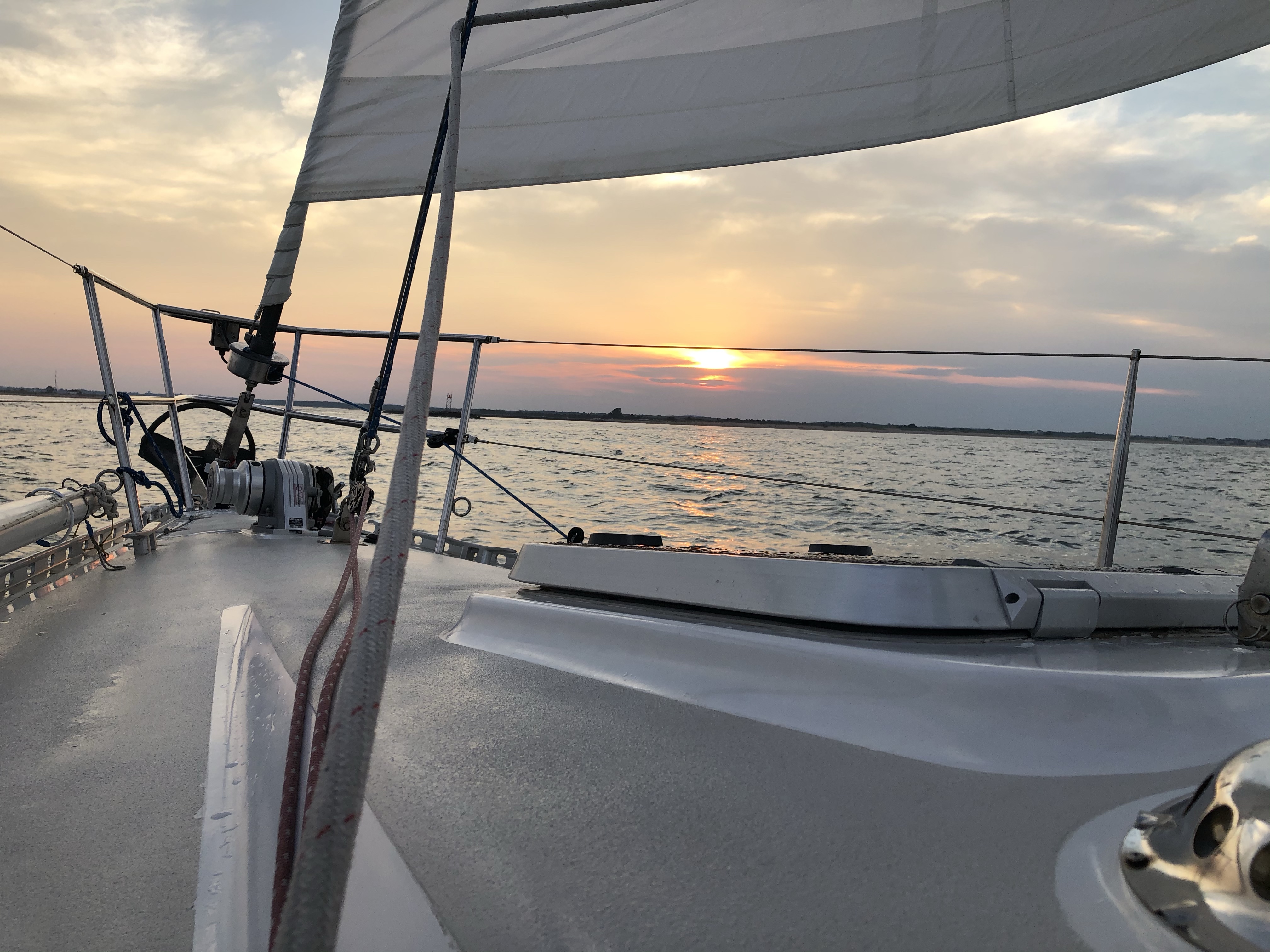
    Yesterday we had the opportunity to sail on Fayaway with friends.  It was an out-and-back sail with one tack.  We left the Merrimack River where they moor Fayaway when they aren’t exploring the world and sailed generally on a compass heading of 90 degrees, which took us roughly along the coast of Maine just out of sight of land.  Sail for 18 miles out one way, tack and return 18 miles the other way.  Not a lot of tactical sailing required, which was perfect for a day of conversation and contemplation on the water.  We had a secondary objective of seeing whales and maybe that evasive Comet Neowise, but each proved elusive on this trip.  A sunfish made an appearance, which was akin to an understudy playing the role when you came to see the star: Wasn’t what you came for, but turned out to be entertaining just the same.

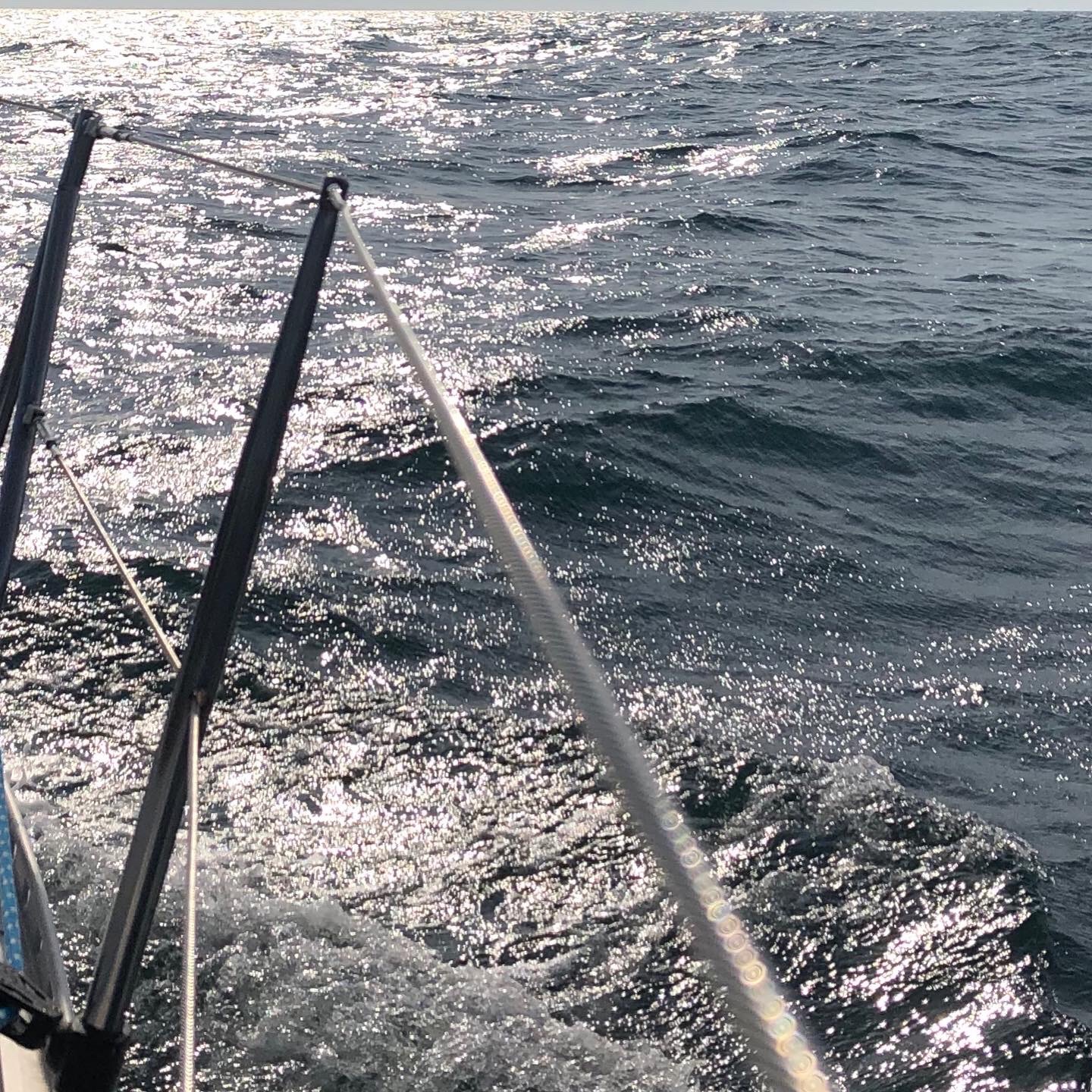
    When we got out of the lee shore of Cape Ann the wave action picked up, with 3 to 6 foot swells that lifted Fayaway and reminded us we were well out at sea.  But Fayaway handles wave action well, and with her sails reefed in the 28 – 30 knots of sustained wind were comfortable for the duration.  Which invited conversation about travel and plans for the future and the kind of catching up you do when it’s just you and others and the wind and splash of waves for hours.

    I’ve learned that I’m a bit rusty with ancillary sailing terminology that goes deeper than the basic rigging, and assisted where appropriate while staying out of the way the rest of the time.  When you see a couple who have sailed together for a year covering thousands of miles you’re witnessing a well-choreographed dance.  I’m not the sharpest knife in the drawer but I know enough not to be the clumsy fop who thumps onto stage mid-act.  Instead be the quiet stagehand who puts away the props when the performers are done.  I was grateful for a patient crew who recognized the rustiness in this sailor.

    There are a few highlights when you sail up the coast from the Merrimack.  You begin with the chaos of the Merrimack River with powerboats and jet-skis racing to win perceived races to get “there”.  It reminded me of aggressive drivers on the highway shifting two lanes and back to get one car ahead.  Its the antithesis of the sailing we were doing, and I greatly prefer being out of that race.  Once you clear the Mouth of the Merrimack, sails are up and you set course for nowhere in particular.  The lines of umbrella stands on Salisbury Beach and elbow-to-elbow fishermen and women on charter boats indicate that social distancing is a guideline many choose to ignore.  I’m sure plenty were doing their best to be socially responsible, while others proved more reckless.  I considered the similarities between drivers on the highway, power-boaters racing each other in a narrow channel to get to the fish first and close-talking beach umbrella bunnies in a pandemic for a moment, and released the thought onto the breeze.  We all live our lives in our own way in America, if not always responsibly.  I was observing from the vantage point of a sailboat in close proximity with another couple, but with the mutual assurance that each couple was taking appropriate measures to avoid COVID-19 exposure.  Maybe those beach throngs were doing the same thing.  I hope so.

    Soon Fayaway moves beyond umbrellas, beyond the sight of land, beyond the hum of motorboats, and we’re in our own world.  For much of the duration of our trip out and back we were completely alone other than a couple of commercial fishing vessels busily working the waters of the gulf.  Time on the water gives you time to ponder and think, and, if you let it, to look through the swirling waves deep into yourself.  And Sunday became another micro adventure for the books.  Leaving terra firma for the sea and exploring a relatively small segment of the Gulf of Maine.  It served as a reminder that I have far to go, but where I am isn’t all that bad either.

  • The Wild Amongst Us

    “Like winds and sunsets, wild things were taken for granted until progress began to do away with them. Now we face the question whether a still higher ‘standard of living’ is worth its cost in things natural, wild and free.” – Aldo Leopold, A Sand County Almanac

    Last week I drove up the street I live on and saw a bobcat cross the road with its freshly-killed dinner dangling from its mouth. Looked like an unlucky chipmunk to me, but might have been a small rabbit. Honestly I was focused on the bobcat. For I’d never seen one before, and even though I knew right away what it was I still called my friend Tom to validate what I believed I’d just seen.

    The next day my daughter and I were looking out the window and saw a red-tailed hawk land on the umbrella next to the pool, look around for a moment and then fly off to another vantage point. Its search for lunch momentarily overlapped in our world. I sit under that umbrella writing now, as I often do.

    Yesterday, while mowing the lawn, I glanced up the street and saw a doe carefully crossing the street at roughly the spot my car was when I saw that bobcat. She was escorting three fawns across the road. Two were more spry, the third a bit awkward on the legs, as if just born. They disappeared into the brush on the other side of the road, just as the bobcat had a few days before.

    All of these interactions with the wild amongst us would be familiar to countless generations of humans who lived on this land. They’d be far more taken aback by the swimming pools, lawn mowers and cars parked in driveways than the wildlife I find so fascinating. The question is whether they’ve been here all along or if they’re just returning in greater numbers as they adapt to the world we’ve dropped down in their neighborhood. Surely the deer and hawks have grown in numbers in my lifetime. But what of the predators like bobcat, fisher cats, mountain lions, coyotes and wolves? Evidence shows they’re returning to the land too. My encounter with the bobcat isn’t uncommon anymore, what was uncommon was the years when it would have been.

    All this points to a relatively healthy ecosystem surrounding the development I live in. Granted, it might have been even healthier were this development not dropped into the woods 22 years ago, but it was, and over time the land adjusts and the wild creatures return. The difference here was a requirement for open, undeveloped space allocated around house lots. Less profitable for the developer, but more attuned to the land. And that land serves as a highway for all sorts of wildlife, and in turn keeps me here, rooted to the land in ways I hadn’t expected when we sunk a foundation onto this plot. And so it is that I serve my tenure as watchman for the land, and wild amongst us. May I serve it well.

  • Setting the Tone

    I had a professor in college who pointed out that the greatest books in history had great opening lines that set the tone for the everything that followed.  He pointed out the Bible as the most unambiguous example of setting the tone for everything else that follows, but you can’t forget the brilliance of Homer or Dickens or Melville.  Consider:

    “In the beginning, God created heaven, and earth.” – The Book of Genesis, Holy Bible

    “Sing in me, Muse, and through me tell the story” – Homer, The Odyssey

    “It was the best of times, it was the worst of times…” – Charles Dickens, A Tale of Two Cities

    “Call me Ishmael” – Herman Melville, Moby Dick

    I’d humbly point out that great songs have a similar tendency.  And since most people seem to have shelved their discipline of reading the classics after graduation, it may be an easier example to illustrate.  Consider the following immortal songs and how the opening line sets the tone for all that comes after:

    “Mother, mother ocean, I have heard you call” – Jimmy Buffett, A Pirate Looks at Forty

    “If you could read my mind love” – Gordon Lightfoot, If You Could Read My Mind

    “Something in the way she moves” – The Beatles, Something

    “Out of the tree of life I just picked me a plum” – Carolyn Leigh, The Best is Yet To Come

    “Don’t worry about a thing” – Bob Marley, Three Little Birds

    “Imagine there’s no heaven” – John Lennon, Imagine

    “There must be some way out of here” – Bob Dylan, All Along the Watchtower

    And so it is that I think about the words that set the tone for this blog, and took the immortal words of Henry David Thoreau that grace the home page of this site and made them more prominent.  For his call to action is also my own, and set the tone for all that this blog aims to be:

    “Rise free from care before the dawn, and seek adventures.” – Henry David Thoreau

    I realized somewhere along the way that this is exactly the way I try to live; rising early, seeking adventure in this day, writing about it when it deserves consideration (and perhaps sometimes when it doesn’t), savoring the day and then putting it behind me, that I might rise from care once again tomorrow.  This isn’t head-in-the-sand optimism, it’s a calling, and some days are more adventurous and free from care than others.  But string them together and you set the tone for a life more interesting.  What sets the tone for your life?  Be bold in your selection.

  • Hiking Mount Tecumseh on a Foggy Night

    It seemed like a good idea at the time is a beginning statement that might indicate more adventure than bargained for.  And so it was that I hiked solo up Mount Tecumseh at 6:30 PM on a random Thursday, with noble intent to meet the Comet Neowise halfway by climbing a relatively easy mountain and looking at the stars.  Except that the stars were hidden in overcast, and the stakes of a solo hike ratchet up when it gets dark on a steep and wet trail.  But I had a plan B for the descent all the while, which turned out to be an epic adventure of its own.

    Mount Tecumseh is a relatively small mountain that was recently demoted from an official 4000 footer to a just short of greatness 3997 foot.  The mountain is named for the Shawnee Chief who unified tribes against settlement in the Great Lakes region and fought against America in the War of 1812.  There’s no logical connection between Tecumseh and New Hampshire that I’ve seen, but I can respect his name more than some others I’ve come across hiking.  I’ve hiked it before and remembered it as a relatively easy hike save for a steep mile of the trail known as the staircase.  This made hiking the trail as it was getting dark less concerning for me.  But the last time was in winter when Tecumseh’s famous staircase is softened by a heavy snow blanket.

    The ascent was easier than I thought it would be, which bodes well for the trend in my overall fitness level I suppose.  I arrived at the summit at 8 PM with plenty of light to see the view, if the clouds hadn’t dropped down to start blanketing the mountain anyway.  I changed into a long sleeve shirt and began my descent quickly after arriving.  I knew I had a challenging descent to deal with if I chose to hike down the Tecumseh Trail, though I had the gear necessary for a hike in the dark.  But there was that fog to consider, which makes a headlamp beam about as effective as your high beams in your car in fog.  I decided to hike as long as it was safe to do so without using the headlamp.  And after considering the Tecumseh Trail made the decision to hike the Sosman Trail on the descent.  I’ve hiked this one before and knew it was relatively easy for a descent, partially following the ski trail for Waterville Valley.

    But here’s where the story takes a twist.  The fog and darkness made it very difficult to mark the trail, and I lost it in the swirling mist at the summit of the ski lift.  And so I said my first WTF of the night, looked at the ski trail sloping down and decided to just walk down that instead.  I kept to the green trails, which are a combination of gravel road and grassy meadow in the summer.  Skiing down a slope and hiking down are very different things, and I found it slow going.  At one point I spooked a couple of large birds roosting in a tree – likely those turkey I’d been wondering about earlier in the week, and it startled me enough that I thought I might just expire right then and there.  But that would’ve been too easy.  I uttered another WTF and kept descending.

    After walking for what seemed like hours I reached the middle chair lifts at the ski area and looked down to see the lights of the ski lodge depressingly far away.  I said another WTF and made the fateful decision to follow the chair lifts down instead of the gravel access road that would add a lot of time to the hike.  And I discovered just how tall the meadow becomes on the walk down.  By now it was completely dark and I used the beam to illuminate every step and the hiking poles to probe for gopher holes and other hazards.  Eventually I made it down to the base and glanced around at just how lonely a ski area looks at 9:30 on a foggy summer night.  I arrived at my car, used the beam to check for ticks and headed home.  Not your average Thursday night.

    Lessons learned on this one.  Hiking solo in the dark wasn’t the best idea I ever had.  Even though I knew the trails I was hiking, they always look different in the dark, and especially when there’s fog.  I would’ve been better off descending the Tecumseh Trail.  Even if it was slow going its clearly defined and I would have arrived at roughly the same time as taking the Sosman Trail.  The point of this hike was to see the night sky, and I might have been better off just bagging the hike when I saw the overcast at the summit.  But I don’t panic when I hit WTF moments, I assess.  There were things that could have gone wrong but I took it slow and easy and got back safely.  I’m glad I hiked it, and all the extra drama of darkness and fog and overgrown ski trails made it memorable, if slightly reckless (but calculated reckless). Another 4000 footer completed, and a story to tell.

  • Collecting Daily Microadventures

    I heard a Rolf Potts podcast interview with Alastair Humphreys during a long walk around town.  I listen to podcasts when walking on loud roads because I can never fully immerse myself in nature when heavy objects traveling at terminal velocity are close enough to know the deodorant of choice of the driver.  Of course, I always keep an eye on the driver and the relative distance between their passenger mirror and my rib cage.  But a podcast gives me something else to think about during this regular dance on the narrow shoulders of New Hampshire roads.

    Potts and Humphreys captured my imagination during my dance with the drivers with a discussion of microadventures.  Microadventures is Humphreys’ term, but the pursuit of adventures isn’t a new concept.  I’ve been doing many of the things he lists on his site already, and think of them as exclamation points on a day of living on this planet.  But impressively he does take it to another level.  This well-made video explains the concept, or do a deeper dive on his web site (I felt a bit of web site envy visiting his site, and it once again prompted me to up my alexandersmap.com game.  You can see my ongoing progress on the site).  There are many microadventures available for the able and willing, I could get in my car and drive to the White Mountains for a hike, or drive to a waterfall for a shower under bracingly cold water, or camp out on a sleepy beach for sunrise.  But I wanted something close to home and on a somewhat smaller scale as a nod to the spirit of microadventuring.

    And so it was that I found myself getting in my car with a camera and tripod and driving a couple of miles away from home to an entirely different world: the soccer fields my kids once competed on, which last night transformed into a dark and mysterious upside down world with vaguely familiar fences and sheds providing anchors of bearing.  I was challenged by three separate people to go out and see the Comet Neowise, dancing just below the Big Dipper just after sunset.  It seems people have noticed my affinity for the stars over the years.  I’ve silently been plotting a viewing all along, but the weather proved frustratingly unreliable for comet gazing.  Last night was a micro adventure of comet hunting, confirming that my Nikon Coolpix B500 camera wasn’t up to the task (or more likely its owner), and learning from the experience.  Perhaps I’ll get that evasive picture tonight or in the next few days before Neowise travels on for another thousand generations, or maybe I’ll just bring the binoculars out and just view it.  Plenty of better photographers are taking stunning photos of Neowise already.   My micro adventure wasn’t for a picture anyway, but for the experience of trying something new right in my own town.  It was me alone in a dark field, strange noises in the forest beyond, constellations and planets spinning above and satellites zipping past.  Memorable even without a digital image to post on social media.

    Here’s the thing: we get caught up in the big bucket list stuff.  Hiking the Appalachian Trail, sailing across the ocean, hiking to Machu Picchu, visits to Amsterdam, Paris, London and a hundred other great cities.  Heck, even hiking the 48 NH 4000 footers in my home state requires time investment and planning on a larger scale than a simple microadventure.  Life should be full of the great exclamation points that a bucket list offers, but lifetimes are made up of a collection of days.  Why not downsize the scale of the adventure and do something interesting today?  So when someone asks you tomorrow what you did last night, you aren’t replaying the same old soundtrack of streaming Netflix series or watching YouTube videos of other people’s adventures.  Yesterday, in between the traditional fare of a random Wednesday, I began my day with a plunge in the pool at 6 AM and ended it with a hunt for Comet Neowise until past my bedtime.  So a memorable yesterday, if only for the endcaps.  So what shall today bring?


  • Everything Flows

    Everything Flows

    “Wu-wei is the understanding that energy is gravity, and thus that brush writing, or dancing, or judo, or sailing, or pottery, or even sculpture is following patterns in the flow of liquid.”
    “Panta rhei—everything flows, and therefore the understanding of water is the understanding of life. Fire is water falling upwards.”
    – Alan Watts, Cloud-Hidden, Whereabouts Unknown

    I’m a novice when it comes to Chinese philosophy – Taoism – and perhaps I should have spent more time previously in pursuit of a better understanding.  But in a way I was following my own flow in a different direction.  Or better put, I was following a parallel stream with gardening, hiking and time on the water.  Eventually experience leads you to the same conclusions, even if you don’t understand Chinese characters and the rituals that lead you to the stream.  I’m not sure yet how deeply I’ll be swimming into this stream, but find it familiar and natural.  I believe that’s the whole point.

    Google the term “go with the flow” and you’ll see various points of origin, from Marcus Aurelius to William Shakespeare.  I wrote a post a while back about the river as an analogy of timelessness.  So to now tap into the stream of consciousness that is Alan Watts and dipping a toe into the waters of Taoism isn’t unnatural.  Unnatural is commuting to the same place every day, sliding into a cubicle and staring at a screen for hours, working through lunch to prove you’re a team player and willing to pay the price to get ahead.  Intuitively I knew I had to get out of that world as soon as possible and delighted in the exit strategy provided by my employer at the time.  I used a phrase back in my rowing days to describe the lifestyle I’d found myself in with coaching and doing odd jobs to sustain my pursuits: It was an “attractive rut”.  Enjoyable enough to keep doing it indefinitely, but limiting enough to recognize that you needed to do more in life.  Attractive rut also summed up my time working 50 hours per week in an office environment.  Great money, but soul-crushing in the end.

    Career shifts, sabbaticals, graduations, divorce, moving across borders to new places and the like are all forms of state changes. Fire is water falling upwards.  Transformation of our former self into something new, as dried wood transforms to fuel for fire then ash and finally back to the earth to begin again as something entirely different.  But transformation happens in every moment along the way from birth to death.  The question for each of us is how true to our path we remain along the way (I’m reminded of splitting wood, and how some pieces are all knotted and stubbornly resist the swing of the axe.  Difficult and unnatural, but they’re consumed by the flame just the same in the end).  This concept of transformation isn’t exclusive to Taoism:

    “For dust thou art, and unto dust shalt thou return.” — Genesis 3:19

    We’re inherently different people day-by-day as experience molds us and events steer us just as water swirls around rocks in a stream.  We’re watching the world around us swirl around the pandemic and social unrest and transform who we are and will be downstream, and I recognize that I’m also transforming.  And so it is.  Life is a dance, and we’re all finding our way across the page one way or another, following patterns in the flow of liquid and making our small ripple in the endless stream of time.  There’s nothing unnatural about Tao, for it is inherently the natural path of life.  What’s unnatural is resisting the flow and diverting yourself towards pursuits that don’t align with who you are.  One of the beautiful things about life is discovering your own flow and releasing the resistance to following it.


  • Missing Poultry and Other Such Thoughts

    I woke up thinking about missing turkeys.  This isn’t a normal occurrence.  I dwelled on the question; Where do the turkeys go in summer?  They made a point of being very present for winter and spring, but seemingly go on vacation all summer.  Sure you might still see one now and then on the side of the road, but it seems lost and disgruntled, wondering where the rest of the family went without her.  There’s always that one oddball in the family.  But then again, some just might view me that way (I hope so: “normal” is boring).

    When the mind is alive and vibrant and most of all open the world pours willingly in.  It might have been trying all along, but sometimes your senses are too dulled to pay much attention.  I’m paying attention.  Perhaps too much attention.  Almost certainly too much attention.  Wondering about such abstract, random things as where the poultry that swarmed the neighborhood went, and what might have prompted them to go there.  Clearly turkey have their own version of The Great Wildebeest Migration that happens in Tanzania, or the Monarch butterfly migration across North America to hang out in Mexico for the winter.  And let’s not forget the Humpback Whale migration in both the Atlantic and Pacific Oceans as they swim from the colder waters of the north to the Caribbean or Hawaiian waters, respectively.  There are many more examples, often driven by the search for food and water and of course mating (There’s always mating involved when you go to the tropics).

    So what’s the deal with turkeys?

    According to the National Wild Turkey Federation (who knew?) “the annual home range of wild turkeys varies from 370 to 1,360 acres”.  The county I live in has approximately 695 square miles of land, which equates to almost 445,000 acres of land for roaming turkeys.  And that’s assuming they don’t all cross over into bordering Massachusetts.  That’s a lot of alula room for a flock of turkeys.  All I’m sure of is that they aren’t in my neighborhood at the moment.  And I guess I’m good with that.  Just let them know I was thinking of them.  Enough that I had to look up alula.

    All of this turkey talk is just my vibrant mind (no really, stick with me on this) wondering at the world around me.  I view getting out of your own head as a good thing, and thinking of things other than yourself as a noble path.  And so it is that I’m spending time this Tuesday talking turkey.  Which brings me to alliteration… 


  • Cloud-Hidden, Somewhere on the Mount

    “I asked the boy beneath the pines.
    He said, “The Master’s gone alone
    Herb-picking somewhere on the mount,
    Cloud-hidden, whereabouts unknown.”
    – Chia Tao

    Inevitably I had to arrive at Alan Watts.  I’ve circled around his work for some time, and finally landed on Cloud-Hidden, Whereabouts Unknown, which is as much personal journal as philosophical work.  And so it was that I lingered on these lines from Chia Tao that open Watts’ book.  I thought about my hike yesterday, cloud-hidden myself, with my whereabouts largely unknown on a solo hike.  It seemed appropriate to borrow this translation for my own observations.  For yesterday’s post was all nuts and bolts detail on hiking Mount Garfield, but it didn’t convey much about hiking solo largely in solitude.

    There’s a part of me that wants to knock off the 48 New Hampshire 4000 footers as a solo hiker.  Not because I’m anti-social, but because I feel the mountains differently when I’m alone with them.  Perhaps I’m more attuned to the ripple of water and the breeze in the trees, but mostly I’m more attuned with myself.  Slipping or tripping on a solo hike feels more consequential than it does when you’re with hiking buddies.  Sure there are other hikers on the trails, especially on a 4000 footer, but if you’re injured you’re relying on the goodwill of strangers and blowing up their own moment with the mountain.  Who wants that memory of your last hike?  I’d just as soon take the extra millisecond to be especially sure of footing.  To that end, I find hiking poles to be especially valued on a solo hike for the reassurance they provide on the descent.  It took me years to conclude that there was any value at all in hiking poles.  Now I find them invaluable.  I was reminded of their worth when I slipped on a hidden muddy root on my descent yesterday and my right pole bore the weight of my slide, keeping me from a hard fall and now shows evidence of bearing the brunt of the force in the form of a slightly bent shaft.  Thanks for your sacrifice, friend.

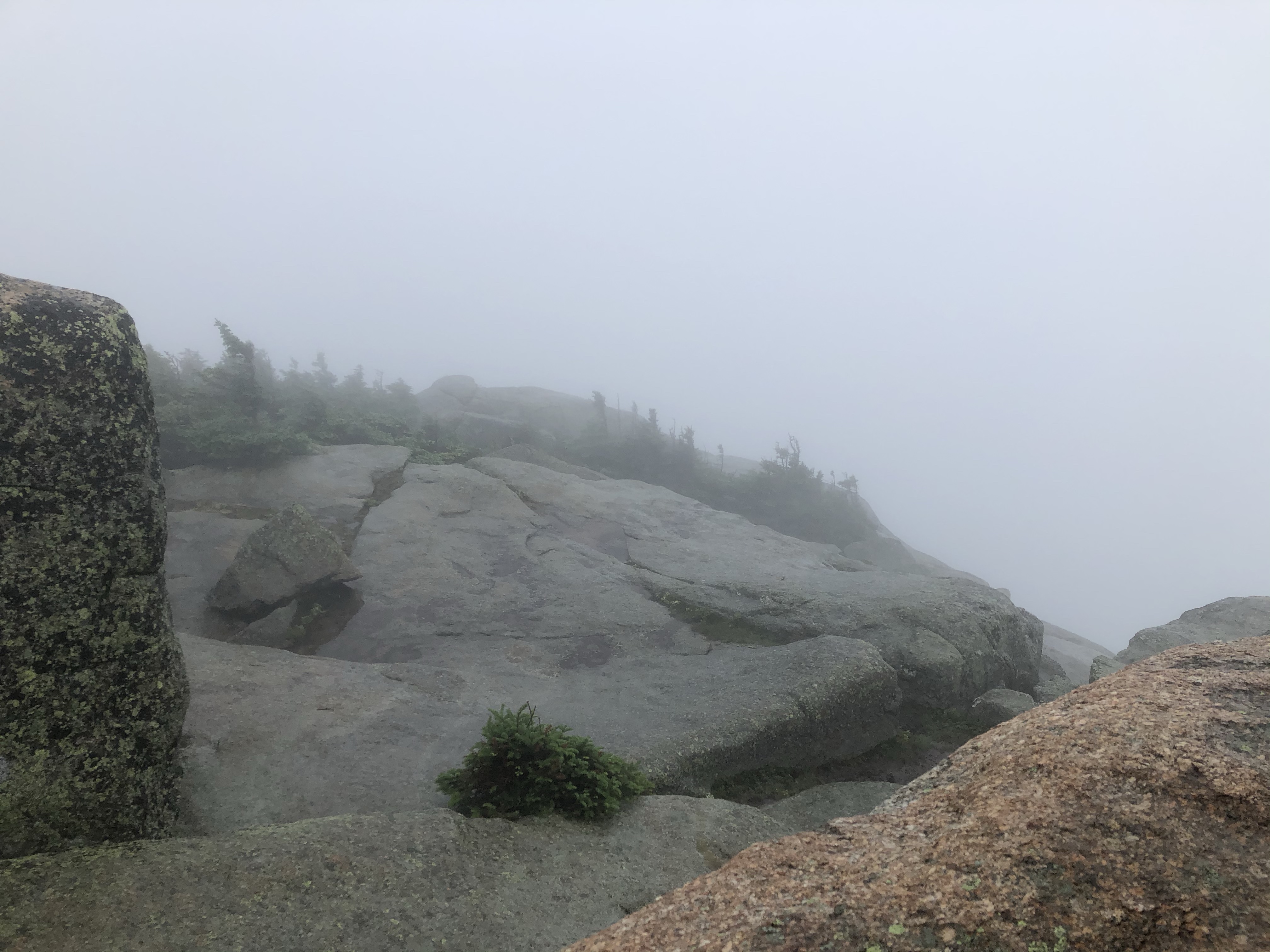
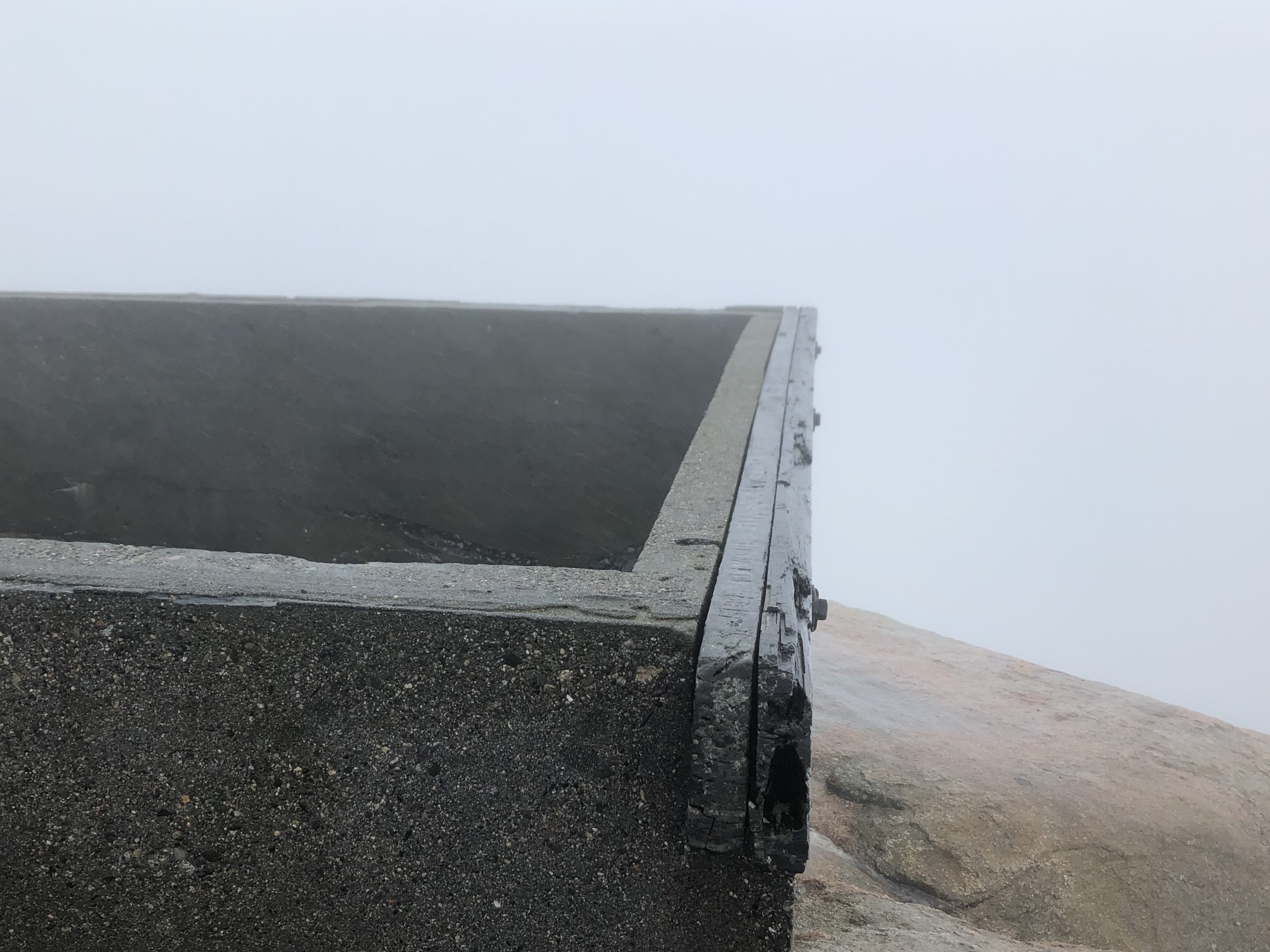
    The summit of Mount Garfield is a knob of granite with an old fire tower foundation set into it.  I arrived at the summit feeling a bit like a character in that Chia Tao poem.  Cloud hidden and whereabouts unknown.  There’s something about being alone in swirling clouds that is otherworldly.  I’ve felt this before, most notably when the fog rolled in as I stood alone on North Head at Signal Hill in St. John’s, Newfoundland.  My time on the summit lacked the drama of foghorns waking up to blare warnings to all that would hear, but made up for it with wind gusts that implied a threat of their own.  Normally the summit is a place to linger, but the mountain suggested I should move along.  When you’re on the mountain listen to the mountain.

    “The solitary is as necessary to our common sanity as wilderness, as the forest where no one goes, as the waterfall in a canyon, which no one has ever seen or heard. We do not see our hearts…” – Alan Watts, Cloud-Hidden, Whereabouts Unknown

    I’m not sure what I’d do if the rest of the world woke up early.  I suppose I’d go for long walks alone in the woods, or quietly slip a kayak into the bay or a river, or some such pursuit of solitude.  But the world tends to sleep in, or otherwise keep to itself, and so must I in the early hours.  Hiking offers a measure of solitude, even when you’re with others.  For who doesn’t listen to the mountain when they hike?  Sadly I’ve come across such people – loud talkers you hear from a mile away, or worse, people who play a soundtrack through their phone speakers as they tackle the trail like they’re on a treadmill at the gym.  There are people who never hear, because they never really listen.  I choose to listen.

    The morning after such a hike is filled with reminders: muscle kinks and soreness that grumble, memories of moments of lightness and wonder, gear to store away after a night of drying.  This is the afterglow of time on a trail, and some of that glow stays with you for a lifetime.  I still wonder at moments spent hiking from the Colorado River up Havasu Creek to the lower falls, or watching a meteor shower late in the night on Old Speck Mountain in Maine with college friends.  Hiking doesn’t always fill you with wonder, but it generally puts you in the neighborhood.  The rest is up to you.


  • Hiking Mount Garfield

    As U.S. Presidents go, James Garfield is barely remembered, but he seemed like a decent guy.  He fought for the Union primarily to eradicate slavery, and is the only President to be elected from a seat on the House of Representatives.  So he should be viewed favorably and as an American success story.  Unfortunately, his tenure as President lasted a mere six months, as he fell victim to an assassination attempt, dying a few months after being shot from complications.  That you and I don’t remember much about Garfield has as much to do with his short and tragic life more than any flaw in his character  His mother Eliza was born in New Hampshire, so it seems fitting that there’s a mountain named after him.  This morning I climbed that mountain.

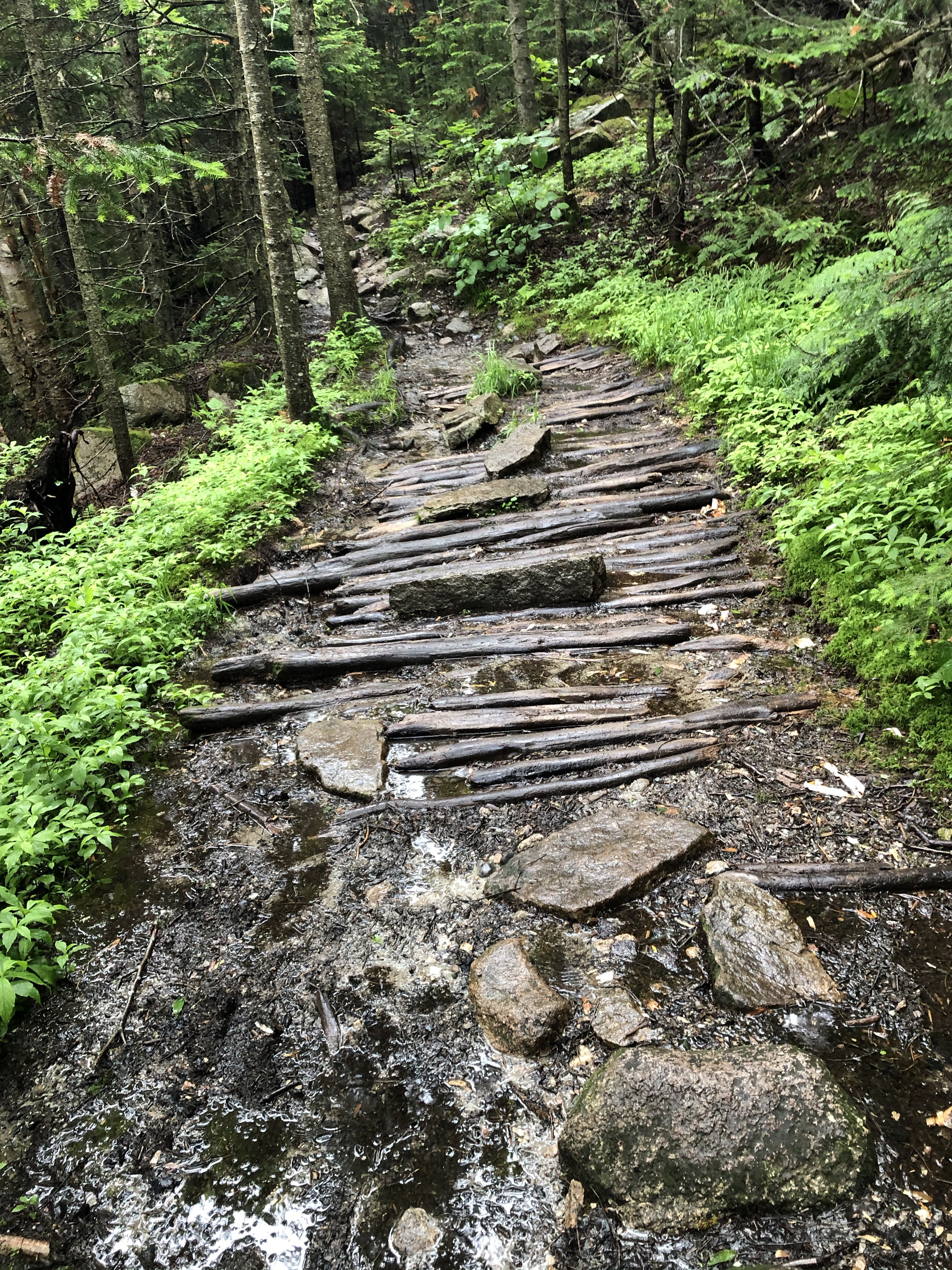
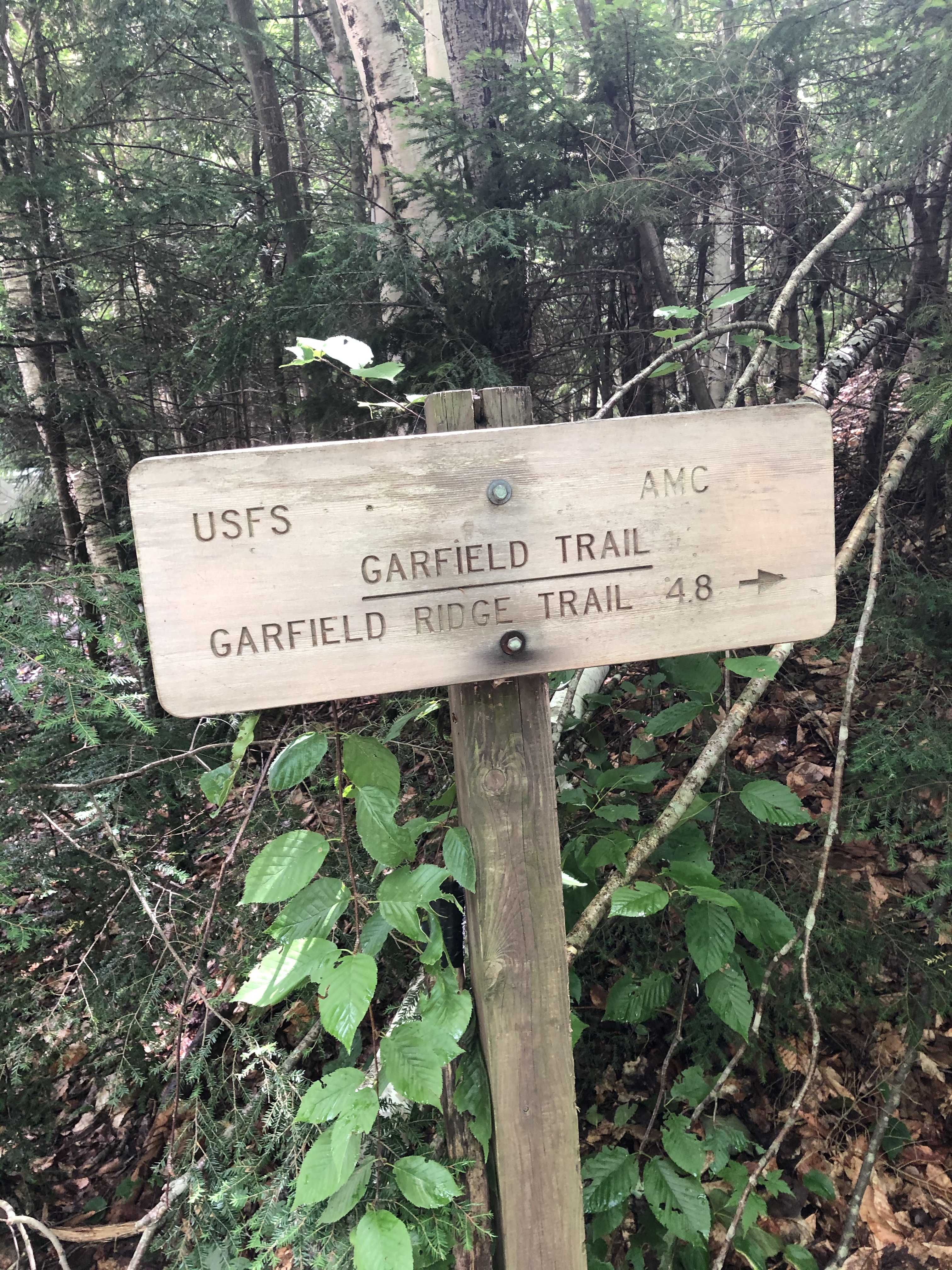
    Mount Garfield is known for the view from the summit.  There would be no view this morning, as rain and low cloud cover announced from the start that this wouldn’t be one of those days when you could see for miles.  I decided to hike it anyway, and to do it solo. The Garfield Trail is a relatively easy hike, and I was able to get to the summit in 2 1/2 hours.  As a wet hike, the Garfield Trail leaves a lot to be desired.  You feel like you’re hiking in a stream in stretches, and on the verge of getting bogged down in mud in some others.  But it’s a classic New Hampshire hike, with a cathedral of mature trees lining the ridge in the first third of the hike, and rocks for much of the rest of the way.  This is the type of hiking I’ve grown up with, and I quickly settled into my rhythm for the climb up.  For all its wetness, there were no bugs for the duration.

    Beginning at 7:30, I found little company on the trails.  I passed one father and daughter pair early on, and was in turn passed by a woman who flew past me after the first hour of hiking.  I’ve long checked my ego at the door when it comes to my pacing on hikes, and when I go solo I’m very deliberate with footing.  I’d see her again as she flew down the mountain at almost the same pace.  And that was it for company on the ascent.  It seemed most people were saving Garfield for a sunny day.  But the descent proved me wrong, with a steady parade of hikers streaming past me, most wondering about the view at the summit.  Not much of one, I’d tell them, but even as I spoke those words the day was beginning to change, with sunlight burning through the cloud cover and warming up the forest.  I was grateful for having done the ascent in the cool rain, even if the view didn’t cooperate.

    Mount Garfield is considered one of the easier climbs of the 48 4000 footers, but with that big payoff of a magnificent view waiting for you on a clear day.  If I wasn’t pursuing the 48, I might have saved this hike for better day, but I don’t view it as a waste at all.  20,000 steps later, I’d finished another 4000 footer and began my drive back home.  Garfield is a mountain I’ll do again a few times, certainly in autumn but also in winter when it becomes a longer hike as they close the gate on the access road.  Maybe my timing wasn’t good for a view, but it was an excellent 4 1/2 hour round trip anyway.  I’ve got my second notch on the 48 (I started over again from the beginning this year, since I rarely logged hikes previous to pursuing this goal) 4000 footers, and I got a decent workout in before lunchtime.  I’d call that a great success.

    A side benefit of hiking the 48 is learning more about the people the mountains are named for.  Other than knowing he was President and that he’d been assassinated, I didn’t know much about James Garfield until I chose this hike.  I’m glad I took the time to look back on his life a bit.  He only lived to aged 49, but managed to accomplish quite a bit in that time.  He was a classic rags to riches story with a life cut short too soon.  The White Mountains are dotted with more famous Presidents, but that doesn’t make Garfield a bit player.  Just a guy who ran out of time before he could do more.  I think he’s had a lot of company in that club.  A good reminder to get busy already, time waits for no one. And with that in mind I’m considering a peak bag for my next hike, which involves summiting multiple peaks in one day’s hike. I have another couple of former Presidents in mind for that one.