Month: August 2020

  • Merely Time

    “Life will follow the path it started upon, and will neither reverse nor check its course; it will make no noise, it will not remind you of its swiftness.“ – Seneca, On The Shortness Of Life

    I re-read Seneca’s On The Shortness Of Life again over the last few days. Its a quick read but jammed full of timeless quotes we’ve all heard and yet don’t hear. They say repetition penetrates the dullest of minds, and perhaps thats a reason to re-read essays like this often. By dull I don’t mean I’m an idiot (though you may insist I reconsider), but rather distracted by the madness of life. We’re all so distracted by the whirl of everyday that we don’t value the breathless moment we’ll never see again. Seneca pokes at us from a distance- he’s been dead far longer than he was alive. And so will we be someday too soon. And so it is that he reminds us; why are you not fully alive today? Stop postponing time you don’t have!

    “Postponement is the greatest waste of life; it deprives them of each day as it comes, it snatches from them the present by promising something hereafter. The greatest hindrance to living is expectancy, which depends upon the morrow and wastes to-day.”

    It isn’t easy to honor the urgency of life. Even as I write this I’m distracted by other pressing things and need to force myself to turn off the work monitor until normal working hours. To turn off the Twitter feed, and all the rest of the noise. And to reflect on what matters now. For now will surely slip away as quickly as then did. The stack of thens grows taller by the day, casting a shadow on the brightness of tomorrow. There is only now.

    Life is divided into three periods – that which has been, that which is, that which will be. Of these the present time is short, the future is doubtful, the past is certain.”

    So what do we do in a pandemic when we can’t travel freely? In a career that demands fair share of your time? And in other commitments that demand of you? I believe we choose wisely, and make the most of the moments at hand. To live in this moment, drawing from the past for wisdom, and with an eye towards the future we’re navigating towards (even if we might never reach it). Making the most of our lives in the time we have.

    “The part of life we really live is small. For all the rest of existence is not life, but merely time”
  • Reflections of the Day

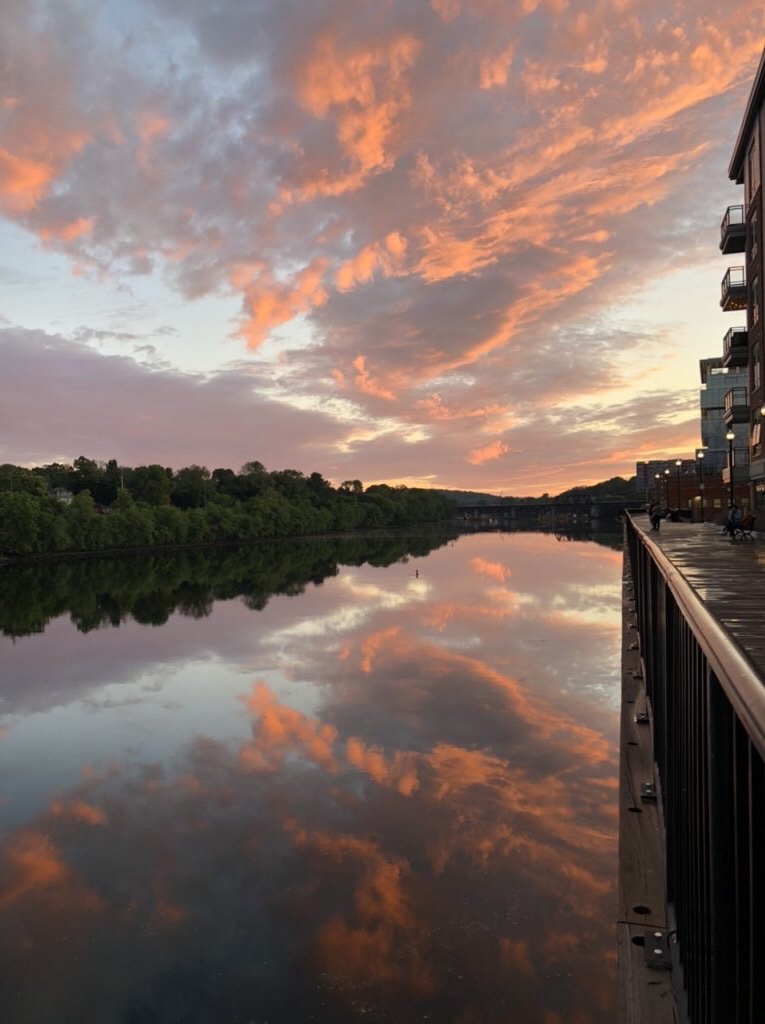
    Merrimack River at Sunset, Haverhill, Massachusetts

    “Water does not act like a perfect mirror. Light objects will appear a little darker and duller in their reflected images and dark objects will appear a touch lighter… A reflection [also] shows you the view from the point on the water’s surface that you are looking at, not the perspective from where you are standing.” – Tristan Gooley, How To Read Water

    I admit, standing on the riverwalk next to the Merrimack River in Haverhill, Massachusetts I didn’t think about whether the reflection was perfect or imperfect. I only thought about the beauty of the reflected light on the dark river water. For why dwell on the science behind the magic? Does knowing the science behind why something happens a certain way make it less magical? I should think not, and neither does Tristan Gooley. If anything it amplifies the beauty. Does knowing the name of the constellations improve or detract from the wonder in the night sky? Clearly it improves the experience. And so it is with water.

    I’ve borrowed How To Read Water from a friend and I chip away at it slowly. In fact, I finished two other books since he handed it to me. It’s not that I don’t want to read it, it’s more that the other books have been whispering to me more persistently. But after witnessing the sunset on the Merrimack River I’m inclined to dive deeper into the book.

    The Merrimack River holds a special place in my heart, flaws and all, because of my time living along its shores, and rowing on its waters, and exploring it from source to sea. Haverhill has never been my home, but I’m drawn to the city for its history and the raw beauty it still displays despite rough treatment by humans for generations. The land and the river both share the same affront from generations of humans, but still the land stoically holds on, scarred but dignified. And the river flows persistently onward, outlasting the generations who abused it. Those generations are eventually buried six feet into the land, becoming a part of it as we all must someday. For all our noisy encroachment, the land and the river silently have the last laugh.

    When you combine the history and the river and sunset, well, you’ve generally got me. And so I lingered along the edge of the river. My old friend and I quietly conspired as the light danced with shadows on her still water, until finally the shadows won out. The day faded and the river transformed into a black ribbon of water that now reflected starlight even as I reflected on another day that quietly slipped into the past.

  • Full House Solitude

    “A creation of importance can only be produced when its author isolates himself, it is a child of solitude.” – Johann Wolfgang von Goethe

    We got word yesterday that our daughter, a senior in college, would be spending her glorious fall semester studying remotely from home. Not what we wanted for her, and surely not what she wanted for herself. But here we are, and here we’ll make the most of it. There are silver linings in every setback, and we’re deep into a massive setback in 2020. So be it.

    Our son graduated from college in 2020. We’re 2-for-2! Currently working elsewhere, he’ll be home in late September and we’ll adjust to the new normal of four adults living together. For all the celebration of having everyone together once again, we know the reality is that they want to fly, not be back in the nest.

    That nest is what I’m thinking about now. We spent the spring lockdown renovating or updating room-after-room. But we didn’t renovate with four of us working from home in mind. As Goethe says, we all need a little isolation to be our most productive. And now I’m thinking about where to give each of us a bit of space to roam creatively. Divide a house built for living and carve out four private offices for distinctly different career paths. Office in a shed? Thought about it. But there’s space here, if we get creative.

    I always joked about selling the nest and traveling when the kids went off to college. I’m grateful that remained a joke. The empty nest will quickly fill up, clutter and chaos will return, noise levels will be higher than anticipated, grocery bills will escalate. The days will grow shorter and colder as winter sets in, making outdoor time more evasive. And chasing solitude for creative work is going to be a challenge. But there’s always long walks to reset the mind. And early morning hours. And other such strategies. The investment in effort to make it work is worth it.

  • A Self-Indulgent Rant on the WordPress Change to Block Editor

    I started writing this blog using Blogger, which was free but very limited in what I could create. I switched to WordPress and started paying for the privilege because I enjoyed using it and liked the creative challenge of building a website that I liked. Alexandersmap.com is still a work in progress and still amateurish by many standards, but it generally works for me and hopefully for you too.

    Then WordPress started pushing harder on the Block Editor, which is lovely, but seemed intrusive to me. Why force tools on people just because you fall in love with them as a company? That seems a bit too Apple to me… and yet here we are: force-fed, beginning today. To their credit, WordPress gives you two paths back to what you started with, but that means you’ve got to do the work to change things back to what you had versus having you opt in to their Block Editor experience. I’ve opted out for a long time for a reason, but then they forced my hand anyway. Thanks WordPress.

    Complicating my feelings on the matter are a new issue of uploading media to a post that started occurring when Block Editor was unceremoniously shoved into my lap. Perhaps they’re two separate things, but I don’t believe in coincidence. And don’t enjoy having to tackle my own technical support instead of simply writing, which is what I signed up for with WordPress. If a platform charges you money but eliminates the simplicity of why you started paying to use their product, is it still worth paying them money?

    This all makes me sound like a curmudgeon, and sure, I’ll take that categorization in this case even if I haven’t reached the minimum age limit for curmudgeon membership. For all the problems in the world having Block Editor forced on the paying customers of WordPress doesn’t seem like that big a deal, right? Right. And yet it seems an affront anyway. With a hint of we know what’s best for you smugness.

    I’m writing this post using Block Editor. Its not bad, just different. Who knows – maybe I’ll fall in love with it? Maybe I’ll figure out why my mobile uploads suddenly don’t work anymore? Maybe I’ll figure out how to select all and copy to another post? Maybe drafts will suddenly speed up again instead of taking forever to upload? Maybe. But I like WordPress a little less than I once did. Not because of Block Editor, but because they changed the tools on me whether I opted in or not. Again, it strikes me as a smug corporate move. Surely that doesn’t make a bit of difference to them, but hey, if enough of us complain maybe they’ll listen? No? Anyway, this post is completely self-indulgent, but my original post has been stuck in limbo while I try to figure out the mess I’ve been handed.

    Ultimately this is an exercise in handling change. There’s been a lot of change in 2020, and this is just one more. A good life lesson in handling minor inconvenience and finding creative ways to deal with it. And that’s what this post is really all about – approaching a hurdle thrown in my lane and finding a way to clear it without face-planting into the asphalt. Maybe tomorrow’s post will feature beautiful media and precisely-formatted content? One can hope.

  • How Shall I Live?

    “When a person tries to apply his intellect to the question “Why do I exist in this world?” he becomes dizzy. The human intellect cannot find the answers to such questions. What does this mean? This means that our intellect is not given to us to find a solution for this question. Our intellect can only answer the question: “How shall I live?” And the answer is simple: “We should live so as to bring good to all people.” – Leo Tolstoy

    There was a moment in college many years ago when I thought I’d like to major in Philosophy, but couldn’t possible justify it to my peers and parents.  But no matter: I’ve majored in Philosophy off and on ever since.  And it seems from my reading lately that I’m back on.  Perhaps there is something in the air.  Or perhaps there’s something in the changing light as the earth pivots and the days persistently grow shorter.  But I find myself drawn back into the great minds of history lately.  Seneca, Marcus Aurelius, Tolstoy, Campbell, Jung, Nietzsche, Frankl, Thoreau…  and on.

    The root of philosophy are these two questions posed by Tolstoy: Why are we here? and so, How shall I live?   As Leo points out, the first question is one most people don’t dwell on.  Existential questions about why we’re here make you pause a beat too long.  It’s easier to just get right to the second question.

    “I don’t believe people are looking for the meaning of life as much as they are looking for the experience of being alive.” – Joseph Campbell

    Most people just go about living whatever identity they choose for themselves.  For the most part you can march along most of your life just living your chosen identity, until something like 2020 comes along to disrupt that illusion.  The easy path becomes harder, doors that were always open are closed, and the people we’ve come to rely on to reinforce our identity have their own problems.  But there’s nothing unique in history about the challenges we’re dealing with in 2020 – the only thing unique about it is that its happening to us this time.  And in a year as disruptive to identities as this one, what better question to ask of ourselves than how shall I live?

    “As far as we can discern, the sole purpose of human existence is to kindle a light in the darkness of mere being.” – Carl Jung

    Kindling light is lovely, but sometimes your battery is running low and you’re a long way from the dawn.  So where do we go from here?  I hear people despair at lost semesters, lost seasons in sports, lost jobs, lost mobility to cross borders, lost time with loved ones…  and what I hear most is despair of lost identity.  We all had plans for these days, and those plans were turned upside down.  But here in the darkness of 2020 philosophy gently taps you on the shoulder and offers direction from those who came before us, and in many ways suffered in ways that we can’t imagine in our current life of relative comfort:

    “It did not really matter what we expected from life, but rather what life expected from us. We needed to stop asking about the meaning of life, and instead to think of ourselves as those who were being questioned by life – daily and hourly. Our answer must consist, not in talk and meditation, but in right action and in right conduct. Life ultimately means taking the responsibility to find the right answer to its problems and to fulfill the tasks which it constantly sets for each individual.”  – Viktor Frankl, Man’s Search for Meaning

    So how shall I live?  Responsibly; in this moment and the next one too, bringing good to all people and bringing light to the darkest corners.  Offering a shoulder to cry on and an ear for those who need it.  To keep climbing the hill and giving a hand to those who need it.  To be patient with those who lose their way but firm with those who would pull you towards the darkness.  To be a steady presence in an unsteady world.  And when the bucket empties, draw from the wisdom of those who came before for strength and sustenance to keep going.

  • So Many Mornings


    “This is the earnest work. Each of us is given
    only so many mornings to do it—
    to look around and love
    the oily fur of our lives,
    the hoof and the grass-stained muzzle.
    Days I don’t do this
    I feel the terror of idleness,
    like a red thirst.
    Death isn’t just an idea.”
    – Mary Oliver, The Deer

    Each morning I jot down one sentence that sums up the day prior in my Clear Habit Journal.  This one exercise alone has prompted me to be more creative in my days; to seek adventures worthy of writing down.  But there are plenty of days when I just go to work (which currently means walking downstairs) and maybe had a meaningful conversation with someone.  And sometimes that’s enough.  But in the back of my mind I feel that tomorrow morning I ought to write something down that was worthy of a day alive.  For as Mary Oliver says above, each of us is given only so many mornings, and death isn’t just an idea.

    Saturday morning brought tales of night swimming with my bride and hot embers warming cold skin.  Sunday morning brought soreness and a note about the magical Franconia Ridge Trail.  And this morning brings a summary of bottles of wine, grilled goodness and laughter with friends at a distance.  This was a string of worthy days and I work to compress the entirety of it all into one sentence that somehow may sum it up.  These are moments of quiet smiles and satisfaction.  Sometimes I write about adventures above tree line, but sometimes I write about installing a new toilet in my parent’s bathroom.  Both count just the same as worthy entries.

    Just as the blog forces me to reach beyond my comfortable place to explore and try new things, the daily sentence lingers as a cold-hearted judgement on the worthiness of any given 24 hours on this planet.  If that seems like a lot to live up to, well, so be it.  I believe we’ve got to live with urgency for all the reasons I’ve written about before that you already know too.  Someday I’ll have my last morning on this planet, and I hope the day that follows it is so epic that I wish I’d had one more to write down what I did.  Those single day entries will pass on to those who survive me, and I hope they’ll see the sparkle and shimmer of a life well-lived, one day at a time.


  • Saper Vedere: Knowing How to See

    “And so she woke up
    Woke up from where she was
    Lying still
    Said I gotta do something
    About where we’re going”
    – U2, Running To Stand Still

    This song is about drug addiction.  Thankfully I’ve never been a drug addict and so I guess I don’t hear it that way.  Instead I hear the cry out for more than this that leads the couple to escape through drugs.  Seeking a more vibrant canvas than the one we’ve currently painted is a common trait among humans.  Whether we do it through positive pursuits like travel, art, or exercise or through other pursuits like drugs or porn or consuming media makes all the difference in how we grow.  The character Bono sings about could easily have gotten up and picked up a pen instead of a needle.  Perhaps they didn’t see another path out of their current situation.  Perhaps they never saw the light that glimmers around us in the dim reality of poverty.

    “The purpose of life is to live it, to taste experience to the utmost, to reach out eagerly and without fear for newer and richer experience.” – Eleanor Roosevelt

    To reach for “newer” demands we stretch ourselves.  To reach for “richer” infers personal growth as we expand our ideas about what our place in this world can be.  We all face the same ticking clock and react to it in our own way.  And that reaction itself changes with time and experience.  At least if we learn from our experiences as we accumulate them.  I shake my head at some of the experiences I had earlier in my life that I didn’t learn from.  But not learning from what happens in our lives is as much an experience as learning and adjusting the first time.  We all travel the winding path of life at our own pace, and some paths are much harder than others.  But having the vision to see what you want your life to be and building a foundation underneath it is the missing link for so many.

    “The painter has the Universe in his mind and hands.” –  Leonardo da Vinci

    Leonardo da Vinci had a philosophy about life called “Saper Vedere” that I find particularly fascinating.  Saper Vedere means “knowing how to see” and it involves visualizing whatever it is you’re creating through a mix of “arte (skill), scientia (knowledge), and fantasia (imagination)”.  (Here’s my source of this information).  So Saper Vedere applied to our lives offers clarity and purpose to the sculptor inside of us.  We’re all inventing our lives every day, or we’re sliding sideways letting the world dictate what we do today and tomorrow and the rest of our days.  I like the former, don’t you?  Every day I try to learn a bit more, to apply that knowledge in productive ways, and to taste, and learn from, experience.  I don’t always achieve everything I visualize in a day, but believe I get closer to the ideal than I might otherwise.

    So Saper Vedere takes its place with Carpe Diem and Memento Mori as a way of living that squeezes the most out of our raw potential.  Slowly creating the life you visualize, one step at a time in our quest for Arete (another word that’s been lodged in my brain since I was a teenager).  In Greek mythology Arete means “Excellence”, or reaching one’s potential in this very human life.  I’m not sure its possible to reach our potential, but we can get a lot closer, can’t we?  The striving for excellence begins with having a vision for the life you’d like to live, and then doing the work to achieve it.  To wake up and do something about where you’re going.  To reach out without fear for newer and richer experience.  To have a vision for your life and to pursue it in earnest, beginning today.

  • Hiking the Franconia Ridge Trail: Little Haystack, Lincoln and Lafayette

    Today’s epic hike began with a 4 AM wake-up call (late by some hiker’s standards) and a drive two hours north to Lincoln, New Hampshire accompanied by Venus flirting with the crescent moon and old friend Orion pivoting in the sky.  A lot has happened since I last saw Orion, and we have a lot to catch up on.  But I focused on the road and the surprising number of cars driving north with me.  Who are all these people driving at 4:30 on a Saturday morning?  Are they up early or wrapping up a late Friday?  At least one car drifting out of their lane multiple times indicated the latter.

    The reason for the early morning was to beat the swarm of hikers that inevitably descend on the Falling Waters Trail.  This is one of the easiest  trailheads to get to, and one of the prettiest returns on your hiking investment with multiple waterfalls along the trail (even in a dry August) and a beautiful ridge line hike across Little Haystack Mountain to Mount Lincoln to Mount Lafayette along the Franconia Ridge Trail, which is a section of the Appalachian Trail (surely one of the AT’s most beautiful sections).  A short detour takes you down to Shining Rock, which lives up to its name with water flowing down a large granite face.  That detour doesn’t feel short when you turn around to hike the tenth of a mile back to the trail junction, but its worth the time.

    So knowing the trail would be crowded, I had my cloth mask at the ready and utilized it many times on the hike.  The majority of hikers brought masks with them and used them in tight quarters as you were passing each other.  I found myself wishing I’d brought a balaclava instead of a mask just for the ease of quickly pulling it up and down as you came across other hikers, and I came across a lot of hikers on this one, particularly on my descent of Lafayette to the Greenleaf Hut, which is open for business once again but requires a mask when you walk inside.  I was very ready for a cup of coffee when I visited, and a visit to the restrooms before beginning the descent down the Old Bridle Path.

    One thing that annoys me about crowded trails is trail etiquette.  In particular the people who leave their toilet paper after peeing next to or on the trail.  Pack it out with you, or if that grosses you out dig a cathole.  But don’t leave it clumped there for all to see.  A friend tells me that there are three times the normal number of people hiking this year because of COVID-19.   After my experience on Pierce/Eisenhower and now Little Haystack/Lincoln/Lafayette, I believe it.  But that doesn’t mean you shouldn’t respect the mountains.  Leave no trace people!

    Mount Lincoln is of course named after Abraham Lincoln.  As peaks go its pretty easy, sitting between Little Haystack and Lafayette.  Little Haystack is 760 feet above the 4000 foot mark but doesn’t qualify because its less than 200 feet to Lincoln, which is 5089 feet. As the taller of the two mountains, Lincoln gets the nod for the official 4000 footer list, but I can’t help but feel hiking Little Haystack and not getting credit for it makes up for hiking Tecumseh (3′ short of 4000) and getting credit.  The 48 giveth, the 48 taketh away…

    Mount Lafayette is named after Gilbert du Motier, Marquis de Lafayette, the French hero of the Revolutionary War and a heck of a singer in the Hamilton musical.  The mountain is 5249 feet and the most prominent of the three.  I lucked out with the weather, which offered beautiful views and a refreshing light breeze.  On my descent it started raining a bit, which didn’t amount to much.  But I bet it made some of the granite and basalt slippery.  Thankfully I was well past that by the time those few drops started falling.

    The loop up Falling Waters to Franconia Ridge Trail/AT to Old Bridle Path back to the parking lot is nine miles.  I’d like to say I did it solo, but I had a lot of company on the trail from my start at 6:15 to the return to the car at 1 PM.  I took a few photos of waterfalls, detoured to Shining Rock overlook, lingered for “brunch” on the summit of Lincoln, for some trail mix on the summit of Lafayette, and for coffee at the Greenleaf Hut and still completed the loop in under seven hours.  Not bad.  I didn’t set any speed records on the trail, and I’m just fine with that.  But I did lose five pounds in a day, even with rehydration and grazing on trail mix the entire drive back.  All-in-all a wonderful day in the White Mountains.

    img_8554

  • On Reading and Time

    “Sit in a room and read–and read and read. And read the right books by the right people. Your mind is brought onto that level, and you have a nice, mild, slow-burning rapture all the time.” – Joseph Campbell

    Over the last two weeks I’ve found myself reading less, and I feel the impact in my writing and in my overall mood.  It started with trying to get the blog done before I read, which is surely a noble pursuit, but a change of routine for me.  Then came the distraction of a complicated jigsaw puzzle that lured me in on vacation and as far as I know may never be completed.  And now I’m back and trying to crank out twice as much writing in the early morning hours when reading was an essential part of waking up my mind.  And the call of the writing distracts me when reading, which muddies up the whole works.

    Its not like I don’t have a cue of great books to read.  No, I’m particularly excited about a few of them and want to dive back in.  This is a disrupted habit loop that is still in a funk since vacation.  A habit loop that requires attention.  Normally I reset my reading by picking up a page-turner that spins my adrenaline up.  That worked quite well earlier in the summer.  Now not so much.  So how do you rectify the problem?  Schedule reading time after the writing and work?  That doesn’t feel like a slow-burn rapture to me.  It sounds like a chore. Reading for pleasure shouldn’t ever feel like assignment reading.  We’ve all lived the school assignment reading discipline.  Assignment reading gets the job done whether we like it or not.  After school there’s plenty of work-related assignment reading written strictly to inform that fills our days.

    So change the description from assignment reading to scheduled reading.  Scheduled reading time works for me.  I used it to work my way through some very dry reading in 2018 that bordered on assignment reading.  Scheduled reading time is a short burst of time carved into the day to prime the pump.  On a morning like today when I have a lot to do that might be ten minutes of quick reading, but even ten minutes will serve to reset the habit loop and leave me wanting just a bit more.  And when time allows I dive deeper.  Time is a funny thing, isn’t it?  We tend to find it again when we’re highly engaged.  And we wonder where the time went when we look up.  Good reading will do that.

    Look, I know the world is full of complicated problems and my reading habit doesn’t rise very high up on the things the world should be focused on.  But I do believe the world would be a much better place if more people carved out some time for some nice, mild, slow-burning rapture.  Whatever gets us off the news cycles and the click-baiting outrage and the constant stress of living in 2020 that seems to overwhelm so many people.  Reading great books drops you into another world – a world filled with wonder and discovery and empathy.  And when you step back into the “real” world maybe you’re just a bit better off for the journey you’ve been on.


  • To Kindle a Light

    “Make of yourself a light,” said the Buddha, before he died.” – Mary Oliver, The Buddha’s Last Instruction

    Last night I lay quietly in the backyard well past my bedtime watching bits of billion-year-old space dust streak across the sky in brilliant dying gasps of white light. The dust is debris from the comet Swift-Tuttle, which takes 133 years to orbit the sun. The Earth, orbiting the sun every year, meets this debris field every August.  I won’t be alive when the comet Swift-Tuttle visits again, but every year I look for her cosmic wake in the form of the Perseid Meteor Shower.

    “As far as we can discern, the sole purpose of human existence is to kindle a light in the darkness of mere being.” – Carl Jung

    If ever there was a year during my lifetime to bring more light into the world, its 2020.  I’m not sure yet how much light I have to offer, but I know the answer is…  more.  And so I’m going to double down on the writing for the next hundred days to get through the first draft.  And then do the work to make it sparkle, for surely it won’t sparkle in 100 days.  Ah, but writing kindles a light in me, and I must stoke that kindling until I get a good flame going.

    “A good book is [one] you can feel [is] alive.  You can feel it vibrating, the character comes alive, you can sense the brain matter of the writer is like flickering on the page.  They’re alive.  And a dead book the author doesn’t have any energy, the person they’re writing about doesn’t come to life, ideas have no sparkle to them.  So you have to bring energy and aliveness to the process.  It shows in your writing.” – Rolf Potts, from his Deviate podcast

    One thing I’ve often lectured myself about is a tendency to announce what I’m going to do instead of just doing it and talking about it later.  Yet here I am talking about the next hundred days like I’ve actually done anything meaningful.  A way of forcing my writing hand to fish or cut bait. I’m tired of cutting bait.  And holding my own feet to the fire seems to work for me.  I rowed a million meters in four months because I said to my world that I would.  And now I’m saying this will be done.  Sometimes a measure of audacity puts you on the spot just enough to get you over the hump.

    I’ve firmly established the habit of writing early in the morning.  Demonstrated by the consistency of published posts to the blog.  But writing a book requires a different level of focus.  I’m just not producing enough focused material towards the book…  yet.  November 19th is 100 days from yesterday, when I began this journey of 100,000 pages.  What’s that?!  Day one is already gone.   A lot can happen in the next 99 days, but only with sweat equity and commitment.  I believe it to be one of those five big things, so why not treat it as such?

    The comet Swift-Tuttle last visited in 1992, but was only visible with binoculars at the time (like NEOWISE last month).  I was cosmically indifferent to it then, but I’ve never been indifferent to the Perseids.  Comets seem more timeless and steady in their travels across the universe.  Meteors are only here for a moment of flash and streaking brilliance and then they’re gone forever.  We’re a lot more like meteors than comets, aren’t we? Why not kindle a light in the darkness of mere being in this brief time?