Month: August 2020

  • Blue Wings

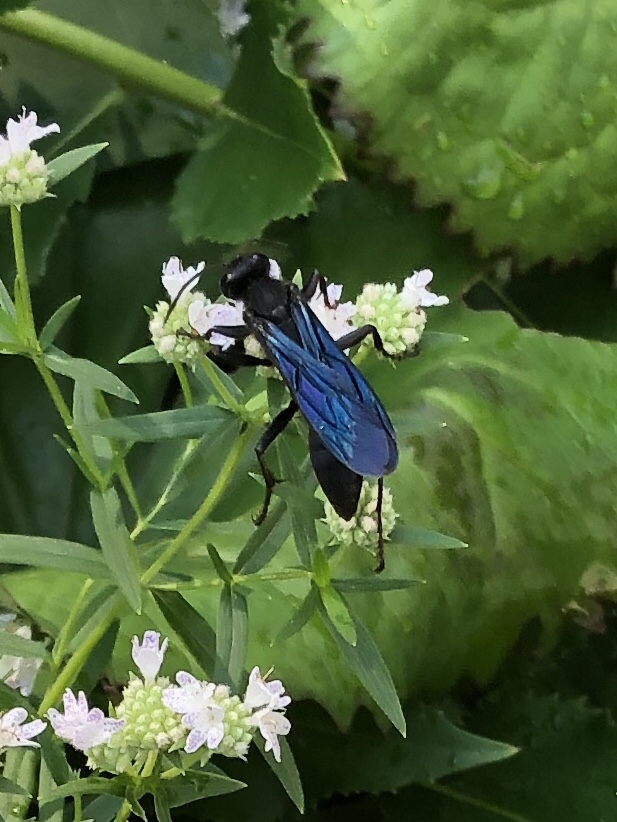
    Wasps are not something I think about very often (until they become a threat anyway), but my attention was drawn to a half dozen fascinating black wasps with blue wings diligently working the flowers like honeybees. I’ve seen them in other years, but sometimes you don’t pay any attention to such things until you’re ready to. It seems I was ready to. And researching this wasp made me gasp.

    I can think of many ways to die that would be better than the way the prey of the Great Black Wasp (Sphex pensylvanicus) die.  In fact, it might just be the most horrific way to die I could think of.  The wasps sting their prey, usually things like grasshoppers and katydids, to paralyze it.  They’ll then bring it back to their underground nest, where they lay eggs on the stomach of the prey that feed on the still-alive and most unfortunate victim.  If you were going to write a script for a horror movie, being eaten alive by the offspring of your hunter while paralyzed in captivity might be your inspiration.

    The Great Black Wasp lives up to its name – black all over with iridescent blue wings.  Its huge by wasp standards. The ones flying around in my garden were more than an inch long, which is daunting when you consider the stinging insects flying around you.  But they were too busy pollinating flowers and looking for food for their offspring to eat alive to worry about me.  I was grateful for their lack of aggression, because I found them to be beautiful insects.  But then, I’m not a grasshopper.

    Viewing the wasps was a nice departure from the devastation caused by the groundhog.  It reminded me that the flower garden is really my preference anyway, precisely because it attracts interesting pollinators like the Great Black Wasp.  At some point maybe the garden will return to normal again, just as I hope the world will. And in those dark moments that 2020 brings think about those beautiful blue wings and remember: things can always be much, much worse.

  • Getting Up and Looking Further

    “No doubt in Holland,
    when van Gogh was a boy,
    there were swans drifting
    over the green sea
    of the meadows, and no doubt
    on some warm afternoon
    he lay down and watched them,
    and almost thought: this is everything.
    What drove him to get up and look further
    is what saves this world,
    even as it breaks
    the hearts of men.”
    – Mary Oliver, Everything

    This will be the 773rd blog post for a total of 333,789 words (including quotes from others).  I wonder sometimes where the words go when I click publish.  And I wonder sometimes whether writing everyday matters.  But I snap out of it, remembering the words of Seth Godin:

    “Daily blogging is an extraordinarily useful habit. Even if no one reads your blog, the act of writing it is clarifying, motivating and (eventually) fun.”

    Daily blogging has indeed turned out to be all three of those things and more.  But it isn’t lost on me that I set out to blog about exploration and I tend to be locked in my own yard most days.  But that’s 2020 for you.  Above all, writing is clarifying.  And even if no one reads the blog, the act has mattered far more to me than anticipated.

    What drove him to get up and look further is what saves this world, even as it breaks the hearts of men.

    It also isn’t lost on me that few actually ever read it.  But I haven’t earned that following just yet (and don’t invest any time in self-marketing my blog).  Still, there are those WTF days when you bleed all over the screen and the world buzzes in complete indifference.  Like putting all that energy into a garden and having it mowed down by a groundhog while you were away for a few days, its the world telling you that your work doesn’t matter as much as you thought it did.  The ultimate exercise in humility.

    Someone told me recently that the blog is a gift for my children someday when I’m gone.  I suppose that’s true, but its also a living trust of sorts, with the writer being the primary beneficiary while he’s still around.  If I should keep this up for the next ten years that works out to be roughly 1.5 million more words coming out of my brain and onto the page.  If I push the average up I could make that 2 million words.  Godin also mentioned that the first 1000 posts are the hardest.  Frankly I can’t agree more.  The process of writing, of getting up and looking further, is moving me in directions that are enlightening and yes, clarifying.  And maybe that’s enough.


  • Shift Happens

    The lingering glow of immersion in salt water quickly sweated out of me when I returned home to a yard in need of attention.  Some of the attention simply needed a prompt investment in labor, like mowing the lawn and cleaning the pool.  Co-existing with mature trees means picking up a collection of branches and other debris before you can mow.  Co-existing with wildlife meant scooping six frogs out of the pool once the solar cover was removed, disrupting frog spa day, and more tree debris.  It also meant assessing the damage from the groundhog, who has raised the stakes significantly by wiping out most of the remaining vegetables, but more egregiously climbing up the potted Hibiscus, breaking branches on its quest to mow down tasty bits from the top.  This shall not stand.

    There’s a tangible shift happening with the back yard from June/July satisfaction with the joys of a private oasis in the middle of a pandemic to a feeling that maybe this work is more than I want to deal with.  I recognize this as a post-vacation reality slap and know it will subside in time.  Part of this is a recognition that the pandemic marches on with no clear end in sight, and a burning desire to just get out in the world once again.  To cross borders real and imagined.  Part of it is knowing the routine for what it is and not being quite ready for it just yet.  We’re 1/3 of the way through August and this is naturally the time when I start to look around at where we are and what needs to be done.  The garden had faded even before the large rodent accelerated the process.  Where do we go from here?

    There’s another part of the shift, and its the recognition that time slips quickly away, and our best efforts to maintain a pristine environment can be wiped out faster than you can spell groundhog.  More attention paid to those big things from yesterday’s post, and less on half-assed attempts to grow pumpkins and tomatoes and hibiscus.  Does creating a backyard paradise mean hunting down a mammal that finds a buffet paradise in my efforts?  Or do I just stop planting the things it likes to eat and go to the farm stand for tomatoes and pumpkins?  The garden, however noble a pursuit, was never about produce.

    Yesterday I woke up on the edge of the bay.  This morning I woke up on the edge of the forest.  Each offers a dose of reality that you’ve got to come to terms with.  I’m not a Rhodes Scholar but I’m smart enough to recognize good fortune when I see it.  Appreciate the good and learn from the setbacks.  That’s 2020 in a nutshell.  The world marches on, and shift happens.

  • Five Things

    “Strategically, its better to do five big things with your life than 500 half-assed things.” – Derek Sivers, The Knowledge Project podcast

    This statement got me thinking.  I’ve done plenty of half-assed things in my life, but what are the big things, both accomplished and yet to complete?  That’s the real question of a lifetime.  I’m likely past the halfway mark on my own life (you never know), so what have you done with the time?

    “Doesn’t everything die at last, and too soon?
    Tell me, what is it you plan to do
    with your one wild and precious life?”
    — Mary Oliver, The Summer Day

    Raising two children to be good humans is one notable accomplishment.  An accomplishment that was decades in the making.  And if they’re a work in progress, they’re far ahead of where I was at their age.  Surely parenthood is one of the five big things.  When I look at my two I’m amazed at who they’ve become.  I played a part in that (perhaps only as an example of what not to do?).  If you have kids be a responsible kid with them, delighting in the world.  Most of parenthood is figuring things out as you go, but being a steady, reassuring presence in your children’s lives as they stick their own necks out into this crazy world.

    And if parenthood is one big thing, so too must a long, happy marriage?  Having gotten this one very wrong once, I celebrate the one I’ve gotten right.  And by right I mean I haven’t screwed it up just yet, despite my stumbling through the minefield of time.  I’m no expert on the topic, but I’ve learned a few things over the years.  Ultimately you get what you put into something, and if you invest the time and passion into a marriage you’ll have a healthy return on investment with the right partner.  Marriage is never 50/50 – sometimes you give 80, sometimes you give 20, but with the right partner it evens out over time.  So that’s two, for those keeping score, and where do we go from here?

    Career?  One’s career is a complicated journey full of half-assed things, but if you play it well there’s potential for that big thing over time.  If I’ve learned anything at this stage of my career its that relationships and trust built day-after-day matter more than skills accumulated or degrees earned.  It all counts, but nothing matters more than how you interact with others.  I celebrate being in a good place in a complicated time with the potential for great things should I do the work well.  Isn’t that what we all want in a career?  One of the key decisions you’ll make in your career is how much you want to sacrifice time with that family and in your marriage  for career growth.  Choose wisely, for balance is possible.  Life is too short to work for assholes.

    So riddle me this: Beyond family, marriage and career, what are the next couple of big things that you want to accomplish in life?  Starting a business?  Meaningful charitable work?  Environmental activism?  Writing that great American novel?  Athletic accomplishments?  And what of world traveler?  I like to think of myself as an unpaid American diplomat, going out into the world and demonstrating that what you see in the movies and reality television and (God forbid) politics isn’t the real America, but just a part of our story.  There’s a lot to be said for climbing the ladder and reaching a hand down to help others on their own climb.  The more you’re a student of the world, the more you learn and the more you can apply that knowledge towards meaningful interactions.

    “Life is like arriving late for a movie, having to figure out what was going on without bothering everybody with a lot of questions, and then being unexpectedly called away before you find out how it ends.” – Joseph Campbell

    Focus on the big things, and less on the half-assed things.  You’ll know the big things when you find them.  At least I’m counting on that as a guiding principle on my own path.  And if you don’t eventually get five big things accomplished, maybe one or two is enough.  But make them really big things.

  • Dazzling Infinity

    “The buying of more books than one can read is nothing less than the soul reaching toward infinity.” –  A. Edward Newton

    I have an ongoing fascination with the infinite.  Maybe it’s because I’m rather finite myself, with only so many days left at the dance with life.  Or maybe its the humility that comes with thinking about things bigger than yourself that attracts me.  Whatever, the attraction is real.  The French have an expression for it: l’éblouissement de l’infinit or “dazzling infinity”.  I think that’s a fitting adjective to tack on to the infinite. For who among us who bothers to look up from their phone isn’t dazzled by the vastness of the universe?

    I try to create infinity bookends in a day by getting up early for sunrises and going out late to look at the stars as one way of putting myself at the edge of forever.  And it might explain the draw of rivers and the ocean and the mountains.  Each dazzles in their own way because they’re both silent witnesses to forever while simultaneously the embodiment of it.

    The Newton quote above hits close to home.  I do collect impossibly large stacks of books that I fear I’ll never get around to.  But rather than reign in my collection I add to it.  Someday maybe I’ll finish the stack, but I know its almost certainly blind optimism talking.  I may never get to all of the books or all of the places I want to go to, but that doesn’t mean I won’t vainly believe deep down that its possible I could.

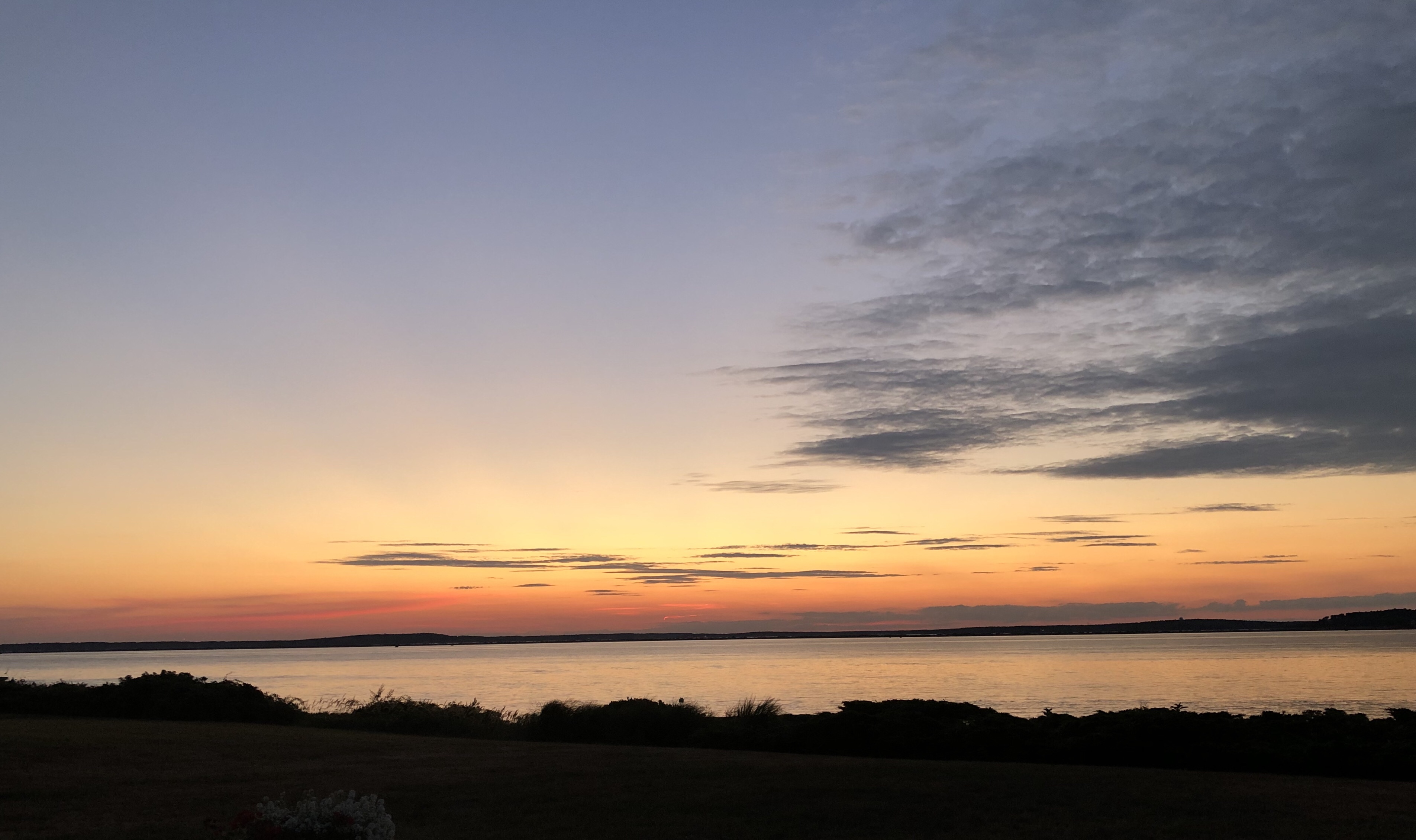
    Watching the post-sunset show along the shore of Buzzards Bay a couple of nights ago I thought about the long list of experiences I’d like to have before I go gently into the night.  It seemed a rather long and impossible list given the state of the world at the present moment, but I think its rather like the stack of books.  I may not get to everything on the list, but hopefully I’ll get to enough.

    Watch the stars in their courses and imagine yourself running alongside them. Think constantly on the changes of the elements into each other, for such thoughts wash away the dust of earthly life.” – Marcus Aurelius, Meditations

  • The Four Chronometers of Greenwich

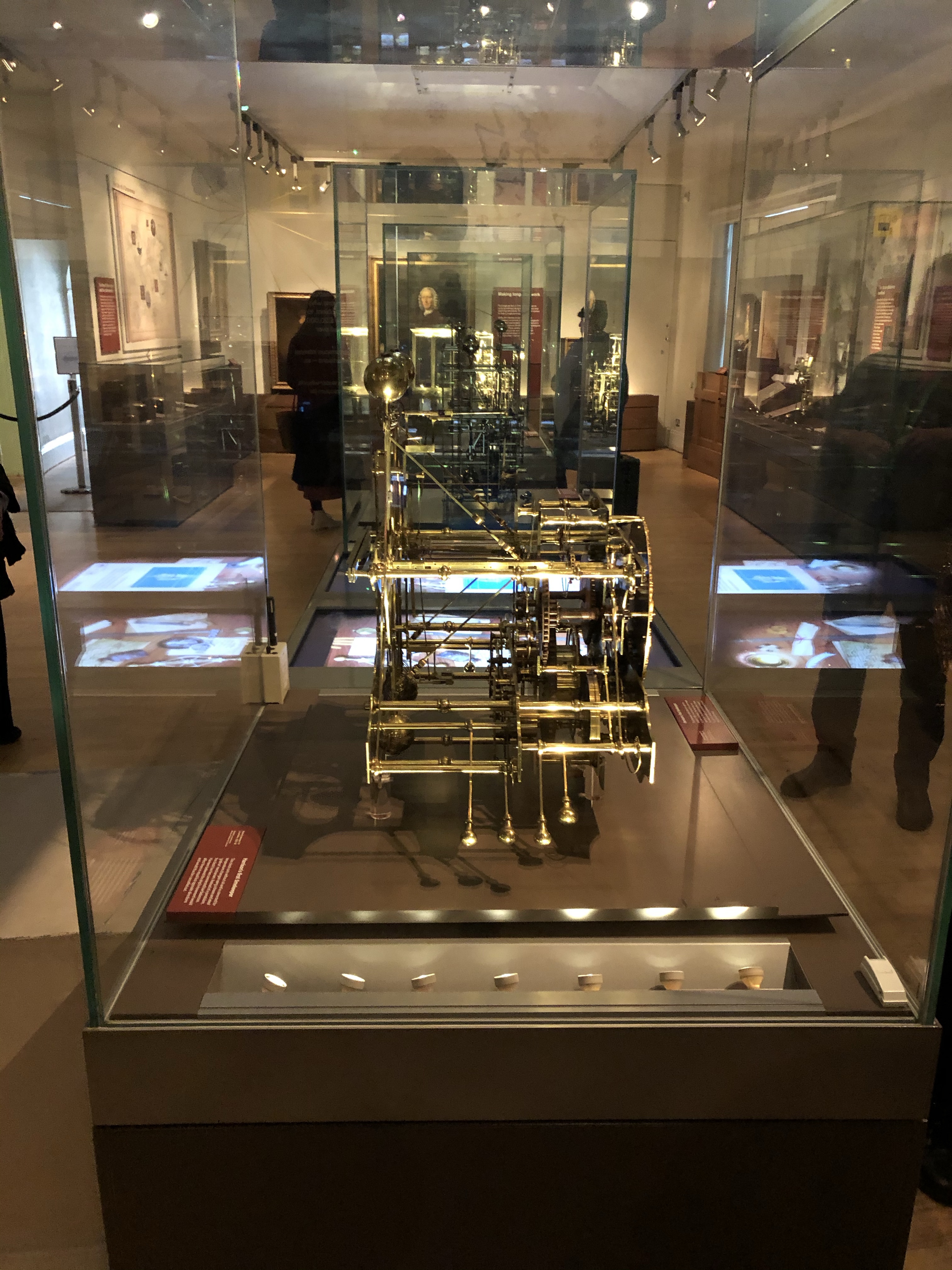
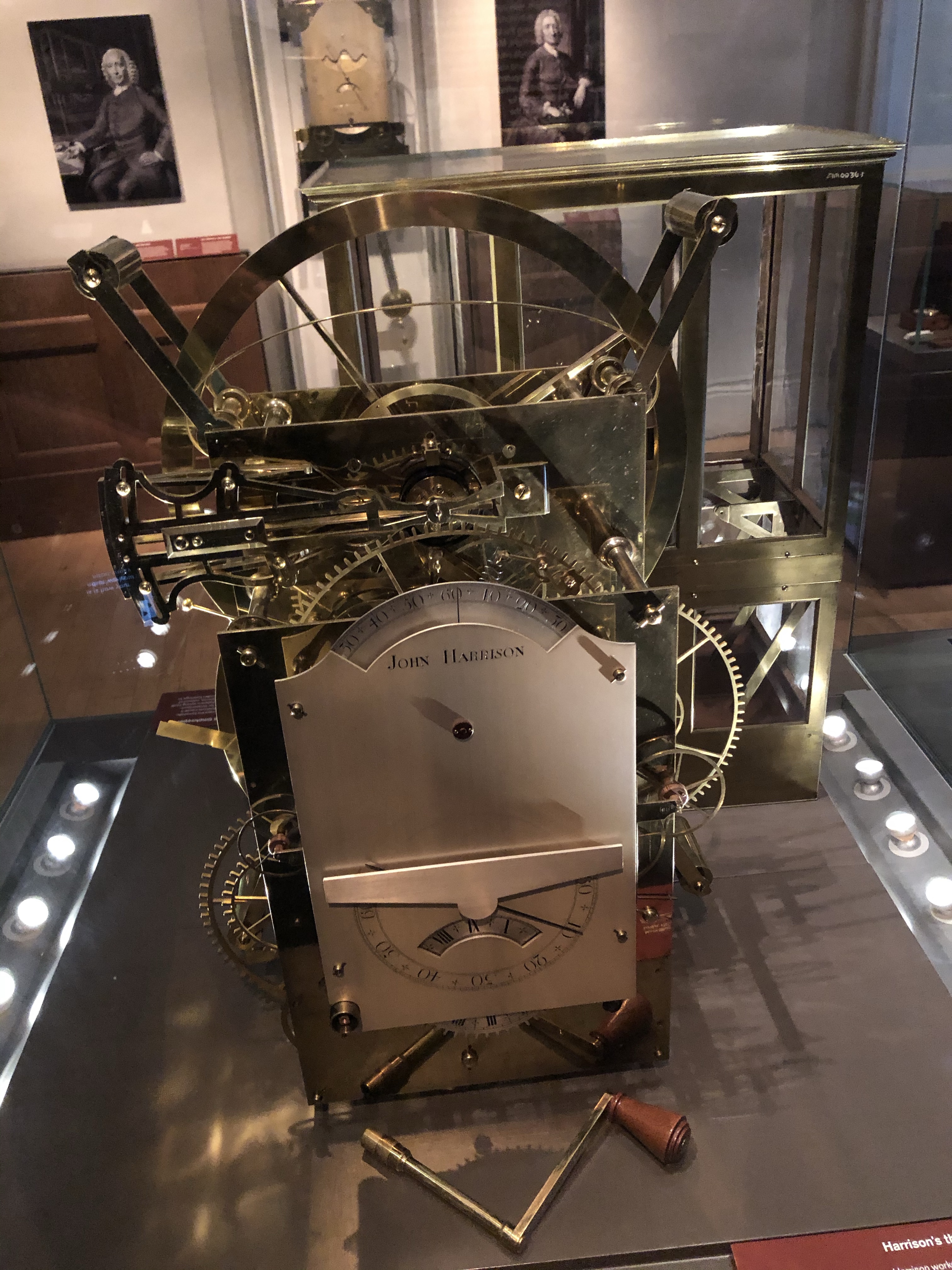
    I confess when I visited Greenwich my mind wasn’t on chronometers, it was on the Prime Meridian and Greenwich Mean Time.  But after the obligatory pictures at 0° along the famous line that dictates so much of our modern lives I spent the duration of my time exploring the Royal Observatory Greenwich, and listened intently as an exceptional guide detailed the story of the four clocks that changed the world.  That all four of the clocks were on display, and three of them were still running was a mind-blowing moment.

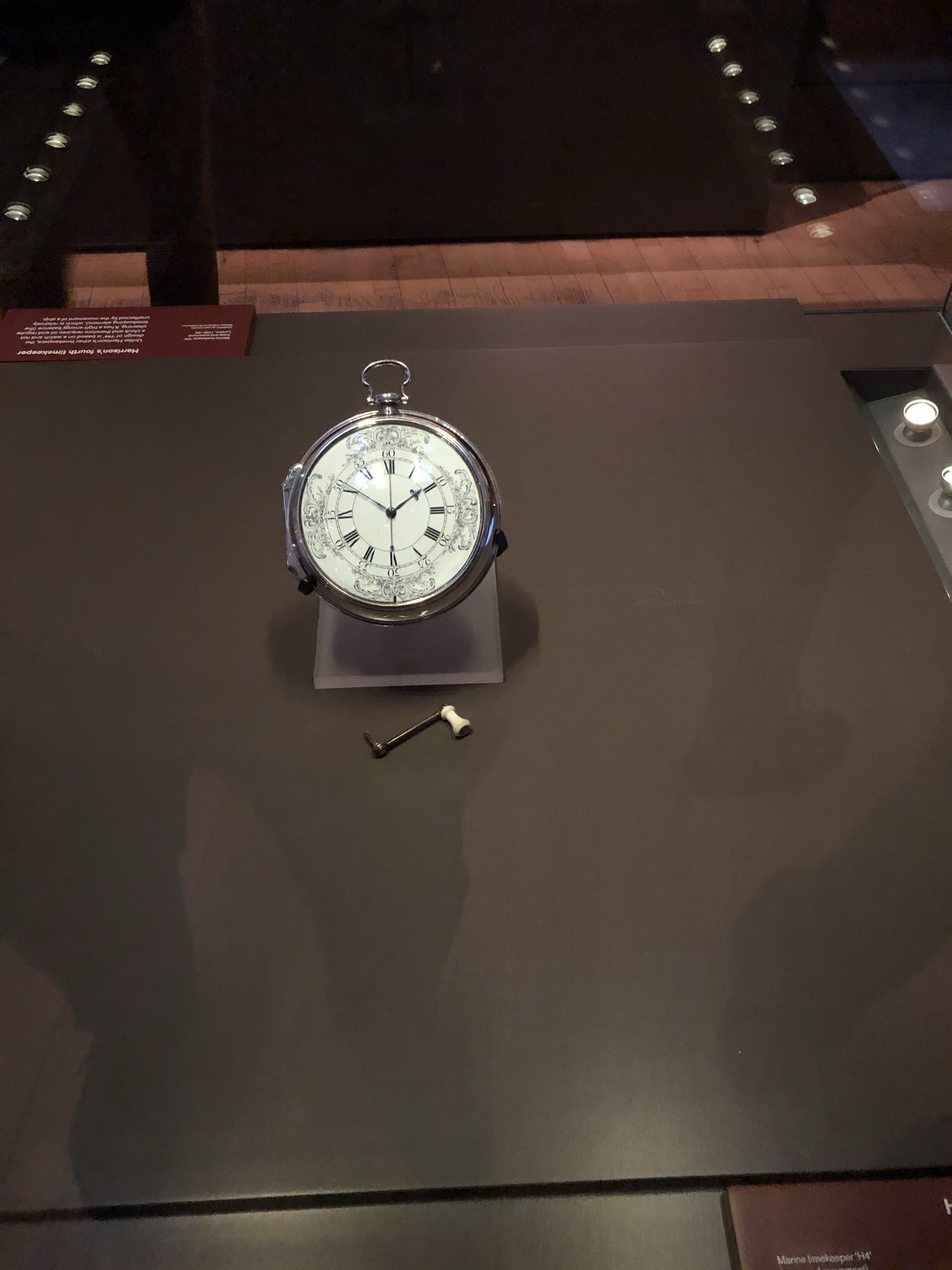
    John Harrison invented the first clock, H-1, in an attempt to solve the most perplexing problem of the day – determining longitude while at sea.  It was such a critical issue that Parliament passed The Longitude Act 1714 with a prize of £20,000 for anyone who came up with an accurate way to determine longitude.  Dava Sobel wrote an excellent book that details Harrison’s lifetime pursuit of a final solution.  H-1 was completed in 1735, but Harrison wasn’t completely satisfied with it and went about immediately to work on an improved chronometer.  H-2 never went to trial (tested at sea), H-3 was completed in 1759 but wasn’t trialed right away because of the Seven Years War.  While they waited to trial it Harrison invented the smaller H-4, which was the size of a very large pocket watch, which went on to win the prize money after a lifetime of work and refinement and continuous trouble with The Commissioners of Longitude (some of whom were biased towards an astronomical solution to the longitude riddle).

    Part of me wishes I’d read Sobel’s book before visiting Greenwich and seeing the four chronometers that changed the world.  But there’s another part of me that is grateful for discovering them unexpectedly.  I immediately purchased Longitude when I returned from the UK.  Having seen the four chronometers side-by-side in the museum, with all in working order (H-4 is deliberately kept unwound to preserve it), I felt an immediate affinity for the story when I began reading.  But another hero emerged from the book besides Harrison.  It was Rupert Gould, a Lieutenant-Commander in the British Royal Navy who was given permission to restore the four chronometers that had been sitting in a deteriorating state for almost a century.  Gould spent 13 years restoring the clocks to their original state, and in doing so returned four examples of timeless magic for visitors to the Flamsteed House and the Royal Observatory Greenwich.  He’s a quiet hero in history, and is rightfully remembered as such.  I was spellbound by H-1, H-2 and H-3 as they earnestly marked time 2 1/2 centuries after Harrison built them.  Now that I know their history, I look forward to a return visit someday, and will re-read Longitude and linger for a spell in the presence of history.

    H-2
    H-1

    H-4
    H-3
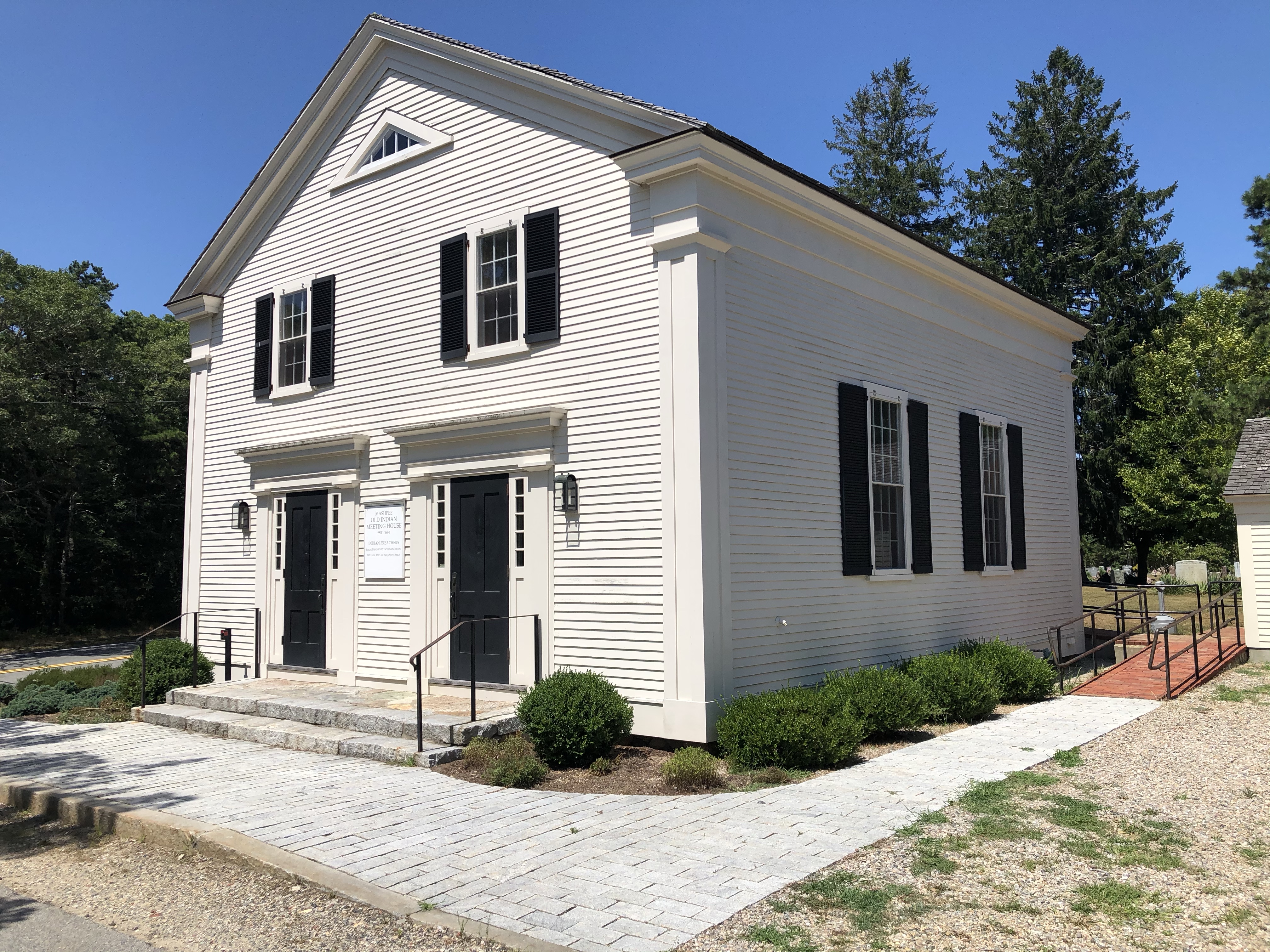
  • The Old Indian Meeting House

    The Nauset of Cape Cod are part of the Mashpee Wampanoag and were known as the “Praying Indians” because they became converts to Christianity.  They were an important ally for the colonists against tribes that rose up against the encroachment of the English settlements.  Most famously they worked with Benjamin Church as guides in his hunt for Metacom, or “King Philip”.  It was one of the Praying Indians who killed Metacom, effectively ending King Philip’s War in 1678.

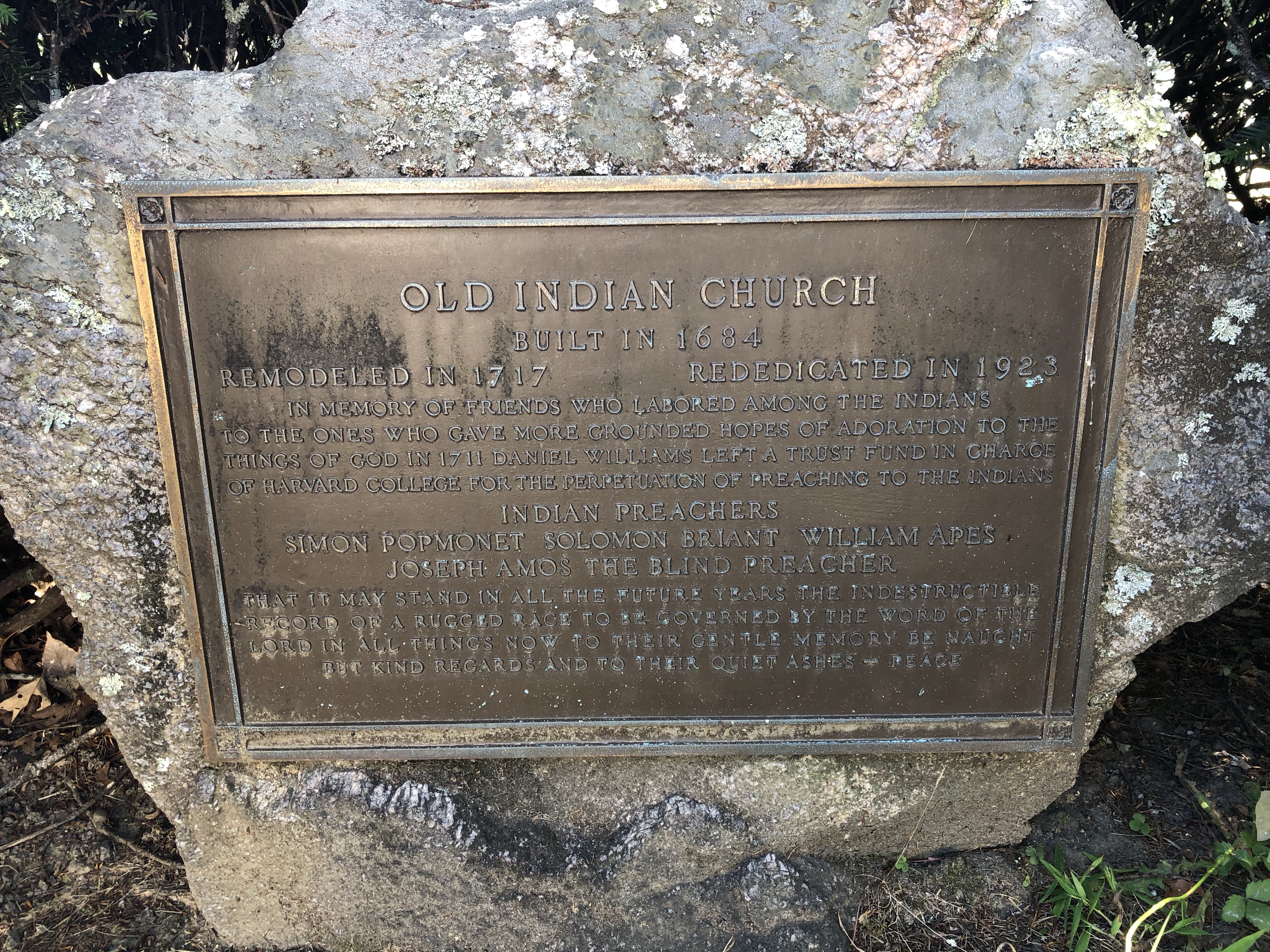
    The Nauset were clearly converts to Christianity in the 1670’s, and they met somewhere in Mashpee to pray, but the original building is long gone.  A second building was purportedly built in 1684 at the original site near Santuit Pond.  That building is generally agreed upon as the current Old Indian Meeting House, relocated in 1717 to its current location on Meetinghouse Road (naturally) just across from the Mashpee River. This would make it the oldest church on Cape Cod and the oldest Indian church in the United States.  I’ve read at least one article that disputes the original date of construction for the meeting house, with a local historian claiming the building was actually built in 1757 or 1758 by Deacon John Hinckley.  I believe that Deacon Hinckley is agreed upon as the builder of the church, so determining the actual date should be relatively easy from there.  But I’m not diving deep into this controversy.  There’s no doubt that the Meeting House is historically highly relevant and important.  It was used by the Nauset as a church, and also no doubt that it was here that the Nauset staged a nonviolent protest known as the Mashpee Revolt against the Commonwealth of Massachusetts in 1833 over control of the tribe’s land.  Of course, that was exactly what Metacom was doing from 1675 to 1678, but he chose violence (spurred on by violence against the Pokanoket).

    I visited the Old Indian Meeting House on a quiet, hot August day.  Not a lot of Cape tourists hanging out at an old build next to a cemetery on a perfect beach day. I find that I’m often the only visitor to such places in the moment I’m there. But I prefer quiet time with places of relevance. It’s set on a small hill on the edge of the cemetery, roughly three miles from Santuit Pond, which would make moving it on logs on old colonial roads quite an undertaking.  The Mashpee Wampanoag hold this place as sacred, and I respectfully walked around the site for a few minutes, read a few of the nearby gravestones and generally tried to get a feel for the place before moving on.  A visit to their web site prompts a popup requesting that you sign a petition to help the tribe protect their lands from changes at the Bureau of Indian Affairs.  It seems that the contributions of the Praying Indians are once again being forgotten by some in the endless land grab of the native lands.  That would be par for the course.

  • A Sand and Scrub Pine Kid Visits the Past

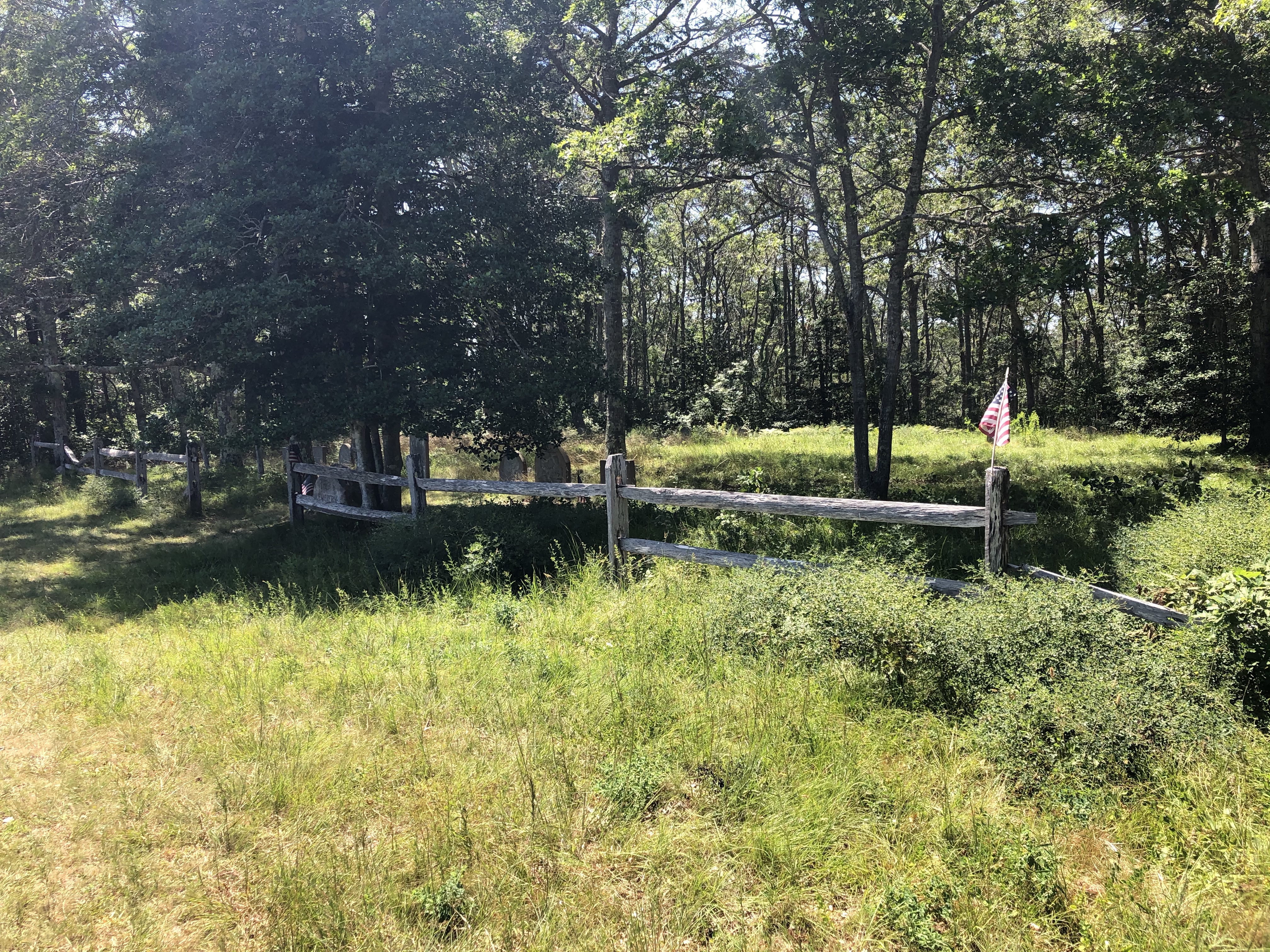
    It might say a lot about me that on a hot Monday morning on Cape Cod when I found myself with time alone I didn’t opt for the beaches, but instead made a pilgrimage to an old graveyard in the woods of Forestdale.  This was a trip back for me, for I would walk in this graveyard as a kid reading the names and the stories behind the people who once lived and died in this place.  The graveyard was a short walk from the shores of Peters Pond, a place that I’d spend many summers in my formative years.  For I was a sand and scrub pine kid.

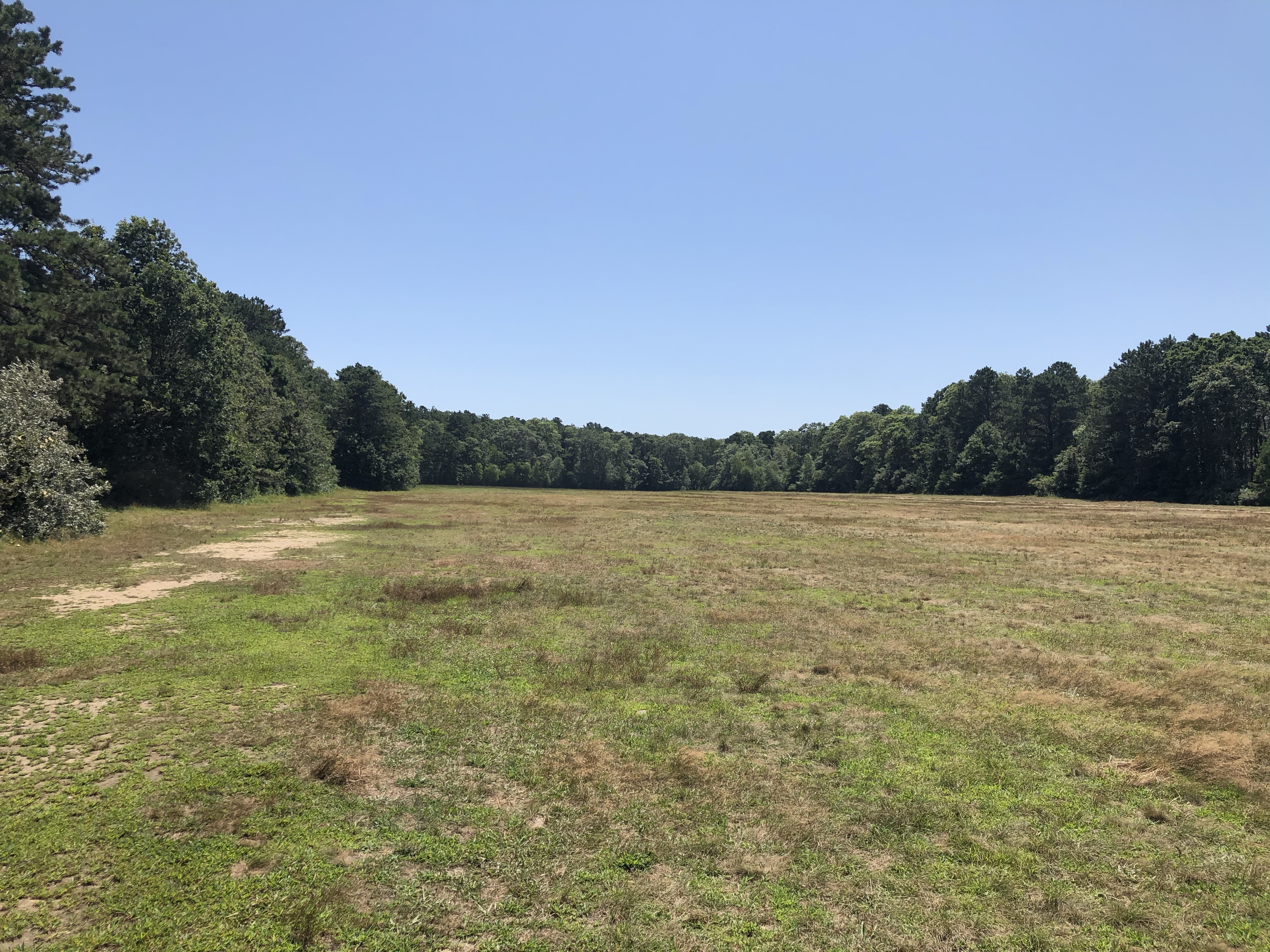
    30 years ago you could read the names clearly on most of the gravestones, and the cemetery was well-maintained by the caretaker for the Hewlett Packard Sandwich Resort (back when HP was a different kind of place).  That place on Peters Pond was a great perk for employees – a place to bring your kids for a week or two every summer at no charge.  When you went on the same week every year, you’d build friendships with other HP families, and that would build momentum year-after-year until it became a defining part of growing up for many of us.  The summer would end and they would have one last company party with employees grilling steaks and burgers and having games with prizes on a large field up the hill from the grounds of the resort.  That field is now home to The Sandwich Bazaar Flea Market, which effectively preserved the field in just as it was three decades ago.  I was grateful it hadn’t become a landing spot for condos.

    Sandwich Bazaar Field, once a part of HP’s Peters Pond Resort

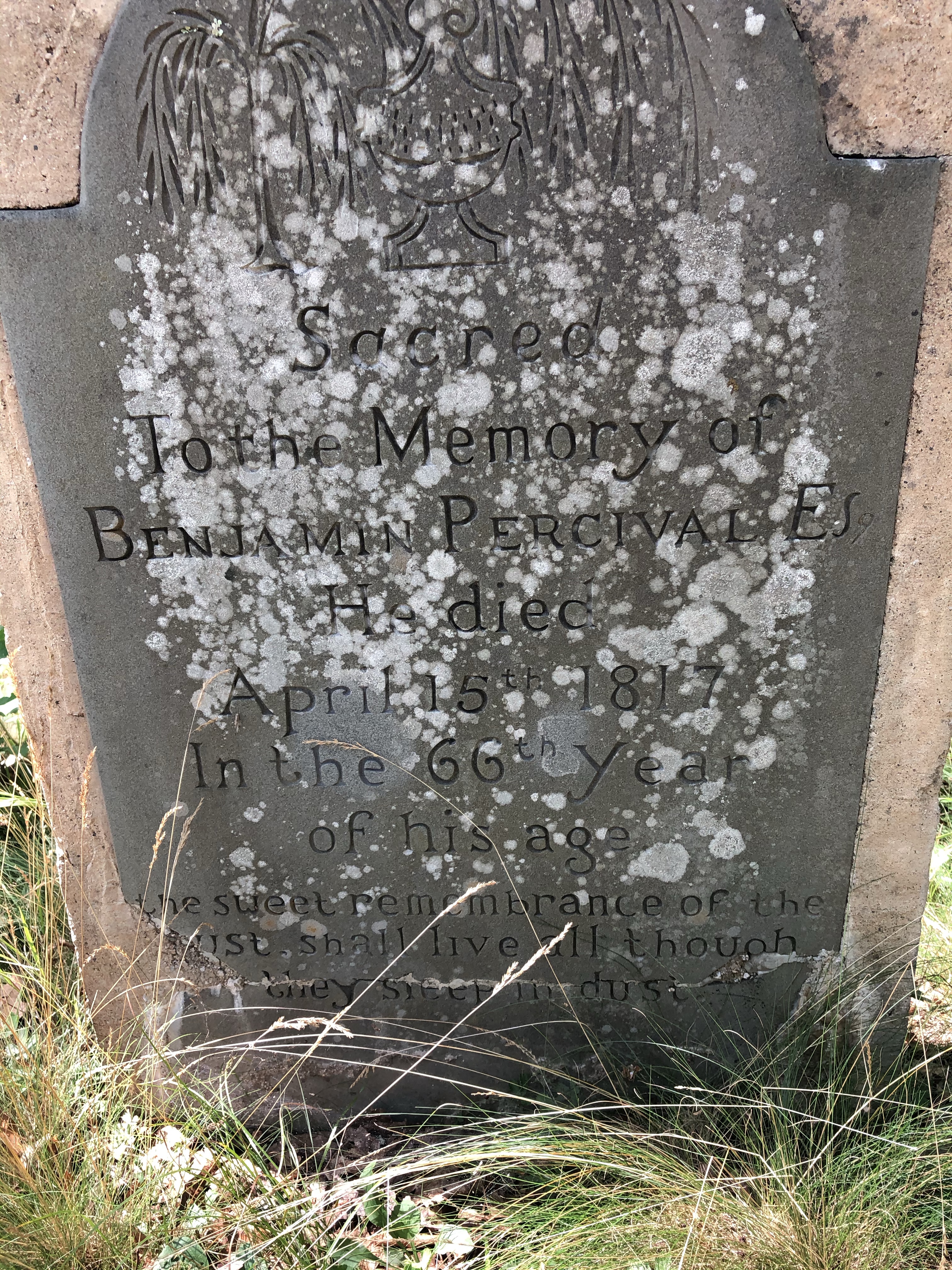
    The entrance to the field is chained off to prohibit cars, but I parked across the street and walked over.  Warning signs about deer ticks and Lyme Disease greeted me.  We didn’t think about such things when I was a kid, we’d just pull ticks off of our skin before they became engorged.  Now I guess you need to remind people.  And so I walked down to where I remembered the small graveyard being, walking in a time warp back to the late 1970’s and early 1980’s when this was my escape and the rest of the family didn’t think anything of you disappearing for the entire day as long as you showed up for dinner (I never missed dinner).  I saw the fence for the graveyard well past where the tire tracks for the flea market stopped.  Just where I remembered it being.  But sadly the old graveyard isn’t maintained anymore.  Where once the grass was neatly mowed, now it was as tall as the gravestones.  More troubling was the poison ivy that spread all over the grounds.  Apparently the Town of Sandwich has decided to let this cemetery return to nature.  At least the gravestones that were still standing.  Many were crumbled piles of broken stone.  Perhaps vandalized?  But even the gravestones still standing showed they haven’t aged well.  Most were illegible as the sandstone faces curled and peeled downward.  The last three decades haven’t treated the old graveyard well.

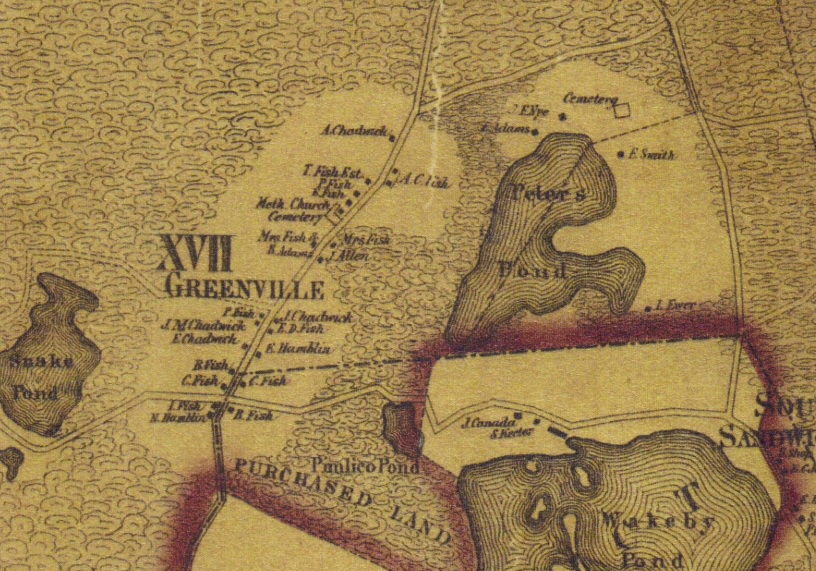
    The Sandwich Historical Commission does a great job of posting old maps of the area.  I compared two maps from around the time that the people taking up permanent residence here would have been alive.  The first was a map from 1794 that offers a larger view of Sandwich, with delightful details on the map.  Peters Pond is clearly named, making it an easy point of reference.  The land is marked as “wast land” on one side of the pond and “good land” on the other.  But the graveyard isn’t noted.  It does show up on a map from 1857, which also notes family names on houses in the community.  Interestingly, none of the names correspond with the people who are buried in the graveyard.  Its as if all references to them disappeared.  And so now is the graveyard, quietly being swallowed up by forest and poison ivy.  I thought of that 1794 map, describing this land as “wast land”.  Its impossibly hard to make a living farming on sand, but the land isn’t a waste.  It raised countless generations.  And for a dozen or so summers, it raised me.

    Segment of 1857 map of Sandwich

    I walked the serpentine path through the graveyard where the tall grass had been trampled down.  The path followed a route to the gravestones that were still intact.  I’m not the only one to visit Tobey Cemetery this year.  Which made me wonder, was it other sand and scrub pine kids returning to their childhoods as I was?  Or curious flea market people wondering what this remote graveyard was all about?  I’d like to think the former.  There were so many of us once.


    Tobey Cemetery

    One of the few intact and legible gravestones left
  • Skipping Across The Water: 20 Places To See By Boat

    Perhaps its my proximity to water at the moment, or perhaps the heavy influence of the crew of Fayaway on my thinking the last few days, but I’ve been thinking about places best seen by boat lately.  For when you combine water and beautiful scenery you can quickly build a list of must-see places that are perfectly situated to or only possible to see by boat.  I’ve managed a few of these in my lifetime, the rest are bucket list items for the right moment, should it come along.  But we all have to have hope for a future where we can once again explore the world, don’t we?

    Interesting if only to me, many of the places I want to go to most are in cold climates.  The tropical destinations are nice, but I’m a Northern bird and appreciate a bit of snow and ice in my life too.  And then there are the places I’ve been to before that I secretly plot to return to again as soon as possible.  You know you’ve fallen in love when a place haunts you for decades after visiting, and a few on this list qualify.

    Without further ado, here are twenty places best seen from the water for your consideration:

    The Outer Hebrides  Begin with Scotland?  I should think so.

    The Faroe Islands Stunning and remote?  Sign me up!

    Westfjords, Iceland – but why stop there?  The rest of the country whispers to me too.

    Iceberg watching between Newfoundland and Labrador (any excuse to return to Newfoundland works for me, and Labrador offers a world of remote exploration all its own.

    Easter Island, Chile to visit those Moai characters at sunrise and contemplate the extraordinary.

    Isla del Cocos National Park, Costa Rica – diving with hammerhead sharks?  Maybe.

    Nahuel Huapi Lake & Nahuel Huapi National Park, Argentina for the glory of the Patagonian Andes from the water.

    Whales and icebergs in Disko Bugt (Disko Bay), Greenland, and maybe a polar bear or two from afar.

    St Helena – maybe because its so remote, or maybe because of Napoleon, or the useless airport?  Whatever the reason, I’m interested in getting to St Helena someday.

    Carribean island hopping: Dominica, Martinique, Grenada, Saba, Barbados, etc. for all the reasons you’d expect.

    White water rafting through the Grand Canyon.  Because once was not enough.

    Inside Passage Alaska, and also because once was not enough.

    Revisiting the Statue of Liberty and New York Harbor again someday when the world is normal, or at least a little more normal.

    A cultural immersion in Okinawa, Japan for all that this place offers, from the historical perspective of Shurijo Castle and the WWII sites to slowing down in Sefa-utaki.  I have riding a bicycle across the Irabu Ohashi bridge on my short list of activities for someday, maybe.

    Milford Sound and Doubtful Sound in Fiordland, New Zealand remains on that evasive list of places to get to as soon as reasonably possible.  I fear that I might just want to stay in New Zealand should I ever visit, but its a chance I’ll have to take.

    Visiting Sydney Harbor and climbing that bridge are high on my list of things to do.

    Mo’orea, French Polynesia – and while you’re in the neighborhood, who doesn’t dream of visiting Tahiti, Bora Bora, Marquesas?  A visit to Mo’orea necessitates lingering to see more.

    Li River cruise China – China is a mystery to me, but a place I’d love to explore someday.  And I can think of no better place to start than on the water cruising the Li River.

    Cruising down the St. Lawrence Seaway and through the Great Lakes has been on my mind for some time.  If there were a reason to get another sailboat, it would be to do this trip.

    Last but not least and closer to home, sailing Lake Champlain is something I’ve contemplated since I was a teenager seeing sailboats moored along the shore with the Adirondacks rising in the distance.  And my fascination with the early history of this region makes it a must-do for me.  Early October would be sublime with the foliage.

    So there you go: twenty bucket list places to see from the water.  All we need is time and a way to get there.  A chance to skip across the water like a stone and see parts of the world you can’t always get to from land.  A mix of salt water and fresh water destinations just ready to explore.  Are you ready?  This list could take some time.
     

  • Be Less Comfortable

    “It takes many hours to make what you want to make.  The hours don’t suddenly appear.  You have to steal them from comfort.  Whatever you were doing before was comfortable.  This is not.  This will be really uncomfortable.” – Derek Sivers, Where To Find The Hours To Make It Happen

    This phrase, stealing hours from comfort, was  plucked from a blog post Sivers wrote last October and highlighted yesterday by Seth Godin, borrowing for one of his own blog posts.  And so I pay it forward here.  For there’s genius in the phrasing, isn’t there?  We all have the same amount of hours in the day, and those who do exceptional things with their lives do so by stealing hours otherwise spent on comfortable things like binge-watching Ozark or SV Delos YouTube videos (guilty x 2).  In the meantime the great novel in your head slides sideways into the abyss.  The language you might have learned remains a mystery to you.  The belly gets soft.  The community volunteers carry on without you.  The work is accomplished by others, and we look on in awe at what they achieved.

    And the answer, of course, is to be less comfortable.  To challenge yourself more.  To do the work that must be done to get from this place of relative comfort to a better place of greater meaning and contribution.  To stop scraping by at the bare minimum and double down on your effort.  For all that is worthwhile in this world requires an investment in time and a healthy dose of discomfort to earn it.  But we have to remind ourselves of this daily, because comfort is a dangerous temptress.  And before we know it the days, weeks and years fly by and the dreams remain only dreams.  So toughen up, buttercup!  A bit less comfort is the answer to the question of where will you find the time?

    As Jackson Browne sings, I’ve been aware of the time going by…  and so I’m trying to invest my time in less comfortable things.  Hiking with intent, writing more, working more focused hours in my career, and slowly chipping away at expanding the possible of today.  But I’m still too comfortable.  When there’s so much more to do in the time we have left, isn’t it essential we get to it already?  And in some ways the pandemic offers us a reason to make profound shifts towards the uncomfortable.  To break from the routine and tackle the meaningful.  A catalyst for change just in the nick of time – in this, our critical moment.  For if not now, when?