Month: November 2020

  • Norumbega

    “Not on Penobscot’s wooded bank the spires
    Of the sought City rose, nor yet beside
    The winding Charles, nor where the daily tide
    Of Naumkeag’s haven rises and retires,
    The vision tarried; but somewhere we knew 5
    The beautiful gates must open to our quest,
    Somewhere that marvellous City of the West
    Would lift its towers and palace domes in view,
    And, lo! at last its mystery is made known—
    Its only dwellers maidens fair and young, 10
    Its Princess such as England’s Laureate sung;
    And safe from capture, save by love alone,
    It lends its beauty to the lake’s green shore,
    And Norumbega is a myth no more.”
    – John Greenleaf Whittier, Norumbega Hall

    Norumbega; the mythical city of gold in the northeast corner of North America. The name most people today have never heard of. But you see hints of it to this day if you look around enough. around the Wellesley and Newton, Massachusetts area. This poem above was from the dedication of the huge building that was College Hall at Wellesley College, which say on Norumbega Hill until it burned down in 1914. There never was a city of gold in the northeast, but the legend lives on anyway.

    The name became associated with this place we now call New England, but this place could easily still be Norumbega if the French had been more successful in their first interactions with the Native American population living in New England at the time. But the French Commander Jean de Poutrincourt was afraid of the Native Americans, and they in turn deeply distrusted him. Conflict and a hasty retreat north of the Penobscot River, and an opportunity lost. Instead they left an opening for the English. In 1620 Pilgrims arrived, found the local population decimated by disease likely from interactions with other Europeans, and settled into our familiar narrative about New England.

    The name preceded the French. Norumbega appeared on maps by a couple of Dutch cartographers, who situated this lost city of gold south of New France but north of Florida. Maps weren’t especially detailed back in the 1500’s. Abraham Ortelius published his famous Typus Orbis Terrarum in 1570, which shows far greater detail in the areas Spain had conquered than in the northern half of the Americas. But there’s Norumbega, tantalizingly real on a map, ready for the taking by some enterprising conquering nation (the Native American population apparently not a strong consideration).
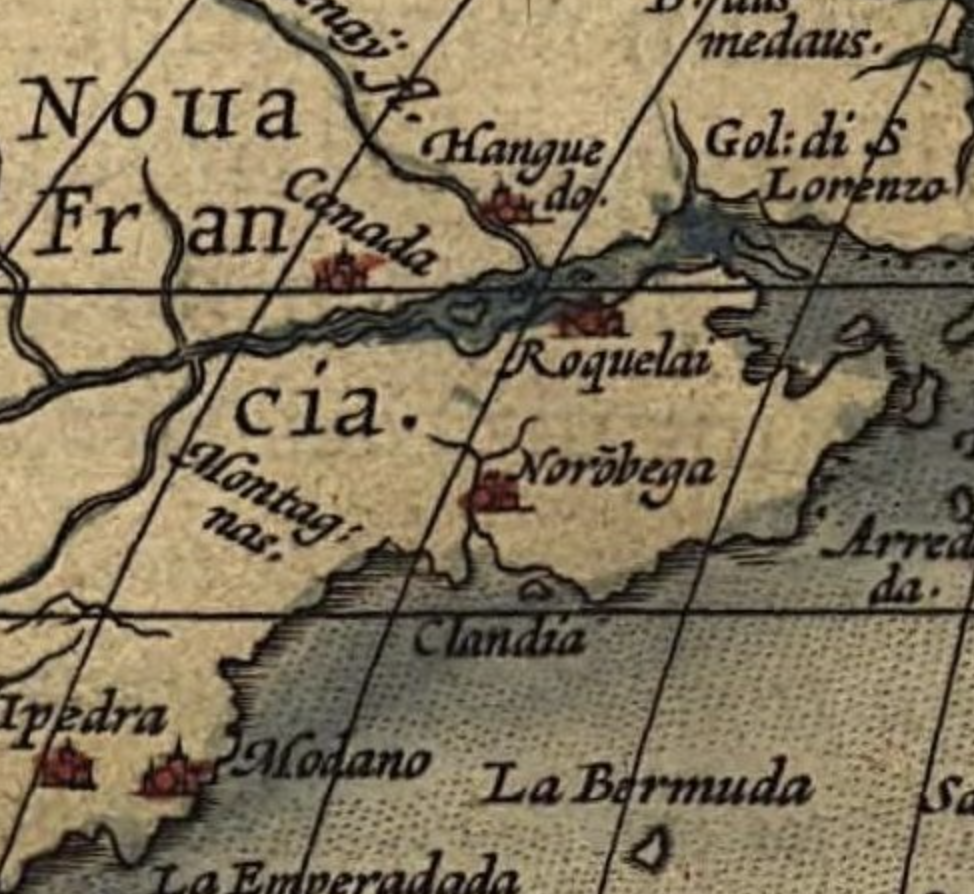
    Norumbega, depicted in the 1570 Ortelius Map

    Cornelielius van Wetfliet seemingly had Norumbega situated where present-day Washington, DC in his 1597 atlas that, at the time, was the most detailed map of the northeastern coast of North America. But Norumbega was generally accepted to be far north of the Potomac, perhaps the Hudson River but most say it was either the Charles River or the Penobscot River. When you don’t really know the lay of the land you mush it all together into a general blob. Such were the early maps of North America.

    So, since the mythical city of gold in the northeast never really existed, Norumbega became the general place name for New England for a time. That time ended when the English put a stake in the ground at Plymouth Colony in Massachusetts and the eventual settlement of what would be called New England. By the time my old friend Alexander’s map was published in 1624 the place was firmly established as New England, and Norumbega faded into history like the people who lived and explored this place long before the Mayflower set sail. But pull back the covers of history and there it is: mythical, elusive, fascinating. Norumbega is a myth no more

  • Towards Remarkable

    “What is the purpose of writing? For me personally, it is really to explain the mystery of life, and the mystery of life includes, of course, the personal, the political, the forces that make us what we are while there’s another force from inside battling to make us something else.” – Nadine Gordimer

    I don’t know much about Nadine Gordimer that you can’t find in her obituary or on Wikipedia. She was a South African writer who helped expose the darkness of apartheid for the world to see. She won a Nobel Prize for her writing and was on the short list of people that Nelson Mandela wanted to see first when he was released from prison. By all accounts she was a pretty remarkable woman.

    “…with an understanding of Shakespeare there comes a release from the gullibility that makes you prey to the great shopkeeper who runs the world, and would sell you cheap to illusion.”

    You know remarkable when you see it. There’s a life force exuding out of certain people that pulses. It’s not celebrity, though some celebrities, athletes and leaders have it (certainly not all). You learn to spot the authentic energy from the great shopkeepers and cons. It’s an intangible force from inside that is magnetic but genuine. People are drawn to them, because they see something in them that they haven’t quite let out of themselves.

    “If I dreamt this, while walking, walking in the London streets, the subconscious of each and every other life, past and present, brushing me in passing, what makes it real? Writing it down.” 

    I understand Nadine Gordimer better through her words. And in her words she shows us the way. Learn from the great observers of the past. Write it down (Rolf Potts recommends a “commonplace book” where you can record the best ideas you find – blogging certainly helps achieve this too). Keep improving over time. With patience but earnest effort.

    “Your whole life you are really writing one book, which is an attempt to grasp the consciousness of your time and place – a single book written from different stages of your ability.” 

    I’ve come to focus on remarkable recently. Having come across a few people with that extraordinary life force exuding out of every pore, you begin to think about how you might reach some level of that yourself. Gordimer hints at the journey we’re all on with this last quote. We’re all climbing at different paces, at different stages of our ability, towards our own peak. Towards remarkable.

  • Bold Living

    “There is freedom waiting for you,
    On the breezes of the sky,
    And you ask ‘What if I fall?’
    Oh but my darling,
    What if you fly?”
    – Erin Hanson

    Salto mortale, means the dangerous or potentially lethal leap. Mortale is the potentially bad outcome. Salto is the tricky part: the leap. We humans tend to dwell so much on bad outcomes that we never get around to leaping. And then we regret the leaps we didn’t take more than we celebrate having not leaped. And that suggests another Latin phrase that stirs those quivering leaping muscles: Quam bene vivas refert non quam diu, or “It matters not how long but how well you live”.

    “I don’t believe people are looking for the meaning of life as much as they are looking for the experience of being alive.” – Joseph Campbell

    Alive time means being out there, taking chances, doing things that make you a little bit uncomfortable but thrill you just the same. Not frivolous risk-taking, but leaping into the calculated risk of bold living. The art of being alive while you’re here and vibrant enough to spring to action.

    Live boldly. Leap. Fly.

  • Beaver Paint and Population Growth

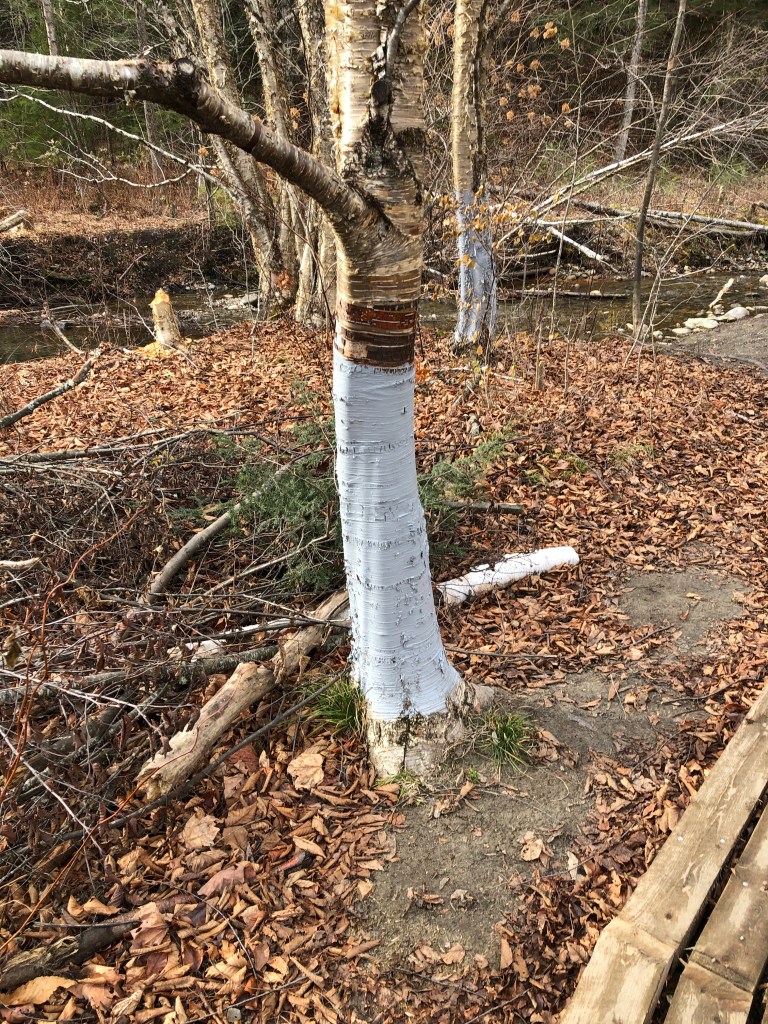
    You know right away when you see it. The trunk of a beech tree painted gray for the first four feet from the ground. But not every tree, just certain designated survivors. The rest are up to the whims of fancy. This is beaver country.

    The paint itself is latex paint, the color doesn’t matter to the beaver, but it does to us. Something that somewhat matches the tree is a nice touch, with enough contrast to recognize from afar that that’s the painted one. But paint alone doesn’t do enough to turn off the beaver, according to the Beaver Institute (!) you’ve got to mix in 20 ounces of mason sand per gallon of latex paint. That makes the bark an unpleasant sandpaper texture that even the hungriest beaver is going to turn their nose at. And in theory that saves the tree.

    Humans and beavers don’t always get along well. They were relentlessly hunted by Native Americans for trade with Europeans in the early 1600’s, and those Daniel Boone hats made a fashion statement even as they kept your head warm and dry. Beaver trappers and hunters wiped out the population in New England and New York over the next couple of centuries.

    According to an interview I read with Ben Goldfarb posted on NENC, there was a time in the early 1900’s when they tried to reintroduce the beaver to New England but simply couldn’t find any active colonies to build off of. They tried New York and they didn’t have enough either. So they acquired some Canadian beavers and some beaver from Yellowstone and relocated twenty of them to New York. Eleven years later they had 15,000 beaver and the population has skyrocketed since. Beavers can have 3-5 kits during the winter months, so that’s some serious beaver mating to achieve that kind of exponential growth.

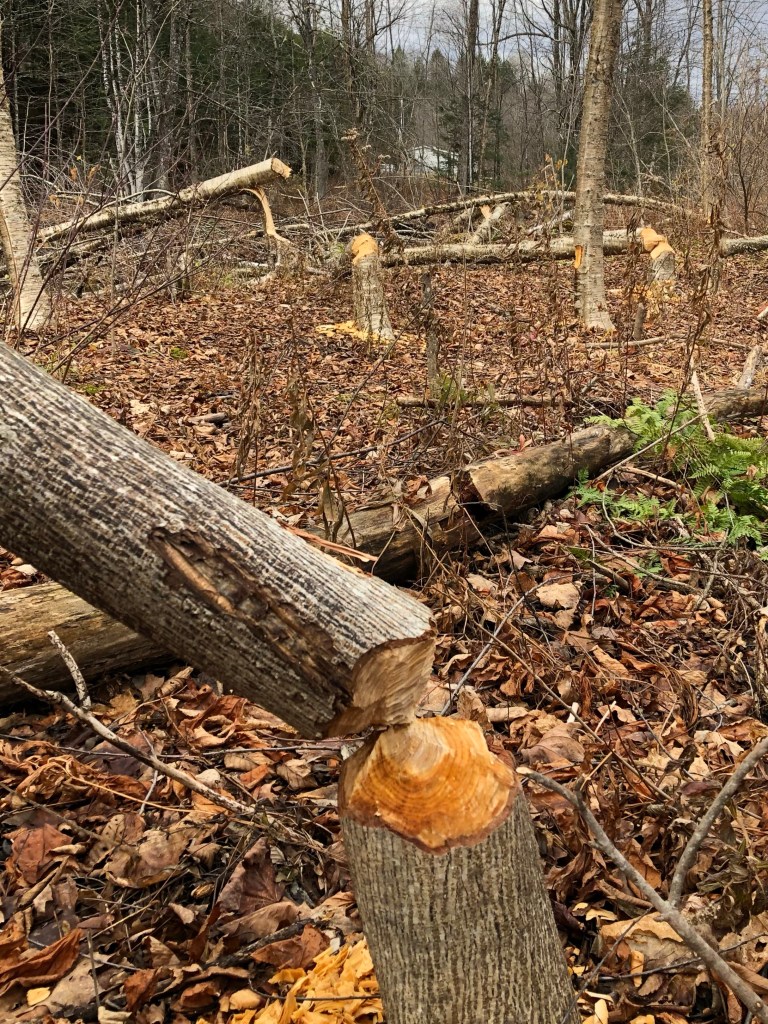
    They don’t just gnaw them down to make nests; this is their food source. Beaver range in size from 30-100 pounds, and they need to eat to keep that beach body. The average beaver eats about 200 trees per year, from saplings to the bigger trees. They prefer aspen, alder, willow and other soft wood deciduous trees. That’s a whole lotta trees. So proactively painting a few with that paint/sand mix is a good way to preserve a few of them while offering up the rest as sacrificial lambs.

    I wondered at this as I walked amongst the trees along the Moss Glen Brook in Vermont over the weekend. The beaver were clearly busy stocking up their food supply for winter, with several downed trees scattered about near the brook. And here amongst them were the designated survivors with gray paint and sand mix. A wonderful curiosity that demonstrated the health of the beaver population in this area. Welcome back.

    Designated Survivor
    Beaver Food
  • A Weekend at The Trapp Family Lodge

    The cow outweighed me by more than 1200 pounds and had long horns protruding menacingly to her right and left, but I edged closer anyway. Bob, the Activities Director at The Trapp Family Lodge, insisted that it was safe to walk out amongst the Highland Cows. He gave us instructions on what to do if they approached us looking for apples (fold your hands into your body and turn slowly away to show you don’t have food). And he told us when one of the cows was annoyed with us. Otherwise, we were turned out to explore the field. Turning around, I realized I was one of the few who took him up on the offer. But risk has its rewards, and being close to the cattle was thrilling.

    Highland Cow

    I’ve been to Stowe, Vermont many times over the years. Mostly I’d drive up for Heady Topper beer, look around a bit and dream of lingering awhile. I’d even stopped to visit the Trapp Family Lodge, walking into the lobby to see what all the fuss was about. Like most Americans I’ve seen The Sound of Music a few dozen times. This wasn’t the Austrian Alps, but you can definitely see why they sank their roots here. The hills are alive in Stowe too.

    The Trapp Family Lodge is a lovely place, with fires roaring and pilsner flowing freely from taps and a quiet elegance without pretense. Pictures of the family decorate the walls throughout the lodge along with art derived from the story of the family’s escape from Nazi Austria. The mountains surround the property in all directions, and the von Trapp family owns much of the land and has donated many more acres to a land trust, ensuring this view would remain largely as it’s always been.

    We’d explored some of that land on our first day at the Lodge, walking the trails to find the Chapel at the top of the hill, and circling back to check out the Kaffeehouse for a snack. There are hiking and snowshoe trails criss-crossing the woods at the resort, and we had plenty of options for getting to know the lay of the land. Mountain bikers had their own single track trails that offered challenging terrain to explore. And wide cross-country skiing trails waited patiently for the snow to arrive. This was an outdoor enthusiast’s paradise. The outdoor hot tub and spa is a great reward for having done the work.

    After meeting the Highland Cows we walked back up the hill to the Lodge, with massive ravens flying about us speaking a sophisticated language of their own. I wondered at the banter, and wished we had more time to get to know them better. But we had other places to explore, and a long hill to walk back up. It seemed the cows were on the furthest pasture from the Lodge, and we had to earn our visit. It worked out to be about a mile each way, and a good way to work off breakfast with a different vantage point.

    We made a quick trip to downtown Stowe to explore the shops and made a stop at The Alchemist to pick up our Heady Topper beer order curbside before returning to the Bierhouse for lunch and a pint. We made a point of saving room in the cooler for some von Trapp beer as well. The Alchemist helped make Stowe the heart of New England IPA country, but the von Trapp’s make a great case for pilsners with their brews. This wasn’t some mass-produced American lager, this was beer with substance.

    Brewing at von Trapp is serious business

    As luck would have it, the woman who seated us was Kristina von Trapp, the granddaughter of Maria and a Director of the resort. She was a gracious host, with a striking presence about her borne of her family celebrity but honed on an active life outdoors and running a successful business. She wasn’t quietly sitting in the corner office looking at spreadsheets, she was hands-on and engaged with the public. And that made the von Trapp experience all the more impressive.

    We resolved to come back here again in the other seasons. Stowe is beautiful year-round, even on a cold November morning when the trees are bare and the snow is just hinting that it might return again. Staying here in all four seasons seems a worthy goal. And it will help keep the refrigerator well-stocked too.

  • Mountains and Waterfalls

    A weekend in Vermont stirs the imagination, and Stowe is famously rich in beauty, romance and adventure. As with so many other places, the magic crackles and sparks here on the edges of the day. Days are filled with adventure, nights a starry dome. The edges in between are when the light dancers march across the mountains and leap and twirl in the sky. In the morning the mountains are jagged black walls that holds the rising dawn back from our eager eyes. At dusk the mountains turn ember-red as they reach for the last rays of light. My iPhone screen mocks my attempts to capture it, but try I must.

    We stayed at the Trapp Family Lodge to get the full Stowe experience. The lodge is lovely and full of the amenities you’d expect at such a place. For me the abundance of hiking trails just outside the door were a nice incentive to stay here. The spa, Bierhall and Kaffeehaus all spoil the senses. But if you’re in Stowe get your ass outside.

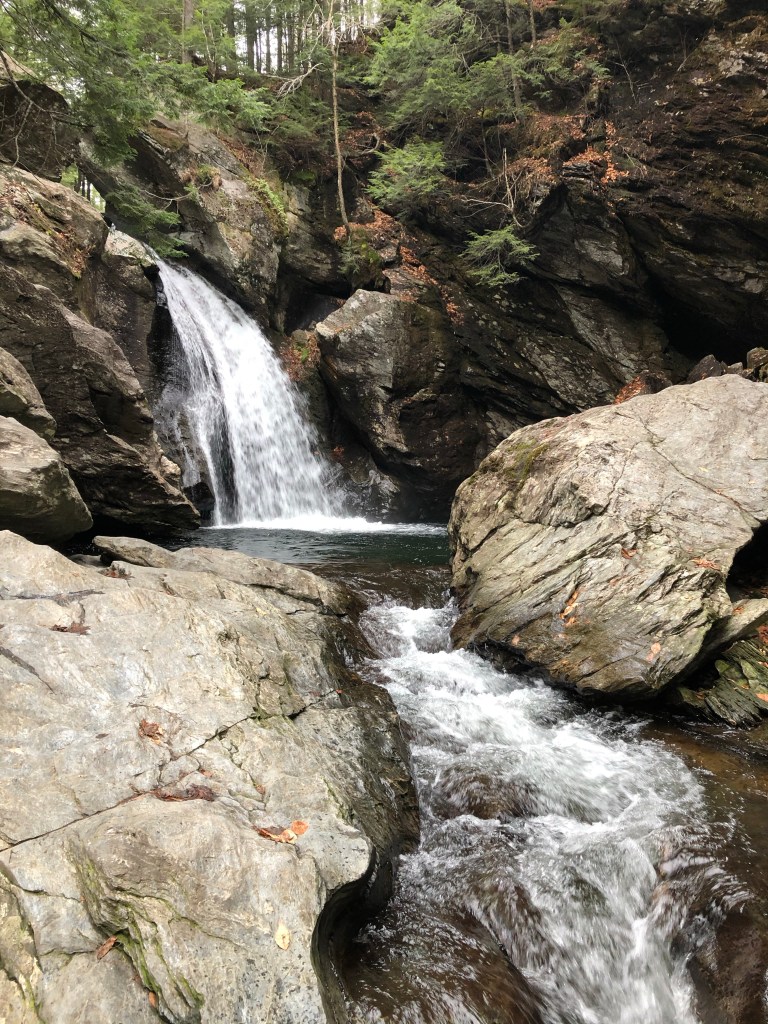
    Hiking options are everywhere here, but we wanted waterfalls on this trip. Stowe has a couple of waterfalls nearby that are well worth the quick hike to see. Moss Glen Falls are a tumbling cascade framed by hemlocks. It’s an easy ten minute hike from the car to the best viewing point, and I smiled at how over-prepared we were for a much longer trek. The falls are postcard perfect, and worth a visit on quiet days when the tourists are elsewhere.

    Bingham Falls are near Smugglers Notch with a beautiful waterfall falling into a pristine pool worth the descent. What goes down must go up, and the walk up isn’t as bad as you think it will be after descending a couple of steep, muddy stretches. A few people have died falling into the gorge here, and it’s easy to see how. Nothing separates you from a plunge into the gorge but your own awareness. Not a place for little kids to run unattended.

    Mountains and waterfalls pair well together, and I greedily seek out each. I often wonder why there aren’t more visitors when I come across beautiful places, but usually it’s because I go when the crush of visitors ebbs. Like the mountains at sunrise, waterfalls whisper to you when there’s nobody else around. But only if you’re there to listen.

    Moss Glen Falls
    Bingham Falls
  • Life As You See It

    Develop interest in life as you see it; in people, things, literature, music—the world is so rich, simply throbbing with rich treasures, beautiful souls and interesting people. Forget yourself.” – Henry Miller

    The quality of life is in proportion, always, to the capacity for delight. The capacity for delight is the gift of paying attention.” – Julia Cameron

    Paying attention is a gift, and writing about it sharpens the focus. I believe that blogging has done more to wake me up to the wonders of my immediate world than anything save the birth of my children. Having children developed my habit of capturing moments in pictures, but the years my kids were growing up were also years the writing quietly lay dormant, biding time. You don’t have much quiet time when the mad dash from diapers to packing school lunches to soccer and dance recitals to driving to away games to picking colleges is happening. And yet I wish I’d written it all down anyway.

    Now, after the mad dash, the writing stirred awake from its slumber. I look around at all there is to see in this world. All there is to learn about the world. All there is to read and taste and see and most importantly, to do. Faraway places will have to wait once again, but there’s so much to see right outside.

    Read a Mary Oliver poem and you see that you’ve been blind the entire time. Chastened yet challenged, you look more deeply at the world in front of you and deeper into the soul. And you write.

  • The Other Side

    “What happens to the leaves after they turn red and golden and fall away?”
    – Mary Oliver, Roses, Late Summer

    I walked out just before bedtime for a quick look at the sky. The Northern Taurids peaked the night before, but we had overcast skies and alas, nothing to see here. A quick scan revealed another disappointing cloud cover masking the show. And still Mars shone through the passing clouds, offering hope that if I tried hard enough, maybe I’d see through to the other side. I went to bed instead.

    The Leonids offer a second chance, peaking on Tuesday night. The forecast doesn’t look favorable for the peak, but Monday night looks promising, and I promise myself I’ll stay up late to see them. We’ll see.

    Promises to ourselves have a way of falling away, like those leaves on the tree. I know where those red and golden leaves go: right over the fence into the woods by the tarp-full. I see them now; mounds of brown, damp leaves transforming back to mulch to feed their kin. And I see them gathering once again on the front lawn, mocking previous hours of work. And I wonder, where did all of these ones come from?

    The other side is that place we can’t see but we know it’s there. The other side of a fitness goal is evasive when you’re looking at the scale or your splits and don’t see much progress. The completed novel, the perfect job, the perfect marriage, and whatever it is on the other side of life all tantalize us with how close they are, yet how elusive they remain.

    All we control is what we do now. The direction we point ourselves. The consistency and honesty of our effort. Accepting this for all that it is. The rest blows in the wind, landing where it may.

  • Misguided Angels

    I said “Mama, he’s crazy and he scares me
    But I want him by my side
    Though he’s wild and he’s bad
    And sometimes just plain mad
    I need him to keep me satisfied”
    – Cowboy Junkies, Misguided Angel

    I saw a Facebook post the other day that broke my heart. A longtime friend who I view as a kid sister posted a picture mocking Joe Biden in a creepy caricature. With this one simple post I realized that she was another misguided angel and mourned losing her as we’ve lost so many others. It wasn’t so much that she clearly voted one way and I voted another. It was the ugliness of blindly following the masses down the rage and accusation path that saddened me.

    This Cowboy Junkies song is sadly beautiful. It’s the daughter who falls for the bad character and will go with him even as her parents and siblings beg her to see what they see. This guy just isn’t good for you. He’s leading you to heartbreak and disappointment on false promises. And of course I feel that way about the guy the American electorate just broke up with but for some reason can’t let go of.

    There’s something in human nature that draws us to the con artists. They say things to make us feel emboldened or powerful, and we fall in line. You see it in some evangelical leaders, in some politicians, business leaders, and yes, in relationships. I’ve learned that I can’t save everyone, but like the family of the misguided angel in the song, I want to try with those I care about.

    In many ways, I guess that makes me a misguided angel myself.

    “Misguided angel hangin’ over me
    Heart like a Gabriel, pure and white as ivory
    Soul like a Lucifer
    Black and cold like a piece of lead
    Misguided angel, love you ’til I’m dead”

    – Cowboy Junkies, Misguided Angel

  • Elton John Proving Me Wrong in Four Songs

    I had a conversation with a friend over the weekend about Elton John. She was surprised that I was a bit ambivalent about his music. The fact is I don’t love Elton John/Bernie Taupin’s catalog the way I love, say Jackson Browne or Billy Joel’s catalogs. Sure, he’s iconic and has some great, great songs, but the underlying combination of sadness and pouting just don’t capture my imagination. Too harsh? I say it with respect for his brilliance, but give me Freddy Mercury’s optimistic campiness over John’s pouty campiness anytime. And still, I do love many of Elton John’s songs. Here are four that easily make the case for why I may be wrong in my assessment:

    Tiny Dancer
    “But oh, how it feels so real
    Lying here with no one near
    Only you, and you can hear me
    When I say softly, slowly
    Hold me closer, tiny dancer
    Count the headlights on the highway
    Lay me down in sheets of linen
    You had a busy day today”

    The opening song on Madman across the Water, Tiny Dancer both sets the table and becomes an impossible standard to follow. Then Levon begins and you realize that this album runs deeper. I’d put the first half of this album up against many of the great albums in rock & roll music. There are thousands of vinyl copies of this album worn out on one side but pristine on the other.

    When I say I don’t love the Elton John Catalog, Tiny Dancer raises its hand and offers an animated challenge. Bernie Taupin’s lyrical pirouette forever married to Elton John’s gentle tap dance across the keyboard. This song remains as vibrant for me as the first day I heard it. And perhaps more so.

    Levon
    “Levon’s sells cartoon balloons in town
    His family business thrives
    Jesus blows up balloons all day
    Sits on the porch swing watching them fly
    And Jesus, he wants to go to Venus
    Leave Levon far behind
    Take a balloon and go sailing,
    While Levon, Levon slowly dies”


    How do you follow Tiny Dancer? With an epic Levon, of course. This is a big song, almost as big as the one that preceded it. Jesus can’t wait to fly away from the domineering father figure Levon and leave his oppressor to wither away. And we’re right there with him, grabbing a balloon and going for the ride. With so many albums why choose two from the same? Because it’s my list, that’s why.

    I love the stripped down version of this song on the BBC performance in the link above. Just three musicians and a gem of a song, with a respectful audience that doesn’t get in the way. A reminder that you don’t have to wear a duck costume to win over the audience.

    Someone Saved My Life Tonight
    “I never realized the passing hours
    Of evening showers
    A slip noose hanging in my darkest dreams
    I’m strangled by your haunted social scene
    Just a pawn out-played by a dominating queen
    It’s four o’clock in the morning
    Damn it listen to me good
    I’m sleeping with myself tonight
    Saved in time, thank God my music’s still alive”


    Well, here we are in Poutyville, with our glam rocker resenting the powerbroker who controls him and his career. But damn it (listen to me good) this is such a great song. And it signals resistance to the people who he believes control him. This song pairs well with Goodbye Yellow Brick Road, another song with the same theme. But I like Someone Saved My Life Tonight just a little bit more.

    Mona Lisas and Mad Hatters
    “While Mona Lisas and Mad Hatters
    Sons of bankers, sons of lawyers
    Turn around and say good morning to the night
    For unless they see the sky
    But they can’t and that is why
    They know not if it’s dark outside or light”


    This is a love song to New York City, and I can imagine the city in the early 1970’s, with its cast of characters making the city their own. This is a song rooted in simplicity and beauty. And just might be my favorite Elton John song. Bernie Taupin paints a portrait of New York in all its gritty wonder, and Elton John strips down the campiness to a stunning piano arrangement. This is a quiet walk through Central Park with a close friend, talking about what you saw in the city this week. November is when I think about New York City, for I always end up there for a few days this month every year. Except this year, of course. But there’s always next year… right?

    And there you go: four songs that prove me wrong about Elton John. There are others standing behind these to help make a strong case; Border Song and Rocket Man come to mind as two more that I love, but I’ll stick with four. If we drift too far into the catalog we might bump into Crocodile Rock, and I’m trying to stay positive.