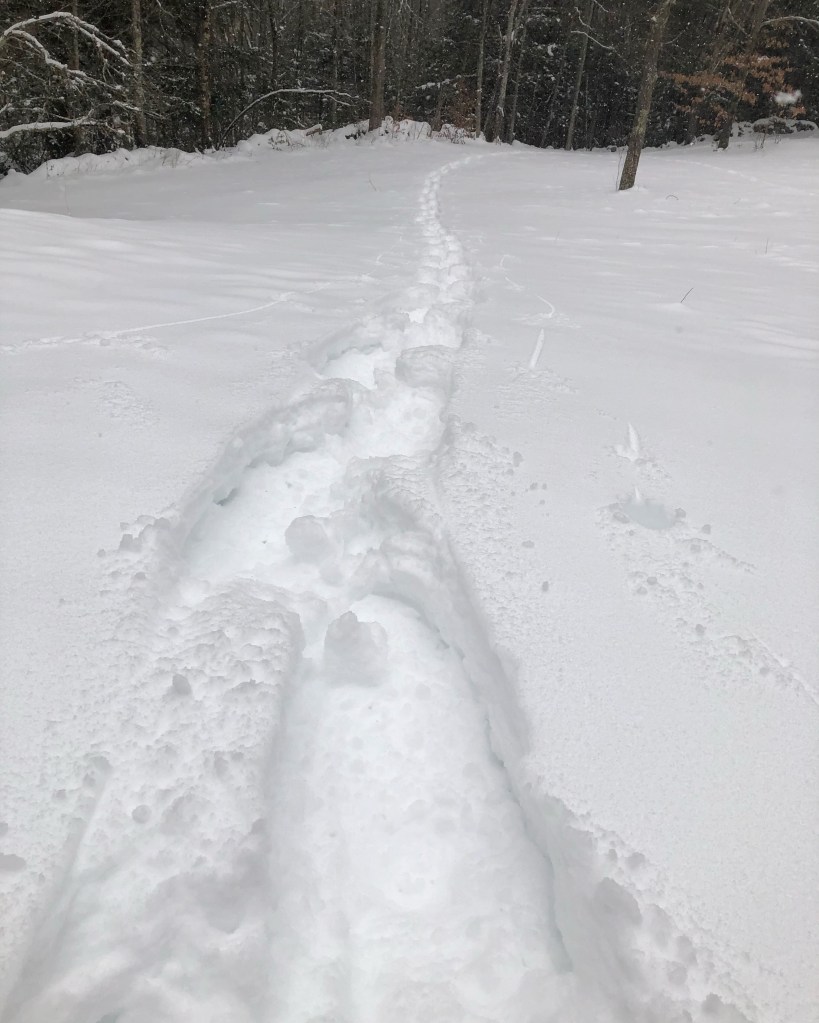
Month: February 2021

  • A Rock in the Woods

    History whispered from the woods, calling me to find it. A mere rock this time, set in place to forever mark the border between two agreed-upon places, as settlers tended to do. This one, they say, was set here in 1741, a year after being settled and eight years before Hampstead would be incorporated. The other town, Atkinson, would be incorporated twenty-six years later. That there is a carved A and H on the stone that is a handy indicator that you found it, but neither settlement was known by these names in 1741. Hampstead was known as Timberlane Parish then, and Atkinson at the time was a part of Plaistow, New Hampshire. No, the carving came sometime later. And so did the red paint used to highlight the letters.

    Living on a border town between New Hampshire and Massachusetts, I’m fascinated with these border markers. Some are easier to find than others, conveniently standing aside the road they’ve watched grow over their lifetime. But others are more evasive. And town border markers tend to be less fussy still. When the plowed fields return to the woods they always wanted to be the stones become hidden. And that’s where the fun begins for adventurous history geeks like me. This one wasn’t so hidden; it appears on trail maps for the conservation land it resides in. But ask the 15,000 residents of the two towns where it is and maybe 400 might not give you an odd stare back. The rock isn’t exactly a national landmark like the fictional Plymouth Rock.

    And yet, this tiny rock in the woods marking the border between two towns was set in the heart of the lands the Abenaki once used to stage raids on Haverhill, Massachusetts only four decades before. It would stand witness to the French and Indian War, the Revolutionary War, The Civil War and two World Wars, drawing the settlers from the land that surrounds it to fight for survival nearby and across the globe. And of course it would witness the birth of a nation.

    So sure, it’s just a rock in the woods, but it’s a rock that has seen a few things in its job marking a random border set in 1741 between two settlements in New Hampshire. And I wondered, brushing the snow off it for a better look, how many of those people have wondered at it in that time as I do now? And for how long will it guard this border before such things don’t matter again? I wonder.
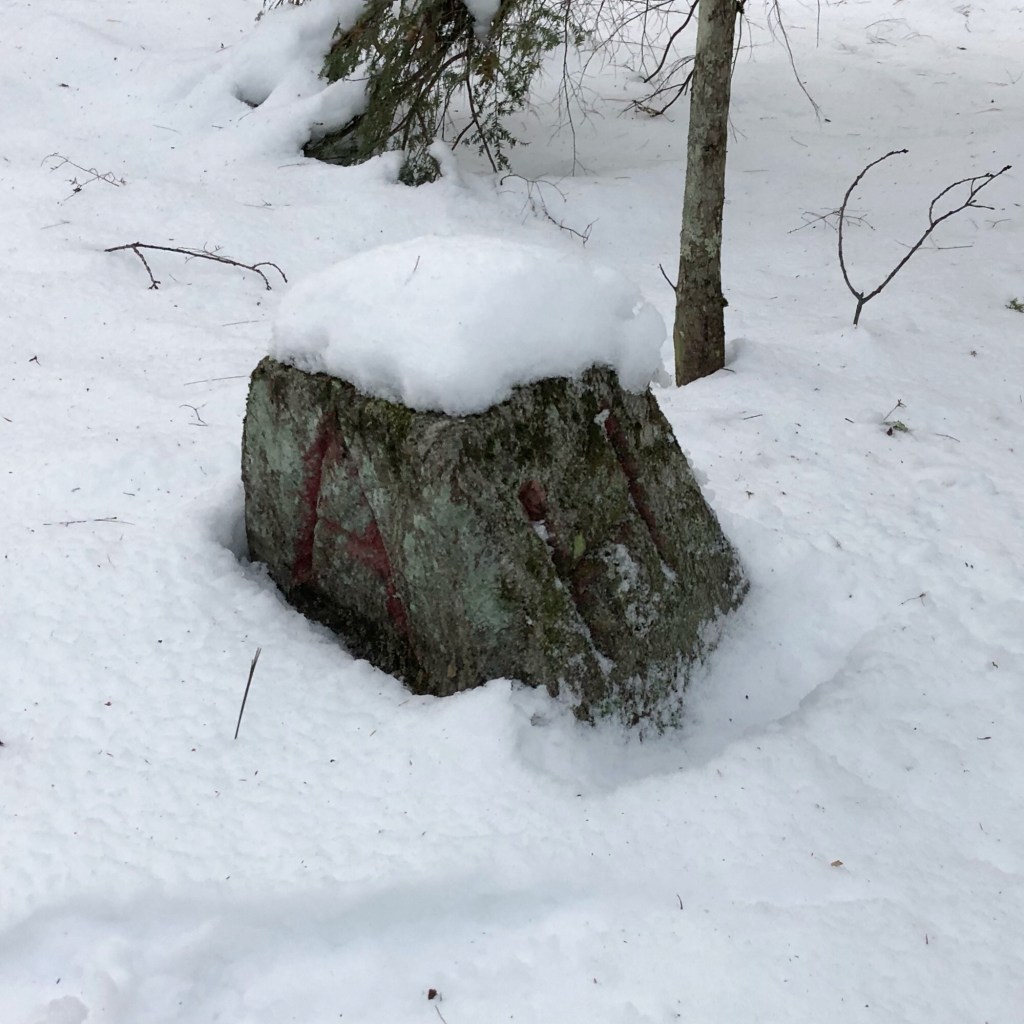
    1741 A/H Marker
  • At That Moment

    “I felt at that moment that it was my chance to do one thing supremely well.” – Roger Bannister

    The extraordinary – mastery – starts with that feeling. That spark of excitement at the possibility that just maybe I can do this. And as they say, all it takes is a spark. True, but once the fire is lit, all it takes is fuel to make it roar. For it is just the beginning. There are more moments to come.

    The time before that moment aren’t full of sparks, they’re full of stumbles and awkwardness and frustration. The paying of dues. The long slog. The apprenticeships that turn novices into prospects and prospects into rising stars. All a precursor to that moment when you finally know that this, this is it. And once you realize it, you do whatever you must do to, well, realize it.

    “You have to expect things of yourself before you can do them.” – Michael Jordan

    All of us experience that other it. Those moments when you realize that this is definitely not it. Sometimes that it is our it masked by the long slog to get to it. But usually we know the truth of something before too long down the path. And the truth is that most its aren’t our it. So we try another it. And another. Many never find it at all. Plenty experience maybe this is it. And really, it might just be it, but the climb is long and the friends are calling to go out for a few drinks to celebrate the end whatever isn’t their it, and before pretty soon that maybe isn’t your it either.

    The relatively few who do find and fully realize their it may experience the extraordinary. For it, by definition, lies beyond the ordinary. Finding your it requires singular focus on achieving it. Which brings us back to that moment. And what you feel. And what you do with your chance.

  • The General Union

    “The happiest fate is that of the author who, as an old man, is able to say that all there was in him of life-inspiring, strengthening, exalting, enlightening thoughts and feelings still lives on in his writings, and that he himself now only represents the gray ashes, whilst the fire has been kept alive and spread out. And if we consider that every human action, not only a book, is in some way or other the cause of other actions, decisions, and thoughts; that everything that happens is inseparably connected with everything that is going to happen, we recognize the real immortality, that of movement – that which has once moved is enclosed and immortalized in the general union of all existence, like an insect within a piece of amber.” – Friedrich Nietzsche

    I stood out in a three inch deep puddle at the end of the driveway, chipping away at an ice dam that was keeping the water from flowing into the catch basin and back on its journey to the infinity of the Atlantic Ocean. It’s funny to think about the icy water I stood in as part of the infinity, but then again so are we. All part of an endless loop of the water cycle. We humans trap a bit of that water for ourselves to mix with some carbon and energy for a time before releasing it back on its way. And our own time soon comes to an end, leaving memories and examples and maybe an insight or two.

    The thrill of writing is still with me, as much as ever really. The streak of writing every day almost ended over the weekend when I struggled to stay awake to finish a post written piecemeal over the course of a busy day of hiking and socializing. Would it really matter if I missed a day? The world surely wouldn’t stop, but I’d know. I’m not ready to break the streak just yet thank you. Every day we wake up is a continuation of the streak, and there’s a thrill in getting up and out there to greet the world when you know you’ve got things to contribute to it. If only a few words that relatively few will read.

    Being active and adding to the conversation is the root of the thrill for me. Being in the mix and doing things. Will anyone care that I wrote this post? Perhaps not many, but the act itself is enough for me. A few thoughts and actions that ripple while using up my three billion heartbeats during this life, to be enclosed and immortalized in the general union of all existence. Like a puddle reaching for the ocean, and welcomed back warmly by the whole.

  • On New Paths

    What good is livin’ a life you’ve been given
    If all you do is stand in one place – Lord Huron, Ends of the Earth

    If snow transforms the landscape, then a walk in that snowy terrain transforms the winter walker. Add a new path and suddenly you’re seeing the world entirely differently than you had before. Add snowshoes and you’re suddenly set free to break off trail to see new places, explore animal tracks that run off into the woods, and to see what’s on top of a rise you might have walked by at another time of year.

    There’s a popular pursuit in hiking called red-lining, in which hikers hike every bit of every trail on a map or guide. A popular red-lining pursuit in New England is hiking the AMC White Mountain Guide. The whole point of red-lining is to explore new paths – to get off the crowded hiking trails and try something new. To do it, and to belong to a small group of hardcore hikers who have also done it. And add a measure of accomplishment and camaraderie in the world of hiking. I don’t see myself hiking every trail in the AMC White Mountain Guide, but I’m fully onboard with hiking new trails and seeing the previously (for me) unseen.

    On Valentine’s Day I explored trails previously unseen in a forest I’ve spent a lot of time in. Snowshoeing with friends, we walked a trail largely by ourselves to new places. When you’re on a new trail like that, every step is a discovery, every bend in the trail is a curiosity, and every trail junction is confirmation and validation of what the map was trying to tell you all along. There’s magic in taking that image on a map for a walk and making it real.

    The day after a long walk on new trails you start thinking about the trails at those junctions that you didn’t take. You wonder at what you might have missed down that way and begin to realize the allure of red-lining. For how do you want to spend your time in this world? Sticking with the familiar or exploring new places and challenging yourself in new ways? There are other paths that warrant exploration. I’ve seen them out there, if only on a map.

  • Hiking Cannon Mountain

    A flurry of texts over the work week from two directions with questions about hiking led to a decision to join forces for a hike of Cannon Mountain. On the one hand were the Perry’s, increasingly famous in the White Mountains for years of summiting mountains and red-lining trails. I don’t recall a hike in the last couple of years where they didn’t know at least one person on the trails. And a text from my niece Kellyn offered a nice treat, with her deciding to hike with us as well.

    Cannon Mountain is an old granite mound that’s famous for a sheer rock face that once held the Old Man of the Mountain until it collapsed in 2003, and for the tram built to promote tourism and skiing on the mountain in 1938, making it the first passenger tramway in the United States. The Old Man of the Mountain gave this granite mound its first name, Profile Mountain, but eventually its resemblance to a cannon from some vantage points let to what we’re familiar with now.

    So the stage was set for four hikers to set out on a cold February 13th morning for a hike from Lafayette Campground. We chose the Lonesome Lake Trail, with three of us starting in micro spikes on the snow-packed trail. Our fourth hiker stuck with snowshoes the entire time. The conditions on the popular trail made either option fine. As with other hikes, you quickly know when it’s time to put on the snowshoes. For us that was when we took the largely unbroken Dodge Cutoff Trail over to Hi-Cannon for the hike up to the summit.

    Lonesome Lake is a beautiful lake sitting in the bowl of Cannon and the neighboring mountains of the Kinsman Range. It’s a destination of its own, and plenty of people hike up to see it, walk on the frozen lake for the beautiful views it offers, and then hike back down. But you don’t summit mountains when you turn around halfway. We powered on, snowshoeing through a wonder of marshmallow trees up the steep trail. There’s one ice-caked ladder on Hi-Cannon that I’ll always remember for the limited footing options presented to us, but we all got past it with a little help and a dose of courage.

    The thing about summits is they tend to be much colder when you’re exposed to the wind and you stop moving. Sweaty gloves quickly freeze up, making a change a requirement to keep your fingers working. We considered the observation tower for a few minutes and opted to just hike down to the ski resort’s Mountain Station, where I’m told you can buy a beer at 4080 feet. I opted for hot chili and hot chocolate, with extra hot, thank you. It’s a rare day when you can summit a mountain and have hot chili waiting for you. We quickly warmed up and reached a point where if we didn’t get going we might choose to close out the place. Onward.

    Crossing a ski trail is akin to crossing a highway. You judge the oncoming traffic, decide whether your speed can overcome the approaching traffic’s speed and go. We quickly crossed over to the trail back to the summit observation deck, crowned the summit and began our descent using the Kinsman Ridge Snow Chute, er, Trail. On the map, 4/10’s of a mile of hiking, but a lot of squiggly elevation lines stacked up in a small space. We butt-slid down large sections, my snowshoes were more telemarking skis on other sections, and we all collected snowy memories that will make great tall tales someday.

    On one of the butt-sliding sections I lost a water bottle. It wasn’t until we’d snowshoed across Lonesome Lake and I changed to micro spikes that I realized it. My disappointment at losing it turned to delight when we got to the trailhead and someone who’d found it and beaten us down the trail while we lingered at the lake had left it sitting on a post waiting for me. Good hiking karma right there. It was hard to come away with anything but positive vibes after hiking Cannon Mountain on a pristine winter day. A solar halo signaled goodwill to all. A very good day indeed.

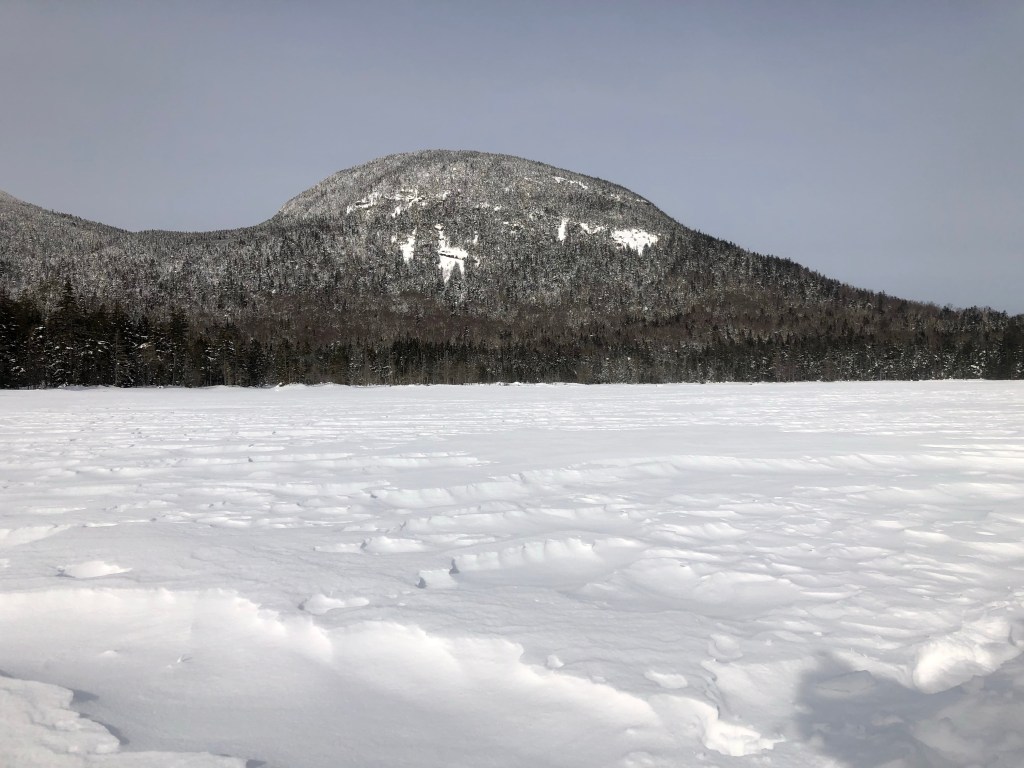
    Cannon Mountain from Lonesome Lake
    Solar halo through the frosty trees
    Lonesome Lake with Franconia Ridge beyond
  • Joyful Walks

    Now shall I walk
    Or shall I ride?
    “Ride”, Pleasure said;
    “Walk”, Joy replied.

    Now what shall I —
    Stay home or roam?
    “Roam”, Pleasure said;
    And Joy — “stay home.”

    Now shall I dance,
    Or sit for dreams?
    “Sit,” answers Joy;
    “Dance,” Pleasure screams.

    Which of ye two
    Will kindest be?
    Pleasure laughed sweet,
    But Joy kissed me.
    – William Henry Davies, The Best Friend

    Joy and pleasure sound similar, but joy is something you can build off of, while pleasure seems more, well, short term. In the forever competition between Pleasure and Joy it’s interesting to note that walking is solidly in the corner of Joy. I’m at my best walking, and fill with joy in those moments on a trail or in the quiet places in the world. I know I’m not alone in this respect.

    What makes walking so positive for the mind and soul? Something in the rhythm of walking long distances clears the fog. Reboots the brain. I don’t have a lot of eureka moments walking, but I’m always better for having done it.

    Today was filled with miles of joyful walking. A poem like the Davies poem above hits you differently when you’re blissfully tired and sore from miles on the trail. Don’t get me wrong, pleasure is nice too, but today belonged to joy. And it started with a long walk.

  • What Do We Perpetuate?

    “It is no harder to build something great than to build something good. It might be statistically more rare to reach greatness, but it does not require more suffering than perpetuating mediocrity.” – Jim Collins, Good to Great

    Good to Great came out twenty years ago this year. It’s interesting to see how the companies Collins writes about transformed over twenty years, but lately I’m thinking more about how I’ve transformed over those twenty years since reading it. Reading through it with fresh eyes, I linger on the personal challenges now, less the diagnostics of what makes a company or its leader “great”. The real question in this book is, do we perpetuate greatness in our own lives, or do we perpetuate mediocrity?

    In answering that question, the next question might naturally be, how do we perpetuate greatness in our own lives? What is our standard for ourselves? And how do we take meaningful steps towards greatness and shake the mediocrity out of our routines and mindset? The answer, of course, lies in action.

    “Yes, turning good into great takes energy, but the building of momentum adds more energy back into the pool than it takes out.”

    There’s the tricky part: turning good into great. Doing the work. Aligning yourself with the key “why” of what you do, the why that inspires you to slog through the tedious, to shake loose the mediocre and reach for something more. It’s easy to read a book on moving a company or ourselves from good to great. What comes after is hard. How many thousands of people read Collin’s book over the last twenty years? How many reached greatness? After twenty years it warrants self-examination and maybe reassessment.

    Everyone has their own definition of success, or greatness for that matter. For some it means a great relationship or family life or washboard abs. For others it’s a C-level title and a house in an exclusive neighborhood. We all have our why. And it defines what we do to reach for greatness. What is your goal? Family, grades, professional or athletic career, relationship… what are you really reaching for, what’s your why?

    We must push our personal flywheels for seemingly forever to build some measure of momentum. And when you stop pushing you lose it. It’s a tricky thing, that momentum: It works for you when you keep going, and even for a short time after you stop. But when you get too comfortable and stop pushing for too long the momentum is gone. Without it, what have you got? If you wallow too long, you have mediocrity. Personally, I haven’t had washboard abs in years. But they’re hiding in there waiting for me to push harder.

    Collins has a phrase that lingers for these twenty years: “Good is the enemy of great.” The battle between good enough and reaching a profound place of mastery and excellence comes down to that question: what do we perpetuate in our own lives? How hard are we pushing for more? For our most compelling whys (the right flywheel for us), pushing harder seems the only answer.

  • A Measure of Health

    “Nature says thou shalt keep the air, skate, swim, walk, ride, run. When you have worn out your shoes, the strength of the sole leather has passed into the fibre of your body. I measure your health by the number of shoes and hats and clothes you have worn out. He is the richest man who pays the largest debt to his shoemaker.” – Ralph Waldo Emerson

    Those Concord folks were walkers, weren’t they? Ralph and Henry wandered about, wearing out shoes and building big thoughts. There are a couple of versions of that Emerson quote above, but some online research makes me believe these were his words. I like the alternate quotes just fine, but when I start quoting people I’d like to have it right. I love the idea of transferring the strength of the shoes into the fiber of your body. It applies just as well with shoes as it does time and sweat equity invested in other worthwhile things.

    I’m wearing out shoes more quickly lately. My feet took a beating last year, ankles and knees too, but they merely paid it forward to my heart and soul. Over time the body adjusts and stops complaining about taking another step and just goes. It’s a bit like writing and washing dishes and making the calls, you just teach yourself that there’s joyful bits in every moment of doing.

    I’m a collector of joyful bits. On my deathbed I won’t regret not finishing Breaking Bad, but I’ll surely regret not seeing the Northern Lights or the Southern Cross should I not see each. The last year is a reminder to not take mobility for granted. Wearing out more shoes seems a great goal for our next normal. The correlation seems apparent. Wearing out your gear is an easy measure of your physical and mental health. So lace up; we have places to go.

  • Making Tracks

    I promised myself a snowshoe walk in the woods for lunch, and dammit if I wasn’t going to honor that promise. There was more snow drifting down, quietly adding to the base layer in fluffy contentment. Day-old snow welcoming the new to the accumulation. We’re in the weather pattern now, folks. Snow-upon-snow: February in New Hampshire.

    I’d walked these woods on Sunday, but felt a return was in order. Conservation land, with trails popular with dog walkers and tree whisperers. At lunchtime on a random Tuesday in winter you don’t expect a crowd but you expect somebody. In this case one car running, its driver staring down at a phone screen, oblivious to me strapping on snowshoes and beginning my walk.

    The trail is compacted again, a day after six inches of snow and with more in the air, speaking to the popularity of the trail. I help compact it for twenty steps and then move off trail into deeper snow. This is what I came for after all: the highly addictive, calorie-burning bliss of clumping about in deep snow. I followed an old stone wall that spends its lifetime keeping the woods and fields apart, and wonder at the farmers who built it a few hundred years ago, and the generations that mended it until the woods finally wrested back control of the land. Now it’s my turn on the land, and I quietly honor those who came before me; their hard life on display.

    I rejoin the trail and the pace picks up, crossing a bridge over a stream I see a stand of old pines and step off trail to walk amongst them. Just me and the snowshoes, walking an endless blanket of white that covers the features of the land. Fallen trees, dormant vines and brambles, rocks and frozen wetland all lay together under Mother’s white blanket. And one soul clumping about above like a kid at recess. For that is how I feel, being out like this on a snowy workday.

    I think about the time. How long have I been out here? 45 minutes? An hour? Hard to say, really, and I don’t want to look at the watch or phone to find out. But I know it’s time to head back towards the car. Clumping along, I join a familiar path, newly blazed but strangely not compacted as much as other trails. I help with that task while walking under hemlock trees – old friends who I speak with now and then across the years. They’d like me to linger awhile, I smile and hint I’ll be back another day. And cross a stone wall and step out on another field of white.

    The car isn’t all that far away now. I could be in it and back in my home office in minutes. But the snowshoes want to fly some more, and so do I. Not just yet, world. I step off the path and walk back into the deep snow, a wandering soul in a quiet, timeless field. I spot a tall stone wall on a rise across an unbroken plane, set my course, and fly.

    A quick look back and then back on my way
  • The Restlessness of the Unexplored

    “That’s what makes death so hard – unsatisfied curiosity.” – Beryl Markham, West with the Night

    Where does restlessness come from? I believe it comes from that unsatisfied curiosity that Markham references above. What will you regret on your deathbed? The restlessness of the unexplored: unsatisfied curiosity. This phrase from such an accomplished woman, such an adventurous spirit, knocked me back two steps. Because I understand myself more in that pile of words. Don’t you?

    Unsatisfied curiosity. I see is in friends buying a bigger sailboat to go farther, to go longer, on their next adventure. In friends collecting mountain summits and filling social media with their seasons of wonder. In family and friends building meaningful businesses and careers out of schemes and dreams. And I see it in myself, writing and searching for more, exploring our history and the world around us. Stretching in new directions and pushing at my own limits.

    Unsatisfied curiosity drives progress and growth. Restlessness is a form of being uncomfortable with the limitations we find ourselves living with. The world is out there, should we be bold. Should we leap. And why shouldn’t we? Why be timid and afraid of life? There’s work to be done. Places to go and visions to be realized. Enter Henry:

    “Rise free from care before the dawn, and seek adventures.” – Henry David Thoreau

    It seems impossible, really, when you think about the leap from the Wright Brother’s first flight in 1903 (itself extraordinary) to Markham becoming the first person to fly solo across the Atlantic Ocean 33 years later, to humans landing on the moon 33 years after that. In our brief time together on this planet, aren’t you curious about what you can accomplish? Bold action satisfies curiosity. What you can see? What can be realized?