Month: February 2021

  • Muscle Memory

    I grab the newel post with my left hand in the dark, pivot slightly and feel the stair rail with my right. Twenty-two years of early morning flights and workouts and pouring thoughts into piles of words adds up to the kind of muscle memory that allows you to navigate a house in the dark. So much has changed in that time in the concentric rings of relationships that circle closer and closer to the brain between these ears. But this act, grab left and pivot to right, hasn’t changed at all.

    When you’re in a new relationship everything is discovery and revelation. Hopes and dreams. The small endearing habits, the smell of shampoo, the imperceptible twitch of an eyebrow or shift of a glance that betrays a belief you’ll learn over time.

    Relationships with place are similar, but the friction is different. You get to know the creaks and tendencies in a house, the way it breathes when the furnace turning on, how it reacts to frigid cold and gusty wind, the appliance working to survive another cycle, and the sleep cycles of fellow inhabitants. What sounds right and what seems off.

    A house wears like a pair of jeans, faded and stretched in some places. Lived in. Pets come and go. Children bridge the time between new house and familiar abode. A crayon mark or that chip in the tile from the oldest banging a fireplace poker that you don’t even see anymore. Memories of earlier days flood in; bringing the youngest home for the first time, birthday parties, celebrations and holidays.

    Twenty-two years. For all the talk of travel and downsizing and the encroaching habits of the neighbors, there’s something to be said for the familiar. For muscle memory in dark times.

  • Walking to Interesting

    If you watch a commercial on television, or a reporter out on a city street, or even the cast intro on Saturday Night Live in February 2021, everyone is wearing masks. A year ago you’d have wondered at it, even as the pandemic rapidly descended on the world. Today it’s commonplace, and I’m more often surprised at the outliers walking into a store without one. I stood in a line for snowblower parts and a mechanic walked briskly through the store unmasked. In a crowded grocery store I saw an elderly woman(!) without a mask on. In both cases I had the same reaction I might have had two years ago to someone wearing a mask. Isn’t it funny how the world has changed our perceptions in such a brief turn of the calendar?

    I chafe at restrictions, favoring wandering, crossing borders, friendly conversations with strangers and simply getting out there. But we all sense a light at the end of the tunnel, and we’ll reach a tipping point with vaccinations as we did with mask wearing. With more and more people I know joining the ranks of the vaccinated, a sense of optimism grows. Travel will soon be a reality again, even if a bit different from the travel of a few years ago. There’s plenty of travel available today, without worrying about the complexity of borders, just outside.

    “My vicinity affords many good walks; and though for so many years I have walked almost every day, and sometimes for several days together, I have not yet exhausted them. An absolutely new prospect is a great happiness, and I can still get this any afternoon. Two or three hours’ walking will carry me to as strange a country as I expect ever to see. A single farmhouse which I had not seen before is sometimes as good as the dominions of the King of Dahomey. There is in fact a sort of harmony discoverable between the capabilities of the landscape within a circle of ten miles’ radius, or the limits of an afternoon walk, and the threescore years and ten of human life. It will never become quite familiar to you.” – Henry David Thoreau, Walking

    Many times during the past year I’ve thought of Thoreau walking the landscape I know today. There’s plenty that’s changed since his time, but there’s also plenty that remains just as it was then. Much of it remains undisturbed, as if in a time warp, awaiting a visitor. I doubt he ever got up to the corner of New Hampshire where I walk, but I’ve walked in his woods near Walden and note the similarities.

    “Walk until your day becomes interesting — even if this means wandering out of town and strolling the countryside. Eventually you’ll see a scene or meet a person that makes your walk worthwhile.” – Rolf Potts, Vagabonding

    With a hint of the coming snow in the air, I took my snowshoes out to find new prospects. I quickly moved off the packed trail into virgin snow, crunching along on the snowdrifts through woods and fields. Cold hands soon warmed as I worked up a good pace past old stone walls and silent trees. Snowshoeing offers a slow burn, steady state workout similar to cross-country skiing. There’s a small thrill in hovering over the frozen land while blazing a new trail on snowshoes, and I felt a bit like I was flying as I crunched along.

    Reconnecting with the blazed trail at a frozen stream crossing, I noted the collection of prints of those who had come before me. Snowshoes and fat tire mountain bikes, micro spikes and dog prints spiraling in circles from the trail in patterns of joyful exuberance and the freedom of the winter woods. It occurred to me that my own tracks were more similar to the dog prints than those of the trail walkers. Wandering spirits are rarely contains for very long on defined paths.

    A simple walk in the woods, off trail, can change a person. In winter what was familiar ground becomes a voyage of discovery. Perception is how we frame the world around us, and I find it best to turn my perceptions upside down now and then. Every walk suggests something profoundly new, and winter transforms both the landscape and the visitor alike. Pausing a moment, I listened to the sound of silence. My snowshoes and I had walked our way to interesting, embracing the cold indifference of the woods to pandemics and masks and turns of the calendar.

    Walking along on familiar trails transformed into strange country, I stopped worrying about the neglected collection of stamps in my passport. Feeling a million miles from anywhere I’d every been before, I came across a border marker deep in the woods indicating I’d crossed over from the town forest of my neighboring town into the undeveloped forest of my own town. I smiled and noted that not all borders are closed. And the unfamiliar isn’t very far at all from home.

    Into the snowy woods
    Snow blanket on an old stone fence
  • Leaning Towards High Agency

    “When you’re told that something is impossible, is that the end of the conversation, or does that start a second dialogue in your mind, how to get around whoever it is that’s just told you that you can’t do something? So, how am I going to get past this bouncer who told me that I can’t come into this nightclub? How am I going to start a business when my credit is terrible and I have no experience? You’re constantly looking for what is possible in a kind of MacGyverish sort of way. And that’s your approach to the world.” – Eric Weinstein on The Tim Ferriss Show

    I was brought up to follow the rules. Thinking that adults knew something in this world, I would follow rules of behavior and take no as the answer. Fall in line, do your part, don’t question things… passive, low agency characteristics.

    But I also grew up bending the rules ever so slightly in my favor, or breaking them outright. At four taking my three year old sister for a walk to visit my grandparents a mile or so away across a busy road? Let’s do it. At eleven or twelve taking my dad’s Playboy magazines and trading them with the neighbor’s dad for his Penthouse magazines and charge money for the other kids to read the articles? Seemed okay to me.

    But somewhere along the way you slip into the workforce and pick up obligations. Maybe you enter middle management and start following the HR playbook. And slowly, over time, you become passive and decidedly low agency. You become… sheepish. But somewhere inside you that inner maverick chafes at the wool coat. And then you listen to a guy like Eric Weinstein talk about high agency, you hear the example of the main character on The Martian finding a way. And you understand.

    “It’s important to be willing to make mistakes. The worst thing that can happen is you become memorable.” – Sarah Blakely, Spanx

    We generally accept things the way they are. But what if we questioned things a bit more? What if we tried a different way to do the thing that didn’t work the first or second time? What if we developed higher agency within ourselves to set our lives in the direction we want it to go? To be more Arnold Schwarzenegger or Sara Blakely or Elon Musk or Steve Jobs in our own careers? In our own lives?

    “Persistence is very important. You should not give up unless you are forced to give up.” – Elon Musk

    I think it starts with where we are right now in our lives. Living through a pandemic in our own way with Zoom or Teams, a laptop and a mobile phone at the ready. We’re all dealing with restrictions on travel and social distancing, some with a much harder hand to play than others, but as the stoics would tell us, we must play the cards we’re dealt anyway. And what do we do next?

    “What we face may look insurmountable. But I learned something from all those years of training and competing. I learned something from all those sets and reps when I didn’t think I could lift another ounce of weight. What I learned is that we are always stronger than we know.” – Arnold Schwarzenegger

    While we were complaining about shortages of toilet paper there were thousands of people figuring out a vaccine to make this problem go away. Right now, there are people building companies, writing the next great novel, inventing things or doing critical research that will outlive us all. The next big thing, created in the same time of COVID that you and I are living through. So what are we doing with our time? How are we going to work through whatever it is that isn’t working and finding a way through? A way to finally get it right?

    “There is an awful lot of fails before you get it right.” – Elizabeth Isabella, Scripted Fragrance, an Etsy business featured on CBS Sunday Morning

    I heard the Eric Weinstein interview on Tim Ferriss a few years ago now. I had the High Agency dogma reinforced in a George Mack Twitter thread a while back now too. In general I’ve leaned into higher agency in my own life. But still have a lot of fails before I get it right. Don’t we all? Keep trying.

    “Your time is limited, so don’t waste it living someone else’s life. Don’t be trapped by dogma – which is living with the results of other people’s thinking. Don’t let the noise of others’ opinions drown out your own inner voice. And most important, have the courage to follow your heart and intuition.” – Steve Jobs

    We might not ever get to a point where we’re mentioned in the same list as Schwarzenegger or Jobs or Blakely or Musk, but then again, maybe we will. But only if we pivot more, find a way forward or through, and shake off the passive. Time marches on. Will we?

  • Sana: A Goal of Health and Strength

    “Mens sana in corpore sano” – The Latin phrase for “a strong mind in a strong body”, has been in my thoughts lately. Let’s face it, we aren’t getting any younger, and we’ve only got this one body, and this one mind, for this one life. If we don’t take care of them eventually each breaks down. My favorite Navy pilot used to say that he saw the future, and he didn’t like it. Well, I’ve seen it too, and I don’t like what it might be without focused, consistent effort. We can’t stop the inevitable, but dammit we can delay it a bit.

    The care of Mens, or “the mind”, is demonstrated in a lifetime of learning. Stretching your mind in new directions with unique experiences, travel and challenging reading that informs, proper nutrition, hydration, and above all, sleep. A fatigued, dehydrated mind is a sad spectacle indeed. Keeping our minds sharp should be a primary goal, acted upon daily. It offers the side benefit of richer conversations with a broader circle, a richer and fuller life, and doing well watching Jeopardy!

    Corpore sano, “a healthy body”, shouldn’t be neglected in pursuit of a career, a vibrant mind, or because we’re busy with other things. The clear answer is that a healthy body is the foundation for all that we do in our lives. And as the Latin phrase infers, there’s an obvious connection between the health of the body and the health of the mind. Fitness and consistent exercise should be a primary focus in our daily lives, and should be scheduled and selfishly guarded against all who might infringe on our pursuit of a healthy body.

    Think about the last time you had the flu, your body shut down to fight it. You had chills and aches. All you wanted to do was find some measure of comfort in your bed and try to sleep it off. Or think about the morning after some particularly hearty celebration, with a strong hangover and head pounding. Walking in a fog and feeling like death. We’ve all experienced the former, and most of us have experienced the latter. That’s no way to live, friends. But these moments inform, should we take notice.

    So how about flipping that around to feeling our best most of our lives? Extending our vibrant lives to fill our days, and to extend our functional lifetimes? What is functional anyway? I’m looking for a bounce in my step and sharpness in my wit well into my senior years, and that starts with a strong foundation now. Why can’t we be hiking up mountains in our 90’s? Taking long, unassisted walks along cobblestone streets in faraway, ancient cities? Why can’t we be tackling new languages and reading Yuval Noah Harari and Nassim Nicholas Taleb books as we round 100? And shouldn’t we be doing that now as stepping stones for deeper thinking then?

    Speaking of Taleb, the goal is resiliency. To become as antifragile as we possibly can so we can give our bodies and minds a fighting chance in this crazy world. To bend but not break when the going gets rough, as it surely is now for so many people.

    “If something is fragile, its risk of breaking makes anything you do to improve it or make it ‘efficient’ inconsequential unless you first reduce that risk of breaking.” – Nassim Nicholas Taleb, Antifragile

    The moments that test us, the toughest workouts and the most challenging concepts we wrestle with in our minds, these make us stronger, more resilient, and more vibrant. So waking up to this gift of another day, think Mens sana in corpore sano. What will we do to strengthen our minds and bodies today? Act now, without hesitation. A vibrant and fulfilling life begins with this. Our health and vigor define everything that we do in this, our one wild and precious life.

  • Encountering Darshan

    “‘There’s a Sanskrit word, darshan,’ Jon said as we gazed up at Konka. ‘It suggests a face-to-face encounter with the sacred on earth; with a physical manifestation of the holy.’ I hadn’t known the word, but I was glad to have learnt it. Darshan seemed a good alternative to the wow! that I usually emitted on seeing a striking mountain.”Robert Macfarlane, The Old Ways

    Waterfalls and sunrises and mountains and ancient trees are a physical manifestation of the holy. And so is the ripple across a calmly rolling ocean betraying a puff of wind. And the Milky Way on an especially dark and clear night. The catch in my throat when I see these things is spiritual, more than any church I’ve ever walked into, and I go out of my way to seek them out. Admittedly, I haven’t been to the Sistine Chapel yet, but I’m not convinced you can’t find the same thing walking deep into the woods.

    I stumbled on the quote above from Macfarlane and immediately identified with darshan in this context. I read this book almost eight years ago and keep returning, skimming over magical phrases and bucket list places. But in the end the book is about standing up and walking out to find yourself in the world. To come face-to-face with the divine requires inspired effort. Sweat equity in your spiritual education. Getting out there and in it.

    And yet… One of the most beautiful waterfalls I’ve ever seen is She-Qua-Ga Falls in Montour Falls, NY. It felt like cheating when I arrived, because you essentially drive right up to them. The falls are framed by houses and a concrete lined basin below and an arched bridge above. Like Niagara Falls humanity encroaches on the beautiful, threatening to edge it out in the process. But truthfully I don’t see those things at all; I look at the timeless waterfall captured there, like a rose under glass. And I see darshan.

    There’s a tendency for people to see something beautiful and immediately try to put a stake in the ground there. The Eagles wrote about this in The Last Resort. Houses lined up on the edge of the beach grabbing a share of sunset and water views. Homes mounted atop mountains to maximize the view while killing it for those looking up at the mountain they’ve scarred with a box. I visit a house with a great sunset view as often as I can, and would be a hypocrite if I were to condemn those who build for the view. For all the beauty we see from that house by the bay, I know that the view from the water or from the other side of the street is a row of houses. So I take no issue with the people who built Montour Falls for edging up to the falls and wanting to linger there, but wish the land around the falls had been preserved in its original state. Then again, the falls are beautifully accessible for those who can’t hike deep into the woods. Darshan on display for everyone. And maybe that’s enough.

    The network of trails and rhumb lines that weave across the Earth like a tartan reveal the whispers of those who came before us. There’s very little that hasn’t been seen by someone before us except in the most remote corners of the planet. But who said encounters with darshan must be exclusive anyway? Each human making their way in this world looks for something greater than themselves. Encounters with darshan are uniquely ours alone, even when shared with others we internalize it differently. But what is darshan if not seen through the lens of our mortal human perspective? We seek it out, discover something in ourselves, and try to capture the divine with a few inadequate words and pictures. And honor it as best we can before leaving it for others to discover in their own time.

  • What Is

    “What is left
    is what is.”
    – Wendell Berry, The Broken Ground

    Lingering soreness from a long winter hike and tackling a foot of snow with a snowblower that quite halfway through the task, leaving only shovels to overcome mechanical obstinance. Fatigue, not all of it in muscles, wished me a good morning with a smirk.

    Looking out the window, I saw the tip of a snow drift dropping down from the roof, as if a wave frozen in the middle of its break. This naturally lured me outside for a look, which led to a walkabout, which led to slipping on snowshoes for a walk in the deep snow out to the bird feeders at the edge of the woods. Silently carving my two foot path across the yard, nothing but the rubbing clumpy sound that cold snow makes when compressed. One foot in front of the other, out and back, feeders filled. Were the yard only longer, for I wasn’t quite ready to finish.

    The feeders were wiped out by Starlings. Greedy, sloppy eaters who cast away seed by the shovelful to get at the dried fruit and other choice treats they favor. What’s left is an empty feeder and a mess on the snowy ground that is gobbled up by squirrels and Mourning Doves and other such ground feeders. The food is there for this purpose, so do I have a right to complain? Only at the waste and frenzied emptying. I can either pause feeding until they find somewhere else to ransack or tolerate the intrusion. But once you commit to feeding the birds you can’t very well stop after a heavy snowstorm.

    For all the dry sameness of the inside of the house, outdoors offers something new at every turn. The second morning after a big snowfall lacks the drama of tackling the job at hand, but it makes up for it with time to have a look around. To see what’s changed. To assess the landscape and yourself. To see what’s left. What is.

  • Traction and Comfort in Winter Hiking

    The last day of January felt like it should throw up challenging hiking in New Hampshire. In fact the temperature read a solid -4 degrees at the start. But the truth is that if you aren’t breaking the trail it’s comparatively easy. The snow pack on popular trails covers up a lot of the erosion and exposed granite ankle biters that are a normal part of hiking in the White Mountains. You simply trade the pounding on your lower extremities for a different pair of challenges: traction and hours of walking with your toes pointing up.

    Think about a groomed ski slope, all corduroy and pristine. Perfect for skiing down, but imagine walking to the summit straight up that slope. How do your feet grip? How does that angle feel on your ankles and calves after about an hour? That’s the dilemma of the hiker on a snow packed trail. Snowshoes and descending butt sliders press the snow down into a version of that groomed slope, albeit it two feet wide. Step six inches off trail and your foot plunges down two feet into the abyss.

    Overcoming such challenges requires mechanical assistance. On the one hand you have micro spikes; one of the best inventions ever for handling winter traction issues. I’ve gushed about micro spikes before and generally they’re perfect for frozen packed snow. They become more challenging when the snow softens and begins to ball up under your feet. Walking on snowballs is just as enjoyable as it sounds. Another consideration is ice. I feel comfortable walking on ice with micro spikes on, but not walking up a slide with them. Trusting rubber bands with your general well being has limits. And this is where an upgrade is in order.

    A step above micro spikes are crampons, which offer more traction with a deeper spike designed to linger in your nightmares. I see crampons and think about those times I accidentally kicked myself in the back of the leg hiking in tight terrain and shudder. But then I recall a story I read about a guy who stepped out of his tent to take a leak hiking Everest or some such place. He made the unfortunate decision to not put on his crampons and promptly slid down the mountain screaming to his death. Crampons are made for comfortable late night relief in such conditions. Truthfully, I tend to avoid most “icy slide nightmare” hiking, but sometimes you run into spots where it would be the better choice. On Mount Liberty a couple of days ago I wished I’d had them a few times as I kicked my micro spikes into frozen snow hoping for footing.

    And then there are snowshoes, used by generations of people trying to get from point A to point B without post-holing every step along the way. Snowshoes have come a long way, and the best of them have crampon-like steel spikes protruding from them and a wonder for the sloped uphill hiking conditions: the heel lift. A heel lift is a metal hinge that flips up to offer welcome support for your heel. It effectively levels your foot on a slope, creating a more comfortable hiking angle. Snowshoes come in different sizes based on your weight and the type of snow you’re hiking it. I have a great set of Tubbs snowshoes that are perfect for fluffy powder walks in open terrain. Being a tall clydesdale my shoes are 36″ long, which makes them a challenge on tight trail hiking. And with the trail compacted it’s simply easier to stick with the micro spikes or crampons. Using shorter snowshoes for compacted snow would offer the best of both worlds.

    There are times when you might put all three on in the same hike. I didn’t bring crampons on my last hike but wore the snowshoes for an hour during a steep ascent in packed powder. My hiking partner that day chose to stick with micro spikes on the ascent and flew up the hill with me gasping to keep up with the extra burn of snowshoes. When I conceded and switched back to micro spikes our hiking speed equalized again. He wore his crampons on the descent while I wore micro spikes. In softening snow broken down by many hikers at that time of the day it was a toss-up. Had it been frozen and compacted as it had been in the morning the crampons would have been better.

    Ultimately accessories are successful when you start with a great pair of boots, pick the right accessory for the terrain, and are willing to switch on the fly when things change. Another truth is that if you don’t get out there in it, none of this matters. Winter is meant to be lived in fully. Being shut up in the warm house might be comforting, but don’t we spend way too much time in our houses now? Step out there. Just wear the appropriate gear.

  • Hiking Mounts Liberty and Flume

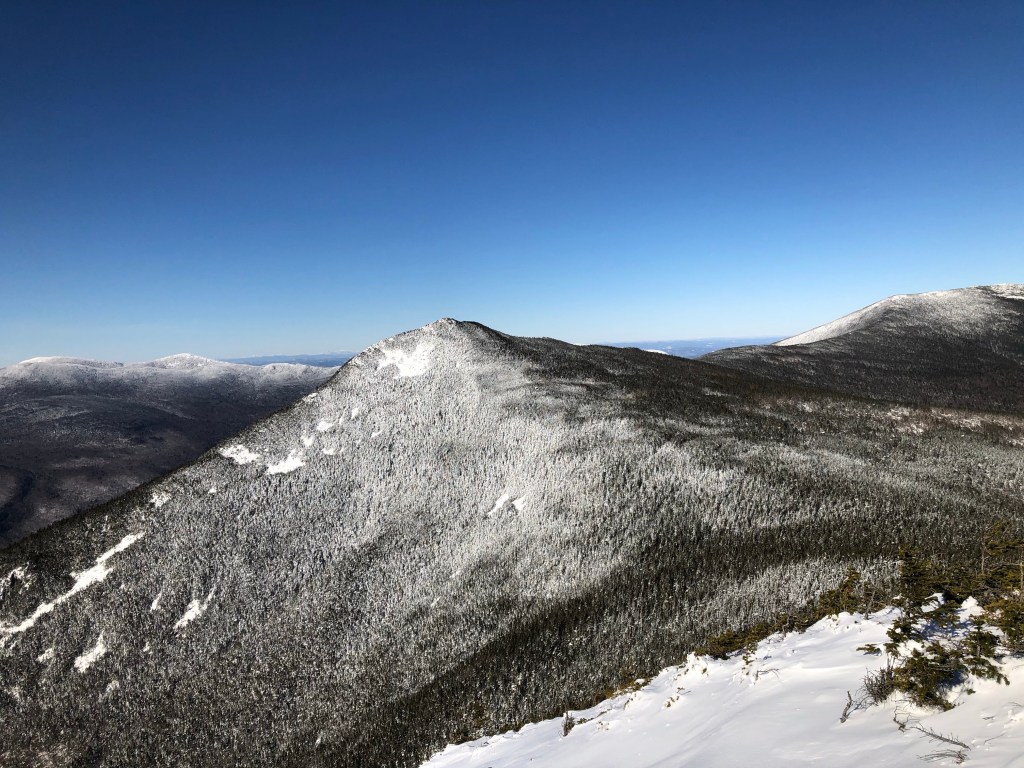
    Let the record show that on the last day of January, 2021 this author fell in love with a pile of granite atop a ridge in New Hampshire. Mount Liberty rises 4,459 feet with a prominence of 379 feet, making it one of the state’s 4000 footers. I’ve flirted with Liberty for years, but when I wiped the slate clean and re-started my pursuit of the 48 4K’s last year in the middle of a pandemic I decided to leave this very popular hike for a quieter day. How about first light on the last day of January?

    Mount Liberty was named for George Washington, but since there was already a Mount Washington Liberty seemed appropriate. It seems when you look at the mountain from a certain angle it looks like George lying in state. And sure enough, from a certain angle you can see that.

    While Liberty was the goal all along, the proximity of Mount Flume, itself a 4000 footer with the rather intriguing measurements of 4,327’/407′ prominence made it a no-brainer for a peak bagging day. Since we were hiking an out-and-back, we ended up summiting Liberty twice, making for a three summit, eleven mile hike. There’s a loop option that includes the Flume Slide Trail, but we just weren’t that ambitious (and a friend talked me out of it). Talking to a hiker with crampons who’d done it, he described it as “gnarly”. And not in a good gnarly way. Better to stick with the safer route, thank you. Mount Flume is the source of Flume Brook, which carved the spectacular gorge named, you guessed it, The Flume. It’s worth a visit on a quiet day in late spring, but best done mid-week and early to beat the crowds.

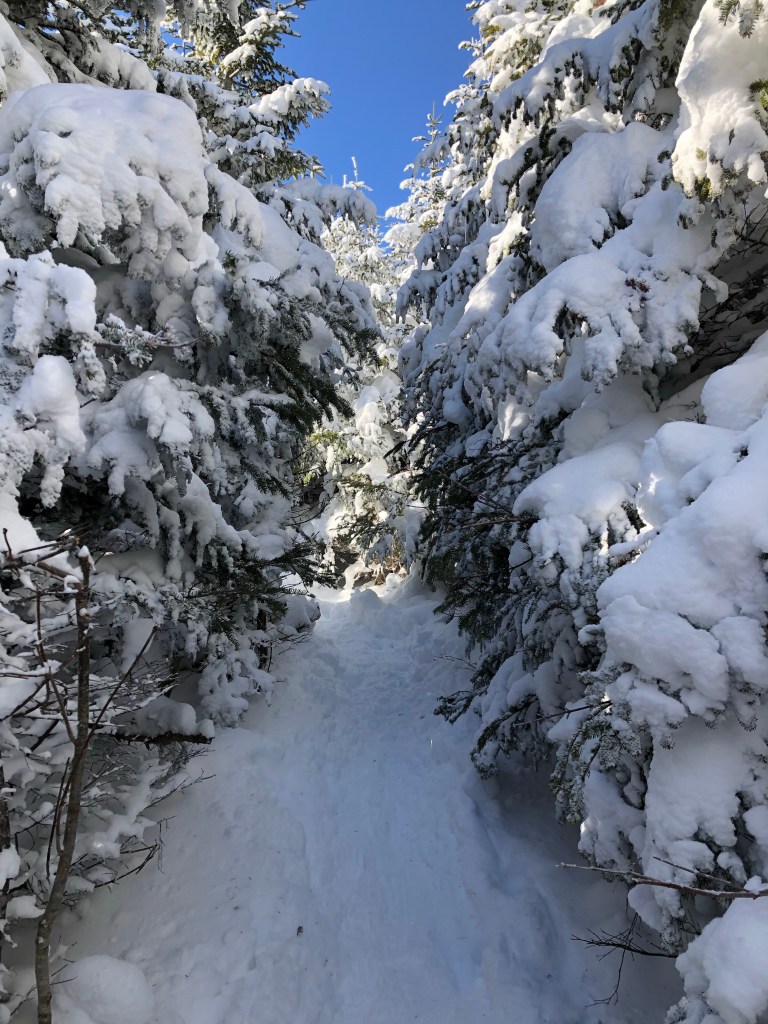
    You know right away that most people turn around after some time on Mount Liberty by the condition of the trail. The Liberty Springs Trail was compacted snow the entire hike, and the summit was completely compacted. The trail between Liberty and Flume was defined but definitely not as well-travelled. Since we started early, we were contributing to the trail break, but it was just compacted enough to keep the snowshoes strapped to the pack (more on snowshoes in tomorrow’s post).

    For this hike, I’d texted a college friend I’ve hiked with before. The two of us met at the Liberty Springs trailhead at 6:45, making us some of the first hikers to climb that morning. We saw a few people on the summit of Liberty and were soon joined by a few more. The crowd was even thinner on the summit of Flume, with just a few diehards when we arrived there. But the day was spectacular and the traffic was picking up. Our return hike to Liberty required a lot of passing maneuvers, which generally meant whoever was coming downhill to posthole into virgin snow off trail to allow someone to pass. In summer you don’t think anything of it. In deep snow you think about it every time.

    Back on a now-crowded Liberty, we had a quick snack, drank some water and began our two-hour descent. Plenty of people passed us on this leg, suggesting the return hike can be much faster for those who like to jog or butt slide down the trail. We took our time, a concession of age or wisdom or experience. I’m just not going to jog down a mountain with a full pack with snowshoes strapped on the outside. With all the traffic and the sun warming the snow the trail was breaking down a bit. Our timing was just right.

    Mount Liberty, seen from Mount Flume summit
    Trail between the summits was a winter wonderland
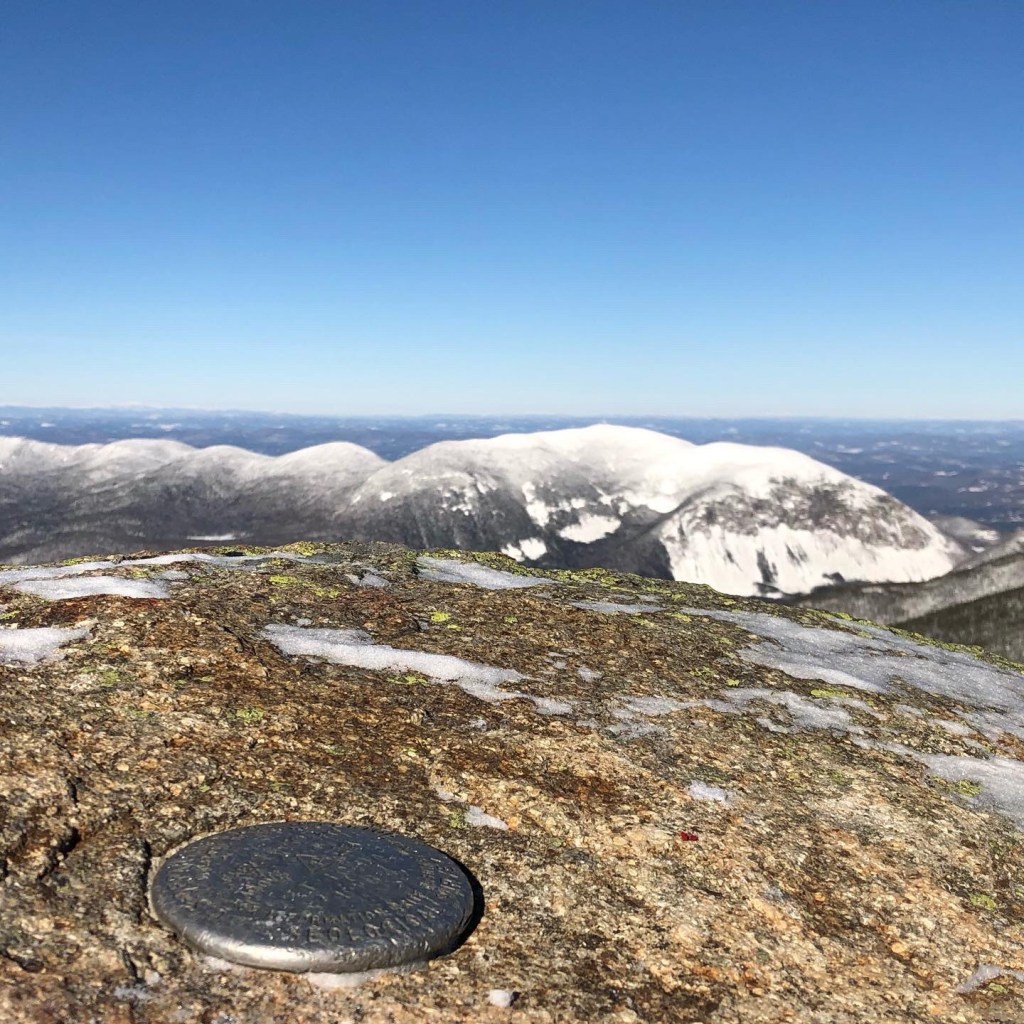
    USGS marker on Mount Liberty with Cannon Mountain in the background