Month: March 2021

  • What You Are Not

    In order to arrive at what you are not
    You must go through the way in which you are not.
    And what you do not know is the only thing you know
    And what you own is what you do not own
    And where you are is where you are not.
    – T.S. Eliot, East Coker

    This is the way: we march on through the unknown, discovering the world and ourselves in each step. That’s part of getting older and, too infrequently, wiser. We don’t know our identity until we’ve reached beyond that which we’ve done before. Life is the sorting it all out part in between steps. Knowing with certainty that this thing is not my thing. But maybe the next thing is… or maybe not.

    I know I don’t have all the answers, but I do know that the more we learn and grow and experience, the more we recognize ourselves in the patterns and energy around us. The more we encounter that which is not us, the more we seek another way. Life is learning to navigate the channel even when it isn’t clearly marked. You experience a few bumps along the way but you don’t sink unless you’re reckless.

    If we have any freedom at all eventually we stumble into uncharted territory. Some turn right around and go back to where they came from, trusting the familiar over the uncertain. But life changes around you whether you’re a willing participant or not. So embrace the things you don’t know and revel in the discovery.

    You can’t possibly know what being a parent is like until you’ve had children. And you can’t really understand until you’ve nudged them through each stage of their own lives. I say this knowingly, but also knowing what I don’t know as they grow beyond the previously familiar. And so we learn together and embrace the unknown.

    This is just the next step in the journey for each of us. We all reached the pandemic and experienced the changes it made in us. Some grew, others crawled to darker places. But we were all transformed over twelve months and will be again as we rediscover the changes in those we once thought we knew. If it wasn’t the pandemic it would have been graduations or career changes or major life events. Change is part of the game.

    Where you were is not where you are now. And so it follows that where you are is where you are not going to be soon enough. Accept that for what it is and step boldly into the unknown. For there you’ll find yourself.

  • Trust Our Heaviness

    How surely gravity’s law,
    strong as an ocean current,
    takes hold of the smallest thing
    and pulls it toward the heart of the world.


    Each thing—
    each stone, blossom, child —
    is held in place.
    Only we, in our arrogance,
    push out beyond what we each belong to
    for some empty freedom.


    If we surrendered
    to earth’s intelligence
    we could rise up rooted, like trees.


    Instead we entangle ourselves
    in knots of our own making
    and struggle, lonely and confused.


    So like children, we begin again
    to learn from the things,
    because they are in God’s heart;
    they have never left him.


    This is what the things can teach us:
    to fall,
    patiently to trust our heaviness.
    Even a bird has to do that
    before he can fly.

    by Rainer Maria Rilke, How Surely Gravity’s Law

    It’s been a long time since I posted an entire poem, but Rilke’s demands a full reading. And if I were bolder I might just leave it there by itself, instead of injecting my own commentary on the world. But a blog (to me) necessarily demands contribution not simply reposting. And so my own words dare to follow Rilke’s, reaching for a place at the table.

    The key word in the poem is surrendered: to earth’s intelligence, to God’s heart if you will, to our own heaviness. You realize your imperfection and embrace it. In doing so you recognize the entanglements and struggles in others. You accept them for what they are as well. And learn to trust others and most of all your own voice.

    You reach a point in life where you let go of it all and to stop worrying about place and whether you’ve earned it. You stop worrying about everything, really. The work remains, but the will is stronger. You’ve rooted yourself to things tangible and true and begin to rise up.

    To push out beyond. Grounded. And anchored so, we begin to fly.

  • Incrementally Better

    “A mistake repeated more than once is a decision” – Paulo Coelho

    “The best criticism of the bad is the practice of the better.” – Richard Rohr

    When you live long enough you start to lose some of the hard edge that once defined you. That sarcasm you voice to others was nothing like the self-talk you once gave yourself. Quite simply, you stop worrying about the chase for perfection and start living with who you are.

    The Coelho quote above once tortured me for the patterns of decisions I’d made over time that didn’t help me. Eating the wrong food, opting out of exercise, not making the call you know you needed to make, not following through when you should have, and then not following through the next time either. Decisions made, not mistakes. This quote can eat you alive if you let it.

    And then I stumbled upon the Rohr quote, and recognized the incremental improvement in myself over time. When things aren’t going well in some area that self-talk amplifies the worst traits, making it more of who you are. Once you’ve recognized and completely own past decisions, what do you do with them now?

    You work to reduce their impact in your life. You get better each day at the things you once avoided. Slowly, surely, you incrementally grow better and the bad shrinks to memories of the way you once were. Still a part of you, always, but not who you are.

    Freud would rightly point to the Id, Ego and Superego at this point in the game. As you get a couple of years older you recognize each for what they are inside you. When you’re young and wild you run with one voice (Id) and just eat the chips with abandon. A bit later another voice (Ego) will start pointing towards the weight loss goals on your list and tell you to stop eating those chips. The Superego makes you feel guilty for eating the chips or proud for not eating them and working out. (This moment of pop-psychology brought to you by Pringles).

    Today, I’m just trying to be a bit better than I was yesterday so that tomorrow I’m proud of the progress made. It’s not that the Superego cuts me more slack, more that I choose not to wallow in self-criticism. The best way to diminish that critical voice is to show it progress towards the person you’re trying to become. Because that identity you’re aiming for is impressive. And even if you don’t reach it, “close enough” is still pretty good.

  • The Newfield Covered Bridge

    The 1853 Newfield covered bridge is a survivor. Wooden bridges were usually torn down when they grew old. New York State once boasted of 250 such bridges, now there are only 24. And Newfield’s is the only remaining covered bridge in Tompkins County, New York. As with any survival tale, it comes with a story of perseverance and a battle of beliefs.

    If you aren’t from places where they build such things, you may wonder about the reason for covered bridges. It was simply a matter of economics. Wood was plentiful, but you couldn’t realistically leave a wooden deck exposed to the elements in northern climates without having to close and replace parts of it every few years. So the builders would simply put a roof over it. It was a lot cheaper to replace a roof every twenty years than the bridge itself every few years. And once you had a winner, other communities would copy the design and soon these timber tunnels were commonplace in the northeast United States.

    But soon steel bridges were the rage, quickly replacing older wooden bridges as they aged. It was another case of economics – a steel bridge would last far longer than any wooden bridge, and could be built longer and wider – allowing for more cars and taller trucks. Progress trumped timeless beauty. And so the wooden bridges were taken down one-by-one as they grew weary.

    And then the engineers came to Newfield in 1969 and declared that this bridge too would be replaced with modern steel and concrete. And a woman named Marie Musser said “Over my dead body” and dug in her heels to fight progress. She and her husband Grant fought the county over the fate of the bridge and eventually won the right to preserve it.

    Three years later they oversaw the restoration of the bridge, and again in 1998 when it was reinforced and raised to support modern vehicular traffic. And so it was that the Newfield Covered Bridge survived and today looks as good as she ever did. It’s now the oldest active bridge of its kind in the area. Driving through it feels like time travel. In a way it is.

    Marie Musser died the year after that 1998 restoration, and her husband Grant died the year after that in 2000. Their old bridge survived them both, and was added to the National Register of Historic Places on February 25, 2000. I imagine they both knew in their last days that their bridge would make it. I hope so anyway.

    And this story informs. What are we willing to fight for, as the Muller’s fought for this old neglected bridge, resurrecting it to a sparkling example of the possibility of purpose? What is our own contribution to the future? It only takes one of us to stand up and say “Not on my watch.” If the Newfield Covered Bridge tells us anything, it’s that we are the bridge between the past and future. And where there’s a will there’s a way.

  • The Eternal Makes You Urgent

    “Once the soul awakens, the search begins and you can never go back. From then on, you are inflamed with a special longing that will never again let you linger in the lowlands of complacency and partial fulfillment. The eternal makes you urgent.” – John O’Donohue, Anam Cara: A Book of Celtic Wisdom

    O’Donohue picked the name of his book with purpose. “Anam cara”, or “soul mate”, suggests that the timeless wisdom buried within might offer the kind of guidance you would get from a cherished friend or spouse. Google it and you’ll find coffee mugs and spiritual retreats and other such things. It would also be a great boat name. And it stirs something in you whether you have one or long for one.

    This idea of the soul awakening isn’t new to us. If this awakening happens at all, it might not be thought of as soul, but as passion or purpose or calling. Some of us steer clear of words like soul. It almost feels intrusive for me to be writing about such things. Not skating my lane, you might say. But I understand eternity, and urgency, and this idea that the things that matter most to us require immediate attention. For our time in eternity isn’t the moments on this side of the turf.

    My own urgency started burning inside of me when I started writing again. It served as a catalyst for exploration and deeper thinking. And when you have it yourself you quickly see the urgency in others. Hikers hiking every available moment, landlocked sailors scrambling to be ready for the warmer days ahead, small business owners pouring every bit of available energy into standing up something special, artists creating brilliant mirrors that reflect back on the rest of us. Urgency senses its kind out in the wild.

    The trick is finding and awakening that soul. And you only find it by trying and doing, tossing aside and finding something else to do. If you’re lucky you find it quickly and embrace it. Or you see it and follow a different path, only to have it pull at you until you finally listen or die embittered at the path you took instead. That’s no way to begin eternity. Is it?

  • We Must Be Still and Still Moving

    Old men ought to be explorers
    Here and there does not matter
    We must be still and still moving
    Into another intensity
    For a further union, a deeper communion
    Through the dark cold and empty desolation,
    The wave cry, the wind cry, the vast waters
    Of the petrel and the porpoise. In my end is my beginning.
    – T.S. Eliot, East Coker

    Beginning at the end as I do in quoting this masterpiece is admittedly the easy path, but seems appropriate given the context. I’m roughly where TS Eliot was when he wrote East Coker – middle of life (hopefully). Or maybe just past the middle. But who’s counting? Days are days, and here and there does not matter. Time will tell, as it always does.

    This blogger has settled into this rhythm of still and still moving. Moments of quiet contemplation, deep reading and exploration interspersed too infrequently with mountaintop adventures and faraway places. Thoughts of past exploration and schemes of future possibility fill the mind, and are betrayed by more than a few posts. We aren’t sharks, always moving, but humans immersed in life in all its complexity. The thoughtful wrestle with the same ideas, the masses distract themselves with media and games.

    Old folks ought to be explorers. And us not-so-old folks too. We ought to be out seeing the world, exploring vast waters and rounding bends. Bridging gaps in language and understanding and toasting the folly of it all with old and newfound friends. Catching a sideways glance and throwing it back. Dancing in celebration and settling into deep conversations. We will again, we see that now. Where will you go? What will you do with the time you’re given?

    This human journey leads to another, more intense place, or perhaps merely to stillness. Who are we to know, really? Do you choose logic or faith? Which is the real leap? Our path is one of tapping our potential, to struggle and explore the darkest and brightest days alike. To make the best we can of ourselves. To turn it all over and understand where we came from. This seems to me the way, for the end is the beginning. In some ways, we’ve known that all along, haven’t we?

    Beginning
  • A Visit with Benjamin Church

    A seasonably warm Sunday lured me from a visit with friends in Mattapoiset, Massachusetts to Little Compton, Rhode Island to finally meet Benjamin Church. Church was appointed Captain of the first Ranger force in America in 1675 by the Governor Josiah Winslow of Plymouth Colony. He was famous for being the guy leading friendly Native Americans that finally killed Metacomet (King Philip). His greatest innovation was in imitation: adopting the Native American style of fighting to allow his forces to survive and find success in battles with the French and hostile native population.

    What made Church honorable was his respect for the native population and his desire to coexist with them. While many around him were inclined to encroach and eventually push aside native tribes, Church wanted to coexist and work with them. This led to recruiting friendly tribes to assist in King Philip’s War and in later battles with the Abenaki and French in Acadia. War is a dirty business, and there was plenty of atrocity committed on both sides, but Church seemed to live by a code of honor untarnished by historical perspective.

    Today Church lies in rest in a quiet triangle-shaped graveyard in the middle of Little Compton with his wife buried next to him. A monument honoring him stands at his feet, and someone glued an Army Ranger tab just above his engraved name. That engraving is fading away now, barely legible after 300 years of exposure to the elements. If you asked a thousand people in New England who Benjamin Church was, maybe one or two would know. Time fades memory faster than it does engraved stone.

    Here lyeth interred the [body]
    of the Honorable
    Col. Benjamin Church, Esq.,
    who departed this life, January 17, 1717-8 in
    the 78 yeare of his age.’

    On a beautiful Sunday afternoon I was the only visitor, but a group of teenagers were playing basketball nearby. I wondered if they knew the story of the soldier buried nearby? Does their local school teach children about the war that happened right across the river, or about the man quietly marking eternity in a faded grave in the middle of town? I hope so.

    Fading history
  • Discharging The Loyal Soldier

    “Odysseus is a loyal soldier for the entire Odyssey, rowing his boat as only a hero can—until the blind prophet tells him there is more, and to put down his oar.” – Richard Rohr, Falling Upward

    Richard Rohr planted this seed of discharging the loyal soldier in my mind. He described the ritual used with Japanese soldiers returning from World War II being thanked for their service and discharged to focus on the next stage of their lives – to be productive members of society. I’ve read a fair amount of history of that war and know the fanatical intensity of the typical Japanese soldier, so to shed that character and assume some level of normalcy on a mass scale is itself impressive and instructive. If your only path was total victory or death, how do you process defeat and going back home? So ritualistic discharging saved what was left of a generation of soldiers to rebuild Japan from the ashes.

    “This kind of closure is much needed for most of us at the end of all major transitions in life. Because we have lost any sense of the need for such rites of passage, most of our people have no clear crossover to the second half of their own lives.” – Richard Rohr, Falling Upward

    We’re at a time in our collective lives where we need this ritual for society. Thank you for your social isolation, for your mask-wearing and countless hours trying to keep people alive. Thank you for your passionate political opinions and protests on both sides. Thank you for voicing your opinions so forcefully on social media. You’ve done your service for society. It’s time to focus on rebuilding now, for the world needs you for another mission. To save the planet and humanity.

    I recognize the transition happening in my son’s life – graduated from college, finished with organized sports, and now what? With the pandemic they didn’t even have a graduation ceremony, let alone a discharging of loyal soldiers. Here’s your diploma, mailed without pomp or circumstance. Good luck! No wonder this generation is looking around and saying “What next?” You learn that they aren’t ready to hear everything yet, as you weren’t. But they’re definitely ready to hear the message that they’ve done well fulfilling the first mission – we’re proud of you, now go forth and find the next mission.

    I’m in my own transition, of course, with the responsibilities of parenting shifting to sage advice strategically inserted whenever a teaching moment arrives – sometimes validating, sometimes contradicting the advice from the other parent. But what of us? We’re stepping into the second half of life when we start filling the proverbial container we built in the first half of life. So what do you fill it with?

    “Discharging your loyal soldier will be necessary to finding authentic inner authority,,, When you first discharge your loyal soldier, it will feel like a loss of faith or loss of self. But it is only the death of the false self, and is often the very birth of the soul. Instead of being ego driven, you will begin to be soul drawn.” – Richard Rohr, Falling Upward

    Discharge that loyal soldier and become “soul drawn“? That’s a bumper sticker or a name for an IPA if I ever saw one! The coolest cat surfing life, dispelling timeless wisdom in clever soul drops as you serve your new guiding light.

    We’ve all been in a period of forced transition, timed for some of us in a period of natural transition. It’s time to focus on what comes next, and do the work you were honed to do during the previous you. Time to put the oar down and follow through on that next mission. That soul drawn and fulfilling mission.

  • The Rhode Island Red Monument

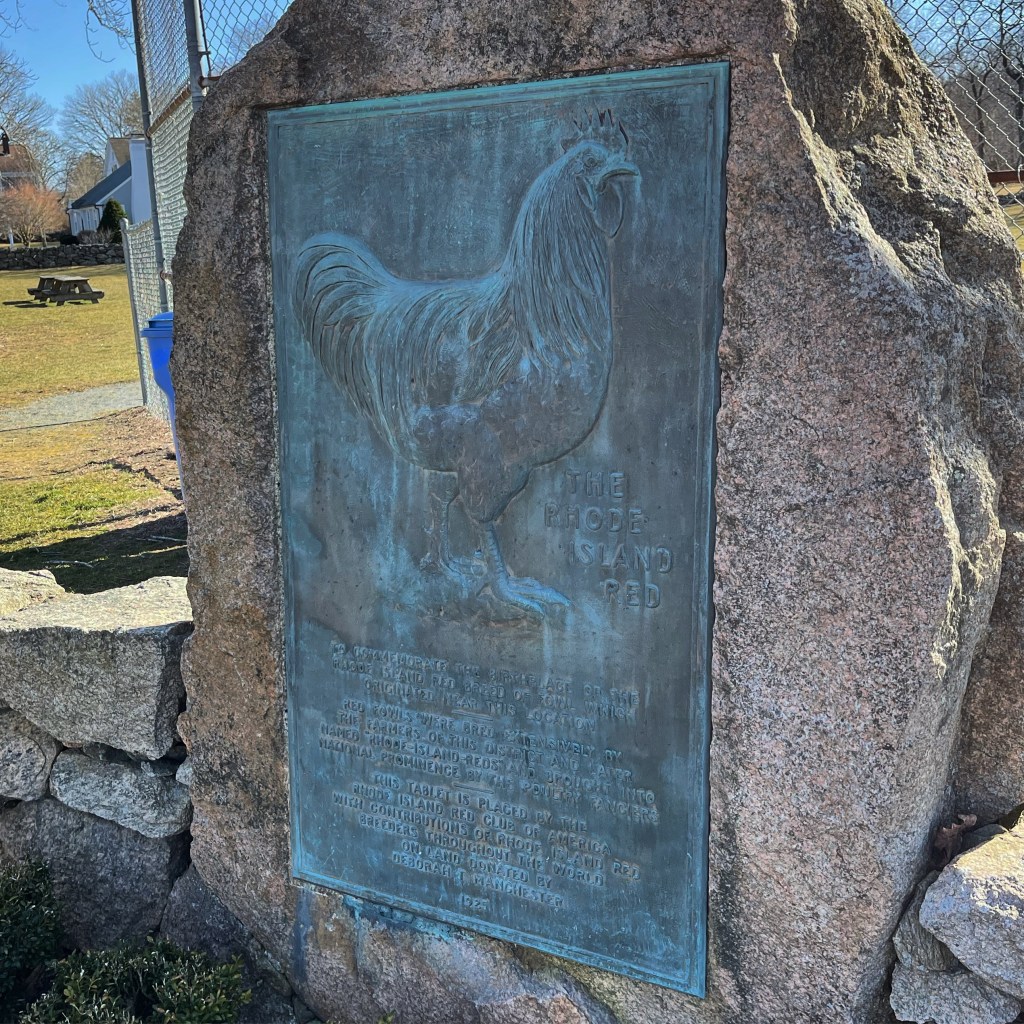
    One of the joys of travel is stumbling upon roadside curiosities. On my pilgrimage to visit a favorite hero of King Philip’s War I came across a monument to the Rhode Island Red that drew my attention. The Rhode Island Red is a hen, of course, that famously and productively laid eggs particularly well, which led to breeding of this particular character to make eggs a common and reliable staple of our diet. It seems the Rhode Island Red was first bred on a farm in Little Compton, Rhode Island.

    In 1925 a group of Rhode Island Red enthusiasts erected this monument to the hen, commissioning an artist named Henry Norton to make it. But here’s where the story gets interesting. One group wanted the monument to be erected at the actual farm where the hens were first bred. Another group wanted it in a more prominent location in town (where I came across it, validating their choice I suppose). For a small town, this was pretty heated, with both sides trying to establish a pecking order. At the unveiling of the first monument the opposing group didn’t show up, apparently feeling the location was pretty… fowl. A year later they erected their own monument at their preferred site. The 1925 monument features a rooster, the 1926 monument features a hen. But a well-placed hen. They really showed ’em.

    The 1925 Rhode Island Red Monument

    The inscription on the 1925 monument reads:
    “To commemorate the birthplace of the
    Rhode Island Red breed of fowl which
    originated near this location
    ___
    red fowls bred extensively by
    the farmers of this district and later
    named “Rhode Island Reds” and brought into
    national prominence by the poultry fanciers
    ___
    this tablet placed by the
    Rhode Island Red Club of America
    with contributions of Rhode Island Red
    breeders throughout the world
    on land donated by
    Deborah Manchester
    1925″

    This entire incident is described in the monument’s Wikipedia page in delightful detail. Not having the back story when I came across the monument, I wasn’t aware of the other monument. Now I feel compelled to return to Little Compton again sometime to find it. In the meantime, Norton’s 1925 monument quietly marks time, closing in on its 100th birthday. Placed on the National Register of Historic Places in 2001, this monument to a chicken has secured its own place in history.

  • 7 Observations on Reaching 1000 Blog Posts

    We all write for different reasons, and my observations might not be yours, nor should they be. But reaching a milestone like 1000 blog posts deserves some measure of reflection. As I look forward with anticipation to post number 1001, I pause to give you seven observations about the journey to this point:

    1. The well never runs dry. You just run out of time. Writer’s block is a myth. If you’re earnest and curious you never run out of things to write about. But you will wrestle with perfection and trying to make a post reach its potential. When you post daily you learn to love it as it is and know when it’s time to let it fly. No, it’s never perfect, but you post it anyway.
    2. Everything becomes a potential blog post. I started writing Alexanders Map intending to have a local travel blog with historical sites with visits to amazing places. The name itself infers this. But it quickly expanded to include a diverse (some would say eclectic) mix of topics. You learn to listen to the muse, and embrace the new. And in the unexpected you find your own voice. You are the link between each post, and part of you reflects back on what you’ve visited.
    3. This business of blogging is your own business. You can quickly grow your blog follower list by playing the game of actively following and liking other bloggers. Or you can do the opposite and grow organically. I choose the latter: I’m very selective about who I follow, I “like” what I actually read and appreciated, and I don’t follow to gain followers. You choose what you want to be in the blogging world. I didn’t even mention I had a blog to family and friends until I’d written a hundred or so posts. I do link to Twitter, but rarely on other media. Choose what works for you, because your blog is how you present yourself to the world.
    4. One sentence at a time, you become a better writer. Let’s face it, none of us start a blog thinking we’re bad writers. Bloggers tend to believe they’ve got some skill for writing or they’d start a YouTube channel or build an Instagram or TicTok site. But the craft of writing develops through the daily struggle. I’m nowhere near the writer I thought I was, and I’m nowhere near where I want to be. But I keep chipping away at it, day-by-day. Blogging is an apprenticeship in writing, but you never meet the master.
    5. Some of your favorite posts will be completely ignored. You will work on a blog post that stirs something deep inside you, feel a wave of emotion crash over you as you click publish, and see the world react with complete indifference. Write these posts anyway, and write them often. Because when you tap into this well you aren’t blogging for instant fame, you’re writing to find something inside yourself that you thought, maybe, was there all along.
    6. You develop an eye for the interesting and an ear for the hidden stories. You stop more frequently in fascinating places, detour to find and celebrate the obscure and forgotten, and do things you might not have done otherwise. You become a ghost whisperer, visiting old graveyards and monuments to the past engraved by some soul long forgotten, who was honoring something of note that brought us to where we are today. You learn poetry and philosophy and Latin phrases and stir up the magic in an old pile of words. You hike to places of wonder and seek adventures. In short, you become more alive, and you appreciate this journey more than ever before.
    7. You learn to follow through on the promises you quietly make to yourself. You want to be a writer? Then write, no matter how you feel, and post that work every day, no matter what. Keep that commitment to yourself today. And tomorrow too. As James Clear puts it, every action you take becomes a vote for the type of person you wish to become. Your blog is a stack of votes for your identity. So craft them as best you can and set them free for the world.

    So there we are: 1000 blog posts. As I mulled over this one the last few days, I found myself in a corner of New England I don’t visit enough and chanced upon a couple of roadside wonders I might never have seen had I not set out for an old grave I wanted to visit. And just like that I’ve got three more blog posts in my mind. The world is funny that way – it opens up for the curious observers. I can’t wait to see where the next 1000 take me.