Month: April 2021

  • A Visit to First Encounter Beach

    If Provincetown claims the first landing of the Pilgrims in North America, and Plymouth claims the place they settled, Eastham is the place where they first encountered the Native American population. And like the thousands of encounters between settlers and natives to follow, it wasn’t hugs and kisses.

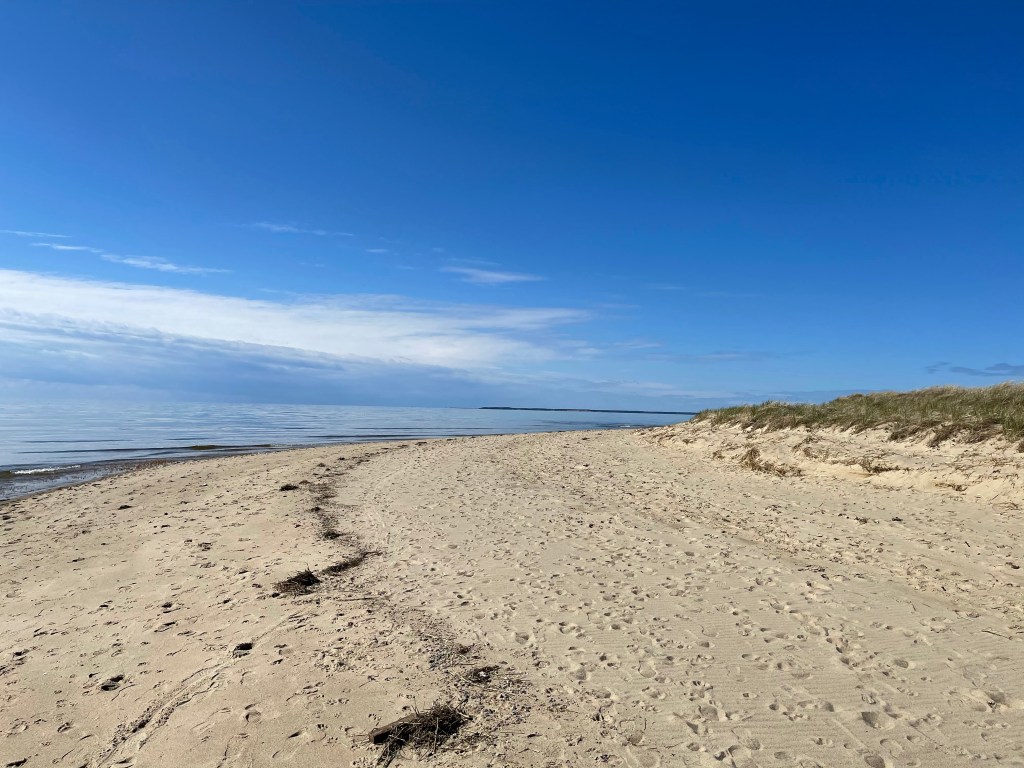
    Today there’s a popular beach with a paved parking lot on the calm waters of Massachusetts Bay. The real estate runs in the millions now, with great sunsets and a chance to swim while the sharks stake a claim on their ancestral hunting grounds on the opposite coast of Cape Cod. Really, it’s all funny money out here, but especially when you can claim a water view.

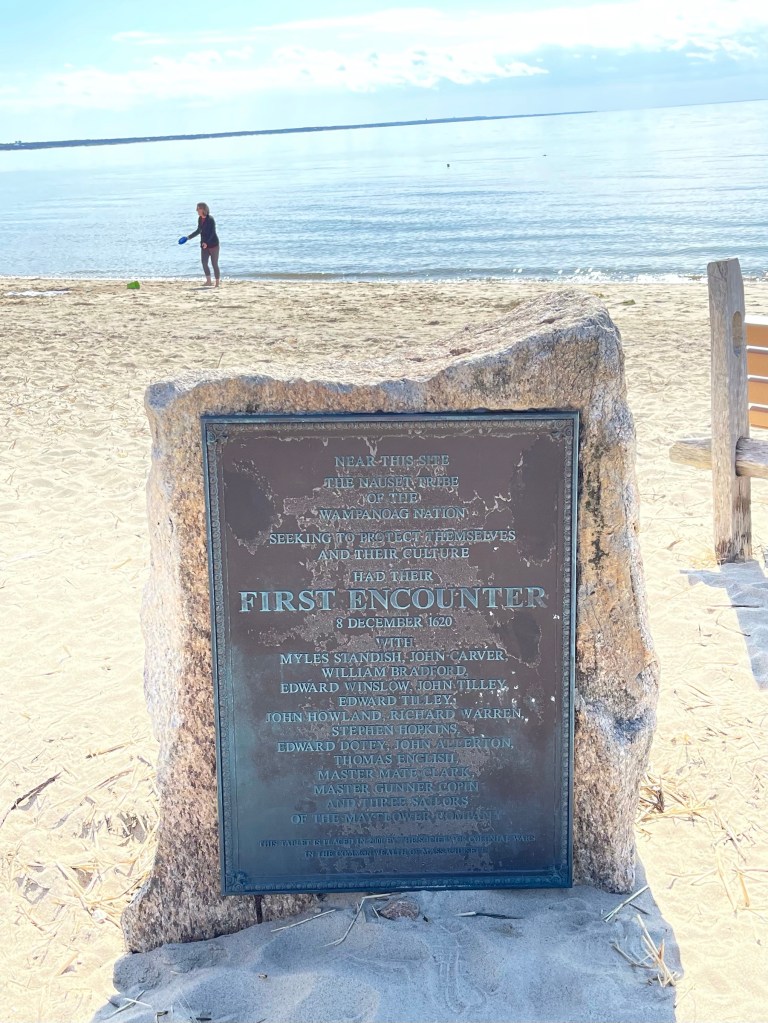
    There are two memorial plaques at the beach. One is hidden from view up the hill a bit from the beach, placed there to commemorate the tercentenary anniversary of that first encounter. The second, and more obvious one, is right as you walk from the parking lot onto the beach. Each offer a history lesson in worldview of the time.

    1920: “On this spot hostile indians had their first encounter December 8, 1620”

    2001: “Near this site the Nauset Tribe of the Wampanoag Nation seeking to protect themselves and their culture had their first encounter 8 December 1620”

    Both are true, aren’t they? But the devil is in the details, and none of us really know how that first encounter went down. We have historical record from one side but not the other. And that’s history for you; recorded by those who ultimately survive to write about it. Ultimately both inform, and the site itself pulls at history buffs like me. How do you visit Cape Cod for decades without a pilgrimage to the site of the first encounter between those who had it all and those who would ultimately take it from them?

    Now all you need is a parking spot at $15 per day for non-residents. For all the historical import of the site, today it’s mostly just a pretty, family-friendly beach. And a nice place for a quiet Spring walk with your significant other. And maybe a few hugs and kisses.
  • A Walk on Cahoon Hollow Beach

    “The sea-shore is a sort of neutral ground, a most advantageous point from which to contemplate this world. It is even a trivial place. The waves forever rolling to the land are too far-travelled and untamable to be familiar. Creeping along the endless beach amid the sun-squall and the foam, it occurs to us that we, too, are the product of sea-slime.” – Henry David Thoreau, Cape Cod

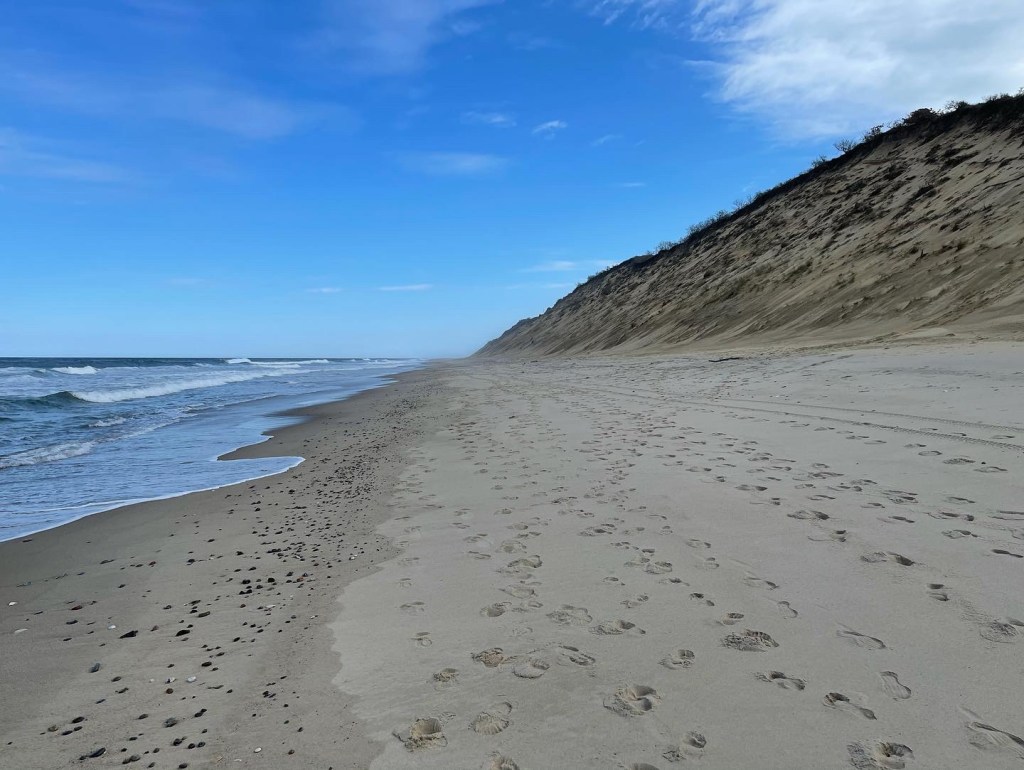
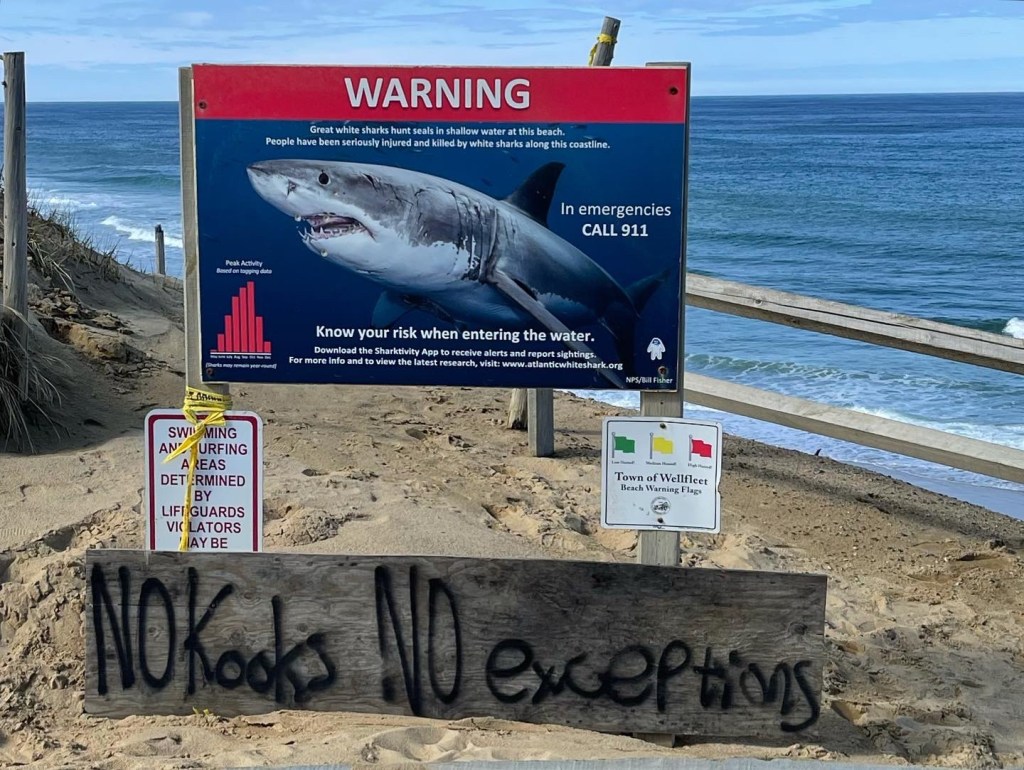
    Between the massive dunes and the crashing Atlantic Ocean in Wellfleet is a strip of sandy beach bearing the brunt of the relentless assault from wind and sea. The surf in warmer months is a feeding ground for Great White Sharks, who have modified their hunting style to chase grey seals right into the churning shallows that swimming humans like to frolic in during the warmer months. Great Whites don’t hunt humans, but sometimes they mistake humans for seals.

    In April you don’t see many seals bobbing in the surf on Cape Cod. So the sharks move on to other hunting grounds and leave this stretch of wild ocean to the occasional surfer and the beach walkers. A walk on the Cape Cod National Seashore can happen just about anywhere with an access path down the 100-foot dunes. Sand is dangerous stuff that can bury a reckless trespasser in no time at all. Sticking to the access paths preserves the dunes and just might preserve you too. The access paths themselves inform in their soft give. This is not a place for the meek. If you can’t handle the access path don’t walk this beach.

    For an off-season walk, we chose to park at the Beachcomber in Wellfleet and walk a stretch of soft sand known as Cahoon Hollow Beach. The Beachcomber is a trendy cool place at the height of summer. In mid-April it’s a convenient parking spot for easy access to the beach. A sign of the times is a shark warning with a handmade sign added to the bottom sharply suggesting “No kooks, no exceptions”. Wellfleet has had just about enough of the worst representatives of shark tourism.

    The National Seashore has a 40 mile stretch of beach that would test the strongest of walkers. When you say you’ll walk just to the bend you soon realize that bend keeps disappearing ahead of you. We walked about a mile, following the curve of the dunes around the forearm of Cape Cod. Walkers tend to gravitate towards the surf line where shells and smooth rocks offer themselves up for consideration. Soon your pockets are full and you recognize the folly of treasure hunting when every receding wave reveals another treasure.

    Thoreau walked the entire length from Chatham to Provincetown in the mid-1850’s and wrote about it for lectures that would end too soon in his abbreviated life. It would be published after his death in 1865 – the same year the Civil War ended. I think often about Thoreau, dying at 45 with so much left to do and see and write about. And here I was following him again, walking the beach between dune and sea, thinking it might just go on forever. Knowing it won’t.

  • Where a Road Will Go

    What if this road, that has held no surprises
    these many years, decided not to go
    home after all; what if it could turn
    left or right with no more ado
    than a kite-tail? What if its tarry skin
    were like a long, supple bolt of cloth,
    that is shaken and rolled out, and takes
    a new shape from the contours beneath?
    And if it chose to lay itself down
    in a new way; around a blind corner,
    across hills you must climb without knowing
    what’s on the other side; who would not hanker
    to be going, at all risks? Who wants to know
    a story’s end, or where a road will go?
    – Sheenagh Pugh, What If This Road

    That anticipation of what’s around the bend or over the next rise is the fuel of exploration. Getting out there, seeing what there is to see, chancing upon magic and the mysterious, that’s the stuff of life. And it’s what we anticipate in the faraway places we might visit after the world opens up again.

    But the alternate path, the shake of routine to try a new way, that holds plenty of potential too, doesn’t it? I should think so. The last year has proven the point: when you can’t cross borders, the world down that path you’ve ignored for years looks pretty inviting. That dusty little corner with a story to tell is more informative in its proximity than those extraordinary places that remain tantalizingly out of reach.

    The last year has a silver lining, and it’s learning our own backyard better than we ever thought possible. Those castles and islands and mountains that call to us are just around the corner too. But for now let’s embrace the road we can travel on today, and see just where it will go. And where we might go.

  • What is Precious

    What is precious
    inside us does not
    care to be known
    by the mind
    in ways that diminish
    its presence.
    -David Whyte, The Winter of Listening

    A storm pivots around New England, sideways rain one minute, bright sunshine the next. Cold wind pushing the swirling mix about, demanding attention. I step outside and look for the rainbow that must be out there somewhere. Nothing but icy rain greets me. I quickly abort the mission and hustle back inside.

    Some days rainbows appear out of seemingly nowhere. Some days conditions diminish the very possibility. Likewise, bold ideas come to us when we’re quietly resolved and ready to hear them. Our most precious and colorful thoughts are sometimes evasive. Maybe it just isn’t their time. Or maybe it isn’t ours.

    When the student is ready the master will appear. If we are open to hearing the call. If we open our minds to possibility. The funny thing about rainbows is that they always appear directly opposite of the sun.

  • The Lindy Effect

    A few years ago Nassim Nicholas Taleb described a phenomenon known as the Lindy Effect in his book Antifragile. Soon after you started hearing about it in other work, referenced in blog posts, magazine articles and even its own Wikipedia page. I tend to shy away from uber-trendy topics, but I’ve thought a lot about this Lindy Effect since reading about it in Taleb’s book.

    “I follow the Lindy effect as a guide in selecting what to read: books that have been around for ten years will be around for ten more; books that have been around for two millennia should be around for quite a bit of time, and so forth.” – Nassim Nicholas Taleb, Antifragile

    Lindy’s was a famous deli in New York where comedians and actors would gather and discuss such things as the durability of a Broadway show. The observation is that if something survives for a period of time longer than the norm, it implies that it will survive at least that long into the future. The Lindy Effect only applies to non-perishable items, so you and I and that orange on the counter don’t count. But that picture you take or that book you write or the product you release to the market do count. The implication is that you might build something that outlasts you by a long stretch.

    Henry David Thoreau died just eight years after publishing Walden, but the book lives on to this day. When it was originally published it was hardly noticed. Yet today it’s been read by millions. When Ansel Adams took the photograph “Monolith, the Face of Half Dome” in 1927 he was creating something that still captures the imagination of people around the world almost 100 years later. It was the picture that built his legacy and helped preserve Yosemite.

    Ernest Hemingway published his first classic, The Sun Also Rises, in October of 1926, six months before Adams took that photograph. Hemingway had a burning desire to be a great writer, and to publish great and lasting work. Many people point to the last lines of the novel for the way it captures the relationship between the two central characters. You might also see the final line as a hopeful wish from Hemingway that this book might fly:

    “Oh Jake,” Brett said, “We could have had such a damned good time together.”
    Ahead was a mounted policeman in khaki directing traffic. He raised his baton. The car slowed suddenly, pressing Brett against me.
    Yes,” I said. “Isn’t it pretty to think so?”

    – Ernest Hemingway, The Sun Also Rises

    I’ve noticed a small trend in this blog where 6-10 specific blog posts seem to get views all the time, while the other 1000+ have their moment in the spotlight and fade away over time. Millions of books and paintings and pictures similarly fade away over time, but some stand up forever as legendary. Making art may have a formula, but creating its stickiness remains a mystery to most of us.

    Ironically, Lindy’s, the delicatessen that gave birth to the concept of building something that might last forever, closed forever in 2017. For businesses are perishable too. Yet its name lives on. Maybe, like Thoreau or Adams or Hemingway, that is as it should be.

  • Leaning Into Revelatory Writing

    “I feel it’s important for me to be completely honest in what I write about. To me artists fall into two categories, they are revelatory or obfuscatory. There are artists that want to create an image of themselves, that isn’t really them, but it’s part of the product, the brand and stuff like that. So whenever they are in the context of performance… they adopt this persona. And the words that they write are from this persona not from themselves… I have always been a revelatory artist. I am most interested in writing about the things that I actually think about rather than trying to think about what someone wants to hear and write about that.” – Todd Rundgren, from The Moment podcast interview

    There are days when I’d rather have published anonymously. There’s something liberating about the free pass granted to the anonymous – you see it in Tweet and troll comments I suppose, where people feel they can say anything that comes to mind. But, deep down, can you really respect the anonymous? I don’t believe so. We respect those who put themselves out on a limb.

    We all balance the character we want to present to the world with who we actually are. As you get a bit wiser you stop worrying about becoming a character and you just become yourself (and some of us are real characters). Artists either play for the hits or mine deep for the gold. Now and then you get both in the same work.

    If you’re lucky and a bit brave, you reach a point where you just write for the love of discovery and revelation. Joyful bits of magic stumbled upon and written about, one post at a time. Some frivolous, some tedious, but now and then you scrub the words together just so and something sparkles. Sometimes you’re the only one that sees the glimmer, other times it bounces around the room like laser light on a disco ball.

    You know when you’ve put it all out there, just as you know when you’ve held back a bit of yourself. I’ve written a few posts where I clearly obfuscated and see it immediately when I look back on it. I think most people see it too. Deep down we all know when someone is holding back or playing to the audience. Fluff writing designed for clicks and likes and whatnot.

    Rundgren reminds me that there’s more to do. You want your work to crackle and spark imagination and wonder? Go deeper. Leaning into revelatory writing is a leap into the the chasm. But where else would you rather be?

  • Good Fences

    There where it is we do not need the wall:
    He is all pine and I am apple orchard.
    My apple trees will never get across
    And eat the cones under his pines, I tell him.
    He only says, ‘Good fences make good neighbors.’
    Spring is the mischief in me, and I wonder
    If I could put a notion in his head:
    ‘Why do they make good neighbors? Isn’t it
    Where there are cows? But here there are no cows.
    Before I built a wall I’d ask to know
    What I was walling in or walling out,
    And to whom I was like to give offense.
    – Robert Frost, Mending Wall

    It happened once, and it seemed awkward at the time. The neighbor walked between his fence and my fence to retrieve golf balls he’d been chipping beyond his fence. He quietly picked them up, we waved at each other and the moment ended. Except that it didn’t really end. The neighbor now works from home in a pandemic on conference calls all day, head set on, chipping golf balls back and forth in his yard. And so this scene is repeated several times a day.

    You might be wondering why there are two fences up. Well, that’s a good question with a reasonable answer. The folks that originally put up the neighbor’s fence put it up four feet inside the property line, and had it curved slightly to follow the tree line. A few years later we got a black lab who liked to explore the neighborhood on his terms. We installed a black chain link fence around the perimeter of our yard to discourage this, thinking it blended in with the woods beyond. The dog was mostly contained, the trees between the fences obscured the unusual nature of two fences running parallel to each other. Mission accomplished! Who thinks of Arnold Palmer straying into your personal space at moments like that?

    Fast forward fifteen years and the brush and small trees are cleared out. The neighbors have changed over twice. The dog has since passed. All that remains is the cold reality of a pair of fences quietly marking time. And the frequent moments of the golfer gathering his golf balls while on his conference calls on the edge of our back yard. A back yard that for twenty years offered the illusion of privacy with the woods beyond.

    It’s my own fault, really. I mentioned in passing one day that the land between was his, and Kilroy has since taken great pains to stake his claim to it with errant golf balls and purposeful walks to scoop them up. It seems passive aggressive to me, like running a lawn tractor in your driveway when your neighbor is having a birthday party. Wait, that’s him too…

    If this seems like a justification for building a taller fence, well, it may be. Wouldn’t that be something, two privacy fences running parallel to each other along the yard? Frost’s old neighbor would say good fences make good neighbors. And Frost would rightly question, just what are we walling in and walling out?

  • Like Stone Nestles on Stone

    “Poetry is language against which we have no defenses.” – David Whyte

    I’ve been spending a bit of time with David Whyte lately, catching up on words I ought to have read long ago but wasn’t ready to hear. I was a different person then, more closed to the world despite the outward bravado. You learn who you are through the windy path of words flowing from you onto the page. And then you set them free to find an audience ready for that particular jumble of words to add to their own foundation.

    Let the words join
    one to another
    the way stone nestles on stone,
    the way water just leaves
    and goes to the sea,
    the way your promise
    breathes and belongs
    with every other promise
    the world has ever made.

    Now, leave them to go on,
    let your words
    carry their own life,
    without you, let the promise
    go with the river.
    Have faith. Walk away.
    – David Whyte, To Break a Promise (Cúnga Fheichin)

    For me releasing the words into the wild is a form of building my own foundation. Each place visited, each poem immersed in, and each mountain climbed is like stone nestled on stone joined together just so as a work very much in progress. Building a life out of adventurous conspiracies and schemes, written down and sent on their way out into the world for you to see.

    “The act of writing anything worthwhile always takes place at that strange and sometimes disturbing crossroads where aloneness and intimacy meet… This break of the boundary between what we think is a self and what we think is other than our self is where the rich vein of beauty and insight become a reward in and of itself, and where the words suddenly seem to belong to everyone.” – David Whyte, from the forward of Essentials

    Experience and words create that thing that is other than our selves. It’s the building of that puzzle that is our self one piece at a time. What seems a chaotic pile on the table slowly forms into a picture of who we are. The funny thing about a puzzle is you finish and throw it all back in the box and build another picture. You can’t build another part of your identity until you clear the table of the old one.

    So which is it? Are words and experience stacked together like a stone wall or foundation, laid to be resilient, or like a puzzle built very much the same way but temporary in nature? That’s one of those forest for the trees questions, isn’t it? The universe views the stacked stones and the stack of words the way it views those jigsaw puzzles on the table. Everything is temporal. Words are like carbon, momentarily ours and one day something else entirely.

    I believe we ought to keep stacking words and building new puzzles, but to do it for the joy of the process. To set those words free to fly on their own. Scattered throughout the world to land where they may. To that meeting place between aloneness and intimacy.

  • Reaching Beyond Yourself

    Just beyond
    yourself.

    It’s where
    you need
    to be.

    Half a step
    into
    self-forgetting
    and the rest
    restored
    by what
    you’ll meet.
    – David Whyte, Just Beyond Yourself

    Reaching beyond yourself can be frustrating, humbling and sometimes humiliating. The ego wants to be in a happier place, warmly wrapped up in comfortable self-talk and stretching just far enough… but not too far. But that’s not where the growth is. That’s not where you’ll find your limits.

    If there’s a phrase that seems to be common amongst the overachieving set in this world, it’s “leaning in”. You don’t lean in when you’re just standing there – you’ll fall right over. You lean in when you encounter some resistance. Resistance appears when we challenge other people’s ideas about what is far enough beyond themselves, but more often than not it’s our own ideas on the matter. Why challenge the status quo? Where you are is pretty good, right?

    This will be posted on a Monday morning. Monday’s serve as a threshold of sorts – an entry into another work week. And another day we’re all blessed with the gift of living on the planet. Leaning in to the work ahead, the task at hand, will soon fill us with plenty of resistance to lean in on. But are you leaning in the right direction or simply being pushed a certain way? Just where do you need to be anyway?

    Setting your course implies moving beyond your current location – moving beyond yourself. Moving beyond implies self-forgetting who you once were and meeting your new self as you progress towards this new place. How many successful people tackle imposter syndrome? All but the most narcissistic and delusional. It’s normal to question where you’re going.

    Most of us rarely think in terms of self-forgetting, but we encounter it all the time. How many jobs seem to dead-end because your coworkers thought of you as whatever you were when you began working with them instead of what you would become? Sometimes you have to leave a company or an industry to get beyond the stalled beliefs others have of who you are to grow. But what of our own self-beliefs?

    Becoming whatever you’ll be, just beyond yourself, begins with leaning in to the resistance inside yourself and moving in that direction you know in your gut you ought to be moving in. The wonder lies in the transformation of who you believe you are as you move beyond that resistance. A move into something entirely different. Towards your new self.

  • A Walk in Dense Fog

    The dense fog presses up against the glass, tapping on the window lightly, wanting to come inside. Or calling me outside. I listen and layer up for a walk to the bay. I know it’s out there, if only from memory. And walk slowly to the water.

    The fog comes
    on little cat feet.
    It sits looking
    over harbor and city
    on silent haunches
    and then moves on.
    Carl Sandburg, Fog

    The birds carry on their morning song, but not so many today. Early still. What does 98% humidity sound like? It sounds like it looks; muted and disorienting. I close my eyes and let my bearings reset. I’m the only human outside this morning. Or possibly one of thousands – who can tell in the gray billowing dance?

    Down by the water, surprising wave action on a still morning. The bay is restless, like a sleeping child with a fever. Fog blurs hard lines. Instead I focus on what it amplifies. The lapping sounds of the waves slapping on the beach. A loon hidden from view out there somewhere calling its kind. Reaching me.

    Walking up from the shore, the sweet smell of dune grass requests a moment of my time. I gladly linger and thank the grass for the invitation. The air feels different as you walk away from the beach. The waves recede, birdsong grows and the world brightens. Dawn is approaching even as the fog asserts its hold on the world.

    Much later, fog lifting, you see the details fill in. I admit I liked the ambiguity of the fog just a bit more. If only for a momentary change in perspective. And, ironically, the clarity it brought. Swirling in the darkness by the bay.