Month: June 2022

  • Understanding the Rhyme

    Wer einmal sich selbst gefunden, der kann nichts auf dieser Welt mehr verlieren. Wer einmal den Menschen in sich begriffen hat, der begreift alle Menschen.” (Once you’ve found yourself, you can’t lose anything in this world. Whoever has understood the human being within himself, understands all human beings.) — Stefan Zweig

    I’d first read about Zweig years ago, for his story is compelling. A popular Austrian writer in his day, who’s popularity and influence reached across the world, he was swept up in the madness boiling over in Germany and Austria in the 1930’s and eventually fled to Brazil. It was there that he and his wife committed suicide in 1942. Just two more casualties of the Nazis. I wonder, had he only held on just a few more years, what he might have understood about humanity then? As it was, his view of the darkness in that moment was apparently too much to take.

    We work to reach our full potential in our lifetime, or we settle for whatever we grow comfortable with along the way. I suppose the question of motivation ought to be examined on this journey. For are we trying to rise above everyone else or reach our own personal peak? Doesn’t darkness lie in the relentless pursuit of the former, while hope lies in our earnest pursuit of the latter?

    I shake my head at some of the people in this world trying to grab for more and more power and influence, upsetting the apple cart and leaving scars on society that will take generations to heal. Zweig saw this in his time, seeing what was lost forever. Tragically, he didn’t hold out long enough for the best in humanity to overcome the worst. Who are we to judge him, for the darkest days eight decades ago were pretty damned dark. Looking at World War II, we like to think we could stand up to fight for decency and fairness like the greatest generation did. Well, we have our opportunity to prove that today, don’t we?

    When we rise up to meet our individual potential, we honor those who built the foundation we started from, and set a new standard for those who make the climb after us. But we can’t forget, in our pursuit of excellence, that foundations can erode quickly when undermined by waves of greed and hate. We are the cornerstones for the future, and must work to shore up the base. And if we understand anything about human nature, it’s that history rhymes.
  • Our Legacy of Previous Work

    Our previous work lingers, either nagging us for where we didn’t measure up or offering a standard to exceed in what we do next. It ought to be the latter, and as we grow we learn to accept that we’ve generally improved upon our previous selves.

    Walking around the yard, I scrutinize the hardscape, for it leaves a lasting impression. I remember a particularly hot Father’s Day laying the brick patio, and a particularly challenging fence post hole when erecting the fence. I remember having the excavator I’d rented getting stuck in wet loam and having to call the rental place to help me tow it out, then scolding me for not renting a different tractor that could handle the conditions I was putting that Bobcat through. Life is a series of lessons.

    Writing is the same. I have posts written long ago that receive likes today, prompting me to reflect on what I was saying at the time. Despite our best efforts we try not to repeat ourselves too often, but there are clearly themes running through this blog that regular readers may rattle off readily. Writing every day requires a steady consumption of new experiences, reading books of substance and a willingness to put it out there. Some posts were clearly works in progress when I click publish, some are more polished. All were my best available in the moment I had with you.

    We can’t linger with our previous self when there’s so much living to do ahead of us, but we can glean lessons from our past. We can also celebrate the things that we did well. That brick patio turned out pretty well, and so did that fence (so long as you don’t look too closely). Some blog posts stand the test of time, while others fade away.

    Our legacy is our work. It reflects who we were and the tools we had available at the time. So long as we did our best, we shouldn’t judge it too harshly. In our work we see the progression to where we are now. And maybe find insight into who we might become in the future.

  • Something Different This Way Comes

    Living on a quiet wooded street near a stream for 23 years, you see all kinds of wildlife passing through. The usual animals range from turkey, rabbits, snapping turtles and deer to those a notch up on the food chain, like bobcat, coyote, fox and bear. You get to a point where you feel like you know the place and have seen it all. And then nature surprises you with something different.

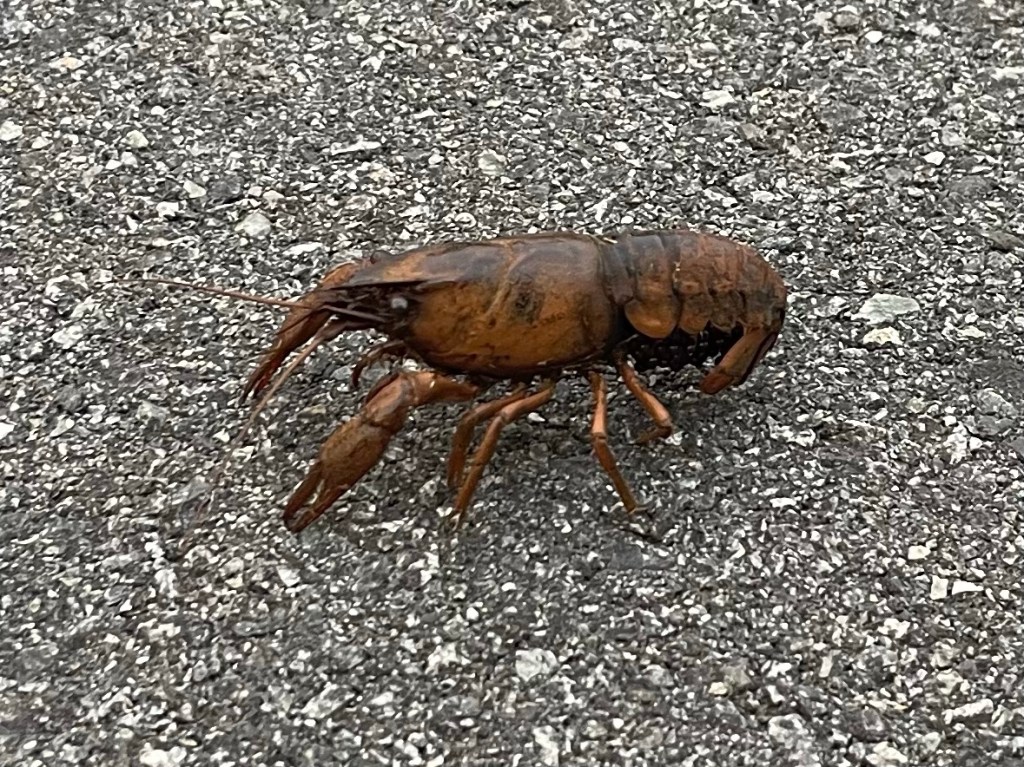
    Taking a walk on the cul-du-sac on a humid night after a day of rain, the sky began a light show of soft orange and yellow moving to deeper orange, pinks and reds. The street had long since dried out and most of the focus was on what was happening in the sky. But then something caught our eye. Some form of critter moving deliberately down the street in our direction. First thought was some kind of bug, but it was almost the length of a chipmunk. On further inspection, it was what I believe to be a rusty crayfish (Orconectes rusticus).

    This thing had black eyes that saw us coming from twenty feet away, and it immediately curled into a defensive position. Debating what to do with it, I decided to remove it from the potential danger (the middle of the street) and move it towards the stream. A bucket and brush did the trick, and this oddity was safely off the street and probably walking through deep grass to the water by the time we finished our walk.

    It was only later when researching this crayfish that I realized it was an invasive species, introduced to waterways as bait or dumped from aquariums. I cursed myself for helping it thrive in an unnatural environment, but you don’t always know what you’re working with until it’s too late. I wasn’t inclined to make jambalaya out of it, and until the moment I found out it was invasive I felt it had earned another day on this planet walking down the middle of a long street between wherever it was to where it was clearly going.

    Humans deliberately and inadvertently help invasive species move into new environments. After years of the expected, this was a first in my particular environment. Maybe shellfish walking down the street is common in your neck of the woods but not so much in Southern New Hampshire. It does make me wonder, what the heck will I see walking down the street next?

    Hey—you’re not from around here?!
  • Beyond What We Avoid

    “One must consciously ask each day: In what way am I so afraid that I am avoiding myself, my own journey?” — James Hollis

    My bride has a strong fear of heights, and I have a nasty habit of challenging her to try things that test that fear. Examples are rattled off in conversations with friends of times I pushed her beyond her comfort zone: helicopter on to a glacier, zip-lining through an Alaskan forest, The London Eye, driving the narrow, twisting switchbacks on the Pacific Coast Highway or the Italian roads to the Dolomites and then riding the cable car to Seceda. There is a pattern of seeking experience beyond her comfort zone, and I greatly appreciate her willingness to put fear aside just a bit to give it a go. In every case the end result was worth it.

    She asked me the other day what I’m afraid of. We’ve been married for almost 27 years, so for her not to know outright was interesting to me. But then again, I also have a hard time thinking of something I’m afraid to try. I can think of many extreme sports that I’d never do, but it’s not for fear but a healthy respect for keeping my body in one piece that keeps me from trying them. There’s a reason most people aren’t surfing 26 meter tall waves like Sebastian Steudtner or attempting Alex Honnold’s Free Solo climb of El Capitan. These are the very definition of extreme, because in the entirety of recorded human history nobody has ever survived such a feat. And yet they pushed through their own fears and did it.

    My own fears aren’t challenged in extreme sports or public speaking, but in putting my work out there for all to see and having it measured. There’s a reason my early blogging was anonymous, for it took me some time to want to have my name tied to it. Perhaps you’ve experienced something similar in your own writing. This fear first expressed itself in college, when I chose to avoid creative writing classes where my work would be judged by my peers and chose classes where I simply analyzed other people’s writing. A few decades later I still regret the lack of courage to simply put it all out there right then and there. But regrets aren’t productive unless we burn them as fuel for becoming something more.

    My greatest fear is leaving my best work on the table before I check out of this world. To develop the talent and the habits necessary to produce something of consequence but never actually putting it out there for the world to judge for themselves nags at me. Blogging is a necessary hammer and chisel chipping away at that block, but deep down I know it isn’t enough. It is absolutely a necessary part of the journey, but it must never be the journey itself. Blogging daily can be a form of avoidance—as if I might quench my thirst for doing more simply by putting out a blog post every day.

    There’s much more to do, friends. Much more on the table that needs to be put out there. And that’s the comfort zone I need to push beyond. If life experience tells us anything, it’s that the end result will be worth it.

  • The Garden Blues of June

    There’s been some unusual activity in the garden lately. A squirrel walked up to me as I sat still sipping coffee, looked me squarely in the eye and didn’t run away until I called his bluff. A pair of bluebirds, normally quite shy, are aggressively guarding the birdhouse they made into a home. They let that squirrel know it was time to move along, while given me a sideways glance to remind me there will be no eggs for breakfast for me today.

    Speaking of blue, it’s almost blueberry season in New Hampshire and that means the return of catbirds, the little devils who gobble up ripening blueberries by the pint, usually just before harvest. In previous years I’d rig netting and chicken wire to hold them at bay, but they always seem to find a way to the fruit. This year no netting and only a half-hearted attempt to chase them away. After traveling for much of June I’m conceding the early harvest to nature. Maybe I’ll have better luck with the tomatoes later in the season. We all choose what we fight for in this world. Isn’t it funny how that changes season-to-season in our lives?

    Earlier this morning I walked around the garden, seeing first-hand all the work I’ll need to do to set things straight. Nearing the fence, I spooked a large doe, who betrayed her position in her panic. I told her as her white tail bounced away that I’d never have seen her if she’d just waited a beat longer. Movement betrays, it’s only in stillness that we become one with the natural world. The doe had no use for my unsolicited advice.

    The garden is neglected and mocks me my late return to tend it: “Too little, too late pal.” Such is the way, for stillness need not apply in the garden. But I’ve come to think of the garden differently this season. Or maybe just my position as head gardener. I’ve taken something of a sabbatical this year with more emphasis on the hardscape and less on the seasonal magic. Looking around, it feels foreign to me, this garden I’ve labored over for years. Thinking about the behavior of that squirrel and the doe, I wonder if they simply aren’t used to having someone linger in the garden anymore?

    Gardens, like our lives, ebb and flow. In June 2022, when things are usually flowing, I feel an ebb. So much feels different this season, but the bluebirds remind me that change is inevitable. We either roll up our sleeves and get back to work or we wallow in the blue. Gardens frown upon the wallowing gardener, for the season—our season—isn’t over just yet. And so it must be that we get back to it once again.

  • Emptying the Noise Bucket

    Wherever I am, the world comes after me.
    It offers me its busyness. It does not believe
    that I do not want it. Now I understand
    why the old poets of China went so far and high
    into the mountains, then crept into the pale mist.

    Mary Oliver, The Old Poets of China

    We’re all busy, and compounding our generally hectic lives, the world wants our full attention. It throws attention-grabbing headlines, distressing developments, and plenty of opinion about all of it at us and wants us to join the maddening chorus. Surely these are troubling days that shouldn’t be ignored. And as citizens of the world we must pay attention and work to improve our general lot. But, like our mobile devices that long ago became an extension of our brains, we should never forget to recharge our batteries regularly.

    “To become empty is to become one with one with the divine—this is the Way.” — Aza Kenzo

    When our focus turns to the noise outside we don’t hear our inner voice. We lose our compass heading. We miss a beat. And in that lapse our best work—our purpose, suffers. We must empty the bucket of noise and fill the void with silence. Luckily, solitude is just a walk or a garden full of weeds away. Simply leave that phone behind, step away from the noise and listen to yourself for awhile. We don’t owe the world all of our time, no matter how much it insists upon it.

    “The music is not in the notes, but in the silence between.” — Wolfgang Amadeus Mozart

    The thing is, that bucket of noise is going to keep filling up, no matter how much we try to empty it. As Mozart structured his symphonies, we ought to structure the music of our own lives. The magic isn’t in the noise at all, but in the silence in between. If we wish for more magic in our lives, if we wish to compose something that transcends the chatter of everyday life, if we simply wish to reset our jittery compass, then we must empty the noise bucket and dance with the silence left behind.

  • The Nerve for Excellence

    “A New Yorker essay that fall noted that mathematicians do good work while they are young because as they age they suffer “the failure of the nerve for excellence.” The phrase struck me, and I wrote it down. Nerve had never been a problem; excellence sounded novel.” — Annie Dillard, Afterword of Pilgrim at Tinker Creek

    Take that New Yorker example of mathematicians and apply it to rock stars. How many Paul McCartney or Elton John or Joni Mitchell songs written in their 40’s or later resonate as much as those written in their 20’s? They may be good or even great, but they aren’t classics. Excellence requires the nerve to go for it.

    As someone who is no longer in their twenties, I remember the audacity of youth as much as I appreciate the pursuit of safer routes as we age. After all, we’ve got bills to pay and mouths to feed and a 401(k) to nurture, right? So what does that mean for those of us who aren’t kids anymore? Should we hang it up after we hit 30? Of course not. But we have to stretch beyond our comfort zone if we want to achieve anything beyond the average.

    Sure, when we’re young we have less to lose, so it becomes comparatively easy to jump in to the deep end. But there are other ways to reach the deep end. We can methodically wade in one step at a time. Or to flip analogies, when everyone around us is slowing down to savor the view, we still have the choice to power up the hill.

    Nobody reaches mastery without tenacity and drive. Surely there’s a case for perseverance. For incrementally—relentlessly—applying accumulated knowledge towards our goal. Will that lifetime work become a masterpiece? Few ever do, but that doesn’t mean we shouldn’t have the nerve to try.

    Go deeper. Climb higher. See what we might make of our best work.

  • A Snapshot of Modern Domestic Air Travel

    Those not residing in or actively flying domestically in the United States may be unaware of just how challenging air travel can be at the moment. There are simply not enough active pilots or flight crews to meet demand. This is partially because of the pandemic, when everything dried up and many active pilots and crew retired or moved on to other careers, and partly because the airline industry didn’t keep up with training new pilots to replace those who were retiring. In any case, there is a severe shortage of crews, making delays and cancellations more and more common. Throw in a general public eager to travel and you’ve got a formula for fun.

    Consider my most recent flight, from Nashville to Boston:
    — Flight delayed by 50 minutes before I even arrived at the airport.
    — After finally boarding the plane, they determined they needed to reboot the plane’s Operating System, which involves shutting down the plane for 5-10 minutes (did I mention it was 100 degrees Fahrenheit in Nashville at the time?)
    — Upon departing the gate and taxiing towards the the runway, the plane was pulled out of line by air traffic control minutes before takeoff because of air traffic roulette in the northeast.
    — Waited on tarmac for two hours, which meant a mandatory return to a gate so passengers could get off for relief or food. While an option, they encouraged everyone to stay on board so they could leave sooner.
    — Finally took off 3 1/2 hours late and arrived in Boston after midnight. Flight attendant mentioned she’d just had a 16 hour day. Who am I to complain after hearing that?

    Does flying the friendly skies sound glamorous yet? Let me add another tidbit:
    Since I’d transferred from another flight, I was in a middle seat at the very back of the plane, seated next to a toxic lump of evaporating booze and churning empty calories throwing up in his mouth and exhaling for the rest of us to enjoy. He kept nodding off and bouncing his head into the seat in front of him like he was head-butting a villain in a Diehard movie. I write this fondly, and find myself missing him already. Almost as much as I miss that middle seat when the plane was being rebooted on a hot day in Music City.

    Travel has never been easier, and yet never so challenging. Life is funny that way. If I was impressed with anything during that experience, it’s that everyone on that plane accepted the reality of a moment we couldn’t control. We all suffered that shared experience together in stride, without a single headline-making incident. Maybe there’s hope for society after all.

  • Breakfast of Champions

    There’s a classic Saturday Night Live sketch where John Belushi portrays a dominant track athletic at his peak. His secret? Little chocolate donuts. It spoofs every performance food ad of the time and really, since. And it raises the question—what exactly are we eating for optimal performance in our days?

    Travel opens our eyes to what constitutes breakfast from place-to-place, and forces us to examine what exactly we consume to start our day. What exactly fuels us as we begin our days? As we learn more about what is good for us and what simply fills us up, shouldn’t our expectations for what we consume is evolve?

    Eating breakfast in places around the world, you immediately pick up on the differences. Americans are heavy on portion size. We like our eggs and bacon and pancakes with a healthy pile of home fries or grits, depending on how you feel about snow. Austrians and Germans seem to favor cheese and cold cuts with a hard-boiled egg and bread. Other countries favor fish, olives, figs, dates and yogurt.

    Who’s right? We are what we eat, but the Mediterranean diet seems to be the consensus pick for healthiest. Still, it might be a tough transition from corn flakes or biscuits to smoked fish and a handful of figs. Ultimately, we have to decide what we’re going to eat. We ought to lean in on fuel and shy from fill. But who doesn’t love a chocolate donut now and then?

    I suppose the answer is to standardize on the healthy diet, and splurge occasionally on the things that taste good in the moment but aren’t especially good fuel for our bodies. It’s a pay me now or pay me later scenario, but the now is a very immediate rush of satisfaction and a fairly short window before the debt is owed. If we can resist the immediate temptation until we’re satiated on the good stuff, maybe we can avoid the bad stuff altogether.

    Part of the breakfast offering in Israel
  • On Place and the Tilt of the Earth

    “I am summer, come to lure you away from your computer… come dance on my fresh grass, dig your toes into my beaches.” — Oriana Green

    Maybe it was appropriate that today, June 21, the Summer Solstice, I awoke at 4 AM—just in time to mark the exact minute (4:13 AM CST) of the tip of the planet back towards shorter days. But let’s worry about that tomorrow, for today is the longest day of the year in the northern hemisphere. After bouncing from Vienna to Boston to Nashville, my body isn’t quite sure which time zone it currently resides in. Yet the mind is fully rested and ready to hit the day.

    By the time of the solstice it usually feels like summer has been with us awhile. This year feels different, like I’m running away from the season. Travel will do that. I spent a day at home assessing the neglected garden before flying off once again. Is that a tragedy or simply a new way of experiencing the season? The weeds seem to enjoy my absence, while the cats seem surprisingly annoyed when I packed a suitcase as soon as the laundry was done from the previous trip. Sorry felines, the world calls.

    Do you wonder why we heed the call at all? Isn’t summer a chance to slow down and relax for awhile? Tell that to a farmer. Europeans know how to take a proper holiday, Americans jump right into the next thing. Which is right? It depends on what you want your life to be.

    Ultimately summers, like life, are made by what we do with the time. Whether our longest day or our shortest matters little if we don’t make something of the moment. Experience begins with presence, the rest is just finding a place to land and the tilt of the earth.