“There is no cure for birth and death save to enjoy the interval.“ — George Santayana
Santayana was a Harvard professor who personally influenced a long list of people who in turn became influential themselves. People like Robert Frost, T.S. Eliot, Walter Lippmann, Gertrude Stein, G. E. Moore, Wallace Stevens and others. So the way he spent his interval seemed pretty substantive and consequential. He demonstrated that we can enjoy our time while also making the most of it.
So sure, they say that life is what we make of it. But on the surface this feels somewhat simplistic, given the general indifference of the universe towards our feelings on the matter of our fragile egos. Through the fair and unfair, the rituals and routines, the obligations and distractions, the magical and the mundane, we all choose and have choices imposed on us. In the end, or rather, in the interval, it’s all in the way we play the game, despite everything thrown at us along the way.
Knowing we’ve hit this lottery of birth in our time and place, we ought to be fully aware of this moment and the opportunity it represents for us. I might have written a version of that phrase a hundred times now in this blog. Be assured it’s a reminder to myself more than a call to action for others. A reminder that, in the end, this interval is all we’ve got to work with.
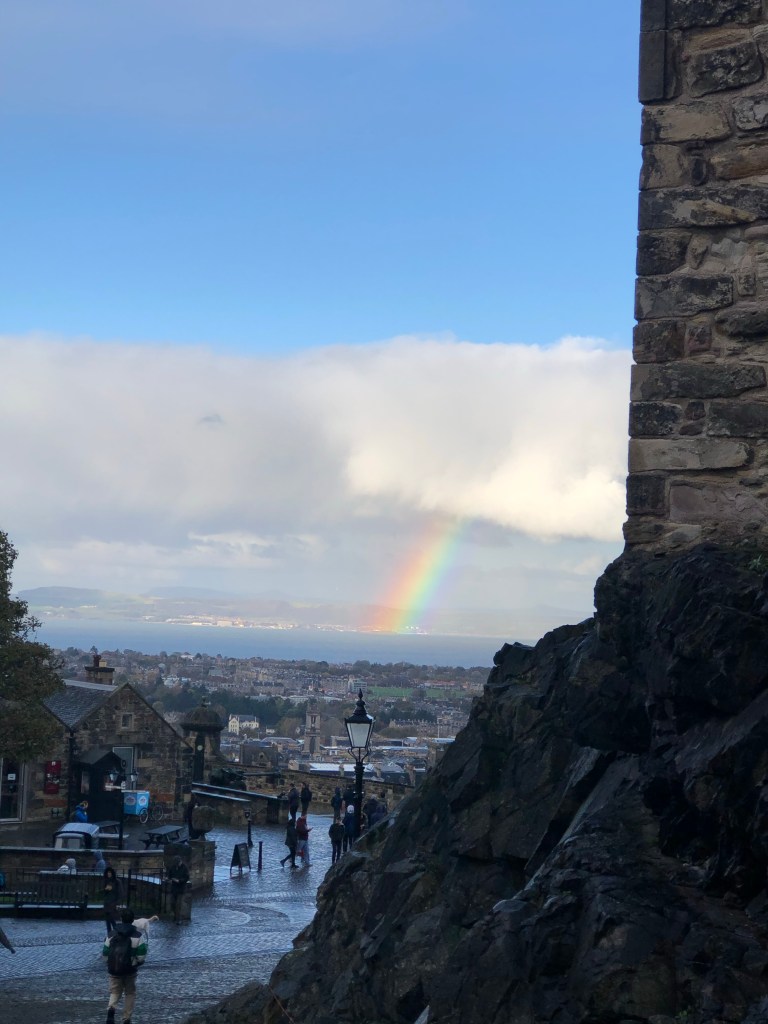
Well, I see the end of the rainbow But what more is a rainbow Than colors out of reach? — The Avett Brothers, Swept Away
There’s a fine line between being satisfied with what you’ve got and yearning for what you haven’t got. I follow, and thus am constantly teased by, Aurora Borealis updates. I happen to live in a place with a very slight chance of seeing the Northern Lights, but sure, I’m saying there’s a chance. The hardy souls who stay up all night on mountain tops for the ten minutes with the Aurora post their photos immediately, making me grumble when I rise early the next morning and see what I’ve missed. But I know that that show wasn’t meant for me.
We are in our moment, in our place, with or without the things we yearn for. There’s nothing to do about that which we’ve missed out on. For the things we seek, we must either go to them or let them fly away unencumbered by our attempt to grasp them.
When you go to a place you’ve dreamed of going to, be it a tropical paradise or Paris or (just maybe) Iceland for volcanos and waterfalls and the dance of the Northern Lights, you close the book on dreaming and capture its memory, like a flower folded into a book. The thing is, memories are rainbows out of reach too. But with memories, bits of the color embed themselves in us that live on through us. You can see it in your eyes when you look at yourself in the mirror, and others see it in you too. Each encounter brings more color to our lives.
Ultimately we can’t have it all, and we ought to focus on the things that are most important to us. Yet there’s something to be said for a recurring dream of light and color dancing in the sky. It will always remain just out of reach, yet so very close to our heart.
So what do we chase, and what do we let fly away? Don’t we already know? For our answer appears when we stop chasing every rainbow and really think about what’s important now.
“A library is a good place to go when you feel unhappy, for there, in a book, you may find encouragement and comfort. A library is a good place to go when you feel bewildered or undecided, for there, in a book, you may have your question answered. Books are good company, in sad times and happy times, for books are people – people who have managed to stay alive by hiding between the covers of a book.” ― E.B. White
Someone recently asked me why I write a blog every day. Surely there are other things I could do with the time. But other than exercise and sleep I can’t think of anything done regularly that improves you more than consistently putting yourself out there in the world. Writing forces contemplation, feeds both the stack of books and the small and large experiences consumed to be shared, and maybe in some small way make the writer alive for the reader, whether you’re reading this today or 50 years from today.
Lately I’ve felt a sense of loss when I finish a blog post. It’s a tangible shift from my work to my past work as I click publish. It’s similar to the feeling of putting a letter in the mailbox once felt, before email and text made letter-writing feel less… self-gratifying. When you click send on an email or text the response back is close to immediate. There’s a high in surfing this wave of electronic banter that the sender experiences in real time. I suppose a blog also offers likes and views and subscribers that may feed that sensation. But getting back to the point, dropping that letter in the mail was consequential: “I’ve created this, for you, and now I’m releasing it.”
Don’t you miss crafting such letters and dropping it in the mail with all your hopes and dreams sailing away on the wings of a postage stamp? Don’t you miss the experience of receiving a letter from a thoughtful friend, full of introspection and insight? Maybe we ought to write more letters, I don’t know, but we certainly should be writing more. Writing offers a chance to fly into the future for the author, and a time machine back to our present for the reader. It’s our moment with the infinite, even as we realize the fragility of the exchange.
“If the world were merely seductive, that would be easy. If it were merely challenging, that would be no problem. But I arise in the morning torn between a desire to improve the world and a desire to enjoy the world. This makes it hard to plan the day.” — E. B. White
I grow cilantro, not so much to eat it, but to watch bees roll around in the wispy white flowers that wave ever so lightly in the breeze. Surely someone must grow cilantro for all the tasty dishes (or soapy dishes) one might imagine it worthy of, but give me the bees, please. Summer officially ends for me the moment the cilantro peters out—like life itself—entirely too soon.
The dance between the earnestness of rolling up your sleeves and fixing things versus opening up your heart and savoring all the world offers is a constant struggle. As with everything, we must skate the line between the world of order and the world of chaos, Yin and yang. Nobody said this living business would be easy, but it’s such a short ride we ought to make the most of it.
Still, there’s work to be done, and no time to waste in solving the world’s problems. As anyone out there trying to get things done knows, there’s just not enough people willing to make a go of it and do the work. Every school, every hospital, every landscaper and construction firm and restaurant is struggling to find a warm body with an eager mind to simply do the work. Who are we to ignore the call? Yet so many do.
Every day should be filled with a bit of challenge, and a bit of seduction. Every life lived well ends with a measure of satisfaction for the things we did well and a measure of consternation for that which wasn’t accomplished. That’s life, and we must learn to skate that line. In the end, we do with it what we will.
About suffering they were never wrong, The old Masters: how well they understood Its human position: how it takes place While someone else is eating or opening a window or just walking dully along; How, when the aged are reverently, passionately waiting For the miraculous birth, there always must be Children who did not specially want it to happen, skating On a pond at the edge of the wood: They never forgot That even the dreadful martyrdom must run its course Anyhow in a corner, some untidy spot Where the dogs go on with their doggy life and the torturer’s horse Scratches its innocent behind on a tree. In Breughel’s Icarus, for instance: how everything turns away Quite leisurely from the disaster; the ploughman may Have heard the splash, the forsaken cry, But for him it was not an important failure; the sun shone As it had to on the white legs disappearing into the green Water, and the expensive delicate ship that must have seen Something amazing, a boy falling out of the sky, Had somewhere to get to and sailed calmly on. — W. H. Auden, Musee des Beaux Arts
The big things happen around us, things that are planet-changing, culture-changing, life-changing, yet most people go about their business in the most human of ways—intently focused on themselves. Walk into any scene playing out around us and chances are the actors are engaged in the mundane while largely ignoring the monumental. Wars, political scandals, climate change, images from deep space…. all are monumental but don’t quite make the cut when compared to that itchy nose or debate over what’s for dinner or who is taking the recycling out.
It’s this we must understand in our attempts to influence and cajole the apathetic. It’s not about us, it always must be about them. To inspire, stir or instigate the story necessarily must reach into the souls of each member of the audience. Storytelling, selling, pandering for votes—each is a form of engaging the audience and making them feel the story is all about them. For even if it feels like it’s about something much larger, it never really is. It’s always been, and forever will be, how might I stir something in you?
And even then, someone else will be walking past oblivious to the two of us. No matter, for we can’t reach everyone. We just have to reach enough.
“For you and your children hold a message: act so that the fruit of hatred, whose traces you have seen here, bears no new seeds, either tomorrow or forever after.” — Primo Levi
This world offers a full sampling of good and evil. We sip from the fountain we choose to belly up to. It may be perplexing to see so many choose a path contrary to all that we believe to be true, but that doesn’t mean we should join them. We might instead offer a different path, one without hate.
Despite it all, we each may choose what we perpetuate.
“We think of inertia as the state of being inert or motionless—one of our purer displays of passivity and disengagement. It’s not. Inertia is an active event in which we are persisting in the state we’re already in rather than switching to something else… The most reliable predictor of what you’ll be doing five minutes from now is what you’re doing now… The most reliable predictor of who you’ll be five years from now is who you are now.” — Marshall Goldsmith, The Earned Life
Yes, you might detect a pattern in the writing recently. I keep returning to the Tom Peters statement that excellence is the next five minutes. Habits are hard to break, routine is either a prison or a path to a brighter future. And inertia now can predict who we are in five years if we don’t take that next step to change right now.
Does that sound unnecessarily urgent? Perhaps, but aren’t the stakes just that high? We are what we repeatedly do, and more often than not we repeat the same damned thing this five minutes as we did last. So we ought to take this next five minutes and demand something more of ourselves than the previous five. We ought to make it an active event that transcends our previous place.
The easiest way to determine the truth in that is to look at what we did last week and compare it to what we did last year. Sure, there are highlight moments of trips and events that break up the sameness, and a pandemic mixed in to skew the data, but on the whole things are roughly the same. If our habit loop is positive this can be a very good thing, but if we keep repeating bad habits we might be living in a rut that runs straight to the grave.
“Every action you take is a vote for the type of person you wish to become. No single instance will transform your beliefs, but as the votes build up, so does the evidence of your new identity. This is one reason why meaningful change does not require radical change. Small habits can make a meaningful difference by providing evidence of a new identity. And if a change is meaningful, it is actually big. That’s the paradox of making small improvements.” ― James Clear, Atomic Habits
It’s easy to spot inertia when we look at intentions. If we intend to write the book or run the marathon or summit the mountain but find ourselves dancing with the same excuses we had yesterday and five years ago, well, let me introduce you to our friends inertia and low agency. On the flip side, if you’ll allow me to use a few of my own examples, inertia is publishing this blog every day for the last four years, reading early every morning and most nights and maintaining a streak on Duolingo that’s approaching 1000 days. Maybe each is small in the big scheme of things, but each is a +1 on the path to becoming.
@jackbutcher
Moment-to-moment we make decisions that pull us forward or set us back. We default to the familiar, which both reinforces our identity now and reinforces it in our future. That past moment isn’t this moment unless we choose the same thing. Will it be a plus or a minus? Our vote ought to be for an active event, our action should be a plus.
To understand many things you must reach out of your own condition. — Mary Oliver, Leaves and Blossoms Along the Way
There’s a place for nuance. There’s a place for understanding. And above all, there’s a place for meeting in the middle. This inclination to receptiveness runs counter to the toxic stagnation of self-centered.
There is another virus spreading through the world—it’s a virus of the closed mind. We’ve become closed to new perspectives that might challenge our own. Too many sip the same flavor of Kool-Aid (blue, red, orange seem to be the only flavors at the moment in the U. S.). But a full life doesn’t fit neatly into such rigid choices, does it?
Like a root-bound plant left too long in its pot, we must reach out of our own condition to grow to our potential.
A monk sips morning tea, it’s quiet, the chrysanthemum’s flowering. — Matsuo Bashō
The mornings are chilly again, and unlike Bashō’s poem, full of the sounds of squirrels gathering food and bickering about who gets what. The water is warmer than the air, for the sun is reluctant to stick around so long nowadays. The seasons are flipping, just as surely as the hickory nuts are falling.
I think about the fall cleanup and shudder. Is it the chill in the air or the thought of forced labor to come? We dream of autumn for all its beauty, for the crisp air and the scent of fallen leaves. We forget about the work. We pay penance for the pleasure.
I promised myself I’d drink more tea this summer. I planned to use more of the mint spilling out of its terra cotta pot in an attempt to displace the basil in the neighboring pot. Yet the drink of choice is most often coffee. Does coffee nullify my monk inclinations, or does the ritual matter more? Ask the flowers—for they’ve quietly observed all summer.
“Don’t ask what the world needs. Ask yourself what makes you come alive and then go do that. Because what the world needs is people who are alive.” — Howard Thurman
Most people remain too busy to worry about such things as coming alive. They’re too busy getting things done. Bills to pay, a calendar full of meetings, chores to do, calls to make… it’s all too much, really, to be thinking about things like doing something more than this.
I wonder, who is more alive, a monk living in seclusion and contemplating the big questions or a business tycoon living their answer to a different set of questions? Are humans built for thinking or for action? Most people would point to the latter, for the modern world and our very resilience was built on action: overcoming enemies and disease and solving the riddles of science and technology to arrive right here at this extraordinary moment in time (!).
But who do we seek out for answers? It’s the poets and philosophers and deep thinkers who seclude themselves from the madness and settle down with the questions everyone else is too busy to answer. The wisdom of the ages was derived from contemplation. So can’t we make a solid case for the monk?
The world needs both, of course. Action and contemplation are each essential elements for the progress of humanity. Yet each can be a form of procrastination and avoidance. It’s fair to ask ourselves which path is right for us, but we can’t get so caught up in the question that we don’t go anywhere. The world is already full of people who never come alive. Ultimately, we must stop wrestling with questions and seek our own answer.
So is it ready, aim, fire or ready, fire, aim? The order isn’t always as important as the balance between the two. Running around in circles is just as pointless as sitting there thinking about what you’re going to do without ever actually taking a step. Action and contemplation lead us to vibrancy together. We can’t know what makes us alive without each.