Month: February 2023

  • The Futility in Fragility, and Doing It Anyway

    If blood will flow when flesh and steel are one
    Drying in the colour of the evening sun
    Tomorrow’s rain will wash the stains away
    But something in our minds will always stay
    — Sting, Fragile

    Pushing snow off a driveway in an active snowstorm is an act in futility, displayed for all to see in the snowflakes quickly filling the void, relentlessly stalking you and the shovel down the pavement. Best to wait until it ends, clear it all at once with a snowblower, or a plow, or perhaps not at all if the forecast offers hope of melting days to come. But that’s not me. I clear the way, accept the temporary nature of my labor, and retreat inside to let the falling snow erase my work. Until I do it all again. Such is the way with fragile things. We’re all temporary, despite our efforts, but we may leave a mark nonetheless.

    Perhaps nobody knows fragility and futility like a snow shoveler. Perhaps. Tell that to the soldier. Tell that to the climate activist. Tell that to the writer. Everything is futile, at least until we prove it otherwise. Everything is fragile. Tell me otherwise.

    But there’s meaning in the work. And so we do it anyway. Again and again.
  • Choosing Brevity

    It’s easy to lean into the comfort of words. I accumulate words like I accumulate t-shirts, and feel the very same way about them over time. To be perfectly honest, I try to keep this daily blog to a maximum of three or four paragraphs largely because I find the crafting of them so delightful that I wouldn’t get anything else productive done in my days. The struggle is real.

    Alternatively, choose brevity.

    The thing about using less is it forces us to edit things out of our life. Opting for simplicity can be complicated. At least in the beginning. Eventually we hit our stride. I’m told. I have a ways to go.

    Stephen King told us to kill our babies: Edit ruthlessly. It’s not as easy as it sounds, but that’s why he called them babies.


  • Give It Wings

    “Days are expensive. When you spend a day you have one less day to spend. So make sure you spend each one wisely.” — Jim Rohn

    “Let others lead small lives, but not you. Let others argue over small things, but not you. Let others cry over small hurts, but not you. Let others leave their future in someone else’s hands, but not you.” — Jim Rohn

    When we think of life as brief, we realize the expense of each day. How we use them in turn matters more. In fact, we come to realize that everything matters. Each day, each decision, stacked together makes up our life, however big or small it may be. Over time we might see that we have agency over our days, and in that realization everything changes.

    That word, agency, is usually greeted with a blank stare. Most people don’t think in terms of agency, of believing to the core that we have a say in how we react to our environment and the actors working for and against us. Thankfully, in the modern world slavery largely doesn’t exist as a legal construct. Yet how many settle for subservient lives?

    “A slave is he who cannot speak his thought.” — Euripides

    We each grow into our potential. We each decide what to be and, within reason, have the opportunity to go be it. Living a larger life doesn’t come simply from the decision, for we must build habits and systems that carry us across the gap between desire and achievement, but it begins there. We plant our seed and nurture it until it is fully realized, selectively watering that which will become our future identity.

    We each develop a working philosophy for our lives, shaped over time. If we’re lucky it’s derived from a place of high agency and boldness. We know, deep down, what we wish to become. Each day offers an opportunity to bridge the gap: To rise up to meet our potential, uniquely ours, represented in the hopes and dreams we shelter from the harshness of the world. Like any fragile dream, we must set it free to fly or flounder on its own. The way to realize a fuller life is simply to give it wings.

  • No Other Way

    when it is truly time,
    and if you have been chosen,
    it will do it by
    itself and it will keep on doing it
    until you die or it dies in you.

    there is no other way.

    and there never was.
    — Charles Bukowski, so you want to be a writer?

    Keep on doing it until you die or it dies in you. The writing continues for another day. Who it finds is anyone’s guess. But like a spouse bored of life with you it must find a way out. Nothing boring, nothing pretentious, nothing that doesn’t scream to leave you and meet the world.

    A high bar to clear. We’ve all slogged through countless boring books, tedious slogs through the waist-deep piles of words that mean nothing but a thesaurus referred to. And, if we’re honest, we’ve written our share of boring too. All to tempt the muse. All to find the magic and make ourselves a part of it. Join the Great Conversation once and for all, and maybe, if we might be so bold, find a place at the table one day.

    But not today. Not just yet. Today we work through the process. Truly, there’s no other way.

  • To Be Ignorant Is to Be Afraid

    To be ignorant is to be afraid, and in the dark mystery of the unknown a man cannot find his way alone. He must have guides to speak to him with authority.— Edith Hamilton, The Greek Way

    And, truly, what of good
    ever have prophets
    brought to men?
    Craft of many words,
    only through
    evil your message speaks.
    Seers bring aye
    terror, so to keep
    men afraid.
    — Æschylus
    , Agamemnon

    Both of these quotes were drawn from Hamilton’s extraordinary book. The Gutenberg Project offers the entire English translation of Agamemnon, which the link above will take you to. Hamilton’s life story is itself fascinating and worth a deeper dive another time. For today, let’s focus on the urgency of climbing the steep hill of the informed. History ebbs and flows and, as Mark Twain said, rhymes.

    Much of the world runs on fear and ignorance. Those in the know shake their heads in disbelief at the things the ignorant regurgitate from the talking heads trying to hold power at any costs. That they’re largely successful speaks to the effectiveness of the platforms designed to stoke the fire. We must put out the fires being stoked or eventually be consumed by them.

    We dare not be ignorant. Look around at the world and feel the obligation of the informed, carrying the weight of the ignorant. We must look squarely into the eyes of those who would destroy democracy and rise up to meet them. Many will walk through life with blinders on, lest they witness anything contrary to what they’re told. There’s no nuance in the fears they express, no dance with life, merely a cycle of fear of what others are coming to take from them. They don’t see that they’ve already had everything taken from them by their messenger of choice.

    The thing is, we can’t change the extremists on either end of the spectrum, we can only shine a light on, and be open to, the truth. Life is a dance with either ignorance or knowledge. We must choose our dance partner with the utmost care, and in turn teach others to dance. Feel the rhythm in the rhyming of history and step towards truth. The alternative is wretchedness and fear. What kind of life is that?

  • The Next and Most Necessary Thing

    “Routine will take you further than willpower.”@ShaneAParrish

    The “next and most necessary thing” is all that any of us can ever aspire to do in any moment. And we must do it despite not having any objective way to be sure what the right course of action even is. — Oliver Burkeman, Four Thousand Weeks: Time Management for Mortals

    I ran into an old friend a while back, someone I hadn’t seen in a long time. We passed the usual compliments to each other about surviving to this point relatively intact, exchanged phone numbers and went our separate ways. We might never see each other again, or maybe we’ll be best friends someday. The only certainty is the next step.

    All we ever have is now and the next most necessary thing. We fall into the groove of routines, and it’s hard sometimes to slip out of that groove and introduce new things. It’s our attractive rut, carrying us to the grave or to salvation, whichever comes first. We remind ourselves over and over again that we are what we repeatedly do. The hidden message in Aristotle’s statement is that sometimes we have to break free of habits and find a new groove. And once in a blue moon we find the right groove and ought to stick with it.

    There are days when it all feels right, and days when nothing does. Routine saves the day more often than not, if we choose wisely. We tell ourselves to move more, eat better, read and write and floss. Each is a habit, a ritual, embedded into the groove of routine. If some part of that routine feels unfulfilling, who says we can’t find a new one? We have the agency to make the most necessary next move.

    Whatever will be will be, surely it will, but we may alter the course a degree or two in our favor. The two or three things that make the most positive difference in our lives ought to be part of our ritual. The things that slide us sideways off the track ought to be replaced with better routines. The question we might ask ourselves in our next chance encounter, with an old friend or perhaps the mirror, is whether time has treated us well or not. We can influence the answer with our routine established now and next. Given that, it doesn’t seem so routine at all.

  • What Falls Away is Always

    Great Nature has another thing to do
    To you and me; so take the lively air,
    And, lovely, learn by going where to go.

    This shaking keeps me steady. I should know.
    What falls away is always. And is near.
    I wake to sleep, and take my waking slow.
    I learn by going where I have to go.

    — Theodore Roethke, The Waking Poem

    We might agree that our lives are a brief accumulation of ideas and ritual, happenstance and things, that are ours today and a part of our history tomorrow. We’re all winging it, it seems, following instinct and a compass that is drawn to comfortable and habitual. Learning this about each other and ourselves, most of us hit our stride in time. Still, some chafe at life and constantly turn it upside down in the hope that there’s more on the other side. What is the right path? Doesn’t that change too? We’re a work in progress, each of us, wherever we are along the path. The view and how we feel about it changes as we ourselves change.

    Looking back is most striking. Old photographs and videos from another time in our lives betray who we were once, and that wave of change breaks over us, soaking us in memories. We recognize that we are not any one moment in our lives, we’re the sum of it, a character study transforming. We each see where we’ve been, but we learn by going. Who we were always falls away. The only way is onward to the next.

  • How We Interact

    I was looking through some old pictures for images of an uncle who passed away over the weekend, images that would be part of a collage of images of interactions he’s made in his lifetime. It occurred to me that he’s never joined Facebook or Instagram. If you wanted to interact with him you needed to do it the old-fashioned ways with a call, a letter, or best of all, face-to-face. Technology is handy, but it will never substitute for a conversation with an engaged, interested human being.

    Writing this, I sit at a desk looking to my right to a Mac screen. Looking left, I might interact with a PC screen. I’m technology-agnostic in this way, as most of us must be. Work to the left, personal to the right. Throw in work and personal iPhones loaded with apps, a Kindle, iPad, and both an Apple and a Garmin watch and it seems I can interact with the world in all manner of ways. But I still prefer talking to humans face-to-face. Call me an old soul if you will.

    Technology makes us scalable and efficient. I can click publish on this blog post and it’s possible for the entire world to read it in an instant. We both know that’s not going to happen, because the entire world is pushing out their own content too, making it a very noisy tech world indeed. To rise above the din you must be louder and more committed to connection, not just more interesting or introspective. I’ve come to realize that accumulating followers is just not me. I celebrate organic growth, but dwelling on it is counterproductive and artificial. I’ll just keep doing my thing, quietly interacting with you and the occasional five hundred-ish other folks, from now until it ends.

    One of these days I’ll fix the blog, to make it easier for people to interact with me. Or maybe not, but just know it’s not because I’m not interested in the humans on the other side. Just not so much the technology that connects us. There’s irony in that statement, but it’s not meant to be clever. It just means I’m more like my uncle than I thought I was.

  • Something Amazing

    “Life is never what one dreams. It is seldom what one desires, but for the vital spirit and the eager mind, the future will always hold the search for buried treasure and the possibility of high adventure.” — Ellen Glasgow

    The very idea of l’élan vital, the vital spirit, of living each moment with rapt attention and the eager anticipation of what comes next is a bold, some might say extravagant, way of moving through our days. But what is the alternative? Practical living? Skating our lane to the last? Give me something amazing, thank you. Give me adventure and the search for buried treasure hidden in the moments to come. Give me joie de vivre. Give me l’élan vital.

    But Glasgow also pointed out that this vitality has a shelf life in the moment:

    “No matter how vital experience might be while you lived it, no sooner was it ended and dead than it became as lifeless as the piles of dry dust in a school history book.” — Ellen Glasgow

    The thing is, an active, vital life isn’t meant to be a singular moment, but singular moments stacked one upon the other, lifting us to a higher level of engagement with the world. What’s done is surely done, but something of it remains within us, a hint of something betrayed in the sparkle in our eye. Those who acquire enough of it emanate a magnetic energy that attracts others. We’re all walking swarms of electrons looking to dance with life.

    I’ve surely lost the physicists with my blog today, but nonetheless, there’s something to being actively engaged in living that increases our vitality. The hunt for the buried treasure in the next moment is a mindset. It reveals a zest for life and a reach for boldness. Aspiring for something amazing in our next moment isn’t setting us up for disappointment, it’s setting us up to find more of what we seek.

  • Little Things

    Elle est retrouvée!
    Quoi? -l’Éternité.
    C’est la mer allée
    Avec le soleil.


    She is found!
    What? -Eternity.
    It’s the sea gone
    With the sun. — Arthur Rimbaud

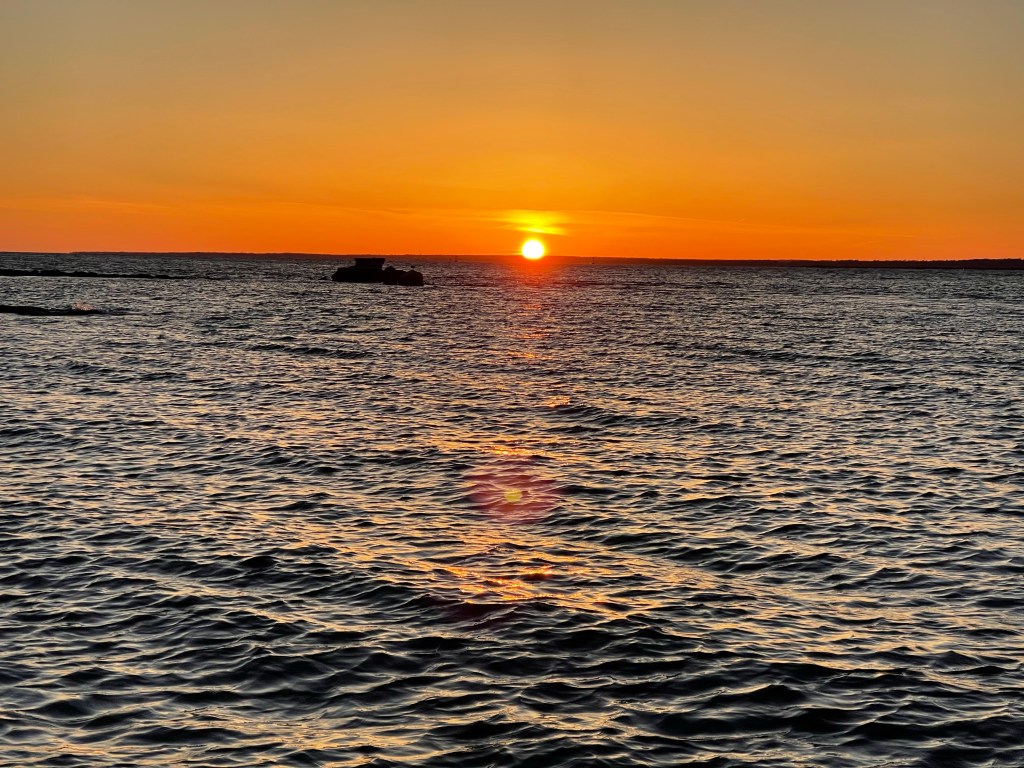
    Sunsets are routine, often ritualized. Little things, really, repeated daily. I’ve been known for carrying on about such things as the position of the sun relative to where it was in warmer days. Most people, it seems, could care less about where the tilt of the earth is. We are what we focus on.

    “Little things in life, which afford what [Daniel] Kahneman calls “experiences that you think about when you’re having them,” provide a great deal of everyday enjoyment. Because you’re apt to pay more attention to your remembering than your experiencing self, however, it’s all too easy to forget to indulge yourself in these small but important pleasures on a daily basis, thus depriving yourself of much joy.” — Winifred Gallagher, Rapt

    I should think life would be less enjoyable the very moment one forgot to savor the little things. We get used to things that once delighted us, looking for the next big thing to replace that feeling, always chasing. Never really savoring.

    Most writers have an eye for details, and linger in them longer than the average bear, seeking a deeper understanding. There’s pleasure to be derived from digging deeply into what seems trivial. Consider Rimbauld’s twelve words, arranged just so, that draw so much out of what someone else might think of as just another sunset. Poetry itself might be thought a little thing. Ah, but what things they are, sunsets and poems! I think I’ll stick with little things, thank you.