Sleep baby sleep Now that the night is over And the sun comes like a god Into our room All perfect light and promises — INXS, New Sensation
The days of May grow longer and full of daylight, which means that the early morning hours are brighter and full of their own promise. These are the days when I wake up feeling like I’ve missed out on something special if it’s already light out. I thrive on astronomical twilight and the hope of the coming day. Each morning ought to be celebrated for the ripe potential it offers.
These are all days to remember, but memories are built on action and an underlying purpose. We aren’t here to make it through the day, but to make something of the day. We feel this most intentionally in the early morning light. For it truly is the start of something new.
I dwell on early starts and dabble in productivity, for each are a bridge to fulfill the promise of the day. We owe it to ourselves to meet our purpose and potential head-on and make something of each in the brief allotment of time offered. The trick is to be nimble and open to everything that comes our way, without being bogged down by distraction. When you get up earlier than most people you find elbow room to process such things as priorities and purpose.
What would we give for one more day? Someday we’ll wish for it, won’t we? Get up and greet the morning, and bring to the day everything that would be answered in this question. As the expression goes, this new day wasn’t promised to us, but it is a gift. Feel the energy in the promise, the vibrancy of place, the potential of the start. Amplify that feeling with full awareness and hope. And dance with it.
“I have been and still am a seeker, but I have ceased to question stars and books; I have begun to listen to the teaching my blood whispers to me.” — Hermann Hesse, Demian
We all listen to whispers—hints and suggestions and guidance from deep within. We usually don’t act on most of these. Perhaps some seem reckless, or frivolous. Perhaps we don’t like the stretch out of a comfort zone. But now and then we do stretch, and sometimes even leap. The whisper is all we hear at times like this.
The question isn’t what whispers to us, for there will always be whispers, the question is, which one stirs? We ought to do more of that. Naturally, we already know this. Do you wonder why we ever hear anything else? Or why we choose not to listen to our very own whisper more often?
“Go live your life. Live it fully, without fear. Live with purpose, give it your all, and never give up.” Effort is important, for without it you will never succeed at your highest level. Achievement is important, for without it you will never experience your true potential. Pursuing purpose is important, for unless you do, you may never find lasting happiness. Step out on faith that these things are true. Go live a life worth living where, in the end, you’ll be able to say, “I’m glad I did,” not “I wish I had.” — Gary Keller, The One Thing
Without being reckless, what would you have done differently yesterday? How about this year? Who would you spend time with? Where would you linger a beat longer? Where would you have gone if not for the place you stayed instead? What work would you have applied yourself to, worthy of your precious time? In other words, what do you regret leaving off the table in this brief life?
Perhaps, choose to do it today. Perhaps reach out to that person. Perhaps, linger in the moment when it arrives instead of rushing off to the next urgent thing. Perhaps, book the trip today, while there’s still precious time. Live through the lens of “I’m glad I did” and defer “I wish I had” instead. Be focused. Be intentional. Be bold.
There is the idea of deathbed regrets. We are all on our deathbed, whether today or a hundred years from now. We ought to feel the urgency in that realization and do something with our time. Through what lens do we view the world? Choose the “I’m glad I did” lens. We probably won’t regret it.
“We are kept from our goal, not by obstacles but by a clear path to a lesser goal.” — Robert Brault
I have a work friend who works at a frenetic pace. He’s constantly charging from one thing to the next, in a hyper-reactive state trying to do more than one ought to aspire to in a day. His favorite self-depreciating joke is to turn his head sideways and yell “Squirrel!” and take a step in that direction. In a way that’s exactly what he’s doing with his time. Despite his best intentions, the chase becomes his day, the path always changing in crisis mode. His answer is to work even harder.
The world wants us to fall in line, to play our part, to belong to something bigger than ourselves. The trouble starts when we aspire to greater things. We might decide what to be and head down the path to being it, but there are so many seemingly urgent distractions along the way. Greater things call to us, but good enough is so very much closer.
Every day we check the boxes: writing, exercise, flossing, etc. that move us from this to that. Incremental progress isn’t a leap, but it’s progress nonetheless. We are, after all, on the path to our goal. But is it enough? Baby steps aren’t quite a stride, let alone a leap. But it helps if those baby steps go in the direction we’re aiming at. Save the squirrel chase for some other day.
There’s something to be said for upping the ante. When we aren’t progressing forward quickly enough we may choose to take a leap: Sign up for a 5K, or a writing class in Paris, or make a bet with a friend with stakes high enough to make you uncomfortable (like donating money to a candidate you despise if you don’t hit your goal by a certain date). These stakes aren’t a clear path, but they sure help us focus on it.
Life flies right on by, whether we chase our dreams or not. We ought to pursue the greater at the expense of the lesser. This begins with ratcheting up those incremental habits to something more like a stride, or even a leap. We’re less likely to stray down a side path when we’re charging along towards our primary goal. Raise the stakes, and the path becomes clear.
“When conditions are such that life offers no earthly hope, somewhere, somehow, men must find a refuge.” — Edith Hamilton, The Greek Way
Everybody wants to go to heaven Get their wings and fly around Everybody want to go to heaven But nobody want to go now — Jim Collins / Marty Dodson, Everybody Wants to Go to Heaven
Heaven is sometimes believed it to be the light at the end of the tunnel in an otherwise bleak and miserable life. It offers hope when there’s no reason to believe there ought to be any. Others describe it as a place to aspire to—an exclusive club that only the truly enlightened amongst us will ascend to. I’m not sure I’m buying that. We’re already in an exclusive club having been born at all. Do we accept the miracle of being alive each day we wake up? If we don’t celebrate this miracle, what makes us believe we’ll behave any different if we reach Heaven?
“I don’t feel the slightest interest in the next world; I think it’s here. And I think anything good that you’re going to do, you should do for other people here and not so you can try to have a happy time in the next world.” ― Katharine Hepburn
I fall in Hepburn’s camp on the idea of Heaven. It’s all very nice to talk of an afterlife and being happy then, but we live here and now. This is our time to fly. We’ve each hit the birth lottery, and thus far have evaded the grip of the Grim Reaper. Isn’t that cause for celebration? We might think of this lifetime as an apprenticeship for whatever comes then, should we be so bold as to believe we’ll ascend to such a place.
Simply put, when we defer to this “someday when” we do a disservice to ourselves and the universe. Sure, we can’t always control whether our lives at the moment are heavenly or hellish, but we can control how we react to it. And most of us can do a lot more than that.
“Take care to create your own paradise, here and now on earth” — Omar Khayyam
Stories about heaven and hell offer guidance that historically helped keep society together. But the same stories can be used to pull people apart. We see a fair amount of that divisiveness in the world today, with people using stories of heaven and hell to justify horrific behavior and violence. If there are indeed Holy Gates I’m not sure I’d walk through the same way some of these characters believe they’ll be going. So maybe save the preaching for someday when. Nothing speaks louder than action. Give me fairness and love and living by the Golden Rule. Celebrate and honor the miracle right here.
The longer I live, the more deeply I learn that love — whether we call it friendship or family or romance — is the work of mirroring and magnifying each other’s light. — James Baldwin
We’re in the business of amplification, you and I. Our life’s work is accretive in nature. The longer we’re actively engaged in this world, the more we can contribute of ourselves to the greater good. But we must be engaged.
Our children are a product of our presence or absence their lives, just as we are a product of our own parents engagement with us. This ripple extends to family and friends and those who become more than just friends. We’re each muting or amplifying the best and worst of each other.
The last few years, I’ve seen some people change in profound ways. Maybe it was the pandemic, or maybe it’s their stage of life, or it’s the sum of everything the world dumps on us piling up inside. I remind them that we do have agency. We either shed ourselves of the bile or let it sink into our pores. Of course, we do the same with love. The question is, what do we mirror and magnify?
When I find myself becoming angry and more cynical I find that person repulsive and force that tide of darkness to recede back inward. We all have reason to be angry in this maddening world, but we also have reason to be joyful and loving. Whoever we are will surely be reflected back to us. Choose wisely.
Life is about building momentum. We see this in our careers and work, in our health and fitness, and surely, we see it in our relationships. When we are consistently present and offering love, we build deep relationships with others that carry us through the challenging times and amplify the good times. So reflect on this: we are the sum of our active engagement with others, and when we live well, that sum will resonate long after we’ve left the room. How do we live well? By choosing to be joyful and full of love.
“Why be saddled with this thing called life expectancy? Of what relevance to an individual is such a statistic? Am I to concern myself with an allotment of days I never had and was never promised? Must I check off each day of my life as if I am subtracting from this imaginary hoard? No, on the contrary, I will add each day of my life to my treasure of days lived. And with each day, my treasure will grow, not diminish.” ― Robert Brault
A week ago, hearing extraordinary live music on a beach in the tropics, we danced to the last note of the evening. The thing about dancing on beach sand is there’s only joy and motion. Nobody is stepping on another’s toes. You simply dance and celebrate the moment for all that it offers.
The next morning, walking out on that beach, you’d hardly know that there was buried treasure there. The band was long gone. So too were the dancers. All that was left was the beach sand and the surf in the distance. Each trained to keep their secrets. The moment was gone, but the memories remain, at least for now. Another memory, to be treasured.
We tend to forget, in the passing of the years, that we’re accumulating memories and experiences on our way to becoming who we are now, who we will be tomorrow. Life is a brief dance, but it is surely a dance. The treasure we accumulate in a lifetime is made up of moments that become invisible but for our memories and a few photographs. Shouldn’t we wonder, as we begin each day anew, what will we add to our treasure today?
The more I travel, the more I believe there are two types of people in this world: those who would block out all the noise and retreat into themselves, and those who are actively engaged with everything and everyone around them. This might be best observed on a plane, where the window seat becomes a portal to the universe for those actively looking out the window, or alternatively, closed the entire flight that the traveller may forget that they’re propelling tens of thousands of feet above the earth in an aluminum tube. Take those two travelers and bring them into a room or a garden and I’d bet most would behave similarly.
I’d like to believe that I’m actively engaged in the world, but still own noise cancelling headphones and resent the person in front of me for reclining their seat. I celebrate the input I seek from the world, yet resent encroachment from that which I don’t. Does that make me complex, or practically engaged? I’m a work in progress either way; with stoicism as a lens for which to see the world.
Given the choice, would you choose an aisle seat over a window seat? Would you take one for the team and sit in the middle seat? These are choices that say a lot about us. The aisle offers flexibility—you can stand up any old time you want to so long as that fasten seatbelt sign isn’t illuminated. Yet you’re constantly encroached upon by (seemingly) every person bumping into you as they pass by. There’s joy but also despair in the aisle seat, presented to you in a jolt just as you doze off.
That middle seat must be suffered. You know exactly what you’re in for, and usually, that vision is realized. There’s something very stoic about traveling in the middle seat. Amor fati—love of fate. We accept the universe as it comes to us. All we can do is cross our arms and take the air miles. If you’re lucky, the person in the window seat is a kindred spirit and has the shutter open for you to catch a partial view of what might have been.
The more I travel, the more I want the window seat. Sure, you’ve got to manage your bladder trips wisely, but otherwise you’re in a place of least possible encroachment under the circumstances with the most opportunity for wonder just an open shutter away. We’ve all got such a short trip in the big scheme of things, why not be open to experience as much as possible? Everything but that reclining seat, anyway.
“Perseverance is not a long race; it is many short races one after another.” — Walter Elliot
“The future we have bet on unfolds as a series of outcomes.” — Annie Duke, Thinking in Bets
The journey of becoming what’s next never stops, does it? We just move from one version of ourselves to the next, and then the next still, until we reach the end of our days. The trick is to build off each, creating something bigger than our current selves in the process. Life is reinvention and renewal, but it is also fragile and fraught with danger. We must be bold in our choices and tough in our resolve.
“The thing about life is that you must survive. Life is going to be difficult, and dreadful things will happen. What you do is move along, get on with it, and be tough. Not in the sense of being mean to others, but being tough with yourself and making a deadly effort not to be defeated.” ― Katharine Hepburn
Being hyper-aware of the race we’re currently in is essential to savoring a life well-lived. So too is being hyper-aware of the direction we’re going in, that we might stay on course for who we aspire to be in the next version of ourselves, and the one after that. We must play the long game even as we deal with the cards we’ve been dealt in this hand.
There is no other way to progress through this life than one step at a time. Sometimes we leap, sometimes we take smaller steps than we’d like. Sometimes we go sideways around an obstacle. But we must feel the urgency of the moment and act. Life is urgent because life is so brief. We simply have no time to lose if we are to reach the places we’ve set our course for. And yet we must take the long view, even as we deal in today. Life is now, with an eye on whatever we can make of then. We must get on with it.
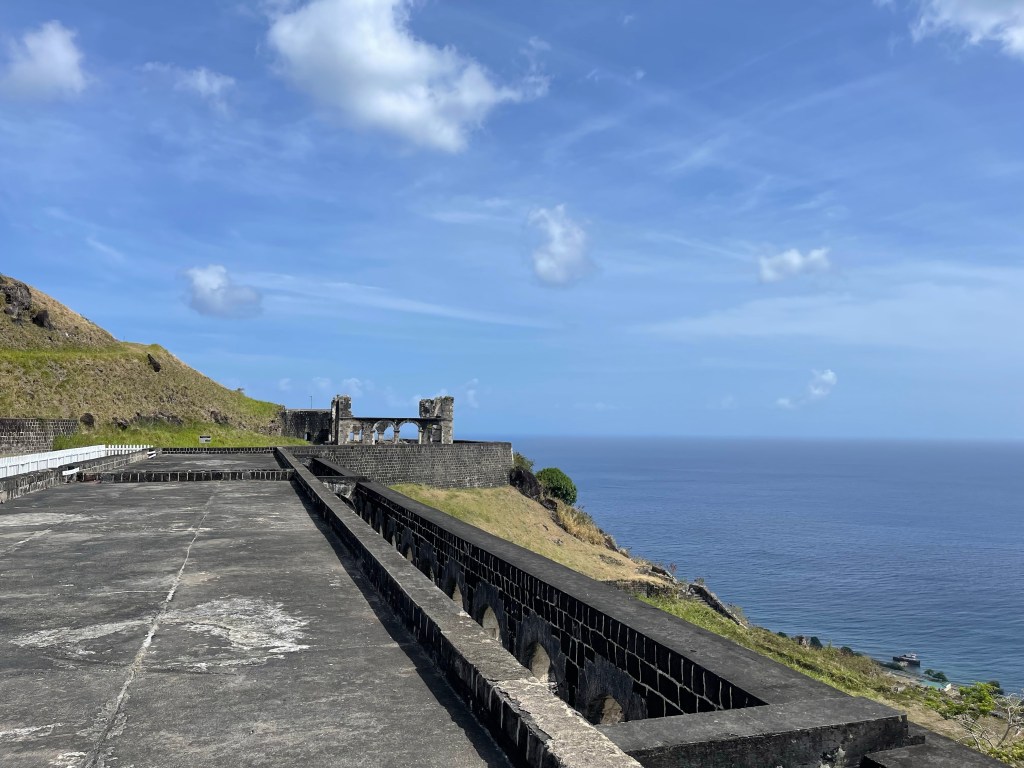
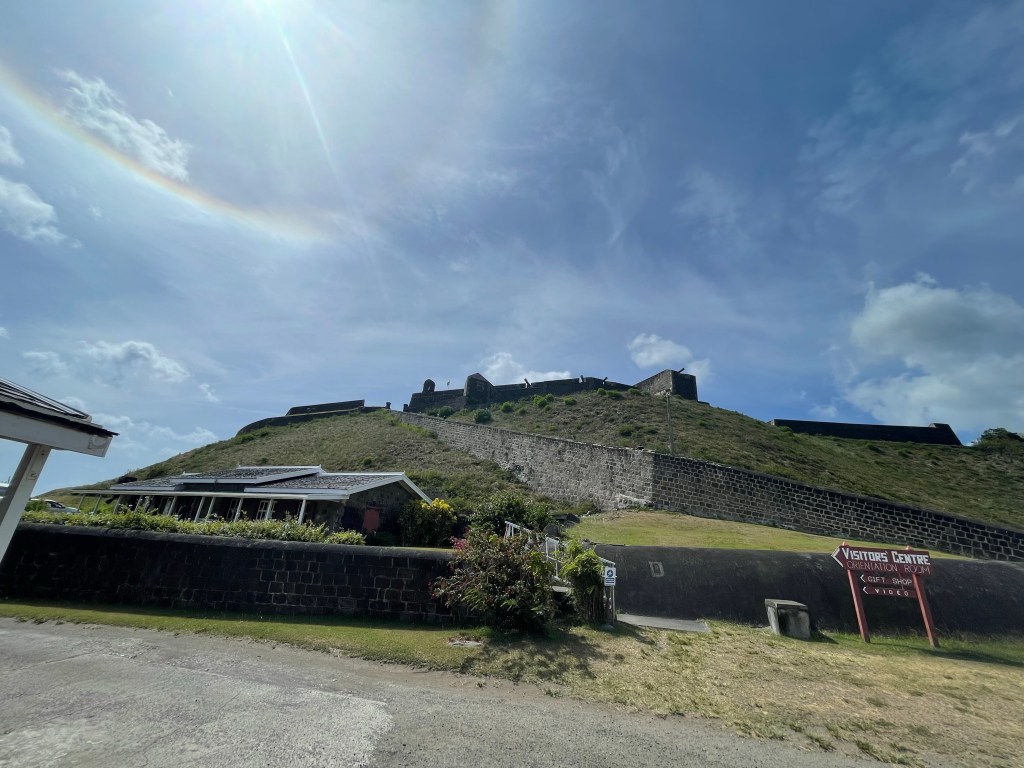
On a steep and imposing chunk of rock with the mountains at her back, Brimstone Hill Fortress continues to watch over the Caribbean long after the strategic reasons for having a fort here at all have faded into history. Today St. Kitts and Nevis, and the other island nations nearby, are destinations for fun in the tropics, but three centuries ago these islands were strategically valuable producers of tobacco, cotton and especially sugar and its byproducts, molasses and rum. The conflicts between England and France were played out in the North American colonies and in small islands like St. Kitts. While most soldiers considered being stationed in the tropics a death sentence due to the high mortality rate (from disease, alcoholism, etc), it was nothing compared to that suffered by the original inhabitants and the slaves that built the fortress. Each were decimated as the history of this place evolved. Visiting the castle after playing tourist for a few days, the contrast between the joyful destination of today and its dark history was sobering.
They say that history is written by the victors. This is largely true, but with enough time and clues, you find enough evidence to piece together a more complete story. The English and French united to massacre thousands of Caribs (kalinagos) in 1626 at a place aptly called bloody point, not far from Brimstone Hill. Once they’d eliminated the native population, the English and French divided St. Kitts between them, with the English taking the middle of the island and the French the rest. This tenuous peace between colonists would last until 1713 (the end of Queen Anne’s War).
Brimstone Hill Fortress was built by slaves between 1690 and the 1790’s. The slaves were brought from Africa in a continuous loop that began the slave trade of tobacco, cotton and sugar for captured and enslaved people. This highly lucrative trade created generations of wealth and tragedy. The fortress is an early example of the polygonal system, which created fields of fire to ensure that all sides were covered from assault. The sheer height of the fort ensured it would be very difficult to attack from the ground, while offering the prominence of the high ground to fire canon balls up to a mile away. This was state-of-the-art technology for the time. The volcanic stone was mined and cut into a formidable fortress, using lime quarried from lower in the mountain.
During the American Revolutionary War, the French (allied with the American colonists) invaded St. Kitts and laid siege on the fortress from January and February of 1782. A siege is the kryptonite of a fortress, as the inhabitants face a dwindling supply of water, food and ammunition while the attackers wait them out. Eventually even the strongest fortresses capitulate, and the English surrendered and marched out with full honors. A year later the English were back again when the Treaty of Paris restored the islands to them.
Today the Brimstone Hill Fortress is a Unesco historic site and remarkably well preserved. Many of the original canon line the fort, awaiting an assault that will never come. Today’s assault is from tourists seeking out the spectacular views from the fortress, stirred with a sobering history lesson. It’s absolutely worth the trip up the narrow, winding road on a clear day. A walk out to the outer walls confirms exactly why they built the fortress here—you can see forever in all directions. Including the past.