Month: June 2023

  • Mingling with Do You Ever

    There is a pleasure in the pathless woods,
    There is a rapture on the lonely shore,
    There is society, where none intrudes,
    By the deep Sea, and music in its roar:
    I love not Man the less, but Nature more,
    From these our interviews, in which I steal
    From all I may be, or have been before,
    To mingle with the Universe, and feel
    What I can ne’er express, yet cannot all conceal.
    — Lord Byron, Childe Harold’s Pilgrimage

    Do you ever look at the surface of a pond or pool and wonder at the gumption of those who would breach the surface and enter another world? Dolphins and whales leap from the deep and experience our world for a brief moment. Humans dive into water and recall deep within the connection. There’s a calling in water that draws us there. Those who live there apparently seek time in our world as well. This is as it should be, for we are all of the water.

    Do you ever feel the presence of the trees when you walk deep in the woods? The ancients, not the brash young things fighting for a place in this world. Old growth trees know things we’ll never know in our brief lifetime. Rooted deeply into the past, reaching into the future, grounded by a sense of place, trees are the life force of the forest. When we cut down forests we rob ourselves and generations to follow of all of these things.

    Do you ever spend time above treeline, looking at clouds mingling with the lower peaks below you. Are we meant to be in such places where even the wild things steer clear? Walking in such places brings us closer to the universe, and to the heights we may aspire to in our quiet moments of bold reflection.

    We all want a sense of timelessness and a place with the infinite. We forget sometimes that we’re already a part of it. We can’t see the forest for the trees. We must break the surface of self-absorption and see what we’ve been missing deep within ourselves. Doing more of the “do you ever” things is a step in the right direction.
  • A Visit with Myles Standish

    Duxbury, Massachusetts doesn’t have the same notoriety as its neighbor Plymouth, but the roots of history run nearly as deep here. To be fair, if people think of Duxbury at all, it’s usually as an upper class suburb of Boston. There’s plenty of wealth on display in this town. But step away from the massive homes with their perfectly manicured gardens and you’ll find a legacy that reaches back to the Mayflower. The most famous character on the Mayflower, Myles Standish, lived and died in Duxbury, and is buried in what is now known as the Myles Standish Burying Ground.

    The burying ground was once adjacent to a meeting house, long gone, but marked with granite stones to indicate where it once stood. It is the oldest continuously maintained graveyard in the United States. The lay of the land is largely the same within the enclosure. The thing about graveyards is you’re walking on ground largely unchanged since the days when the people buried there were laid to rest. The entire area around a graveyard becomes housing developments and strip malls and paved roads, but these small graveyards are a time machine back to another time.

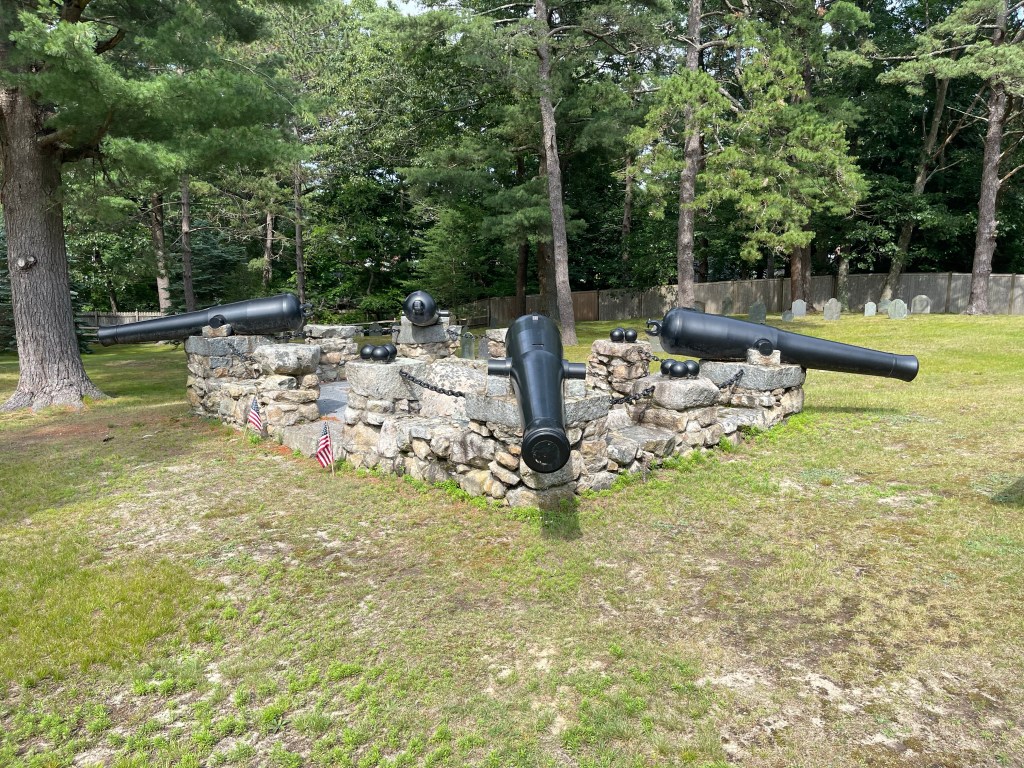
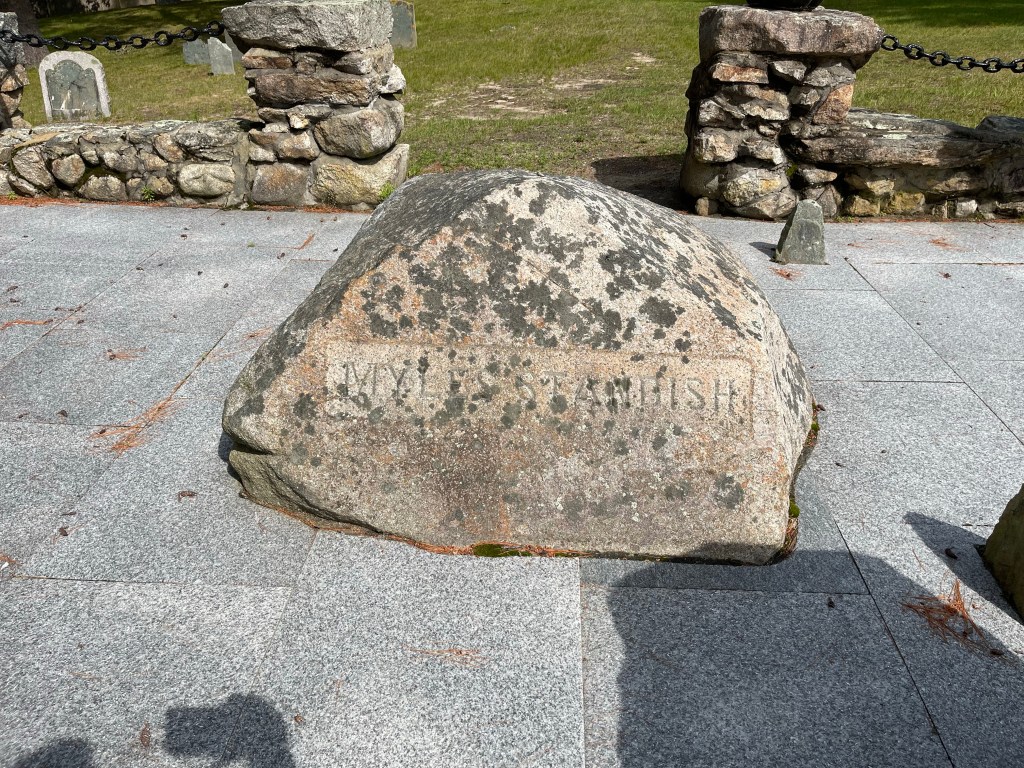
    Captain Jonathan Alden, son of Mayflower passengers John and Priscilla Alden, is also buried in this graveyard, and his is the oldest gravestone in the burying ground. Standish, who died well before Alden, likely had small pyramid-shaped stones marking his interment initially, and the monument built around the spot in 1893 (you can see one of these stones behind the boulder engraved with Myles Standish’s name in the picture below). That engraved boulder, like Plymouth Rock, is something for the tourists. The monument itself, with a fieldstone wall surrounding it and four cannon mounted on each corner, projects the violent boldness of the man interred beneath.

    Myles Standish was a military advisor to the Pilgrims. By all accounts he was brutal and decisive in his actions. He would preemptively attack when he heard trouble was brewing, and famously stuck the head of one rival, Wituwamat, on a pike as a deterrent to others. There seems to be no doubt that Wituwamat was lured into a room and murdered. Was this act of brutality something to be celebrated or scorned? Was there a legitimate threat to the Pilgrims, and could it have been resolved in a more diplomatic way? What’s clear is Standish believed he was fighting for the lives of the colonists, and used any method he could to intimidate those who he believed were threats to their safety. As with all history, we judge it from the comfort of distance.

    At another spot in town, on a point of land jutting out into Kingston Harbor, there are four more granite stones laid out in a park amongst multi-million dollar homes overlooking the harbor. It was here that Myles Standish actually lived. I found this interesting, as a military man like Standish would normally seek the high ground. A review of a Google map later revealed a small pond nearby that would have been his source of fresh water. Perhaps Myles dined regularly on Duxbury oysters, which have become almost as famous as the town’s most notable resident.

  • Becoming Rich With Memories

    “The business of life is the acquisition of memories. In the end that’s all there is.” — Mr. Carson of Downton Abbey

    “You retire on your memories. When you’re too frail to do much of anything else, you can still look back on the life you’ve lived and experience immense pride, joy, and the bittersweet feeling of nostalgia…. Making deliberate choices about how to spend your money and your time is the essence of making the most of your life energy.” — Bill Perkins, Die With Zero

    We all talk of how the time flies by, but perhaps we ought to focus on how many great memories we accumulate in that span. If we’re living well, experiences are acquired and flipped into memories with the turn of the calendar. We may not become financially wealthy, but surely we might accumulate a lifetime of memories worthy of our time. As the quote above points out, in the end, isn’t that all there is?

    What are memories but the realization of deliberate action? As much as I love a good spreadsheet, I know deep down that working in them isn’t creating memories that will last a week, let alone a lifetime. But I may just remember the conversation I have with someone important in my world a lot longer. I may recall the thrill of peering over a cliff at an angry ocean in Portugal and smile someday when I’m too old for such things. I expect I’ll still smile at the recollection of my kids realizing the amusement park ride they insisted on going on was going to be a lot scarier than they’d bargained on when they begged to go on it. This is the accumulated wealth of memories.

    Perkins’ book challenges us to stop accumulating savings and start spending our money while we’re healthy and fit enough to actually do the things we promise ourselves we’ll eventually do, someday, when we retire. As if we can do at 65 what we might do at 25 or 35. Do it now. There is no tomorrow, and if there is, we won’t be able to pull off some of the things we believe our bodies and minds will be capable of someday when.

    I’ve watched too many people in my life hear the news that they won’t make it to retirement. Cancer seems to be the most common thief of dreams, but maybe an accident or a heart attack steals everything you’ve ever planned for “someday when” away from you. Your life is now: accumulate the memories that will make you richer then. It’s the best return on investment we can have with today.

  • The Less Lazy Way

    “Men are inclined to laziness. Some will feel that he might have said with greater justice: they are all timorous. They hide behind customs and opinions. At bottom, every human being knows very well that he is in this world just once, as something unique, and that no accident, however strange, will throw together a second time into a unity such a curious and diffuse plurality: he knows it, but hides it like a bad conscience.” — Friedrich Nietzsche, The Will to Power

    To borrow the Kenny Loggins phrase: This is it. Make no mistake where you are. You’re going no further. We know this intuitively, yet we still wrap ourselves in lazy routines and escapism. We’ve got nothing more than now to work with, yet we treat our days as frivolously as disposable napkins. ’tis now or never friend. Break the lazy—be bolder.

    Easier said than done. We all have our bank of bad habits. I know I ought to work out more and put in more time with the things I’m leaning into becoming. But life gets busy, people we care about need our attention, work demands are never quite satiated. The fact of the matter is, after a long day of filling other people’s buckets our own feels pretty empty. Good enough seems okay in such moments. This is where we must break free of ourselves.

    “How does one become stronger? By deciding slowly; and by holding firmly to the decision once it is made. Everything else follows of itself.” ― Friedrich Nietzsche, The Will to Power

    Decide what to be and go be it. And then establish habits that affirm the identity we wish to have in this brief lifetime. Simple, right? We know better. Creating the person we wish to become is never simple, but it is possible. This is the less lazy way, and everything else follows.

  • The Way of Rain

    You have been forced to enter empty time.
    The desire that drove you has relinquished.
    There is nothing else to do now but rest
    And patiently learn to receive the self
    You have forsaken for the race of days.

    At first your thinking will darken
    And sadness take over like listless weather.
    The flow of unwept tears will frighten you.


    You have traveled too fast over false ground;
    Now your soul has come to take you back.


    Take refuge in your senses, open up
    To all the small miracles you rushed through.

    Become inclined to watch the way of rain
    When it falls slow and free.
    — John O’Donohue, For One Who is Exhausted, A Blessing

    I might go weeks without reading poetry. I may feel victorious in my efficiency and productive use of time. I can sometimes grind through my days in hopeful work, forgetting to walk outside to greet the day. These are days of emptying the bucket while filling the ledger with checked tasks. Empty buckets make a hollow sound. They demand to be filled.

    It’s not lost on me that I’m posting about taking time to rest at the beginning of another work week. When we go, go go! for weeks at a time, sometimes things like weekends disappear in a flash. We forget to see the small miracles we rush through in our mad pursuit of getting things done.

    Slow down. Step away. Find that which is calling you from outside yourself. The work will always be there, awaiting your return. Or maybe it was never your work at all. How can you know if you never take the time to listen?

    The days and the seasons roll on by, like waves to the beach. We only have so many days. Only so many seasons. We must learn to slow down and celebrate the one we’re in.

  • Being Frugal With Sand

    When the goal is to seize the day—Carpe diem— then being busy is the natural state. To do everything we wish to do in a lifetime requires our full attention. But the thing about attention is it is quickly stolen away by all of life’s distractions. Focus is thus essential to prioritizing the most important things. We know when we’re being pulled away from the meaningful and important, and when we’re deeply immersed in it. What we lean into makes all the difference in how we feel about those grains of sand moving through the hourglass.

    There’s no doubt that one kind of “being busy” can be viewed as a distraction from other things we ought to be tackling. But there’s also a kind of “being busy” that is living an active, meaningful life. One key indicator is the phrase itself: When we say we’re very busy, it’s usually the distracted kind of busy. When we’re deeply engaged in meaningful activity, we don’t think of ourselves as being busy so much as making the most of our time.

    Taking stock of the year as we close in on the halfway point, we might be amazed by all we’ve done with the time. I hope so, for isn’t that the point? To augment our days with joyful activity at the expense of all of the trivial pursuits that the universe throws at us has always been our underlying mission.

    It’s one thing to be aware, it’s another to be absorbed by the trivial. How many grains of sand would we trade for things that don’t matter in the end? We must be frugal, even as we must be active. Our lives depend on it.

  • The Present

    “And I asked myself about the present: how wide it was, how deep it was, how much was mine to keep.” — Kurt Vonnegut, Slaughterhouse-Five

    “It occurred to him that there must be some state institute, a kind of time bank, where he would be able to change at least some part of his shabby seconds.” — Rainer Maria Rilke, The Notes of Malte Laurids Brigge,

    Time is not ours to keep—more a wave we surf to the beach. We dabble in time, thinking about improving our productivity and efficiency and doing more with less, but really, we’re trying to avoid wasting the time we have. Making the most of the present is the only worthy goal as we surf this wave.

    Lately conversations about time have come up a lot in the circles I run amuck in. Talk of people taking more time off, people who feel they’re time hasn’t been used wisely, people quickly running out of time (I’ve had more conversations about hospice recently than at any time in my life). Everybody is going through something in their lives. The surfing isn’t always great in this complex world.

    This writing habit is one of the best things I’ve invested my time in. Writing isn’t passing the time, and it isn’t a celebration of one’s greatest exploits. It’s putting a spotlight on the hourglass and seeing each grain of sand and savoring the seconds. This is living in the present: good, bad and all that lies in between. The secret is to add depth and breadth to each moment of it. And maybe write the chapter in such a way that it lives on beyond the present.

  • Life is Sweet

    They told you life is long
    Be thankful when it’s done
    Don’t ask for more
    You should be grateful
    But I tell you life is short
    Be thankful because before you know
    It will be over
    ‘Cause life is sweet
    And life is also very short
    Your life is sweet

    — Natalie Merchant, Life Is Sweet

    The very first time I saw the VH1 Storytellers video for this song I was getting dressed in a hotel room in California preparing for a busy day on a business trip. By all accounts it was a day of hopefulness and adventure. With the lyrics running in my head, it became the soundtrack forever associated with a tragic event in American history for me. That was the day that Columbine happened. I’ve been wrestling the song back from that event ever since.

    There are people who will go to great lengths to apply their own brand of miserable to the world. But life can be beautiful if we offer a different perspective. We may not have as many days, or as many good days, as we’d want out of life. But the gift is there for us to celebrate should we take the time to unwrap it.

    Returning from a business trip last night through Washington DC, flight again delayed and overbooked, as they all seem to be nowadays, I glanced at the television monitors showing rolling footage of another tragedy, this one the Titan submarine that imploded on a Titanic dive. We all know that life is short, and the untimely deaths of people making the most of their lives can be shocking. Perhaps that’s why everyone slows down when passing an accident scene, or tunes in when breaking news occurs. Each day offers the opportunity to affirm our beliefs in the darkest nature of humanity or the very best within us. What do we focus on in the moment?

    Memento mori. Carpe diem. We know the soundtrack. Dance with life while the music is playing.

  • All is Well

    “I conclude that all is well,” says Oedipus, and that remark is sacred. It echoes in the wild and limited universe of man. It teaches that all is not, has not been, exhausted. It drives out of this world a god who had come into it with dissatisfaction and a preference for futile sufferings. It makes of fate a human matter, which must be settled among men.
    All Sisyphus’ silent joy is contained therein. His fate belongs to him. His rock is his thing. Likewise, the absurd man, when he contemplates his torment, silences all the idols… Sisyphus teaches the higher fidelity that negates the gods and raises rocks. — Albert Camus, The Myth of Sisyphus

    Fidelity has two meanings, of course, but in the case of Sisyphus, it’s verism—we humans must embrace the entirety of life, not just the beautiful but warts and all. That means the drudgery, the pain, the elation and the wonder. As with Sisyphus, this is our curse, but also our purpose. We’re here to do what we can with the circumstances life delivers to us. Amor fati.

    There are a lot of people who would rather dabble in distraction and conspiracy theories, rather than face the rock and push. The realist finds clarity in verity and derives purpose in the push. Some days grind us to dust. Some days fill us with joy. Each is a gift we may not fully realize. Sometimes the gift is surviving to fight another day. So it is. We have but to react to it in the moment and find that bit of hope that keeps us going to we push again. All is well, friends.

  • The Story Continues

    “Nothing in my past life fills me with the vain desire to repeat it. I have never been anything more than a mere vestige, a simulacrum of myself. My past is everything I never managed to become. Not even the feelings associated with past moments make me nostalgic; what one feels is of the moment; once that is past the page turns and the story continues, but not the text.” — Fernando Pessoa, The Book of Disquiet

    I confess that reading Pessoa is a struggle for me. I am a different person than he was, trying to engage with the world and not just be a witness to it. Still, I press on with his book, off and on, working to finish it one of these days. James Joyce said that life is too short to read a bad book, and I generally subscribe to that theory. The thing is, I don’t believe that The Book of Disquiet is a bad book, it’s just not a book that resonates with me at this moment. Yet here I am, quoting it anyway, precisely because some of what he writes does indeed resonate with me. Perhaps that’s enough in the end.

    If you could, would you repeat a chapter of your life? When you think back on who you were at the time, would you do it again? In a life well-lived I should think you’d consider it for a beat or two. I might go back to a time of peak fitness and all the time in the world. But what is the trade-off? Would you do it all again the same way, or would you stray off the path into something different? It’s easy to remember the best of ourselves, but what of the worst?

    Give me today, thank you. Give me the next chapter of this story, not the earlier chapters that merely set the stage for who I’ve become. There’s nothing to the past but faded memories and the things that got away from us. We can only do something meaningful with today, building on the momentum that brought us here. Life is a progression, not a regression. Our best days may yet be ahead of us.