Month: August 2023

  • Two Bush Island

    Maine has 4000 islands, which means some names repeat, while other names stand out for their charming descriptiveness. Two Bush Island is one of those latter names. And coming across them inspires even more wanderlust. You simply want to explore a place like this.

    We saved our wandering for Isle au Haut (surely a future blog post), But I was left wondering about the fanciful, perhaps practical name of this tiny island. As we sailed we tossed around all kinds of possibilities, being a lighthouse station and all, but the answer was as Maine Yankee practical as we originally thought. Here is the official version of where it got the name: “The island was named by local fisherman for two large pine trees which inhabited the island and served as navigational daymarkers before the station was built. Two Bush Island Light Station was established in 1897 to mark the southwestern entrance to Two Bush Channel in Penobscot Bay”.

    That link above also offers a wonderful story of the lighthouse keeper’s dog being involved in a rescue. The dog’s name was “Smut”. One night he heard two men trying to row their dory to safety and Smut started barking at them, luring them towards the island and safety. Sure, smut can be the ruin of many a sailor, but this story clearly demonstrates that sometimes Smut can save the day.

    Two Bush Island
  • Sunrise, Tenants Harbor

    Tenants Harbor, a village in the town of St. George, Maine, was once full of schooners in various stages of construction. It retains that working harbor feel today, but today it’s lobster boats that fuel the economy. This is very obvious at sunrise, as the boats ply the waters to haul up traps to harvest any lobsters unlucky enough to have taken the bait. The lobsters will be gobbled up all over the world, and especially in restaurants and seafood shacks throughout coastal Maine. So it goes.

    Still, some of us seek a respite from work in places like this. I’ve gently placed my obligations and commitments to the side in favor of rest and relaxation for a few days. There are 4000 islands in Maine and they say 3,478 miles of tidal coastline. Along that coastline there are seals, dolphins, loons and whales. Other than writing a bit, this particular time bucket will lean into exploring some of that coastline.

    Anchors aweigh.

  • Commitment vs. Obligation

    Commitment is seeing things through despite all the obstacles, stress and BS thrown our way. Commitment is being fully present in the moment even when being elsewhere seems so damned appealing in the moment. It’s an unsaid line in the sand that you’ll do what you tell yourself you’re going to do.

    Obligation isn’t commitment. It’s a feeling that you have to do something, either because you’re required to or honor-bound to get it done. We tend to take pride in our commitments and resent our obligations. That ought to tell us all we need to know about the differences between the two.

    When commitment butts up against an obligation it can cause stress and consternation. We desire to serve our commitments but sometimes obligations get in the way. The trick is to minimize obligations while focusing on our commitments. Easier said than done, but so it must be. Life is complex, no doubt, but the recipe for happiness is leaning into the commitments we wish to serve while separating ourselves whenever possible from the obligations.

  • Catching Days

    “How we spend our days is, of course, how we spend our lives. What we do with this hour, and that one, is what we are doing. A schedule defends from chaos and whim. It is a net for catching days. It is a scaffolding on which a worker can stand and labor with both hands at sections of time. A schedule is a mock-up of reason and order—willed, faked, and so brought into being; it is a peace and a haven set into the wreck of time; it is a lifeboat on which you find yourself, decades later, still living.” ― Annie Dillard, The Writing Life

    The days fly by, don’t they? We fill our hours with chaos and whim or reason and order, and so goes our life. Structure thus becomes a means to a more fulfilling lifespan. That doesn’t infer rigidly-defined productivity at the expense of joyful experience, but rather using our time strategically to make the most of the what’s available to us.

    Just imagine: Imagine what we can do with our lives should we add a bit of informed structure to our driving purpose. Imagine the places we might see, the people we might influence. Imagine the ripple set across time with just a bit more focus on catching days. Imagine following through on that quiet commitment you made to yourself to do the work that speaks to you.

    We know that focusing means saying no to the parade of other options that flood our senses. No to watching that amazing episode of The Office for the nth time, no to diving into that trendy new hobby that friends are doing, no to all kinds of potential fun that we may say yes to this other thing. But that’s the rub: to do anything well we must do most everything else less well, or not at all.

    “Living life to the fullest requires settling. You must settle, in a relatively enduring way, upon something that will be the object of your striving, in order for that striving to count as striving.” — Oliver Burkeman, Four Thousand Weeks

    So are we striving for something or simply going through the motions? We choose how we react to the world as it’s presented to us, and in that reaction is our opportunity to fill our moments with something more meaningful than the other options on the table. In the heat of the moment life can feel frenzied and limited. We can’t possibly do everything.

    When we think of life in terms of time buckets or seasons, it can help bring clarity to what is essential now, versus then, and allow us to prioritize accordingly. What is most essential right now? Life would be boring with blinders on the entire time—to live fully we must open ourselves up to the world around us—but that doesn’t let us off the hook. We must carve out time for what is essential lest the time slip away forever.

  • Seeing the Way

    Only the perfect man can transcend the limits of the human and yet not withdraw from the world, live in accord with mankind and yet suffer no injury himself. Of the worlds teaching he learns nothing. He has that within which makes him independent of others.
    If the eye is unobstructed, the result is sight. If the ear is unobstructed, the result is hearing. If the nose is unobstructed, the result is smell. If the mouth is unobstructed, the result is taste. If the mind is unobstructed, the result is wisdom.
    — Chuang Tzu

    In the quest for clarity, we must remove the distractions and occlusions that get in the way of truly seeing. Mostly, this is our monkey brain at work, but often the circle of influence around us plays their part too. It isn’t a stretch to think of examples of the times we’ve opted for anything but seeing (the phone currently cradled in your hand is a great tool for this). We all want clarity, but take great pains to avoid it. Such is life.

    Seeking wisdom in a world full of madness seems frivolous on the one hand but absolutely essential on the other. None of us get out of this alive, but we may transcend our current hyper-distracted mind with a bit of applied focus. Easier said than done: I mean, I just got a puppy. I’ve blown up part of my home with yet another remodeling project. I’ve got a brother with terminal cancer. Who has time such pursuits as wisdom when your world is upside-down?

    The thing is, life is always full of such urgent distractions. We have to pause a beat, even in the most maddening of times, and find clarity and purpose. Without it we’re simply winging it through life, and find ourselves looking around and wondering where the time went. We must fill our lives with the essential for our lives to be fulfilling. The things I listed as distracting from purpose are themselves essential for a full life. You likely have a similar list. The aim isn’t to remove these things, but to rise above them to see the forest for the trees, that we know where we’re going. To know, deeply, that this is the way for us.

  • Dog Days & Lily Ponds

    August of another summer, and once again
    I am drinking the sun
    and the lilies again are spread across the water.
    I know now what they want is to touch each other.

    — Mary Oliver, The Pond

    As we head into the dog days of summer, I find myself with a good dog to share walks with. Puppy walks are wonderful too, but the longer walks are mine alone. Walking for distance solves many problems for me: general fitness and quality time with the occasional long-form podcast, but mostly it offers the opportunity to reacquaint myself with the world.

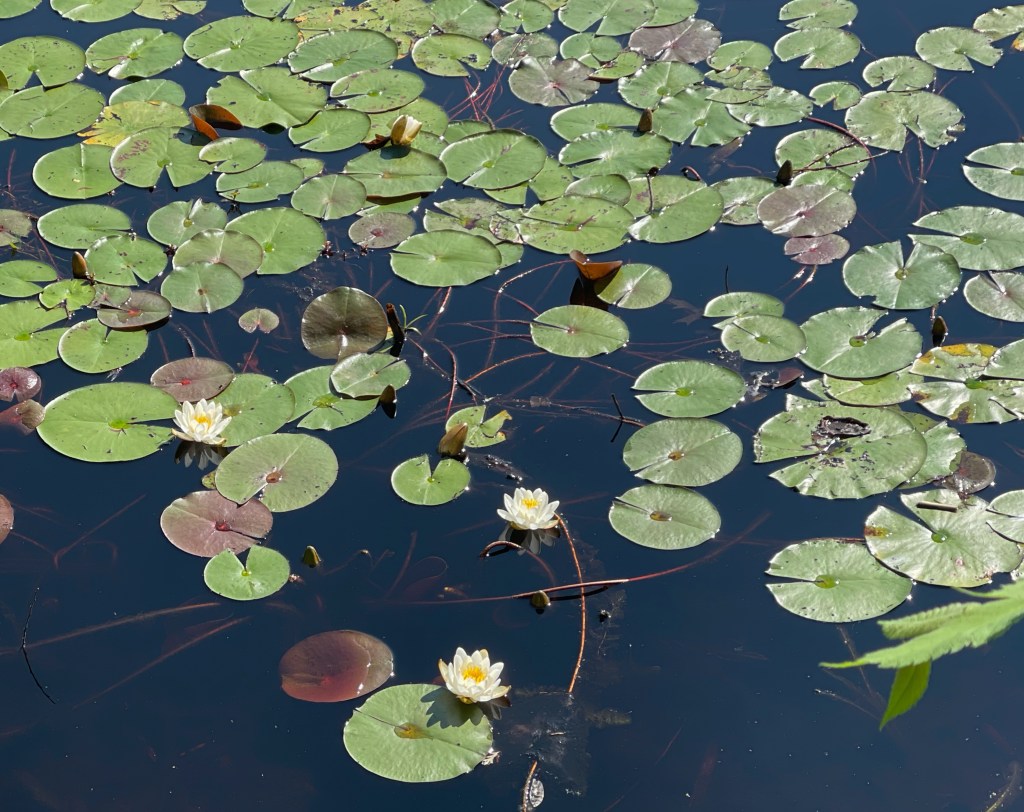
    One of my favorite things about this time of year is the abundance of flowers dotting the lilies in the ponds I walk past. Each is a marvel, and each is just far enough away that I can’t possibly get a good picture with my phone’s camera. But that’s just the way it is. After all, this is a written blog, not a first-rate photography blog.

    About that drinking the sun business Mary Oliver speaks of in her dance with words: We haven’t had all that much of it this summer in the northeast. Not at the frequency that we wait for all winter, anyway. So on a stunningly beautiful weekend what are we to do but get out in it? To be with others outside invites conversation and smiles, and like the lilies, we are drawn to each other on warm summer days. We want these days to last forever, but know they’ll be gone too soon. Savoring summer days with all our might is the very best way to pass this time. So forgive me if I step outside once again.

  • Expanding the Fullness

    “Five decades ago, some very kind people in Japan slipped me the secret: you can dramatically extend life—not by multiplying the number of your years, but by expanding the fullness of your moments.” ― Shinzen Young, The Science of Enlightenment: How Meditation Works

    “Pay more attention to every moment, however mundane: to find novelty not by doing radically different things but by plunging more deeply into the life you already have.” — Shinzen Young

    I don’t meditate, not in the traditional sense anyway. Instead I remain present with whatever the world offers me. With a new puppy I’m very much in her moments as she learns her new environment and sorts out the complexity of living with two cats who aren’t yet pleased to share the limelight with a new being. Some things take time.

    The trick is in savoring our presence right here and now. We ought to immerse ourselves in whatever we’re doing, but we get caught up in the minutia of everyday living instead. We react instead of absorb, and in doing so, sometimes miss the nuance of the moment. But seeing how a new puppy navigates the garden changes how you look at it yourself. Zooming out a bit, you also see how the world reacts to the new puppy. Fellow humans gush, while felines feign annoyed indifference. House wrens chirp threateningly when the pup gets too close to their nest, betraying something else happening there that I wasn’t previously aware of. When we pay attention to the world it opens up for us in fascinating new ways.

    The other day I sat in the sun while my brother slept, exhausted from sleepless nights from the pain he finds himself in as he undergoes a third round of radiation. He’s got limited time now, and the quality of the time he does have is greatly diminished by the treatment plan he’s chosen. Despite the underlying tragedy of his situation, my own in that moment was rather pleasant, and I was struck by the contrast as the two of us occupied a small corner of the world in very different phases of our respective health spans. Contrast aside, or perhaps serving as an amplifier, I found myself very much in the moment.

    It isn’t lost on me, the end of life struggles of one person against the beginning of life awakening of a puppy. And me? Somewhere in between, living day-by-day and doing my best to savor the plunge.

  • Our Most Important Things

    So easily forgotten are the most important things
    Like the melody and the moonlight in your eyes
    And a song that lasts forever, keeps on gettin’ better
    All the time
    — Keb’ Mo, Life Is Beautiful

    Walking a lot of miles lately, I’ve come to see the town I live in at ground level, turning corners into places I haven’t been in a long time, or ever before. I see the changing nature of things, and I’m reminded of a time not so long ago when it was my own children at beginner’s summer soccer camp or at baseball practice. These stages of life fly by quickly, but the next generation steps right on to that field to build someone else’s memories. Our own will inevitably fade, perhaps, but the foundation laid in time and presence is strong.

    I walk to cover miles, deliberate and at the fastest pace I can sustain for 5-7 miles. I’m not a speed walker but I have a long stride that helps when the aim is fitness and mileage. Countering this pace, a couple of times a day I take the new puppy for a walk. She’s finding her courage in a strange new world, and the pace is much slower than my normal stride. My favorite Navy pilot once told me that when you’re walking a dog you aren’t walking, the dog is walking. You’re just keeping it company while it experiences the world. So rushing that experience does the dog a disservice, but it does for us too. Like those children growing up way too quickly if we aren’t paying attention, puppies grow up too. Embrace the pace you find yourself in, for one day it will change again.

    For all the changes happening all around us, some things remain the same. It’s easy to forget the people and routines that hold us to solid ground when life does cartwheels. They offer something tangible and meaningful for us in good times and bad, through the dizzying pace of rapid change and the dullest days of stagnation and limited progress. We ought to celebrate our quiet anchors, even as we explore the changes life takes us through. They are our most important things as we sort out the changes and find our stride for what comes next.

  • Now Happening

    “It’s the very last thing, isn’t it, we feel grateful for: having happened. You know, you needn’t have happened. You needn’t have happened. But you did happen.” — Douglas Harding

    My brother was told he had six months left to live. This was naturally shocking to him, less so for some of us who have watched his decline. Early on I used to speak in stoic terms about memento mori and such things, but he doesn’t need such reminders, he’s processing it in the moment. So why don’t we? Because we aren’t told in such concrete terms what our expiration date is. Yet it’s there, lingering in the distance, someday much sooner than we might believe.

    Sometimes we over-complicate this existence thing, forgetting the gift for all the friction and pettiness of living. Gratitude for having happened at all is a wonderful sentiment, and one we ought to embrace more. Make each day a celebration worthy of the gift. For it’s more than just happening, it is a happening. Dance with it.

  • ChatGPT (as?) Me

    ChatGPT can be seen as a tool to enhance productivity or to accelerate the end of days. The optimist in me sees the potential in Artificial Intelligence (AI). As with any technology, it’s people who weaponize it. The moment you can create a nuclear weapon out of household goods is the day we all should contemplate the afterlife. Assuming controls are in place, we might actually find value in AI. Then again, it might just steal all of our jobs. As a creative type, I have to admit to being both delighted and humbled by the speed and accuracy of ChatGPT when I started using it.

    Consider my chat, “summarize War and Peace in one paragraph”:

    “War and Peace” is a classic novel by Leo Tolstoy, set in 19th-century Russia during the Napoleonic era. The epic story revolves around the lives of five aristocratic families and their experiences during times of war and peace. It delves into themes of love, ambition, fate, and the human condition. The narrative masterfully interweaves the personal journeys of its characters, showcasing the effects of war on society and individuals, while also exploring profound philosophical reflections on life and historical events. The novel’s vast scope and intricate character development make it a timeless exploration of the human spirit, offering profound insights into the complexities of human relationships, the consequences of our actions, and the pursuit of personal and societal meaning.

    Now consider something far more personal for me, “summarize the content of alexandersmap.com in one paragraph”:

    “Live with intention, embrace the journey, and seek a deep connection with the world around you. Be curious, explore new places, and appreciate the beauty of nature. Cultivate gratitude for the small moments and cherish the relationships with loved ones. Embrace challenges as opportunities for growth, and find balance between work, leisure, and reflection. Understand that life is a continuous learning process, and wisdom comes from experiences, failures, and self-awareness. Strive to leave a positive impact on others and the planet, fostering a sense of community and global consciousness. Ultimately, find purpose in living authentically, mindfully, and with a sense of wonder, making the most of every moment on this extraordinary journey through life.”

    Wow. Lovely summary, and great advice! But it raises a serious question: Why go on writing? If AI can tap into everything we’ve ever done and write in our style, why should we create anything at all? Well, because we are each processing our own data aren’t we? Life is a string of days figuring things out at our own pace, and writing offers a way to create something beyond ourselves. We ought to continue writing our own verse, not just in spite of it all, but because the ripple matters. ChatGPT didn’t create my words, it summarized them from an admittedly modest ripple across the Internet. Somewhere within there is my contribution. Somewhere in there is me.

    In the context of infinity none of this matters a great deal anyway, but it matters just enough to keep at it. We aren’t nihilists, we’re artists. Art is an expression of something profoundly unique deep within us. Maybe AI can mine a large enough sample size to offer a close-enough copy, but it’s still nothing but a derivative of the original work. So keep doing the work.