Month: February 2024

  • Leap (Right Now)

    Don’t wanna wait til tomorrow,
    Why put it off another day?
    One more walk through problems,
    Built up, and stand in our way ,ah
    One step ahead, one step behind me
    Now you gotta run to get even
    Make future plans, don’t dream about yesterday, hey
    C’mon turn, turn this thing around
    Right now, hey
    It’s your tomorrow
    Right now,
    C’mon,it’s everything
    Right now,
    Catch a magic moment, do it
    Right here and now
    It means everything
    — Van Halen, Right Now

    Another Leap Day is upon us. Seth Godin’s blog post today suggested this is a great opportunity to leap ourselves. I would suggest something similar. And shouldn’t we take our own advice? Be bold today. Do the thing that we’ve procrastinated on. We won’t have another Leap Day for four years. Imagine, what can we accomplish in that time? Leap.

    When such thoughts creep into my head, a playlist comes to mind. Really, there’s a playlist for everything in my world, and Leap Day is no exception. Today’s theme then must align with the day. What better tune to have in the back of your mind on this day than Right Now? So catch a magic moment. Do it right here and now.

    When we leap, we ought to have a rough idea where we might land. But all leaps have uncertainty to them. That’s why most people never leap at all, but shuffle along in life climbing from one safe landing to the next. That’s fine most days, but shouldn’t we shake it up now and then? Maybe once every four years isn’t enough leaping, but isn’t it a good place to start? We might find we like the journey all the more.

  • The Grave of the Female Stranger

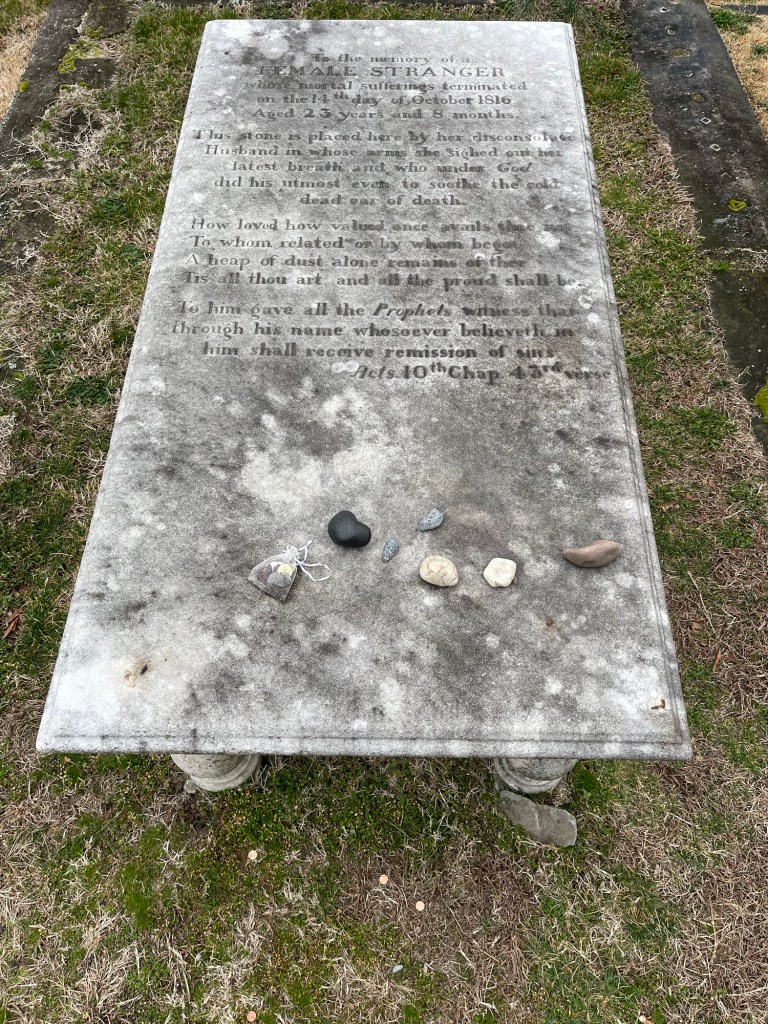
    Alexandria, Virginia is full of history, making it a wonderful place for a history buff to wander about. My early morning walk took me to the Alexandria National Cemetery and the neighboring St. Paul’s Cemetery. Honoring the Union dead was a given, but the lure of my trip was the tragic tale of a young woman visiting the region who died in 1816 shortly after her arrival. The story goes that she and her husband gathered the doctors and nurses before she passed away to have them swear never to reveal her name. They honored her wish and went to their own graves having never told her name. Her husband spent a small fortune on an elaborate tabletop gravestone and then skipped town before the bill was paid. The mystery of the Female Stranger lingers to this day. It’s said that her ghost still haunts the Gadsby’s Tavern, where she apparently died.

    Atop the gravestone is engraved the following:
    To the memory of a
    FEMALE STRANGER
    whose mortal sufferings terminated
    on the 14th day of October 1816
    Aged 23 years and 8 months
    This stone is placed here by her disconsolate
    Husband in whose arms she sighed out her
    latest breath, and who under God
    did his utmost even to soothe the cold
    dead ear of death
    How loved how valued once avails thee not
    To whom related or by whom begot
    A heap of dust alone remains of thee
    Tis all thou art and all the proud shall be
    To him gave all the Prophets witness that
    through his name whosoever believeth in
    him shall receive remission of sins
    Acts. 10th Chap. 43rd verse.

    The unique gravestone is easy to spot, and yet I always seemed to be looking in the other direction as I walked through the St. Paul’s Cemetery. The Female Stranger is not the only soul interred at the cemetery, and I spent some time reviewing the lives of her neighbors on my walk before finally circling back to give my respects to this young lady who’s spirit still haunts the region more than two centuries later. The tokens and coins left behind by other visitors indicate she is more famous in her anonymous death than she ever might have been had her name simply been revealed.

  • Front Loading Productivity and Purpose

    “Putting first things first means organizing and executing around your most important priorities. It is living and being driven by the principles you value most, not by the agendas and forces surrounding you.” — Stephen Covey

    Early risers are normally starting the day a step ahead, while late risers begin a step behind. That doesn’t translate into what each accomplishes in a day, but it does play a part in how we feel. I hate feeling like I’m late for anything. Some people in my life don’t stress about such things unless it’s a flight or other time-dependent circumstance. Who says one is better than the other? But we know which is better for us.

    Productivity isn’t dependent on starting early, but when we prioritize the right things first it helps ensure that those things get done. For years now that’s been writing, reading and my most essential work tasks. Everything else can fall into place, get piled on or slip to tomorrow, but the day will be deemed a success once I’ve checked those right boxes.

    We know what is essential in our day because it nags at us until we’ve done it. Likewise, we know what isn’t all that important too. To borrow a concept from James Clear, we vote for our identity one checked or ignored habit at a time. He would also suggest making good habits easy to complete, and bad habits more difficult. The best way to do that is to front load the most important things and defer the trivial and bad.

    I know a brisk walk or row would greatly compliment my habit stack in the morning, but I often defer this until late in the day where excuses swirl like leaves in autumn. As a result, the fitness routine is inconsistent. Fortunately I know the fix: do it first. Earn breakfast with sweat equity. Those established habits have enough momentum to sustain a minor deferment.

    The question that greets is each morning is, what drives us? Covey was right that our principles push us forward. When we live a principled life we won’t tolerate excuses from ourselves on why we didn’t at least try harder to follow through on our promises. We become less complacent with where and who we currently are and more proactive in getting after our “it”. For there’s no time to waste.

  • Too-ra-loo-ra-loo-ral

    Over in Killarney, many years ago
    My mother sang a song to me
    in tones so sweet and low
    Just a simple little ditty
    in her good old Irish way
    And I’d give the world if she could sing
    that song to me this day
    Too-ra-loo-ra-loo-ral, Too-ra-loo-ra-li,
    Too-ra-loo-ra-loo-ral, hush now, don’t you cry!
    Too-ra-loo-ra-loo-ral, Too-ra-loo-ra-li,
    Too-ra-loo-ra-loo-ral, that’s an Irish lullaby.
    — James Royce Shannon, Too Ra Loo Ra Loo Ral

    Saint Patrick’s Day came early for me this year when tickets for The Irish Tenors became available and I quickly opted in. Life is funny that way, isn’t it? Saturday morning I woke up and The Irish Tenors weren’t even on my radar. Monday morning comes around and I’ve got their voices ringing in my head. Too-ra-loo-ra-loo-ral indeed.

    We have many such moments in our lives. Opportunities to say yes to unexpected adventures or opportunities. It’s easy to say no and just keep on doing what we always do. Routine is our saving grace in some instances, but our shackles in others. We must develop our awareness and wisdom to know when to hold ’em and know when to fold ’em. Opportunities don’t come around every day, as every human who has ever truly lived can attest.

    A good rule of thumb in such moments is to be bold but not reckless. What is the best that can come of this moment? What’s the worst? For something like attending an Irish Tenors concert, there’s almost no downside other than time away from routine—an obvious “hell yes!” For decisions where the stakes are higher, say changing jobs, there ought to be more consideration. But the filters work in either case.

    Attending that concert was delightful. I’m not one to walk around whistling old Irish songs, but I knew plenty of them. To use the French phrase, these are the moments that collectively bring us to joie de vivre and the joy of living. When we are active participants in such moments, especially with those you love, joyfulness is an attainable state. Jump right in and sing along.

  • A Walk on Plum Island Beach

    There are different ways to walk a beach. Some walks are meditative, some are merely workouts, and some are clearly meant for people-watching. The reasons why we walk lead us eventually to where and when. Each beach offers a new lens through which we may see the world and ourselves.

    My bride is a beach bunny at heart, and it turns out our pup is too. We’ve been taking her to a local New Hampshire beach for long walks and she’s grown more courageous with each bold step. She’s no water dog and won’t plunge in like our Labrador retriever would, but she’ll delightfully chase waves and bite at the sea foam. Her joy is ours, and walks on the beach have become a more frequent way of getting her away from the permanent mud season of never-winter-as-it-once-was that is our new reality.

    If Hampton Beach is a long, flat walk on firm sand, Plum Island Beach offers an experience more like Cape Cod National Seashore: soft dune sand plunging steeply in places to the ocean breakers. The dunes aren’t nearly as tall as Cape Cod, but the walk can be just as wonderful. On one end is the turbulent mouth of the Merrimack River, on the other are the dunes and swirling sandbars of Plum Island State Park reaching out into Ipswich Bay. In between are rows of homes ranging from beach shacks to McMansion: beach edition luxury homes. As with everywhere exclusive, money determines the future state of the real estate here. But Mother Nature has a say too.

    Plum Island is not an easy place to walk nor an easy place to live compared to other beaches in the area. Just as wealthy homeowners in the Hamptons on Long Island struggle with beach erosion and the fickle protectiveness of sand dunes, the people who dare to build homes on Plum Island face the same challenges. One day you’re living in paradise, the next you’re living through a nightmare of storm surge and wave action. It’s an audacious act to live in such places, emphasized with insurance rates that discourage the casual investor. It takes disposable income to have such homes in such places as this.

    Plum Island State Park prohibits dogs, so a walk to the end with the pup was out of the question, but there was plenty of beach available for our power trio. Walking towards the Merrimack River, we met a couple walking three dogs of their own. As soon as they said their dog’s name I knew it was a locally-famous author but kept it to myself. We all seek out the beach for our own reasons, and often it’s to get away from who we are further inland. We had a small reunion on the return and went our separate ways.

    Every beach has its own story to tell, just as each beach walker does. I wonder sometimes why we aren’t walking more beaches, and promised myself to add beaches to the collection of mountain summits, waterfalls and historic sites I’m collecting on my life experience list. The time bucket for such activity is now, isn’t it? We must venture out while we’re blessed with good health and a desire to do something with it. Perhaps we’ll see you out there too?

  • Why This?

    “The real voyage of discovery consists not in seeking new landscapes, but in having new eyes. ― Marcel Proust

    Yesterday I wrote of writing every day no matter what. The streak is very much alive and will be until the day it isn’t. The underlying question is why? Why do this at all? No fame or fortune or other such ego stroke. A blogger can’t even state they’re a novelist. Plenty of helpful people in my life would like me to lump a bunch of these blog posts into a series of books. Honestly, once they’ve been released into the world the words aren’t ours anymore. Perhaps that’s why they come so freely? No paywall or subscription necessary. This is just me in the moment, telling friends what I’ve stumbled upon on my journey.

    Writing is discovery. It’s finding something new within ourselves each day and bringing it to the surface. It’s surprising ourselves and others that we’re still at this thing. It’s the occasional comment from someone you hadn’t realized was paying attention at all. Writing is processing the complexities of the world and our place in it and putting a stake in the ground for who we are at this moment in time. I write these words without truly knowing where they’re coming from. We surf in this way with the Muse, along for the ride pretending we have some measure of control.

    Writing leads to an increased power of observation. It leads to new books and podcasts and small corners of the past that most people drive by on their way to someplace else. If awareness is the key to being present, then self-awareness is knowing when to shut the hell up and understand what is happening in the moment. When we write we’ve channeled that awareness into words. Here’s another time stamp of that dance.

  • Favorable Conditions

    “We are always falling in love or quarreling, looking for jobs or fearing to lose them, getting ill and recovering, following public affairs. If we let ourselves, we shall always be waiting for some distraction or other to end before we can really get down to our work. The only people who achieve much are those who want knowledge so badly that they seek it while the conditions are still unfavorable. Favorable conditions never come.” ― C.S. Lewis, The Weight of Glory

    For years I didn’t write because the time wasn’t right to write. Now I write every day, no matter what, and the words flow. It’s not ever about finding the perfect opportunity to do it, it’s about simply doing it. Always ship the work, as Seth Godin would put it.

    So what of other things? When will the workouts be more consistent? When will the pergola be fixed? What of the broken window that’s been nagging? Life is full of things we say we’ll get to someday, when. Every one of these deferred promises pile up one atop the other on our mind, rising to the top, sliding downward for another promise until they are wrestled to the top again. A lifetime of deferred promises is no way to live a life. Do what must be done and throw the rest away.

    “You can do anything, but not everything.” ― David Allen

    Looking back, it’s clear that momentum plays a big part in where we are now. We are what we repeatedly do and all that. Does that make it excellent or merely routine? Repetition for its own sake can be our salvation or our ruin. If I only write when conditions are perfect for writing this blog would be published every month or two, maybe with a longer break while I took care of some other things. Perhaps that would result in better content, but I should think it would mostly result in lost momentum and another promise broken. Do the work, whatever the situation, and ship it.

    The thing to defer is the excuse. I’ve promised myself many times that I’ll stop writing this damned blog over and over again when things get hectic or I’m on a vacation or I’m amongst friends and family and the time used for writing feels better served elsewhere. What’s one day off from the routine? Ultimately I push something out anyway, just to check the box, written in a hurry on my Jetpack phone app and most definitely not perfect. Tomorrow I can quit this routine, just not today.

    Which leads back to that pile of promises weighing me down, nestled just so on the back of my mind. There’s a distinct loss of stability when we become top heavy. The answer is to shed ourselves of the things that don’t matter all that much in favor of the things that matter a great deal. Break down the latter into manageable bits and chip away at them no matter what.

    “Every action you take is a vote for the type of person you wish to become. No single instance will transform your beliefs, but as the votes build up, so does the evidence of your new identity. This is one reason why meaningful change does not require radical change. Small habits can make a meaningful difference by providing evidence of a new identity. And if a change is meaningful, it is actually big. That’s the paradox of making small improvements.” — James Clear

    At some point we look back and realize that we’ve been doing that thing we promised ourselves we’d do for a good long time. It dawns on us that it’s become part of our identity, not just empty promises but clear examples of who we’ve become. Something as simple as reading and writing and taking a walk every single day make a huge difference over time. We simply must begin and persist in perpetuating the myth on our hero’s journey to whom we will become.
  • Venture

    “Dare to be strong and courageous. That is the road. Venture anything. Be brave enough to dare to be loved. Be something more than man or woman. Be Tandy.” — Sherwood Anderson

    So what, one might fairly ask, does Anderson mean by Tandy? It’s not an English word and you won’t find it in the dictionary unless there’s reference to Jessica. Well, he spares us all of that, as Tandy is defined in the very quote and the short story of the same name that it comes from. Venture anything. Be brave enough to dare to be loved. There we go. Some people venture into dark places. Some shine brightly in a lifetime of growth and transformation. Choose wisely.

    Anderson was an influential author who apparently really embraced the roaring 20’s and the personal freedom that brought to those who let it all hang out at that time. Henry Miller mentioned him as one of his favorites. William Faulkner spent a good deal of time with him. A hundred years later most people don’t know his work, but it lives on through the work of authors who became giants themselves. His epitaph reads, “Life, Not Death, Is the Great Adventure”, which is a statement we may get behind ourselves. He seemed to be quite a character, and his work is on my radar. This is how we expand into broader reading, isn’t it? This blog is full of such characters who come to life through their words and Wikipedia bio.

    What do we aspire to? Are we willing to pay the price to reach that place? Perhaps. Anderson himself turned his life upside down a few times over to become who he wanted to be. Novels and some measure of fame aside, his life doesn’t read as a hero’s journey, and ended abruptly when he swallowed a toothpick that created internal bleeding and likely sepsis. There are so many strange ways to end a life. But the question remains—how do we live?

  • Living Joyfully

    “To be joyous is to be a madman in a world of sad ghosts.” — Henry Miller

    The secret of life is enjoying the passage of time
    Any fool can do it
    There ain’t nothing to it
    Nobody knows how we got to the top of the hill
    But since we’re on our way down
    We might as well enjoy the ride
    — James Taylor, Secret o’ Life

    There are people in my life who have seen me frustrated, angry and depressed. We can’t go through life without these feelings, particularly with things we can’t control, like the death of a loved one or frustration at the ineptitude of the U.S. Congress (by no means am I equating the two of those). But it’s those things that we can’t control that are the very things we can’t have drag us into darkness. Amor fati: love of fate. We don’t have to love the outcome (often we feel quite the opposite) but we ought to learn to accept that which we are living through.

    Every year I’m on this planet I feel myself move further away darkness and closer to joy. I know life won’t get easier, my peak fitness level is a distant memory, and the longer I’m on this planet the more things can go horribly wrong for all of us. We can know these things and still enjoy the ride. Who’s more likely to keep things together when it all goes to hell, the sad ghosts among us or the optimistic people who get things done?

    I know joyfulness is considered quaint and naive in some circles. I’ll take joy over melancholy any day. Self-pity is an indulgent act we have no time for in a lifetime measured in trips around the sun. We must move beyond ourselves and embrace the world. Indeed, embrace our place in this world, and make the very best of it. There is truly madness and misery in this world, but there’s also joy. Which do we want to dance with?

  • A New Day

    “Finish each day and be done with it. You have done what you could. Some blunders and absurdities no doubt crept in; forget them as soon as you can. Tomorrow is a new day. You shall begin it serenely and with too high a spirit to be encumbered with your old nonsense.” — Ralph Waldo Emerson

    Emerson wrote a version of this quote as advice to his daughter in a letter. Over time it evolved into this bite-sized quote that makes the rounds in our sound bite world. It’s a lesson for the writer, for our long form thoughts will eventually be boiled down to their very essence by the reader (if we’re bold enough to assume we’ll be referenced at all). Life is short: get to the point.

    The older I get, the less I worry about blunders and absurdities. We’re simply humans doing our best in a complex, hurried and harried world. Try as I may, I still post blogs that are incomplete, with typos or words that clearly don’t belong in the sentence. If I catch it the same day I’ll fix it, but plenty of older posts have mistakes that will linger for as long as this platform exists. So it goes.

    Today is a new day, full of possible adventure and meaningful leaps forward on our quest to become what’s next. It’s possible there might be a blunder or two along the way. Most every one of them can be an opportunity to laugh at the situation and get right back to living a bold life. The only real choice is to get out in the world and see what’s possible. We must be zealous when we’re writing our own history. Someday when we’re gone we’ll be summarized in a few concise words as well. What are we writing for those who will remember us? Carpe diem, friend.