Month: April 2024

  • To Go to Rome

    You hear a lot about Rome from those who have been there. Nearly all agree it’s a crowded place, too full of tourists and the aggressive hawkers and pickpockets who prey on them. Rome is complicated: like all cities it’s got its share of beautiful and ugliness all right there waiting for you. The layers of history are undeniably present all around, impressing on you that you are simply just one more soul passing through this place.

    And yet we pass through. Rome would be nothing but ruins were it not for the masses of people who live here and visit in such startlingly large numbers. To visit is to feel a part of the hive of humanity. Personal space is ridiculously impossible to find when you seek out the places everyone must go to. Yet we still go, feeling the call, or perhaps simply a fear of missing out.

    If Vienna waits for you, so too does Paris and Istanbul and Amsterdam and Barcelona and yes, Rome. The great cities of Europe aren’t simply waiting for us to grace them with our presence. They’re doing just fine without us, and yet they welcome us when we finally do arrive. I know that every picture or observation I make about Rome has likely already been taken or made, to be repeated again by the soul to follow me. Yet I feel compelled to share them anyway, for having been there.

    To go to Rome is to see what all the fuss is about, and to perpetuate that fuss for those who will follow one day themselves. Rome may not be the center of the universe as it once aspired to be, but it remains an integral part of our imagination. Having been, I want to believe I’ll return again one day. That, I think, is when you know a place has you in its grip. And surely, it has me.

    The Pantheon and lots of company
    Build it and they will come
  • Historical Memory

    “History is written by the victors and framed according to the prejudices and bias existing on their side.” — George Graham Vest

    History writes itself as humans progress generation-to-generation, but that’s no guarantee of it being remembered. For, as Vest, a Confederate Senator who managed to retain power after the American Civil War pointed out, our written history is only remembered when subsequent generations choose to remember it. How many billions of souls are nothing more than a footprint? How many heroic figures would have been portrayed as villains had the other side won?

    The point was hammered home for me on a visit to the Colosseum in Rome. The Colosseum affirms history—for who doesn’t know of the Colosseum?—while also emphasizing that remembering or saving anything from one generation is at the mercy of those who follow in the next. Whole sections of the Colosseum were removed and recycled into other things, which themselves may have been removed and recycled again and again. Were it not deemed sacred the Colosseum likely would have disappeared like the statue Colossus, from which it got its name, did.

    Most Emperors, Presidents and Popes fall away into history, let alone you and me. The lesson is to enjoy the ride while we’re here, but also to be so valued by those we leave behind that we’re remembered for all the right reasons. Ultimately, our lives are fragile enough as it is without the burden of being remembered beyond a generation or two after we’re gone, so we ought to simply pursue excellence for its own sake. Our time is not some dusty monument, we write our memories now. The rest is up to those who follow.

    Rome’s Colosseum
  • A Trevi Snapshot

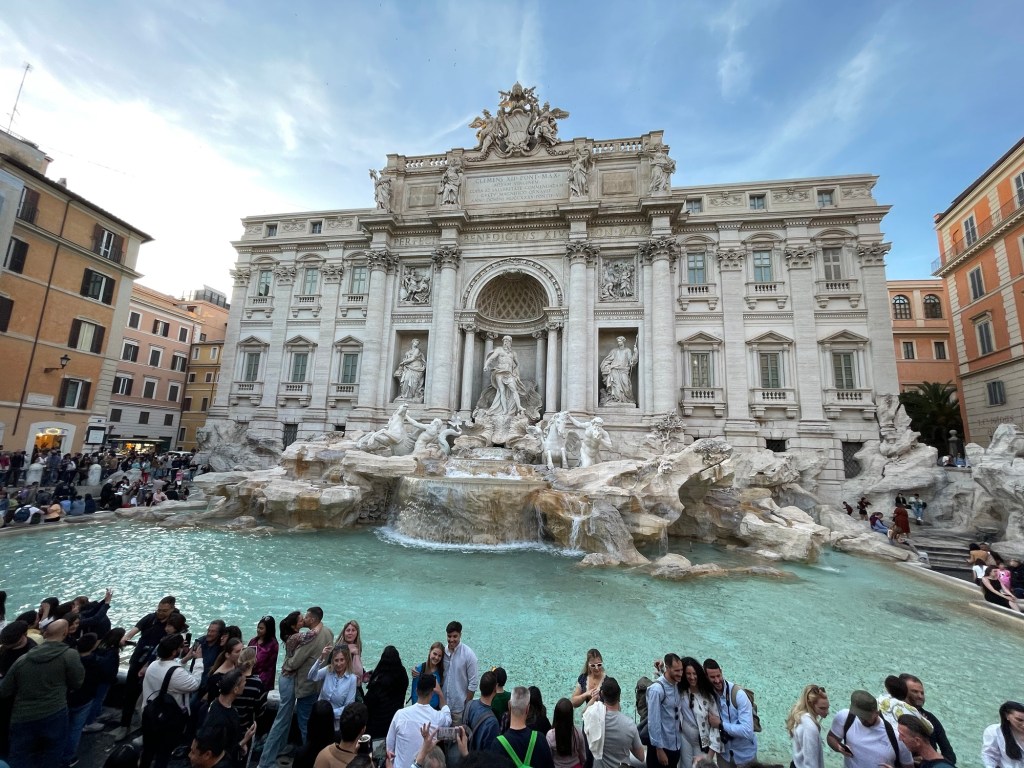
    The Trevi Fountain (Fontana di Trevi) is named after the three roads that converge where the fountain sits. It ought to translate into something more, but it’s come to mean quite a bit to those who make the pilgrimage to it. And it is a pilgrimage for tourists. It’s one of the must-see attractions in Rome, and so we did our part as confirmed tourists to visit it first.

    According to Wikipedia, the fountain was “designed by Italian architect Nicola Salvi and completed by Giuseppe Pannini in 1762”. It’s “26.3 metres (86 ft) high and 49.15 metres (161.3 ft) wide”. And it needs to be that big to accommodate the massive crowds that converge on it every day. The Trevi is worth a visit, but be prepared to have a lot of company. Just remember to take a snapshot and throw a coin in to ensure your return one day.

    The Trevi Fountain, with its statues of Oceanus, Abundance and Health.
  • Onward, Lisbon

    “Perfection is the fulfillment implicit in art, and [James Joyce] achieved it. Imperfection is life. All forms in life are imperfect, but the function of art is to see the radiance through the imperfection.” — Joseph Campbell

    I returned to the scene of the crime today. For it was in Lisbon that I spent the last days working for a company I didn’t love, with some characters I didn’t like all that much, simply to prove to myself that I hadn’t made a mistake joining that company two years prior. The crime, as you may have guessed, was selling one’s soul for financial gain. Immediately after Lisbon we parted ways, I began blogging in earnest and choosing culture over money in my work. The rest is history (mine anyway). Lesson learned, and passions pursued.

    This time I’m not lingering in Lisbon, but I’m using the opportunity to assess where I am versus where I was. On the whole I’m better, and still a work in progress. We must never rest on our laurels or settle for something that isn’t us. I’m surprised by the blog in many ways, for it hasn’t been the journey I thought it would be, but I’m still at it, even as I’m no longer that person who departed Lisbon six years ago.

    I’ve learned to accept imperfection in my writing, But work towards improvement. Perfection is an audacious act reserved for the very best, but who says we can’t strive to get closer to it? Today, the journey continues, literally and figuratively. Onward, Lisbon. A lot has changed since we’ve been together.

  • Happy Endings

    “If you want a happy ending, that depends, of course, on where you stop your story.” — Orson Welles

    Not every story has a happy ending. Some might say that every single one of our stories will end badly. I say life is a series of beginnings and endings, and we may strive to be happy for most of our story. To pursue happy is folly—there’s no depth to it. Depth is found in the lows as much as the highs. We must wade through it all, accepting our story as it unfolds—amor fati. We ought to begin with the end in mind, but focus on making this particular chapter compelling, such that it is.

    Having an impromptu dinner with friends last night, talk went to the number of trips around the sun we’re on. That cast of characters clearly read too many of my blog posts, for they’ve written this one for me. A trip around the sun on this planet is 365 days and change. This is a leap year, which accounts for that loose change. It’s all just numbers and science and passing our days on planet Earth in the best possible way we can muster given the circumstances. Cheers.

    This blog will end one day, just as surely as the soul writing it will. The end is assured. What matters isn’t that it’s a happy ending, simply that we wring the most out of each day. Some fall flat, some resonate, and some are downright terrible, but on the whole, a happy life is attainable when we are fully aware and engaged with a supporting cast of amazing people. We know the story: we are the average of the people we surround ourselves with. So build it and they will come. There’s your happy ending.

  • Breaking Up with Temporality

    “You give yourself to life by leaving temporality behind. Desire for mortal gains and fear of loss hold you back from giving yourself to life.” — Joseph Campbell

    Admittedly, I’ve had a complicated relationship with time. I spent too much of it rushing from one commitment to another, always striving to be early so as not to waste someone else’s time should the universe align itself to create delays. I write this very blog post in a coffee shop having arrived early for a meeting just down the street. Temporality is deeply engrained within me. It’s a hard relationship to break with.

    That doesn’t make it a healthy or enabling relationship. In fact, much of the stress I’ve felt in my lifetime is related to my relationship with time. Productivity calculations in a quarter, splits on a screen as I try to beat some preconceived expectation of how quickly I can complete some workout, or the pressure I put on myself to read or write a certain amount in the time I have available for such things. Time isn’t a great measure of our worth, unless you’re an Olympic athlete or attempting to solve a Rubik’s Cube or some such thing. Tempus fugit, indeed.

    So I’ve promised myself I’d break up with temporality, once and for all. Maybe not today, mind you (for I do have these commitments lined up), surely not tomorrow (I have a flight to catch, after all), but very—very— soon. How soon? Well, maybe time wIll tell? But know this: I’m serious this, uh, time.

  • On Home and Garden

    Ah, yet, ere I descend to the grave
    May I a small house and large garden have;
    And a few friends, and many books, both true,
    Both wise, and both delightful too!
    And since love ne’er will from me flee,
    A Mistress moderately fair,
    And good as guardian angels are,
    Only beloved and loving me.
    ― Abraham Cowley, The Wish

    I keen observer recently challenged me on how much I telegraph desired change in my writing. The perils of writing to an audience that includes people I interact with regularly… We write what we write and things fall out as they may. So forgive the repetition, it’s not dissatisfaction with the current state, it’s a strong focus on becoming better. Sometimes that means habit change, sometimes it means habitat change, but there’s no rush to move to a place faraway. I do kind of like it here.

    Here, of course, is far more interesting when the garden grows and stick season gives way to budding trees soon to leaf out. The garden changes everything. We might pay lip service to the hardscape of winter, but it’s the dance of annuals with perennials in that hardscape that makes the life of a gardener joyful.

    Cowley poetically sums up the simple joys of a good life. I seem to revisit this poem every couple of years just as the season changes. A few good friends, a few great books, a roof over one’s head, a garden to roam about in and someone to cherish it all with. Change will happen, some chosen and some a much a surprise to me as it will be to you. That’s the game we’re all in. But isn’t it more lovely with a bit of sun and color?

  • The Places We Will Be From

    Closing time, you don’t have to go home
    But you can’t stay here

    — Semisonic, Closing Time

    There’s something comfortable about staying in place. Things feel more natural and familiar, after all, and this is where all our friends are. But life is change, and we too must embrace it. Even the farmer, seemingly always in the same place, changes with the seasons. Most of us aren’t farmers, but we ought to listen to the wind and watch the level of the sun and know our place in this world will not be what it once was. We must be change agents for progress to happen.

    Closing time, time for you to go out
    To the places you will be from

    It’s easy to think back about who we were then. It’s harder to imagine who we’ll be in the future, let alone to map the path from here to there very accurately. Surely, there will be unexpected twists and turns along the way. The future is not ours, any more than the past is us today. But we do have the present, such that it is, to do with it what we will. Someday this will be who we used to be too. So we ought to make it a great story.

    Closing time, every new beginning
    Comes from some other beginning’s end

    When one door closes, another is said to open. How many doors have closed already? No matter—not really. What matters is the door opening in front of us, and our willingness to step across the threshold to what’s next. Life is about reinvention, rebirth, renewal. It’s closing time on some older version of ourselves, isn’t it? We can’t stay here forever. But as with any great adventurer, we should develop a strong sense of what’s next.

  • Conducive to Brilliance

    “Don’t rush your most important work. Allow it instead to unfold along a sustainable timeline, with variations in intensity, in settings conducive to brilliance.” — Cal Newport, Slow Productivity: The Lost Art of Accomplishment Without Burnout

    There’s something brilliant hiding in there somewhere. We believe it because we feel it, even if it takes its sweet time meeting us halfway. Or more likely, brilliant is waiting for us to meet it halfway. The truth is, all things have their time and when the work is done we’ll all be delighted for having completed it. Yet we live in a world, and with a mind, that demands results today.

    Newport’s book isn’t revelatory, but it is an important reminder that our most important work takes time—and a little time off—to reach a higher pinnacle. Sure, we want results now, but we’re talking about the work of our lifetime, not some simple project we could push out in a week. The trick is to know the difference, and settle into the journey that takes us there.

    We reach a place in our lives where accomplishment isn’t the primary goal anymore, but contribution is. We want to do work that matters, not just check boxes on a meaningless career path. In moments of clarity, we might see the forest for the trees, but the grind of important work means there’s a whole lot of trees to navigate. It’s natural to wonder: does it matter in the end? Sometimes it’s only a means to an end. Which leads to other questions. And so it is that life is one riddle after another in this way.

    The answer is to set up a routine that is conducive to brilliance. This blog may be all over the place at times, but it’s about the process of writing and publishing something every day that matters most. There are days I curse myself for having begun the journey, but I’ll get that one random like on a post from six months ago or a text message of support from someone that inspires me to keep going. We can always quit tomorrow, right? Just not today.

    The question is whether we’ll run out of runway before that brilliant work can take off. Plenty of great ideas crash and burn in this way. Still, we can’t worry about the length of the runway, only that we’re gaining momentum and lift. So we set a sustainable timeline (runway) and work daily towards achieving liftoff. That we might one day soar.

  • The Precious Few

    “Besides the noble art of getting things done, there is the noble art of leaving things undone. The wisdom of life consists in the elimination of non-essentials.” ― Lin Yutang, The Importance of Living

    The older I get, the less I care about the accumulation of things like accolades and titles and possessions. Sure, it’s nice to have that crystal bowl gifted to my bride and I when we got married, but we’ve never touched it, save to dust it off and place it back on the shelf again. So why do we hold on to it anymore? So the shelf won’t be empty?

    The thing is, it’s easier to just leave things in place as we move on to other things. But then we have all these things we don’t really need or want accumulating all around us. What’s the point of it all? It all amounts to nothing but an anchor. We all need an anchor now and then, but it doesn’t need to be so big that we can’t haul it up when we want to move on to the next beautiful place in our lives.

    Lately I’ve been looking at the roles I play in my life, and deciding which to dust off and keep and which to eliminate from my life. The person I once was is nice, but if I’m not that person anymore, why keep doing the same old things I did then? We ought to eliminate the non-essential from our lives that we might linger with the essential that much more.

    When we think of elimination, we ought to consider too the very habits that define who we are now. Is writing this blog every day bringing me to the person I want to become in the future, or is it holding me back from doing something else that would carry me there? You, dear reader, may be asking the same question about visiting this blog regularly, and isn’t it appropriate to do so? All is fair when we decide who we ought to be.

    And that’s the point. We should question everything that holds us to here. Do we have too much anchor to simply haul up and go when we hear the call of that faraway place? It’s fair to ask ourselves such things, but harder to act upon the answers that we arrive at. The one thing that is essential is to find and focus on the precious few, wherever it takes us.