Month: October 2024

  • Time to Step Out

    House on fire
    Leave it all behind you
    Dark as night
    Let the lightning guide you
    Step outside, time to step outside
    Time to step out
    — José González, Step Out

    Yesterday was one of those epic days we’ll remember for the rest of our days. I picked up my daughter from a red eye flight, which meant I was up quite early myself, and capped the evening with the northern lights dancing brilliantly overhead late into the evening. Why does anyone stay inside when the universe wants to play with us just out the door? Just what call are we listening for instead?

    Every other time I’ve chased the aurora borealis I’ve gone somewhere other than home. Most of the time I’ve come up empty. Scotland, Iceland, Maine, and northern New Hampshire have largely mocked me with overcast or a fickle aurora. But there’s something to that Cheryl Strayed quote about putting ourselves in the way of beauty that continues to whisper to me. Step out! Be patient…

    What we seek often comes to us if we simply get out of our own way and put ourselves in the way of it. Last night I opted to stay put and see if Norðurljós wanted to dance. It turned out she did, and what a performance!

    The thing is, we get wrapped up in what we miss, instead of simply stepping out of ourselves to find what is often right in front of us. Something like the northern lights is out of our control most of the time, but what is in our control is a willingness to dance with whatever comes our way. Amor fati: Love of fate. Fate brought my daughter home and a visit from Norðurljós in one memorable day.
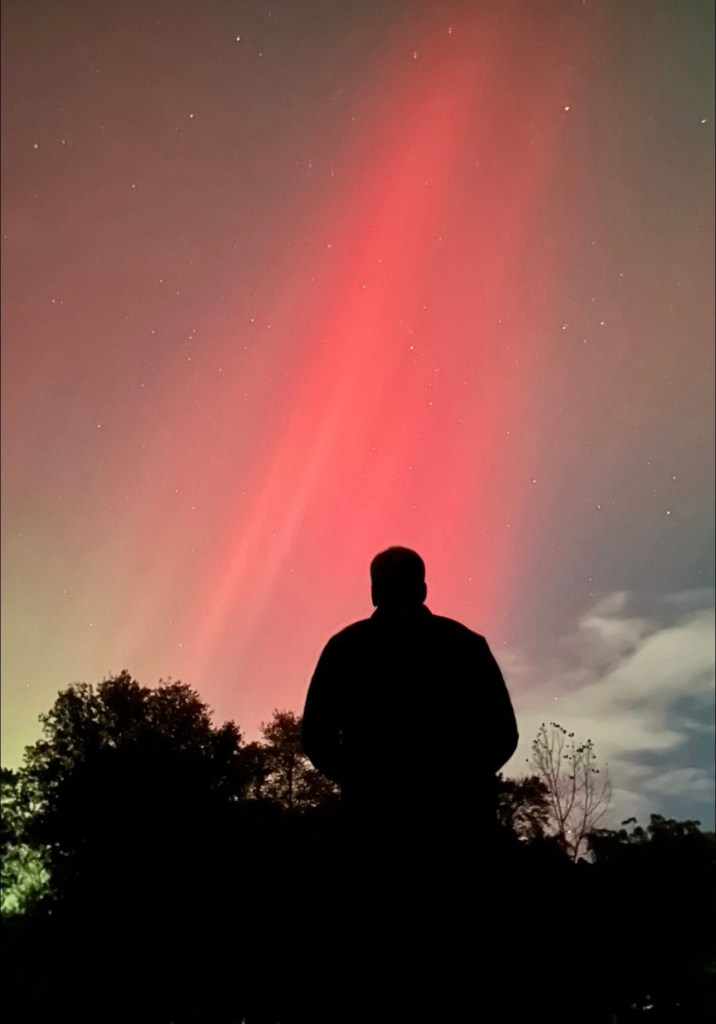
    Photo credit to my daughter for this one
    Visible to the naked eye, but incredibly bright in night mode
  • Practicing Radical Amazement

    “Our goal should be to live life in radical amazement. …get up in the morning and look at the world in a way that takes nothing for granted. Everything is phenomenal; everything is incredible; never treat life casually. To be spiritual is to be amazed.”
    — Abraham Joshua Heschel

    We get so casual with life. We take things for granted, growing tone deaf to the miracles all around us. When we become self-absorbed and jaded we miss so much that might have become a vital part of us. Sure, a good filter is helpful in a world with its share of ugliness, but we ought to remember to be fully aware of the incredible wonder surrounding us that we might fold it into the layers of our identity.

    Today is a crisp, cool October day in New Hampshire. It’s the kind of day that makes postcards. Right now the foliage seekers are poised for that perfect photograph somewhere beautiful. You know what they say about beauty being where you find it? That’s a lot easier when you live in the midst of natural wonder. Call me a country mouse if you want, but I’ll take a quiet country lane any day over asphalt through a concrete jungle.

    One big reason I write and take gazillions of photographs is to prompt attention towards the immediate and to one day recall the wonder previously experienced. Don’t blink or you’ll miss it and all that. Yes! Of course all that! For what else is there? But how many of us hear that call?

    Maybe we can’t all be poets or artists, but we shouldn’t all be corporate lawyers or middle managers either. It’s never been about what we call ourselves anyway, but what we pay attention to in our corner of the universe. That’s exemplified in the stories we tell ourselves and in the wonder we encounter between the previous moment and the next.

    Why is it radical amazement? Because most people settle into comfortable indifference. So we ought to take heed of Heschel’s suggestion: go be amazed—it’s all just waiting for us to notice.

  • Staying Out of the Clutches

    invent yourself and then reinvent yourself,
    don’t swim in the same slough.
    invent yourself and then reinvent yourself
    and
    stay out of the clutches of mediocrity.

    invent yourself and then reinvent yourself,
    change your tone and shape so often that they can
    never
    categorize you.

    reinvigorate yourself and
    accept what is
    but only on the terms that you have invented
    and reinvented.

    be self-taught.

    and reinvent your life because you must;
    it is your life and
    its history
    and the present
    belong only to
    you.

    — Charles Bukowski, No Leaders Please

    Rip currents drown those who fight it, while those who choose to swim perpendicular to it often live to see another day. The lesson is to simply stop fighting the current and swim out of it. Quite literally changing direction can save your life.

    There are those who love to float down those lazy rivers, drifting along sipping cocktails and peeing in the water so they can keep that happy haze going all day. I don’t want to swim in other people’s pee, no matter how warm the water is. Swimming in mediocrity is a lot like those lazy rivers: comfortable, but not really going anywhere good. We ought to expect more of ourselves.

    To reinvent oneself is to swim against the rip, to climb out of the lazy river and take a plunge into the bracing cold of a blue ocean. The more comfortable we get in our lives, the less likely we’ll ever be to embrace a path contrary to the norm. If we’re all being swept along like those rubber ducks in the river fundraisers, does the prize really go to the person who gets to the net first, or the one who escapes the current altogether?

    Anyone tracking this blog would see that it’s a documentation of reinvention over time. We all are constantly changing who we are, resistant as we might be to the forces pulling us in different directions than the one we thought we’d be going in when we got up that morning. I’d been swimming against my own rip currents for some time, and found myself swept out to sea. But I haven’t drowned just yet. Panic is the real killer, even before fatigue. Those who keep their wits about them can survive most any crisis. The thing about ocean swimming is you can choose to go in any direction you want.

  • What We Notice

    “Life is a garden, not a road. We enter and exit through the same gate. Wandering, where we go matters less than what we notice.” ― Kurt Vonnegut, Cat’s Cradle

    After an unsuccessful hunt for the northern lights last night, I walked out into crisp early morning darkness for a just-in-case glance at the heavens. Alas, no aurora, but instead I caught the brilliant Jupiter and a blushing Mars, caught in the act of chasing Jupiter across the sky. Orion stood between them as guardian, forever distracted by the hunt for the bull. As a Taurus myself, I’m always rooting for Orion to miss the mark. It turns out Orion is never inclined to release anyway.

    I find myself uniquely aware of the garden as we wander through it. Some call me a wanderer, distracted by life, never inclined to release the arrow on the hunt for success. Success to me isn’t found in a C-suite, it’s found in a spark of connection between me and another. It’s found in a sliver of hope and direction given to another wanderer, who simply lost their way from here to there. We all do, eventually, lose our way—don’t we? Success is often disguised as a moment of clarity given to another, or found in our own reflection.

    If there is a road at all that we humans travel upon from here to there, it’s a winding road that often doubles back on itself. We are forever wandering through life, figuring out which way to turn next. The only secret adults know that children don’t is that adults are winging it too. We go through life accumulating experiences and apply that knowledge towards whatever we chance upon next. If we’re lucky we choose a path that favors us, if not we stumble eventually, pick ourselves up and figure out the next. It turns out that what we experience on the path matters a great deal more than where we thought we were going in the first place.

  • The Beautiful Present

    “Never look down to test the ground before taking your next step; only he who keeps his eye fixed on the far horizon will find the right road.” ― Dag Hammarskjold

    Oh Lord, how shining and festive is your gift to us, if we
    only look, and see.
    — Mary Oliver, Look and See

    For all my talk of stopping to smell the roses, I barely noticed a beautiful sugar maple turning towards peak foliage as we drove by it yesterday. Had my bride not commented on it, I’d have missed it entirely. There’s something to be said for being focused when driving a two-ton automobile, but there’s also something to not rushing through life with blinders on. The point is, we may still get from here to there while enjoying the passage of time.

    When I write about the necessity of savoring each moment I do so as a reminder to myself as much as any reader who stumbles upon this blog (Welcome, nonetheless. Or rather, especially). We ought to begin with the end in mind, as Covey once said, while still enjoying the things we chance upon as we march through our small piece of history. Hammarskjold is absolutely correct in pointing out that we ought to be aware of that far horizon, but the poet in me rejects the idea of never looking at your next step. Our next step is all we have. Have a look at all that is beautiful in it, while still glimpsing the future horizon that we may not lose our way. Put another way, all work and no play makes Jack a dull boy.

    I’m aware of the passing of time, and look towards that horizon with keen interest in how far down the path I might go before I tire and settle into an armchair to tell the same familiar stories to anyone who will listen again and again. But those stories are created today, with full awareness of all that happens in the now. We ought to savor the beautiful present flashing before our eyes instead of fixating on the next intersection. The journey will be all the more enjoyable. We’ll get there either way.

  • From Within

    “I am a writer who came from a sheltered life. A sheltered life can be a daring life as well. For all serious daring starts from within.” ― Eudora Welty, On Writing

    As the air grows crisp and ever colder, the garden recedes back more each day towards dormancy. Why is it now that writers begin to stir and strive towards a higher aspiration? I think it comes from a place of stillness, when we finally slow down enough to feel the restlessness within. Maybe there’s a carry-over from the reading habit and a desire to dance with words at certain times of the year. Mostly I think it comes from a feeling of immediacy. It’s now or never, friend. The things we most want to see written won’t just write themselves.

    The pup has other ideas for me. I have the beginnings of carpal tunnel syndrome in my wrist from all the frisbee throws. She’s a lot like the universe in this way: always expecting one’s complete attention for as long as she wants it and not a second more. If we are to accomplish anything in this lifetime, at some point we must learn to break away and listen to that voice within that similarly insists on our attention.

    The thing is, we run out of excuses not to be daring. We must create the work we want to see in the world. Those aren’t my words, they’re the words of every writer who had the audacity to think they had something to say in their time and got to work. Enough of reasoning already! Be bold and begin, but finish it this time.

  • Icarus Also Flew

    Everyone forgets that Icarus also flew.
    It’s the same when love comes to an end,
    or the marriage fails and people say
    they knew it was a mistake, that everybody
    said it would never work. That she was
    old enough to know better. But anything
    worth doing is worth doing badly.
    Like being there by that summer ocean
    on the other side of the island while
    love was fading out of her, the stars
    burning so extravagantly those nights that
    anyone could tell you they would never last.
    Every morning she was asleep in my bed
    like a visitation, the gentleness in her
    like antelope standing in the dawn mist.
    Each afternoon I watched her coming back
    through the hot stony field after swimming,
    the sea light behind her and the huge sky
    on the other side of that. Listened to her
    while we ate lunch. How can they say
    the marriage failed? Like the people who
    came back from Provence (when it was Provence)
    and said it was pretty but the food was greasy.
    I believe Icarus was not failing as he fell,
    but just coming to the end of his triumph.

    — Jack Gilbert, Failing and Flying

    We all have our seasons of triumph and tragedy, hope and despair, but we tend to dwell on the end of things too much instead of celebrating all that was when we never thought we’d touch the ground. In a lifetime we repeatedly rise from the ashes of who we once were to fly again. Icarus, like Sisyphus, is seen as a tragic figure in mythology. And yet he flew. Sisyphus, pushing his rock up that hill, might have caught a glimpse of Icarus from the top as he followed the rock back down to start his next defiant act.

    I’ve reached a point in my life where I’m ready to do something different. It’s a familiar feeling, having been here so many times before in my life. Some people settle into an identity and never leave it, cozy as it feels wrapped around their shoulders. Some people are nomads, shifting with the seasons, restless when change is in the air. Deep down we know who we are. In quiet moments we hear the whisper of change calling for us. No wonder so many reach for distraction rather than face the plunge into the unforgiving sea—the unknown next.

    No, we are not gods, and sometimes our audacity is punished by fate. Still, we must rise to meet the season when life brings change. For life is nothing but change, and we may dare the gods again with our boldness.

  • Developing a Voice

    “The voice which a poet forms is not any more something that a poet creates than it is something, over the years, that creates the poet. Throughout my life, unquestionably, I have made decisions one way or the other based on the influence of this inner voice—this authority with which I most intensely and willingly live.” —Mary Oliver, The Poet’s Voice

    Writing a blog is not the same as writing a novel, but it’s writing just the same. And as such, it ought to get one’s best effort. For otherwise, why do it at all? Isn’t life already too full of half-hearted pursuits? We can’t quiet-quit on our personal pursuits too and hope to have any reason to carry on in this world. We must do our best with the time and talent we have in the moment and allow it to carry us to the divine.

    Whatever the world thinks about blogging doesn’t matter a lick to me. I write to develop my voice, and once developed, refine it over and over again until it flows out of me like a Boston accent in unguarded moments. When I ask myself why I begin each day this way instead of simply taking a walk with the dog like a normal person, it often comes down to knowing I have something to say and finding a way to express it consistently, if not always eloquently.

    But what do we then do with a voice, once developed? Write more blog posts? Make the shift to long form essays and Substack? Or something <gasp> more? We can’t very well stuff our voice into the back row of the choir with the mimers, can we? We must sing our verse with passion and the skill honed through those ten thousand hours of chipping away at the marble. What emerges may just be magical. But magic doesn’t just appear out of thin air, it only seems that way to the casual observer.

    An acquaintance of mine wrote a few novels and published them as e-books just to give his children an example of doing what he said he was going to do. He’s also an active and talented podcaster with a silky smooth voice and the insightful questions that betray active intelligence. His voice may have been there all along but the full package took time and effort to develop. Whatever his motive for writing the novels and doing the podcast, the point is that he’s doing it. And so are we, at least if we have the inclination to see what emerges from that once quiet voice whispering to us in the back row.

  • Have a Look

    “Mountains should be climbed with as little effort as possible and without desire. The reality of your own nature should determine the speed. If you become restless, speed up. If you become winded, slow down. You climb the mountain in an equilibrium between restlessness and exhaustion. Then, when you’re no longer thinking ahead, each footstep isn’t just a means to an end but a unique event in itself. This leaf has jagged edges. This rock looks loose. From this place the snow is less visible, even though closer. These are things you should notice anyway. To live only for some future goal is shallow. It’s the sides of the mountain which sustain life, not the top. Here’s where things grow.
    But of course, without the top you can’t have any sides. It’s the top that defines the sides. So on we go—we have a long way—no hurry—just one step after the next.” — Robert Pirsig, Zen and the Art of Motorcycle Maintenance

    I see it in the pup when we get home. She bolts into the house, looks for our friends who’d been staying with us, and realizes the emptiness in a sad look back at me. Life is change, I want to tell her, but the beauty of being a dog is there’s always a chipmunk to chase down outside, and she’s soon forgotten her sadness and is out hunting instead.

    The thing is, it’s humans that really pay the price of change every day. It’s part of growing into who we may be next. Holding on to the past wastes today. And so the only answer is to savor more. Carpe diem is more than just seizing the day, it’s embracing all that it offers. In this way it pairs well with that other reminder from our stoic friends: Amor fati: Love of fate.

    We grow in the climb itself, even as we aspire for the summit. And so on we go. We ought to be careful what we wish for, for as Pirsig points out, we’ll miss all the good stuff charging ahead through life in hopes of reaching some imagined better place. Our place is simply where we’re standing now, friends, even as we’re poised for the next step. So have a look.

  • The Mask

    “Masked, I advance.” ― René Descartes

    Later today I’ll be presenting to a group of people I’ve never met before, like a thousand times before. There’s nothing unusual about speaking to strangers when you make a living building bridges and nurturing trust. More essential in that moment, the subject matter I’m presenting is very familiar to me, and not so much to them. I hope they surprise me with deep familiarity and the inclination to challenge every word I say, because that would indeed be interesting, but more than likely they’ll simply accept what I say for what it is. We tend to simply believe what we’re told, rarely questioning the validity of the statement unless it’s especially incendiary or directly challenges our worldview.

    We all know those characters who navigate word soup with the stage presence to pull it off. But to pull it off, we’ve got to believe it ourselves. We are all actors in the play, and stage presence matters a great deal, but so too does some underlying belief in why we’re up there on the stage in the first place. Every day we wake up with a collection of beliefs in who we are and why we’re here. To break away from those beliefs requires an assumption of faith that the gap between who that character we’re stepping into and the one we’re leaving behind isn’t so great that we plunge to our doom.

    But what is doom anyway? What’s the worst that could happen in putting on the mask and advancing into the unknown? We’re pushed back? We’re cut down? Parry and redouble, friend. Thankfully, few matches are fatal. We live to fight another day. When we believe in the mask we’re wearing we may advance with courage.

    Sounds easy, right? The thing is, false bravado is easy to unmask. The first person we have to convince is ourselves. Yet often we’re the last to know. Assuming a character often helps us find something in ourselves that was waiting to emerge. Small steps at first, then a little bolder, and there’s no telling where we might find ourselves next.