Month: September 2025

  • A Strange Vocation

    Poetry, my starstruck patrimony.
    It was necessary
    to go on discovering, hungry, with no one to guide me,
    your earthy endowment,
    light of the moon and the secret wheat.

    Between solitude and crowds, the key
    kept getting lost in streets and in the woods,
    under stones, in trains.

    The first sign is a state of darkness
    deep rapture in a glass of water,
    body stuffed without having eaten,
    heart of beggar in its pride.

    Many things more that books don’t mention,
    stuffed as they are with joyless splendor:
    to go on chipping at a weary stone,
    to go on dissolving the iron in the soul
    until you become the person who is reading,
    until the water finds a voice through your mouth.

    And that is easier than tomorrow being Thursday
    and yet more difficult than to go on being born—
    a strange vocation that seeks you out,
    and which goes into hiding when we seek it out,
    a shadow with a broken roof
    and stars shining through its holes.

    — Pablo Neruda, Bread-Poetry

    I’ve gone and shared the entire poem. I’d meant to be more precise with a line or two about the stars shining through or rapture in a glass, but neither tells the story. Perhaps the english translation doesn’t tell the entire story either, but here we are. The point is, in the sharing there is a story. And naturally, we are the stories we decide to tell the world.

    Do you wonder when to begin a new chapter? Or are you too busy finding rhymes for this poem to worry about something that may never be? I think that’s the thing for most of us, isn’t it? We’re too busy living to focus on what’s next. If now is all that matters, why dwell on the tomorrows? Because it’s coming for us, ready or not? The grasshopper learned too late that the ant had it right, but in the end it was the grasshopper who made music. The real lesson is to find time to build a life and to thoroughly live it too.

    How much is enough to share? Each word published is released, never to be mine again. Perhaps that’s for the best; these words were only looking to fly free from me that they may dance in the light. I’ll click publish and go about my day, looking for as much meaning in the grind as I found in a few moments of creative output. Which work will live beyond me? It isn’t for us to decide, but to offer the best of ourselves in whatever we give our lives to.

  • Wealth in Health

    “The greatest wealth is health.” — Virgil

    On a beautiful Sunday afternoon, I knew I’d regret it if I didn’t get out for a ride on the bike. It’s been leaning against the wall mocking me for weeks, waiting for my excuses to run out. Busy should never be our excuse for not exercising, not when the true answer is that we chose to prioritize something else with our precious time. So I got out there, and quickly surprised myself with the gains I’d made.

    If we remember our three currencies in life—health, wealth and time—we ought to consider both our accumulation and spend rate of each. Will I be riding a bike up steep hills when I’m 85? Probably not, but I can do it today. And in doing it today I’m increasing the probability of doing it one day when I’m 85. So I ought to do the work today that makes me healthier tomorrow.

    But it’s hard for us to work hard to accumulate for some imagined version of ourselves in a few decades. Perhaps the better thing to do is focus on more immediate gains in health and vitality and let the compound interest of a lifetime of fitness do the rest. The trick is not just to be active, but to do the activities that are enjoyable so that we keep on doing them for the rest of our days.

    I’ve come to enjoy weight circuits because they’re relatively enjoyable to do (and I get to play my favorite music loudly). Those weight circuits have made me stronger and leaner, making those hill climbs on the bike easier, which in turn makes riding the bike even more fun than it already was. After not being on a bike for a month, I set four PR’s on four measured segments of the route, making for one exhilarating ride yesterday. It wasn’t like I set out to do a time trial, it just happened because I was more fit than the last time I rode.

    I know that each workout is going to help me as I grow older, but the payoff can’t be some far off tomorrow if I hope to be inspired enough to make it a lifetime habit. But thankfully, today’s reward is an immediate increase in energy, vitality, athletic performance and in the way we feel about ourselves as we see gains. It all builds on itself, allowing us to reap the rewards of an active life now while building a stronger foundation of fitness for our latter years. And that, friends, is a win-win.

  • Naturally Next

    “Remember that there is only one important time and that is now. The present moment is the only time over which we have dominion. The most important person is always the person you are with, who is right before you, for who knows if you will have dealings with any other person in the future? The most important pursuit is making the person standing at your side happy, for that alone is the pursuit of life.” ― Leo Tolstoy, The Emperor’s Three Questions

    What next? I’ve heard the question over and over again since summer ended. Is it because I’m asking it myself? Or because we reach the same point in life where such questions become increasingly important? I think if I ask one more question in this paragraph I’ll lose a few subscribers in rapid succession. What’s next is blessedly the next paragraph.

    We navigate our place in the world, run into obstacles we learn to get around or stall behind indefinitely. Habits are obstacles, and so is a closed mind. Sometimes we get so focused on the obstacle in front of us we don’t step back to see the many ways around it. When writing stops flowing I simply walk away for a few minutes, make a coffee or throw the frisbee to the pup and the obstacle drifts away.

    I think Tolstoy had it mostly right with his focus on the present moment, and the most important person being the one we’re engaged with right now. But is our most important pursuit making that person happy? I think this itself becomes an obstacle, for happiness is a fickle thing, and serving the whims of another’s state is slavery.

    We’ve all got to find our own path to whatever is next for us. Helping others to see is a fine thing indeed, but they must learn to reconcile their obstacles in their own life. Maybe that obstacle is us. To give space and time for others to find their own way may be the most generous gift we can give them.

    What’s next? The sky filled with migratory birds noisily chatting about the commute. Maple leaves turning yellow and orange and red as the sun gradually reminds them that their time is almost over. Montauk Daisies budding so very long after the rest of the garden fades. Cherry tomatoes bursting in the autumn sun because we cannot possible keep up with the harvest. Next is always right in front of us, showing us the way around whatever we imagined was impossible to get beyond. Dare I say we must pay attention to now? Or is that one question too many?

    Then how about this? Answers come from doing. Stop worrying about the obstacle and simply do what calls for attention today. Like writer’s block, simply doing something pulls us inevitably to possibility. Look around, it’s all around us—everywhere except that place we were stuck in. We may simply do what is naturally next, and see where it takes us.

  • Brahma Muhurta

    “Brahmamuhurta (Sanskrit: ब्रह्ममुहूर्त, lit. ’time of Brahma’) is a 48-minute period (muhurta) that begins one hour and 36 minutes before sunrise, and ends 48 minutes before sunrise. It is traditionally the penultimate phase or muhurta of the night, and is considered an auspicious time for all practices of yoga and most appropriate for meditation, worship or any other religious practice. Spiritual activities performed early in the morning are said to have a greater effect than in any other part of the day.”
    — James G. Lochtefeld, The Illustrated Encyclopedia of Hinduism

    I don’t practice Hinduism, but based on the definition above it’s apparent that I’m an active seeker of truth and meaning during Brahma Muhurta. We each tend to fall into a rhythm of life that works for us, and my auspicious time for writing and the deep contemplation that sometimes accompanies it is this period of time before the dawn. That it is precisely 48 minutes (muhurta) is interesting. My writing usually lasts much longer, and often in a state of flow, not contemplative. Does that mean I’m not properly harnessing the optimal time for a deeper dive into the soul? Should I save my writing for after Brahma Muhurta? Perhaps, but it seems to work for me.

    Creativity isn’t so rigid a process as to be wrapped into a 48 minute window of time. Nor is spirituality for that matter, whatever spirituality means to you or me. The point is to consistently put ourselves in a state of openness and to see where it brings us. If that’s prayer or meditation or madly scribbling on a pad of paper, we are using the time of Brahma actively engaged. What washes over us in that muhurta is for us to come to know.

    Here’s the thing, I think it all comes back to what Cheryl Strayed’s mother told her about putting ourselves in the way of beauty. When we show up consistently open to hear what the universe or God or the muse or that nugget between our ears has to say, eventually something is going to whisper back at us, if only to get us off their back. We don’t get a sunrise or sunset, a brilliant idea or spiritual enlightenment if we don’t place ourselves in a position to receive these blessings of the moment. Since we’re up before the dawn anyway, we ought to be open to receive whatever comes next. And to then do something with it before it drifts away like the stars fading with the morning light.

  • The Dog and the Frog

    “A calm and modest life brings more happiness than the pursuit of success combined with constant restlessness.” — Albert Einstein

    Every morning I let the puppy out to relieve herself. Inevitably, she ignores her full bladder and makes a beeline for the pool to see who is swimming there today. Most mornings this time of year there’s a frog bobbing around with the acorns believing it’s found paradise on earth. And so the standoff begins. The pup will circle for hours if I let her, chasing something that she’ll never catch. The only way to break the spell is to take the net and rescue the frog from the pool, relocating it over the fence. Tomorrow it will likely be right back in there again, awaiting the pup. This would go on each morning until the end of time if the season wasn’t drawing to a close.

    Are we any better than the dog following the frog? We also run around in circles relentlessly pursuing some concept of happiness or success, as if either are tangible. Reach for either and we find it’s bobbing somewhere other than the place we just dove for it. Each are nothing but ideas of what we think we ought to be.

    The aim of life is growth. A tadpole or a mighty oak measures it’s time alive in growth, and so should we. We ought to break the spell of chasing happiness or success, whatever the heck those mean to us and focus instead on purposeful gain. What might our net gain be today with a change in focus? Knowledge or strength? Enlightenment? A deeper understanding of ourselves and our place in this world?

    Forget about running in circles with nothing to show for it but a wet nose. Break the spell of the chase and focus on incremental growth instead. Whatever moves the needle forward in a meaningful way towards personal excellence and growth are the true wins for the day. Stack enough of these wins together and we may realize a state of happiness and success.

  • Godlike

    “The struggle of life is one of our greatest blessings. It makes us patient, sensitive, and Godlike. It teaches us that although the world is full of suffering, it is also full of the overcoming of it.”
    ― Helen Keller

    We are not the sum of the best of our days any more than we are the sum of the worst of them. We are shaped by all that we encounter, and we are either frail or toughen in the face of it all. Choose a path to greater resilience, challenging as it may be.

    The thing we forget sometimes on our best days is that we’ll struggle through really bad days too. To press on, learning and growing and finding a way to become that something or someone we set out to be is a hero’s journey. Hero’s naturally run into a few obstacles along the way. It’s not meant to be a casual stroll through the garden.

    To be Godlike is audacious, but also aspirational. It’s a decision to reach closer to personal excellence, our old friend Arete, despite our human shortcomings. We will never get all the way there, and yet we may get closer. So toughen up buttercup—we have places to go and things to do.

  • Always Mine Time

    “When I paint a picture, the time it takes will always be mine, or I get something out of it; time doesn’t end because it has passed. I feel sick when I think about the days that are passing—interminably. And I don’t have anything, or I can’t get at it. It’s torture; I can get so furious that I have to pace the floor and sing something idiotic so that I won’t start crying with rage, and then I almost go crazy when I stop again and realize that meanwhile time has been passing, and is passing while I’m thinking, and keeps on passing and passing. There is nothing so wretched as being an artist.” — Jens Peter Jacobsen, Niels Lyhne

    When we stumble across that which captures our move through time, traps it in amber as Vonnegut put it, we realize the infinite—that which is timeless. Timelessness is itself an illusion, as is time, we simply capture our passage through it with something that will outlast us.

    Do you doubt this? Look at an old photograph from a moment in the past and feel what stirs within. Read an old letter, when people still wrote those, and see what is captured in amber. I write this blog post, as with all the rest of them, knowing that once I hit publish it becomes always mine time—this moment of thought and emotion and intellectual momentum (or perhaps inertia) are now captured. I move on to the next thing in my day, and the next; passing and passing. What of the rest is captured? Precious little, but these words remain.

    What artist hasn’t felt swept up in the moment of creation? What artist hasn’t felt the emptiness of uncreative moments? We must be productive in our time, or watch it drift away like so many empty days. The only answer to the coldness of time is to do work that matters, and to strive towards mastery in it. Personal excellence (arete) may be forever out of reach, but to reach for it is to make something more out of… time.

  • Stoke the Fire

    “Beware the barrenness of a busy life.” — Anonymous (often attributed to Socrates)

    We often feel the least satisfaction with our busiest days. We learn that there is always something else pressing upon us—our best is never enough. And this is the time when we must step away from the grindstone before we ourselves are ground to dust.

    The older we get, the more the fallacy of busy becomes apparent. All those getting ahead stories were told to stoke the fire. Did we ever realize that we were the coal? That fire was someone else’s. Hustle and sacrifice are noble traits, but we must be very clear about what is being hustled and sacrificed, and who we’re doing it for. Hustle is time, applied with energy and vigor to some endeavor. Sacrifice is what we would be doing otherwise, given the clarity of choice.

    There is no time to sacrifice our very best years to the factory furnace. The answer is to slow down and see what stokes our own fire. Do the essential, move deliberately away from all the rest. While there is still time to realize the dream.

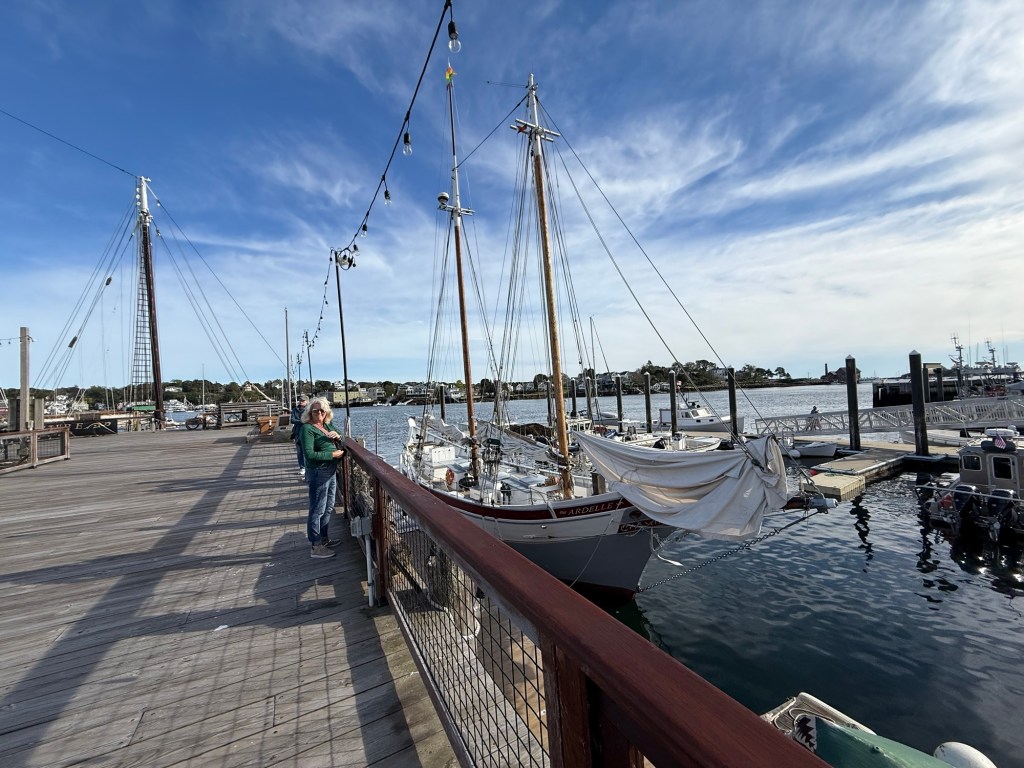
  • The Schooner Ardelle on a Celtic Sunset Cruise

    These summer clouds she sets for sail,
    The sun is her masthead light,
    She tows the moon like a pinnace frail
    Where her phosphor wake churns bright.
    Now hid, now looming clear,
    On the face of the dangerous blue
    The star fleets tack and wheel and veer,
    But on, but on does the old earth steer
    As if her port she knew.
    — William Vaughn Moody, Gloucester Moors

    We know when we are in the midst of something extraordinary. Anticipation creeps up on us as the minutes pass by, awaiting our participation. Awareness floods in as the magic unfolds. Joy and gratitude edge in, provoking other emotions. There comes a time when we must simply put away the camera, stop searching for just the right word or phrase, and simply be a part of all that is happening around us.

    Gloucester, Massachusetts has a long history with the sea. Its famous harbor has long welcomed home fisherman and sailors from passages as far and wide as the ocean’s reach. One feels the history sailing in this harbor, and you play some small part in the play for having been here at all. The fleets of old are mostly all gone now, ghosts of what once was. But there are a few holdouts, and newcomers built in the traditional way, to offer some hint of what it was like long ago.

    Harold Burnham has built several schooners in the traditional fashion. For a couple of centuries the Burnham’s have built ships in Essex, Massachusetts. Two of his schooners are harbored in nearby Gloucester, and Harold himself captains sunset cruises. You simply have to put yourself in the way of beauty and sign up to participate. And if you’re especially fortunate, you may join on a night of Celtic music to offer a proper soundtrack for a September night when the clouds are just so to harness a bit of heavenly magic.

    Maritime Heritage Charters offers many opportunities to learn and experience a few hours on a schooner sailing in Gloucester Harbor. One not to miss is the Celtic Music Sunset Sail with Michael O’Leary & Friends cruise, when traditional music and song fill the heart and soul as you slip past history and witness the divine dance of fading light. The experience is one that will stay with you forever.

    The Schooner Ardelle, Gloucester, Massachusetts
  • Framing the Day

    Come, read to me some poem,
    Some simple and heartfelt lay,
    That shall soothe this restless feeling,
    And banish the thoughts of day.
    — Henry Wadsworth Longfellow, The Day is Done

    This blog may ultimately stand for something, or perhaps it will simply be a lifetime of favorite poetry, lyrics and prose quoted as prompts for the words that follow. We all write for our own reasons. To share it at all is the audacious act. The words, cherished while embraced, are simply allowed to float away into infinity, where we will one day join them.

    I’ve grown weary of debate. It doesn’t matter a lick when each side is dug in and unwilling to consider common ground. To reach across the aisle is considered weak. So we learn to ignore each other’s radical ideas. And we are collectively the lesser for closing the door on each other’s most passionate pleas. Instead we get bland exchanges about the weather. How lonely is a life devoid of meaningful engagement with the larger world?

    I may have it all backwards. I begin my day with hopefulness and close it with resignation that the work didn’t change much of anything. That’s no way to end the day. We must bookend our days with aspiration and hope. The trivial thoughts of the day will not be remembered—they will dissolve as all the rest have before them. It is only the way we frame our days that will have the structural resilience to hold together the story of a lifetime. Choosing the right material for that frame thus becomes a critical affair.

    And so I build my frame of poetry and song. I glue it together with philosophy. I make it rigid through engagement with the world, beginning in the garden and venturing outward as far as the travel budget allows. All of this living means something, I’ve come to understand, mostly to me. But that doesn’t make the frame any less solid. Or any less a part of someone else’s frame for having shared at all.