Author: nhcarmichael

  • The Consent to Discover

    “One doesn’t discover new lands without consenting to lose sight, for a very long time, of the shore.” — André Gide

    The truth is, we each concede more than we consent. The truth is, discovery is a shore too far for many of us. And yet we each set sail in our own way from the past every day. What seems the same alters ever so slightly each day, imperceptibly, inalterably, and we wrestle with the truth of it whether we set our course for distant shores or futilely try to hold on with all our might to what once was.

    This is the time of year when parents post pictures of children heading off to school, on their way to discovering their own new lands. The discovery isn’t just for the children, but the parents too, as they return to a home different than it was before. At such moments the daily leap is profound in its breadth.

    So often we dwell on the gap between where we are and where we hope to be and our confidence waivers. Discovery requires a leap into the unknown, and the courageous consent to make that leap. Indeed, the thrill of losing sight of who we once were and gliding into an unknown future might be frightening, but ultimately, doesn’t it bring us to places we never thought possible?

    Sometimes we get so caught up in what we might lose that we forget about what we might find.

  • Solitude as a Path Forward

    “Society is the cave. The way out is solitude.” — Simone Weil

    We know, deep down, that our way is found in the quiet moments. It’s so easy to be caught up in the expectations and scandals of society, so easy to trap ourselves in the words so tightly shaped around the stories of our lives, that we might never really fly. Yet we must fly, whatever our flight path may be, if we are to get out of that cave. How many countless souls never fly?

    We grow up hearing we might be odd if we aren’t part of the group. As adults we hear that we’re either in the collective party of the righteous or there’s something suspicious and odd about us. To be a part of the tribe we must participate in the rituals of the tribe. And so we all fall in line, find our career path, work to strengthen our relationships, build our bridges, marry up and in, and then have kids and place them carefully into the right environments to maximize their own potential in society.

    There’s nothing inherently wrong with being a part of things. We learn and grow in society. We play our part and find meaning through our connection with others. We meet people who help transform us from what we were to what we might become. We rightfully celebrate our place in society and the people who are woven into the fabric of our lives.

    One might point to the social structure as the clearest way to find our place in this world. We get in the mix, bounce ideas off each other, collaborate, feed off the energy in the room, get a leg up with the help of others, and so on. And indeed, so it is that we thrive in a world built on maximizing the contribution of the individual for the benefit of our collective future together.

    But if there’s a shared secret we all know, it is the critical nature of solitude in finding our own path forward. It’s the voice inside your head saying, “And what of me?” We can’t really make out what that voice is saying until we step away from the din. What we find, if we are so audacious as to listen, is that that voice has a lot to say.

    Is it narcissistic to ask such questions? Parts of society would shout down such selfish ideas. The very idea of contemplation and individuality are reckless and dangerous in many corners of this world. But is it selfish to seek solitude, or selfless to find places to reflect? We don’t run away from society, we stride boldly towards ourselves. The boldest ideas are conceived in solitude.

  • Time in Orange

    The early morning is my game: fresh ideas, new hope, quiet time with the reset before the madness begins. All the petty frustrations of yesterday punted abruptly to a previous version of me, not today’s me. No, not yet.

    A rising waning crescent moon, just a sliver, dances with Venus, also rising, calling for attention herself. Behind me, Jupiter, god of the sky, living up to his nickname as he brightly dominates the western sky, not conceding any royal status as the sky brightens ever so timidly around him. A satellite glides quickly past, just below the king, brash in its intrusive busyness. “A little decorum, please?”, I think to myself, quietly admiring the boldness of technological advancement in the face of custom. Jupiter, playing the long game, remains stoic and proud, despite the affront.

    I return to yesterday, thinking today might be better. It ought to be better, with a bit more effort, a bit more applied acting the part, and maybe, like that satellite, a bit more intrusive busyness. But there I go again, dwelling on the past, cheating the present. This rusty, orange, glowing, hopeful present. It demands more from me. It deserves more from me.

    I dreamed of a TSA agent who wouldn’t set me free. I’m not someone who remembers dreams, but this one woke me at just the right moment, freshly minted in my brain as it was, that it stayed with me through the ritual of orange. I think of it still, that maddening limbo. And it made me think of fresh starts with a sprinkling of boldness.

    Time in Orange
  • Every Single Day

    “If you want to write, if you want to create, you must be the most sublime fool that God ever turned out and sent rambling. You must write every single day of your life. You must read dreadful dumb books and glorious books, and let them wrestle in beautiful fights inside your head, vulgar one moment, brilliant the next. You must lurk in libraries and climb the stacks like ladders to sniff books like perfumes and wear books like hats upon your crazy heads. I wish you a wrestling match with your Creative Muse that will last a lifetime. I wish craziness and foolishness and madness upon you. May you live with hysteria, and out of it make fine stories — science fiction or otherwise. Which finally means, may you be in love every day for the next 20,000 days. And out of that love, remake a world.”― Ray Bradbury

    I went for a long walk late in the day yesterday, dodging raindrops, a rarity this summer, to power through nine muggy miles (14.5 km). The mileage wasn’t a surprise, for it was agreed upon before the walk began. The trick in longer walks is to set your expectations and pace, and naturally, to wear good shoes. The rest is just putting one foot in front of the other and observing the world as it comes to you.

    The similarities with writing, or any other mission you decide to show up for every single day, are within reach if one should be inclined to harvest them. We establish our routines, dance with the muse one idea at a time and let it run through us to become something tangible. When it’s finished we share a sense of accomplishment and loss all at once, linger for a beat and shift our mind to what comes next.

    Life is a series of days, repeated one after the other, optimized by expectations and pace. We do with them what we will. And then? We move on to whatever comes next. Yet we always return, don’t we, to the things that matter most to us?

    It would be bold to expect another 20,000 days in my own lifetime. That would make me a very old blogger indeed. But I do have this one, and maybe tomorrow, or maybe not. So I work to make this blog post count for something, maybe stand up as that final post should it be that. Of course, every sentence can’t end in an exclamation point, we’d be seen as more insane than most think of writers as already, but we can’t put our best into everything we do in the moment… just in case.

    Hope to see you tomorrow. 😉

  • Becoming That Shape

    “The ability to fantasize is the ability to grow. [For] boys and girls… the most important time of their day, or especially at night before going to sleep, is dreaming themselves into becoming something, or being something. Into being something. So when you’re a child you begin to dream yourself into a shape, and then you run into the future and try to become that shape. When I was 10, 11, 12 I began to dream of becoming a writer, and the rest of my life has been the real task of shaping myself to that boyhood thing. So fantasizing has been very creative.” – Ray Bradbury, from Day at Night Interview, with thanks to The Marginarian for showing the way.

    It’s easy to spot potential in others, when you pay attention to such things. A nephew with a knack for brilliant cooking, a niece with an eye for brilliant photography, a friend with the aptitude and attitude for finish carpentry, a son or daughter with the unique combination of empathy and talent that they bring to the world. When you look for the spark in others, often it’s easy to see. And sometimes it’s barely detectible, needing space and air to spark into something more substantial. We, witnesses to the fire burning inside others, either feed the spark or snuff it out. Which will we offer in the moment?

    And what are we with ourselves? Are we stoking our own dreams or snuffing them out? We ought to be arsonists with our spark, stoking our dreams and lighting the way for others. For in those moments alone with a dream, when we see so clearly what we might become, we discover our anima. In Latin anima refers to “a current of air, wind, air, breath, the vital principle, life, soul” (wiki). There’s magic in air as we dance with that vital principle, for there we form our (dare I say it) life’s purpose. For us humans trying to reach our potential, the question or what animates us ought to be front and center in our journey to becoming what we might be.

    In our brief dance with light and air, we must build our beacon in earnest. Shaping ourselves into whatever we believe possible shouldn’t be the stuff of childhood fantasy, it can be our lifetime pursuit. For dreams ought to be stoked, if only to see how brightly that spark might burn.

  • Input vs. Output

    We must consume books and art and bits of the universe both sweet and bitter to produce anything of consequence. From birth we’re actively consuming to stay alive and grow, to learn from those who came before us and ultimately to mold ourselves into an active, thinking adult. But we weren’t born to be sponges, we were born to produce.

    Input and output go hand-in-hand, but output isn’t guaranteed simply because there was input. We need agency, don’t we, to transform all that input into something resembling output? It’s comfortable always being the student of life, soaking in all that this universe offers. The stakes go up considerably when we put ourselves out there with our own work. To raise our hand and speak up, to offer a new twist, to boldly contribute to the Great Conversation.

    If there’s a disease in humanity, amplified in these times, it’s mistaking combativeness and criticism for output. This is “Man in the Arena” territory, where those who don’t do the work feel perfectly fine condemning those who do the work. We ought to collectively have no patience for it and turn the trolls and charlatans away. Yet too many treat the noise as input, and think themselves clever by parroting the same sound bite as their own output. These are empty calories for the brain, and distract us from building.

    We don’t need more noise, but we definitely need more insight, more contribution to the critical issues of our time, more solving of problems, and more collaboration and meeting in the middle to find a way forward. We are what we consume, this is true, and we are also what our actions demonstrate we are. We must do better, collectively, with our output.

    Input is fine, I suppose, but where are we going with it?

  • Enjoying the Interval

    “There is no cure for birth and death save to enjoy the interval.“ — George Santayana

    Santayana was a Harvard professor who personally influenced a long list of people who in turn became influential themselves. People like Robert Frost, T.S. Eliot, Walter Lippmann, Gertrude Stein, G. E. Moore, Wallace Stevens and others. So the way he spent his interval seemed pretty substantive and consequential. He demonstrated that we can enjoy our time while also making the most of it.

    So sure, they say that life is what we make of it. But on the surface this feels somewhat simplistic, given the general indifference of the universe towards our feelings on the matter of our fragile egos. Through the fair and unfair, the rituals and routines, the obligations and distractions, the magical and the mundane, we all choose and have choices imposed on us. In the end, or rather, in the interval, it’s all in the way we play the game, despite everything thrown at us along the way.

    Knowing we’ve hit this lottery of birth in our time and place, we ought to be fully aware of this moment and the opportunity it represents for us. I might have written a version of that phrase a hundred times now in this blog. Be assured it’s a reminder to myself more than a call to action for others. A reminder that, in the end, this interval is all we’ve got to work with.

  • Colors Out of Reach

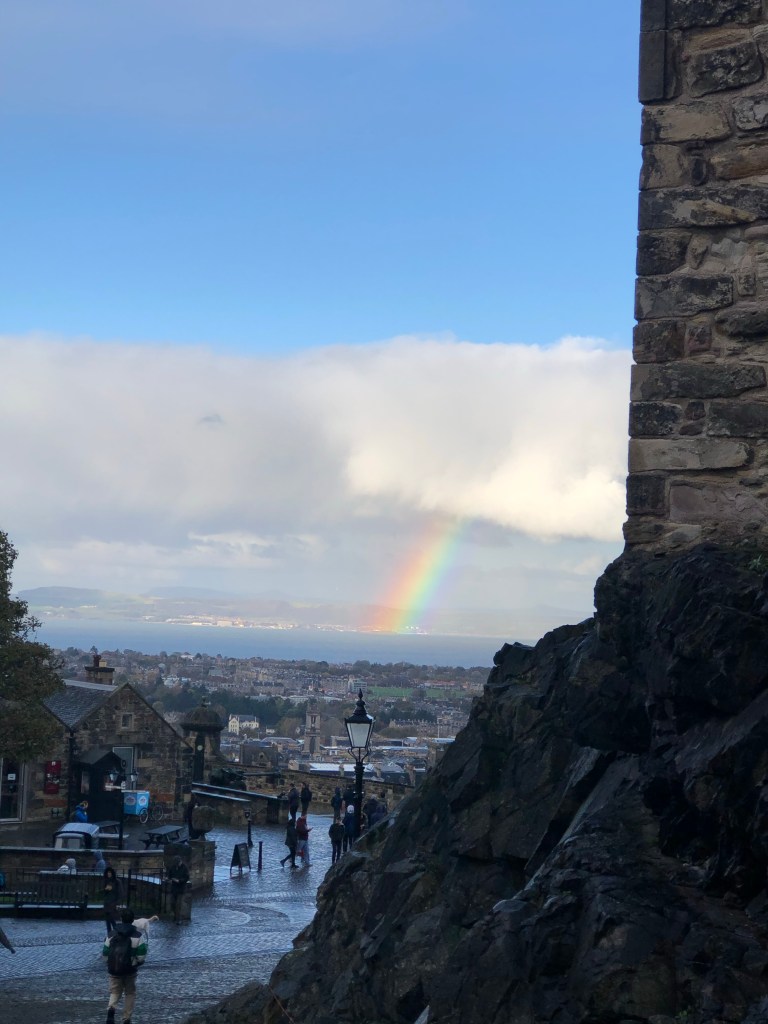
    Well, I see the end of the rainbow
    But what more is a rainbow
    Than colors out of reach?
    — The Avett Brothers, Swept Away

    There’s a fine line between being satisfied with what you’ve got and yearning for what you haven’t got. I follow, and thus am constantly teased by, Aurora Borealis updates. I happen to live in a place with a very slight chance of seeing the Northern Lights, but sure, I’m saying there’s a chance. The hardy souls who stay up all night on mountain tops for the ten minutes with the Aurora post their photos immediately, making me grumble when I rise early the next morning and see what I’ve missed. But I know that that show wasn’t meant for me.

    We are in our moment, in our place, with or without the things we yearn for. There’s nothing to do about that which we’ve missed out on. For the things we seek, we must either go to them or let them fly away unencumbered by our attempt to grasp them.

    When you go to a place you’ve dreamed of going to, be it a tropical paradise or Paris or (just maybe) Iceland for volcanos and waterfalls and the dance of the Northern Lights, you close the book on dreaming and capture its memory, like a flower folded into a book. The thing is, memories are rainbows out of reach too. But with memories, bits of the color embed themselves in us that live on through us. You can see it in your eyes when you look at yourself in the mirror, and others see it in you too. Each encounter brings more color to our lives.

    Ultimately we can’t have it all, and we ought to focus on the things that are most important to us. Yet there’s something to be said for a recurring dream of light and color dancing in the sky. It will always remain just out of reach, yet so very close to our heart.

    So what do we chase, and what do we let fly away? Don’t we already know? For our answer appears when we stop chasing every rainbow and really think about what’s important now.

    Edinburgh Rainbow
  • Staying Alive Between the Covers

    “A library is a good place to go when you feel unhappy, for there, in a book, you may find encouragement and comfort. A library is a good place to go when you feel bewildered or undecided, for there, in a book, you may have your question answered. Books are good company, in sad times and happy times, for books are people – people who have managed to stay alive by hiding between the covers of a book.” ― E.B. White

    Someone recently asked me why I write a blog every day. Surely there are other things I could do with the time. But other than exercise and sleep I can’t think of anything done regularly that improves you more than consistently putting yourself out there in the world. Writing forces contemplation, feeds both the stack of books and the small and large experiences consumed to be shared, and maybe in some small way make the writer alive for the reader, whether you’re reading this today or 50 years from today.

    Lately I’ve felt a sense of loss when I finish a blog post. It’s a tangible shift from my work to my past work as I click publish. It’s similar to the feeling of putting a letter in the mailbox once felt, before email and text made letter-writing feel less… self-gratifying. When you click send on an email or text the response back is close to immediate. There’s a high in surfing this wave of electronic banter that the sender experiences in real time. I suppose a blog also offers likes and views and subscribers that may feed that sensation. But getting back to the point, dropping that letter in the mail was consequential: “I’ve created this, for you, and now I’m releasing it.”

    Don’t you miss crafting such letters and dropping it in the mail with all your hopes and dreams sailing away on the wings of a postage stamp? Don’t you miss the experience of receiving a letter from a thoughtful friend, full of introspection and insight? Maybe we ought to write more letters, I don’t know, but we certainly should be writing more. Writing offers a chance to fly into the future for the author, and a time machine back to our present for the reader. It’s our moment with the infinite, even as we realize the fragility of the exchange.

  • What We Will

    “If the world were merely seductive, that would be easy. If it were merely challenging, that would be no problem. But I arise in the morning torn between a desire to improve the world and a desire to enjoy the world. This makes it hard to plan the day.” — E. B. White

    I grow cilantro, not so much to eat it, but to watch bees roll around in the wispy white flowers that wave ever so lightly in the breeze. Surely someone must grow cilantro for all the tasty dishes (or soapy dishes) one might imagine it worthy of, but give me the bees, please. Summer officially ends for me the moment the cilantro peters out—like life itself—entirely too soon.

    The dance between the earnestness of rolling up your sleeves and fixing things versus opening up your heart and savoring all the world offers is a constant struggle. As with everything, we must skate the line between the world of order and the world of chaos, Yin and yang. Nobody said this living business would be easy, but it’s such a short ride we ought to make the most of it.

    Still, there’s work to be done, and no time to waste in solving the world’s problems. As anyone out there trying to get things done knows, there’s just not enough people willing to make a go of it and do the work. Every school, every hospital, every landscaper and construction firm and restaurant is struggling to find a warm body with an eager mind to simply do the work. Who are we to ignore the call? Yet so many do.

    Every day should be filled with a bit of challenge, and a bit of seduction. Every life lived well ends with a measure of satisfaction for the things we did well and a measure of consternation for that which wasn’t accomplished. That’s life, and we must learn to skate that line. In the end, we do with it what we will.