Author: nhcarmichael

  • To Grow and Know

    “With each encounter with truth one draws nearer to reaching communion with it.” — Rainer Maria Rilke, Letters to a Young Poet

    What resonates? Doesn’t it change moment-to-moment as we ourselves change? As the world offers lessons, from subtle and brutal? Just what is our truth, our first principle?

    We try to arrive by sorting. We must process the world as it comes to us, and indeed, encounter the things that challenge our worldview. Assumptions and beliefs fall aside for the willing truth seeker. We must find and embrace each encounter for all that it offers us. Like the body adapting to exercise, the stronger mind is capable of handling even more challenges. Each challenge in turn makes us stronger (if we don’t let them destroy us).

    The truth is, we are alone on this journey. Surely friends and family offer support, mentors guidance, and those who came before us breadcrumbs to follow (or ignore), but this is our vision quest. We follow the winding path and see the changes in ourselves as we climb.

    She has seen me changing
    It ain’t easy rearranging
    And it gets harder as you get older
    Farther away as you get closer
    And I don’t know the answer
    Does it even matter?
    I’m wonderin’ how

    Crosby, Stills & Nash, See the Changes

    We ought to leave our own breadcrumbs. For the conversation to continue with those we love, and those we’ll never meet, we must draw from ourselves and leave it for the world to accept or ignore. It’s not ours to choose, but when we suck the marrow out of life and gleen the wisdom of the ages our voice becomes more compelling.

    We won’t ever fully arrive at the truth. We might accomplish some noteworthy things, reach conclusions that resonate, grow closer than we ever thought possible to certain people while remaining dissatisfied and chagrined at the ones that got away… but we never will fully arrive. Still, we ought to be satisfied in the end that we gave it a go to grow and know. And to celebrate the journey wherever it leads us.

  • August Signals

    Black-eyed Susan’s once again dominate, staking a claim on more of the garden every year if you let them. I mostly let them. They remind me of conversations with a favorite gardener who’s moved on, which means they’ll forever receive favorable treatment in my garden.

    Crickets receive no such favorable treatment, but we peacefully coexist nonetheless. They play the soundtrack of August. Most of the year we hardly give crickets a thought, until they begin playing their persistent song from mid-summer to mid-autumn. Thousands of musicians announcing “We’re here, if only so very briefly.” Is there anything more stoic than a cricket?

    The gardener senses the seasons. No calendar is required. The days grow shorter even as the heat continues. For these are the dog days of August, marked by black-eyed Susan’s dancing to the persistent tune of an orchestra of crickets.

  • Every Day Has Something

    Everything that was broken has
    forgotten its brokenness. I live
    now in a sky-house, through every
    window the sun. Also your presence.
    Our touching, our stories. Earthy
    and holy both. How can this be, but
    it is. Every day has something in
    it whose name is Forever.
    — Mary Oliver, Everything That Was Broken

    Nobody said life was supposed to be a happily ever after greatest hits package of days to remember. Yet even the most tedious, frustratingly mundane days offers a gift of timelessness. We only have this one, no matter how it goes, and ought to celebrate the smallest sparkle of light just as we celebrate the highlight reel moments that come along, however so infrequently.

    The artists, poets and some not-always-so-poetic blog writers share one thing in common; an appreciation for the moment at hand. For every day has something to offer, should we go looking for it. Every moment offers a gift of possibility. What will forever look like today?

  • Making Room

    Things!
    Burn them, burn them! Make a beautiful
    fire! More room in your heart for love,
    for the trees! For the birds who own
    nothing—the reason they can fly.

    Mary Oliver, Storage

    We talk of downsizing. Simplifying. Getting rid of stuff that doesn’t matter in favor of that which matters very much: Elbow room for the body and soul.

    Leaving the anchor behind and setting course for adventure! Clearing the runway and lightening the load! Surely there’s liberation in releasing the weight of years of accumulation: stuff, beliefs and biases, people trying to hold you to what you once were.

    What do we cling to that is holding us back from soaring?

  • Turning Inward for Answers

    He went to Paris
    Looking for answers
    To questions that bothered him so
    — Jimmy Buffett, He Went to Paris

    “As we grow old, the beauty steals inward.” — Ralph Waldo Emerson

    And now I will tell you the truth.
    Everything in the world
    comes.

    At least, closer.
    And, cordially.
    — Mary Oliver, Where Does the Temple Begin, Where Does It End?

    It struck me reading a book on Existentialism that it’s almost impossible to arrive at enlightenment and sagacity when life becomes relentlessly hectic. Try absorbing deep thoughts from another era when you’re exhausted and grabbing a few pages in between commitments and sleep. We’re all so damned busy that we don’t take the time to understand the universe, let alone ourselves. The maze might have a beginning and an end, but we get so caught up finding the cheese that we forget to figure out where we are.

    Busy never answers, busy avoids answers.

    As we stack experiences one atop the other, do we take the time to sort them into insight? We spend so much time focused on becoming and belonging that we short the time required to being. The quest for answers never really ends, but we can edge closer to that which resonates for us. It seems the benefit of aging is capturing the time that eluded us when we were younger to sit with deep thoughts, reflect on the universe and find ourself.

    The real question is, why do we wait so long to sift through the answers?

  • The Gloucester Fisherman’s Memorial

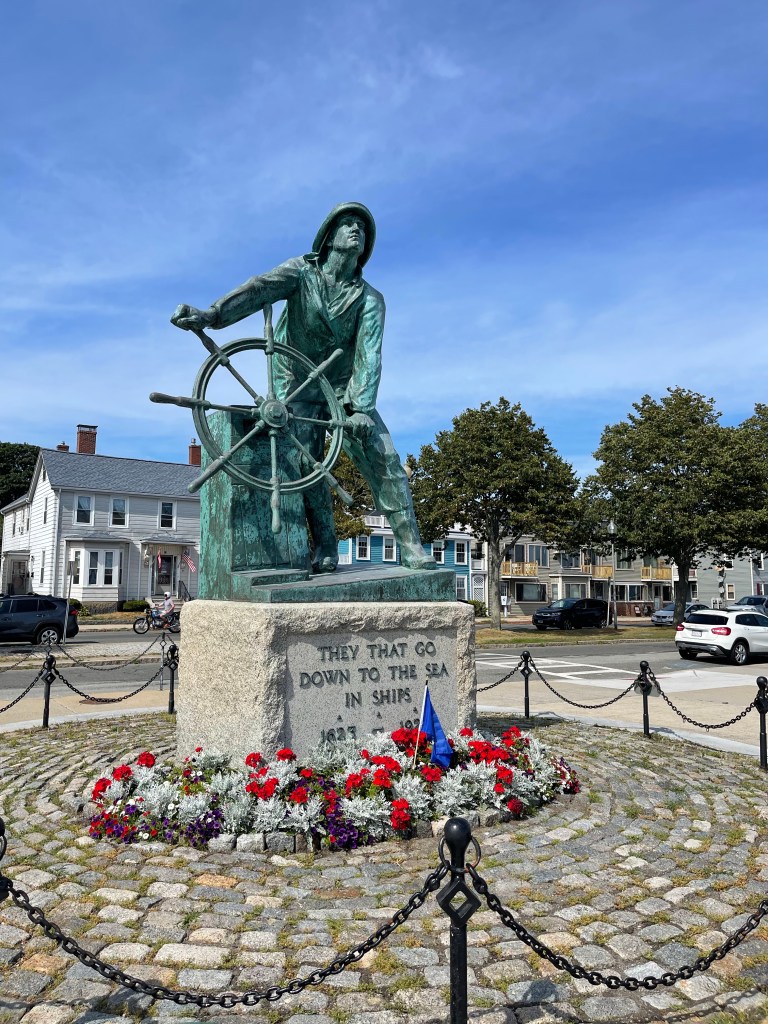
    “These courageous men have been known by names other than fishermen. They were father, husband, brother, son. They were known as the finest kind. Their lives and their loss have touched our community in profound ways. We remain strengthened by their character, inspired by their courage and proud to call them Gloucestermen.” — from the memorial plaque at the Gloucester Fisherman’s Memorial

    Gloucester is a small city that sits near the tip of Cape Ann, in Massachusetts. The city is growing increasingly gentrified, but there’s no doubt it maintains its roots in the fishing industry. And when you think of fishing, how can you not think of the Gloucester fisherman? Generations of men and recently women from the community have made their living from fishing. Many went to sea never to return. The Gloucester Fisherman’s Memorial was built in 1925 to forever memorialize them. A few years short of the 400th anniversary of the founding of Gloucester, and the 100th birthday of the memorial itself, I felt compelled to revisit.

    More than 5300 men who left Gloucester Harbor full of hope are known to have been lost at sea. Swept up in Nor’easters, collisions at sea and all sorts of tragedies, whole ships full of fishermen were lost in the unforgiving North Atlantic. Technology makes it safer to go to sea today than its ever been before, but there are still dangers lurking in the unknown. Names are still added to the memorial plaques, but instead of hundreds of names in a given year like 1879, there might be a couple. The most familiar names in recent years were those lost during the “perfect storm” of 1991.

    You don’t get into commercial fishing to be famous, you go to make a living, hoping to return to those you love when your work is done. The memorial itself is modeled after a man named Captain Clayton Morrissey, who died of an apparent heart attack while at sea, years after the memorial had been erected. There’s tragedy in this too, but doesn’t it feel appropriate, that he should pass away at sea? In a way, it makes his image on the statue ring more true.

  • Write to Clarity

    “You want to become a clearer thinker, you need to spend more time alone with your own thoughts, and keep writing every day.” — @Orangebook

    How do we reach clarity? Don’t we have to wrestle with conflicting thoughts to see which emerges more persuasive than the rest? The vehicle to clarity might be walking or meditation or therapy or writing, but the wrestling within that vehicle must happen. The alternative is to reach for distraction. We all have moments with each, but which way do the scales tip?

    Maybe we never reach clarity at all, maybe we reach contentment with the great compromise of the clear and the unknown. The stoics have a saying, amor fati, which translates to love of fate. We control very little in this universe, the rest belongs to the universe to decide. Accepting what we can control is certainly a milestone moment on our journey to clarity.

    The thing is, the process of sorting out the journey is what life is. We might think more clearly, but this step in becoming brings us into a more complex head full of doubt, which, transcended, in turn leads to another. We ought to celebrate the journey to clarity, without expecting to actually arrive.

  • Clearing the Hurdles

    “Life will throw everything but the kitchen sink in your path, and then it will throw the kitchen sink. It’s your job to avoid the obstacles. If you let them stop you or distract you, you’re not doing your job, and failing to do your job will cause regrets that paralyze you more than a bad back.” — Andre Agassi, Open

    When you witness excellence in action, it’s hard to comprehend the work that went into the performance. Seeing Sydney McLaughlin destroy her own 400 meter hurdles record is awe-inspiring because she does the incomprehensible. But the work that brought about the moment isn’t ours to see, or feel. The hurdles aren’t the only obstacle she had to clear on her way to a record-breaking performance—she had to clear every other distraction along the way to get to it. People like McLaughlin or Agassi or Tom Brady are anomalies to the rest of us. They’re obsessively focused and a bit quirky in their habits. Most of us balk at the price of greatness, for them it’s simply the act of doing your job.

    Disciplined routine is the answer. Doing your job is the moment-to-moment bias towards productive action and good decisions. Anyone in New England will hear Bill Belichick’s own words ring in that Agassi quote. Do your job… and do it well. It’s a simple thing to grasp, must harder to execute with an undisciplined mind. We must get up daily and do the work that calls to us. No excuses needed, you either do or do not, there is no try (thanks Yoda). This is a tough mindset to acquire, but it’s required for reaching excellence.

    “Excellence is the next five minutes”, as Tom Peters put it, “or nothing at all”. We get too caught up in excuses that lie beyond the immediate. Surely we must know where we’re going, but we must then get beyond long term thinking, for it’s a form of procrastination. We often kick things down the curb that we ought to be doing right now. Planning isn’t doing, so we mustn’t tell ourselves what we’re going to do, we mustn’t tell ourselves anything at all, really. We must friggin’ do it.

    There are so many obstacles to navigate in life that it can be overwhelming. But most of it is BS playing on a loop between our ears. The only way to break that loop is with a viable habit loop that forces us to execute in the now. Excellence is the next five minutes, or maybe the next 50.68 seconds, or maybe just this very instant. What we do with this moment determines so much of who we’ll be at the finish line. Don’t regret the moment.

  • Finding the Safe Channel

    I once met with a boss I had great admiration for, a boss who dressed the part, had a witty remark for everyone, intelligent and clearly marked for future big shot roles in the corporation. He seemed to like me as well, encouraged my growing collection of ties and appreciated the early starts and late finishes to my work days. And then one day I walked in and told him that some employees were grumbling about some initiative or another, repeating their logic for why it wasn’t the right path for our company, relaying what I’d heard but didn’t feel strongly about in my soul. His face grew dark, he looked me squarely in the eye and told me that I should never aspire to be the messenger for other people, because it was the messengers who always got shot. Welcome to corporate America, kid.

    Fast-forward to today, I don’t wear ties much anymore. I work hard but don’t feel compelled to be the first one in or the last one out the door. And I’ve learned to always listen to but avoid repeating what other people say. But there are exceptions to this rule.

    In a recent management meeting, I lobbed a hand grenade on the assembled managers, repeating a statement from the employee of another manager who stated that he had to cover his ass with some tasks that had to be completed. When you hear something like this you might hold that card for a moment alone with that manager, or maybe bring it to the company President to discuss in private, or leave it for others to reveal. When you’re a small company and highly dependent on each other, you must identify potential problems. Without revealing the department where the trouble lay, I tossed it right on the virtual floor in front of the encircled management team and revealed it for the underlying problem it was. The thing is, there’s a time and a place and an audience for everything. This wasn’t an opportunity to undermine, it was an opportunity to mark the channel.

    When you’re out on the water, the ocean often looks tranquil and safe in all directions, but underneath the surface there are rocks and other hazards that can sink a boat if you blithely sail into them. When you identify threats, you must mark the channel, that others might continue on safely. There are some hostile environments where the channel isn’t marked, where you must fend for yourself. Progress slows dramatically in such places, and the bottom is littered with the broken hopes and dreams of those who foundered before.

    You know when you work in a culture that encourages open communication. These are clear channels that enable progress and growth. It’s an essential element in drawing out the potential in any team, and when it’s missing the team reverts to an every man for himself mentality. That tie-wearing, hard-charging kid I once was was thrown to the wolf by some men and women who didn’t dare confront the boss with objections themselves. It was no surprise that that company soon folded under the weight of competitive pressure they couldn’t adapt to. We must feel empowered to mark the hazards else we’ll surely find our ship foundering on the rocks someday. Clear channels of communication foster safe passage.

  • The Wanting-to-Know Type

    “There are two different types of people in the world, those who want to know, and those who want to believe.” ― Friedrich Nietzsche

    Belief is the easy route. We suspend our own development and believe the stories other people tell us. Beliefs about other people seemingly different from us. Beliefs in political “leaders” who make promises and amplify those differences, always pointing their finger in another direction so followers don’t look too closely at them. Beliefs about religion or sports or the best movie ever made (don’t even tell me it’s not Local Hero).

    Belief is arrogant, closed, and the end of the story. Stories we’ve arrived at, or stories we’ve never left. Wanting to know is self-effacing, open, and a path to new places. When you want to know you pursue answers. Belief is static, wanting to know is dynamic and fluid. Which of these characters do we want to be in a conversation with at a cocktail party? Who would they want to be having a conversation with?

    This business of becoming is a journey with wanting to know. There’s a place for belief in this world, but the thing is, when you arrive at belief you’ve ended a journey. And who really wants that when there’s so much living still to do?