“The longer your food lasts, the shorter you will.” — David Sinclair
Simple tweet from Sinclair that elegantly sums up the mission: eat fresh, natural food without preservatives. Eliminate the sketchy processed foods from our diets. Stop piling on junk atop junk for our bodies to stress over. We all know it intuitively yet make exceptions for what we chew on. We forget the long game for the savory moment.
When you read a statement like that, are you inclined to dismiss it? Challenge it? Or accept it as a wisdom nugget? Do you change the way you eat or defer action to another day? If we are what we eat what exactly are we becoming?
The shorter the truth nugget, the longer it lingers in the mind.
As the days grow longer in the Northern Hemisphere we detect the changes around us. The changes were happening anyway, but it seems to accelerate. Just this morning I watched the sun rise through a window where I haven’t seen the sun rise since last autumn. A mix of travel and weather conditions made it a complete surprise when it happened.
And what of the changes we take ourselves through? We exercise, eat the right food, read and write every day and nothing seems to come of it. And one day we catch ourselves in surprise at who we’ve become without realizing it. Hey, that’s me! The light dawns on Marblehead, as they say in Boston when you’re the last to know. We know we’re changing, but don’t often see it in ourselves.
Until we do.
Why don’t we have more incremental awareness? Why don’t we see the smallest of changes in ourselves as we’re making them? Are we lacking self-awareness or are we just not giving ourselves the credit we deserve for doing the work? It’s as if we’re trained not to notice that we got up and worked out for three days in a row, we have to wait until we have washboard abs to be allowed to celebrate.
The only way to be incrementally aware is to track ourselves. To write it down. To draw a big X through another day on the calendar (especially when you didn’t really feel like doing X that day). It’s not about the washboard abs or the number on the scale or the published novel, it’s about the process — saying we’re going to do something and following through on it. And then doing it all again tomorrow. Incremental action isn’t suddenly seeing the sunrise after your first day, it adds up over time and reveals itself slowly.
Watch the man beating a rug. He is not mad at it. He wants to loosen the layers of dirt.
Ego accumulations are not loosened with one swat. Continual work is necessary, disciplines. — Rumi
We’re all on our journey of becoming. We’re all working to grow in our chosen work, to experience life more richly, to continually refine and reinvent ourselves, to reach our potential. But we can’t grow in a box. The journey requires some space and momentum, which necessitates cleaning out some old beliefs and habits acquired along the way. Sometimes cleaning up the old is easy because it was never really a part of our core, but sometimes the old is so embedded in who we are that we’ve got to beat it out.
I have some old beliefs and habits I’m not particularly willing to carry around with me anymore. I don’t give them any light to grow, but ugly beliefs and bad habits don’t need a lot of light to fester. The process of clearing them out requires a lifetime of consistent effort.
Discipline is derived from the Latin disciplina, which means “to learn”. But any dance with the dictionary will indicate that discipline also has another meaning: “to chastise or scold.” Discipline thus has both a positive and negative connotation. No wonder people shrink away from discipline! So what are we to make of it?
We’re all works in progress. Old habits are like old friends that remind us of what we once were. Sometimes that’s a delight. But often we shake our head at who we used to be. To live in the present is to acknowledge that former self and see who we are today. Every day is a reset, a chance to move forward or to slide back. Every day we get to decide what to be and go be it.
After a few nights in New York and New Jersey, I returned to New Hampshire to reflect on the differences. I’d hiked in pristine woodland next to gorgeous streams, the kind of stuff you see regularly in the White Mountains of New Hampshire. I’d stayed in a beautiful resort surrounded by hills. I’d eaten at a vineyard next to a lovely river. I’d visited New York City itself, deep in the heart of it. And capped my visit to the city with a trip to Liberty Park in New Jersey with its striking Upper Bay view of Manhattan and the Statue of Liberty.
It was all beautiful. The days and nights were lovely. The people were generous and friendly. You learn to love the spirit and energy and vibrancy of the place and miss it when you’re away from it. And yet I’ve never gotten used to the ambient noise.
The Metropolitan New York region has a relentless buzz that stays around you all the time. If you live there you likely don’t even know it exists, but when you’re a country mouse coming to the big city regularly you pick right up on it. The automobile traffic, the air brakes on trucks, the train whistles, the sharp roar of planes and helicopters flying overhead, the steady rumble of ships on the Hudson River and the constant beeps and thumps and shouts of close proximity that collectively create a soundtrack of urban living. This soundtrack bleeds for miles up the Hudson River, far out into the Atlantic on Long Island and deep into the hills of New Jersey and Connecticut. It begins with the roar of the city and fades to the sound of sprawl.
Hiking the amazing Harriman State Park next to a pristine river, you’d think the white noise would drown it all away. But reach a bit of elevation and you hear the traffic informing you that you must go even deeper into the green splashes that surround the map of New York City. Even Harriman, as big a green space as it is, has roads full of commuters cutting through it, like Central Park in the hills of the Hudson River Valley. Those roads surely serve, but they also detract if you let them. Don’t let them.
For it’s all so very beautiful. Even the ambient noise, that guarantees no escape from the world, fades just enough when you focus on what they’ve protected from the sprawl. This is a place that offers the advantages and disadvantages of one of the greatest cities in the world, the constant beat of progress and growth and rising to the occasion that New York is famous for. But within an hour are these places like Harriman where you might immerse yourself in nature, so long as you accept the soundtrack playing way in the background and focus on the wind in the trees and the water finding its way through ancient boulder fields.
The farther away you get from the ambient noise of New York the more faint it is. Somewhere along that spectrum of noise we reach a place where we feel the ambiance most vividly. Life isn’t about escaping from the world, but finding our place in it.
If you had any doubt that we’ve mentally come out the other side of the pandemic, drive around a few of the metropolitan areas. Los Angeles, San Francisco, New York, Miami, or any other major city or the connecting smaller cities that they’re connected to. The roadways are all back to gridlock traffic. How some react to that reality is distinctly different. Welcome back–who are we now?
When traffic is moving, some people dial up the crazy. I see more mad dash drivers than ever trying to squeeze into every pocket, using the breakdown lane for passing, multi-tasking with texting… whatever. It can all seem mad, because it is maddening. So how do we counter the madness outside the windshield?
When I get tired of the same old characters around me, I’ll pull into a rest area or take an exit to stop for five minutes, whether I need to or not. It’s like moving out of a neighborhood with too much drama—instant refresh! Get out of the car, walk around a bit, refuel the body and mind. And when you get back on the road, the new “neighborhood” seems interesting enough to carry you through.
I know a lot of people crank up the music on commutes, and sometimes I’ll do that too. But frequently I’ll use the time to reconnect with people using [gasp!] phone calls. Conversations are like time machines, transporting you for miles seemingly in an instant. Likewise, podcast interviews do the same thing for me. The time isn’t wasted, for the mind is moving faster than the car you’re in.
Nobody welcomes traffic, but when we can’t time our trip better we ought to accept it as a part of living in this particular time. A bit of perspective after what we’ve all been through, and a desire to be in a better place despite it all. After all, aren’t we all trying to get somewhere a bit better than where we just were?
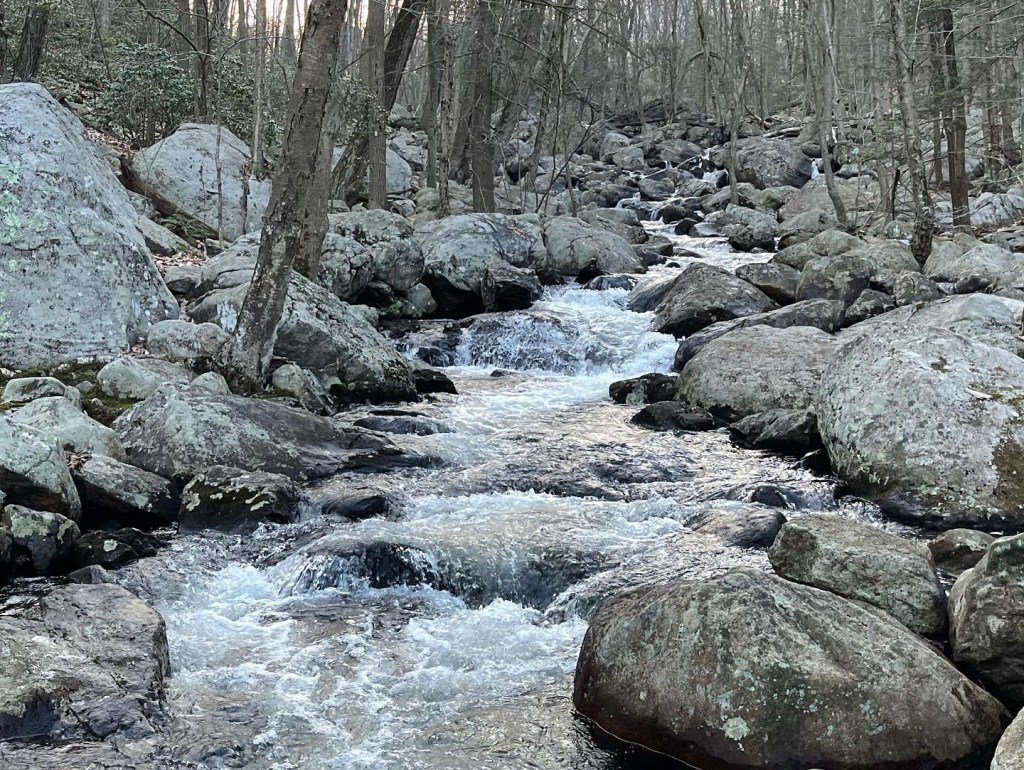
Harriman State Park in New York is the second largest state park in the state, and honestly it feels pretty big when you’re in it. Still, it doesn’t feel like there should be this kind of elbow room so close to the gridlock of Metro NY. And yet here it is.
This story began two days ago, when I participated in a group hike with several co-workers. As these things go, our available time for hiking got compressed and we had a couple of people who were a bit slower than the average hiker speed. Combined this created a situation where we had a little more than an hour to hike one of Harriman’s most popular trails, the Reeves Brook Trail Loop. Instead of reaching a waterfall and pond we’d been hoping for, we had to cut the trip short and head back. Still, that waterfall stayed with me.
There was only one thing to do: get up early and take a solo hike to find it. If there’s a problem with April hikes, it’s that it doesn’t really get light out until close to 6 AM. I didn’t have that kind of time and headed out at 5:30 in search of the waterfall. I had a headlamp with a weak battery and two iPhones as backup for light, but found I didn’t really need any of that once my eyes adjusted. It helped that I’d done a good part of the trail two days earlier and knew the landmarks that might otherwise have been a mystery in the dark.
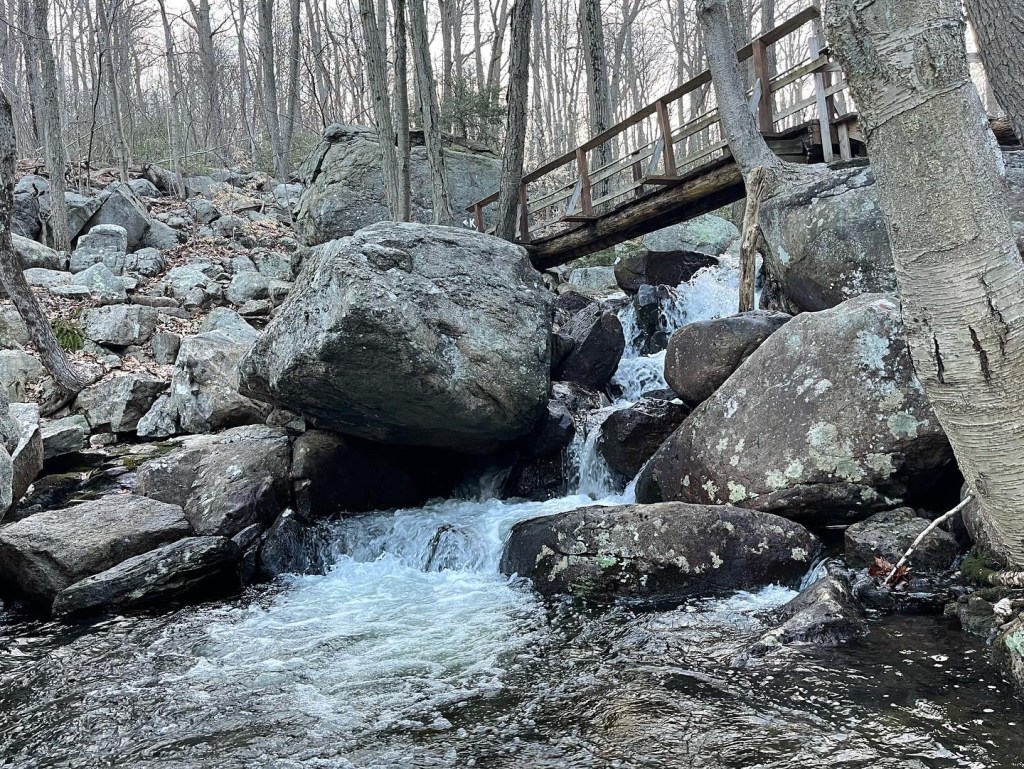
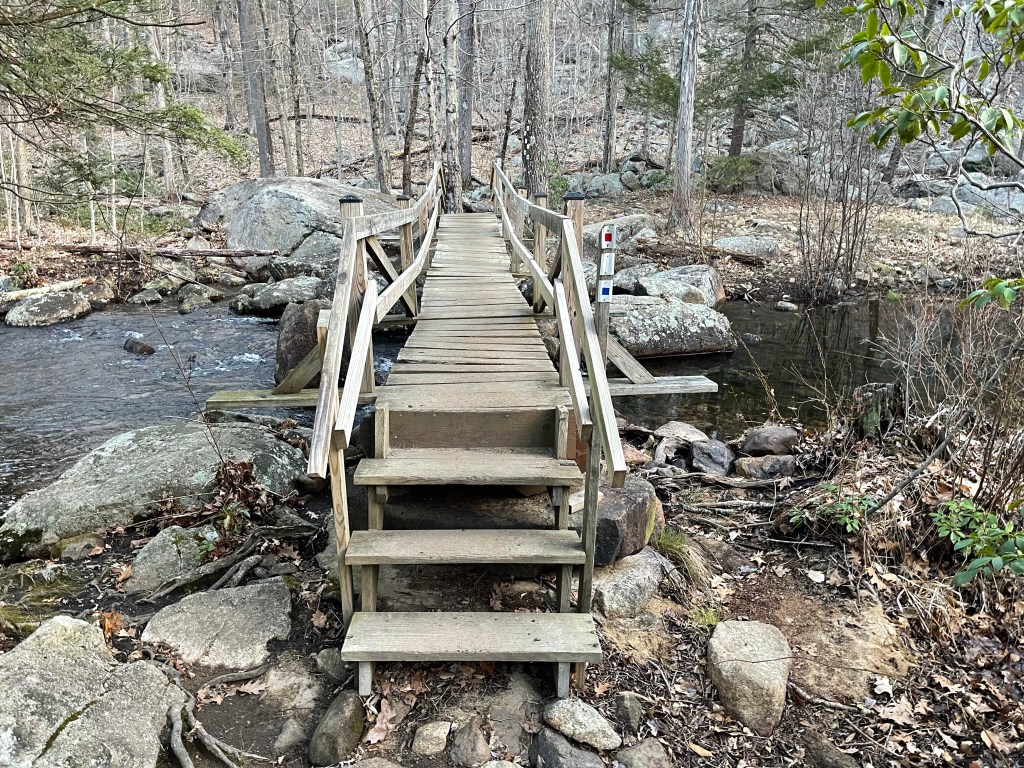
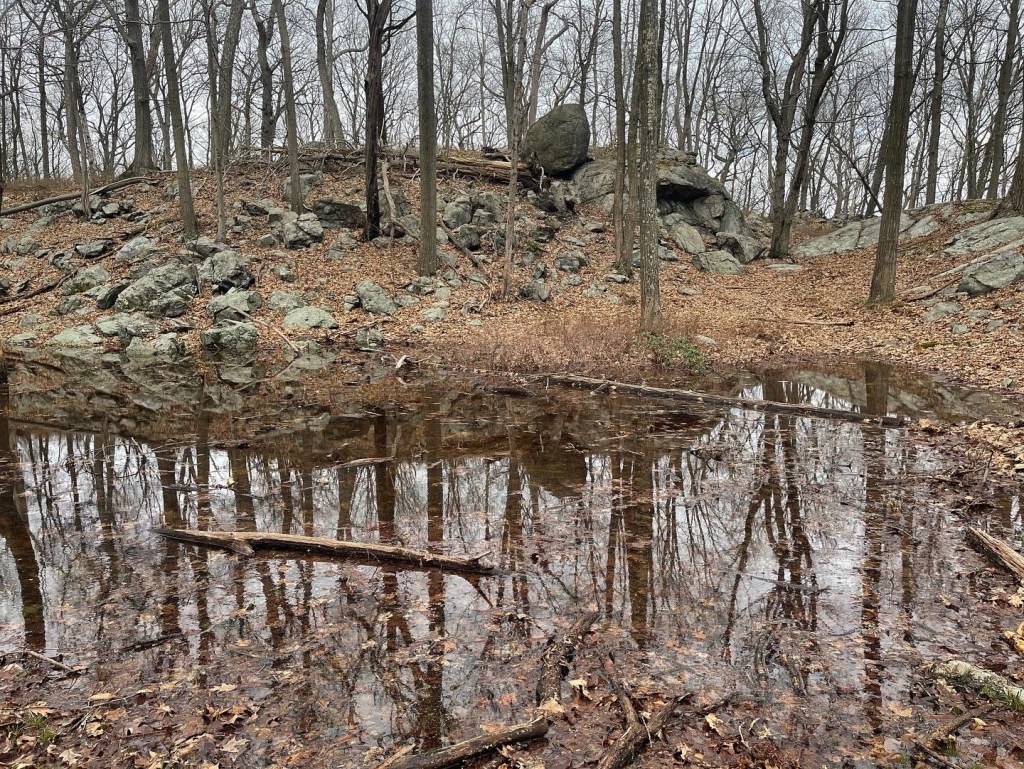
I eventually found that waterfall, just ten minutes away from where we’d turned around on the previous hike. So close and yet so far. But the waterfall looked smaller than I’d anticipated, so to be sure I hiked another ten minutes up to a bridge where the trail split. Looking at my watch, I recognized that there was no way I’d have the time to hike the entire loop around the Reeves Brook Trail Loop…. damn. The pond and rock scrambles would have to wait for another day. I headed back down with a solid hike completed and a hot shower waiting for me. And like the waterfall before, the pond now calls my name. Knowing there’s so much more to see, I’ll carve out half a day for going much deeper into the network of trails next time. Definitely something to look forward to.
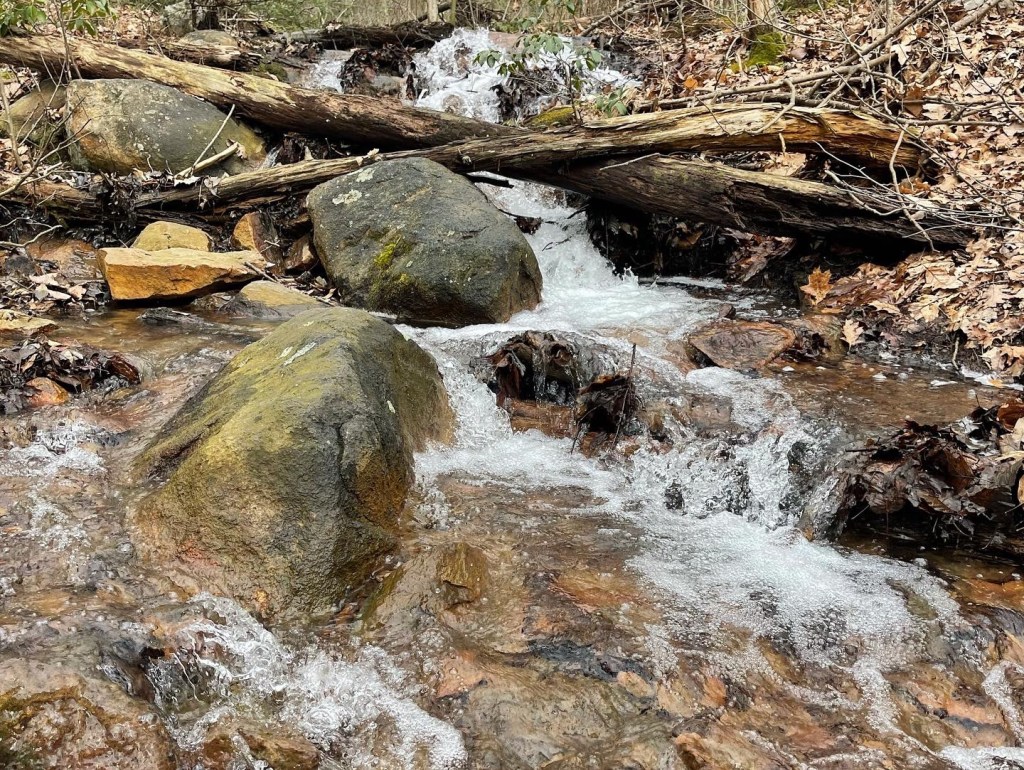
Stony Brook lives up to it’s nameAn elusive waterfall, wrapped in boulders and capped with a bridge.Crossing this bridge convinced me that I’d best turn back and try again another day for the pond.
“Belief in yourself is overrated. Generate evidence.” — Ryan Holiday
What does your personal scorecard look like as we crossed off the first 100 days of 2022 earlier this week? What were your highlights? What hasn’t met your expectations when we began the year?
Doesn’t that inform us of what needs to change immediately?
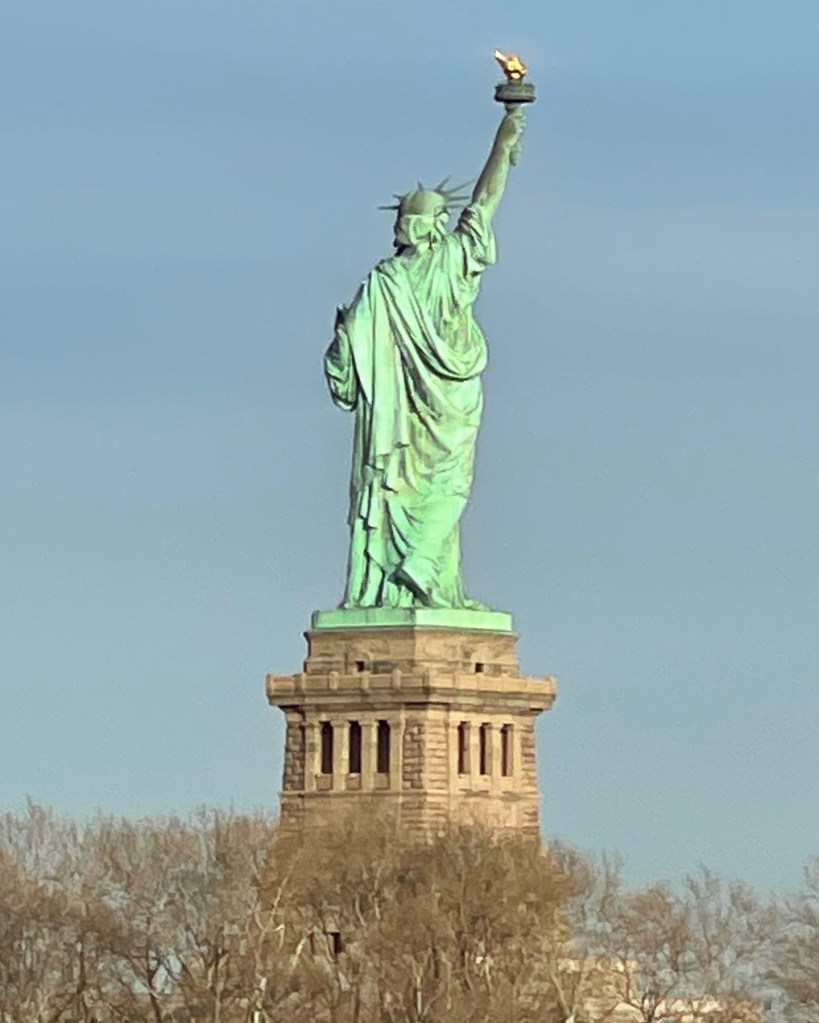
When you see the Statue of Liberty from the New Jersey side, it feels a bit surreal. We’re all used to that image in our head of the face of Lady Liberty, but how often do we ever think of the back? Yet that’s what New Jersey sees. I recall a joke about Lady Liberty forever turning her back on New Jersey, but let’s flip that script around for what’s really been happening since 1886: New Jersey’s always had her back.
Liberty Park offers a striking view of Manhattan and Frédéric Auguste Bartholdi’s bold vision of American liberty. He called his work “Liberty Enlightening the World”. Liberty represents the hopes and dreams of millions, standing exposed to the elements for 13+ decades. 1886 was within the lifetimes of Civil War veterans, think about what that statue meant to them. What it still means, when we look at the world with new perspective.
Liberty connects generations, and she stoically stands, not just American’s, but for the world. The work was literally a gift from the Old World to the New. We ought to remember the message in the gift. Forget the people trying to co-opt her message for political gain, Liberty represents all of us. When you look at America’s Liberty from New Jersey, you aren’t just looking at it, you’re a part of it. And from that perspective, shouldn’t we all have her back?
Let’s get the elephant in the room addressed right off the bat: Anthony’s Nose has an odd name. Here’s one story I came across in Kiddle that describes how it got it:
“Pierre Van Cortlandt, who owned this mountain, said it was named for a pre-Revolutionary War sea captain, Anthony Hogan. This captain was reputed to have a Cyrano de Bergerac type nose. One of his mates, looking at this mount, as they sailed by it, compared it to that of the captain’s nose. He said that they looked similar in size. This good-natured joke soon spread, and the name Anthony’s Nose stuck to this peak. Washington Irving’s History of New York, a satire, attributes the name to one Antony Van Corlear, who was the trumpeter on Henry Hudson’s ship.”
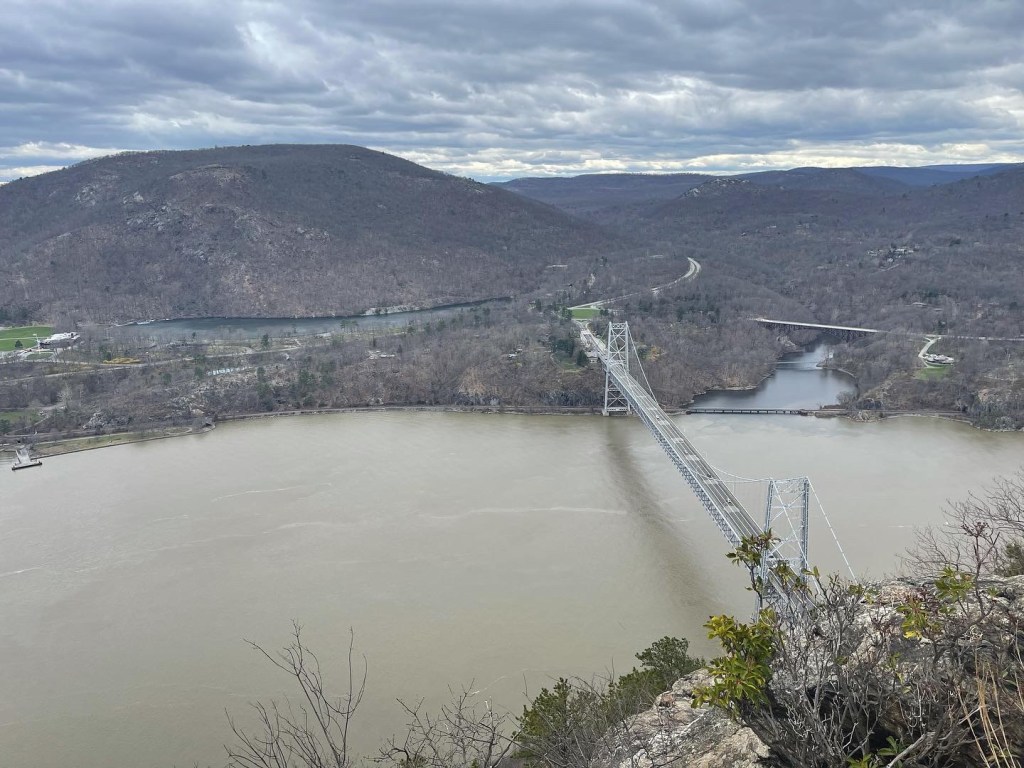
Whatever the source, it requires that each hiker now forever able to say they went up Anthony’s Nose. How you feel about that is entirely up to you. For me, the motivation was to see a bridge I hadn’t seen in almost 30 years, get a quick hike in to break up a long drive and get a feel for a stretch of the Hudson River from a hill top.
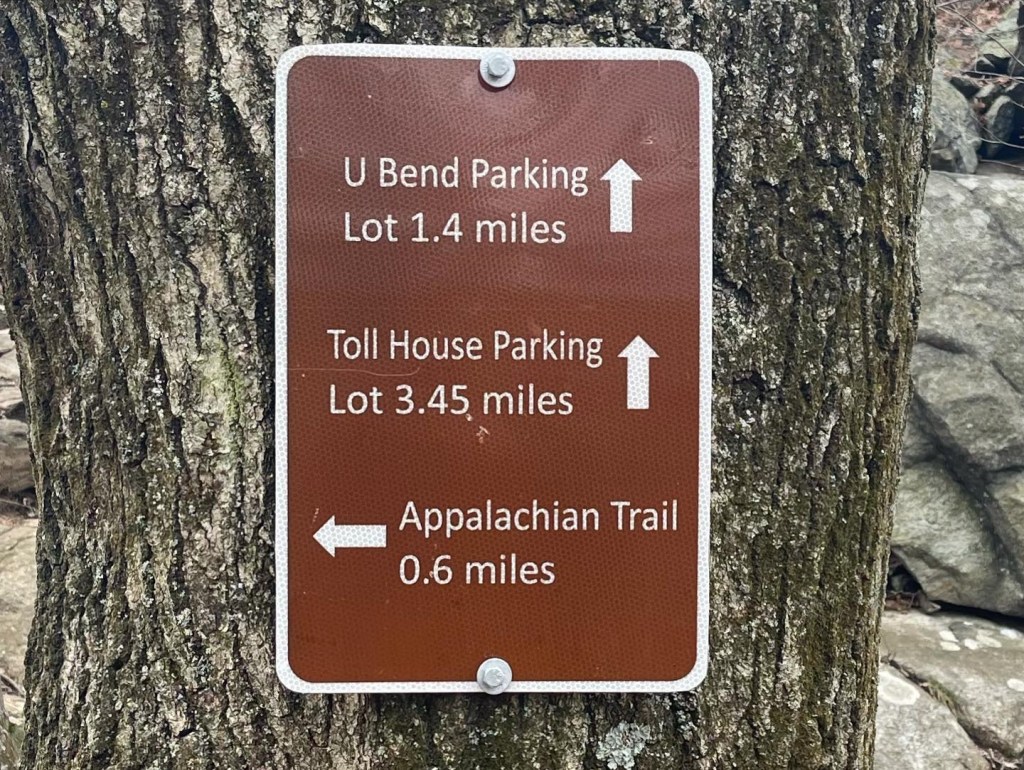
There are a few routes up Anthony’s Nose (sorry). The most direct route is a steep granite “staircase” that brings you to your destination relatively quickly. This requires street parking on a busy stretch of road. Alternatively, there are a couple of longer routes to the lookout spot, the one I favored followed the white blazes of the Appalachian Trail. The AT crosses the Bear Mountain Bridge over the Hudson River and meanders up through a final stretch of New York before reaching Connecticut. You might expect a stretch of the AT to be lovely hiking. You’d be correct for this stretch.
There seems to be a lot of confusion about where the trailhead is for Anthony’s Nose. If you’re going to hike straight up the staircase, you begin at a small deck on the side of the road not far from the bridge. If you’re more interested in a 90 minute round trip hike, take the AT route. The trailhead begins on South Mountain Pass Road, which is a rutted stone dust road for a long stretch. If you’ve got a small sedan you might consider driving in from the Blue Mountain Beacon Highway side, which offers a bit more pavement to work with. Driving a truck, I enjoyed the off-road feel of reaching the trailhead after a few hours of highway driving to get there.
The key for the trail is to follow the white blazes, which leave an old roadbed a few hundred yards up and begin descending towards a small stream before climbing back along the ridge line. The trail head would benefit from a bit of signage and a map, as one hiker after another asked each other if they were in the right spot. Perhaps a Boy Scout Troop could take it on as a project.
The hike took 90 minutes round trip. Parts of the trail felt like you were in the middle of the White Mountains, but with glimpses of the Hudson River along the way. There was a bit of traffic buzz in the background, but overall it was a perfect hike to break up a drive from New Hampshire to New Jersey for me, or a short destination hike away from New York City. I’d recommend bringing lunch and soaking up the view.
Bear Mountain Bridge with it’s namesake rising up behind it
At what point on the line of consistent routine does a habit accelerate from a regular part of your life to a major part of your identity? Put another way, if we are what we repeatedly do, at what moment does what we do become us? It may be that moment when you can’t imagine doing anything else but this habit now and forever. But I think it’s a notch beyond that: when others see you as that character you’ve developed into and that habit is reinforced and self-perpetuates.
Consider a friend who has only been consistently hiking for maybe ten years. Her identity developed around hiking and she’s gained hundreds of followers on her InstaGram account because people associate an activity they want to do more of with her. Or consider my bride, who has run consistently since she was a teenager. Half the town knows her as that lady that’s always out running. Heck, I sometimes think of her as that lady too. Consistent routine develops identity. Identity becomes the essence of who we are.
But both of these women began with a first awkward step out into the unknown. Both learned what worked for them and what definitely was not going to work. The essence of who we are is derived from what is essential for us. The rest is marketing. You either inform the world of who you’ve become or wait for them to see it for themselves.
Like a river carving its deepest channel on its truest route, what we say yes and no to as we favor our chosen path becomes the deepest part of our channel. In a river oxbows gather silt and are eventually cut off altogether in favor of the channel. Likewise, some things that were so very much a part of our identity peter out and die from lack of attention. I once fancied myself a sailor, yet I don’t currently have a boat. A friend also fancied himself a sailor and purposefully accelerated and reinforced that identity by trading up to bigger and bigger boats and forgoing career advancement for a log book full of hopes and dreams realized. Who’s the sailor?
I’m about to click publish on this blog, as I’ve done every day for a few years running now. Does that make me a writer? The answer is what you want it to be. Decide what to be and go be it. And then inform the world (and yourself) with your consistency.