Author: nhcarmichael

  • A Visit with Andrew Carnegie

    “The man who dies rich dies in disgrace.” – Andrew Carnegie

    Andrew Carnegie was born into poverty, turned steel into gold and then gave away 90% of his fortune in the last 18 years of his life. Of all the places in the world he could spend eternity, he chose the Sleepy Hollow Cemetery. I wonder at such things – why here? Why not his beloved Scotland? Why not Lenox, Massachusetts, where he spent his last couple of years? The only way to know is to visit the place.

    Walking around you realize that Sleepy Hollow is a beautiful spot, and likely was peaceful once, before cars and sirens and encroaching development squeezed the solitude right out of the place. But deep in the heart of the cemetery, way up on the hill, you find it grows relatively still, even now. And this is where you’ll find Carnegie.

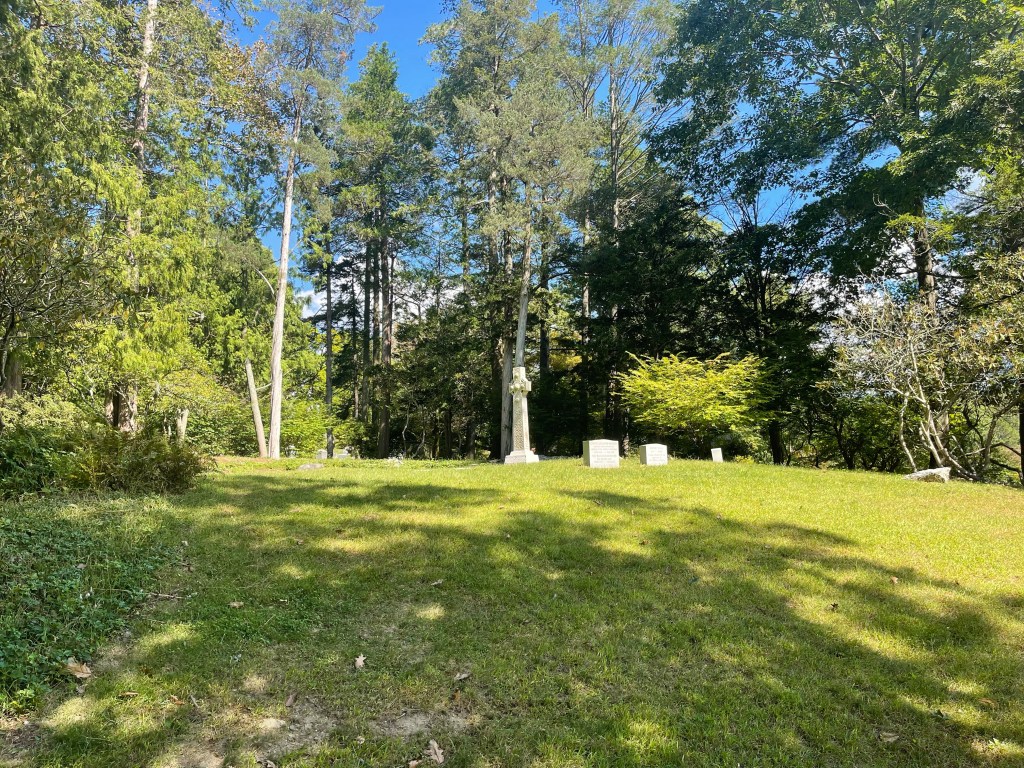
    Looking around at the grand celebrations of wealth displayed in death at Sleepy Hollow (You see? I mattered!) I was struck by the simple and beautiful Celtic Cross gravestone rising amongst the trees at Andrew Carnegie’s burial plot. Granite ledge behind him and a gentle sloping hill in front. Peace.

    Wealth bought him elbow room in death, and wisdom guided him to use it in the most simple, dignified way. I should think he made a point of being placed at arms length from the wealthy posers of the day. He was especially good at calling them out for what they were:

    “There is no class as pitiably wretched as that which possesses money and nothing else.”

    I’m not particularly interested in being buried in one spot. I think I’d rather have my ashes scattered to the winds and sea – to be an eternal traveller in this world. But I see the value of having a place where people can visit you, as I visited Carnegie this week.

    Carnegie became larger than life when he gave away his fortune before death. That Celtic Cross serves as a compass in his absence, pointing the way for the generations who followed him. Quietly reminding us to do enough in our life that others might want to invest a bit of their own brief lives to visit you long after your gone.

    Simplicity and elbow room at Andrew Carnegie’s final resting place.
  • Visiting a Legend in Sleepy Hollow

    “To look upon its grass grown yard, where the sunbeams seem to sleep so quietly, one would think that there at least the dead might rest in peace.” – Washington Irving, The Legend of Sleepy Hollow

    There are two Sleepy Hollow Cemeteries of note. There’s the one up in Concord, Massachusetts with it’s Author’s Ridge populated with the bones of Thoreau, Emerson, Alcott and others. And then there’s the one here on the shores of the Hudson River, where the wealthy vacated the city for one last time and tried to one-up each other in death with grand mausoleums as their final statement about how rich and powerful they were.

    Those rich folks can wait in their eternity. For there’s really only one name that matters when you talk about Sleepy Hollow, the guy who put it on the map: Washington Irving. Irving wrote two of the most familiar short stories in our cultural memory: The Legend of Sleepy Hollow and Rip Van Winkle.

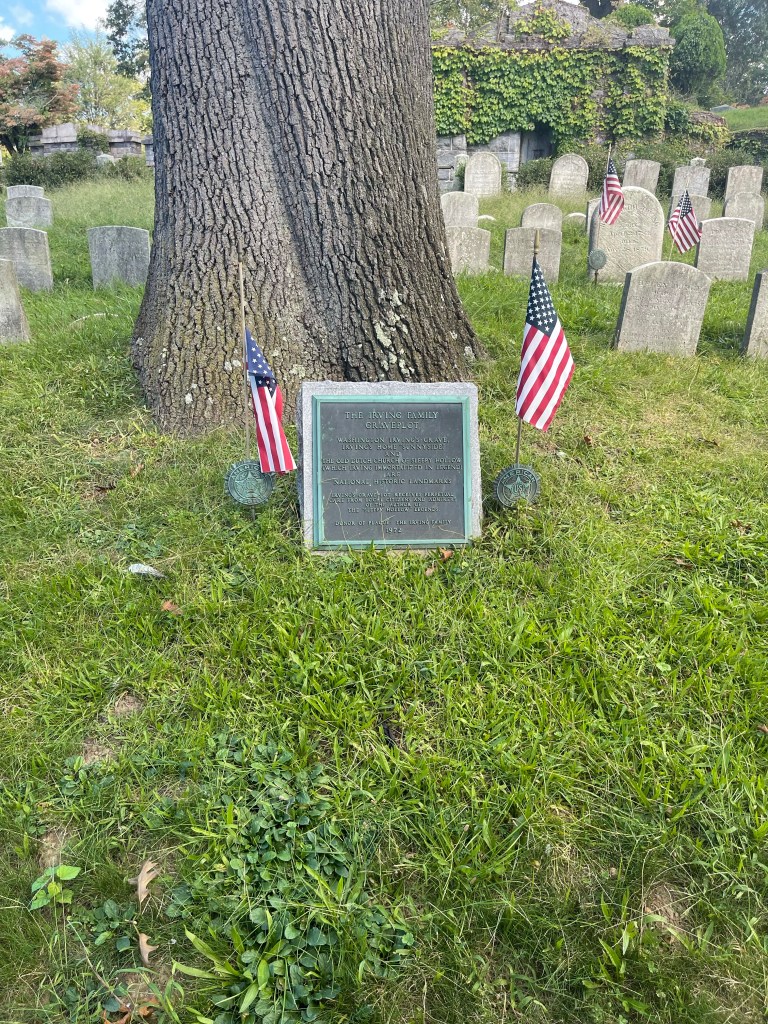
    It’s that tale of the headless horseman that inspires people to visit his grave at the Sleepy Hollow Cemetery. Irving is buried in the oldest section of the graveyard, with unpaved roads crisscrossing un-mowed plots with headstones protruding up in neat columns. That walk up the hill to visit his grave seemed perfect. Like walking back in time to visit those who came before us.

    I didn’t visit out of some ghoulish fascination with his short story, but for the whispers you hear at their resting place. Cemeteries generally hold the lay of the land as it was on the day they buried someone, and Irving’s resting place nestled amongst his family on a hill overlooking the Hudson River Valley seems a lovely place to spend eternity.

    Of course, Irving doesn’t need to whisper, for he wrote plenty for us to draw on. His stories will likely outlast every gravestone in Sleepy Hollow. Does that make him a legend?

  • Diner Talk

    Everyone thinks of travel as exotic, and business travel as bordering on gluttonous. Well, let me shatter those illusions. This evening I’m staying in a dumpy Hampton Inn with a privacy lock that appears to have borne the brunt of a few too many kicks to the door. If there’s anything good about seeing that, it was quickly forgetting about the mildew smell that greeted me as I opened the door. But hey, the hotel sneaks just under the maximum rate for this particular corner of the world.

    On the plus side, I got to experience the natives in the wild. By wild, I mean I went to a New York diner (open 24 hours!) and listened to the father and mother conversation at the table closest to me. Ever wonder if people talk like George and Jerry on Seinfeld when they’re at the diner? I’m here to tell you they hit the mark.

    The son (more George than Jerry) did almost all the talking, with Mom playing the dutiful part of good listener. Talk ran from the state of the New York Yankees and reminiscing about the good old days of George Steinbrenner to a new car this poor guy purchased two weeks prior that clearly didn’t measure up to expectations. But mostly it was an overall appreciation for the amazing onion rings he crunched on between Yankee and car talk. After all, this was a New York diner, and food is a big deal here. The menu runs heavy and varied, while the bar menu runs comparatively light (5 choices of mainstream beer, and a choice of 5 mixed drinks, featuring a classic hit, the White Russian). But people don’t go to diners to pound drinks, they go fill their bellies and talk about the state of the world.

    Now don’t get me wrong, I didn’t go to this diner to eavesdrop, but the sheer enthusiasm expressed for the range of topics made it impossible to focus on reading the latest book on the Kindle app. Sometimes you’ve got to savor the moment as it’s presented to you. I might be a few chapters behind pace in finishing that book, but my gosh I soaked up some unadulterated New York diner talk. And realized in the process that I’ve missed these moments of travelling bliss more than I dared believe.

    By comparison, they probably thought my table pretty boring.

  • Nature’s Pilot

    “THE DEVIL. What is the use of knowing?
    DON JUAN. Why, to be able to choose the line of greatest advantage instead of yielding in the direction of the least resistance. Does a ship sail to its destination no better than a log drifts nowhither? The philosopher is Nature’s pilot. And there you have our difference: to be in hell is to drift: to be in heaven is to steer.”
    – George Bernard Shaw, Man and Superman

    On the long road to knowing, admittedly some of us are late bloomers. But the path is long, even as life is frustratingly short. We humans, pre-built with an expiration date, aren’t designed to ever know it all. But in learning we might find the right path instead of wasting this precious time wandering about in trial and error.

    What is philosophy but refined knowledge about how to best live? It is knowledge acquired and contemplated on, which offers channel markers as we navigate uncertain waters in our time. This is what we draw on from humanity’s philosophers, and increasingly from ourselves as we grow.

    Growth is a choice. And choosing this line of greatest advantage offers the opportunity to steer instead of drift. In Shaw’s work, Hell is populated with the posers and drifters. To transcend this fate, we must strive for improvement:

    “I tell you that as long as I can conceive something better than myself I cannot be easy unless I am striving to bring it into existence or clearing the way for it. That is the law of my life. That is the working within me of Life’s incessant aspiration to higher organization, wider, deeper, intenser self-consciousness, and clearer self-understanding. It was the supremacy of this purpose that reduced love for me to the mere pleasure of a moment, art for me to the mere schooling of my faculties, religion for me to a mere excuse for laziness, since it had set up a God who looked at the world and saw that it was good, against the instinct in me that looked through my eyes at the world and saw that it could be improved.”

    The truth about philosophy is that it isn’t a thought experiment, it demands active participation. To go through the motions in life is the greatest of sins, for it’s a betrayal of the self. We owe it to eternity to use our time as best we can. Our moment to steer is now.

  • Among the Trees (for Pops)

    When I am among the trees,
    especially the willows and the honey locust,

    equally the beech, the oaks and the pines,
    they give off such hints of gladness,
    I would almost say that they save me, and daily.

    I am so distant from the hope of myself,
    in which I have goodness, and discernment,
    and never hurry through the world
    but walk slowly, and bow often.

    Around me the trees stir in their leaves
    and call out, “stay awhile.”
    The light flows from their branches.

    And they call again, “It’s simple,” they say,
    “and you too have come
    into the world to do this, to go easy, to be filled
    with light, and to shine.”
    – Mary Oliver, When I Am Among the Trees

    A year flies by, doesn’t it? And beneath it all, carried quietly, my own grief and sense of loss. Buried so that others might bear their own.

    You knew the trees and taught us to see them too. And you taught us the simple joy of being alive while there’s time. And, as Mary Oliver puts it so much better than I, to go easy, to be filled with light, and to shine.

    Today, among the trees, we’ll remember you again (as if we ever forgot). To feel you stir in the breeze and see the mischief carried on in the eyes of those who knew you best. We’ll close this one chapter and begin the next, knowing you’ve never really left us. Not really. For you’ve filled us with light.

  • The Widest Helpful Influence

    “There is no wealth but life. Life, including all its powers of love, of joy, and of admiration. That country is the richest which nourishes the greatest numbers of noble and happy human beings; that man is richest, who, having perfected the functions of his own life to the utmost, has also the widest helpful influence, both personal, and by means of his possessions, over the lives of others.” – John Ruskin, Unto This Last

    It’s no surprise to learn that Gandhi was strongly influenced by John Ruskin when you read something like this. The ripples of Ruskin continue to reverberate in Liberal thought. By Liberal I’m not speaking of foolish political labels, but in the concept that life and liberty for everyone matter. Matter, in fact, more than the political ambitions of some autocrat or profiteer.

    Think about this: who has the loudest voice in the room? Does that person hold the most influence? It seems so, doesn’t it? But it’s generally the person that influences them who has the most power. It’s the person behind the spotlight who has the power, not the person who the light is being cast upon.

    So how do we develop the widest helpful influence over the lives of others? The obvious answers are to build wealth, a powerful network, and a base of followers. And there’s no doubt that these will reverberate the loudest. But nothing is more powerful than developing the right story and the commitment to having it heard. And that starts with us.

    Gandhi, Ruskin, Thoreau, Nietzsche, King, Emerson, Seneca, Aurelius, Carson, Oliver, Goethe, Montaigne… all are just people who developed a story and a voice. All found an audience over time. So why not us? What story will we tell?

  • Taking Our Measure

    “The only man who behaved sensibly was my tailor: he took my measure anew every time he saw me, whilst all the rest went on with their old measurements and expected them to fit me.”

    “When you go to heaven, Ann, you will be frightfully conscious of your wings for the first year or so. When you meet your relatives there, and they persist in treating you as if you were still a mortal, you will not be able to bear them. You will try to get into a circle which has never known you except as an angel.” – Jack Tanner in George Bernard Shaw’s Man and Superman

    These two quotes from Shaw’s fascinating play Man and Superman resonate with anyone who has tried to shed the preconceptions that those who knew us “then” have about what we’re capable of “now”. We all grow, yet there’s a lag time for those who might measure our fit based on the person we used to be. This is one reason people job hop or move far from home. If you leave your old identity behind, you free yourself to be whatever you want to be in the place where you land.

    Of course, one person we never leave behind is ourselves. If we aren’t aligned with a belief in our future potential we’ll never reach it. What is left of us then but incremental improvement? That’s not a leap forward at all, but a slow shuffle across our brief time.

    When we grow we no longer fit into that old character we used to be. We must adjust our own expectations of what is possible, take a deep breath and leap towards our greater potential. And if necessary find a circle that believes in our present potential instead of clinging to our limited past.

  • Let Us Go Forth

    “What is literature but the expression of moods by the vehicle of symbol and incident? And are there not moods which need heaven, hell, purgatory, and faeryland for their expression, no less than this dilapidated earth? Nay, are there not moods which shall find no expression unless there be men who dare to mix heaven, hell, purgatory, and faeryland together, or even to set the heads of beasts to the bodies of men, or to thrust the souls of men into the heart of rocks? Let us go forth, the tellers of tales, and seize whatever prey the heart long for, and have no fear. Everything exists, everything is true, and the earth is only a little dust under our feet.” – W.B. Yeats, The Celtic Twilight: Faerie and Folklore

    There is still a schemer in you and me, plotting escapes to faraway places and magical hidden nooks closer to home. There are still stories percolating in our heads, looking to escape into the world in mischievous stacks of words. For everything exists, and we do too for such a short time as this. We must explore it with the urgency that this brief life demands.

    We’ve all learned a hard lesson the last few years. The world isn’t fair, doesn’t care about your hopes and dreams, and far too many people believe whatever Machiavellian story someone else is spinning for them. Is there not worthier magic in this world that needs expression? We must explore the physical world, and swim the sparkling waters of the ethereal within our imagination while there’s still time.

    Have the mettle to rise above the dismal din. Fly, while we may, for the world is only a little dust under our feet. Go forth and bring its wonder back for all to see.

  • Becoming Equal to the Whole

    “The problem with most people, he felt, is that they build artificial walls around subjects and ideas. The real thinker sees the connections, grasps the essence of the life force operating in every individual instance. Why should any individual stop at poetry, or find art unrelated to science, or narrow his or her intellectual interests? The mind was designed to connect things, like a loom that knits together all of the threads of a fabric. If life exists as an organic whole and cannot be separated into parts without losing a sense of the whole, then thinking should make itself equal to the whole.” – Robert Greene, describing Goethe, Mastery

    This idea of making yourself equal to the whole through exploring all available interests, normally gets you tagged as unfocused or a Jack-of-all-trades (master of none). Such expansive thinking is regarded as inefficient by many. But let’s face it, the people with a wide range of interests are able to transcend the ordinary and create things that others might not see. They become visionaries.

    We’re all just connecting the dots, trying to make sense of the world and our place in it. We are a part of that sum, and it’s okay to question what that part might be. What’s certain is that it’s our part, nobody else’s, and we ought to find a path that makes the most sense for ourselves. Everything we do, every pursuit, every relationship, every stumble along the way is a part of becoming whatever it is we’ll title the sum of our lifetime. That process of becoming is what life is all about.

    Surely, we can never really equal the whole, but we can get pretty far down the path. And that’s about all you can hope for in one lifetime, isn’t it? To pursue our diverse interests as far as we can take them, and to contribute something back to those following their own paths towards that elusive whole. That’s what Goethe did, and Robert Greene is doing. Shouldn’t we too?

  • A Fortnight of Motion

    “The job of feets is walking, but their hobby is dancing.” – Amit Kalantri

    “When we breathe, we expand our life force.” – James Nestor, Breath

    There’s no secret to the key to life. Keep moving. Water stagnates when it sits still for too long, and it’s the same for our bodies. So keep the river flowing. Moving is the key to good health. Circulating the blood, getting the oxygen moving in and out of our bodies, flushing toxins out of our system through motion. We all know this, but still catch ourselves parked on our asses for hours at a time. Get up and move already!

    We all find ourselves in situations where we can’t hike or swim or dance, but we can always move. We can always breathe deeply. So why do we forget to do it? Our bodies will rest plenty in our eternal sleep, why get a head start on it?

    With all this in mind, I’ve begun a fortnight of motion. 14 days of focus on exercise, breathing and better nutrition. Two weeks are long enough to make it a challenge, but short enough to stay focused. As a rule, I don’t like writing about what I’m going to do. The world is full of people who make promises they’ll never keep. But accountability is a key for success in any endeavor, so a fortnight challenge provides a clear timeframe to put up or shut up.

    Exercise takes many forms. I happen to have the tools for better fitness available. A Concept II rowing ergometer, kettle bells, free weights and good walking shoes. The thing is, I had all of these tools yesterday too, but didn’t use them.

    Use them.

    And then write about it.