Author: nhcarmichael

  • The Eternal Makes You Urgent

    “Once the soul awakens, the search begins and you can never go back. From then on, you are inflamed with a special longing that will never again let you linger in the lowlands of complacency and partial fulfillment. The eternal makes you urgent.” – John O’Donohue, Anam Cara: A Book of Celtic Wisdom

    O’Donohue picked the name of his book with purpose. “Anam cara”, or “soul mate”, suggests that the timeless wisdom buried within might offer the kind of guidance you would get from a cherished friend or spouse. Google it and you’ll find coffee mugs and spiritual retreats and other such things. It would also be a great boat name. And it stirs something in you whether you have one or long for one.

    This idea of the soul awakening isn’t new to us. If this awakening happens at all, it might not be thought of as soul, but as passion or purpose or calling. Some of us steer clear of words like soul. It almost feels intrusive for me to be writing about such things. Not skating my lane, you might say. But I understand eternity, and urgency, and this idea that the things that matter most to us require immediate attention. For our time in eternity isn’t the moments on this side of the turf.

    My own urgency started burning inside of me when I started writing again. It served as a catalyst for exploration and deeper thinking. And when you have it yourself you quickly see the urgency in others. Hikers hiking every available moment, landlocked sailors scrambling to be ready for the warmer days ahead, small business owners pouring every bit of available energy into standing up something special, artists creating brilliant mirrors that reflect back on the rest of us. Urgency senses its kind out in the wild.

    The trick is finding and awakening that soul. And you only find it by trying and doing, tossing aside and finding something else to do. If you’re lucky you find it quickly and embrace it. Or you see it and follow a different path, only to have it pull at you until you finally listen or die embittered at the path you took instead. That’s no way to begin eternity. Is it?

  • We Must Be Still and Still Moving

    Old men ought to be explorers
    Here and there does not matter
    We must be still and still moving
    Into another intensity
    For a further union, a deeper communion
    Through the dark cold and empty desolation,
    The wave cry, the wind cry, the vast waters
    Of the petrel and the porpoise. In my end is my beginning.
    – T.S. Eliot, East Coker

    Beginning at the end as I do in quoting this masterpiece is admittedly the easy path, but seems appropriate given the context. I’m roughly where TS Eliot was when he wrote East Coker – middle of life (hopefully). Or maybe just past the middle. But who’s counting? Days are days, and here and there does not matter. Time will tell, as it always does.

    This blogger has settled into this rhythm of still and still moving. Moments of quiet contemplation, deep reading and exploration interspersed too infrequently with mountaintop adventures and faraway places. Thoughts of past exploration and schemes of future possibility fill the mind, and are betrayed by more than a few posts. We aren’t sharks, always moving, but humans immersed in life in all its complexity. The thoughtful wrestle with the same ideas, the masses distract themselves with media and games.

    Old folks ought to be explorers. And us not-so-old folks too. We ought to be out seeing the world, exploring vast waters and rounding bends. Bridging gaps in language and understanding and toasting the folly of it all with old and newfound friends. Catching a sideways glance and throwing it back. Dancing in celebration and settling into deep conversations. We will again, we see that now. Where will you go? What will you do with the time you’re given?

    This human journey leads to another, more intense place, or perhaps merely to stillness. Who are we to know, really? Do you choose logic or faith? Which is the real leap? Our path is one of tapping our potential, to struggle and explore the darkest and brightest days alike. To make the best we can of ourselves. To turn it all over and understand where we came from. This seems to me the way, for the end is the beginning. In some ways, we’ve known that all along, haven’t we?

    Beginning
  • A Visit with Benjamin Church

    A seasonably warm Sunday lured me from a visit with friends in Mattapoiset, Massachusetts to Little Compton, Rhode Island to finally meet Benjamin Church. Church was appointed Captain of the first Ranger force in America in 1675 by the Governor Josiah Winslow of Plymouth Colony. He was famous for being the guy leading friendly Native Americans that finally killed Metacomet (King Philip). His greatest innovation was in imitation: adopting the Native American style of fighting to allow his forces to survive and find success in battles with the French and hostile native population.

    What made Church honorable was his respect for the native population and his desire to coexist with them. While many around him were inclined to encroach and eventually push aside native tribes, Church wanted to coexist and work with them. This led to recruiting friendly tribes to assist in King Philip’s War and in later battles with the Abenaki and French in Acadia. War is a dirty business, and there was plenty of atrocity committed on both sides, but Church seemed to live by a code of honor untarnished by historical perspective.

    Today Church lies in rest in a quiet triangle-shaped graveyard in the middle of Little Compton with his wife buried next to him. A monument honoring him stands at his feet, and someone glued an Army Ranger tab just above his engraved name. That engraving is fading away now, barely legible after 300 years of exposure to the elements. If you asked a thousand people in New England who Benjamin Church was, maybe one or two would know. Time fades memory faster than it does engraved stone.

    Here lyeth interred the [body]
    of the Honorable
    Col. Benjamin Church, Esq.,
    who departed this life, January 17, 1717-8 in
    the 78 yeare of his age.’

    On a beautiful Sunday afternoon I was the only visitor, but a group of teenagers were playing basketball nearby. I wondered if they knew the story of the soldier buried nearby? Does their local school teach children about the war that happened right across the river, or about the man quietly marking eternity in a faded grave in the middle of town? I hope so.

    Fading history
  • Discharging The Loyal Soldier

    “Odysseus is a loyal soldier for the entire Odyssey, rowing his boat as only a hero can—until the blind prophet tells him there is more, and to put down his oar.” – Richard Rohr, Falling Upward

    Richard Rohr planted this seed of discharging the loyal soldier in my mind. He described the ritual used with Japanese soldiers returning from World War II being thanked for their service and discharged to focus on the next stage of their lives – to be productive members of society. I’ve read a fair amount of history of that war and know the fanatical intensity of the typical Japanese soldier, so to shed that character and assume some level of normalcy on a mass scale is itself impressive and instructive. If your only path was total victory or death, how do you process defeat and going back home? So ritualistic discharging saved what was left of a generation of soldiers to rebuild Japan from the ashes.

    “This kind of closure is much needed for most of us at the end of all major transitions in life. Because we have lost any sense of the need for such rites of passage, most of our people have no clear crossover to the second half of their own lives.” – Richard Rohr, Falling Upward

    We’re at a time in our collective lives where we need this ritual for society. Thank you for your social isolation, for your mask-wearing and countless hours trying to keep people alive. Thank you for your passionate political opinions and protests on both sides. Thank you for voicing your opinions so forcefully on social media. You’ve done your service for society. It’s time to focus on rebuilding now, for the world needs you for another mission. To save the planet and humanity.

    I recognize the transition happening in my son’s life – graduated from college, finished with organized sports, and now what? With the pandemic they didn’t even have a graduation ceremony, let alone a discharging of loyal soldiers. Here’s your diploma, mailed without pomp or circumstance. Good luck! No wonder this generation is looking around and saying “What next?” You learn that they aren’t ready to hear everything yet, as you weren’t. But they’re definitely ready to hear the message that they’ve done well fulfilling the first mission – we’re proud of you, now go forth and find the next mission.

    I’m in my own transition, of course, with the responsibilities of parenting shifting to sage advice strategically inserted whenever a teaching moment arrives – sometimes validating, sometimes contradicting the advice from the other parent. But what of us? We’re stepping into the second half of life when we start filling the proverbial container we built in the first half of life. So what do you fill it with?

    “Discharging your loyal soldier will be necessary to finding authentic inner authority,,, When you first discharge your loyal soldier, it will feel like a loss of faith or loss of self. But it is only the death of the false self, and is often the very birth of the soul. Instead of being ego driven, you will begin to be soul drawn.” – Richard Rohr, Falling Upward

    Discharge that loyal soldier and become “soul drawn“? That’s a bumper sticker or a name for an IPA if I ever saw one! The coolest cat surfing life, dispelling timeless wisdom in clever soul drops as you serve your new guiding light.

    We’ve all been in a period of forced transition, timed for some of us in a period of natural transition. It’s time to focus on what comes next, and do the work you were honed to do during the previous you. Time to put the oar down and follow through on that next mission. That soul drawn and fulfilling mission.

  • The Rhode Island Red Monument

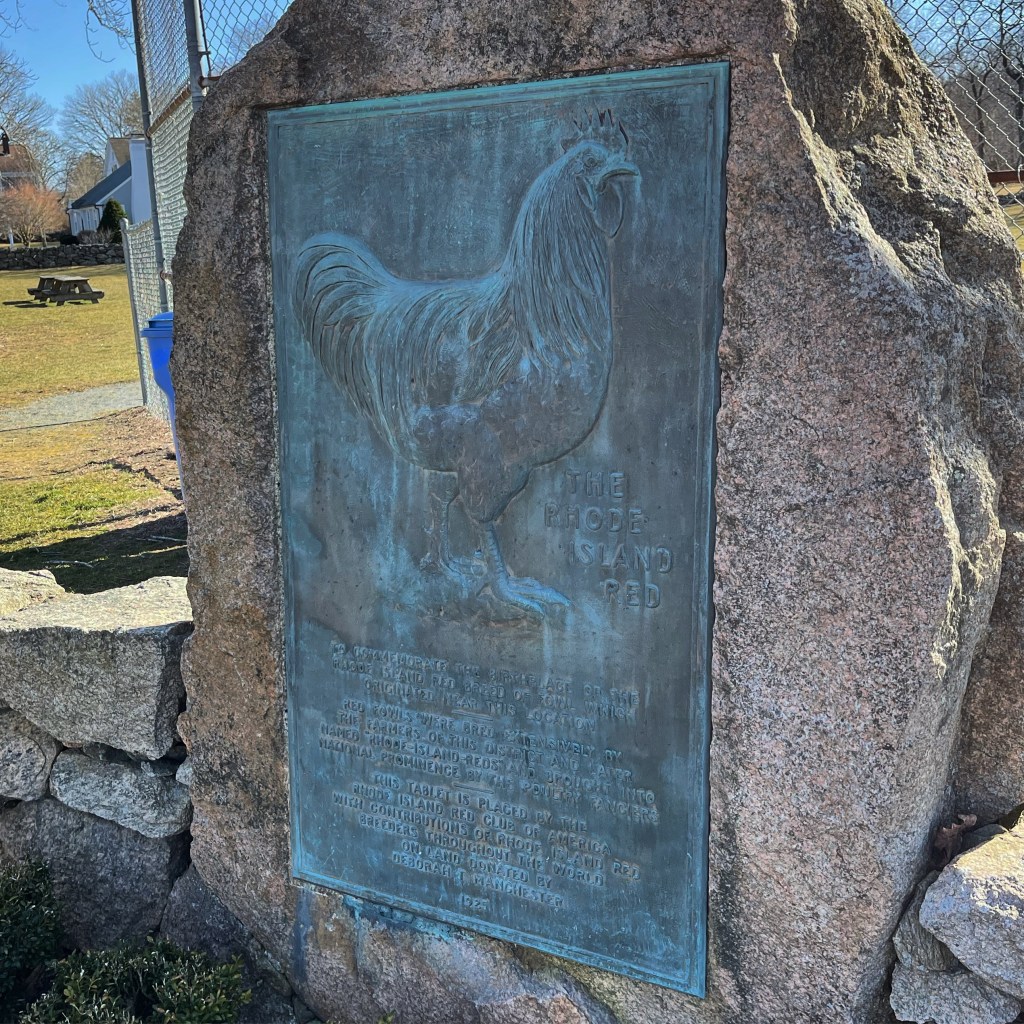
    One of the joys of travel is stumbling upon roadside curiosities. On my pilgrimage to visit a favorite hero of King Philip’s War I came across a monument to the Rhode Island Red that drew my attention. The Rhode Island Red is a hen, of course, that famously and productively laid eggs particularly well, which led to breeding of this particular character to make eggs a common and reliable staple of our diet. It seems the Rhode Island Red was first bred on a farm in Little Compton, Rhode Island.

    In 1925 a group of Rhode Island Red enthusiasts erected this monument to the hen, commissioning an artist named Henry Norton to make it. But here’s where the story gets interesting. One group wanted the monument to be erected at the actual farm where the hens were first bred. Another group wanted it in a more prominent location in town (where I came across it, validating their choice I suppose). For a small town, this was pretty heated, with both sides trying to establish a pecking order. At the unveiling of the first monument the opposing group didn’t show up, apparently feeling the location was pretty… fowl. A year later they erected their own monument at their preferred site. The 1925 monument features a rooster, the 1926 monument features a hen. But a well-placed hen. They really showed ’em.

    The 1925 Rhode Island Red Monument

    The inscription on the 1925 monument reads:
    “To commemorate the birthplace of the
    Rhode Island Red breed of fowl which
    originated near this location
    ___
    red fowls bred extensively by
    the farmers of this district and later
    named “Rhode Island Reds” and brought into
    national prominence by the poultry fanciers
    ___
    this tablet placed by the
    Rhode Island Red Club of America
    with contributions of Rhode Island Red
    breeders throughout the world
    on land donated by
    Deborah Manchester
    1925″

    This entire incident is described in the monument’s Wikipedia page in delightful detail. Not having the back story when I came across the monument, I wasn’t aware of the other monument. Now I feel compelled to return to Little Compton again sometime to find it. In the meantime, Norton’s 1925 monument quietly marks time, closing in on its 100th birthday. Placed on the National Register of Historic Places in 2001, this monument to a chicken has secured its own place in history.

  • 7 Observations on Reaching 1000 Blog Posts

    We all write for different reasons, and my observations might not be yours, nor should they be. But reaching a milestone like 1000 blog posts deserves some measure of reflection. As I look forward with anticipation to post number 1001, I pause to give you seven observations about the journey to this point:

    1. The well never runs dry. You just run out of time. Writer’s block is a myth. If you’re earnest and curious you never run out of things to write about. But you will wrestle with perfection and trying to make a post reach its potential. When you post daily you learn to love it as it is and know when it’s time to let it fly. No, it’s never perfect, but you post it anyway.
    2. Everything becomes a potential blog post. I started writing Alexanders Map intending to have a local travel blog with historical sites with visits to amazing places. The name itself infers this. But it quickly expanded to include a diverse (some would say eclectic) mix of topics. You learn to listen to the muse, and embrace the new. And in the unexpected you find your own voice. You are the link between each post, and part of you reflects back on what you’ve visited.
    3. This business of blogging is your own business. You can quickly grow your blog follower list by playing the game of actively following and liking other bloggers. Or you can do the opposite and grow organically. I choose the latter: I’m very selective about who I follow, I “like” what I actually read and appreciated, and I don’t follow to gain followers. You choose what you want to be in the blogging world. I didn’t even mention I had a blog to family and friends until I’d written a hundred or so posts. I do link to Twitter, but rarely on other media. Choose what works for you, because your blog is how you present yourself to the world.
    4. One sentence at a time, you become a better writer. Let’s face it, none of us start a blog thinking we’re bad writers. Bloggers tend to believe they’ve got some skill for writing or they’d start a YouTube channel or build an Instagram or TicTok site. But the craft of writing develops through the daily struggle. I’m nowhere near the writer I thought I was, and I’m nowhere near where I want to be. But I keep chipping away at it, day-by-day. Blogging is an apprenticeship in writing, but you never meet the master.
    5. Some of your favorite posts will be completely ignored. You will work on a blog post that stirs something deep inside you, feel a wave of emotion crash over you as you click publish, and see the world react with complete indifference. Write these posts anyway, and write them often. Because when you tap into this well you aren’t blogging for instant fame, you’re writing to find something inside yourself that you thought, maybe, was there all along.
    6. You develop an eye for the interesting and an ear for the hidden stories. You stop more frequently in fascinating places, detour to find and celebrate the obscure and forgotten, and do things you might not have done otherwise. You become a ghost whisperer, visiting old graveyards and monuments to the past engraved by some soul long forgotten, who was honoring something of note that brought us to where we are today. You learn poetry and philosophy and Latin phrases and stir up the magic in an old pile of words. You hike to places of wonder and seek adventures. In short, you become more alive, and you appreciate this journey more than ever before.
    7. You learn to follow through on the promises you quietly make to yourself. You want to be a writer? Then write, no matter how you feel, and post that work every day, no matter what. Keep that commitment to yourself today. And tomorrow too. As James Clear puts it, every action you take becomes a vote for the type of person you wish to become. Your blog is a stack of votes for your identity. So craft them as best you can and set them free for the world.

    So there we are: 1000 blog posts. As I mulled over this one the last few days, I found myself in a corner of New England I don’t visit enough and chanced upon a couple of roadside wonders I might never have seen had I not set out for an old grave I wanted to visit. And just like that I’ve got three more blog posts in my mind. The world is funny that way – it opens up for the curious observers. I can’t wait to see where the next 1000 take me.

  • The Heart of the Bay

    Nobody owns the sky or the trees.
    Nobody owns the hearts of birds.
    Still, being human and partial therefore to my own
    successes—
    though not resentful of others fashioning theirs—

    I’ll come tomorrow, I believe, quite early.
    – Mary Oliver, Winter and the Nuthatch

    Oliver writes of building trust with a nuthatch that eventually learns to eat out of her hand. One morning she arrives later than other mornings only to find her nuthatch friend eating from another person’s hand. And thus she resolves to arrive earlier the next morning. I’ve felt this myself, not with birds in the hand so much as places of solitude.

    Early Spring is still a time of hard frosts and temperature swings. Maple syrup weather – when the sap flows and gathers in buckets around Maple trees throughout the region. But not here. Cape Cod is more temperate, not subject to the extremes that draw the sap out. And then there’s the trees themselves, which seem to prefer the other side of the bridges. No, here we have a different sap drawn out in the early mornings. And I’m drawn to the light and the chorus.

    Buzzards Bay, well before the dawn, is awash in deep blues and burnt orange and the calls of thousands of Eider Ducks off in the distance. They have a lot to say to each other. It must be breeding season for these migratory birds. They didn’t pay much attention to the stranger on land, and I let them alone in their banter and flirting. The chorus felt altogether different from the bay in warmer months, when outboard engines of fishermen roaring off to favorite holes pierce the silence. Eiders quickly become white noise as I refocus on the task at hand.

    I crunched across a deep frost, leaving footprints in the grass on my walk to the shoreline. Low tide drew me out further into the bay, right to the waters edge quietly lapping in quiet surges like a heart beat. The bay is alive in this way. Alive in its vibrant, nutrient-rich, welcoming way. It pulls at me as it pulls at the Eider ducks, down from northern regions for their version of Spring Break. I suppose I am as well, looking for a change of scenery from New Hampshire to Buzzards Bay. For a return to salt water reflections and big skies.

    The chorus of Eiders ends with the sun breaking the horizon. Mating time gives way to feeding time. I leave the shoreline myself, for I’m not adorned in the down of a duck and the morning chills me in lingering too long. Hot coffee and inadequate words await me, with the glow of the morning alive in my mind.

    Buzzards Bay
  • The Familiar and the Habitual

    “The familiar and the habitual are so falsely reassuring, and most of us make our homes there permanently.” – Richard Rohr, Falling Upward

    We all find comfort in the familiar, whether a favorite chair to sit in or your morning coffee routine, the people we hang our with or the way we greet them. We embrace it and make it our own, and rarely deviate from it. This is the nature of the familiar and the habitual.

    How many of us stick with things just because it’s the way we’ve always done them? Familiar is strangely comforting, even if it doesn’t benefit us. This is the way we’ve always done it. Humans evolved by mitigating risk by sticking to tried, true and trusted. Those who were foolhardy didn’t survive to dilute the gene pool. When the risk is deeply programmed into your identity, it doesn’t matter if it’s bad for you or not – it’s falsely reassuring and part of you. We all know smoking and overeating are bad for you, but how many do it subconsciously, risk and viable alternatives ignored?

    With everyone’s routine disrupted over the last year, it’s interesting to see how people react to going back to the way things used to be. Do you want to commute to a cubicle farm chipping away at your tasks, all while trying to ignore the screams inside you again? Return to the same old ways, or pivot to something new? How resilient were some of those routines and rituals in the face of a pandemic?

    It’s easy to embrace anchors in our lives – homes, relationships, jobs, and routines, and hard to question that which we’ve always known to be true. But ultimately the only true anchor is our self. None of this is permanent. Forget anchors: embrace sails. Embrace change. For change happens around us whether we want it to or not.

  • A Focused Place

    “Finding a very focused place to do your work rewards you many times over.”-Seth Godin

    “The opposite of ‘distraction’ is ‘traction.’ Traction is any action that moves us towards what we really want. Tractions are actions done with intent. Any action, such as working on a big project, getting enough sleep or physical exercise, eating healthy food, taking time to meditate or pray, or spending time with loved ones, are all forms of traction if they are done intentionally. Traction is doing what you say you will do.” – Nir Eyal

    Perhaps it was a week of chaos and distraction that made Eyal’s statement grab me by the shoulders and focus my mind on the truth of the matter. Distraction is diluting my moments of clarity, and this simply won’t do. It isn’t just the noise from mobile devices and televisions or the crush of emails and requests from people near and far. It’s also that noise within that shakes you from sleep or makes you not hear what was just said on that Zoom call you participated in.

    If our best moments are when we’re fully alive, what does fully alive mean anyway? I believe it to mean being fully engaged in the moment, aware of the world around you, and embracing your part in it. Keeping promises to yourself to do what you intended to do. This isn’t just habit formation, it’s traction formation. Honoring intention with intentional focus.

    Eyal takes aim at one of my go-to habits for getting things done: the to-do list. His issue with to-do lists is that things just continue to get added to the list. There’s no intention to is until you block off time in your calendar and honor the time commitment to work on it. Even if you don’t finish you’ve done what you said you’d do, which establishes trust in yourself. As Eyal puts it, you can’t be distracted from something if you didn’t have an intended action (traction) that it was pulling you from.

    Today happens to be the last day of a very busy work week. I thought about that to-do list and the things that aren’t completed yet and felt the tension raise up inside me. But then I thought about the work that was completed this week, the actions done with intent, and felt the tension melt away a bit. However you measure it, the pile of done should be especially satisfying. And the pile of undone shouldn’t be a cruel demon whispering in your ear. The path to removing that demon is in knowing what your intentions are, and honoring them as best you can in the time you’ve allotted.

    That focused place to do the work isn’t a place; not really. It’s a block of time and a commitment to yourself to do what you said you were going to do. Promises kept, one block at a time.

  • Charming Gardeners

    “Let us be grateful to people who make us happy; they are the charming gardeners who make our souls blossom.” – Marcel Proust

    Spring in New England is a tricky thing. We pivot from beautiful warm days to snow squalls and bitter wind, often within a few minutes of each other. But the days grow longer and we quietly grow more confident about putting the lawn furniture back out and maybe planting some seeds in starter soil. Basil, cilantro and parsley are each growing in sunny windowsills as I write this, and I’m considering getting the dahlia bulbs going soon. Such is the mind of a gardener.

    Proust writes of a different kind of gardener, of course, but they’re generally one and the same. The people who light us up in social interaction are quiet observers of humanity, readers of eyes and solicitors of smiles. In this particular time when social interaction has been elusive, we haven’t had as much interaction like this, and we’ve never needed it more.

    Spring brings hope to the gardener, and vaccines bring hope for time with those people who make us happy. I’m as ready for a gathering of celebration with friends and family as I am for the smell of fresh cut grass and tomato vines. Confident hugs and hand squeezes and shoulder leans are just around the corner.

    Imagine the days ahead, as a gardener imagines them – life blossoming anew, hope in the air, warm sun on our backs. Breathe in the fresh warm air, turn towards friends old and new, and smile. They could use it – and so could you.