Author: nhcarmichael

  • Stories to Come

    “At first sight the field seemed flawless; floe country. Then I set out across it and started to see the signs. The snow was densely printed with the tracks of birds and animals – archives of the hundreds of journeys made since the snow had stopped… Most of the animal tracks on the course had been left by rabbits. If you’ve seen rabbit prints in the snow, you will know they resemble a Halloween ghost mask, or the face of Edward Munich’s screamer: the rear two feet are placed laterally to make elongated eyes, and between and behind them fall the forefeet in a slightly offset paired line, forming nose and oval mouth. Thousands of these faces peered at me from the snow.” – James Macfarlane, The Old Ways: A Journey on Foot

    I first read this passage from Macfarlane’s book seven years ago, and was stunned by the beauty of this opening story of walking out into a golf course after it snowed. Lately I’ve been looking back on a few books I’d loved before, ignoring for a spell the stack of books waiting for me to make their acquaintance. Life is short and there’s only so many pages to read in the daily march. But I wanted to revisit this magical golf course with Macfarlane, and see those faces in the snow once more. You know great writing when you read it, and for me, this was it.

    They say if you want to write better you should read more, and of course get out and see the world. I believe one hand washes the other, and writing prompts me to read and see more too. So goes the dance. I’ve been an avid reader, an eager traveler and an occasional writer. Writing every day has amplified my reading and travel alike. With a few trips planned, both business and pleasure, I’m looking forward to seeing how that travel flavors the writing.

    This morning the writing took place back inside in a chair facing back into the room, away from the world waking up behind me. By all rights I should spin the chair around and look outward, but the inward view has its merits too. I came inside as the coolness of the morning air mocked my choice of clothing. It’s August still, but the air says September. Our cat resumed her routine of sitting behind me, covering my back literally and figuratively, should the chipmunks and squirrels stage a late summer raid. She approves of my move indoors, appreciating the company. I think of days to come, and wonder what I’ll write about next. Like a stack of books waiting for you, there are so many stories to get to, and never quite enough time.

  • The In Between Time

    Once, while hiking the Hundred Mile Wilderness in Maine, I woke up to the sound of splashing in the small pond our tent overlooked. Rising to observe, I watched a moose swim across the pond, climb out the other side, shake himself off and disappear over the hill on the opposite shore. I never saw that moose again, but see it clearly almost three decades later. I’ve chased mornings like that ever since.

    Re-discovering Vagabonding has offered new perspective on many of the quotes Rolf Potts sprinkled throughout the book.  Today I’m borrowing two from his collection.  First, the extraordinary Joseph Campbell, of “Follow your Bliss” and “Hero With a Thousand Faces” fame:

    “People say that what we are all seeking is a meaning for life. I don’t think this is what we’re really seeking. I think what we’re really seeking is an experience of being alive.” – Joseph Campbell, The Power of Myth

    There’s a lot of stoicism in that quote.  The experience of being alive.  I feel most alive on the edges of the day.  The early morning, when I’m often alone with the world, and after sunset, when the light show continues well past the sun disappearing.  The morning offers possibility, reflection on what came before and that rare moose sighting.  I’ve documented plenty of early morning observations on this blog less grand than that moose swimming, but exclamation points on a moment just the same.  The early morning is when you hear the call to follow your bliss.

    I smelled our dog Bodhi last week. He’s passed but still with us; in random wisps of hair found under the sofa, in the dog infrastructure – bowls, food bins and the like – built up to support our canine habit, and especially in the smell of that dog that comes out on a rainy day in the harness and collar hanging in the garage waiting for a final walk that will never come. He stays with us still, Carpet Fresh be damned.

    I also borrowed a bit of Annie Dillard wisdom from Rolf Potts:

    “This is our life, these are our seasons, and then we die. In the meantime, in between time, we can see.” – Annie Dillard

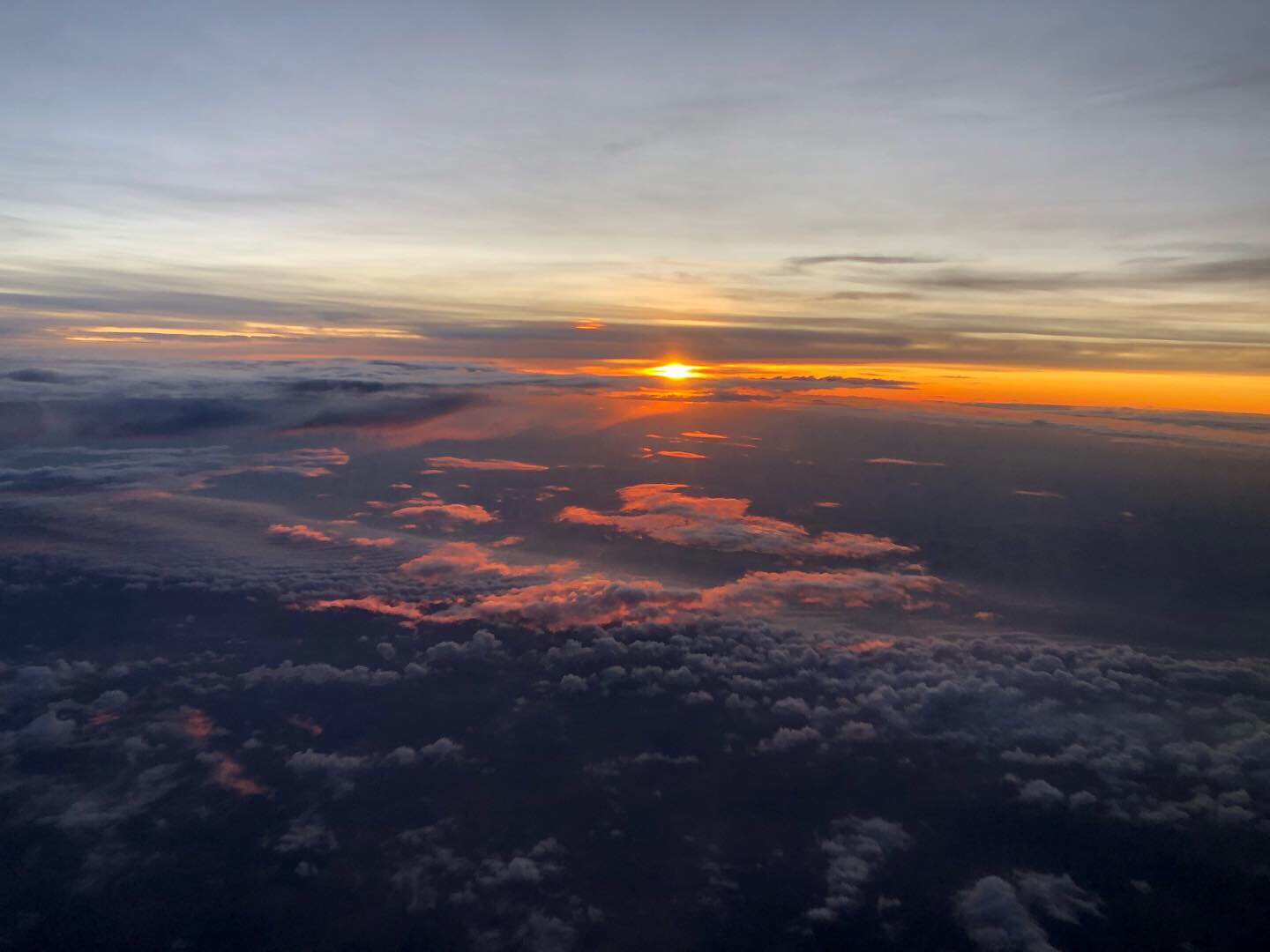
    The time after sunset is when the light show really begins.  If you’re lucky the sky offers you wispy clouds that reflect the fading light in brilliant hues from orange to purple.  When a moment, or a life, has passed, the lingering memory may offer brilliant reflection, staying with us well beyond their time, as the light dances above well after the sunset.  Moments like that moose return to me like the smell of Bodhi on his collar, whispering “I’m still with you”.

    I do think the edges of the day offer focus we may not have during the rest of the day.  Stillness brings awareness that might not be available during the frenzy of activity.  But whether we focus on them or not, each breath is a part of the sum of all of our breaths, and demand consideration. Here again, Annie Dillard reminds us:

    “How we spend our days is, of course, how we spend our lives.” – Annie Dillard

    So our days (and lives) begin with a call to follow our bliss, and end with memories and reflection.  It’s the in between time that is the bulk of our days, and savoring each moment, not just the Instagram moments, is essential. Writing, for me, offers the optics with which to focus on the everyday, and not just that occasional moose moment.

  • Hummingbirds Squeak under a Waning Moon… and Other Observations

    Cool enough for a fleece this morning. It seems summer is tilting away faster by the day. The white noise buzz of crickets fills in. Other sounds penetrate. Cars in the distance getting an early start. Birds like my old friend the Brown Thrasher announce their presence, if further away than in July.

    The mornings are especially active now. The bees and hummingbirds flitter from honeysuckle to basil gone to flower and on to the next. Each have a unique sound; not shockingly bees buzz and hummingbirds, well, their wings hum as they zip by you. I smile when the hummingbirds squeak at each other, a chorus of animated bird banter filling the yard. They largely ignore me as I sip coffee and take in the show. As if to mirror them, the squirrels are jumping tree to tree dropping acorns and hickory nuts that thump to the ground for collection later. Two scratch around my favorite white oak tree on the planet, chasing each other in young squirrel frivolity with their own chirping chorus.

    Looking up, the Waning Crescent moon greets me in a crisp blue sky. This is September blue, always embedded on my mind these last 18 years, a reference point anyone around here that day will understand. A reference point from New England to New Jersey. That day remembered in random moments like this, then gently put aside. There’s a collective joy about September in New England, with an undercurrent of sadness for the summer fading away and change in the air. But it’s still August, even if it feels like we’ve crossed. Seasons come and go, and it feels time for summer to move along too.

    Back on earth, there are a few more tomatoes to harvest, a thriving and ironic grape harvest after my public shaming in the spring, fading flowers and herbs to contend with. Like the squirrels I’ve got to get my act together and do some work to prepare for the cooler days and changes ahead. My fingers are cold from sitting outside a layer short of comfortable. Time to move. So much to do and it stirs a restlessness inside of me. But first another coffee.

  • Breaking Free of Spreadsheet Travel

    “Buddhists believe that we live our everyday lives as if inside an eggshell.  Just as an unhatched chicken has few clues about what life is truly like, most of us are only vaguely aware of the greater world that surrounds us.” – Rolf Potts, Vagabonding

    I’ve been re-reading Vagabonding again.  It’s been about ten years since I read it the first time, and I’m discovering it anew.  At first glance a travel bible, on further review there’s a good dose of stoicism and hard-won pragmatism in this book that I appreciate more now than when I read it the first time.  As with re-reading Walden, it offers something new with every stage of life.

    When we confirmed an upcoming trip to London and Scotland in late October, I immediately started scanning the lists of things to see in each place, lists of experiences others felt worthwhile enough to put at the top of a list. Then came planning the foundational stuff like hotels, Airbnb and traditional Bed & Breakfast reservations, which put us in specific places at specific times. Then came the logistical stuff like car rentals, trains and ferries, amount of daylight at that time of year, the hours of distilleries and let’s not forget the typical weather. Not so much London, where other than the hotel I’m planning on winging it and relying on my daughter to show us her favorite places, but Scotland… Scotland has been heavily researched. I’ve watched just about every YouTube video you can imagine, plotted travel times and scrutinized street views, until finally I’d had enough. It was sucking all the joy out of the anticipation this trip offered.

    “With escape in mind, vacationers tend to approach their holiday with a grim resolve, determined to make their experience live up to their expectations; on the vagabonding road, you prepare for the long haul knowing that the predictable and the unpredictable, the pleasant and the unpleasant are not separate but part of the same ongoing reality.” – Rolf Potts, Vagabonding

    I’m not this way with other travel. When I went to Newfoundland I didn’t plan my every move on a spreadsheet, I booked a place to stay, went to the meetings I needed to go to and asked the locals where they recommended I visit beyond that. Simply talking to the locals about what their favorite place is has led me to some amazing waterfalls, restaurants and historic sites I might not have seen living off a spreadsheet.  But Scotland…  Scotland holds a dear place in my heart.  And so I over-planned with eager anticipation.  Vagabonding woke me up once again, and having done what I had to do with the rough framework of our trip, I’ll leave the rest to the whims of the road.  I’m eager to give driving a stick with the opposite hand.  Hopefully that doesn’t distract me from actually staying on the road.  There’s so much to see.


  • Songs That Jolt Me Back to Vibrancy

    Life can be measured by the songs you pick up along the way.  The soundtrack of our lives, as the saying goes.  I’ll always remember moments in life when I hear a specific song, because to me the soundtrack of your life makes the moment itself.  DJ’s know this of course, and play specific songs to as a highlight real moment or to get the party kicking into another gear.  I play the DJ in my own life party.  I’m always listening for the song of the moment.  There’s magic in that moment, if you’ll only embrace it.

    Give It All You’ve Got will always remind me of the 1980 Winter Olympics, just as Oh Very Young will always remind me of a pinning ceremony for graduating nurses in 1986, and Change the World will always remind me of an old building that used to be a movie theater where I saw Phenomenon with my wife well before we had kids.  And these are largely tangental songs in the march through my time on this planet.  The highlight reel songs are more profound still, and offer insight into our lives at any given moment on the timeline.

    So it’s with great excitement and joy when a new gem of a song comes into my life.  If travel and reading history reminds you of what you don’t know yet, hearing an incredible song that is new to you reminds you of how many great songs are out there, waiting to be discovered.  A great song punctuates the moment, as whatever the designated “song of the summer” does for many.

    Complicating things for me is that I don’t rely on whatever the Top 40 cotton candy hit of the moment is.  In fact I actively avoid it, searching instead for the truly great songs that are just below the surface, or hidden in some dive bar juke box.  The songs aren’t always new, just new to me.  Appearing in random places in my travels, they grab hold of your ears and won’t let go.  The reaction is generally “wow, who is THAT?!” which leads to an immediate Shazam to lock it in.  These gems become a part of the growing soundtrack of my life from that point on.  Here an eclectic mix of five songs, old to relatively new, that smacked me in the forehead and demanded I listen:

    Madness, Muse – First time I heard this song two jobs ago on an early sunny morning in Las Vegas, just me and this song and a Venti dark roast, with the occasional slot machine bell ringing in the background.  But it was this song and me, locked in until the end before I moved on with my day, but not on from this song.  It stays with me still.

    Baby, Won’t You Please Come Home, Keely Smith and Louis Prima – Heard this in a big, open public space in Manhattan, maybe not for the first time, but hearing it for the first time.  I Shazam’ed and downloaded it on the spot and it has appeared on certain playlists ever since.

    still feel, half.alive – First saw this just last week on Tiny Desk and absolutely had to know more about this band.  Watch all three songs on Tiny Desk and you’ll be smiling.  Their music video is worth watching even if this isn’t your style of music. For another treat watch them perform still feel on Jimmy Kimmel.  Songs like this is like a double espresso for me, jolting me back to vibrancy and giving me hope for the future of music.

    Johnny Wants to Be a Matador, Rene Lopez – First heard this in a hotel lobby in Nashville, Tennessee, confirming for me that Nashville is indeed a great music town if I was hearing a song this good in some random Hilton hotel downtown.  A song like this makes me look at Top 40 as the scam it is.

    Lucky Man, Courtney John – From the soundtrack of Chef, this song is ten years old as I write this, but feels timeless.  I wish it had been in my life for that decade, but sometimes you need someone to bring it to your attention (Thanks Jon Favreau).

    There you go, five songs on the ever expanding playlist.  As long as it continues to grow life will be vibrant for me.  And vibrancy is what it’s all about.


  • Bunker Hill

    The walk up Pleasant Street gives you a sense of what the British were up against, and why the American militia chose this spot. Beginning at The Warren Tavern, the climb is gradual at first, but very steep as you approach the crest. Waking up to a locked and loaded enemy staring down that hill would have been unacceptable, and action would be required. Just the sight of the British regulars lined up and marching towards you must have been terrifying, and the British knew that and counted on the effect it would have. But on this day terror wouldn’t budge the bold easily.

    Events of that day are well-documented. Heroic figures rose up, died or survived to fight another day. William Prescott commanded the Americans, uttering some of the most famous words of the war (in a war full of famous words) when he shouted to his nervous militia “Do not fire until you see the whites of their eyes!” to conserve ammunition. Israel Putnam and John Stark were heroes that day as well, using their experience in the French and Indian War to offer critical tactical insight. The British side features famous names as well; Thomas Gage, William Howe, Henry Clinton, James Abercrombie and John Pitcairne. For the latter two Bunker Hill would be their last battle.

    The Bunker Hill Monument stands on Breed’s Hill, which is where the bulk of the fighting took place on June 17, 1775. I’ve driven by the monument thousands of times, but only remember climbing up the stairs inside once. Not in the cards on the day I visited either, as my walk up from the tavern around the perimeter and a bit of time to re-marinate myself in my local history chewed up all of the allocated time. But I was pleased with the site, which offers appropriate reflection.

    I’d started by walk up the hill at The Warren Tavern, founded five years after the battle and named for Joseph Warren, the 2nd President of the Massachusetts Provincial Congress, who would become a martyr that day. Warren refused the safety his position offered him and choosing instead to be where the fighting would be worst. He died from a musket ball to the head, and then had his body brutalized by the British, whose heavy losses taking the hill likely inspired vengeance. Warren’s close friend Paul Revere helped exhume his body for burial elsewhere, a sign of the great respect Warren had earned in his life.

    That the bulk of the battle happened on Breed’s Hill is mostly known, but people still think the monument is on Bunker Hill. Sometimes the details get mixed up in the story telling. I love a good story and there were many on that hill on June 15, 1775. I’d say I’m better than many in knowing those who came before, but as with everything you learn as much about what you don’t know, and I appreciate a good refresher course. I’ll dance with the ghosts longer next time. There’s so much more to learn from them.

  • The Secret Burial of Colonel Westbrook

    In the middle of the night 275 years ago a group of family and friends buried the old Colonel in an undisclosed location to keep his body from being dug up and used as a bargaining chip by creditors.  That this war hero was in this position was regrettable, but 1744 Maine was a hardened world not prone to sentiment.  The final years for Colonel Thomas Westbrook were spent in a battle with his old business partner and fellow soldier.  And it was that battle that brought his family and friends out in the middle of the night to bury him, keeping the location of his grave a closely held family secret until the Bicentennial in 1976, an anniversary that settlers in 1744 couldn’t even conceive of.  They were far more concerned with the very real threat of the French and Abenaki than they were about breaking from Great Britain.

    It’s understandable if you have no idea who Colonel Thomas Westbrook is. Frankly I didn’t know who he was until 10:15 this morning, when I passed a sign for the Colonel Westbrook Executive Park on Thomas Drive (well played).  Being in Westbrook, Maine I was curious about a man who accomplished enough in his time to warrant a town being named after him. Which brought me to discover blueberry cheesecake ice cream. But perhaps I’m getting ahead of myself.

    Colonel Thomas Westbrook famously raided the Abenaki village at Norridgewock in search of Father Sebastien Rales (or Rasles, depending on whether you read the English or French description of the man).  Rales led Indian raids on English settlements in Maine (then part of Massachusetts), and by 1722 the English had had enough of it.  Enter Colonel Westbrook who raided Norridgewock but failed to capture Rales.  He did manage to confiscate Rale’s strong box, which had incriminating evidence of coordinating with the Abenaki to raid the English settlements.  This evidence became gas on the fire, igniting more hostilities between the French, English and Abenaki.  In 1724 another raid on Norridgewock resulted in the massacre of 100 Abenaki and Father Rales.  Westbrook wasn’t involved in that event, though his confiscation of the strong box provided plenty of motivation for those who did.  This was indeed a violent time in Maine, with atrocities committed on both sides.  Norridgewock was yet another example.

    Searching for information on Westbrook while I waited for my lunch appointment led me to an article about the discovery of his gravesite, which led me to Smiling Hill Farm, where I asked for directions to the grave site at the ice cream stand along with what their favorite ice cream was, which led me to that blissful blueberry cheesecake ice cream, which – finally – led me to a brief visit with the Colonel. Once again I found myself off-roading in dress shoes. I should really keep some old running shoes in the car for these unplanned detours… but I digress.

    The gravesite sits between a large grass field and a paved lumberyard. Colonel Westbrook was once the Royal Mast Agent supervising the harvest of white pines for the Royal Navy, so I think he’d get a kick out of the ongoing lumbering activity feet from his final resting place. He may be staring up at the planes taking off from the Portland Jetport wondering what the heck is going on in the world though.  Jet engines roar over the white pines that were once the critical material for the cutting edge transportation technology of the 1700’s.  Times have changed, but on the whole the place he’s buried would be familiar for him.  Smiling Hill Farm remains largely as its been for generations, operated by the Knight family since 1720.  They surely know a thing or two about Colonel Westbrook.

    I walked the dirt and gravel road (mostly a pair of tire tracks) around the front of the lumber yard and there it was, a small white sign in front of a patch of woods marking a quiet, overgrown grave.  This was the site that was revealed to the public in 1976 during the Bicentennial, making Colonel Westbrook famous throughout the area.  There’s a good article that helped me greatly commemorating the 40th anniversary of that Bicentennial celebration posted in the Portland Press-Herald on August 4, 2016.  Two years later it seems the Colonel has been largely forgotten again, at least judging from the overgrown condition of his gravesite.  There’s a replica of Father Rale’s strong box next to the grave site, slowly returning to the earth in this shady nook.

    If you go to Smiling Hill Farm, I recommend trying the blueberry cheesecake ice cream, served with a wooden spoon.  Then walk a bit of it off with a five minute walk to visit the Colonel.  He could use some company.  I may have been the first person to visit in some time based on the path to the grave, but perhaps other history buffs have preceded me.  Those that come after me will see the site in the same condition, as my footprints didn’t make much of a dent in the weeds.  But I paid my respects, dress shoes and all, and got on with my day.  Slightly more informed about events 275 years ago on a quiet hill in the middle of the night.


  • Empty Nest

    Sunday night. Terminal E, shipping off our daughter to London.

    Bags checked.

    Checklists checked.

    Dinner done.

    Last minute advice.

    Hugs and love expressed.

    Pictures.

    It’s time.

    Fly.

  • Burpees Before Bed

    The other night I lay in bed, mind racing. My streak of burpees every day was in jeopardy. A busy day, missed opportunities along the way, and to be more honest, procrastination had delayed me until now, 11 PM, a couple of adult beverages into the evening and ready for sleep. Except there was no sleeping with the thought of breaking the streak here. Look, I know it’ll happen eventually, but not this way. Not because of a lazy mind. So I got up, did a dozen burpees to meet the minimum and got back in bed, heart still racing, and slept like a baby. Another link in the chain.

  • Falmouth Road Race

    The race started at one bar and ran to another bar seven miles away. It’s started in 1972 with less than 100 runners and has grown massively popular, with a lottery to get in. The bars have changed, but they’re still there. I used to visit the Captain Kidd before it changed, but never got to the Brothers Four before it became British Beer Works; a place I’ve been known to frequent when down here.

    For the fifth year in a row I drove runners to the Lawrence School in Falmouth to catch the bus to Woods Hole for the start. I’ve experimented with staying in Falmouth and going to a local diner, but three hours is a lot of time to kill and this time I end up coming back instead. Today I came back to Pocasset for breakfast with my son before returning to watch the race. Each year I stand near the Falmouth Heights Motor Lodge, which offers both an excellent view of the runners and a quick walk to the finish line where you can see your favorites again as they cross the finish line.

    This year was hazy, hot and humid. The crowd supporting the runners ebbed and flowed in enthusiasm (try clapping for an hour straight), spiking for larger clusters of runners, wheelchair competitors, children, and cheerleader runners (the runners who raise their arms and prompt the crowd, igniting roars). I tracked my favorite runners on the app, and helped others to my left and right find their favorites on the course. What did we do before apps? We waited and wondered, that’s what we did.

    Runners train all year for a race like Falmouth. Spectators don’t, but maybe we should. Spectaculars shuttle those runners to the buses, fight the crowds for a glimpse of their favorites, then try to find them in the sea of humanity at the finish to shuttle them home. There’s no glamour in being a spectator, but it has its rewards. For me it was the swim after we returned. Hours of madness to earn a ten minute swim in Buzzards Bay. But it works for me.

    So another Falmouth is in the books. It’s become quite a family tradition, as it is for so many others. I’m not a runner, but if I were going to be this would be the race. Seven scenic miles, throngs of cheering spectators, elite runners mixed with the couple next door. Yeah, this is the race I’d run, if I ran. Maybe next year.