Author: nhcarmichael

  • Chive Talkin’

    I planted chives twenty years ago and promptly ignored them ever since, save for the occasional raid with a pair of kitchen shears to supplement whatever meal called for them. Chives are both effortless and generous, multiplying and at the ready when you need them. Unlike the more celebrated basil, chives don’t need to be replanted every year. They require nothing but good soil, sun and an occasional drink. And this time of year they also show a little personality with showy purple crowns.

    Today is a glorious June Saturday in New England. The kind of day you envision when you suffer through the bleakest days of January. The kind of Saturday you yearn for on a Tuesday. There’s a reason people schedule weddings for June and it’s days like this. Many options present themselves on beautiful Saturdays. I chose to be in the garden. We talk about downsizing and moving someplace with less maintenance, but I know I’d miss the gardening. And so I muck about in soil and sweat trying to make the most of my time with it. Life is short, and there are only so many perfect June Saturdays.

  • Deep Greens and Blues

    “And as the moon rises he sits by his fire, thinking about women and glasses of beer.” – James Taylor, Sweet Baby James

    The weekend begins soon, but I know its abbreviated.  I’ll be driving west Sunday to Rochester, New York for an early start Monday morning.  And so it goes.  The trip on I-90 is a familiar one, and each season brings its own delights and challenges.  June brings tourists, exploding bugs on the windshield and orange cones.  But also a lovely green carpet on the Berkshires.

    The Berkshires make me think of Sweet Baby James.  If Boston has Dirty Water and Shipping Up to Boston, the Mass Turnpike has Sweet Baby James.  Its a song that I’ve listened to countless times, but it brings back memories of being a college kid driving I-90 to Ontario, Syracuse and Indianapolis for regattas.  Driving back is when the song resonates, as the song is about longing for what you’ve left behind to do what you need to do.  Both a song for the restless spirits in the world and a lovely lullaby I used to sing to my kids to get them to fall asleep many moons ago.

    “Deep greens and blues are the colors I choose, won’t you let me go down in my dreams?  And rock-a-bye sweet baby James.”

    In winter I’ve put this song right after I cross the border from New York into Massachusetts and see the mountains rise up ahead of me.  The lyrics offer an appropriate soundtrack and after many days away from home I’m usually very ready to get back.  And so the song carries me there…

    “Now the first of December was covered with snow
    and so was the turnpike from Stockbridge to Boston
    Though the Berkshires seemed dreamlike on account of that frosting
    with ten miles behind me and ten thousand more to go”

    My daughter posted something online stating her favorite colors are blue and forest green.  The apple doesn’t fall far from the tree, and somewhere along the way those lullaby’s resonated for her as well.  James, with an assist from me, has left his mark on another generation.  And so it continues.

    “There’s a song that they sing when they take to the highway
    a song that they sing when they take to the sea
    a song that they sing of their home in the sky, maybe you can believe it if it helps you to sleep
    but singing works just fine for me”

  • Two Henry’s

    “Arrived at the Atlantic, he pauses on the shore of this unknown ocean, the bounds of which he knows not, and turns upon his footprints for an instant….  Then recommences his adventurous career westward as in the earliest ages.” – Henry David Thoreau quoting Arnold Henry Guyot, Walking

    Infante D. Henrique, better known as Henry the Navigator, was born in 1394 and died in 1460. Henry, with political clout from his relationship with his brother the King of Portugal and monetary clout from The Order of Christ, inspired the Age of Discovery 500 years ago.  The Portuguese would go on to discover Madeira 600 years ago this year, then the Azores, and further down the coast of Africa during his lifetime, and inspire like voyages by Christopher Columbus and others well after his death.  I came across a statue of Henry the Navigator in Sagres, Portugal last year when I was exploring the area.  The statue faces towards Madeira and the coast of Africa; Henry’s focus half a millennium ago.

    No place in continental Europe makes you feel like you’re on the shore of an unknown ocean more than the western coast of Portugal.  Of course, I’d flown over that ocean to get to Portugal, but this was a time when pirates were a common threat for coastal communities and the thought of sailing beyond the horizon was likely terrifying for most.  It wasn’t until larger sailing vessels were built that the Portuguese and later other European explorers would take the leap into the unknown.

    There was a dark side to exploration, as local populations were exploited, enslaved, murdered or exposed to lethal diseases for the first time.  Progress for some is regression or annihilation for others.  The spirit of exploration and discovery is on the face admirable, and I like to think I carry some of that spirit within me, just as Thoreau did.  Standing on the edge of a hundred foot cliff with breaking waves reaching up halfway to welcome me, one catches the spirit of those words; Arrived at the Atlantic, he pauses on the shore of this unknown ocean.  This would give any sane person pause.  But the courage to move on anyway opened up an entire world for these Portuguese explorers.

    I have Scottish and English blood in my veins, but I also have Portuguese blood.  I like to think that exploration and adventure are a part of my DNA.  And while my relative low risk exploration of the coast of Portugal pales in comparison to the sailors of centuries past, the serve to expand my perspective on the original European explorers who first set sight on America.  As visiting Portugal opened up my perspective on where these souls came from, visiting the Santa Maria replica gave me a greater appreciation for just how small those Nau’s were.  On a vast, unknown ocean, with no previous knowledge of currents and at the whim of the weather, courage was only part of what these explorers needed.  They also needed luck.

    Henry David Thoreau quoted Guyot even as he disagreed with many of his theories.  Thoreau was an explorer whose vehicle of choice were his feet.  I think he would have been fascinated with the fisherman’s trails, the stunning Rota Vicentina, that wind along the coast from Sagres north. Hiking this trail was a highlight for me, and I wish I’d had more time to fully explore the region.

    Thoreau writes of the magic of exploration, and his tendency to head southwest in his journeys away from home.  There is no point further Southwest in Portugal than Cape of St. Vincent and it’s distinctive lighthouse. Had Thoreau stood on the cliffs, as I imagine Henry the Navigator once did and I had the opportunity to do in my own humble way, I think he might have looked westward and recalled his own words, appropriate for this extraordinary place:  “We go eastward to realize history and study the works of art and literature, retracing the steps of the race; we go westward as into the future, with a spirit of enterprise and adventure.  The Atlantic is a Lethean stream, in our passage over which we have had an opportunity to forget the Old World and its institutions.”  That spirit seems as true today as it was in 1860 or in 1460.

  • Choosing the Great Over the New

    New is overvalued relative to great.  … for example, when choosing which movie to watch or what book to read, are you drawn to proven classics or the newest big thing?  In my opinion, it is smarter to choose the great over the new.” – Ray Dalio

    I’m reading a Henry David Thoreau book called Walking.  It’s a quick read – not very long at all – but full of wisdom nuggets as I posted yesterday.  I’ve recently re-read Walden, and read some Hemingway’s The Sun Also Rises last fall.  It’s no secret that I’ve been reading a lot of stoicism over the last couple of years, and re-read Marcus Aurelius’s Meditations again last year.  And I have a pile of classics teed up for future reading.  So this Tweet I read from Ray Dalio today was especially meaningful for me as I try to mix in classics and opt out of things just because they’re popular at the moment.  They’re classics for a reason, and you can glean a lot of out of them if you dive in.

    Choosing the great over the new goes for things beyond books and movies of course.  You get what you pay for in life, and that applies to time as much as it does money.  I dropped a Derek Sivers quote a couple of blogs ago; “Hell Yes or No” that concisely articulates great over new in career opportunities, relationships, what you spend your weekend doing and which food, books and media you consume.  So it was with great interest that I read another Twitter thread from George Mack early this morning:

    The most VALUABLE piece of investing advice I ever received came from Warren Buffett.  

    Buffett gave a talk at University of Georgia.

     He told the students to look around at their friends and answer the following question:

    “If you could get 10% of their earnings for the rest of their lives, what friends would you INVEST in?”

    Once you have the 2-3 friends that you’d invest in, explore the WHY you’d invest in them.

    What values do these individuals hold?

    What habits do they engage in?

    Here’s teh values of friends that made me want to invest:

    1. High Agency/Resourcefulness
    2. Consistency
    3. Give more than they take
    4. Learning machines
    5. Live on the edge of their comfort zones of creating a new project
    6. Pay attention to small details

    After doing this, Buffett sugggest you look around at your friends again.

    “If you could SHORT 10% of their earnings for the rest of their lives, what friends would you choose?”

    Again, once you have these friends in mind – ask the WHY you’d short them.

    What values do they have that you’ll think will harm them?

    What negative habits do they engage in?

    Here [are the] the values of friends that I’d SHORT:

    1. Narcismism
    2. Inconsistency
    3. Arrogance
    4. Dishonesty
    5. External locus of control
    6. Map knowledge/know it alls

    Once you [have] these lists, you have finally answered one of life’s wooliest questions:

    “What are my values?”

    You have the guiding principles you can look to embody.

    You can extrapolate this further than just financial ROI.

    You can look at your friends balance sheets for happiness, relationships, fitness, etc.

    Who would you invest 10% in?  Why?

    Who would you short 10%?  Why?

    You can download the values you need for these areas too.

    This exercise is so powerful because our identity isn’t involved.

    “It’s easier to recognize other people’s mistakes than our own.” – Daniel Kahneman

    Emotion & Ego distort our reality.

    It’s so easy to see when a friend should break up with their partner, quit their job or shut down their company.

    Yes despite having more information on the subject than you, they still can’t see it.

    Why?

    Emotion & Ego (Identity)

    The Buffett exercise is so powerful because it gives you the ability to view your human operating system in the same way everyone else will:

    1. Objectivity
    2. Don’t care about you
    3. Want to know what value you can provide

    Self aware ness has the Dunning-Kluger effect built into its software.

    The most self aware people I know are convinced they lack self awareness.

    The least self aware people I know are convinced they are self aware.

    Buffett’s investment advice passes Peter Thiel’s test.

    You know your friends better than ANYONE.

    This means that you have a SECRET that the rest of the world doesn’t have about their values and habits,

    This information gained is truly unique to everyone who applies it.

    SUMMARY:

    1. Treat your objective analysis of other people as the best form of self knowledge
    2. Understand what values you’d invest in and what you would short in every area of life.
    3. The tactile knowledge of your friends is a secret as unique as your finger print.

    I copied this down here as much to retain it for myself as to blog about it.  Coming back around to the Dalio quote, choosing the great over the new, I’m applying this in my work as well as my reading and other pursuits.  I’ve weaned myself off of low value business relationships, and avoid toxic business relationships whenever possible.  I’ve fired customers who are such A-holes that they aren’t worth the commission check that comes with dealing with them.  And I’ve developed other business relationships that are absolutely worth the long term investment even though the return isn’t there quite yet.

    So the quoted material is longer than the original content from me this time around, but I thought I’d stick with the great instead of adding the new.  Hopefully some of my new will prove great in the long run.

  • Fences and Forests

    “At present, in this vicinity, the best part of the land is not private property; the landscape is not owned, and the walker enjoys comparative freedom. But possibly the day will come when it will be partitioned off into so-called pleasure-grounds, in which a few will take a narrow and exclusive pleasure only – when fences shall be multiplied, and man-traps and other engines invented to confine men to the PUBLIC road, and walking over the surface of God’s earth shall be construed to mean trespassing on some gentleman’s grounds. To enjoy a thing exclusively is commonly to exclude yourself from the true enjoyment of it. Let us improve our opportunities, then, before the evil days come.” – Henry David Thoreau, Walking

    When I moved into the house I’m living in twenty years ago, when this cul de sac was just being built, I watched a dozen deer run through the woods and diagonally through the backyard out to the front where the driveway is and then off to wherever they roamed from there.  A few years after that I became annoyed with one of my neighbors central vacuum system which didn’t (and still doesn’t) have any form of muffler on it.  I put up a six foot privacy fence on that side of the house to block out the noise a bit.  Fences make good neighbors, they say.

    A few years after that we got a very energetic one year old black lab and put him on a run, which was a cable strung tightly between two trees in the backyard with his chain hanging down, giving him some freedom of movement but not enough.  Eventually we fenced in the backyard entirely, and he had room to roam without running away.  Well, we thought so at the time.  Snow pack and exceptional climbing skills proved the fence wasn’t always as high as it needed to be.

    Then came the pool, and it justified the investment in the fence.  And that fence continues to serve us well, in theory keeping the young neighborhood kids out of the pool while being compliant with the town’s codes which require a fenced-in pool.  With a pool you have liability.  Lawyers love pools. Insurance companies love fences.

    The forest remains timeless.  It’s just on the other side of that fence, and it’s largely as it was twenty years ago, and twenty years before that.  It continues to invite itself back into the yard.  After all the backyard was once part of the forest and perhaps one day it will be again.  I see the deer sometimes just on the other side of the fence.  But they don’t run through the yard anymore.

    Thoreau would find his walking to be very different than it was when he wrote those words.  Aside from conservation land and State Parks like Walden the landscape is completely different than it was for him.  Roads are paved, land is subdivided, fences are put up to screen annoying neighbors or to protect pool owners from wandering toddlers.  Thoreau might say that the evil days have indeed come.  And looking at the building boom going on seemingly everywhere I can’t help but think that myself.  Houses and residential communities popping up everywhere.  Roads getting more and more congested.  Mixed-use development projects all the rage.

    I read a book recently that described the frustration that a family had at the development of Bedford, New Hampshire back in the 1960’s.  I know the stretch of road they described as it is today, but never knew it as the quiet country road portrayed in the book.  They ended up moving further north into Maine.  And maybe moving further away is the answer.  Or maybe it starts with taking care of your own backyard before it’s too late.  Conservation and preservation, zoning restrictions, political will and public demand are the formula for open space.  Developers rule most town halls nowadays.  When people are indifferent to the land around them the void gets filled by people who build 55 plus housing developments.  This isn’t developer bashing – developers do a lot of great things and I’ve directly benefited from development.  It’s more a call to all of us to demand more for the environment we’re creating for ourselves and future generations.  A little preservation goes a long way.

  • Santa Maria

    While having a lunch in Newburyport I had the opportunity to check out a replica of the Santa Maria docked for a short stay in town.  The original famously sailed for America in 1492 with Christopher Columbus.  This one sailed to America for a 225th anniversary tour this spring.  There are plenty of differences between the original and the replica, starting with the additions of steel, fiberglass and electronics.  But the dimensions are accurate, and you got a good sense for what the sailors on board were dealing with.

    A few observations from walking around onboard.  First, a 58 foot square-rigged sailing vessel seemed too small for the 45 members of the crew.  Cramped quarters, frequent exposure to the elements, sleeping on wool rolls on a hard, sloped deck, and eating sponge cake washed down with red wine was not a recipe for optimal living.  Throw in hygiene issues, not the least of which was serious body odor, and health concerns ranging from scurvy to lice and it was clearly not a place I would have opted for.

    The Santa Maria, called a Nau in Spain but known as a Carrack in the rest of the world, was a three masted, square-rigged ship weighing between 80 and 150 tons, which stood high about the breaking waves.  The ship’s large hold made it attractive for someone like Christopher Columbus, who made the Santa Maria his flagship.  The raised quarterdeck allowed the captain and midshipmen to command the ship with good sight lines fore and aft.  Striking to me was just how much of a pitch the deck had.  Good for quickly shedding sea water from heavy wave action or rainwater, but standing on it in rough weather must have been tricky.

    The original Santa Maria didn’t survive the trip to America and back, running aground when Columbus and the captain both slept while a cabin boy steered the ship onto a sandbar.  Steering on the Santa Maria was done with a whipstaff, which was a vertical pole connected to the tiller.  The limitation with a whipstaff was that you could only adjust a maximum of about 15 degrees in either direction because a pole stuck through the quarterdeck to the tiller just didn’t allow for more range.  Ships wheels wouldn’t become standard on sailing ships for another two hundred years.  So the cabin boy who was steering wasn’t exactly set up for success.  Even though the ship never made it back to Spain, it remains one of the most familiar ship names in America (Show me a kid who doesn’t know Nina, Pinta and Santa Maria!).  I do hope this one has a longer lifespan and none of the navigational issues of its namesake.

    Columbus has lost his luster as a heroic figure, but there’s no doubting the courage of the crew for sailing on a ship this small, with two even smaller ships, to explore the unknown.  I think that’s why there’s still such a fascination with the three ships, and this one in particular.

  • Life in the Weeds

    Gardening is 80% maintenance and 20% appreciation for what you’ve accomplished.  That ratio is likely way off the mark.  It could be closer to 99% maintenance.  This morning I was weeding the garden in dress clothes, using the time before I went to a birthday party to weed one of the beds.  Such is the mind of a gardener that I thought to do this in dress clothes instead of tackling it before I showered and put on my Sunday best.  I managed to keep most of the dirt off anyway.

    Weeds are what you think they are.  Most plants that naturally grow in your yard are natives that thrive in that environment, while others are aggressive invaders that, well, thrive in that environment.  I didn’t invite the dandelions, clover, chickweed, maple seedlings and crabgrass to the party.  But Leopard Plant Ligularia, Black Eyed Susan and the most aggressive of all, Morning Glory were once planted with eager anticipation for the show they’d put on in the garden.  And the show is nice, but the seeds cast about in the wind growing everywhere?  Not so nice.

    Make no mistake, I don’t mind weeding.  In fact I’m quite fond of it.  Time weeding is “me time” (nobody else is volunteering) when I can think about anything or nothing at all.  And it’s a part of the deal.  You want a garden?  Get down on your hands and knees and bow to the clover god.  And when you’re done with clover there are dozens of Leopard Plant babies popping up all over the place.

    Chemical sprays can kill weeds pretty quickly, especially in the heat of summer, but I try to use them in moderation.  It’s one thing to spray the brick walk to knock down the weeds popping up in between.  It’s another thing altogether to spray in an active garden.  No, this is a task best accomplished with a good pair of grippy gloves and a comfortable pad to kneel on.  And that’s where you’ll find me a few times each week, busily filling a galvanized steel bucket with weeds.  May it go on forever.

  • The Merrimack River Frontier

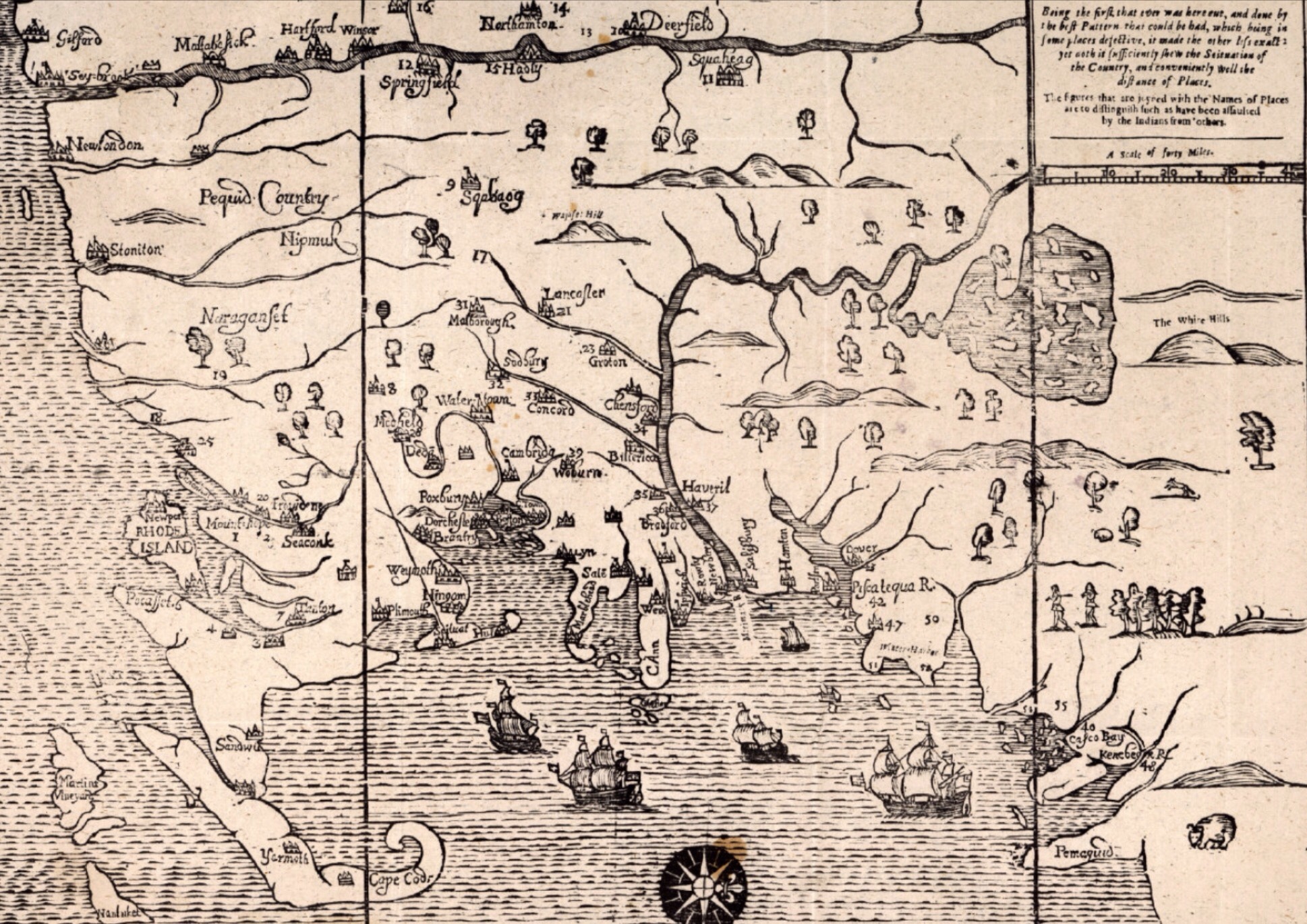
    Yesterday I dove deep into the Cape Cod section of John Seller’s Mapp of New England.  Today I’m looking at another fascinating section – the border between “civilization” and the “wilderness’.  I’ve written before about place names like World’s End Pond in Salem, New Hampshire.  Nothing hammers that home like seeing a map from 1675 showing the Merrimack River towns of Haverhill (“Haveril“), Billerica and Chelmsford (“Chensford“) Massachusetts as the frontier towns they were at the time.  North of the Merrimack River is wilderness in this map, South are the growing settlements of Massachusetts.  The river serves a critical role for settlers and Native Americans alike as both transportation and a border.  Settlements at this time were largely along the rivers and their tributaries, the Concord and Nashua Rivers.

    That bend in the Merrimack River northward was a critical point in the understanding of this land.  Isolated outposts like Billerica, Groton and Lancaster represented the outer reaches of people like us.  The map shows Lake Winnipesaukee and its many islands, so there was clearly knowledge in 1675 of what lay beyond, but it remained for all intents and purposes a vast, dangerous wilderness for another century until the fortunes of war, attrition in the Native American population and the shear mass of settlers from Europe turned the tide.

    It’s no surprise that the most notable Indian raids of the day were happening along the frontier.  York, Haverhill, Andover, Billerica, Chelmsford, and Groton all suffered Indian raids during the series of wars between the French and British.  Further west Brookfield and Deerfield had similar raids.  These frontier towns were dangerous places, and the settlers there would rarely venture out to tend their fields unarmed.  Towns like Haverhill were building fortifications and the brick 1697 Dustin Garrison for a measure of protection in the years spanning King Williams War and Queen Anne’s War.

    There were a series of conflicts between the English settlers and the Native American population that impacted northern New England.  In all cases the underlying conflict between the expansion of English settlements and the encroachment on the Native American population was a key factor.  French influence on the Native American tribes also contributed significantly in many of the raids in Merrimack River Valley from 1689 to 1713 as raiders were offered rewards for scalps and prisoners.  Living in this area for most of my life I see many reminders of that time in our history, and I always glance over at World’s End Pond and the Duston Garrison whenever I pass either.  Duston’s wife Hannah was famously kidnapped during King William’s War, her baby and many neighbors killed, marched through the town I live in by Abenaki warriors, and later escaped back down the Merrimack River on one of those raids.

    Wars Impacting Northern New England in the Early Colonial Period:

    • King Philip’s War 1675-1678 (Northeast Coast Campaign vs. Wabanaki Confederacy)
    • King William’s War 1689 – 1697 (French and Wabanaki Confederacy)
    • Queen Anne’s War 1702–1713 (French and Wabanaki Confederacy)
    • Dummer’s War 1722-1726 (Wabanaki Confederacy)
    • French and Indian War 1754 – 1763 (French and Mohican, Abenaki, Iroquois and other tribal alliances)

    So Seller’s Mapp of New England was a living, breathing document that was strategically important to the British and by extension the English settlers living in New England.  If matters were largely settled with the Native American population in the Southern New England areas by 1675, they were anything but settled in Northern New England.  Northern Massachusetts, including what is now coastal Maine and New Hampshire were the literally on edge, looking north and west for raiders.  That they would ultimately overpower the Native American population and New France settlements was not a foregone conclusion at the time.  Another reason it completely fascinates me.

  • Where the Narrows Open Out

    Looking at John Sellers 1675 “Mapp of New England” I’m drawn to the place names on Cape Cod. “Yermoth“, Sandwich and Pocasset on the Cape, and the islands of “Martina Vineyard” and “Nantuket“. As with the entire map things are way out of scale, but still a fascinating snapshot of place in 1675 Cape Cod.  The other unique thing about Sellers’ map is that he turns New England on its side, offering a new perspective on the familiar shapes.

    The Pocasset Wampanoag were no strangers to Buzzards Bay, but they lived in the area that is now Tiverton, Rhode Island up to Fall River, Massachusetts and surrounding towns. If a place were going to be named Pocasset wouldn’t it be Tiverton or Fairhaven or some other place on that side of the bay? So how did this little corner of Cape Cod become known as Pocasset?

    The answer might lie in the word itself. “Pocasset” and some similar Algonquin names like “Pochassuck” and “Paugusset” all mean “the place where the narrows open out”. And that certainly applies to this part of Buzzards Bay. For the English settlers choosing Pocasset was likely easier than Pochassuck.  I can imagine the middle school jokes at neighboring towns if they’d gone that route.

    This place was likely visited by the Pocasset often as they traded with the Pilgrims at the Aptucxet Trading Post nearby. In talking about the land and the bay around them it’s probable that’s how the area was described as the bay opens up right after the point of Wings Neck. On the map Pocasset encompasses what is now Falmouth. Given the scale of the map it could be a minor point, or perhaps the entire stretch from Wings Neck to Woods Hole was considered the place where the narrows open out.

    That description fits the mind as well. Looking at old maps, reading books, and traveling to new places opens up my own once narrower mind. I break free of the daily routine and see things in a new way. So having a home away from home in Pocasset is more appropriate than I first thought.

  • The Rose Standish

    A little piece of historical trivia is the name of the very first ship to travel through the Cape Cod Canal when it opened on July 29, 1914.  Following the Jeopardy answering with a question format, What is the S.S. Rose Standish?  And the ship was the perfect choice to be first.

    Rose Standish was the first wife of Captain Myles Standish.  She was one of many who died in 1620 during the first winter after the Pilgrims arrived in Plymouth, Massachusetts.  Myles Standish would explore the Manomet and Scusset Rivers three years later considering a canal.  That canal would finally be completed almost three hundred years later with great fanfare, with a future President of the United States, then Assistant Secretary of the Navy Franklin D. Roosevelt, in attendance.

    That first ship, the S.S. Rose Standish, was a coastal passenger vessel built just two years earlier in 1912 and operated by the Nantasket Beach Steamboat Company of Boston.  On that July day in 1914, she led a parade of ships through the canal.  The celebratory mood was likely tempered by news breaking about events the previous day, when Austria-Hungary declared war on Serbia, marking the beginning of World War One.  Almost exactly four years after the canal opened that war would impact the canal itself when a German U-Boat surfaced off of Orleans and fired on a tug towing barges.  That prompted the United States Army Corps of Engineers to take over the struggling private Cape Cod Canal so ships wouldn’t have to take the more dangerous route around the cape.

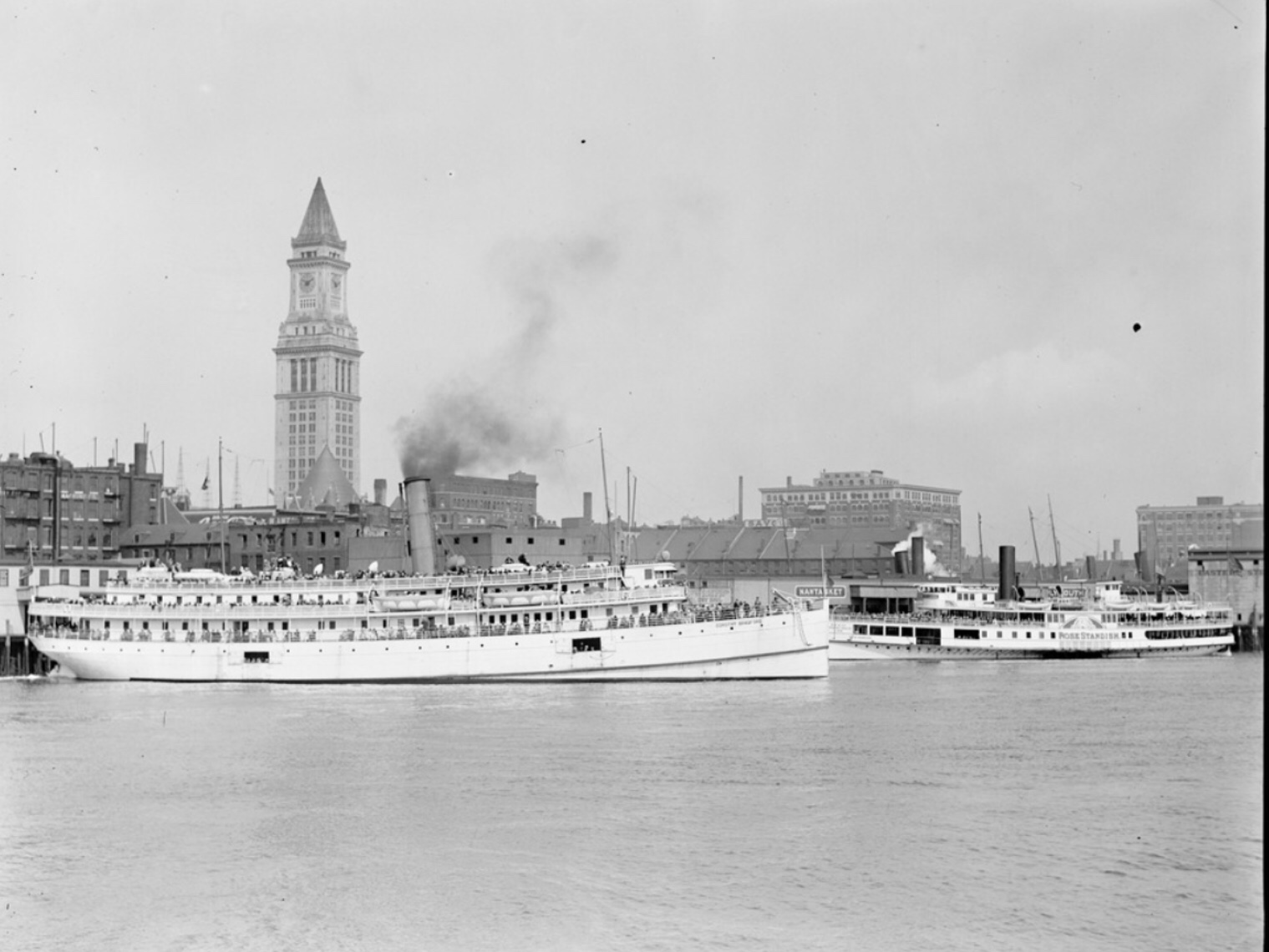
    The S.S. Rose Standish would be in service into the 1930’s.  There’s a great picture from 1930 of her docked in Boston Harbor, right about when the Cape Cod Canal was being widened to its current 480 feet.  She likely outlived many of the people who witnessed that first trip up the canal 16 years before.  History is full of related twists and turns, and this story offers a good example with Rose Standish, one of the first pilgrims, a young Franklin D Roosevelt and a German U-Boat all playing a part in the same story.