Blog

  • Be a Part

    Look around you, look up here
    Take time to make time, make time to be there
    Look around, be a part
    Feel for the winter, but don’t have a cold heart
    — Little River Band, Lady

    After a summer of vigorous discipline, immediately followed by a week of frenzied activity leading up to a major family event, bookended by even more significant events, I can feel that it’s just about time to look around and figure out where to set the compass next. Our cadence of living changes as we say yes to so many things. This is the price of a full, expansive life. We may welcome all that it brings while still recognizing the need to take a breather now and then.

    Living in the moment demands a level of awareness and participation higher than the average. We are here and present, and also in the act of being fully alive. Really, it can be quite exhausting. And fighting the desire to simply veg out for awhile is ever more challenging. We must take time to be there, but also to not be there now and then. Awareness includes knowing when to say enough is enough. Maybe the answer is, enough of those things, let’s try these other things instead. We know when we get there what is right for us right now.

    The U.S. Army had a slogan used to recruit more ambitious candidates: Be all you can be. I think it’s appropriate to adopt this slogan for our own standard of living, even for those of us who opt for the civilian life instead. Being is participatory. We have a shelf life for personal excellence (arete) and the clock is ticking. Breathe in, breathe out, and move on to the next great adventure. We have the opportunity to be a part of it. Seize it.

  • The Moments Between

    “The moments between your milestones are not filler.” — Nelou Keramati

    We know a milestone moment when we’re in it. It’s often marked on the calendar months or years ahead of time, carefully planned for and anticipated with excitement. Bucket list trips, weddings, reunions and graduations are milestone moments, and tend to dominate our thoughts for the time leading up to them and in our memories well after. And naturally, they deserve our full attention.

    But let’s not forget the moments between, the days when simply being alive within our routine existence occurs. This is the stuff of life—these days of work and hobbies and tedious chores practiced daily. Practicing awareness and intent in these moments too are our building blocks for a greater standard.

    Living an excellent life demands our best effort even on our average days if we are to raise our average. Leaning in to the daily activities that stimulate growth and development, stir and inspire, and demand more of us brings us closer to that more fulfilling life we aspire to. Each day is filled with something, why would we settle for less than is possible?

  • Rest in the Grace

    When despair for the world grows in me
    and I wake in the night at the least sound
    in fear of what my life and my children’s lives may be,
    I go and lie down where the wood drake
    rests in his beauty on the water, and the great heron feeds.
    I come into the peace of wild things
    who do not tax their lives with forethought
    of grief. I come into the presence of still water.
    And I feel above me the day-blind stars
    waiting with their light. For a time
    I rest in the grace of the world, and am free.
    — Wendell Berry, The Peace of Wild Things

    There is reassurance to be found in witnessing the dignity with which so many who, seeing the darkness in the world, have chosen light instead. There is calm to be discovered in poetry spun from words magically sorted together in clarifying and entrancing ways. And surely—even now—there are still wild places far from the noise of life where we may find stillness.

    If we are indeed what we consume, does it make sense to soak up the anger, fear and misery imposed by a world that wants us to buy in, or to shun it in favor of a more natural information diet? What liberates us from the shackles of a maddening world? With clarity and focus, we are better equipped to find what we seek. And even that which we aren’t fully aware we’re in need of. In moving away from the noise of the world, we may finally hear what was whispering for us all along.

  • Boundless As the Elements

    “There is no theory. You have only to listen. Pleasure is the law. I love music passionately. And because l love it, I try to free it from barren traditions that stifle it. It is a free art gushing forth — an open-air art, boundless as the elements, the wind, the sky, the sea. It must never be shut in and become an academic art.”
    ― Claude Debussy

    Listen to Clair de Lune again, having read Debussy’s purpose for writing music. There’s magic in the music, released to dance in the moonlight—and with our imagination. It’s a breathtaking journey taken five minutes at a time. Sometimes I’ll simply play it on repeat and write, that I may reach the places the piece will take me to. May we all reach that level of mastery in our own work.

    Debussy was inspired to write Clair de Lune by a poem of the same name, written by Paul Verlaine. The poem is breathtaking in it’s own right, and one can see why Debussy drew inspiration from it. We in turn may draw inspiration from each ourselves. L’amour vainqueur et la vie opportune

    Below is a wonderful translation of it by Chris Routledge in The Reader:

    Votre âme est un paysage choisi
    Que vont charmant masques et bergamasques
    Jouant du luth et dansant et quasi
    Tristes sous leurs déguisements fantasques.

    Tout en chantant sur le mode mineur
    L’amour vainqueur et la vie opportune,
    Ils n’ont pas l’air de croire à leur bonheur
    Et leur chanson se mêle au clair de lune,

    Au calme clair de lune triste et beau,
    Qui fait rêver les oiseaux dans les arbres
    Et sangloter d’extase les jets d’eau,
    Les grands jets d’eau sveltes parmi les marbres.

    Your soul is a select landscape
    Where charming masqueraders and bergamaskers go
    Playing the lute and dancing and almost
    Sad beneath their fantastic disguises.

    All sing in a minor key
    Of victorious love and the opportune life,
    They do not seem to believe in their happiness
    And their song mingles with the moonlight,

    With the still moonlight, sad and beautiful,
    That sets the birds dreaming in the trees
    And the fountains sobbing in ecstasy,
    The tall slender fountains among marble statues.

    — Paul Verlaine, Clair de Lune (Moonlight)

    Here lies the beauty of the creative life. We write and create art that represents our verse, shared with humanity for as long as beauty rises above tyranny. Life is surely bounded with an expiration date stamped for each of us. Our timelessness isn’t our physical presence, it’s the ripple of spiritual presence carried onward through relationships (love) and our creative expression, as boundless as the elements (should we set it free).

  • Pacing our Quest

    You must turn back to the simple things, just as your dream says, to the forest.
    There is the star. You must go in quest of yourself, and you will find yourself again only in the simple and forgotten things.
    Why not go into the forest for a time, literally?
    Sometimes a tree tells you more than can be read in books.
    — Carl Jung

    Up earlier than normal, I read a book of poetry by a well-known author. One singular poem within it, read in a moment of searching, prompted me to buy it. Reading it again, I can’t for the life of me see it the same way. Everything has its time—we are the ones rushing through life.

    Lately, I’ve found myself licking my finger to turn the page well before I reach the end of the one I’m on in my haste to move forward in my reading. It’s a habit born of heavy non-fiction reading, and forcing myself forward to just get through some paragraphs I’d otherwise be lost in trying to understand. That may be okay for textbooks, but surely not appropriate for poetry.

    There’s a lesson here: we must know where we are in our lives and adjust our pace accordingly. Our pace of life isn’t meant to always be frenetic. We can make a case that it should never be. One day perhaps I will return to that book receptive to what that poet had to say. In the meantime, it rests on a shelf with all the others. Books are far more patient than people are.

    Pace is the thing. The right pace will lead us to awareness, holding our hand even as we try to pull away at every new thing crying for our attention. We must learn to slow down and see what we’ve been rushing past. Just as a poem isn’t meant to be quickly scanned on our way to the next, our hours are only ours when we pause this mad dash through our days and set a more gentle pace.

    What are we really trying to find anyway? Meaning? Knowledge? Satisfaction? These aren’t scooped up like power-ups in a video game. It isn’t found on the next page, or the next chapter of our lives, it’s found here and now, waiting for us to slow down enough to notice. We must pace our quest accordingly, if we ever hope to find what we thought was somewhere else.

  • Using Our Full Kit

    “It’s helpful to remember that when you throw away an old playbook, you still get to keep the skills you learned along the way. These hard-earned abilities transcend rules. They’re yours to keep. Imagine what can arise when you overlay an entirely new set of materials and instructions over your accumulated expertise.” — Rick Rubin, The Creative Act: A Way of Being

    We accumulate skills and wisdom as we learn and grow, stumble and pick ourselves back up again. Step-by-step, we learn more and more about the world and how we may survive and thrive in it. This is part of our curriculum vitae—a part of our identity. We are the kind of person who can do this sort of thing. Skills learned in Microsoft Excel aren’t just transferrable from job-to-job, but those spreadsheet skills are applicable in everyday life as well. And we’re just the sort of person who can pull it off.

    Naturally, this applies to creative writing and personal finance and wiring a new light fixture as well. And physical fitness. And raising children. And speaking a language. And most important of all, following through on what we said we’d do. The person we identity as, the person people come to know us as, is an accumulation of skills and wisdom and follow-through that brought us here, now. And now that we’re here, what comes next? Luckily, we’ve got the momentum of all we bring to the table to help propel us into the future version of us we aspire to become.

    Yesterday, I broke free of 75 days of rigid diet and had some pasta, bread and wine to wash it down. I’d like to say that it was worth waiting 75 days for, but it was simply a good meal, enjoyed with family. The point of it wasn’t to celebrate eating processed carbohydrates again, or drinking alcohol for that matter, it was to mark the occasion of having completed something and resetting the mind and body for what comes next. In short, a little of that stuff, but a lot of what brought me here too. Leading up to that meal I’d already worked out twice, drank a gallon of water, read and wrote. Identity had shifted, but not been eliminated by a glass of wine and a bowl of pasta.

    One of the habits I’ve picked up along the way is tracking my sleep score and correlating it with what I consumed or expended prior to going to bed. On average, I sleep very well. But not last night. It seems that my body didn’t celebrate the return of carbs and alcohol in the same way that my mind did in the moment. More research is clearly needed, but it’s a notable development only seen through the lens of awareness developed through discipline.

    The skills learned in doing anything, including abstaining from consuming food one happens to love, are transferrable. Having laid a foundation of fitness, I may either squander that and slip back into bad habits, or use what I’ve learned to grow more fit, more productive, and more selective about what I consume in caloric and information intake. These are life skills I thought I had already, but wasn’t practicing until I jumped into the deep end with an all or nothing regimen. Lessons learned. Wisdom gained. The trick now is to not waste it by not using it going forward.

    Accumulating skills and wisdom are only valuable if we continue to use them on our path to better. We should be consistently asking ourselves, what is the next big thing for us on our climb to personal excellence? What habits need to change? What skills need to be acquired? And what can we use from all that we’ve done to bring us here to help us get there? On to the next, using our full kit of habits, skills, wisdom and street smarts. Our mindset ought to be progressive accumulation and application of all that we’ve learned, towards that place where we’d like to be. For we’ve only just begun.

  • That Ain’t Us

    Yes, there are two paths you can go by, but in the long run
    There’s still time to change the road you’re on
    — Led Zeppelin, Stairway to Heaven

    We forget sometimes that change is dynamic. We make choices, live with the consequences and if we are lucky, get to react to the changes they bring to pivot when appropriate. Or simply double down on the road we’re on now.

    Decide what to be and go be it. If we don’t like being that character, change into someone entirely new. We get to re-write the script again and again in a lifetime, unless we really screw up. Choices, like changes, are incremental. We rarely reach a path of no return. We simply find that returning to who we once were isn’t all that appealing anymore.

    Having reached a place I recently aspired to be at, I have decisions to make once again: Go by the same path I’m currently on or try something new. New is often our best bet. We may take the best of what’s working and build a new path with that skillset and curated stack of good habits. This is how we all learn and grow and evolve towards our potential, by forging a new path with the best we’ve picked up along the way. And those things that don’t fit this new version of us can stay on the path behind us, because that ain’t us anymore.

  • Do Hard Things

    “All great and precious things are lonely.” — John Steinbeck

    Do hard things. This must be our mindset if we are to move forward on our journey to personal excellence (Arete). Opting for easy is a path to average. We’ve all been on that path enough already and know where it leads. It may be comfortable for a long time, but it doesn’t satiate a restless soul. We must learn and grow and become what we decided to be in the time we have while managing the circumstances we’re allotted. There is always a reason not to be bold.

    What is great and precious? We know it when we imagine it for ourselves. Finishing a marathon or writing a novel may be great and precious, but each comes with a heavy price in time and effort (writing anything using an AI hack is not great nor precious, it’s inherently average). We must learn to do the work, and learn to be lonely in the work. It’s the price of greatness that must be paid out every day.

    This summer I’ve had many excuses to just stay the course on my previous fitness lifestyle. Walk a bit, row occasionally, ease off of the carbohydrates and drink in moderation. Those lifestyle choices brought me to where I was back in June when I pivoted into a mental toughness program to blow up the old routine and begin anew. Today is the last day of that program, but not really. Once we strengthen our resolve to do hard things, we begin to look for more hard things to do beyond where we’ve arrived.

    What is lonely about pursing personal excellence? It’s the jabs from friends and family when we say no to what we once said yes to. It’s setting off on a workout or stepping away to write or read or otherwise do the work that must be done instead of having a beer and talking about the state of the world. Early on, when our new habits are young and fragile, it takes an “F you” attitude to overcome the doubts and casual pressure to just make an exception this one time. Mental toughness is developed in the trenches of mind games within our trusted and well-meaning circle of influence.

    The thing is, 75 hard was never a fitness program, even as it leads to greater physical fitness. It’s about eliminating the excuse cycle from our mindset and developing a bias towards action in all audacious and meaningful things. 75 days later, I’m neither great nor precious, but I’m closer to arete than I was before I started. Lifestyle choices don’t really end, they simply evolve in time. We begin to ask ourselves, if we can finish this, just what can we do next? Decide what to be next and go be it.

  • An Expansive Life

    “For all that has been,
    Thank you.

    For all that is to come,
    Yes!”
    — Dag Hammarskjold

    I write this with anticipation for the day. No doubt it may go as it has every year on this day, but then again it may be completely different. We’ll know when we get there. And the feelings that stir within, that combined sense of possibility and unease, are part of the experience.

    We learn to be grateful for the ripe potential the moment offers, as much as we celebrate the successful completion of that moment. Plan a trip, sign up for a race, or schedule any significant event in your life and it triggers an escalating anticipation of what will be. The emotional roller coaster that ensues is as much a part of living an expansive life as checking the box afterwards.

    Tell me, what is life without something to look forward to?

  • The Restless Surge

    Little one, you have been buzzing in the books,
    Flittering in the newspapers and drinking beer with lawyers
    And amid the educated men of the clubs you have been getting an earful of speech from trained tongues.
    Take an earful from me once, go with me on a hike
    Along sand stretches on the great inland sea here
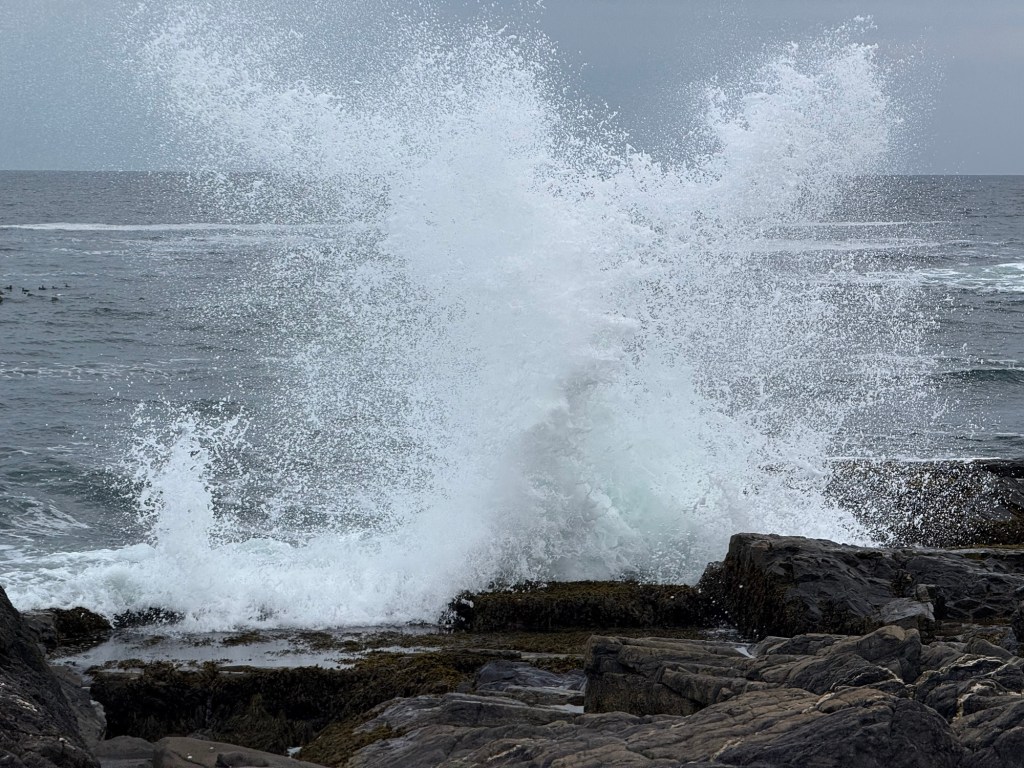
    And while the eastern breeze blows on us and the restless surge
    Of the lake waves on the breakwater breaks with an ever fresh monotone,
    Let us ask ourselves: What is truth? what do you or I know?
    How much do the wisest of the world’s men know about where the massed human procession is going?

    You have heard the mob laughed at?
    I ask you: Is not the mob rough as the mountains are rough?
    And all things human rise from the mob and relapse and rise again as rain to the sea?
    — Carl Sandburg, On the Way

    These days I see more clearly, and I chafe at certain things that used to wash over me. We learn and grow and become someone hopefully better than the character we were before. Each step is revelatory, each step confronts others with the changes within us. That confrontation is sometimes reflected back towards us in subtle ways. Pokes and prods—just to see if the illusion shatters or if there is a new truth to the story of who we are now.

    We rise, relapse and rise again in a lifetime of growth and stumbles, but our story is always set in the present. What has become of us? Where is this going? And just who will join us on our way, and do we dare to wonder—who won’t?

    “I am”… I said
    To no one there
    And no one heard at all
    Not even the chair
    — Neil Diamond, I Am… I Said

    This restless surge of change relentlessly washes away the sandcastles of fragile identity. We are obliged to rebuild them every day, or we are swept away into something entirely different. Made up of the same substance—nothing but grains of sand in our time, yet no longer the same. Only we know the truth of who we are, only we may hear the call. If we dare to listen.