Category: Birds

  • Mine the Magic

    “Dumbo got airborne with the help of a magic feather; you may feel the urge to grasp a passive verb or one of those nasty adverbs for the same reason. Just remember before you do that Dumbo didn’t need the feather; the magic was in him.” ― Stephen King, On Writing: A Memoir of the Craft

    Earlier this morning, still before the sunrise, I sat out with a cup of coffee trying to determine what kind of bird was making a very unusual call when the pup decided I’d lingered long enough without throwing the frisbee and put me to task. That lengthy sentence alone indicates how blessed I am to have a moment like that, one that repeats regularly, despite all the madness in the world. There are plenty of people who would trade places and I’m not so wrapped up in my storm of minor problems that I don’t recognize that. Circumstances arise that change our trajectories, but we largely determine who we become. We mustn’t forget to savor such moments when we find ourselves living them.

    The question of next is always weighing on us, even as we tell ourselves to immerse ourselves in now. Humans are built to ponder the future, with hope or dread or maybe chagrin, but the future isn’t anything but a script that hasn’t been played out yet. We may yet sharpen the pencil and draft something clever for our future self. And isn’t that the hope for all of us creative types? We anchor ourselves to the moment while drafting the exciting, implausible next. Drafts are always rewritten as the editors in our universe play their part, but we may still influence the final scene.

    I never did figure out what that bird was. It flew away to sing its strange song somewhere else, and I was left with another missed opportunity. Life is full of such things, and yet we still have agency. Sometimes we have to remind ourselves to stop grasping for magic feathers and simply mine the magic within ourselves, that we may realize it one day. Don’t let that dream be another missed opportunity that flew away with time.

  • A Moment with Eugene’s Birds

    Nay, I will; that’s flat:
    He said he would not ransom Mortimer;
    Forbad my tongue to speak of Mortimer; 555
    But I will find him when he lies asleep,
    And in his ear I’ll holla ‘Mortimer!’
    Nay,
    I’ll have a starling shall be taught to speak
    Nothing but ‘Mortimer,’ and give it him 560
    To keep his anger still in motion.
    — William Shakespeare, Henry IV, Part 1

    In 1890, a man named Eugene Schieffelin brought European starlings to the United States. According to The New York Times, his motive apparently was to have all the bird species mentioned by William Shakespeare in America. So I have Eugene and a single name drop by Shakespeare in Henry IV to thank for the mess that starlings leave in their wake when they come to the bird feeders in my backyard. We ought to be more careful introducing invasive species to places where they never existed, but when has common sense ever directed anything that humans do?

    You learn a lot about the local bird population when you put the right variety of food out for them. I lived in my home for almost twenty years before I saw bluebirds visit the feeders, largely inspired by putting food they’d actually eat in the feeders. From that point on I’ve had an abundance of bluebirds. The starlings were never invited to the party, but they’re masters at crashing it anyway. Perhaps that’s why they call them invasive.

    This winter I brought the feeders back close the house, that we may enjoy the view of wild birds just outside the window. I forget sometimes the mess that comes with feeders in the form of bird droppings and seed shells, but it’s the uninvited guests like starlings, squirrels and rodents that make me question my sanity. But the birds are worth it. Even the squirrels are entertaining, and I give them just enough of a head start before I let the dog out that they stand a chance of escaping (there are some messes I don’t want to deal with).

    Winter isn’t what it once was, but we do have snow again. The bird feeders become very popular when the ground is coated in snow. The buffet is open for business, and as the movie line goes, build it and they will come. And really, that’s the point. When I go into the kitchen for a cup of coffee or tea, I look out in the yard and see life. Life in turns inspires me to be more lively myself, and the work benefits from my time with the birds. I suppose that’s worth a bit of mess from a couple of uninvited guests.

  • On Sirens and Place

    “Where you are is who you are. The further inside you the place moves, the more your identity is intertwined with it. Never casual, the choice of place is the choice of something you crave.”
    ― Frances Mayes, Under the Tuscan Sun

    I talk of travel but deliberately spend money on plumbing fixtures that cost as much as a plane ticket to faraway places. You can feel the quality in a good plumbing fixture, you can feel the permanence of it if fate allows it a good home. A good faucet will outlive all of us. Surely it will last longer than a trip to Paris or Tuscany. Does a faucet sing a siren song the way that travel does? Surely not, but never forget that Odysseus was simply trying to get home to Ithaca. Sirens pull us away from home, never to return. Still, we hear the call.

    Surely, this place that we call home will outlast our desire to stay in it. Yet the garden remains, with bee balm rising to meet the sun year after year. The hummingbirds return to meet it, and the butterflies and bees. Bee balm (Monarda) is a bit like me, with a wandering soul. Its roots spread out, testing the limits of the garden, and each year the flowers bloom in a different place than the year before. Kindred spirit, I let them roam, content to see where they rise each year. In a walled garden there’s only so much room to run. Still, the hummingbirds always return, knowing they’ll be there somewhere nearby. And so will I.

    Returning seems the thing. When you have a sense of place you’ll move heaven and earth to get back to it again. But to return means to leave now and then. Knowing deep down that place remains.

  • Stories in Time

    Now through the white orchard my little dog
    romps, breaking the new snow
    with wild feet.
    Running here running there, excited,
    hardly able to, stop, he leaps, he spins
    until the white snow is written upon
    in large, exuberant letters,
    a long sentence, expressing
    the pleasures of the body in this world.
    Oh, I could not have said it better
    myself.

    — Mary Oliver, The Storm

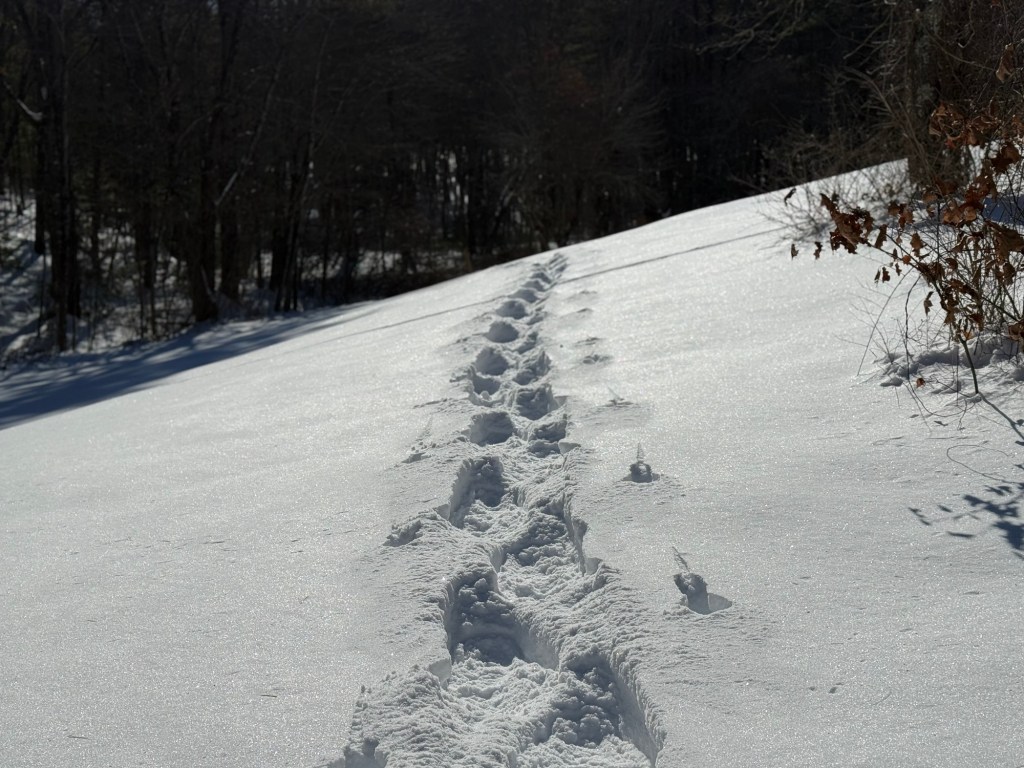
    A rafter of wild turkey hens took up residence in the woods prior to the last snowfall. Likely anticipating the snow better than this human could, they opted for the scattered certainty of fallen birdseed from the feeders over the starkness of scratching out a next meal from the deep blanket of fresh snow. Who can blame them? Without a dog for longer than I care to think about, a turkey might find the backyard a relative paradise. This turkey nurtured the land to be just so, for children who have long since migrated. The tracks across the snow break up the blanket as children and Bodhi once did, and I quietly celebrate the contribution to my own tracks.

    Perhaps it’s time to welcome another dog to write its own story in time. Life goes one. We bring to it what we choose.

  • But for Now

    Some fine day when we go walking
    We’ll take time for idle talking
    Sharing every feeling as we watch each other smile
    I’ll hold your hand you’ll hold my hand
    We’ll say things we never had planned
    Then we’ll get to know each other in a little while
    But for now let me say I love you
    Later on there’ll be time for so much more
    But for now meaning now and forever
    Let me kiss you my darling then once more
    — Jamie Cullum/Bob Dorough, But for Now

    The bird feeders were irresponsibly empty yesterday, distracted by life as I’d been, what with elections and wars and billionaires behaving badly (another reason to not win the lottery). I’d simply let them run empty. When such things happen the birds move on to the neighbor’s feeders, or pick through the fallen leaves for leftovers. Birds deal in the reality of the moment—there’s either food or there isn’t, and act accordingly. “Since it is what it is, what will we do with it?“, they stoically chirped and got on with their collective now. When the feeders were full they returned in earnest, and the cycle repeated once again. I suppose we can learn a thing or two from birds.

    There’s something about November that demands intense focus on immediacy. Lyrical phrases like “these are the days”, “this magic moment”, and “but for now” drift into my head and prompt reflection. Reflection is lovely, but the feeders and fallen leaves remind me that there’s work to be done. This blog might be to blame for making me so very attentive to the business at hand, but then again, it’s just a way to share what was whispering in my ear all along. Is it itself a distraction, or a way to sort through the progress of becoming something more?

    Perhaps, the birds suggest, we think too much and do too little. We shouldn’t relinquish our magic moment but get straight to the point and say and do what must be done. Later, maybe when we actually become what we’re becoming, there’ll be time for so much more. Life isn’t about its little distractions but a sum of what we produce in our days. For we aren’t just feeding birds here, are we?

  • Garden Blessings

    Ah, yet, ere I descend to the grave
    May I a small house and large garden have;
    And a few friends, and many books, both true,
    Both wise, and both delightful too!
    And since love ne’er will from me flee,
    A Mistress moderately fair,
    And good as guardian angels are,
    Only beloved and loving me.

    — Abraham Cowley, The Wish

    The air is filled with squeaky chirps and the buzzing sound of wings beating the warm morning air, announcing that the bluebirds of June were replaced by the hummingbirds of July. They remind me that the garden, despite early neglect, still dazzles, inspires and informs. The frenetic urgency of the hummingbirds to feed brings life to the midsummer garden, just when it most needs a lift.

    It’s sometimes easy to forget the things we build around us that attract nuance and substance. We build our lives on the four cornerstones of relationships, legacy, learning and action. Each in turn determines who we might become as we build our life atop this foundation. Like the birds flirting briefly with the garden, people come and go from our lives. Jobs and money and fashion come and go. We each note the changes, but how we react is determined by who we’ve grown to be.

    What is a garden but a foundation? We stake our place in this world to cultivate our hopes and dreams as life changes around us like the seasons. Each season brings enchantment, frustration, context and acceptance. We become what we cultivate, influenced by the seasons but not always determined by them. Everything has its time, and the blessings in our lives must be realized in their own season.

  • The Garden Blues of June

    There’s been some unusual activity in the garden lately. A squirrel walked up to me as I sat still sipping coffee, looked me squarely in the eye and didn’t run away until I called his bluff. A pair of bluebirds, normally quite shy, are aggressively guarding the birdhouse they made into a home. They let that squirrel know it was time to move along, while given me a sideways glance to remind me there will be no eggs for breakfast for me today.

    Speaking of blue, it’s almost blueberry season in New Hampshire and that means the return of catbirds, the little devils who gobble up ripening blueberries by the pint, usually just before harvest. In previous years I’d rig netting and chicken wire to hold them at bay, but they always seem to find a way to the fruit. This year no netting and only a half-hearted attempt to chase them away. After traveling for much of June I’m conceding the early harvest to nature. Maybe I’ll have better luck with the tomatoes later in the season. We all choose what we fight for in this world. Isn’t it funny how that changes season-to-season in our lives?

    Earlier this morning I walked around the garden, seeing first-hand all the work I’ll need to do to set things straight. Nearing the fence, I spooked a large doe, who betrayed her position in her panic. I told her as her white tail bounced away that I’d never have seen her if she’d just waited a beat longer. Movement betrays, it’s only in stillness that we become one with the natural world. The doe had no use for my unsolicited advice.

    The garden is neglected and mocks me my late return to tend it: “Too little, too late pal.” Such is the way, for stillness need not apply in the garden. But I’ve come to think of the garden differently this season. Or maybe just my position as head gardener. I’ve taken something of a sabbatical this year with more emphasis on the hardscape and less on the seasonal magic. Looking around, it feels foreign to me, this garden I’ve labored over for years. Thinking about the behavior of that squirrel and the doe, I wonder if they simply aren’t used to having someone linger in the garden anymore?

    Gardens, like our lives, ebb and flow. In June 2022, when things are usually flowing, I feel an ebb. So much feels different this season, but the bluebirds remind me that change is inevitable. We either roll up our sleeves and get back to work or we wallow in the blue. Gardens frown upon the wallowing gardener, for the season—our season—isn’t over just yet. And so it must be that we get back to it once again.

  • How Much Alive

    “It matters not where or how far you travel—the farther commonly the worse—but how much alive you are.” — Henry David Thoreau

    Sitting outside, listening to birdsong in the magic hour before the world shook the cobwebs off, I watched a couple of large birds fluttering tree-to-tree. I wondered at them, thinking perhaps pileated woodpeckers who tend to behave this way, or maybe a couple of young turkeys waking up from their roost. Definitely not hawks on the hunt. Black and white with a bit of duck-like appearance to them, I quickly exhausted my list of possibilities and remained mystified. The binoculars and camera remained safely in the house where they offered the least amount of help in the moment. So I quietly thanked them for their visit and released them from my attention as they worked their way away from my own perch. I may find out yet who my visitors were, but it wasn’t our moment for a proper introduction.

    We aren’t meant to know everything, but we ought to be curious. We all seek answers in this world. We climb to high summits, fly to faraway places, seek solace in the new. Shouldn’t we celebrate the world as it comes to us? Why do we feel compelled to fly across the globe? Because we know it’s out there, and like those birds, once we’re aware of that fact we want to know a bit more about it.

    Thoreau traveled too, he just wasn’t collecting frequent flyer miles or navigating security lines. He sought faraway places relative to his time and place, traveling to Cape Cod and Maine and paddling down the Concord and then up the Merrimack Rivers. He sought what was just out of reach just as we do. Credit the pace of travel if you will, but he didn’t postpone his aliveness for when he arrived at his destination, he encountered it in each moment along the way. Shouldn’t we do the same?

  • Chickadee Advice

    In the golden hour before the dawn the black-capped chickadees talked amongst themselves, adding more and more high-pitched “dee-dee-dee’s” to their song the closer I walk to them. I’m the intruding loner early in the morning and this is their warning to each other. I may live here, but this isn’t my backyard—it’s always belonged to the birds since the time of dinosaurs. I’m just the latest affront to their ritual. Knowing my place, I behave and sit still to take stock of the waking world around me, assessing the frenzied week and contemplating the week ahead. A bit of stillness listening to chickadees is welcome.

    We choose what to pay attention to. Away from the din of urgency and outrage we might hear our own voice. We choose how we’ll react to whatever happens in our days. Each quiet morning offers a sabbatical of sorts. We need a bit of stillness now and then. A measure of calm between our storms to set the sails for what comes next. In stillness we decide what to do and be next.

    In the hushed quiet hour before the sunrise, those dee-dee-dee’s say something entirely different to us humans, if we’ll listen carefully to the call we’ll hear our own voice: Decide what you’ll be, be, be! Go on and see, see, see!

  • The Wind Always Speaks

    “If there seems to be no communication between you and the people around you, try to draw close to those things that will not ever leave you. The nights are still there and the winds that roam through the trees and over many lands.”Rainer Maria Rilke, Letters to a Young Poet

    We’re often alone in this world, but alone doesn’t require loneliness. These days gifted to us are full of routine and ritual, from how we wake up in the morning to where we sit and what we eat. Who we interact with is often our choice, but alas, not always. How we react to everything and everyone we interact with—or don’t interact with—is always our choice.

    Stepping outside on a spring day in New Hampshire, the world is alive in chatter. Birds and squirrels debate nest design or which yard has the best feeders today. A light wind might stir the tree tops like a hand brushing over tall grass, while a heavier wind might offer a gusty, heartfelt shake. No, there is no loneliness outside—the world is always present.

    The garden begins to awaken. Rabbits have nibbled the tops off of some early bulbs, inspiring a silent curse and a fence resurrected to stake a claim for beauty. Days are longer now and there’s more to see, but for the stars as they concede more and more to the sun. Every day brings a new voice to the yard as the migration continues northward. Flashes of blue are a regular part of the days now as the Bluebirds, present all winter at the feeder, decided to make the birdhouse their own once again.

    Every day is a poem. Every day offers an embrace when you step out to greet it. Even on the quietest of days, the wind always speaks.