Category: Birds

  • The Wind Always Speaks

    “If there seems to be no communication between you and the people around you, try to draw close to those things that will not ever leave you. The nights are still there and the winds that roam through the trees and over many lands.”Rainer Maria Rilke, Letters to a Young Poet

    We’re often alone in this world, but alone doesn’t require loneliness. These days gifted to us are full of routine and ritual, from how we wake up in the morning to where we sit and what we eat. Who we interact with is often our choice, but alas, not always. How we react to everything and everyone we interact with—or don’t interact with—is always our choice.

    Stepping outside on a spring day in New Hampshire, the world is alive in chatter. Birds and squirrels debate nest design or which yard has the best feeders today. A light wind might stir the tree tops like a hand brushing over tall grass, while a heavier wind might offer a gusty, heartfelt shake. No, there is no loneliness outside—the world is always present.

    The garden begins to awaken. Rabbits have nibbled the tops off of some early bulbs, inspiring a silent curse and a fence resurrected to stake a claim for beauty. Days are longer now and there’s more to see, but for the stars as they concede more and more to the sun. Every day brings a new voice to the yard as the migration continues northward. Flashes of blue are a regular part of the days now as the Bluebirds, present all winter at the feeder, decided to make the birdhouse their own once again.

    Every day is a poem. Every day offers an embrace when you step out to greet it. Even on the quietest of days, the wind always speaks.

  • Disturbing the Roost

    Mid-March brought the turkeys back. They roost high in the white pine trees at the edge of the forest, protected from the coyotes, bobcats and other predators who long for a turkey dinner. They’re silent during the early morning hours until something disturbs them. This morning that something was me.

    Coffee in hand, I walked out into the songbird chorus of pre-dawn, stood silently to let the world sink in, and caught a glimpse of motion out of the corner of my eye. Turning to greet it, I watched a single turkey glide away in the early light. Soon another one began it’s own glide from the high trees to some place further away. A few beats later another dozen flew off silently, and then the squawking began. Grumpy morning conversation about the guy with his coffee disturbing the sleep-in.

    I ought to write about St. Patrick’s Day or the luck of the Irish. I ought to write about war and pandemics and the collective pain we all feel at the disruption of our lives by things out of our control. But the sight of turkey’s gliding silently through a dim, foggy morning in New Hampshire reminded me that we each leave our small ripple on the universe in our own way. Today I disturbed the roost, but they don’t seem worse for the wear.

    It made me wonder, what else lies dormant, waiting to be stirred in the foggy morning?

  • The Duck With the Broken Beak

    If there’s a perk to travel, it’s the opportunity to encounter things you would never see in your daily existence. When you pause from your frenzied attempt at getting things done long enough to observe what’s hiding in plain sight around you. On this particular trip, it began with a glimpse of a duck swimming in the pool at the Rosen Plaza Hotel in Orlando.

    It seems this duck that was hit by a car at some point, resulting in a broken beak and an inclination to live a more comfortable life. The story goes that she had a family with some scoundrel mallard and returned with her ducklings in tow. When she became an empty nester she dropped the old mallard for another mate and now spends her days swimming in the hotel pool and walking amongst the guests looking for handouts.

    At some point in her evening she flies away to spend the night elsewhere, but returns in the warmth of the day to take up her role as ducky ambassador for another day. The hotel employees are familiar with her routine and don’t blink an eye when she walks around looking for stray bits to eat. The novelty is still with the guests, as we encounter this unusual pool duck in our own time. She seems to relish every encounter, and poses for pictures as she’s no doubt done a thousand times before.

    The broken beak is her unique feature, and no doubt caused her great discomfort when she had her accident. But she wears her scars proudly, showing the world that this duck is a survivor. Humans could learn a thing or two from her. Wear your scars proudly, treat everyone with respect and don’t put up with characters who don’t measure up to your standards.

    These encounters are where the joy of travel resides. We move through our time and this world, chancing on these moments with a life force here and there that makes us stop in wonder. I’ll continue my journey, likely never back in this place again. But I’ll remember this scarred, friendly ambassador, poolside with her court.

  • Clever Enough to Be Crows

    “If men had wings and bore black feathers, Few of them would be clever enough to be crows.”
    – Henry Ward Beecher

    I stood at the window and watched three crows walk across the lawn, pausing now and then to pluck some edible creature out of the grass. Each walked with intent, and the three of them orchestrated a reconnaissance mission of the terrain, assessing every morsel and every threat together. The shiny black feathers were striking against the muted green lawn and the relentless fog enveloping everything.

    Crows communicate like no other birds, with a rich and diverse language of their own, and a particular nuance in how they move and gesture to each other that is beyond the understanding of this simple human on the other side of the glass. I had no doubt they were aware of me, and no doubt they recognized the glass for the barrier it was. I thought I was observing them, but you forget in that moment that you too are being observed.

    Standing there, just beyond my gaze, on the far side of the lawn near the relative safety of junipers, was a wild rabbit, young and cautious, also making breakfast at the lawn buffet. The crows and the rabbit were indifferent to each other, aware but knowing the threat level each posed to the other. Each looking outward for the first sign of a fox or coyote or maybe an overzealous neighborhood dog, and with a common purpose, they became allies of the moment. I was the odd one of the bunch, at once a part, and apart, from the action.

    I suppose there’s nothing of travel and philosophy or fitness in this post; no mountains summitted, no waterfalls gazed upon, no international borders crossed, no personal milestones broken. Void of such action, you might think it a frivolous cluster of words. I’ll concede there’s little to glean from these words on travel and fitness, but you might just find a bit of philosophy in the four creatures working the foggy lawn, or the one observer seeking to understand the foggy world on the other side of the glass.

    The crows stayed with me long after they’d taken flight, leaving me with the fog and empty lawn. I’d like to think this observer lingered in their mind well past our moment together. But that would be folly. Crows have better things to ponder than the frivolous life of humans.

  • More Like a Cardinal

    Contemplating the turf war between a pair of stressed House Wrens and a nonchalant female Cardinal perched a little too close to the nest. I was struck by the similarity between the birds and my relationship with my neighbors. The neighbors are fine people, mind you, but they each do something that I find annoying in some small way. And I realized that I was like the House Wrens reacting to encroachment from the Cardinal. And of course, the neighbors were like the Cardinal.

    The Cardinal was simply existing, but doing so in a way that annoyed the Wrens. And I recognized I don’t want to be like a House Wren at all. I want to be more like a Cardinal. Not necessarily annoying the neighbors with my presence, but in the nonchalant way that it goes through life.

    I realized in that moment that I’m probably going to live in this spot, with a nod to fate, for at least thirty years of my lifetime. By far the longest I’ve spent any time in any place. And I’m a nomad at heart. What brought me to this realization? Comfort? Complacency? Commitment? I’m sure there are C’s I’m missing, but you already know the answer anyway. It’s a bit of each. And this is how communities are formed. People sticking together despite annoying tendencies and a competing urge to try a new place now and then.

    Cardinals don’t migrate. They stick with the place they live in and make it work. House Wrens, on the other hand, migrate to warmer climates for the winter and return when the weather warms up again. Snowbirds versus redbirds, if you will. Both return, but where they’ve been in the meantime is so very different.

    Ultimately, I long to fly like each bird. To fly off but return to the home nest seems appealing. I’m coming to terms with the idea that my travel will be shorter in duration, but perhaps more meaningful knowing I have a place to land in when I return. Maybe that’s enough. And thirty years in one nest is surprisingly closer than I ever imagined.

  • The Magical Hours

    Water patterns reflect on the tree trunks, illuminating the bark and lichen in a dance of morning light. The wave patterns slowly fade as my bathing suit air dries in the early warmth. Birds and chipmunks fill the air with a soundtrack of their greatest hits. It’s going to be a scorcher today, they seemed to agree.

    The house wren that moved into the bluebird house dominates the conversation, but the chipmunks have a lot to say too. Until I stand up and abruptly reset the agenda from banter to assessing the new guy. In the sudden hush I catch the sound of a woodpecker, unseen, seeking a meal in a tree somewhere in the woods. The bass tone indicates deep work.

    It’s such a short time, these magical hours spent in outdoor spaces when everything in the world just seems perfect. No bugs, no pollen, no shoes, no problems. That these days exist at all is a blessing. I imagine this is why people live in Southern California, where every day is this kind of perfect. Here we take what we can get while it’s here, and boy do we love it when it’s here.

    Early mornings are reserved for the knowing few. I catch a glimpse of a neighbor out watering potted plants as I do the same with my own. We nod a greeting to each other and return to the work at hand.

    The garden isn’t the same as Mother Nature. Magic doesn’t just happen in a garden, you’ve got to put the work in. These are the days when you’re rewarded (or punished) for the work invested in a yard and garden. Harvest is still weeks or months away for the vegetables, but we’re entering peak season for the flowers.

    How do you know when you’ve reached a peak? When the world aligns in moments of wonder? When everything just seems to click for you? Or do you have to wait until you’ve declined from your peak, when things aren’t going as well and you see, maybe for the first time, just how good that moment was?

    I’m past peak when it comes to athletic performance, but haven’t yet peaked in my learning. If fitness is the flowers in your garden, learning and mental development is the fruits and vegetables, often taking until the very end of the season to fully develop. Like flowers your fitness level doesn’t have to stop midway through your season, and like vegetables you can find enlightenment well before the end of your season.

    There are no hard and fast rules in life or gardening, but there are seasons to honor and work to do in each. In each day there are moments available to appreciate the blessings that have come your way. Those magical hours that seem to fly by so quickly when life seems just about perfect in every way.

  • A Moment of Wonder

    Yesterday morning I chanced upon an Oriole in the garden. He looked at me and I at him and we both had our moment of interspecies connection before he decided to fly off to join his mate (who was no doubt pissed at him for his boldness). The bright orange and dark black are still locked in my mind a day later.

    That night in the very same spot I stood while the fireflies made their debut in the yard. More likely, it was the first performance I could attend. They lit up the darkness at the edge of the woods, just as the brilliant moon was rising through the trees. I expect fireflies know more about illumination than I do, but I was beaming just the same at their shared performance. That big, bold moon and the small, sparkling fireflies dancing quietly in the dark to an audience of one.

    What do we make of the moon this week? Called the Super Flower Blood Moon because it’s a combination of the May full moon and a timely lunar eclipse. This kind of thing stirs the collective imagination of the press, the talking heads who eagerly point out the big event. As a sky geek I’m aware of it, and appreciate the need of a news celebrity to talk about something besides a mass shooting or some other tragedy happening somewhere, right now, that may impact me next. Those masters of string pulling and I can agree that this moon is something special, and special things should be seen.

    But just because something should be seen doesn’t mean that it can be. As is usually the case when there’s something of note happening in the sky, it was overcast in my part of New Hampshire in the early morning hours. The lunar eclipse, like so much in this universe, wasn’t meant to be shared with me today.

    But the universe giveth even as it taketh away. Yesterday it offered those encounters with a bold Oriole and dancing fireflies, and each changed me in our moment together. I should think a moment of wonder is all we can really ask for from the universe. Just remember to say thank you.

  • From Fenway Park to Barred Owls in the Night

    Yesterday afternoon I changed up the routine and watched the Boston Red Sox play the Detroit Tigers at Fenway Park. Day games are a different vibe than night games, and all games are a different vibe during a pandemic. But we’re slowly coming out of it, and going to a baseball game on a beautiful day felt pretty cool.

    It’s been decades since I’d seen that many empty seats at Fenway Park. Social distancing requirements demand low capacity, and we were among the lucky few to get in to see the game. Honestly the game was a mess of bad pitching and horrific defense for both teams, with 21 total runs scored. But being back inside the park after a couple of years, and especially the last year, made it special.

    The entire experience, like everything else nowadays, occurs with appropriate precautions. They zip tie the seats you’re not supposed to sit in, and have some ushers walking around asking you to put your mask on if you aren’t eating or drinking. I saw plenty of people breaking this rule, but people are spaced so far apart that it didn’t matter much. The group I was part of is fully vaccinated and more comfortable than we might have been otherwise. No food vendors walking up and down the stairs pitching hot dogs and popcorn, and there were limited options below. But we were still at Fenway Park and loving the afternoon vibe.

    Back at home in New Hampshire and ready to call it an early night, I heard the calls of Barred Owls in the woods behind the house. Loud. Close. And what sounded like three or four owls. We don’t generally have Barred Owls in the neighborhood, mostly because we have Great Horned Owls and they stay clear of each other. But here they were, and the night was filled with the apocalyptic sounds of Barred Owls in the night.

    You can’t just slip away to dreamland when there’s a cacophony of owl calls outside. So I walked outside on the deck and stood listening to them in the dark. High up in the tree canopy, making baby Barred Owls or at least deep in negotiation. I thought about the contrast between Fenway Park and the woods of New Hampshire on this beautiful day in May. I’m not sure what this “new normal” will be, but if this was it, I felt lucky to have been a part of it.

  • The Rhode Island Red Monument

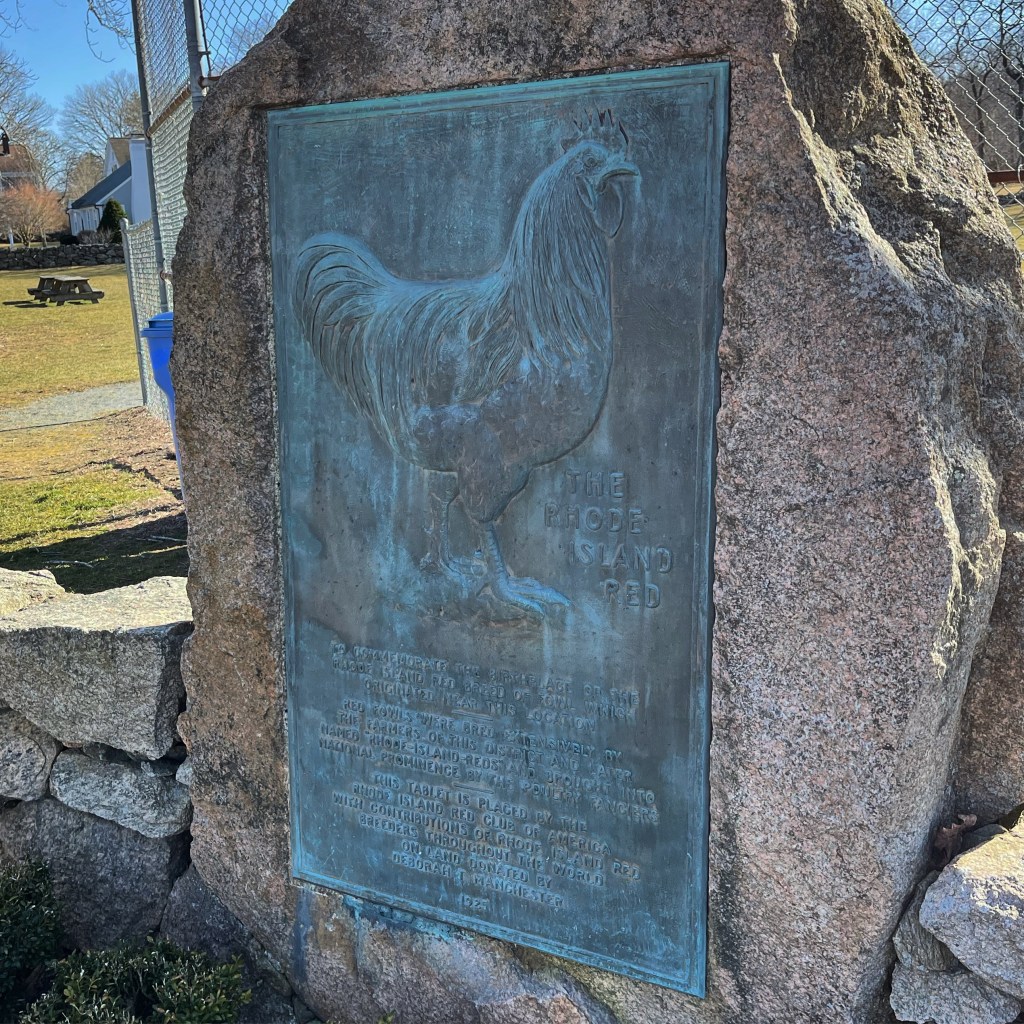
    One of the joys of travel is stumbling upon roadside curiosities. On my pilgrimage to visit a favorite hero of King Philip’s War I came across a monument to the Rhode Island Red that drew my attention. The Rhode Island Red is a hen, of course, that famously and productively laid eggs particularly well, which led to breeding of this particular character to make eggs a common and reliable staple of our diet. It seems the Rhode Island Red was first bred on a farm in Little Compton, Rhode Island.

    In 1925 a group of Rhode Island Red enthusiasts erected this monument to the hen, commissioning an artist named Henry Norton to make it. But here’s where the story gets interesting. One group wanted the monument to be erected at the actual farm where the hens were first bred. Another group wanted it in a more prominent location in town (where I came across it, validating their choice I suppose). For a small town, this was pretty heated, with both sides trying to establish a pecking order. At the unveiling of the first monument the opposing group didn’t show up, apparently feeling the location was pretty… fowl. A year later they erected their own monument at their preferred site. The 1925 monument features a rooster, the 1926 monument features a hen. But a well-placed hen. They really showed ’em.

    The 1925 Rhode Island Red Monument

    The inscription on the 1925 monument reads:
    “To commemorate the birthplace of the
    Rhode Island Red breed of fowl which
    originated near this location
    ___
    red fowls bred extensively by
    the farmers of this district and later
    named “Rhode Island Reds” and brought into
    national prominence by the poultry fanciers
    ___
    this tablet placed by the
    Rhode Island Red Club of America
    with contributions of Rhode Island Red
    breeders throughout the world
    on land donated by
    Deborah Manchester
    1925″

    This entire incident is described in the monument’s Wikipedia page in delightful detail. Not having the back story when I came across the monument, I wasn’t aware of the other monument. Now I feel compelled to return to Little Compton again sometime to find it. In the meantime, Norton’s 1925 monument quietly marks time, closing in on its 100th birthday. Placed on the National Register of Historic Places in 2001, this monument to a chicken has secured its own place in history.

  • The Heart of the Bay

    Nobody owns the sky or the trees.
    Nobody owns the hearts of birds.
    Still, being human and partial therefore to my own
    successes—
    though not resentful of others fashioning theirs—

    I’ll come tomorrow, I believe, quite early.
    – Mary Oliver, Winter and the Nuthatch

    Oliver writes of building trust with a nuthatch that eventually learns to eat out of her hand. One morning she arrives later than other mornings only to find her nuthatch friend eating from another person’s hand. And thus she resolves to arrive earlier the next morning. I’ve felt this myself, not with birds in the hand so much as places of solitude.

    Early Spring is still a time of hard frosts and temperature swings. Maple syrup weather – when the sap flows and gathers in buckets around Maple trees throughout the region. But not here. Cape Cod is more temperate, not subject to the extremes that draw the sap out. And then there’s the trees themselves, which seem to prefer the other side of the bridges. No, here we have a different sap drawn out in the early mornings. And I’m drawn to the light and the chorus.

    Buzzards Bay, well before the dawn, is awash in deep blues and burnt orange and the calls of thousands of Eider Ducks off in the distance. They have a lot to say to each other. It must be breeding season for these migratory birds. They didn’t pay much attention to the stranger on land, and I let them alone in their banter and flirting. The chorus felt altogether different from the bay in warmer months, when outboard engines of fishermen roaring off to favorite holes pierce the silence. Eiders quickly become white noise as I refocus on the task at hand.

    I crunched across a deep frost, leaving footprints in the grass on my walk to the shoreline. Low tide drew me out further into the bay, right to the waters edge quietly lapping in quiet surges like a heart beat. The bay is alive in this way. Alive in its vibrant, nutrient-rich, welcoming way. It pulls at me as it pulls at the Eider ducks, down from northern regions for their version of Spring Break. I suppose I am as well, looking for a change of scenery from New Hampshire to Buzzards Bay. For a return to salt water reflections and big skies.

    The chorus of Eiders ends with the sun breaking the horizon. Mating time gives way to feeding time. I leave the shoreline myself, for I’m not adorned in the down of a duck and the morning chills me in lingering too long. Hot coffee and inadequate words await me, with the glow of the morning alive in my mind.

    Buzzards Bay