Category: Astronomy

  • A Moment of Wonder

    Yesterday morning I chanced upon an Oriole in the garden. He looked at me and I at him and we both had our moment of interspecies connection before he decided to fly off to join his mate (who was no doubt pissed at him for his boldness). The bright orange and dark black are still locked in my mind a day later.

    That night in the very same spot I stood while the fireflies made their debut in the yard. More likely, it was the first performance I could attend. They lit up the darkness at the edge of the woods, just as the brilliant moon was rising through the trees. I expect fireflies know more about illumination than I do, but I was beaming just the same at their shared performance. That big, bold moon and the small, sparkling fireflies dancing quietly in the dark to an audience of one.

    What do we make of the moon this week? Called the Super Flower Blood Moon because it’s a combination of the May full moon and a timely lunar eclipse. This kind of thing stirs the collective imagination of the press, the talking heads who eagerly point out the big event. As a sky geek I’m aware of it, and appreciate the need of a news celebrity to talk about something besides a mass shooting or some other tragedy happening somewhere, right now, that may impact me next. Those masters of string pulling and I can agree that this moon is something special, and special things should be seen.

    But just because something should be seen doesn’t mean that it can be. As is usually the case when there’s something of note happening in the sky, it was overcast in my part of New Hampshire in the early morning hours. The lunar eclipse, like so much in this universe, wasn’t meant to be shared with me today.

    But the universe giveth even as it taketh away. Yesterday it offered those encounters with a bold Oriole and dancing fireflies, and each changed me in our moment together. I should think a moment of wonder is all we can really ask for from the universe. Just remember to say thank you.

  • Planets Dancing

    “in other breaking news
    a silver moon
    sailed
    above the world
    and the only ones
    who knew it
    were the ones who looked up”
    – Kat Lehmann, Small Stones From The River

    The skies cleared in New England after a day of heavy snow, allowing the few who ventured outside to see the waxing crescent moon looking like a giant in the western sky. A bit further along in their dip towards the western horizon was the equally stunning dance of Jupiter and Saturn. They’re slowly moving towards each other for the “Great Conjunction” on December 21st. Last night the moon was at 10% illumination, giving Jupiter and Saturn the spotlight. The three together made for a magical picture.

    I witnessed this dance across a field that cows graze on during the day, on days when it isn’t coated in snow. Last night the cows were huddled in their barn and the field sloped down towards the west, giving a wonderful view of the dance. I wonder if the cows took turns sneaking a peak through the barn door at this once in a lifetime event? Probably not. Most humans pay no attention, who can expect a cow to grasp the significance?

    Monday, December 21st seems to be trending towards rain and cloud cover. That’s par for the 2020 course, as we seem to have cloud cover for most of the celestial events this year. So maybe having the opportunity to witness something that hasn’t occurred at night since the year 1220 will be next to impossible here in New Hampshire. But we can hope for clear skies, for we’ll never see it again in our lifetimes.

    I wonder why more people aren’t lining the roads in wonder at the universe. But every day is a once in a lifetime event for each of us. Maybe we’re used to squandering moments? And maybe the world is too complex and broken for such things as great conjunctions. But I’d like to think that, maybe, they just haven’t looked up yet.

  • Life on Venus

    “Apparently it smells basically like death… It just smells horrific. We once, I think, found a report of someone saying it smelled like the rancid diapers of the spawn of Satan.” – Clara Sousa-Silva, NPR interview

    Life on Venus? Not exactly, but life swirling about in the clouds of Venus is apparently a very real possibility. That there’s a possible confirmation of life in the universe beyond Earth is extraordinary. That the life in question – Phosphine – smells like the bad gas of a rat after a night of dumpster diving is extraordinarily 2020. And yet here we are.

    In another year the announcement of life on another planet would have been front page news. But Phosphine isn’t particularly sexy as life goes, and we have enough alien life to deal with right here on Earth already. Honestly I’m happy there are brilliant people like Clara Sousa-Silva and her peer Jane Greaves are out that the very thing that we’ve all been looking at all along has potential living matter dancing in the Venus clouds. My mind simply doesn’t function in such a way that I’d make that connection between the chemical signature of Phosphine as proof of life on Venus. Or rather, life in the clouds of Venus.

    That brilliant women are leading the discovery of life on Venus leads to the rather obvious men are from Mars, women are from Venus analogy, but I dare not go further than that. I’ll simply concede that these women are far ahead of me in the brain matter department and doing mind-blowing work. I spend my time with words and images and making connections between people, not immersed in science. Shame on me, really, for this is really fascinating.

    And yes, I’ll admit it: Venus and I have had a long relationship. It’s not exclusive, mind you, but we get together often on long evening walks or quiet moments of stargazing. I admit I even take the binoculars out sometimes to get a closer look. But I knew the relationship was best kept long-distance. Venus has a toxic personality, after all. Best to look but not touch. And now to find out that she has bad breath too. It’s all too much, really. To gaze in wonder at this heavenly object for years only to find out she’s not at all what you expected her to be. But expectations are funny things, and we spend far too much time elevating objects of our affection to higher levels than they ought to occupy. That’s a lesson we can bring right back to Earth straight from the clouds of Venus.

  • The Seven Daughters of Atlas

    “Many a night I saw the Pleiads, rising through the mellow shade,
    Glitter like a swarm of fire-flies tangled in a silver braid.”
    – Lord Tennyson, Locksley Hall

    Orion and Taurus, the hunter and the hunted, have a long-standing adversarial relationship in the skies above us. If the Hyades are the face of Taurus turned towards Orion, the “body” of Taurus is a cluster of stars known as the Pleiades or the less magical M45. Looking up well before the dawn this morning they took my breath away. I carefully ran into a dark house for my binoculars for a closer look. While Mars and Venus and the Waning Gibbous moon setting in the west dominated the sky, the Pleiades drew most of my attention this morning.

    The Pleiades cluster has many names across the globe, but my favorite is the Seven Sisters. The Seven Sisters, all daughters of Atlas, dance in place, forever hunted by Orion (but just out of reach!) as their father holds up the heavens. I have but a sketchy knowledge of Greek mythology and rely heavily on Wikipedia and Google to help me out (the Tennyson above and the Hesiod poem below were both posted originally on Wikipedia). But the cluster was familiar to me, having always been there waiting for me to pay more attention.

    And if longing seizes you for sailing the stormy seas,
    when the Pleiades flee mighty Orion
    and plunge into the misty deep
    and all the gusty winds are raging,
    then do not keep your ship on the wine-dark sea
    but, as I bid you, remember to work the land.”
    – Hesiod, Works and Days 618–623

    This poem serves as a warning, for in late October and November when Pleiades is seen setting in the western sky it signals that winter is coming, and with it storms. Get your ships off the ocean and work the land instead. It’s September of course, but there have been plenty of storms already in 2020. And more change is in the air as the days grow shorter and we pivot towards Autumn. Our lives are nothing but change, no matter how much we sometimes wish to just dance in place forever like the Seven Sisters. But that’s not our fate.

    Pleiades reminded me that I need to get up earlier more often, for the brilliance of the sky above is wasted on me in my sleeping ignorance. The magic hour between 3 and 4 AM seems to be the time with the most to see, but how rare it is for me to be outside at that hour to witness it! I feel like an overnight passage or a night awake on a summit are required in the near future. Sleep is essential, but the stars silently dance without you while you’re blissfully dozing. Like Orion, those Seven Sisters are just out of reach for me, but I swear they flirt back at a fellow Taurus. And stir my imagination.

  • Discovering The Photographer’s Ephemeris

    Every now and then I discover something that makes my heart flutter a bit in excitement. There is a flutter happening now that goes beyond the first cup of coffee. For I’ve discovered an app called The Photographer’s Ephemeris. And I wonder where has my mind been all these years that I’d completely miss out on something so incredibly useful for those of us who chase the light.

    Followers of this blog know of my relationship with the early morning light – that magical time between nautical start and sunrise known as civil start. On the flip side of the day, this magical time is known as civil end (sounds a lot like 2020). For years I’ve known the wonder in this time, but I didn’t put a name on it. The combined more-than-a-passing recreational interests in astronomy and photography led me to learn more about the three phases of light in the dawn and at twilight. The Photographer’s Ephemeris handily charts out these phases on a timeline at the bottom of the app. But where it becomes really exciting is with the lines indicating where the sunrise will be and where it is now. It also offers a line showing where the moon will rise. And of course you get the same effect on the western side of the satellite image showing where the sunset will be, where it is now and where the moon will set.

    The word ephemeris is derived from ephemeral and the Greek ephēmero, or something that last for a short time. Each phase of the dawn or twilight is brief and fleeting, just as life itself is. An ephemeris is a method of tracking and predicting this ephemeral information that pivots above us. Making sense of the information falls on us. An ephemeris is usually associated with astrology and the position of the planets at the moment you were born. Or with astronomy and knowing the position of the stars now. Its handy information if you want to know where Mars and the moon are in relation to each other (dancing together last night), or if you believe in such things, why you don’t get along with your coworker.

    Ultimately, information offers a measure of predictability and understanding in our lives. I had a general understanding of where the sun might rise or set, and likewise a general idea of where the moon might be on a given night. But there’s something powerful about having the information readily available on a phone app. A thrill of expectation, but also a measure of control about where you might position yourself for that epic sunset or moonrise picture. It also saves me from looking out the window on those mornings by the bay when simply looking at the time of nautical start the night before would give me all the information I needed beforehand.

    I’m sure professional photographers have known about this app for years, but its new to me and perhaps to you too. I see The Photographer’s Ephemeris quickly rising to the top of my most-used apps. For it answers many of the celestial questions I geek out about in one handy place. And isn’t that the point of an app anyway?

  • The Four Chronometers of Greenwich

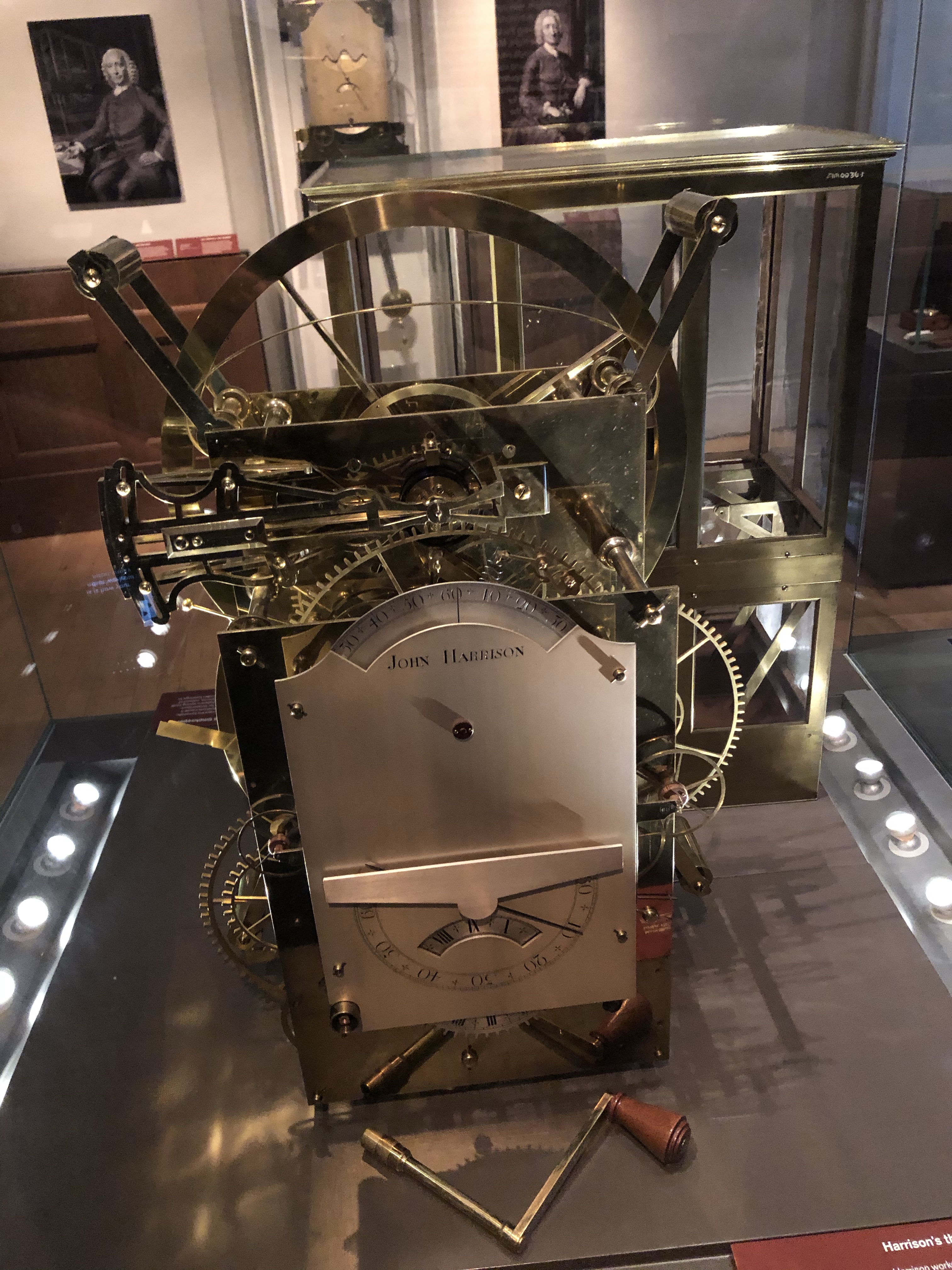
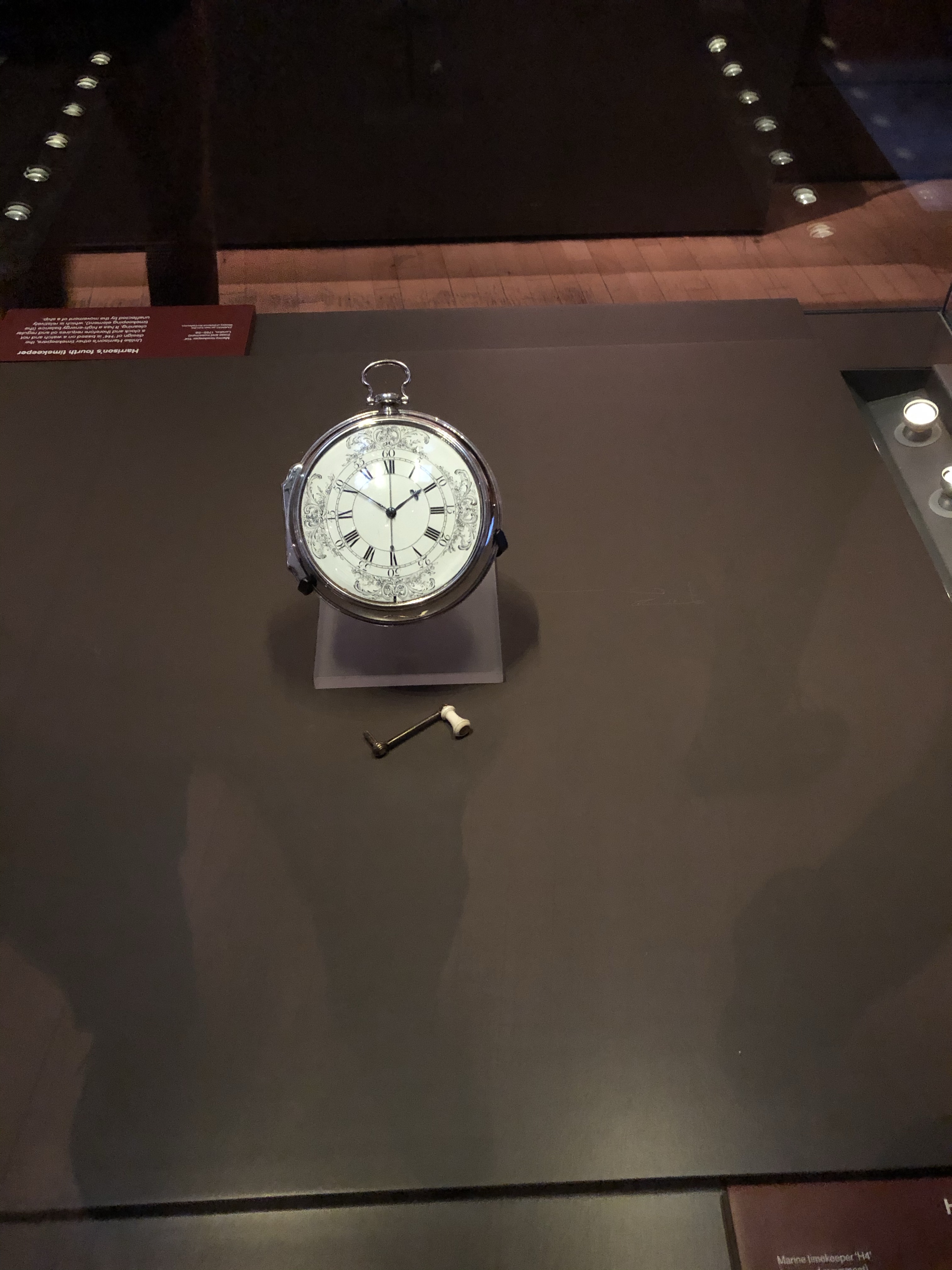
    I confess when I visited Greenwich my mind wasn’t on chronometers, it was on the Prime Meridian and Greenwich Mean Time.  But after the obligatory pictures at 0° along the famous line that dictates so much of our modern lives I spent the duration of my time exploring the Royal Observatory Greenwich, and listened intently as an exceptional guide detailed the story of the four clocks that changed the world.  That all four of the clocks were on display, and three of them were still running was a mind-blowing moment.

    John Harrison invented the first clock, H-1, in an attempt to solve the most perplexing problem of the day – determining longitude while at sea.  It was such a critical issue that Parliament passed The Longitude Act 1714 with a prize of £20,000 for anyone who came up with an accurate way to determine longitude.  Dava Sobel wrote an excellent book that details Harrison’s lifetime pursuit of a final solution.  H-1 was completed in 1735, but Harrison wasn’t completely satisfied with it and went about immediately to work on an improved chronometer.  H-2 never went to trial (tested at sea), H-3 was completed in 1759 but wasn’t trialed right away because of the Seven Years War.  While they waited to trial it Harrison invented the smaller H-4, which was the size of a very large pocket watch, which went on to win the prize money after a lifetime of work and refinement and continuous trouble with The Commissioners of Longitude (some of whom were biased towards an astronomical solution to the longitude riddle).

    Part of me wishes I’d read Sobel’s book before visiting Greenwich and seeing the four chronometers that changed the world.  But there’s another part of me that is grateful for discovering them unexpectedly.  I immediately purchased Longitude when I returned from the UK.  Having seen the four chronometers side-by-side in the museum, with all in working order (H-4 is deliberately kept unwound to preserve it), I felt an immediate affinity for the story when I began reading.  But another hero emerged from the book besides Harrison.  It was Rupert Gould, a Lieutenant-Commander in the British Royal Navy who was given permission to restore the four chronometers that had been sitting in a deteriorating state for almost a century.  Gould spent 13 years restoring the clocks to their original state, and in doing so returned four examples of timeless magic for visitors to the Flamsteed House and the Royal Observatory Greenwich.  He’s a quiet hero in history, and is rightfully remembered as such.  I was spellbound by H-1, H-2 and H-3 as they earnestly marked time 2 1/2 centuries after Harrison built them.  Now that I know their history, I look forward to a return visit someday, and will re-read Longitude and linger for a spell in the presence of history.

    H-2
    H-1

    H-4
    H-3
  • A Shelf Full of Worthy Pursuits

    “We are our choices.”  – Jean-Paul Sartre

    I found myself in a store that specializes in astronomy-related equipment like higher end telescopes and the like. I was there to upgrade my binoculars, which left a lot to be desired when hunting down that elusive Comet NEOWISE. While there he showed me a stunningly gorgeous Questar Standard 3.5 telescope that would only set me back $5000 dollars.  It was breathtaking in its detail, and I could imagine myself having it set up on the deck gazing in wonder at the universe with a glass of scotch in my hand conversing astronomy tidbits with adoring family and friends.  Enticing?  No doubt.  But I stuck with the binoculars and kept my savings account and marriage intact.  I also took his brochure on the local astronomy club and tucked that away safely on a shelf with my other worthy pursuits.  Life is about the choices we make, and Lord knows there’s an abundance of choices we can make in this country.

    “You can’t always get what you want
    But if you try sometime you find
    You get what you need”
    – The Rolling Stones, You Can’t Always Get What You Want

    You may recall a recent post about getting back into scuba diving.  I had almost the exact interaction with the dive shop I visited as the one I had at the astronomy shop, complete with cutting edge dive gear, underwater photography equipment, and that special pricing that comes when you’re in a pandemic and concessions need to be made to keep business flowing.  I’ve shelved that indefinitely as I tackle other projects, and added the brochure about scuba certification to the shelf to revisit another day. Such is the way with worthy pursuits: you can’t have it all. But you just might find you get what you need.

    “Books are like imprisoned souls till someone takes them down from a shelf and frees them.” – Samuel Butler

    Those shelves that imprisoned books also hold those brochures with unfulfilled dreams of adventure travel, cooking with fire, sailing around the world, hiking the Appalachian Trail, gardening, sea kayaking and other pursuits waiting to break free, or dare I say, mastered.  Life is chock full of worthy pursuits, and full of experts to guide you down the path.  But life isn’t full of enough time to master every pursuit that strikes a fancy, and so we must choose what to live with and what to live without.  Something has to give, and the shelf is stacked with victims of the time, money and focus equation not working in their favor.  I’m very interested in astronomy, but I’m not quite there yet for jumping into the deep end on astronomy club activities and diverting $5K towards a telescope…  No, not just yet.  But hey, if we’re both still around in ten years let’s get reacquainted.

    In the casual pursuit of Comet NEOWISE, the binoculars made all the difference.  Even with wispy clouds threatening to mask the view, I was able to see the comet clearly with the new binoculars.  And here’s the reason I chose those binoculars (besides the price tag relative to the telescope of my dreams): the binoculars are small enough to fit into a backpack or a sailing bag or brought outside with a cup of coffee for backyard bird-watching.  And thus combining multiple worthy pursuits with one modest purchase.  Is that the answer when choosing the worthiest of pursuits – what offers the best bang for the buck?  Not necessarily, but surely it helps justify the initial financial step into the new-to-you.

    I may not own the title of the most interesting man in the world, but who has time to do everything anyway?  Follow your passions where they might lead you, but do it responsibly.  The world has enough attention deficit disorder with Twitter and YouTube and sound bite news.  Keep trying new things and you never know what rises to the top of the priority list.  I’m a jack-of-all-trades, who invests time to eventually master some. Or not master some but enjoy the ride anyway. I’ve seen friends drift further and further into pursuits as diverse as sailing and hiking and photography, and I recognize and admire the passion of pursuit and growing expertise within them.  Everything has its time, and some pursuits will be there when the time is right… or perhaps not at all.   There’s joy in focusing on the singular pursuit of something, and happily living with the sampler pack with other, otherwise worthy pursuits.   There’s freedom in learning to say no, not now.