Category: Environmentalism

  • Creating the Moon

    “The moon itself may have been born of a great tidal wave of earthly substance, torn off into space. And remember that if the moon was formed in this fashion, the event may have had much to do with shaping the ocean basins and the continents as we know them.

    There were tides in the new earth, long before there was an ocean. In response to the pull of the sun the molten liquids of the earth’s whole surface rose in tides that rolled unhindered around the globe and only gradually slackened and diminished as the earthly shell cooled, congealed, and hardened. Those who believe that the moon is a child of Earth say that during an early stage of the earth’s development something happened that caused this rolling, viscid tide to gather speed and momentum and to rise to unimaginable heights.

    Physicists have calculated that, after 500 years of such monstrous, steadily increasing tides, those on the side toward the sun became too high for stability, and a great wave was torn away and hurled into space. But immediately, of course, the newly created satellite became subject to physical laws that sent it spinning in an orbit of its own about the earth. This is what we call the moon.

    There is to this day a great scar on the surface of the globe. This scar or depression holds the Pacific Ocean.” – Rachel Carson, The Sea Around Us

    Rachel Carson published The Sea Around Us 69 years ago, and it was a runaway best-seller at the time. I’ve known Carson as the author of Silent Spring, but was ignorant of this book that launched her into fame. As the name suggests, the book explores the sea and is filled with magically breathless wonder. The excerpt above filled me with awe and set the stage to position this book at the top of the stack. For who doesn’t look at the moon and wonder how it got there? And this theory of a massive wave of molten liquid rising up and ripping from the earth to form the moon, and the great scar of the Pacific basin makes as much sense to me as any other.

    Science is a funny thing. I ran away from science in school because the teachers were dispassionate bores. But when I read a passage that delivers a rightful sense of awe to the story, well, it becomes captivating. If the politicization of the pandemic and mask-wearing has demonstrated anything, its that the world needs more captivating story-tellers in science. Carson was a catalyst for a better understanding of our oceans and the environment with a page-turning writing style that betrayed her own wonder at the subject matter. Were her writing style technical and dry she never would have made the impact that she did, and the world may never have realized the threat of nuclear waste dumped into the ocean or of DDT on the food chain we are very much a part of. If she were alive today I expect she’d have a lot to say about plastic and climate change.

    Writing isn’t nearly as epic as creating a moon, but it can feel that way sometimes to the writer. I’m plugging away at the writing, both here and elsewhere, and feel that the words and characters are my own rolling, viscid tide moving unchecked through my mind. At some point maybe that momentum will spawn something awe-worthy. And that’s the challenge isn’t it? To produce something compelling and timeless. Watching the waxing crescent moon peaking through the forest last night as it dropped into the western sky was both an inspiration and a challenge to get it right. I imagine Rachel Carson looked up at the moon in a similar way, and she rose to that challenge. So why not us?

  • Life In Four Native American Quotes

    “When it comes time to die, be not like those whose hearts are filled with the fear of death, so when their time comes they weep and pray for a little more time to live their lives over again in a different way. Sing your death song, and die like a hero going home.” – Chief Aupumut in 1725, Mohican.

    The Chief Aupumut I’ve read about was born in Stockbridge, Massachusetts and fought in the Revolutionary War as an important ally against the British.  He wrote an extraordinary letter to Thomas Jefferson asking for lands for a reservation in Wisconsin, so that his people wouldn’t have to keep moving further and further until they ran out of land.  He was also known as Hendrick Aupaumut, the Chief of the Muhheconneck Nation.  Given the date, the quote above may have derived from his father.  I’m not really sure, I’m relying on a web site dedicated to quotes from Native Americans.  But it took my breath away whomever the source was.  There’s a fair amount of stoicism in Aupumut’s words, not unexpected, and he challenges all of us to live more boldly in pursuit of our own dreams.  That’s a lot to live up to, living that we might die like a hero going home, but what else is this wild and precious life for if not to reach our potential?

    “What is life? It is the flash of a firefly in the night. It is the breath of a buffalo in the wintertime. It is the little shadow which runs across the grass and loses itself in the sunset.” – Crowfoot, Chief of the Siksika First Nation, Blackfoot warrior, peacemaker

    Crowfoot died relatively young at 60 from tuberculosis, so there’s wisdom in this quote reminding us of the briefness of life.  We’re all here for a short time, whether 60 years or 100, it’s all just the flash of a firefly in the night.  So why do we waste time on the trivial when time is so precious?  Because we don’t believe the truth before us.  There’s always another tomorrow, always next year, always an I’ll get to it…  until there isn’t.  Do it now.  If ever there was a consistent call from those who came before us its to make the most of this moment, not some future moment.

    “All who have died are equal.” – Comanche or Navajo quote (source uncertain)

    Google this quote and you’ll find multiple sources for it.  But generally it comes down to either the Comanche or the Navajo.  I wouldn’t be shocked if they both had a version of the same quote.  All who have died are equal.  And all who live are equal as well, even if treated differently.  I was raised to treat everyone the same, no matter what their skin color or nationality or sexual identity or preference.  But I’ve taken my own identity for granted, not seeing the struggles of those who fight unseen battles with those who weren’t raised the same way.  The world is full of struggles for equality and the respect and dignity of all.  But collectively we can make significant improvements in our lifetimes.

    “When a man moves away from nature his heart becomes hard.” – Navajo Expression

    There are a lot of hardened hearts in the world, removed from nature and seeing the world as asphalt and concrete and electricity.  It’s easy to dismiss climate change and consumer waste as hoaxes when you’re not immersed in nature.  How can you possibly see what you aren’t looking at?  I have seen the plastic washed up on remote beaches, and the oil slicks from spills far away.  I have noticed the shift in seasons and the haze over cities on busy commuter days.  As with equality, we can make significant improvements in our lifetimes, but we can’t wait much longer.  Perhaps a new President and Congress will prove to be the catalyst for change long overdue in the United States.  Perhaps the pandemic has given the world enough of a breather to give us the time to make meaningful change in our collective behavior.  But it always starts with us.

    I linger on the edge of nature often.  Gardening and observing the birds and bees and mammals attracted to the garden.  Hiking and getting out on the water whenever possible.  But I need to plunge deeper into the heart of it, to soften the hardness in my own heart.  We’re all that firefly in the night, with so little time.  How will we use our light?  What are you waiting for?


  • Think Like a Mountain

    “We reached the old wolf in time to watch a fierce green fire dying in her eyes. I realized then, and have known ever since, that there was something new to me in those eyes – something known only to her and to the mountain. I was young then, and full of trigger-itch; I thought that because fewer wolves meant more deer, that no wolves would mean hunters’ paradise. But after seeing the green fire die, I sensed that neither the wolf nor the mountain agreed with such a view.…  I now suspect that just as a deer herd lives in mortal fear of its wolves, so does a mountain live in mortal fear of its deer. And perhaps with better cause, for while a buck pulled down by wolves can be replaced in two or three years, a range pulled down by too many deer may fail of replacement in as many decades. So also with cows. The cowman who cleans his range of wolves does not realize that he is taking over the wolf’s job of trimming the herd to fit the range. He has not learned to think like a mountain. Hence we have dustbowls, and rivers washing the future into the sea.” – Aldo Leopold, Sand County Almanac

    We all have favorite writers who take our breath away.  I’ve quoted a few of my favorites frequently in this blog, but not as much Aldo Leopold as I should.  Can you read the passage above and not be breathless at the prose?  Not if you have green fire in your own eyes.  I’ve been trying to think like a mountain since I first read A Sand County Almanac in college, but I find that when you grind away at life too long, stay in too many hotels, endure too many long drives and time in airports, spend too much time in business-speak meetings, and focus a bit too much on your net income the green fire fades.  I’m finding my way back again.

    Writing every day teaches you things about yourself.  I highly recommend it if you aren’t doing it yet yourself.  I thought I heard the call to write and so I wrote, but until I started publishing something of substance every day I didn’t really understand.  Understand the process of disciplined writing.  Understand the formation of thoughts and quotes and observations and molding it into your own creation that you nurture and place gently into the world, whether it’s perfect yet or not.  Blogging isn’t writing a novel, with an editor and time to get just the right phrasing down.  You ship every day no matter what.  No expectations of glory or financial gain or viral explosions of followers, but because it matters to you that its out there.  And its transformative: You’d rarely hear me sorting things out in casual conversation the way I write about it in this blog.  I wrote yesterday about taking on too much and working to simplify things.  That’s my own version of trimming the herd to fit the range.  I just happened to publish it for all to see.

    Aldo Leopold died a week after hearing that A Sand County Almanac was going to be published.  He was only 61 at the time, and had no idea how much his book would resonate and influence generations of people.  He simply created it and gave it to the world, perhaps hopeful it would gain an audience.  He would have been amazed at how transformative his work was for the environment and for those who fight for it. Teaching generations how to think like a mountain.  It’s his enduring gift to the world.  We never really know what can happen if we just put ourselves out there, do we?


  • A Bit of Thoreau and Sagan on Earth Day

    I toyed with the idea of a long blog post about Earth Day. Instead I’ll drop these two quotes. I think Thoreau and Sagan would have gotten along quite well. I’d hardly keep pace, but would love to sit in on that conversation:

    “This whole earth which we inhabit is but a point in space. How far apart, think you, dwell the two most distant inhabitants of yonder star, the breadth of whose disk cannot be appreciated by our instruments? Why should I feel lonely? is not our planet in the Milky Way?” – Henry David Thoreau, Walden

    “Look again at that dot. That’s here. That’s home. That’s us. On it everyone you love, everyone you know, everyone you ever heard of, every human being who ever was, lived out their lives. The aggregate of our joy and suffering, thousands of confident religions, ideologies, and economic doctrines, every hunter and forager, every hero and coward, every creator and destroyer of civilization, every king and peasant, every young couple in love, every mother and father, hopeful child, inventor and explorer, every teacher of morals, every corrupt politician, every “superstar,” every “supreme leader,” every saint and sinner in the history of our species lived there-on a mote of dust suspended in a sunbeam.” – Carl Sagan, Pale Blue Dot

  • Return to Normal

    I know they’re up there, just not as many. I’m sure the flight paths from Europe to America or Boston to Chicago are still traveled by some planes, but they aren’t flying over my home anymore. Chances are they aren’t over your home either. Like many businesses the airlines have furloughed thousands of employees and planes around the globe are getting an extended break from the constant flights that make up their existence. The highways and roads of the world are getting a similar respite from the constant flow of vehicles. Factories are shuttered while the curve flattens. And the planet gasps the cleaner air. The people in India see the Himalayas for the first time in a generation. People in Los Angeles see blue sky. Even here in relatively rural New Hampshire the stars seem clearer.

    No, the sky isn’t empty at all. It’s as full as it ever was, we’ve just finally cleaned the windows enough to see outside. The universe pirouettes above and around us, and collectively we finally see it. Perhaps we’ll remember it when things return to abnormal. For isn’t this far closer to the planet’s normal state than the constant buzz of machinery spewing emissions into the air? Billions of years of normal versus a century or two of abnormal. We just don’t see the forest for the trees.

    Too many act like temporary renters of the space we occupy. Having experienced the attitudes of renters versus homeowners, I know not all renters feel enough of a sense of ownership over where they reside to treat the place well. There are plenty of people roaming the planet with a renter’s mentality. Use it up, discard, get another one. But there are too many of us for that to go on indefinitely. There’s nothing good about COVID-19 for humanity, but the planet might feebly raise a hand to express gratitude. We’re too deep in it to know the long-term impact, but maybe we needed the pandemic to shake us all awake from the drunken stupor we’ve been in. The planet gets a much-needed breather while humans focus on something besides themselves for a bit. The return to abnormal will come, will it be enough of a jolt to reset our worldview? It seems to me that Earth could use more homeowners and fewer renters. What will the new normal be?

  • Scattered Thoughts

    Today I’ve driven all over the state of Connecticut, and I’ll be honest, I look at the woods and see the ghosts of the Pequot who conceded this land to English settlers.  I also think of Benedict Arnold, a native son of Connecticut, betraying his own neighbors in battle after he defected.  These woods could talk, if given the chance.  Instead I rely on the whispers of those who came before, and it’s really hard to hear them over the hum of highway traffic and bulldozers clearing more land for commercial development.  There’s a lot I love about Connecticut, but the ever-expanding development isn’t one of those things.  Knowing the history of a place makes you angry when you see that place abused, and too much development feels abusive to me.  Does that make me a preservationist?  Probably.  Venus and the moon are dancing this evening, and the wind is howling in Connecticut, as if voicing it’s displeasure at being left out of the tango in the sky.  I stared at the two for a few minutes and left them to finish their dance as I checked into my hotel for the night.  It’s not lost on me that I complain about development while staying in hotels and driving on highways and visiting customers in office buildings. I don’t have a problem with development when it’s done well, it just seems to be mostly down and dirty profit-maximization development in most cases, and where’s the magic in that?  I love the quiet corners of Connecticut, and wish that there were more of them preserved for the future.

    “We write to taste life twice, in the moment and in retrospect.” – Anais Nin

    The beauty of writing every day is in the magic you relive in the moments you’ve lived, and in pulling magic out of the air that you weren’t even aware of until you start typing.  I’m not sure why I waited so long to begin writing, but I know I can’t go back to not doing it.  Writing is transformative for the writer, as reading is for the reader.  I’m currently being transformed by reading Josh Waitzkin, Leo Tolstoy, Ryan Holiday, Jack Gilbert, Mary Oliver and Nathaniel Philbrick.  I’m in a routine where I’ll read a few pages of Waitzin, Tolstoy and Holiday in succession and a poem or two from Gilbert and Oliver early in the morning.  I read Philbrick in the evening in a traditional book because I appreciate the tactile experience of reading a book more in the evenings and don’t want to start my day wearing reading glasses, thank you.

    All this highway driving around Connecticut reminded me of an unpleasant moment five years ago as I was driving up I-95 through Connecticut.  A man had committed suicide by jumping in front of an 18-wheeler that had no chance of swerving out of his way.  I was close enough to the situation that they hadn’t covered up the body yet, and I still see the face of the man staring blankly in my direction as his broken body lay unnaturally twisted like a bag of laundry broke on the pavement.  I’ve never been to war, but I imagine my experience with this man shortly after his demise was close to what a soldier might experience.  One moment you’re talking to a person, the next they’re a corpse.  We’re all just bags of flesh and blood and bones.  What makes us alive is our spirit and an energy force of electrical and intangible energy.  That man on the highway chose to give back his energy to the universe, and his body became nothing more than broken matter on the pavement.  Aren’t we so much more than that?

    That intangible energy carries on long after we’re gone through the people we’ve touched in our lives, but what of future generations who never knew us?  Well, I never met Mark Twain or Henry David Thoreau or Mary Oliver, but I feel their intangible energy in the words that they write.  I never met Katherine Hepburn but I feel her energy when I drive through Old Saybrook, Connecticut.  And I never met Coleman Hawkins but I’m stopped in my tracks whenever I hear him preach through his saxophone playing Mood Indigo.  We’re more than a bag of bones and blood.  Our humanity comes from that intangible energy.  When we interact with others face-to-face or through their words on the page it creates sparks, changing us.  Don’t we owe it to the world to pay this energy forward?  To weave our own version of magic?

    So that’s the mission, isn’t it?  Make it your life goal to take that intangible energy, that life force, and transcend the flesh and blood we live in.  Offering more to the world requires learning more, seeking to understand more, observing more, and becoming more.  And in return we reverberate beyond the now.  That seems a better path to me.  Focus on the contribution, and don’t worry about stupid things like WordPress changing you to Block Editor all the time.  There’s so much more to do with the time you have.  Get to it already.


  • A Changing New Hampshire

    It’s the morning of Christmas Eve, and the creatures are stirring. This morning I watched the horses run free on the snowy fields beyond the woods. Closing the trunk of my car, I spooked a dozen deer I hadn’t seen between those horses and me. We don’t always see what’s right in front of us.

    On mornings like this I’m grateful to live here, even as the area changes with more development encroaching on the woods and fields I take for granted. Southern New Hampshire is changing. There’s been so much development in the three towns around me that they’re piping in water from reservoirs to the north to keep up with rising demand. Politicians celebrate the increased tax revenue of Plus 55 housing that comes without the hit on the school budget that more families would bring. So conservation is an uphill battle. You either fight development or you look the other way. Unfortunately I tend to look the other way, focusing instead on career and family. But the people who get things done find a way. It’s all priorities and focus, isn’t it?

    Open land is like the deer I saw this morning. You’re so focused on other things that you don’t notice what’s right in front of you until it’s too late. As I’ve referenced before, they’re paving paradise to put up a parking lot. I’m already missing what’s gone. So what am I going to do about the rest?

  • November Woods

    My favorite walks are November walks in the woods. The leaves stir underfoot, announcing your progress for those who would listen. And I have no doubt they listen. Deer, fox, squirrels and rabbits for sure, and many more I don’t consider. But I’m not here for them today, I’m here for the land, and the productive solitude it offers.

    I don’t take the time to understand people that don’t walk in the woods. There’s nothing to understand, really. You either come alive in the woods or you remain detached and resistant. Some people come alive shopping for bargains, a place where I’m detached and resistant, so I know that we all have our element. Mine is the woods.

    I walk on and come across wintergreen in a sea of brown oak leaves, which reminds me of Carlisle, Massachusetts and the Great Brook Farm State Park. I pick a leaf, snap it in two and smell the minty freshness. Memories of wintergreen moments from years ago invade my mind for a moment, and I smile and release them with the folded leaf.

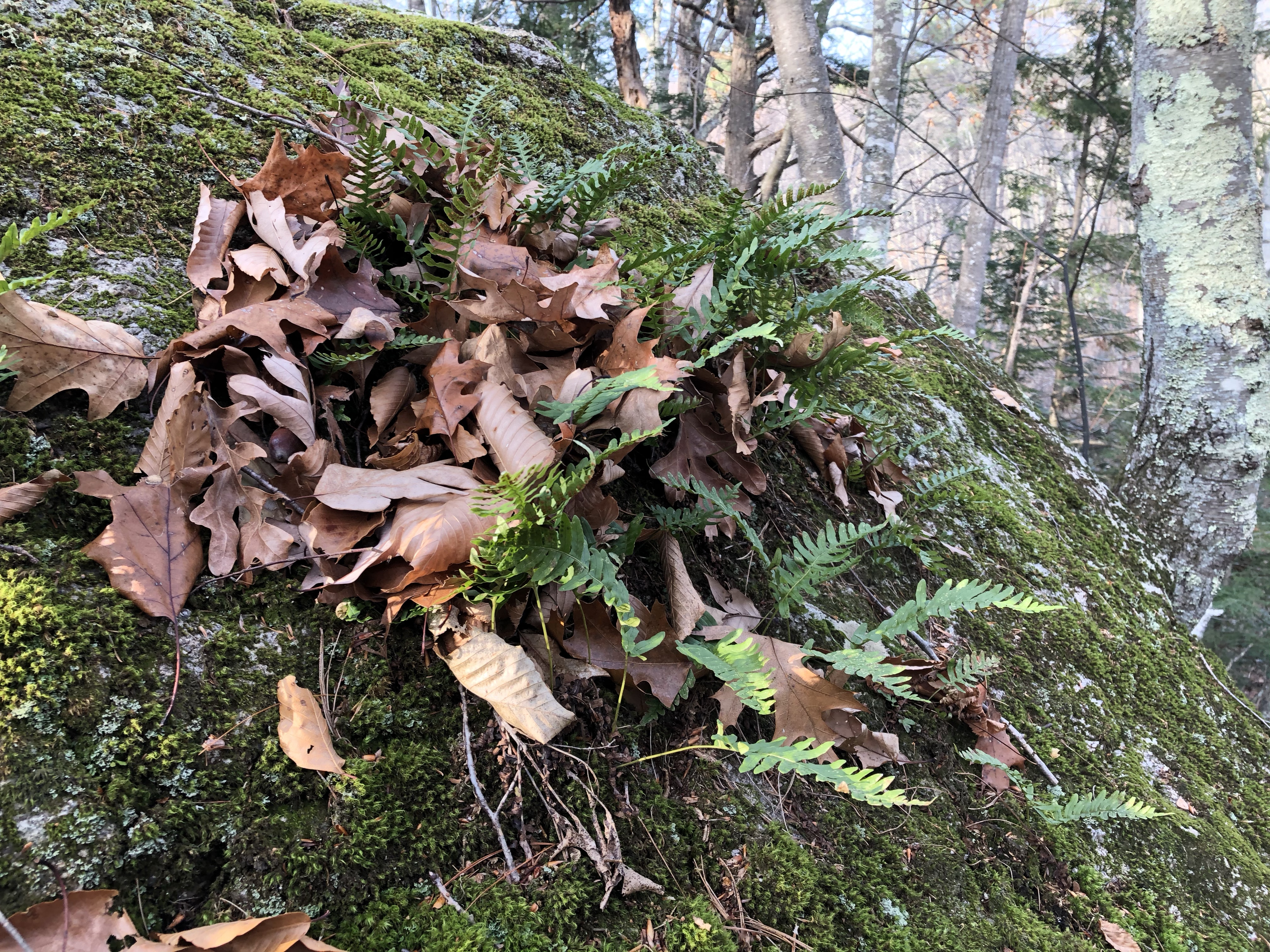
    I walk slowly through the woods; I’ve already reached my destination. I’m here to see not to get somewhere. Climbing a rise I wonder at the moss-covered granite ledge. Ferns cling to the moss, catching oak leaves that only wanted to fly. Will they return to the earth, or feed the ferns right here on the granite? That’s a question for time.

    Conservation land offers familiarity without risk. Risk that this will become yet another housing development. It’s a friend that won’t be betrayed like that friend down the street was. The land has been betrayed before, you see it in the walls and cellar holes. It may be again someday, but in conservation there’s hope for more permanence. At the very least these woods should outlast me in some form. Still, there are no guarantees: Even these woods show signs of recent harvesting.

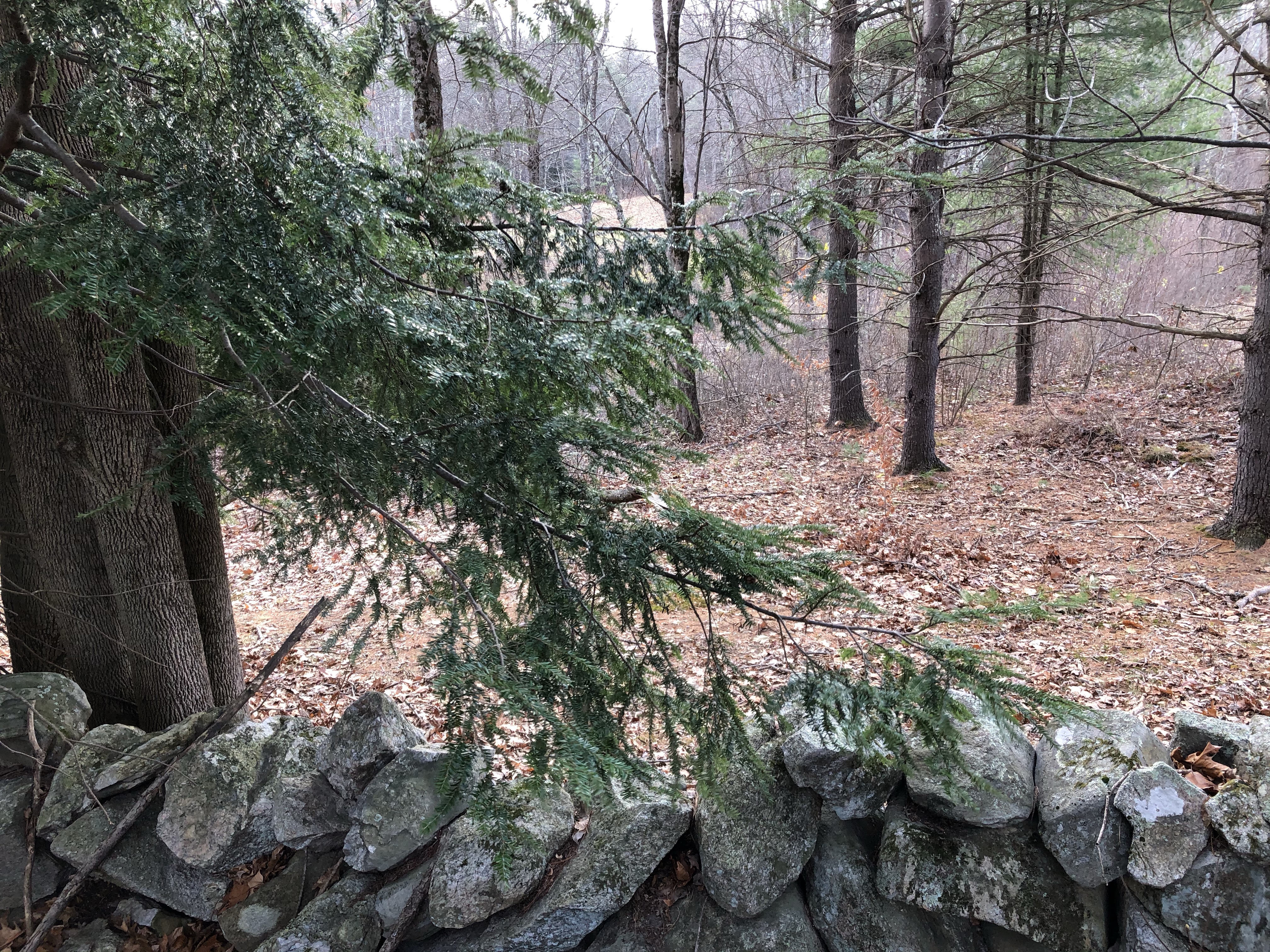
    I turn back towards home. The days are short now and I have things to do. But I pause once again for the hemlocks. For all the bare trees in the November woods, a few remain evergreen. My favorite is the hemlock, with their lacy green limbs riding the breeze. These limbs fold down neatly under snow load, while the oaks stoically resist. This means the oaks stand naked in November while the hemlocks still proudly wear their deep green dress. A case for being flexible under stressful conditions, it seems. So I stay still, watching one limb bouncing above a stone wall that stand tired but proud amongst the clutter of fallen late autumn leaves. It reminds me of an Irish step dance on a carpet of oak leaves in a granite hall. I reluctantly walk on from this performance for an audience of one with a nod to the performer. And I’m awake once again.

  • Rise to the Role

    Reading history you learn just how violently brutal our ancestors were to each other.  Read about people being drawn and quartered, most famously William Wallace, and you shake your head at the cruelty of the slow death.  Listen to the Hardcore History podcast and every episode is about the brutality of mankind in wars from raids of Genghis Kahn to the Rape of Nanking.  This kind of horror should serve as an active deterrent for all future wars, and yet memories fade, people in leadership positions don’t learn the lessons of the past, or worse think of war in terms of a business transaction; a deal to be made, a win in the books, more for me, less for you.

    I’ve no tolerance for the ignorant in positions of power.  That old Spider Man “with great power comes great responsibility” quote is true.  But too many don’t honor that responsibility.  If you rise to a position of power, you only deserve it so much as you earn it every day in how you rise to the occasion.  Rise in embracing the lessons of history.  Rise in meeting the people you lead eye-to-eye.  Rise in acting decisively with compassion, dignity, humility and honor.

    The opposite of great responsibility is backroom betrayals, spreadsheet business decisions that destroy people’s lives, trophy hunting, and ego-driven decision-making.  Padding the bank accounts of “leaders”, but big steps back for humanity.  The world needs more honorable leaders who rise to the role.  Less power-grabbing, wealth-seeking, frail egos.  When we take our collective eye off the people grabbing for power, we’re left with few good choices at the top.  There are plenty of examples of that on the world stage, on Wall Street, and in turf wars around the globe.

    There’s hope too.  Many are rising to make the world a better place.  Public servants who take the term to heart.  Driven individuals who sacrifice time, money and position for others.  Listen to a cancer research doctor to learn what selfless purpose it.  Look at the MOSAIC Expedition on the Arctic, deliberately freezing their ship into the ice to better understand climate change.  And look at the people in the International Space Station, zipping around the globe, collaborating with each other no matter the nationality.  The mix of people changes with every mission, but they all manage to work together towards common goals. Their survival depends on it.  They’re just a fragile little ball flying around in space, highly dependent on the people around them to rise to the occasion.

    The analogy to the rest of us on Earth should be obvious, and yet we have too many people who think only of themselves, who don’t rise to the role they’re in.  They don’t seem to realize or care that our survival depends on it.  We can destroy the planet easily, we can wipe out entire cities in seconds.  We can cut down rainforests for profit, overfish for short term gain, contaminate groundwater to wring oil out of the ground, and start wars to collect on old grudges.  But we’re all living on this fragile ball flying around in space, and rising to the occasion to keep it livable for thousands of generations to come is really the only choice.

    For the individual, pointing at corrupt politicians is an easy out.  I vote, but I didn’t vote for that guy.  But too many don’t run for public office because it’s a really tough job.  You are scrutinized, berated, mocked and threatened.  Who needs that?  We all need that “Man in the Arena” hero who fights for what is right.  History favors the bold.  We need more people who rise to the role, fight through the nonsense and make the place better for having been there.  How will future generations look back at our history?  If the last three years have done anything, they’ve reignited a passionate call to serve, and I’m encouraged by the numbers of people who are rising up to say choose me instead.

    And I’m reminded once again of Walt Whitman, asking a similar question in a time of change, and I’m encouraged:

    “Oh me! Oh life! of the questions of these recurring,
    Of the endless trains of the faithless, of cities fill’d with the foolish,
    Of myself forever reproaching myself, (for who more foolish than I, and who more faithless?)
    Of eyes that vainly crave the light, of the objects mean, of the struggle ever renew’d,
    Of the poor results of all, of the plodding and sordid crowds I see around me,
    Of the empty and useless years of the rest, with the rest me intertwined,
    The question, O me! so sad, recurring—What good amid these, O me, O life?

    Answer.
    That you are here—that life exists and identity,
    That the powerful play goes on, and you may contribute a verse.” – Walt Whitman, O Me, O Life!

    And the next question, from Dead Poet’s Society, “What will your verse be?”

  • Solving the Wren Riddle

    I was clearly wrong. My educated guess was off the mark. My attempts at online research failed. Apps I trusted to point me in the right direction flopped. So it goes.

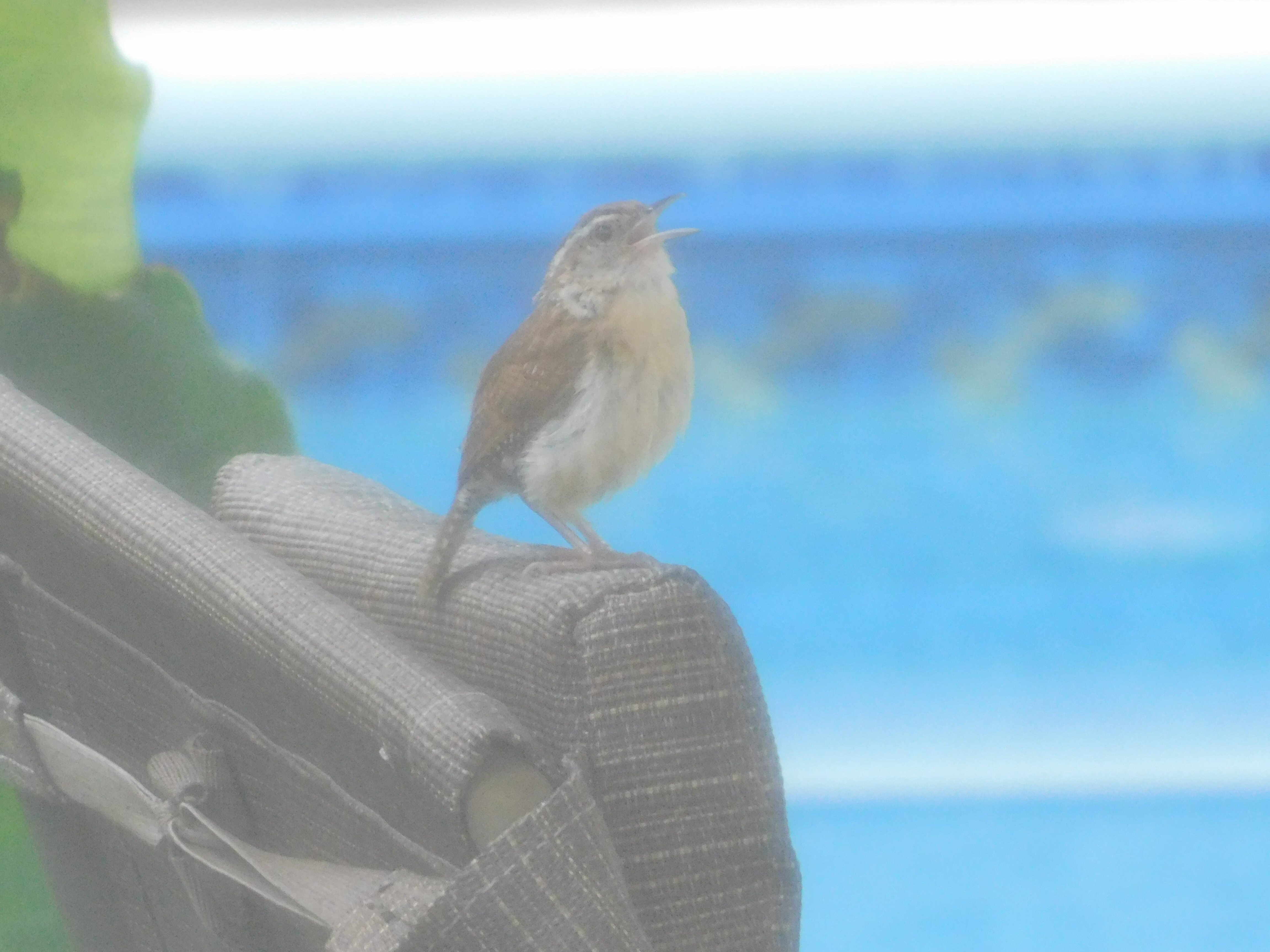
    I’ve written about my attempts to identify a bird I wasn’t familiar with that has moved into the neighborhood. And not just this neighborhood but I’ve heard a similar song on Cape Cod, as if it was following me across the Bourne Bridge, taunting me all along.  After many fruitless searches I’d finally settled on the Brown Thrasher as the most likely candidate, and have referred to the Brown Thrasher ever since.  But it wasn’t a Brown Thrasher at all.  It was a Carolina Wren.

    The Carolina Wren, as the name indicates, is typically seen (and heard) further south of here.  I’ve seen another “southern bird”‘, the Baltimore Oriole, in Massachusetts and New Hamphire, but this was a new song; a song I couldn’t get out of my head until I solved the riddle.  An app that records birds singing and analyzes it like Shazam continually got the wrong answers.  So I tried a different app, and still continually got the wrong answers.  Frustrated, I emailed the .m4a voice file to Chirp, the second app I tried, and they responded within 24 hours with the elusive answer; Carolina Wren.  A quick search online confirmed this was indeed the singer I’d been searching for all season.  It seems the bird song apps use a strong location filter to eliminate matches that wouldn’t normally be found in your area.  And Carolina Wren’s weren’t thought to settle in New Hampshire so Chirp was eliminating it as a choice.  Well, welcome to the Granite State, my southern friend.

    The New York Times recently published an article detailing the decline of North American birds, and followed that with an article detailing birds moving away from natural territory as the climate changes.  New Hampshire’s Purple Finch is apparently considering a move to other climates.  Thankfully the one’s who visit my backyard haven’t felt so inclined as of yet.  But then again, I have this new visitor to my backyard whom I’ve never had before who might be singing that there’s something to this story after all.

    Carolina Wren teasing me with her song, July 2019