Category: Environmentalism

  • Moving Past the K-Cup

    Plastic.  It seems to be all anyone is talking about now.  And not in that this is the future way that The Graduate portrayed.  Plastic has come full circle as it’s accumulated so much over the last 50 years that we can’t avoid the reality that it’s a real problem.  And so the plastic straw and the plastic single use bags at the grocery store are under attack.  In this way the younger generation is way ahead.  Both of my college-age children are well beyond the thought process of my generation.

    I hear people mock the straw shaming – but I’ve heard this all before when change hits home.  People mocked ADA compliance when it hit their wallets, or political correctness when it came to changing the names of their school’s mascots (I was a “Chief” in college, so I know how divisive this was).  Change is hard, and especially hard when it begins to hit the way you’ve always done things.  We get used to convenience, and there’s nothing more convenient than plastic stuff.

    I’ve recycled plastic for 30 years.  I diligently put my plastic bottles in the recycling bin and place it on the curb.  When you had to separate your plastics from cardboard I’d be in the garage making sure everything was separate.  And I celebrated when I didn’t have to do that anymore.  So moving to cardboard or reusable straws?  Slightly inconvenient, but not that big a deal.  Moving back to paper bags or bringing my own bags to the grocery store?  Habit more than a convenience issue.  I’ll be fine.  In fact, the only thing that has proven to be challenging for me is the damned K-cups.

    I’m a coffee lover.  And I’ve made coffee just about every way you can.  I don’t even mind the ritual of making a pot of coffee in the morning.  In fact, I used to love it.  But I’m trying to drink less coffee and if I make a pot I’ll drink a pot.  Make half a pot?  You’re making too much sense.  I’ve tried French presses, single cup drip coffee makers, and all of that assorted coffee gear that’s been out there for years.  Except for one.  The AeroPress.  I’ve seen the AeroPress in action as my nephew used it for his coffee.  I’ve given the AeroPress as a gift to friends who are sailing around the world and blogging about it.  But I hadn’t purchased one for myself…  until now.

    I can’t reconcile the waste associated with K-cups.  I’ve had just about enough of them.  And so this morning I’ve finally brewed my first cup of coffee with an AeroPress.  From a timing standpoint the Keurig has it beat, but not by much.  If I adjust the amount of water I boil in the kettle to a single cup, turn the Keurig on to heat water at the same time I’m boiling water, then go through the brewing experience the AeroPress is very close to the same time.  I timed my second brew (with boiling water ready to go) and it took me 3 minutes start to finish, including cleanup.  If you figure a minute for a Keurig with pre-heated water, I’m saving two minutes per cup with a K-cup.  I can live with the extra two minutes, as the process of brewing the cup is meditative – something I’ve missed with Keurig.

    The benefits are hard to ignore.  The coffee tastes FAR superior!  I was using a bag of Peets coffee that’s been sitting in my cabinet for the entire summer and it blew away the K-cup.  I imagine a fresh bag will be amazing.  And I had none of the mess of a French press.  Simply unscrew the filter, pop out the coffee plug and rinse.  Done!  Looking at the biodegradable coffee and paper filter in the trash felt a lot better than seeing a plastic K-cup in there.  And I have the option of composting the coffee plug to amend my garden soil for an even greener experience.

    So here’s one man’s experience with taking a step away from the K-cup.  The AeroPress is highly portable, easy to clean, and makes truly excellent coffee in close to the time that a K-cup takes.  The cost of a K-cup averages $.60 cents USD.  A bag of really great coffee will be a fraction of that per cup.  So I’m saving money, creating less waste, and drinking better coffee.  I feel better already.

  • The Fate of Trees

    Returning to the poem The Ship and Her Makers this morning as I consider the smoke alarm in my hotel room that chirped all night. Such is the glamorous life of travel. Writing instead of sleeping in is a habit I’ve developed, and there’s no sleeping in with a chirpy roommate.

    Consider:

    THE TREES
    We grew on mountains where the glaciers cry,
    Infinite sombre armies of us stood
    Below the snow-peaks which defy the sky;
    A song like the gods moaning filled our wood;
    We knew no men—our life was to stand staunch,
    Singing our song, against the avalanche.

    – John Masefield, The Ship and Her Makers

    Living in New Hampshire I know the power of trees. The white pines that dominated the forests were cut down for masts and wide plank floors and countless other uses the trees weren’t consulted on, but they’ve grown back, and New Hampshire, just behind neighboring Maine, top the nation in percentage of “above ground woody biomass”, or as we call them around here; trees.

    “Every walk in the forest is like taking a shower in oxygen.” – Peter Wohlleben, The Hidden Life of Trees: What They Feel, How They Communicate—Discoveries from A Secret World

    The irony of writing about trees thirteen stories above the largely treeless Chicago landscape isn’t lost on me. Love the city, but couldn’t live here. Give me trees. Walking amongst the tallest of them certainly brings humans back to earth. Forests are the opposite of cities in that respect too. Skyscrapers race to be the tallest, just as trees do, but they’re all in it for themselves. Not so with trees.

    But isn’t that how evolution works? you ask. The survival of the fittest? Trees would just shake their heads—or rather their crowns. Their well-being depends on their community, and when the supposedly feeble trees disappear, the others lose as well.”

    – Peter Wohlleben, The Hidden Life of Trees: What They Feel, How They Communicate—Discoveries from A Secret World

    There’s an underlying sadness in Masefield’s poem emphasized by the first line. We grew on mountains where the glaciers cry. What a portrait of what once was… we were once this grand forest, now we’re the planks under your feet and the mast above. Such are the sacrifices for mankind. Forests regrow of course, but we all lose something by the loss of old growth trees. Wohlleben wrote that in the quote above; when the supposedly feeble trees disappear, the others lose as well. The others aren’t just the other trees: they’re also us.

  • Three Legs of the Triangle

    Beginning Tuesday morning through last night I drove from Southern New Hampshire to Rocky Hill, Connecticut, up to Danbury, over to Dover Plains, New York, up to Albany, up to Burlington, Vermont and back down to Southern New Hampshire.  That’s a roughly 700 mile perimeter triangle on a map that is bigger in area that some of the states I drove through.  I’ve found that the people are mostly the same no matter where I go, but there are some differences in the three legs of that triangle.  The drive from Southern NH through Massachusetts and Connecticut is one world. The other two legs from Dover Plains to Burlington and back offer a very different world.

    I was at a bar in Danbury talking to a guy who was waiting out the traffic with dinner and a couple of drinks before he got back in his car to crawl home.  I know a guy in Massachusetts who does the same thing.  The traffic in both places will murder you 1/10th of a mile at a time.  There’s a helplessness that comes with relentless traffic that can eat you alive. That guy in Danbury was shell-shocked by a combination of forces working against him.

    Sprawling development has changed Danbury from the place I knew 25 years ago.  Perhaps nothing disgusted me more than seeing condos perched on the top of a hill, offering lovely views for the people who lived there but ruining the view for everyone that had to look at what they did to that hill.  Wedging more homes into open space means more and more people jamming onto those roads.  But the people are great, if worn down by the grind of traffic, urban sprawl, and Connecticut’s bureaucracy. There’s seemingly a sign everywhere telling you what you can and can’t do (Take my sunglasses off when I drive into a tunnel? Who knew?).

    New York is two states, metro New York and everywhere else. Dover Plains is not Metro NY, and neither is anyplace else along the stretch from there to the Canadian border, save for some Capital District commuter misery. North of Saratoga you can breath again. And other than the ferry drama mentioned in yesterday’s post those two longer legs were uneventful bliss. No condos carved into hilltops, no commuters on the verge of boiling over. Bliss.

    If you’ve ever stood by the side of a road you know how unnatural it is. It’s a horrific blur of noise, fumes and speed, all meant to rapidly transport goods and people from one place to another as quickly as possible. It’s inherently inefficient, destroys vast swaths of land, disrupts communities and ultimately destroys itself and chunks of the planet. The flip side of that story is that the world becomes smaller. I love the highway system when I’m zipping around 2/3 of that triangle, and hate it when I’m crawling along on the other 1/3. It’s a complicated debate, but I hope we get it right in the end. Let’s not let the 1/3 leg become the norm

  • I’ll Take Crickets

    PT Barnum was born in Bethel, Connecticut on July 5, 1810. He is buried in Bridgeport, Connecticut, where he once served as Mayor. So he’s as much a son of Connecticut as anyone, but is mostly known for being that circus thing. He demanded attention, and is known still as the greatest showman. I have very little interest in the man… but my grandfather was fascinated with the circus, and so PT Barnum is a curiosity.

    “Audentis Fortuna iuvat” (Fortune favors the bold) – Virgil

    This morning I was sitting in a completely unremarkable diner in Connecticut. Bland food, horrible coffee, no soul. The kind of place Hollywood would use to show the bland existence of some poor character before they woke up and sought more in their life. When they asked me whether I wanted white or wheat toast I knew I had to get out as soon as possible.

    There are parts of Connecticut that are lovely. I forever think of Kent fondly, not because of the private school, trendy stores, or a past relationship (gone horribly bad), but because of the stillness away from Route 7. There’s magic in those hills, and in the light buzz of crickets in the fields, and in the white water of the Housatonic River at Bulls Bridge. I made my way up there on my drive to Dover Plains. Some detours are more essential than others. The hills and crickets offer the same song, and there’s more Manhattan money than ever in this tiny town. We all seek solitude, some pay a premium for it. But the bridge looks about the same, and I drove through a 26 year time warp crossing it. On the other side of that time warp I appreciate where I am now.

    The residents of Bethel put up a statue of old PT Barnum showing him in his most dynamic days. I drove by early this morning because I don’t like sitting in hotel rooms longer than I need to, or soul-suckingly bland diners. The statue was erected in 2010, not all that long ago, and its clear Bethel wants to celebrate their connection to Barnum. I stopped by, took a picture and got on with my day. A nod to my grandfather. He loved the vibrancy of the circus, and old PT offered an association with that vibrancy. Perhaps he was as grandiose as history suggests. But I’ll take crickets, thank you.

  • One Token Ripple

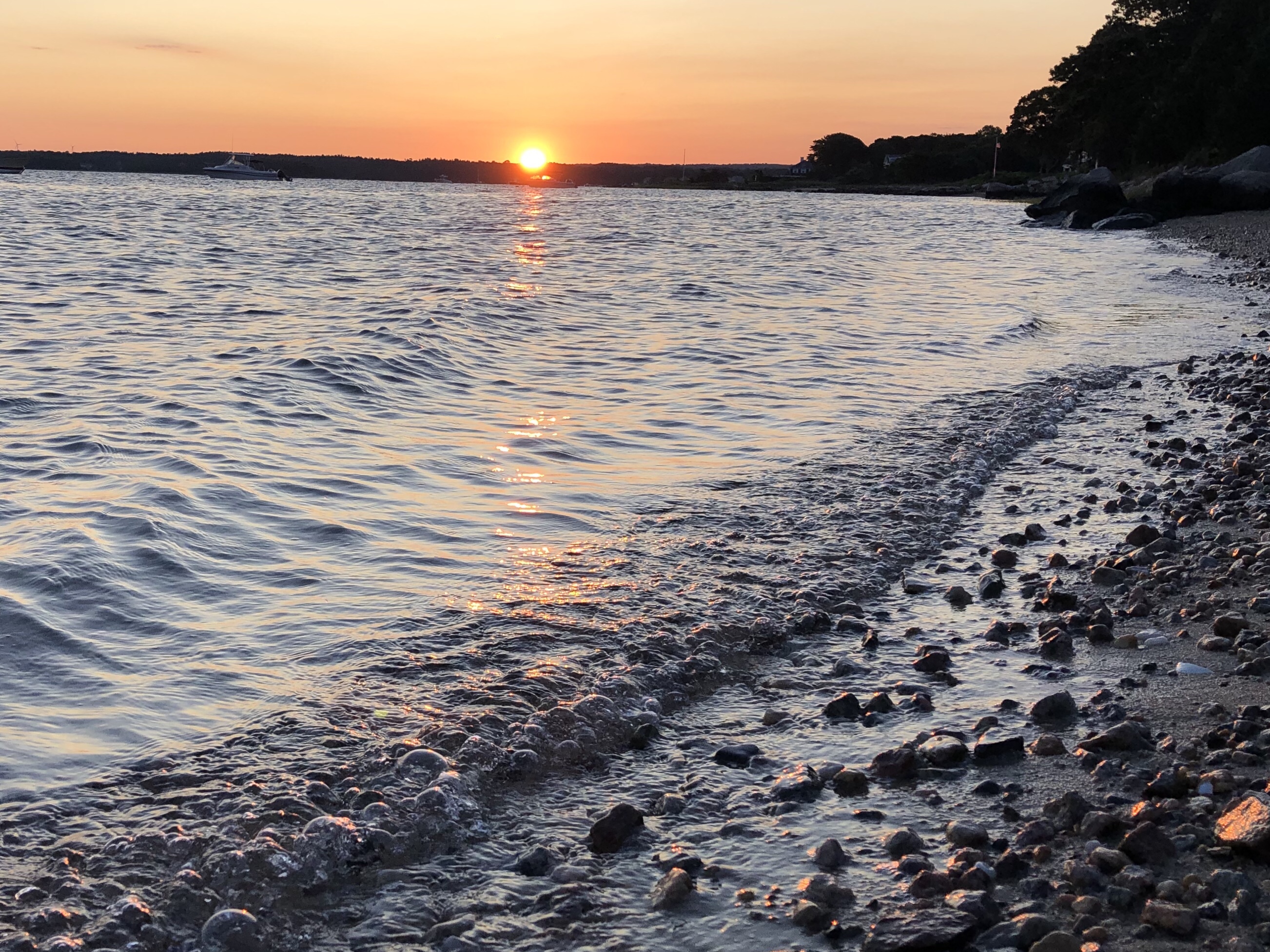
    This morning I stood out on the jetty well before sunrise looking for the pre-event light show. Not much aside from the building gray-to-white-to-orange glow. Limited cloud action and such. As I stood there waiting for the moment I heard the unmistakable momentum of the swells begin building on the rocks and retreated back to higher ground before my shoes soaked through. The wake of some unknown boater from some time before reached the place where I stood. Their ripple intersected with mine and I was the wetter for it.

    Turning around to scan the horizon for my mysterious boater friend, I saw the glint of first orange light up the windows of some house in Marion. They owned the earlier sunrise while I waited for the sun to clear the hills of Pocasset. Turning back to the east I waited out the climb until finally the dark hills caught fire and I became part of the new day too.

    Walking back to the beach I saw footprints and tire tracks below the high tide mark and realized I wasn’t the first one on the beach this morning. Like Robinson Crusoe I recognized I wasn’t alone. Less a shock to me. As the active fishing community here starts their day during my deep sleep stage. I rise early, they rise in the middle of the night.

    I read yesterday that there have been an estimated 107 billion people. I’ve felt the ripple of a small percentage of them, but have been touched by untold others. People I’ve never met, like the boater who’s wake got my feet wet this morning, or the Army Core of Engineers who built the jetty I stood on when it washed over. Or the carpenter who installed those windows betraying the coming sun in Marion. Authors read, and those who influenced them in turn. A chain of 107 billion links; of those who came before and those amongst us still.

    Two cups of coffee later in conversation with a friend who’s ripple has been more profound, we heard the slapping water and boiling sound of a bluefish run right into the beach. Walking down to the water line we watched the swirling ballet of bluefish and fry dance right to the sand and back out again. I saw the reflection of four fry on the sand that had leaped out of the water to escape the frenzy. Scooping them up I flicked them back into the bay one at a time. Perhaps they’ll survive to adulthood and feed some family a year from now. Or avoid that fate and spawn another generation. Impossible to know, but whatever happens to them, it’s one token ripple sent to the future.

  • Rising Above the Sprawl

    I was contemplating the Ramapo Mountains early this morning. I get up early for the magic it brings. This morning didn’t disappoint as the slowly brightening sky highlighted the fog dancing through the hills of Ridgewood State Park. That there’s a highway, gas stations, bus terminal and assorted strip mall horror below this didn’t change my focus on what was beautiful, though I remained aware of the encroachment. There’s really no other way to move through this life – focus on the good, pragmatically manage the not-so-good.

    “God never made an ugly landscape. All that the sun shines on is beautiful, so long as it is wild.” – John Muir

    My drive down here Sunday involved miles of choking, soul-crushing traffic. Playlists and podcasts only go so far in the face of this. Most every car was filled with people coming from or going to something more beautiful, be it family or vacation or a day at the beach. And yet our collective journeys brought us all to the ugliness of gridlocked highways. Surely there’s a better way.

    Society pivots over time. At one point someone pushed for the protection of the forested hills of the Ramapo Mountains, saving them from a carpet of condos or some other indignity. Ridgewood State Park was born the same year I was. Now 53 years later I’m drawn to the very hills that inspired their protection. Good things can happen if we work at it. There’s talk of electric cars and Musk’s transportation tunnel and other such miracles of technological advancement. Perhaps it will transform our highways and cities from gridlocked misery. Society is slowly… slowly, pivoting.

    These hills around me are a good reminder of what preservation can do to protect us from ourselves. Sometimes we don’t see the forest for the trees. We know we shouldn’t eat the French fries but we eat the French fries. We know we should build clean and sustainable infrastructure and we build wider highways. The contrast between the transportation infrastructure below and the cooling green of the Ramapo Mountains above is a striking reminder of what’s possible if we’d only work at it.

  • The Loon Comeback Story

    Early this morning I was reading in the backyard when I heard something I’ve never heard in twenty years of living in this place; the distinct call of a loon as it flew over the house.  In my lifetime loons have always been rare, and usually you’d find them up on the relatively quiet northern lakes.  The first time I heard a loon was on First Connecticut Lake up in Pittsburgh, New Hampshire.  I was 23 at the time; far too old to be hearing a loon for the first time.  Interestingly enough that was the same weekend I first saw a moose in the wild (thanks Pittsburgh).  But it remained a rare experience if you weren’t up in the Lakes Region or north.

    Loons, like hawks and eagles, are the canaries in the coal mine for our ecosystem.  When DDT and other pesticides worked their way up through the food chain it killed more than just bugs.  One research article talked about massive loon die-offs in the mid-1960’s related to pesticides and human interference on Lake Michigan.  This was repeated all around the country as attempts to knock out the mosquito population and pests that eat food crops created unintended consequences.  With the ban of the worst of these pesticides and intelligent management of the rest, wildlife started making a comeback.  As the world struggles with the questions of climate change and plastic in the environment, perhaps looking back on the 40-year rebound of the loon population would be a good example of what positive, long-term change looks like.

    The loons have made a comeback.  The population has tripled in the last 40 years from about 100 in 1974 to over 300 last year.  As the population increases nesting pairs move into new lakes and ponds in Southern New Hampshire, making the once rare sound of a loon song increasingly common again.  That loon flying over my house could have been heading to any of the half dozen large lakes nearby, or perhaps one of the many smaller ponds and that flow into the Spicket River.  But wherever it was heading, it was a signal that things are slowly improving for the loons, and for the rest of us as well.

  • The Daily Buzz

    I keep the news at arms length most days, but I’m generally aware of what’s going on in the world.  One headline that’s hard to miss is the distinct threat to the bee population as commercial bees are on the decline due to constantly movement from farm to farm, disease and pesticides take a toll on them.  Add in the threat to native bees as development swallows up wildflowers and we find ourselves in a precarious place.  No bees, no flower pollination.  No pollination no food.  I know I’m simplifying it, but in general that’s the problem we’re facing.

    I have friends who post constantly about bees on social media.  I prefer to plant instead.  If the bee population is suffering, I’m offering up my yard as a sanctuary garden.  I don’t use pesticides as a rule, preferring traps for Japanese Beetles and leaving most of the plants to fend for themselves.  And so this morning, as I sipped my coffee and watch the sweat bees dancing along on the Sweet Alyssum I cast my vote for the New Hampshire bee population.  The butterflies and hummingbirds don’t seem to mind either.  And I’ve made a similar bee and butterfly sanctuary down on the Cape, where the Pocasset garden, a standout well before I got involved, has recently been supplemented with bee balm, Purple Coneflower, and cilantro.

    I’m no expert on bees, but I’m trying to learn a bit more about them.  What I’m sure about is that they could use a little help from people in the form of more flowers, and maybe a little less asphalt and concrete.  It’s not uncommon to see more wildflowers seeded and left to grow on the sides and median strip of highways.  Generally more awareness creates better ecosystems for all of us.  As with everything though, it starts at home.

  • Clean Water or Jobs?

    In 1969 the Cuyahoga River in Ohio caught fire.  It wasn’t the only time – the river had caught on fire at least 13 times in 100 years.  This wasn’t a case of a temporary oil spill sparking a fire, it was a case of a river so polluted that it would just CATCH ON FIRE.  Time Magazine described it as the river that “oozes rather than flows”.  The 1969 fire had one benefit, it was a catalyst for the creation of the Environmental Protection Agency.  People had had enough of disregard for the environment and this gave enough political will for Congress to do something about it.

    Closer to my home, the Nashua River famously changed colors daily depending on what they were dumping into it that day.  There’s a great story in the Huffington Post that describes how the efforts of one woman inspired other to join in to save the Nashua River, once, like the Cuyahoga River, one of the ten most polluted rivers in the country.  When people questioned the reasoning of companies dumping waste into the rivers, which was legal until 1962, one industrialist smugly replied to an employee; “Which would you rather have—clean water or your jobs?”  

    The Nashua River flows into the Merrimack River, which flows into the Atlantic Ocean.  Cities like Lowell, Lawrence and Haverhill, Massachusetts tap into the river for drinking water.  I still remember when I went to college in Lowell in 1984 and first smelled the water.  It was a smell you got used to, but it wasn’t comforting.  And that was almost twenty years into the cleanup of the Nashua River and other upstream tributaries.

    The Housatonic River is a Superfund site because GE dumped PCB’s into the river for years…  after all, it was legal to do so, and what would you rather have – clean water or jobs?  Onondaga Lake in Syracuse was considered the most polluted lake in America because of a lovely combination of human sewage and Honeywell PCB’s and other chemicals being dumped into the lake.  Boston Harbor was considered the most polluted harbor in the country back in the 80’s until a massive cleanup effort and the Deer Island Wastewater Treatment Plant finally began operating in 2000.  So why the hell did we let our waterways be treated so badly for so long?

    There are different categories of disregard for the environment, running from casual disregard to malicious intent.  Most people fall into the ignorant category.  People who throw their trash out the window of their car are no different than the person dumping chemicals into the river.  Their problem goes away, but it becomes someone else’s problem.  Selfish, narcissistic behavior that requires societal intervention ranging from public shaming, to fines to prison time.  Tossing your McDonalds bag of trash out the window might make your car cleaner, but it’s an eyesore for the rest of us.

    Not in my backyard.  It doesn’t matter that the river is bright orange as long as I’m not tapping into it for drinking water.  It doesn’t matter how many PCB’s are flushed into the lake because I don’t live on that lake.  Its okay to have more coal burning power plants because I won’t be around when the planet is a vast wasteland.  It’s okay if we erode the power of the EPA because shareholder value increases when enforcement gets swept under the rug.

    I had a roommate in college who got all of the people in the apartment together at the beginning of the semester to agree to a dirty dish enforcement policy.  If your dirty dishes where left on the counter or in the sink instead of cleaned after you made a meal the dishes were put into your bed.  This proved to be surprisingly effective, because it was hard to ignore a pile of dirty dishes piled on your bed.  It’s easy to ignore things until it directly impacts your quality of life.  That applies equally to a pile of dishes as it does for a polluter or litterer.  There’s a great video of a person sweeping the road when someone throws their trash out the window right at the feet of the person sweeping.  Another guy sees this, walks up and borrowed the broom and dustpan, swept up the trash that was just dumped out and dumps it into the car of the litterer.  It’s viral because most of us would love to do that to the person dumping the trash.  It’s the equivalent of putting the dirty dishes in the bed of the offender.  I’m all for taking the CEO of GE or Honeywell and having them swim in the Housatonic River or Lake Onondaga, or taking those PCB’s and dumping them in that CEO’s pool.

    The world is a fragile place.  We only have the one planet, but there are too many people who think the world is flat, that climate change is a scam or political ploy, that jobs are more important than clean water.  When Marketing genius Seth Godin proposed changing the discussion point from “Climate Change” to “Atmosphere Cancer“, there were some indignant bloggers whining about the insensitivity towards people with cancer.  They completely missed the point as usual.  At one point when the Cuyahoga River caught fire and the Nashua River flowed a different color every day we reached a critical mass of people who said enough is enough – we don’t want orange rivers or rivers of flamable sludge.  We don’t want to be forced to wear a pollution mask when we take a walk.  We’d like to have things like coral reefs and glaciers and plastic-free oceans.  The race is on, will we reach the resolve needed to course correct, or will we slide into Exponential View’s Climate Calamity.  The choice is ours.