Category: Exercise

  • This Will Be Our Year

    Now we’re there and we’ve only just begun
    This will be our year
    Took a long time to come
    — The Zombies, This Will Be Our Year

    Normally I take time to assess the best memories or the favorite stuff accumulated to wrap up a previous year in the final days leading into the new year. This year, other than listing a collection of books read, I am far more inclined to put 2021 to rest and get on with living. I imagine I’m not the only one in that respect.

    So how do you set the table for a great year? We’ve covered some of this already, deciding what to be and go be it is a good attitude to begin with. To realize it, you’ve got to act on it. Book the trip, block off the vacation time, commit to the athletic event, reserve the campsite or the trail hut and you’re halfway there. In some ways you’re forcing your own hand. Or you can look at it as making a commitment to your future self. It’s a high agency way of taking your life in your own hands and not just going with the flow of random events.

    Booking it naturally starts a countdown to arriving at the moment you do it. A to-do list immediately accumulates. Want to run a marathon or hike the Presidential Traverse in the White Mountains? You’d best get in shape before you set off, buddy. The world doesn’t need another unprepared fanatic hitting the starting line. Commit and begin the incremental climb to fitness so you can actually finish what you most want to start.

    Is it that simple? Of course not, but you’re far more likely to do it if you place a financial and time stake in the ground and then give yourself just enough runway to take off. You can’t commit to something so far off that you lose focus on the goal, but it can’t be so short that you aren’t ready when you arrive. Plan, then execute on that plan in a carefully measured number of workouts, vacation days, or paychecks. Use time and money to help you arrive, not as an excuse for not going at all. We become what we prioritize.

    The big moments await your commitment. Put a stake in the ground at the end of the runway and gather some momentum. It’s time to soar.

  • Decide What to Be and Go Be It

    What do we make of this last day of the year business? What do we make of any day, really? 2021 was a tough year, just like 2020 was, but looking back there was still some epic in-country travel, there was still some great hikes (fewer than I’d have liked), there was still time with family and friends of consequence, and there was still productive output in the work I choose to do. Does that make it a bad year? It’s very hard to string together 365 great days, but just as hard to string together 365 bad. Shouldn’t we acknowledge each for what they are? Good or bad, each day carried us to here, and another chance to make a go at it tomorrow. It’s just life.

    So what do we do with the compass and the map on the last day of the year? Do we be so bold as to make big plans? Do we settle into more of the same? Resolutions are like fortune cookies; a thrill of possibility in a stale pastry of will to follow through. Empty promises, empty calories.

    Better to choose the small stepping stones of habit formation that bring you to where you want to be. Streaks are the only thing that work for me. Check the box with whatever measure is the bare minimum for you on writing or exercise or learning a language or reading more books than you did last year. Try to do more than the bare minimum but keep the streak alive.

    December 31st is just another day, just like January 1st is. Every day we get to reinvent ourselves, every day is a journey to becoming. It’s simple, really, when you think about it. Decide what to be and go be it.

  • 4 Steps to Actually Achieving a Goal

    “To achieve a goal you have never achieved before, you must start doing things you have never done before.” – Jim Stuart, The 4 Disciplines of Execution

    We’ve reached that time of the year again, when people start listing New Year’s resolutions and thinking about life goals. I don’t believe in once-a-year resolutions, but I’m a big believer in maintaining strong habits and positive streaks. I write every day so that I don’t break the streak. Simple. Easy to understand. Achievable. There are days when I don’t even have a coffee but still manage to write. So how do we apply that to the rest of our lives when there’s just so much on our plate already? Apply the four principles from The 4 Disciplines of Execution to our personal lives:

    “The principles of execution have always been focus, leverage, engagement, and accountability.”

    Let’s face it, the reason we don’t finish New Year’s resolutions is because life gets busy again. It’s easy to make grand plans when you’re taking a few days off around the holidays. It’s a lot harder to maintain them when the craziness of life kicks back in. The 4DX authors call this the whirlwind. We all have a lot to do in our day-to-day, and that makes sticking with a new habit challenging. It’s not a part of our routine yet, and the routine is what gets us through our crazy days.

    So what are the four disciplines for executing on your goals?

    Discipline 1 is focusing on one or a maximum of two goals. More than that and you lose focus and face diminishing returns. At that point you get lost in the whirlwind and it’s all over. The 4DX authors calls this a Wildly Important Goal (WIG).

    The fundamental principle at work in Discipline 1 is that human beings are genetically hardwired to do one thing at a time with excellence.

    Discipline 2 is to act on the lead measures. This is an important distinction from what most people do. We all tend to focus on the lag measures: What does the scale tell me? What did we sell yesterday? Did I finish writing the book by December 31st? Lag measures are important indicators of achievement, but they don’t move the rock. You need a lever to move it, and that’s what lead measures are. Instead of focusing on how much weight you lost today, focus on what you put in your mouth. Focus on how many steps you walk today. These are lead measures that move the lag measure over time.

    “A good lead measure has two basic characteristics: It’s predictive of achieving the goal and it can be influenced by the team members.”

    Discipline 3 is the discipline of engagement. This is getting things done. What things? The lead measures of course! Eat the broccoli and move more! Find creative ways to fit it all in when you’re caught up in that whirlwind of your day-to-day. But in order to stick with it you’ve got to maintain a scoreboard to track yourself. Without it you’ll get lost in the whirlwind. Remember that writing goal I had? The scoreboard is the stats. I can see clearly that I haven’t missed a day in three years and don’t want to break the streak, even when I don’t feel like writing.

    Discipline 4 is creating a “cadence of accountability”. Find a support group that keeps you on track. Weight Watchers is successful because it’s based on a weekly cadence of accountability. Find people who will give you a nudge when you aren’t meeting your lead measures.

    “The magic is in the cadence. Team members must be able to hold each other accountable regularly and rhythmically.”

    The book is focused on the very real challenge of getting a team to focus on achieving a wildly important goal that makes a significant impact on an organization. But the same principles apply in your personal life. Decide what you want to be exceptional at and what the lead measures are to move you along every day towards that goal. Then make a scoreboard that speaks to you (it can be as simple as checking the day on a calendar when you do what you said you were going to do). And then build a support structure around yourself to help keep you accountable.

    Execution on an important goal isn’t complicated, but it also isn’t easy. These four disciplines can help keep you on track in the face of the whirlwind. Just imagine how fun actually accomplishing that goal will be!

  • A Coastal Walk in San Francisco

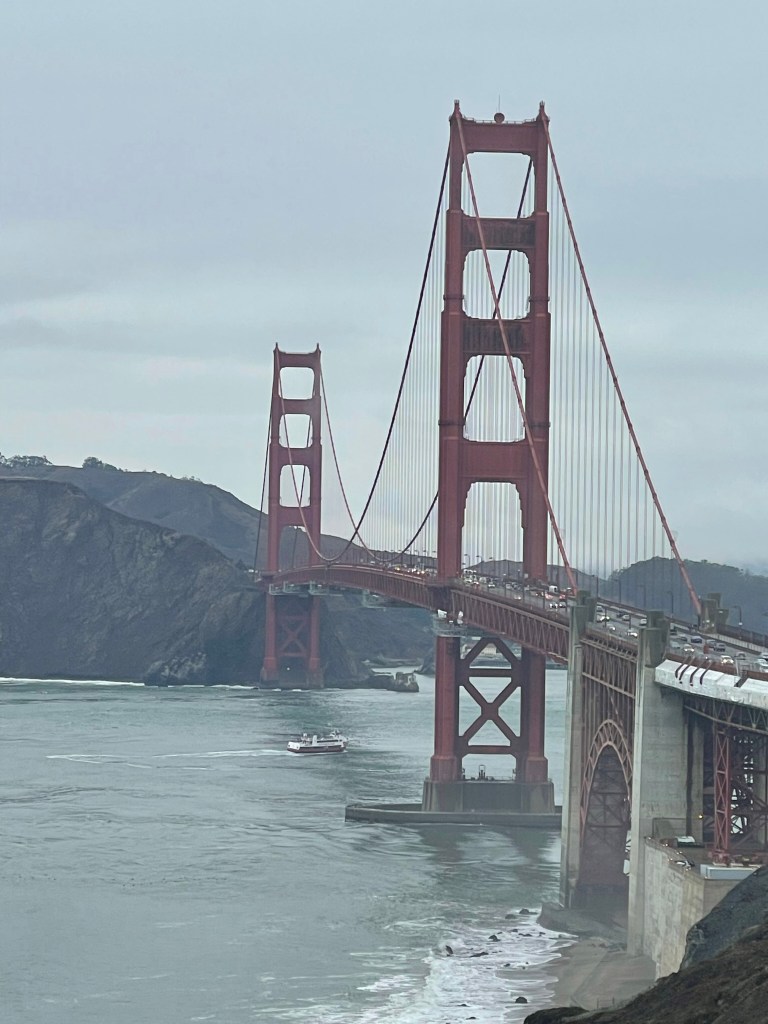
    San Francisco is known for many things, but the Golden Gate Bridge has to be near the top of that list we make in our heads. Without being a tourist checking boxes, shouldn’t you try to see the sites that make a place unique? But seeing doesn’t have to mean doing what everybody else does.

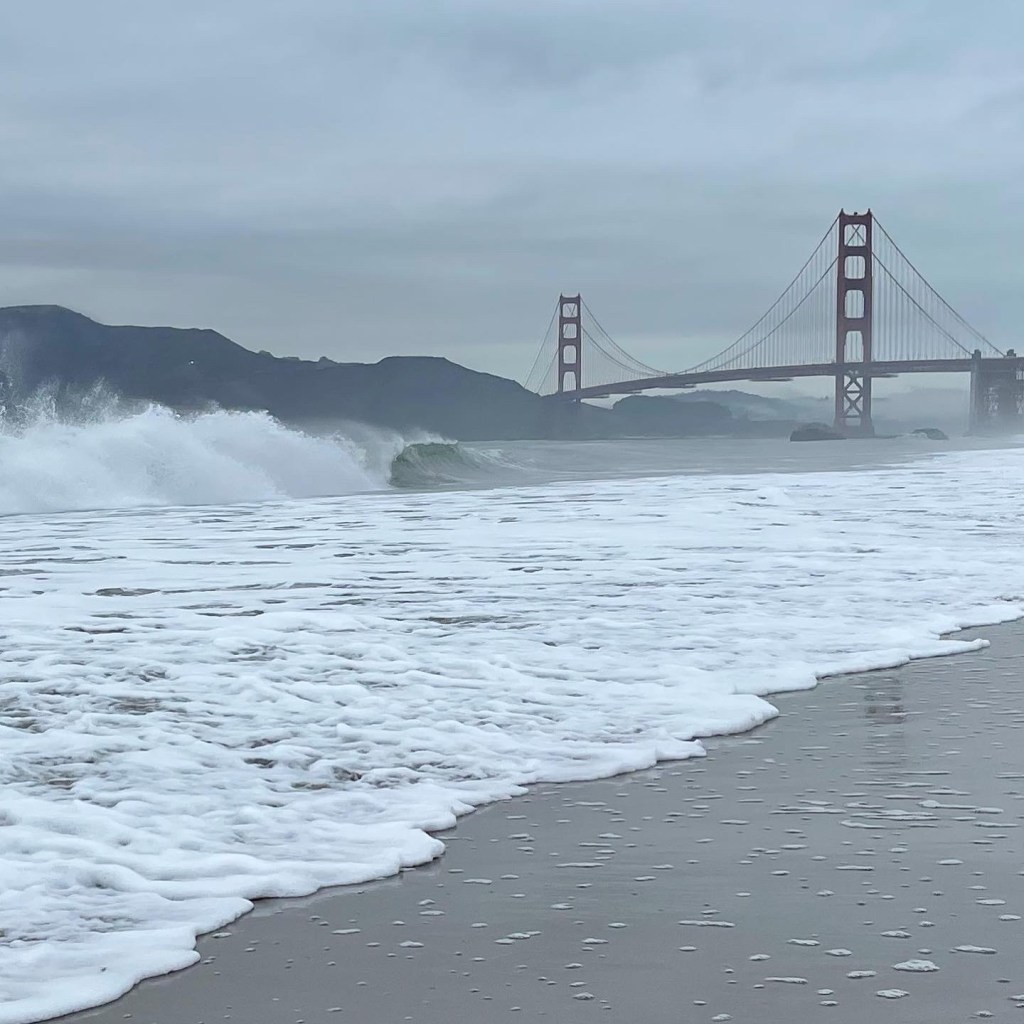
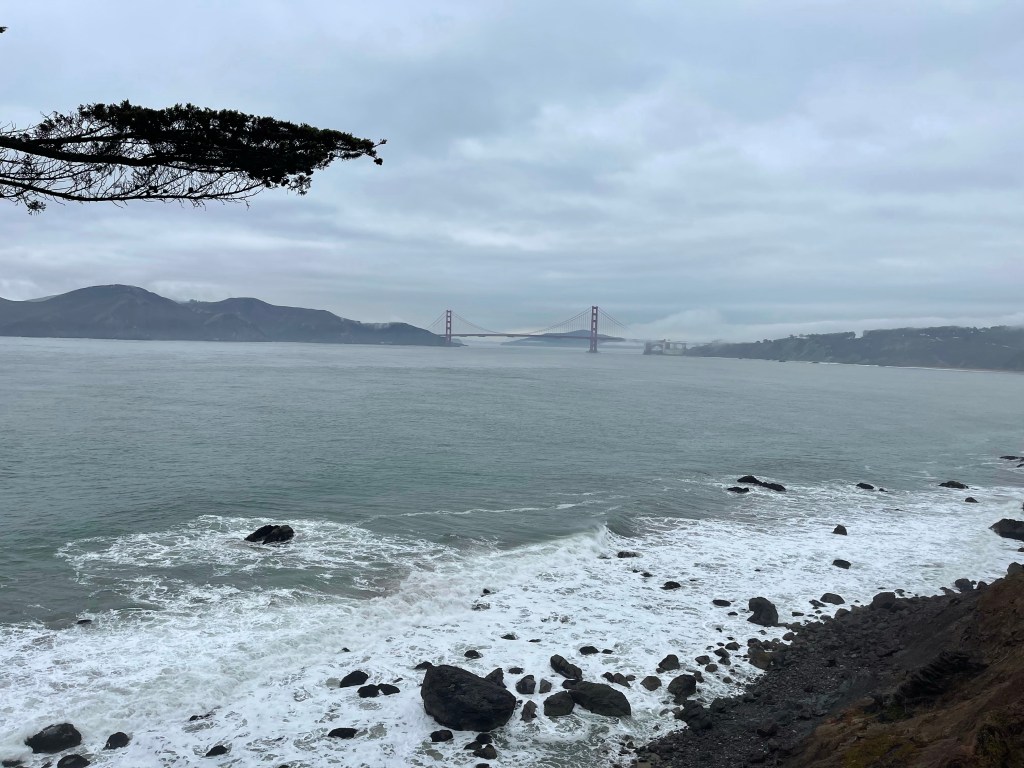
    So how do you see something as famous as the Golden Gate Bridge in a different way? You let it come to you gradually. The perfect way to do that is with a walk from Lands End to the bridge. This walk takes you along a diverse landscape of rocky cliffs, spectacular beaches with crashing surf, high end neighborhoods, past defensive fortifications dating from the world wars and finally to the bridge itself.

    You can Google the route and map it out neatly, but maps only offer a one-dimensional view. Even Street View, for all its delights, can’t convey everything. You don’t experience the clumpy clay in the sand after a light rain, or the shear cliffs that claim the lives of the careless adventurers looking for that perfect vantage point, or the spa-like aromas emanating from the wet flora, or the cheap plastic Halloween decorations adorning multi-million dollar homes. No, you’ve got to walk it to experience these things.

    The walk itself is a good workout, with a lot of climbing and long stretches on soft sand, but it’s not the Appalachian Trail, you can get by with a moderate fitness level and good walking shoes. The bridge and the roar of crashing waves will be your constant companion. Were it not for the bridge you might think you were in another place.

    The bridge comes at you from different vantage points. One of those vantage points is mental. We can all visualize the Golden Gate Bridge in our minds. So it can be invigorating when you see the real thing. It was thought impossible to build by many, but 84 years after opening she looks as good as you imagine she would.

  • A Place for Consistency

    Two weeks goes by so very quickly. If you don’t prioritize exercise you might find that the days slip by without really doing much of anything. But when you do focus on exercise, what can you accomplish in so short a time? Two weeks ago I decided to find out.

    I chose to row 5000 meters per day at 75-80% intensity. The first row reminded me that I hadn’t done it for some time, but I was patient with myself anyway. The second row reminded me that I know how to do this when I put my mind into it. And so it progressed with each row, as I relearned the rhythm of the stroke that has been with me since I was 18 years old. It works out to be roughly 500 strokes each workout, which doesn’t sound like a lot until you push yourself through them.

    And then I traveled, visiting seven states in three days. I was concerned I’d broken the habit of exercise and blown up my fortnight experiment. But I came back and hopped on and told myself to just get through it no matter what. And I hit broke my previous times during the previous streak. There’s a place for rest in your exercise routine. And there’s a place for consistency.

    The entire point is to establish the habit of movement. To pick something you love and maybe hate just a little and get after it consistently, no matter what your mind comes up with as an excuse. I used to travel a lot, so rowing was problematic for me. Then the pandemic hit and in theory I should have been rowing every day for 18 months. It turned out to be far less consistent, but I chose hiking, long walks and swimming laps as my go-to’s. Not rowing but still productive motion.

    When you do a specific exercise almost every day you learn to listen to your body instead of your mind. Your body wants to be in motion, the mind wants to be left alone. At least until you trick it into believing something within you is incomplete until you get back to it, today. And every subsequent day too.

    Today I begin another business travel journey. I know I can’t row during that time, but I can jump right back onto the erg when I return. Or not… the choice is ours, isn’t it? I have a streak to break on my next fortnight of exercise. Best to get right to it as soon as I can.

  • A Fortnight of Motion

    “The job of feets is walking, but their hobby is dancing.” – Amit Kalantri

    “When we breathe, we expand our life force.” – James Nestor, Breath

    There’s no secret to the key to life. Keep moving. Water stagnates when it sits still for too long, and it’s the same for our bodies. So keep the river flowing. Moving is the key to good health. Circulating the blood, getting the oxygen moving in and out of our bodies, flushing toxins out of our system through motion. We all know this, but still catch ourselves parked on our asses for hours at a time. Get up and move already!

    We all find ourselves in situations where we can’t hike or swim or dance, but we can always move. We can always breathe deeply. So why do we forget to do it? Our bodies will rest plenty in our eternal sleep, why get a head start on it?

    With all this in mind, I’ve begun a fortnight of motion. 14 days of focus on exercise, breathing and better nutrition. Two weeks are long enough to make it a challenge, but short enough to stay focused. As a rule, I don’t like writing about what I’m going to do. The world is full of people who make promises they’ll never keep. But accountability is a key for success in any endeavor, so a fortnight challenge provides a clear timeframe to put up or shut up.

    Exercise takes many forms. I happen to have the tools for better fitness available. A Concept II rowing ergometer, kettle bells, free weights and good walking shoes. The thing is, I had all of these tools yesterday too, but didn’t use them.

    Use them.

    And then write about it.

  • A Hike to Waterville Cascades

    This hike was meant to be a compromise to myself. No salt water weekend, no longer hikes to knock off another 4000 footer or three. But still spectacular, still a light workout on a beautiful trail, and the real payoff; seven waterfalls in a relatively short span.

    I had my doubts. You walk to the trailhead at Waterville Valley Resort and see right away that this hike is going to start between the road and some of the village condos. But you cross a road and leave most of that behind you. From then on you are hiking a pleasant trail to the first waterfall and not really seeing many people (for me, a Saturday afternoon).

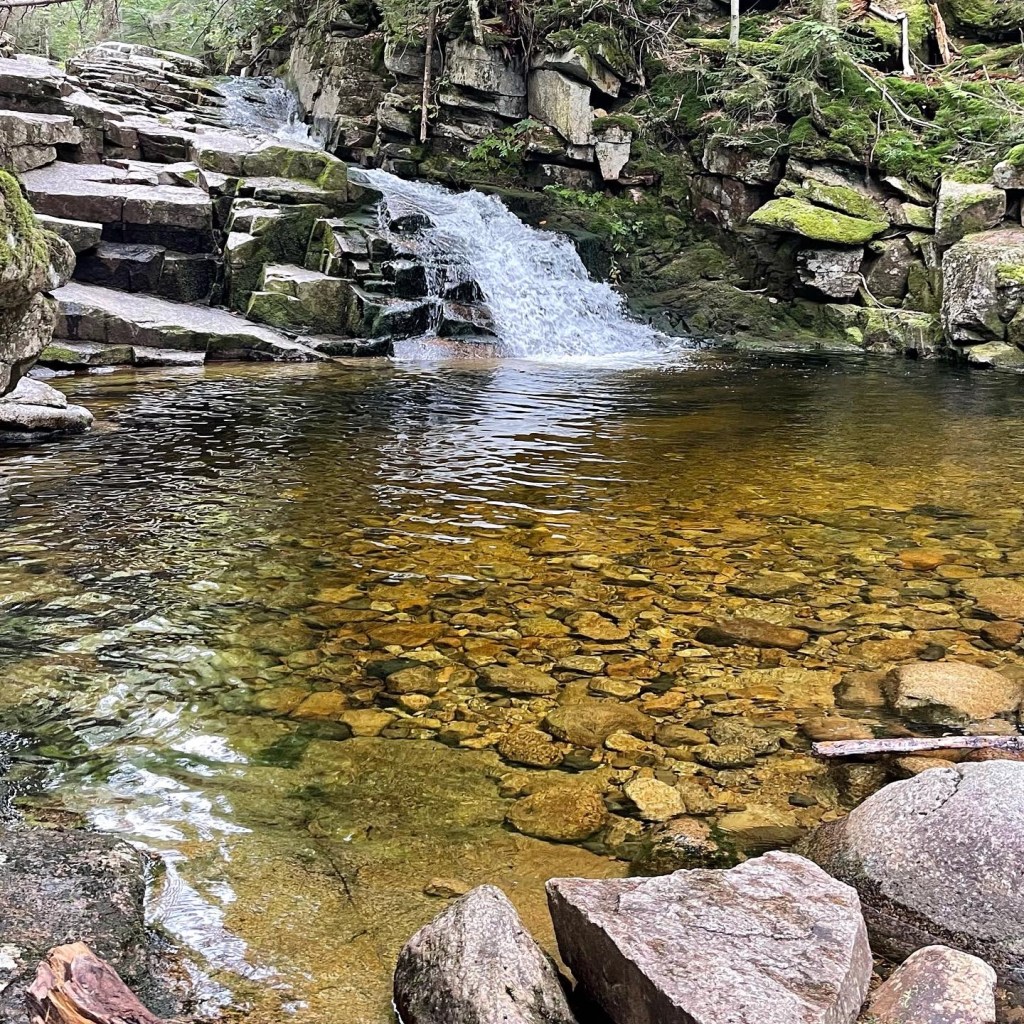
    The Cascade Trail is a 3 mile round trip to the Waterville Cascades. The silence of the forest is notable and welcome. You quickly forget that you’re in close proximity to a ski resort, and instead immerse yourself in hiking relatively pristine second growth forest that wraps itself around you and shuts out the outside world. Before you know it the hike brings you to the first cascade on Cascade Brook, a series of seven plunges that feel bigger and more remote than they really are.

    But there are reminders of the alternative paths to the falls. We met a group we’d seen in the parking lot that opted to ride the chairlift up instead of hiking. We spoke to another couple of guys on mountain bikes who had ridden up to the falls to soak in the swimming holes. Both conversations reminded us that there were other faster ways to reach the cascades than hiking. We saw sad proof of this when we passed a pyramid of empty Bud Lite cans that some fools had stacked alongside the brook. Without a backpack for this short hike I had to leave this mess for someone else to deal with. Not everyone who ventures into the woods leaves them as they found them. This is the price of proximity.

    But the falls themselves were each wonders, and we celebrated the unique beauty of each as we climbed higher and higher up the trail. When you reach the last big cascade there’s a bridge for a mountain bike trail that you can cross to descend the other side and return you to the Cascade Trail and your hike back down.

    I’m interested in how people meet the falls. Some are reverent and respectful, some more nonchalant about the experience. I think it’s relative to how much work you put in towards reaching them, and the path you chose for yourself. But that may seem dismissive and smug when a hiker says it. More specifically, it’s not the work you put into reaching it, it’s how your attitude when you reach it that matters most.

    The work-to-reward ratio of the Waterville Cascades makes it an easy choice. The proximity of that resort comes in handy for lunch or dinner and a restroom afterwards. The entire experience reminds you that finding beautiful in this world isn’t all that hard if you just put yourself out there to meet it.

  • When We Walk

    “When we walk like (we are rushing), we print anxiety and sorrow on the earth. We have to walk in a way that we only print peace and serenity on the earth… Be aware of the contact between your feet and the earth. Walk as if you are kissing the earth with your feet.” – Thich Nhat Hanh

    “When we walk, we naturally go to the fields and woods: what would become of us, if we walked only in a garden or a mall?” – Henry David Thoreau, Walking

    I’ve been walking on pavement too often recently. The mileage is good but the spirit is muted. Your feet have a hard time connecting you to the earth when there’s three inches of asphalt separating you from it. Still, walking on asphalt is better than being indoors all day, and to be honest, I’ve experienced too much of that lately.

    One recent walk took me along the Cape Cod Canal for six miles. Visually it was striking with a parade of yachts and commercial vessels streaming past on a particularly busy day. And the company was certainly good. But that connection to the earth was missing on those paved bike paths.

    Maybe walks on pavement are better than nothing, but like Henry I wonder what becomes of us when we aren’t off in the fields and woods. The more we connect our feet to the earth and cover ground the more we hear our own voice. Walking flushes the toxins out of your body and soul. Sitting all the time, as we do these days with our desk jobs and a return to commuting robs us of that flushing and the ick pools up inside of us until we once again get up and out.

    Today is a good day for a walk.

  • The Great Falmouth Drop-Off

    Every year, except for last year, I find myself crawling along in a traffic jam just after dawn, patiently waiting for an opportunity to drop off a car full of runners for the Falmouth Road Race. As a committed non runner, it’s admittedly an odd position to put myself in. But we do what we must for those we love.

    The Falmouth Road Race was established in 1973, beginning at one bar and winding seven picturesque miles along the coast to another bar. It quickly became a destination race for a mix of international runners, including Olympians and elite runners, but largely recreational runners of varying abilities. That bit about beginning at one bar and ending at another is an important piece of information. For it means moving thousands of runners from one place to another at the beginning of the day. Which brings us to the great drop-off.

    Runners gather at the Lawrence School in Falmouth for the bus ride to Woods Hole for the start of the race. Runners are supposed to be at the school by 7 AM, which creates a crush of traffic most years as those seeking a parking spot mix with those dropping off runners. Add in thousands of runners walking from local homes and inns and you’ve got a recipe for gridlock as all navigate the local neighborhoods in this small town.

    2021, with a reduced number of participants, lightened the traffic considerably, but it didn’t eliminate it. This is the price you pay for participation in a great race, with both a local and international vibe. For all the madness, everyone is there to have a good time on a summer day.

    After dropping off runners spectators strategically position themselves at key viewing spots. My preferred location gives me a chance to see my favorite runners twice: just after the 6 mile mark and again at the finish. Don’t tell anyone though, it’s already getting pretty crowded here. With COVID considerations addressed, isn’t it nice being around people again?

  • No Likeness to That Human World Below

    You ask me:
    Why do I live
    On this green mountain?
    I smile
    No answer
    My heart serene
    On flowing water
    Peachblow
    Quietly going
    Far away
    Another earth
    This is
    Another sky
    No likeness
    To that human world below
    ~Li Po, On The Mountain: Question And Answer
    (translated by C.H. Kwôck & Vincent McHugh)

    Three days later and I’m still on a mountaintop. The aches and pains fade but the glow of walking the ridge line between peaks stays with me. And I wonder at this world I’ve created for myself, pressed in close to a desk, laptop at the ready, always asking for more. The mountains don’t ask for anything of you, but it’s understood that they demand respect.

    Solo hiking, for all the social abuse I receive for it, offers meditation and a connection to the mountains that you don’t get with even the quietest, most reverent hiking buddy. So occasionally I like to indulge in time alone on trails, walking until my own voice finally stops talking to me and I begin at last to listen to the song of the infinite.

    Yet you’re never quite alone in the mountains. There’s always a fellow hiker on a pilgrimage of their own, with a knowing look and a brief exchange before turning their attention back to the trail. The mountains aren’t entirely about solitude, for there are more people than ever on the trails. And every one of us with a reason for being up there.

    There’s an energy that you draw on when hiking with others. A momentum of common purpose, shared struggle, and shared beliefs. I do like hiking with others, quite a lot, and look forward to sharing the mountains with them again soon. Just give me a moment alone with this sky before I reluctantly descend to that human world below. Where I’ll plot my return.