Category: Fitness

  • Unbroken Snow & Writing

    There are different kinds of snow, and different kinds of snowshoeing. Snowshoe hiking up a mountain is very different than snowshoeing across a snow-covered field. Like walking on these terrains when there’s no snow, there’s a certain tactical change that develops with each. Hiking up a mountain, there’s a unique relief in flipping up the heel lifts on snowshoes to level your foot to the incline that you naturally wouldn’t feel on flat terrain. There’s also a wholly different intensity in grinding up an unbroken mountain trail. Steep terrain and unbroken snow are a workout. For me it’s a bit like technical writing, you know the payoff will be big but in your lowest moments the effort feels like it isn’t worth it (it’s almost always worth it).

    Flat terrain snowshoeing is a different story altogether. Easier, in a lot of ways, but that ease releases you to explore more than you might on something more technical and demanding. But that very freedom can force people to stick with the formula of the familiar. Why be uncomfortable in breaking new ground? Because that’s where things get most interesting!

    There are times when you’ve got to stay on the path. Inevitably, you’ll begin on broken ground: trails that lead from a parking lot to open fields, or woodland trails that must be honored before you reach open space. There’s an obligation, unsaid, to help groom the trail by tamping it down with your snowshoes. We do our part, but it feels like paying penance, and you look ahead to where you might break free. The very unevenness of the broken trail is what makes it a chore. Compacting broken snow means staying in your lane, taking what others have left for you and finding a path through it. Broken snow, especially when regular walkers use the same trail, exposes boulders and roots and ruts that lead to post holing on the trail. There’s a certain satisfaction in tamping down the brokenness, akin, in a way, to editing a sloppy bit of writing.

    But the real fun begins when you find an opening to fly. A small break in an old stone fence that leads you to a virgin field of unbroken snow, or a wide open field with a single broken path going across it each whispers, “It’s time: FLY!” and gives you the opportunity to break from all expectations and obligations and just go for it. Like a plane freeing itself from the obligation of the runway, launching yourself into unbroken snow is freedom. It’s just you and the snow, and you can go in any direction you want.

    Writing can feel very much the same. You chafe at the obligatory structure, you get caught up in the rules of punctuation and order, you try to clean up run-on sentences and spelling errors and the like as you go. But to really fly with writing you’ve just got to just launch yourself into it, technique and order be damned, and just see where it takes you. Inevitably to places you never imagined when you started. If you truly let yourself go you don’t worry about editing the broken trail you leave behind you. There’ll be time for that another day. No, this is your time to take wing.

    If you’ll forgive me another analogy about snowshoeing and writing, it’s the conditioning. When you haven’t been out on snowshoes in a while you forget the pace and rhythm and become a bit breathless. When you do it every day you quickly find your pace and rhythm and just get right to it. It becomes natural–a part of you. And when you reach that point you can cover so much more ground than you would otherwise. The lesson, of course, is to get to it every day.

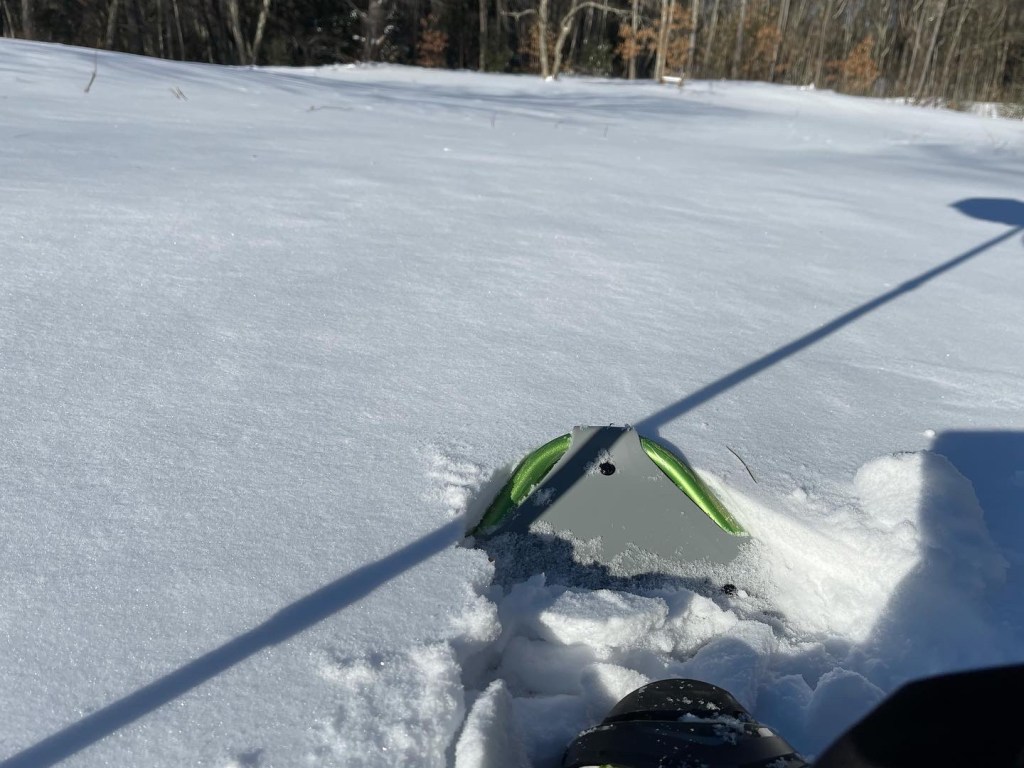
    The obligation of the broken trail
    The freedom of unbroken ground
  • Finding Balance in a Hot Tub in a Blizzard

    The forecast called for a blizzard, and officially it met the requirements to be called one in some places. Not so much where I call home. But a significant storm nonetheless. A storm you take seriously. A storm you hunker down in. A storm in which an adventurous spirit might look out at the hot tub and think to oneself, “I’m going in, now”. And fancying myself so, I changed into a bathing suit, slipped on my adidas slides, a cap and the warmest shirt I own and headed out into the swirl.

    Taking a broom with me, I swept a path through the 4 inches of light accumulation to the tub, swept off the cover, opened the tub and took a deep breath. Off came the warm shirt and the tickle of snow landing on my back greeted me immediately. Stepping out of the slides into the 39 degree Celsius/103 degree Fahrenheit water, I felt the sting of fast-frozen toes meeting heat. I quickly brought my other foot in for the party and dropped down to chin level to warm myself.

    Immersing yourself in hot tubs (or hot springs) is supposed to improve your health in several ways. First, it puts you in a state of weightlessness, easing stress on your joints and relaxing muscles. But it also improves cardiovascular health and helps lower your blood pressure. The jets in a hot tub offer some massage for those sore muscles. But mostly a hot tub draws the stress out of you and plunges you into a relaxed state.

    That state change is most obvious when you’re sitting in hot swirling water in a snowstorm, with the steam rising up to meet the snow as it swirled down to reunite with the water. That’s some extreme swirling, to be sure, and with your head places squarely on the line between chaos and order, Yin and Yang, you have a front row seat for the dance. Too much in either direction and you’ll freeze or drown. Choices. It was life, amplified, in the splurgy decadence of a hot tub in a blizzard.

    The fine snow accumulated all around me, coating all cool surfaces. I felt it landing on my exposed skin, sliding down to greet the hot water or melting in surrender to the warmth of my body. But the snowy assault kept on relentlessly. My knit cap, my eyelashes and nose collected snow. The line between chaos and order is very thin in such conditions, and I delighted in the opportunity to be right there. Nothing else mattered in that moment.

    But all good things must end, and at some point you’ve got to brace yourself for the retreat from the hot tub through the swirling snow to the warm house. This is best done with purpose, and I reached up and shook off a towel, quickly stood and wrapped my shoulders and reached for my wool shirt, shook that off too and replaced the towel with the cold shirt as I got up. I offered the adidas a dip in hot water to clean off the snow and slipped them on.

    It was all a choreographed dance on the edge of chaos, and I loved it without lingering. Buttoning up the hot tub and walking through the accumulation was my penance paid for the indulgence. Still radiating heat, I shuffled back to reality while scheming a return.

  • January is Waiting

    “I wonder how long it would take you to notice the regular recurrence of the seasons if you were the first man on earth. What would it be like to live in open-ended time broken only by days and nights? You could say, “it’s cold again; it was cold before,” but you couldn’t make the key connection and say, “it was cold this time last year,” because the notion of “year” is precisely the one you lack. Assuming that you hadn’t yet noticed any orderly progression of heavenly bodies, how long would you have to live on earth before you could feel with any assurance that any one particular long period of cold would, in fact, end?” — Annie Dillard, Pilgrim at Tinker Creek

    Lately I’ve been watching some Lonewolf 902 YouTube videos of winter camping with a hot tent. I’ve done a bit of winter camping in my time, with an old sleeping bag sprinkled with ember burns to prove it, but not recently. I don’t see myself hauling a titanium stove through the woods of New Hampshire and cutting up dead standing timber for firewood anytime soon. But his adventures northeast of me in Nova Scotia and Cape Breton Island are stirring the imagination once again. It’s time to get back out there.

    You might feel the cold, and might even experience the snow when you stay put in your nest. But you just don’t become a part of the season without being immersed in it. January, by all rites, offers cold, short days. I’ve noticed that I don’t notice as much when I don’t get out in it. Without a dog to walk in the cold night, I don’t watch the celestial dance across the sky. Without gathering my hiking gear and heading north, I don’t feel the sting of winter or the snow blindness of brilliant sun on frigid snow. What fun is January if you aren’t out in it?

    “Sunshine is delicious, rain is refreshing, wind braces us up, snow is exhilarating; there is really no such thing as bad weather, only different kinds of good weather. ” — John Ruskin

    January is the month when you begin to go stir crazy if you aren’t active enough. The best remedy is right in front of us—bundle up and get your ass out there. The magic of snow and ice and crisp air won’t last for long. You must go to it, prepared, if you want to experience the exhilaration of winter. Melancholy is for those who would shelter indefinitely. Nothing breaks the hold of the winter blues faster than embracing winter. So get out and experience all winter offers! How many more do you expect to have? Appreciate the gift that this season represents.

    January is waiting… but it’s slipping away.

  • The Incremental Path

    What might we accomplish in our brief time here should we apply ourselves towards it? Is accomplishing itself a worthy pursuit, or is experiencing the better path to walk down? I believe in fully experiencing life, but without setting a course and working diligently towards a calling who are we but sheep waiting to be sheared?

    I wrote about this of reaching for excellence recently, and perhaps write about it too frequently. But a blog is a sorting place of ideas and observations, shared experiences and insights. Since that post, I’ve added some additional habits to the daily accountability list in my pursuit of my own personal brand of Arete. I’m incrementally further along in that time, yet the path to excellence is long. Who says how far down the path I can reach? Does it doesn’t matter as long as we’re progressing down the one that matters most to us?

    Ars longa, vita brevis (Art is long, life is short)

    Don’t look now, but we’re already 2.5% through the year. What was it we wrote down as our resolution for the year? How’s that going for you? Isn’t it fair to ask? Creating that cadence of accountability is the only way to stay on the path. There are few big leaps forward on the journey to excellence, the path is incremental. And what we do next matters more than what we did yesterday.

    Looking back on what I’d set as milestones for this year, I can see that the milestones have mattered in my daily action. Maybe you don’t always feel like brushing your teeth but chances are you do it every day anyway. We know what matters most, but most beat themselves up if they break a streak of working out or don’t lose ten pounds in the first week of a diet. Would you stop brushing your teeth if you missed a day? No! You’d brush them as soon as you got up the next morning! Similarly, getting back on track is all that matters on this incremental path to excellence.

    Even the masters fall short of excellence. Who are we to expect it of ourselves? But when you turn around and see how far you’ve come, you recognize that the path takes you so much further than you’d have come otherwise. And the experiences you have along the way are richer for the pursuit.

  • Scheduling “Accomplishing Great Things” Time

    “A busy calendar and a busy mind will destroy your ability to do great things in this world.” — Naval Ravikant

    The week after New Year’s Eve is when everything hits the fan. People are back from vacations, tasks that were deferred come due, new initiatives kick in, and most people want to start the year off on the right foot with a high level of activity. You want to push hard on the flywheel to regain any momentum you lost over the holidays, and to have a running start for the year ahead. This buzz of activity inevitably translates into a very full calendar.

    You want to get things done, so you say yes to meetings and projects that you believe will carry you to your goals. In the meantime everyone else’s hopes and dreams need to be met with some of your attention as well–maybe a 30 or 60 minute block of time next Tuesday? And this is where those lofty resolutions begin to hit resistance.

    This is the whirlwind that Chris McChesney speaks of in The 4 Disciplines of Execution. The more you can stay out of the whirlwind, the more you can focus on your real priorities. And the more you can do great things in this world. Don’t we want to do a few great things in our time here in this world?

    It feels like the most important thing to do is to simplify. But that’s a convenient buzzword to throw around. It’s easy to say it, but much harder to do in the crush of daily life. The answer, I think, is to book big chunks of time for thinking and working on your top priorities. To jealously guard the edges of your day when you can do the most. I’d rather get up two hours early and write than sleep in. I’d rather spend two hours reading at the end of my work day than turn on the television. Those four hours don’t make it on to my calendar, but they’re often the most productive time in my day.

    If I were to add one thing to Naval’s quote, it would be this: “A busy calendar, an unfit body and a busy mind will destroy your ability to do great things in this world.” For I believe we forget sometimes (I do anyway) that a fit body and a productive mind are related. If we aren’t eating well, drinking in moderation, sleeping well and exercising regularly our minds pay for it. Blocking off time for exercise is as essential to accomplishing great things as giving yourself space to think.

    With that in mind, I’m beginning to use my calendar differently than I used to. I schedule more “accomplishing great things” time. I’m keeping myself accountable by listing and checking off the key priorities in my bullet journal. And I celebrate when I draw a box around my top goals of fitness, nutrition, writing, reading and my top work priority when I can check all of them in a day. My goal is to string together a full week of closing the boxes. This turns busy into productive in a visible way. When I do, I know that I’m on the path to greater things.

  • Starting Over

    “Think of yourself as dead, you have lived your life. Now take what’s left and live it properly.”
    — Marcus Aurelius

    It’s time to spread our wings and fly
    Don’t let another day go by my love
    It’ll be just like starting over
    –John Lennon, (Just Like) Starting Over

    Tim Urban posted a clever image on Twitter that illustrates the concept of today being the first day of the rest of your life. Everything that you’ve done to now is in the past, every decision you made that got you to this place, wherever that might be for you, is in the past. And all that’s left is what’s in front of you:

    Source: @waitbutwhy

    New Year’s Day represents that for a lot of people: New Year, new me! But really, it’s every heartbeat. We decide moment-to-moment what we’ll steer ourselves towards in the next. Making decisions and actions, step-by-step into the uncertain future.

    What doesn’t help is regretting the choices you didn’t make along the way. What’s done is done, what’s to be is to be, dependent on the choices you make in this moment. All the past did is place is right here, at this point on the line of human progression on this day. And while that does dictate what our options for the next step might be, it doesn’t dictate the thousands of steps that follow.

    This moment is just like starting over. How fun is that? Be bold.

  • This Will Be Our Year

    Now we’re there and we’ve only just begun
    This will be our year
    Took a long time to come
    — The Zombies, This Will Be Our Year

    Normally I take time to assess the best memories or the favorite stuff accumulated to wrap up a previous year in the final days leading into the new year. This year, other than listing a collection of books read, I am far more inclined to put 2021 to rest and get on with living. I imagine I’m not the only one in that respect.

    So how do you set the table for a great year? We’ve covered some of this already, deciding what to be and go be it is a good attitude to begin with. To realize it, you’ve got to act on it. Book the trip, block off the vacation time, commit to the athletic event, reserve the campsite or the trail hut and you’re halfway there. In some ways you’re forcing your own hand. Or you can look at it as making a commitment to your future self. It’s a high agency way of taking your life in your own hands and not just going with the flow of random events.

    Booking it naturally starts a countdown to arriving at the moment you do it. A to-do list immediately accumulates. Want to run a marathon or hike the Presidential Traverse in the White Mountains? You’d best get in shape before you set off, buddy. The world doesn’t need another unprepared fanatic hitting the starting line. Commit and begin the incremental climb to fitness so you can actually finish what you most want to start.

    Is it that simple? Of course not, but you’re far more likely to do it if you place a financial and time stake in the ground and then give yourself just enough runway to take off. You can’t commit to something so far off that you lose focus on the goal, but it can’t be so short that you aren’t ready when you arrive. Plan, then execute on that plan in a carefully measured number of workouts, vacation days, or paychecks. Use time and money to help you arrive, not as an excuse for not going at all. We become what we prioritize.

    The big moments await your commitment. Put a stake in the ground at the end of the runway and gather some momentum. It’s time to soar.

  • Decide What to Be and Go Be It

    What do we make of this last day of the year business? What do we make of any day, really? 2021 was a tough year, just like 2020 was, but looking back there was still some epic in-country travel, there was still some great hikes (fewer than I’d have liked), there was still time with family and friends of consequence, and there was still productive output in the work I choose to do. Does that make it a bad year? It’s very hard to string together 365 great days, but just as hard to string together 365 bad. Shouldn’t we acknowledge each for what they are? Good or bad, each day carried us to here, and another chance to make a go at it tomorrow. It’s just life.

    So what do we do with the compass and the map on the last day of the year? Do we be so bold as to make big plans? Do we settle into more of the same? Resolutions are like fortune cookies; a thrill of possibility in a stale pastry of will to follow through. Empty promises, empty calories.

    Better to choose the small stepping stones of habit formation that bring you to where you want to be. Streaks are the only thing that work for me. Check the box with whatever measure is the bare minimum for you on writing or exercise or learning a language or reading more books than you did last year. Try to do more than the bare minimum but keep the streak alive.

    December 31st is just another day, just like January 1st is. Every day we get to reinvent ourselves, every day is a journey to becoming. It’s simple, really, when you think about it. Decide what to be and go be it.

  • No Time for Tired

    Mais où sont les neiges d’antan! (Oh, where are the snows of yesteryear!)
    – François Villon, Ballade des dames du temps jadis

    We’re all a bit tired, aren’t we? Tired of the pandemic, tired of political deviants and extremists, tired of people not caring about the environment or really anything but themselves. Tired of things the way they are now. Tired that New Year’s Eve plans were scrapped because Christmas turned into a super spreader event, with half the vaccinated family getting COVID. You think maybe that booster will put you over the top and find your trail leg caught the hurdle.

    Villon was a rogue. He spent time in prison, and spent time writing poetry. He’s a complicated footnote in history. This poem, reflecting on the great women of the past during his time, lives on centuries after he too passed like the snows of yesteryear. And the analogy reminds us we too must pass from this moment. Our time here is short and not meant to be devoid of suffering and the occasional inconvenience.

    All we once knew has changed, all we know now will change again. Tomorrow, should we indulge in the folly of being there for it, will bring more change still. This is the way. Tired doesn’t matter. Billions of people had it worse than we do, right now, right here. Did you do a face plant on this hurdle? No? Then get over the next one. For the universe moves on with or without you. There’s no time for tired. We aren’t done with this race just yet.

  • Water and Wine, Experience and Emotion

    “The best wine is the oldest, the best water the newest.’ Water is experience, immediate sensation, and wine is emotion, and it is with the intellect, as distinguished from imagination, that we enlarge the bounds of experience and separate it from all but itself, from illusion, from memory, and create among other things science and good journalism. Emotion, on the other hand, grows intoxicating and delightful after it has been enriched with the memory of old emotions, with all the uncounted flavours of old experience, and it is necessarily an antiquity of thought, emotions that have been deepened by the experiences of many men of genius, that distinguishes the cultivated man.” – W.B. Yeats

    In vino veritas, in aqua sanitas” (In wine there is truth, in water health)

    Water is best when it’s moving. There’s a reason we seek out ocean swells and waterfalls. It taps into out desire for constant change, for movement and action. Stagnant water is usually associated with contamination and sickness. Moving water is associated with vibrancy and health. We seek the fresh and new in our lives for it is life itself.

    Wine is no good at the moment it’s poured into the cask. It must age and mature, and rise to meet its potential depth of flavor. The French call this process élevage, the progression of wine between fermentation and bottling. The term élevage also means procreation. It’s clear the French saw the connection between aging wine and human life.

    Water as experience, wine as emotion. A great life is a proper mix of experience and emotion, new and old. With that in mind, shouldn’t we seek out new experiences? Shouldn’t we mine our deepest thoughts and emotions and create something from it? We need both in our lives, don’t we? Experience to encounter the world, to wrestle with it in real time and find our place in it. Emotion to reflect on what we’ve seen and grow, and ultimately realize our potential through maturity and insight.

    Turning to the Latin phrase, we see that there’s a balance between the two. To be healthy (sanus) we must refresh our bodies with nutrition and hydration and action. To be wise (sapiens), we must learn from this experience, meditate on it and grow. Balancing the two is the key to a vibrant, fulfilling life.

    Slàinte Mhath!