Category: Fitness

  • Twice the Fun: Mount Israel & Beede Falls

    Not every amazing hike is over 4000 feet. In New Hampshire there are other lists besides the 4K list, lists like 52 with a view, which offers some beautiful views with a bit less effort than the 4000 footers. For a warm Sunday with snow melting into snowball-making consistency, a couple of friends invited me to join them on a hike of Mount Israel and for a bonus, a visit to Beede Falls, one of the waterfalls on my personal checklist to see in 2021.

    A bit of history is in order. Mount Israel is named for a settler named Israel Gilman, who lived near the trailhead for this mountain. There’s still an active farm near that trailhead, and it’s easy to imagine the land in the 1760’s when Gilman was walking around this place. Mount Israel is located in Sandwich, New Hampshire, which also has a bit of history in its name. The town of Sandwich is named for the 4th Earl of Sandwich, John Montagu, supposedly the inventor of the sandwich. Given that, I made a point of packing a sandwich for the hike, in honor of the Earl (or whomever it was, lost to history, who made sandwiches for him).

    The hike began at Mead Base in Sandwich, with a straightforward two mile hike up the Wentworth Trail. For those wondering about the name of the trail, a bit more history for you: Sandwich was founded in 1767 from a grant by Governor Benning Wentworth. Another name you’ll come to know is Daniel Beede, who was chosen to lead the settlement of Sandwich and granted 100 acres. Place names usually betray the history of that place, and if you look hard enough you’ll find Easter eggs like these on maps and street signs.

    I quickly fell in love with the Wentworth Trail. It winds through old growth oak and pine trees, with some tree trunks four feet in diameter – exceedingly rare around here. The snow cover acted as a spotlight on the biggest trees in the forest. I was smitten with one oak tree that had to be a witness to the transition from Native American land to English settlement. Further up, the trail wound around granite ledge and hemlocks, offering glimpses out to Squam Lake and the surrounding ridge line.

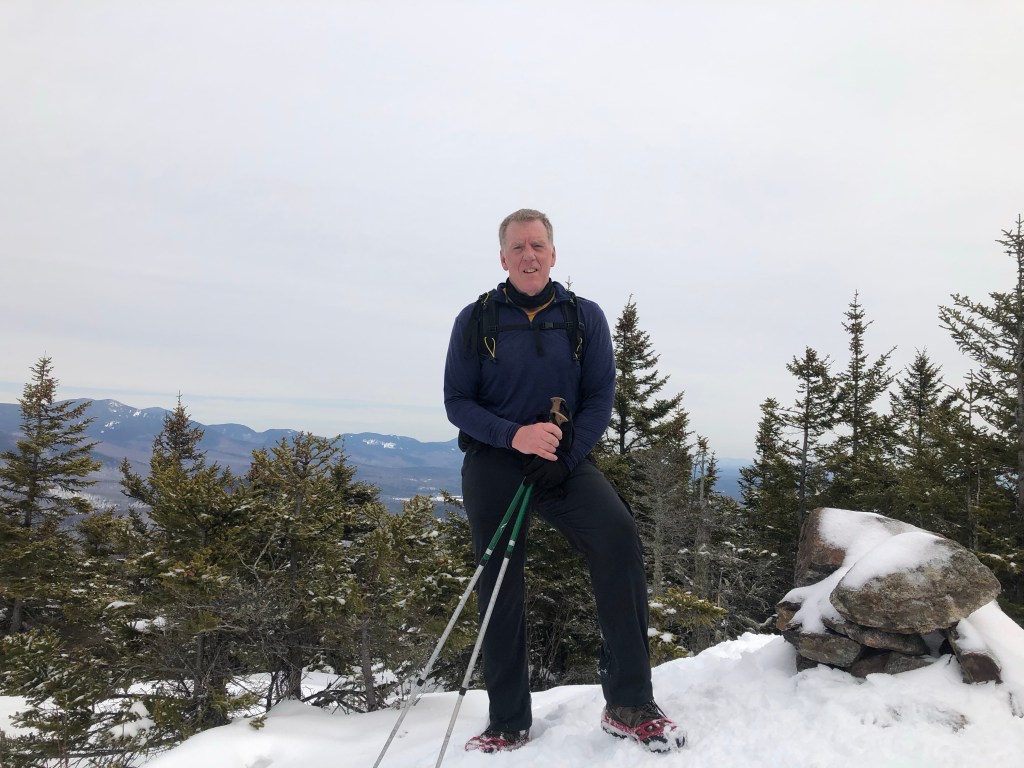
    The summit of Mount Israel is 2620 feet with 1900 feet of elevation. Despite its modest height relative to some of the other mountains in New Hampshire, it didn’t disappoint in views or the stunning beauty of the trail itself. Steep enough for a workout, short enough to give you time for other adventures. We made short work of the trail and before we knew it we were back at the trailhead at Mead Base and Act II.

    A half mile from the trailhead is another wonder worth visiting, Beede Falls, which is named after our friend Daniel Beede. The walk itself is wonderful, with granite ledge and scattered glacial erratics lining the edge of the trail. A large cave named Cow Cave offered a quick distraction. It was so named by some cows that decided to shelter inside the cave one day deep in the past. The cave was interesting, to be sure, but the real show was Beede Falls.

    In late February the falls were largely frozen, and we walked out on the ice that must be a lovely swimming hole on a hot summer day. The amazing part of Beede Falls in looking at them from behind. The falls froze solid in front, but you can access the back from the left and right side, and crawling behind them offered a magical trip into an icy palace. Water cascaded from the granite ledge, plunging between the icy wall you see on the outside and the cave formed behind. There’s just enough room to go all the way through it if you’re adventurous and don’t mind getting a little wet.

    In all our days on this earth, how often can you say that you got to see the world from the summit of a small mountain and from the crawlspace behind a waterfall in the space of a couple of hours? If you’re blessed with good health and mobility, then surely life is to be lived fully. Adventures like this one are within reach of most of us. All you’ve got to do is get out there.

    Frozen Beede Falls
    Ice wall in cave behind the falls
    Summit of Mount Israel
  • Be a Thoroughbred

    “What is courage? Let me tell you what I think it is. An indefinable quality that makes a man put out that extra something, when it seems there is nothing else to give. I dare you to be better than you are. I dare you to be a thoroughbred.” – Herb Brooks

    It was purely an oversight on my part to ignore the 40th anniversary of the Miracle on Ice that took place at Lake Placid when the upstart kids from the United States defeated the USSR hockey machine at the Olympics. I’ve been to Lake Placid twice since those Olympics, and stepped inside that rink the last time. It was a quiet summer day that time, but the rink was lit up and church-like.

    I didn’t play hockey growing up in Massachusetts, but it felt like everyone else did, especially after that Olympics. Everyone knew who Jim Craig and David Silk and Mike Eruzione were, and everyone knew Herb Brooks. The gruff coach with the incredible wisdom bombs dropped on his teams. Sayings like “Legs feed the wolf” and “You’re playing worse everyday and right now you’re playing like it’s next month” were made famous by Brooks and parroted by coaches and athletes alike. There’s something about an underdog pulling off the miracle upset that inspires a generation, and we were all inspired by that team.

    I watched the movie Miracle again last night. They mostly got the Boston accents right, as right as Hollywood ever gets it anyway. And I suppose the folks in Minnesota cringed at the accents on their side. But the soul of that movie is in honoring Herb Brooks and what he created out of a bunch of kids. Herb passed away before the movie was released, but he was certainly aware they were making it. I think he would have appreciated the whole of it, even if reluctant to be celebrated himself.

    It’s hard not to be inspired by Herb Brooks quotes like the one that opens this blog and the one that follows. They make you want to go out and create your own miracle, really. And isn’t that the point? If a bunch of kids can pull off an upset like that why can’t you and I dare to be thoroughbreds ourselves? And what are we waiting for? It’s not like Herb hasn’t kicked us in the ass with his words. The rest is up to us.

    “Let me start with issuing you a challenge: Be better than you are. Set a goal that seems unattainable, and when you reach that goal, set another one even higher.”

  • To Roam the Roads of Lands Remote

    “To move, to breathe, to fly, to float,
    To gain all while you give,
    To roam the roads of lands remote,
    To travel is to live.”
    – Hans Christian Andersen

    Good God I’m ready to roam remote lands again. Exploring faraway places in a world that has shaken off the pandemic and opens its arms in welcome. We aren’t there just yet, we know, but every day we get a bit closer. A year into this and I’m chomping at the bit for the quirky randomness of faraway travel.

    Such thoughts are low agency conspiracies, for the world is right outside, awaiting our arrival. Crossing borders to lands remote may be just out of reach, but crossing thresholds is still very possible. And so the question isn’t the roaming, the question is the focus. I can row a million meters away (and be a different person when I arrive) right in my house, I can time travel in the chair behind me, and I can fly above the earth on snowshoes just outside the door.

    The secret all along? To push through our own borders, wherever we are, is to live. To become by working through. To move. To breathe… to gain all while you give.

  • What Are You Waiting For?

    “Dare to be wise; begin! He who postpones the hour of living rightly is like the rustic who waits for the river to run out before he crosses.” – Horace

    When you really think about it, what are we waiting for? The right time? That river keeps on flowing by and never runs out. We run out.

    Of time… opportunities lost watching it all run by. So then what of this hour? What shall it launch?

    Begin. Do you feel the urgency of time? Do what must be done.

    Start where you are, use what you have, do what you can” – Arthur Ashe

    Easy for me to say, right? Who am I to challenge you? Make no mistake, I’m dipping a toe in that water myself. For I have my own chasms to cross. The only way across is by putting action where words are and getting to it.

    I like a good challenge. Do you? What can you accomplish, see, or become in ten days? Focus on living rightly in each moment, getting across whatever your river is. From today to March 4th and written about right here on March 5th. Comment on that post if you’ve taken the challenge yourself. What are we waiting for? Hurry! For it’s already slipping away.

  • To Live is to Function

    In this symposium my part is only to sit in silence. To express one’s feelings as the end draws near is too intimate a task. But one thought that comes to me as a listener-in. The riders in the race do not stop short when they reach the goal. There is a little finishing canter before coming to a standstill. There is time to hear the kind voice of friends and to say to oneself that the work is done.

    But just as one says that, the answer comes: The race is over, but the work never is done while the power to work remains. The canter that brings you to a standstill need not be only coming to rest. It cannot be while you still live, but to live is to function. That is all there is. And so I end with a line from a Latin poet, who uttered the message more than fifteen-hundred years ago, Death, death, plucks my ear, and says, ‘Live. I am coming.’”
    – Oliver Wendell Holmes (from a radio broadcast when he turned 90)

    This image Holmes painted of cantering after the race is over, living but not quite in the race anymore, lingers. I’ve seen a few people who’s cantering ended sooner than we all wanted, but bless them, they were cantering to the end. Their work was done, and they functioned as best they could until they left us. And whispered a reminder that soon our own race will end, so best run it well.

    The canter that brings you to a standstill need not be only coming to rest.

    My own race took me around a snowy loop in the woods again yesterday, snowshoeing in deep snow, following cross-country ski tracks in a quiet patch of woods that doesn’t see a lot of action from the conservation land walking crowd. Just me and a trusty map, making my way alone in the woods, working up a sweat with a brisk pace as I broke trail next to the ski tracks. This, the morning after, I stepped out of bed gingerly to test the legs and found myself doing okay. Looking back on February so far, I’ve gotten out to snowshoe or hike most days. For I’m still very much in the race, after all, and far be it from me to start cantering now.

    To live is to function – to be out there in the world doing. A challenge to us all from Holmes, all those years ago. To be engaged with those around you, to be charging around the track of life all frothy and full of joyous exuberance at full gallop. Holmes was a Civil War veteran, wounded in battle, a Harvard-educated lawyer who rose up to the Supreme Court and the oldest serving member of that court. A living link between Lincoln and Franklin Delano Roosevelt. He lived in Mattapoisett and Beverly, Massachusetts and by all accounts lived a rich, full life during his own time in the race.

    Death, death, plucks my ear, and says, ‘Live. I am coming.’

    How do you read these words spoken by Oliver Wendell Holmes nearly a hundred years ago? As a reminder to get out and live while you’re still in the race? Or as a dark reminder that death is coming for us all? To me the only choice is the former. To have Holmes quote the stoics near the end of his own life, well into his cantering years, is a wake-up call for the generations lining up for the races after his own. Fast forward to today and now it’s our race. So how shall we run it?

  • The Business of Choosing

    I’m not a surfer, but I imagine them bobbing about in the swells, deciding which wave feels like the best for an epic ride to the beach. On some mornings writing feels a bit like that, with a series of false starts and bits of poetry and verse toyed with then put aside for another day. Each is wonderful and you eagerly want to share them, but they just don’t feel right for this proverbial ride to the beach.

    Writing is a way to sort it all out, of course. Deciding which swell of bubbling thought energy to surf. Once committed, you either ride it to glory or watching it sputter out into nothing much to speak of. But there’s glory in being in the swell too.

    “Your job is to collect good ideas. The more good ideas you collect, the more you can choose from to be influenced by.” – Austin Kleon

    This business of choosing applies to everything we do. Picking the right mate, the right career, the right friends and business associates, the right place to live, the right strategy, the right fitness and nutrition plan for your lifestyle, or the comparatively simple right ideas to explore in a blog. Sometimes the well runs dry, and sometimes the ideas stack up so high you can’t see the forest for the trees. When you’ve reached the bottom of the barrel or conversely when you can’t see the horizon anymore because you’re buried in ideas, a quick change of perspective does wonders for the mind.

    I’ve managed to get out on the snowshoes three times this work week for a quick lap around one of the trails. Twice at lunch and once at the end of the day with the sun setting and a headlamp at the ready should I need it. The cold air and crunchy snow quickly do a number on whatever was scrambling my brain. A rising heart rate always seems to clear a mind that’s turning on itself. In each case I returned home renewed and ready for the next wrestling match with work or words.

    Choosing is the tricky part, but I agree with Kleon, the more good ideas you collect, the more you can choose from. Get out and experience life. Read more material that stretches you in new directions. Get your heart rate up to push it all to the side so you can see where you need to go. And then do it. Even if the wave sputters out on you, you’ll still gain something from the ride.

  • At That Moment

    “I felt at that moment that it was my chance to do one thing supremely well.” – Roger Bannister

    The extraordinary – mastery – starts with that feeling. That spark of excitement at the possibility that just maybe I can do this. And as they say, all it takes is a spark. True, but once the fire is lit, all it takes is fuel to make it roar. For it is just the beginning. There are more moments to come.

    The time before that moment aren’t full of sparks, they’re full of stumbles and awkwardness and frustration. The paying of dues. The long slog. The apprenticeships that turn novices into prospects and prospects into rising stars. All a precursor to that moment when you finally know that this, this is it. And once you realize it, you do whatever you must do to, well, realize it.

    “You have to expect things of yourself before you can do them.” – Michael Jordan

    All of us experience that other it. Those moments when you realize that this is definitely not it. Sometimes that it is our it masked by the long slog to get to it. But usually we know the truth of something before too long down the path. And the truth is that most its aren’t our it. So we try another it. And another. Many never find it at all. Plenty experience maybe this is it. And really, it might just be it, but the climb is long and the friends are calling to go out for a few drinks to celebrate the end whatever isn’t their it, and before pretty soon that maybe isn’t your it either.

    The relatively few who do find and fully realize their it may experience the extraordinary. For it, by definition, lies beyond the ordinary. Finding your it requires singular focus on achieving it. Which brings us back to that moment. And what you feel. And what you do with your chance.

  • On New Paths

    What good is livin’ a life you’ve been given
    If all you do is stand in one place – Lord Huron, Ends of the Earth

    If snow transforms the landscape, then a walk in that snowy terrain transforms the winter walker. Add a new path and suddenly you’re seeing the world entirely differently than you had before. Add snowshoes and you’re suddenly set free to break off trail to see new places, explore animal tracks that run off into the woods, and to see what’s on top of a rise you might have walked by at another time of year.

    There’s a popular pursuit in hiking called red-lining, in which hikers hike every bit of every trail on a map or guide. A popular red-lining pursuit in New England is hiking the AMC White Mountain Guide. The whole point of red-lining is to explore new paths – to get off the crowded hiking trails and try something new. To do it, and to belong to a small group of hardcore hikers who have also done it. And add a measure of accomplishment and camaraderie in the world of hiking. I don’t see myself hiking every trail in the AMC White Mountain Guide, but I’m fully onboard with hiking new trails and seeing the previously (for me) unseen.

    On Valentine’s Day I explored trails previously unseen in a forest I’ve spent a lot of time in. Snowshoeing with friends, we walked a trail largely by ourselves to new places. When you’re on a new trail like that, every step is a discovery, every bend in the trail is a curiosity, and every trail junction is confirmation and validation of what the map was trying to tell you all along. There’s magic in taking that image on a map for a walk and making it real.

    The day after a long walk on new trails you start thinking about the trails at those junctions that you didn’t take. You wonder at what you might have missed down that way and begin to realize the allure of red-lining. For how do you want to spend your time in this world? Sticking with the familiar or exploring new places and challenging yourself in new ways? There are other paths that warrant exploration. I’ve seen them out there, if only on a map.

  • Hiking Cannon Mountain

    A flurry of texts over the work week from two directions with questions about hiking led to a decision to join forces for a hike of Cannon Mountain. On the one hand were the Perry’s, increasingly famous in the White Mountains for years of summiting mountains and red-lining trails. I don’t recall a hike in the last couple of years where they didn’t know at least one person on the trails. And a text from my niece Kellyn offered a nice treat, with her deciding to hike with us as well.

    Cannon Mountain is an old granite mound that’s famous for a sheer rock face that once held the Old Man of the Mountain until it collapsed in 2003, and for the tram built to promote tourism and skiing on the mountain in 1938, making it the first passenger tramway in the United States. The Old Man of the Mountain gave this granite mound its first name, Profile Mountain, but eventually its resemblance to a cannon from some vantage points let to what we’re familiar with now.

    So the stage was set for four hikers to set out on a cold February 13th morning for a hike from Lafayette Campground. We chose the Lonesome Lake Trail, with three of us starting in micro spikes on the snow-packed trail. Our fourth hiker stuck with snowshoes the entire time. The conditions on the popular trail made either option fine. As with other hikes, you quickly know when it’s time to put on the snowshoes. For us that was when we took the largely unbroken Dodge Cutoff Trail over to Hi-Cannon for the hike up to the summit.

    Lonesome Lake is a beautiful lake sitting in the bowl of Cannon and the neighboring mountains of the Kinsman Range. It’s a destination of its own, and plenty of people hike up to see it, walk on the frozen lake for the beautiful views it offers, and then hike back down. But you don’t summit mountains when you turn around halfway. We powered on, snowshoeing through a wonder of marshmallow trees up the steep trail. There’s one ice-caked ladder on Hi-Cannon that I’ll always remember for the limited footing options presented to us, but we all got past it with a little help and a dose of courage.

    The thing about summits is they tend to be much colder when you’re exposed to the wind and you stop moving. Sweaty gloves quickly freeze up, making a change a requirement to keep your fingers working. We considered the observation tower for a few minutes and opted to just hike down to the ski resort’s Mountain Station, where I’m told you can buy a beer at 4080 feet. I opted for hot chili and hot chocolate, with extra hot, thank you. It’s a rare day when you can summit a mountain and have hot chili waiting for you. We quickly warmed up and reached a point where if we didn’t get going we might choose to close out the place. Onward.

    Crossing a ski trail is akin to crossing a highway. You judge the oncoming traffic, decide whether your speed can overcome the approaching traffic’s speed and go. We quickly crossed over to the trail back to the summit observation deck, crowned the summit and began our descent using the Kinsman Ridge Snow Chute, er, Trail. On the map, 4/10’s of a mile of hiking, but a lot of squiggly elevation lines stacked up in a small space. We butt-slid down large sections, my snowshoes were more telemarking skis on other sections, and we all collected snowy memories that will make great tall tales someday.

    On one of the butt-sliding sections I lost a water bottle. It wasn’t until we’d snowshoed across Lonesome Lake and I changed to micro spikes that I realized it. My disappointment at losing it turned to delight when we got to the trailhead and someone who’d found it and beaten us down the trail while we lingered at the lake had left it sitting on a post waiting for me. Good hiking karma right there. It was hard to come away with anything but positive vibes after hiking Cannon Mountain on a pristine winter day. A solar halo signaled goodwill to all. A very good day indeed.

    Cannon Mountain from Lonesome Lake
    Solar halo through the frosty trees
    Lonesome Lake with Franconia Ridge beyond
  • Joyful Walks

    Now shall I walk
    Or shall I ride?
    “Ride”, Pleasure said;
    “Walk”, Joy replied.

    Now what shall I —
    Stay home or roam?
    “Roam”, Pleasure said;
    And Joy — “stay home.”

    Now shall I dance,
    Or sit for dreams?
    “Sit,” answers Joy;
    “Dance,” Pleasure screams.

    Which of ye two
    Will kindest be?
    Pleasure laughed sweet,
    But Joy kissed me.
    – William Henry Davies, The Best Friend

    Joy and pleasure sound similar, but joy is something you can build off of, while pleasure seems more, well, short term. In the forever competition between Pleasure and Joy it’s interesting to note that walking is solidly in the corner of Joy. I’m at my best walking, and fill with joy in those moments on a trail or in the quiet places in the world. I know I’m not alone in this respect.

    What makes walking so positive for the mind and soul? Something in the rhythm of walking long distances clears the fog. Reboots the brain. I don’t have a lot of eureka moments walking, but I’m always better for having done it.

    Today was filled with miles of joyful walking. A poem like the Davies poem above hits you differently when you’re blissfully tired and sore from miles on the trail. Don’t get me wrong, pleasure is nice too, but today belonged to joy. And it started with a long walk.