Category: Fitness

  • 20 Days Left in 2020

    Today there are twenty days left in 2020. What are you going to do with those twenty days? The other 346 tumultuous, maddening days of this year are behind us. All that’s left in this year are twenty days and it will be a memory stacked with all of our other memories. So what will we make of them?

    Time isn’t our friend, my friend. With so little time available in our productive lifetimes, deciding what you will finish, what will define your time here, is in itself life altering. Boiled down even further (since time isn’t guaranteed anyway), deciding what you will finish in a year, a month, a week and, you guessed it, a day lends urgency to the most mundane of tasks. Luckily for us, twenty days is a small enough sample that we can wrap our minds around it.

    What are you here for anyway? Decide what to be and go be it, as the Avett Brothers would suggest. And as the days shrink into the dark nuggets of December days and we round the corner into the New Year, what are you going to do with that precious time anyway? Finishing more seems a good answer.

    For me that means work goals, final chapters in several books, fitness goals and places to be. Everything else is time with loved ones. That’s more than enough to focus on as we hit the home stretch.

    Final Chapters
    I’ve got a stack of critical reading to finish. Seven books in all, that I’ve mentally noted as my finish in 2020 books. For all my complaining about my tendency to bounce around between books, I’ve made steady progress despite it all. If you’re the average of the five people you hang around with the most then raising that average with the authors of exceptional books is a worthy use of limited time. Notably, I’ve set aside some other books that I’ve chosen not to finish. Life is full of compromise. Just make compromises that will still move you forward.

    Fitness
    Stretching your mental boundaries through reading is one thing, but we can’t let our bodies waste away in the meantime. Worthwhile fitness goals force the issue of how you spend your days. I’ve accepted a rowing challenge from old college friends. And so I’ll be spending more of that precious time rowing a few hundred thousand miles in preparation for the moment of truth: 2000 meters for time. Nothing focuses the mind on the task of getting in peak shape like a 2000 meter row on a Concept 2 Rowing Ergometer.

    Places to Be
    Getting fit is great, but I’m an outdoor creature at heart and I can’t very well spend my entire winter indoors rowing. As luck would have it there are worthy places to go and things to see within reach in a year where travel is prohibited. Hiking trails, mountain peaks, waterfalls and long stretches of sandy beach with no footprints on them in winter are all waiting patiently for you. Lonely sites of historical significance with ghosts waiting to whisper to you. All outside the door and a short drive away. Forget binge-watching, try binge-doing.

    Only twenty days left in the year. A power twenty, as rowers would recognize: twenty at maximum effort to pull ahead. Not all that much for a year we’ll surely never forget in our lifetimes. Why not make something positive out of the last twenty? Twenty powerful days to finish this year, and to set ourselves up for a brighter future.

  • Hiking Mount Moosilauke

    I’ve heard about this mountain from several people. Popular because of the great payoff in views and experience for the amount of energy expended compared to other trails. I’d even heard about the Dartmouth Lodge at the head of the trail we were hiking. But you forget what you’ve heard before when you see such places. It served as another reminder that you must get out and see for yourself wonders in this world while you have time.

    There are several trails up to the summit. I’d highlighted the Beaver Brook Trail as one to do based on the cascades there, but with the gimpy ankle my hiking buddies chose an easier trail for this day. The warnings about the Beaver Brook Trail certainly discouraged trying it on an icy day like yesterday. Here’s a typical warning from the AMC: This trail may be extremely dangerous in icy conditions. Okay, got it. Instead we hiked the Gorge Brook Trail out and back. Easier, beautiful, and comparatively free of the ankle-busters you experience on most White Mountain trails.

    Ultimately, this hike made me feel better about the progress of my ankle as it wasn’t a factor. It also made me feel better about the progress of my fitness as the rowing has improved my stamina enough that I didn’t feel winded chasing jackrabbit hikers up the trails. Granted, this was an easy trail and they were likely taking it easy on me.

    Yesterday was several hikes in one. The lower section was wet and a bit muddy in places. The snow started accumulating on ice at higher elevations and prompted us to slip on micro spikes for crunchy hiking. The wind became a factor above tree line. Layers were added and thicker gloves went on. And then on the descent the micro spikes became leaf catchers and clumped up enough that we all opted to stick them back in the packs.

    Moosilauke means “bald place” I’m told, and the summit is fully exposed as advertised. What isn’t guaranteed when you hike is the view. This one would be socked in with fog and snow. No matter, for views are a notable bonus, but hiking the trail to the summit is the goal all along. I’ve got this one on my short list of summits to return to again on a clear day.

    Socked-in summit
    Foundation at summit
    In-between season where there’s snow but still exposed rock
    Snowshoe Hare (see yesterday’s post)
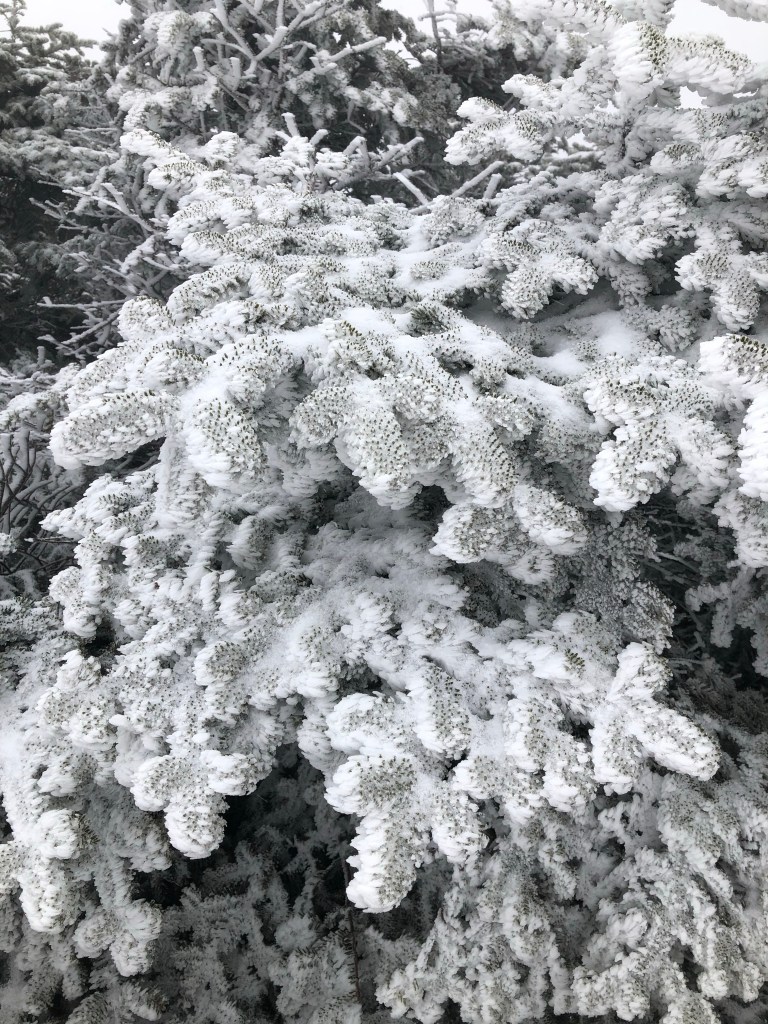
    Rime ice and snow frosting
  • Bold Living

    “There is freedom waiting for you,
    On the breezes of the sky,
    And you ask ‘What if I fall?’
    Oh but my darling,
    What if you fly?”
    – Erin Hanson

    Salto mortale, means the dangerous or potentially lethal leap. Mortale is the potentially bad outcome. Salto is the tricky part: the leap. We humans tend to dwell so much on bad outcomes that we never get around to leaping. And then we regret the leaps we didn’t take more than we celebrate having not leaped. And that suggests another Latin phrase that stirs those quivering leaping muscles: Quam bene vivas refert non quam diu, or “It matters not how long but how well you live”.

    “I don’t believe people are looking for the meaning of life as much as they are looking for the experience of being alive.” – Joseph Campbell

    Alive time means being out there, taking chances, doing things that make you a little bit uncomfortable but thrill you just the same. Not frivolous risk-taking, but leaping into the calculated risk of bold living. The art of being alive while you’re here and vibrant enough to spring to action.

    Live boldly. Leap. Fly.

  • The Other Side

    “What happens to the leaves after they turn red and golden and fall away?”
    – Mary Oliver, Roses, Late Summer

    I walked out just before bedtime for a quick look at the sky. The Northern Taurids peaked the night before, but we had overcast skies and alas, nothing to see here. A quick scan revealed another disappointing cloud cover masking the show. And still Mars shone through the passing clouds, offering hope that if I tried hard enough, maybe I’d see through to the other side. I went to bed instead.

    The Leonids offer a second chance, peaking on Tuesday night. The forecast doesn’t look favorable for the peak, but Monday night looks promising, and I promise myself I’ll stay up late to see them. We’ll see.

    Promises to ourselves have a way of falling away, like those leaves on the tree. I know where those red and golden leaves go: right over the fence into the woods by the tarp-full. I see them now; mounds of brown, damp leaves transforming back to mulch to feed their kin. And I see them gathering once again on the front lawn, mocking previous hours of work. And I wonder, where did all of these ones come from?

    The other side is that place we can’t see but we know it’s there. The other side of a fitness goal is evasive when you’re looking at the scale or your splits and don’t see much progress. The completed novel, the perfect job, the perfect marriage, and whatever it is on the other side of life all tantalize us with how close they are, yet how elusive they remain.

    All we control is what we do now. The direction we point ourselves. The consistency and honesty of our effort. Accepting this for all that it is. The rest blows in the wind, landing where it may.

  • The Next Stroke

    “Every stroke well rowed means a better stroke next time, and so a better chance of winning the race. Every stroke well rowed is felt by all the crew and gives them confidence, and they consequently row their next stroke better; and every careless stroke rolls the boat and puts a nervousness through the crew. So Victory or Defeat depend on the next stroke.” – Steve Fairbairn

    I underlined the above quote in a book back the early 1990’s when I was coaching crew. The quote was almost certainly referenced in some practice session to remind individuals about the essential power of swing in a boat. To focus on the next stroke was all that mattered. The one after that would take care of itself, and so on. Victory or defeat depended on the next stroke. One after another, until you’ve finished the race.

    The rowing began in earnest yesterday. The goal is 100K in November, with only 5K completed. But this is achievable with a mix of 5K and 10K rows over the next twenty days. And then a bigger goal in December. But let’s not get ahead of ourselves. One day at a time.

    This is my sweet spot: consistent steady state rowing over a defined period of time. I loved being on the water, and yet I row in my basement on an erg purchased over twenty years ago. I haven’t rowed in a rowing shell on the water in all that time, and yet I row still. And each stroke is a lesson.

    The erg is different from the boat in countless ways, but the essence of the rowing stroke remains the same. There’s a rhythm and fluidity to the rowing stroke that translates as well to the flywheel as it does to the check in a boat moving across water. Mastering each stroke is all that matters in rowing. You might build strategy into the race or the piece you’re rowing; start fast, drop to a pace you can maintain, pick it up with 500 to go and sprint for the last 20 strokes, but strategy falls on its face if you don’t master this stroke and the one after.

    This approach to rowing, mastering the next stroke, certainly applies to the rest of life too. Master the next call when selling, the next sentence when writing, the next step when hiking, the next stride when running. It’s all the same; consistent focus on mastering the moment at hand. The rest will take care of itself. From now until we finish the race.

  • Walking to Calm

    It’s easy to feel distressed in a tight election, especially when the current President goes mad and declares fraud well before the count is done. Emotions are high. But the noise doesn’t matter so long as there is order. Bluster doesn’t matter so long as calmness prevails. I tune out bluster and madness, not because they aren’t factors to consider, but because they don’t help me navigate life. Who can think with all that noise?

    It’s a great day for a slow walk in the woods, or on a quiet beach, or just to turn off the noise and breathe slowly. Stay off social media, which only amplifies the madness. We always knew this one would be tight, even if we wanted an easy election. Democracy is hard work – never more than now.

    I turned down a hike today because, well, I work for a living. Honestly the hike would have been perfect today, but a brief walk in the woods at lunchtime should do the trick. Instead of coffee perhaps a quick row this morning before things pick up again. Exercise offers another form of resetting the mind.

    Some will celebrate the chaos. I’ll celebrate the quiet. Turn off all media and take a long, quiet walk outdoors today. Walking meditation. Calm. The election will still be there when you get back. The pandemic isn’t going anywhere either. Walk. Breathe. Reset. And move forward with the things you can control in life.

    Simple, right?

  • Return to the Rail Trail

    For the first time since early in the pandemic I decided to take a walk on the Windham Rail Trail after work. I figured at dusk most people would be wrapping up their time on the trail and heading home. I figured wrong. I nodded a greeting to those who made eye contact, ignored those who didn’t, and held my breath many times for the unmasked swarm of humanity that passed by in close proximity unmasked and unconcerned. I’m not a germaphobe, but at this point in the pandemic I’m informed enough to limit such risks whenever possible.

    You notice a lot of things when you walk a trail often: The change of seasons and how that impacts the trail, the increase in traffic, encroaching development, the casual disregard for others by the relative few who dispose of bagged pet waste on the side of the trail, and the ebb and flow of wildlife. My six mile walk was informative. Comparing it to the fall of 2019 at a similar time of day it was much busier, with many more bicyclists than you’d see a year ago. More walkers too, but not exponentially more. No, it was the swarms of bicycles that were noticeable… and notable. Headlines like “Bicycle sales skyrocket during COVID” come to mind. Here is the proof, relentlessly zipping past me one after the other. While I prefer quiet walks, I can’t complain about the benefits of a healthier society overall. Still, I make a mental note to walk the trail in the rain next time.

    Exactly two months ago I did some damage to my right ankle on the descent of the Old Bridle Path from Mount Lafayette. I’ve largely pretended it wasn’t injured and would cinch up my hiking boots tighter during hikes, but I have tried to nurse it back to health. During this walk I was generally pleased with the progress of the ankle and pushed on past Mitchell Pond in hopes of getting a photo or two of the foliage reflecting on water in the late day sun. But with the drought the water has receded far from the rail trail, with muddy pockets and rotting logs replacing the shimmer of water that used to greet me on this stretch of trail. The heavy rain earlier in the week was a welcome relief for the wildlife that relies on this water. A lot more would be welcome. Like many of us, I expect they’re longing for a return to normal.

    My walk was six miles out and back. I was running out of daylight and didn’t want to deal with bicycles speeding along on dark trails. It was nice to get reacquainted with the trail, but it felt a bit less special than at other times. Instead of an intimate conversation with the trail and the wild spaces that it dissects it was more of a shouted exchange in a busy venue:
    “Hey, good to see you again!”
    “Good to see you too!”
    “Can you believe all this?”
    “I know! What a crazy year!”
    “How have you been?”
    “What?!”
    “How have you been?!”
    “What?!”

    Anyway, stay well, we’ll catch up again when its a little less busy.”

    And so I left the trail thinking about how parched it looked and how many people were using it. But I was grateful for having it there for them and for me when we needed it most. We all need to get outside and get more exercise, and rail trails serve as an entry into a safer world away from automobile traffic. Even if I like the trails more when they’re quiet, I still value having a place to go close to home. More utilization means there will be more investment in similar trails in the future. And that’s a win for all of us.

  • The Hard Bit

    “You write. That’s the hard bit that nobody sees.” – Neil Gaiman

    “I believe that reading and writing are the most nourishing forms of meditation anyone has so far found.” – Kurt Vonnegut

    Travel writing is easy by comparison. Experience a place or an event and then convey that bit of magic to others in words. I enjoy travel writing – consuming it and better, writing it. I think fondly of driving about in Scotland close to a year ago or Portugal the year before that and the many adventures I had, most of which never made it to the blog. Writing about places you go is easy. Like you’re sharing tales of an adventure with friends. And documenting it for yourself to remember someday when you aren’t traveling anymore… like now.

    Writing a daily blog becomes harder when you find yourself in the same room for an entire day, with breaks to get the mail or see what the sun looks like. That’s where the hard bit comes in. Tapping into your brain and finding the stories. Doing the work. Some days it goes well, some days it peters out. But I find it easiest when, as with travel, I have something to share with others. A poem that stirs the imagination. A bit of local history that was particularly fascinating. A bear walking in the woods behind the house. Some stories practically write themselves.

    I was talking to a colleague who is struggling with depression. He has much younger children, is used to being out on the road for business and is struggling in this year of years to keep it all together. I’ve heard from several people this year having similar struggles. And I understand. Everything is different, the very foundation of our being sometimes seems to be crumbling. I don’t believe I suffer from clinical depression, but I’ve had moments of despair when the whole thing seems too much. How do you deal with the hard bits? I suppose it’s different for everyone, but for me getting out of my own head does wonders. Walk more. Read more. Have more meaningful conversations with people of consequence. And write it all down. Writing draws the noise out of your head and onto paper… or whatever data center WordPress utilizes for my ramblings.

    I have a friend who calls the blog my “dear diary”, and I suppose there’s truth in that. But for me the writing solves a lot of mind games I play with myself. Processing information consumed in books or translating a poem into my own experience in writing is a form of conversation with yourself, nudged gently along by the author or poet. Long walks solve a lot of problems for me, but so does immersive reading and writing. I read the Vonnegut quote above and understand immediately where he’s coming from. I’m not the only one.

    Gaiman reminds me, whispers in my ear: I’m behind in my writing. Not blogging, but the other writing. And sure Neil; it gnaws at me. Jabs me in the ribs when I’m not looking. It waits impatiently for me to do the other things, the less important things. The easier things. And I look it squarely in the eyes and see myself dodging the truth. I have more to say. More to contribute. And there I am; back in my own head again. Perhaps a walk is in order. And a bit of writing after that. The hard bit.

  • Past Peak

    Normally this weekend in New Hampshire is peak foliage season. But a sustained drought has stressed the trees just enough to pull peak ahead by two weeks. So the thousands of people plugging up the roadways of the Mount Washington National Forest were seeing the forest muted in dynamic impact. And yet they came. And they saw enough. For the mountains offer their own ruggedly stunning backdrop. I considered the tourists on my afternoon commute home from a day of hiking. Clusters taking a photo next to the roadside sign announcing you were in the MWNF, picture-taking all around you. Cars parked in odd assortments along the sides of the road, as if clung together by magnets the way the metal dust would clump together in the old Wooly Willy toy would clump into beards and eyebrows with a magnetic stick. Funny what you think about when you observe tourists in the wild.

    To be amongst the mountains is relatively easy when you live in New Hampshire. Less so, I suppose, if one were to live in Florida. But they have that tropical water hugging them on three sides, and I suppose the amusement parks and fresh oranges to consider too. But you can’t swim in a pond in Florida without risk of being dragged down by an alligator. There are no alligators in the mountains of New Hampshire. Maybe the occasional bear or mountain lion, but they mostly want the food in your pack, not you as food. The bigger threat to your well-being are the damned rocks. New Hampshire is the granite state, and as if to hammer that point home every trail is worn down to ankle-bending, knee-twisting rock. And in October those land mines are covered over in a bed of beautiful leaves. So a descent becomes a shuffle of sorts, as you work to avoid catastrophic injury on remote yet well-traveled trails.

    I have a friend who points out my tendency to pick overindulgent goals for myself. Really though; all my friends point this out. Like rowing a million meters on an erg in three months, or taking my family on a hike up the toughest mile of the Appalachian Trail, or peak-bagging three out-and-back peaks in one day, as I did yesterday with Mounts Willey, Field and Tom. I might have taken a hint from my hiking pro friend who refers to these three as the WTF hike. I chose to experience it on my own, with an extra helping of previous injuries I was nursing. WTF indeed.

    The morning after a hike like the WTF hike, the first step is to get out of bed without incident. Plant your feet and gradually put weight on the ankles and knees that you abused so ruthlessly the day before. Assess how much they resent you, and then shuffle to the bathroom for relief and some Motrin. This isn’t a walk of shame as much as a recognition of all you’d done, in the form of some tender moving parts and sore muscles. And I wonder in those moments of truth, am I past peak myself? Or simply overindulgent? I’d like to think the latter. All I can do is keep moving. Perhaps with a bit of moderation next time. I suppose that’s a perfectly reasonable request.

    Past Peak
  • Hiking Mount Willey, Mount Field and Mount Tom (and Back)

    I didn’t think this one through enough. An out and back using the same trail to hike three 4000 footers necessarily means you’re actually hiking five 4000 footers in a day. Ambitious. A bit reckless. A bit exhausting.

    10 miles round trip, with 4400 feet of elevation gain seems easy on paper. In practice the rock scrambles and ladders bridging impossibly steep sections made it a test of willpower. Some of those rock scrambles were borderline ladder territory as well. As wake-up calls go climbing the Willey Range Trail served as a good one. My heart was racing and my layers were shedding in no time. My mood bounced between exhilaration, despair and frustration with myself for not planning this hike a little better. But it was a quickly drafted plan B, and in hindsight, a good hike. Even if I wasn’t mentally ready for it.

    Mount Willey is 4255 feet tall and named after Samuel Willey and his family, who were killed in a landslide in 1926. Mount Field is 4327 feet and named after Darby Field, who made the first known ascent of Mount Washington in 1642. Mount Tom is 4052 feet tall and named after Thomas Crawford of Crawford Notch fame. The three peaks are relatively tame, other than the hike up the Willey Range Trail to the summit of Mount Willey. Approaching from the south, Willey is a tough ascent. It also makes a challenging descent. Starting and ending my hike with this trail set me up for a tough day. But I finished relatively healthy. And healthy with three more 4K’s checked off is enough for me.

    If you go, consider an approach from Crawford Notch or Mount Hale. The people who I ran into didn’t seem to have the same endurance test of ascending the Willey Range trail. For views, Willey and Field have some good observation spots, Tom not so much. But views are only part of the story. Finishing this hike and summiting these three 4000 footers was its own reward.