Category: food

  • Tomato Days

    These are the early days of summer, even if it feels like it hasn’t started in the northeast United States, where I live. And June is the beginning of tomato days. I grow them as much for the smell of the vines as for the fruit I may or may not harvest, depending on the tomato-loving wildlife and the fickle weather. What I grow we’ll eat, and what I can’t grow I’ll pick up at the local farm stand. Tomato days are the very best days of summer.

    Lately I’ve introduced more tomatoes into my daily routine no matter the season. My PSA score was higher than it should be, not dangerous levels but still make some changes in your life levels. It seems that the abundant levels of lycopene in tomatoes is an excellent way to help protect cells in the body from damage caused by free radicals. Lycopene is an antioxidant ally in a world full of bad stuff trying to mess with our happy lives. So eating tomatoes every day is an easy and logical way to increase our health span.

    And health span is everything! If we hope to have a long and active life, versus a life tempered by assisted living and lowered expectations about what is possible in a day, we must build and maintain a healthy and fit body that can help kick atrophy and disease down the curb. Exercise and good nutrition are building blocks for a better future, while helping us feel more energized and focused today. So have a tomato. Just save some for me.

  • Breakthroughs and Routines

    “Do not let the world form you. Do not conform to it. Instead, transform yourself through a renewing of your mind.” ― Neil King Jr., American Ramble: A Walk of Memory and Renewal

    We are being transformed as much by time as by deliberate act. We cannot control time, such that it is, but we may control our own transformation through the choices we make, the people we associate with and the course we set for ourselves. We said goodbye to some friends over the weekend, knowing that they and we will be changed by the things we encounter between now and the time we may reconnect in the future. We are all forever being transformed, catching up one day to see the changes.

    The universe won’t remember much of us in a thousand years. Hell, I don’t remember much about myself in any given year of my own lifetime but for the highlights and those few unforgettable moments forever imprinted in my mind. We replay stepping stone moments and stumbles ranging from our youth to just this morning, each retained as memorable for what they taught us about ourselves and the place we were in our development to that moment, each still shaping who we are every time we rewind and play the conversation again in our minds.

    But remembering isn’t the thing, for we can’t carry everything with us and still function freely in the now, transformation happens with those few things that get into the bloodstream and forevermore become a part of our identity. It’s like the pesto breakthrough to me: Back as a teenager I encountered a dish of pesto put out as an hors d’oeuvre. For my entire young life up to the moment I savored that dish for the first time I thought of the world in a certain way. When I tasted pesto for the first time I immediately recognized how incomplete my life had been previously and integrated it into my identity forevermore. Life has since been far more delicious.

    We note such watershed moments in our lives that change everything, but we forget the incremental changes we make influenced by the gravitational pull of habit or environment. Writing this blog every day has changed me more than that first pesto experience, perhaps by prompting me to seek more breakthrough moments, but also by noting the existence of gravity in my everyday affairs. If we don’t acknowledge gravity we will never develop the transformational habits to one day reach escape velocity.

    Life is this combination of breakthroughs and routine, transforming us over time into whomever we are and will become. Breakthroughs are rapid change, while routines are the long, slow climb. The muscles we develop determine how well we can resist conformity and go our own way. To be deliberate in our learning and the experiences we seek out are thus our path to transformation on our own terms.

  • Venturing for Pizza

    “Adventures don’t come calling like unexpected relatives; you have to go looking for them”
    — Mark Jenkins

    A friend pointed out that I don’t post all that many pictures in my blog posts anymore. His observation was right on point, as there have been way too many work from home days strung together recently. There are surely efficiencies in working from home, but there are no waterfalls, mountain peaks or historical sites hiding in the closet awaiting discovery. Discovery requires venturing.

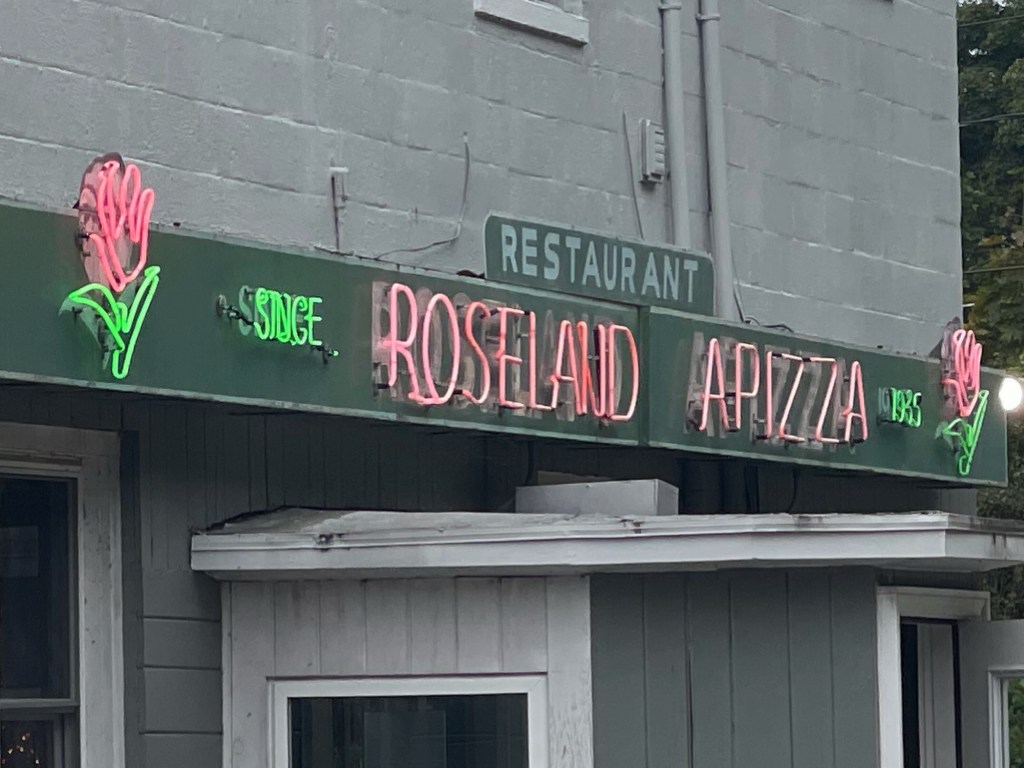
    This week I ventured to Connecticut and found myself in an old pizza shop from the 1930’s. The kind of place that doesn’t open until 3 PM and has a take-out line that runs to the end of the parking lot. Connecticut is famous for their pizza. Maybe not Napoli famous but regionally famous, and so sharing a pizza with a business associate seemed the thing to do. I offered up the big three in New Haven, he offered up a place in Derby that he loved called Roseland Apizza (pronounced ah-beetz). Always go where the locals go, I tell myself, and so we went. I’ll tell you that the pizza was good, but it was never about the pizza in the first place, it was about the venturing.

    Whether we’re chasing waterfalls or history or pizza doesn’t matter so much as the chase itself. Break through the self-imposed walls we build around ourselves and step out of the damned box. When we get out in the world and see if for ourselves, we reignite that spark that was gasping for air. When we return to our box we find we’re breathing a little better, we’re seeing the world a little differently, and we’re more satiated than we had been previously (especially if you’re seeking out the best pizza places in Connecticut). When life seems a little boring, simply add venture.

  • Savor the Salad

    “I was so busy making music that before I knew it the summer was gone.” — Aesop, The Ants & the Grasshopper

    I went into the garden to pick the first ripe tomato and found the bottom half was gone, a sign that a groundhog has tagged my garden as its buffet. I resented the pilferage (who doesn’t love the first tomato of summer?) and picked the next tomato that wasn’t quite ripe yet, that I may at least have that one. I’ve learned to tolerate and even coexist with the critters, but that doesn’t mean I’m giving up the entire crop to them.

    The thing to do in such moments is head to the local farm stand. I grow three tomato plants, they tell me they grow five thousand. And they’re having a good year for tomatoes this year, with plenty of heat and without the relentless rain we had last year. When the local farmers are happy with the weather, we celebrate with Caprese salad. The basil is my own, the tomatoes from the farm stand, the rest of the ingredients from a global supply chain. It takes a village to make a great salad.

    Early August in New Hampshire and it feels like summer will never end even as the days grow shorter and the Halloween candy is on the store shelves. Why? Because retail is always looking 3-6 months ahead of the rest of us. In summer I avoid box stores at all costs, that I may live in the moment. Our summers, like life itself, are so very short. Why be forever looking ahead when we may enjoy the harvest this day brings?

    We all must prepare for the future, as the ants in Aesop’s fable do, but we must also balance this forever preparing with the awareness and insight of carpe diem. We must seize the day for all it offers for us before it’s gone forever. Life is a balance of living in the present with all the lessons of the past to guide us and a hopeful eye towards a bountiful future.

    I don’t begrudge the groundhog for pilfering the first tomato of summer, but I made a point of getting the second before it too was gone. Summer harvests are fragile, fleeting things indeed. So savor the salad.

  • The 75% Lifestyle Choice

    “Scientific studies suggest that only about 25 percent of how long we live is dictated by genes, according to famous studies of Danish twins. The other 75 percent is determined by our lifestyles and the everyday choices we make. It follows that if we optimize our lifestyles, we can maximize our life expectancies within our biological limits.” ― Dan Buettner, The Blue Zones: 9 Lessons for Living Longer From the People Who’ve Lived the Longest

    When you think about it, most of us have far more agency over the quality and length of our lives than we believe we have. Accidents will happen, genetics are what they are, but on the whole we have a say in how healthy and resilient we are. So it follows that we ought to make better choices in our day-to-day routines. Eat better, move more, find time to decompress and place ourselves in a supportive environment with people more like the person we want to become. Simple, right?

    January has come to be known as “damp January” or “dry January” as people cut out alcohol from their daily lives. If we moderate our consumption more in November and December, perhaps we all wouldn’t collectively feel the need to quit cold turkey. But Americans in particular love the pendulum swing. One extreme to the other is our game, but is it a long-term formula for winning the game of life? Probably not.

    My meal choices the last two days reflect that of a business traveler. Too many carbs and fat and sodium, too few fruits and vegetables. The only bright spot in my diet is that I haven’t consumed alcohol on this trip. But deep down I know I ought to be exercising more and eating less junk. We usually know what we should be doing, we just don’t always do it. The more we systematize our choices, the easier it is to stick with what we should do.

    We’re all works in progress, but we should remember that every choice is a step in one direction or the other. We either move towards healthier or move away from it. A good routine makes that direction easier to follow.

  • What Can We Live Without?

    Our life is frittered away by detail. An honest man has hardly need to count more than his ten fingers, or in extreme cases he may add his ten toes, and lump the rest. Simplicity, simplicity, simplicity! I say, let your affairs be as two or three, and not a hundred or a thousand; instead of a million count half a dozen, and keep your accounts on your thumb-nail. In the midst of this chopping sea of civilized life, such are the clouds and storms and quicksands and thousand-and-one items to be allowed for, that a man has to live, if he would not founder and go to the bottom and not make his port at all, by dead reckoning, and he must be a great calculator indeed who succeeds. Simplify, simplify. Instead of three meals a day, if it be necessary eat but one; instead of a hundred dishes, five; and reduce other things in proportion.Henry David Thoreau, Walden

    Now and then I dabble in intermittent fasting. I can’t always control where I am and whether I can exercise, but I can control what I eat and drink. Fasts range from 13 hours up to 24 in general, but mostly I seem to do two or three per week of either 16 or 18 hours. My longest fast ever was about 48 hours. I’ve heard of some people doing seven days. You won’t find me pushing that kind of limit. Simply put, I like to eat, and skipping a meal or two is a good way to remind myself to ease off on the eating thing a bit. There are health benefits to intermittent fasting, ranging from healthy weight loss to long term resistance to degenerative diseases (I’m told). But mostly, I do it to control the conversation in my own head about when and what to eat.

    The question to ask of ourselves is, what can we live without? We soften ourselves with abundance: food, entertainment, friends of convenience, information… the list goes on. Removing most of this noise offers an opportunity to find that which is most essential to us in our lives. Food becomes fuel and not filler. Entertainment elevates to a highlight moment instead of background noise. True friends are true sounding boards and not frivolous back-slapping small-talkers. Information leads to a deeper understanding, not a sound bite with no substance. You get the idea.

    If there’s an irony to Thoreau, it’s his tendency to jamb a hundred words into a sentence just to get everything out of his head and on paper. For a man that preaches simplicity, we sometimes have to wade through a lot of word soup to get to the key message. But Thoreau lived a short life, and there was so very much to put out there in the world before he left us. We all ought to feel that urgency.

    A bit of temperance is good for us. A bit of solitude with our thoughts brings the truth to the surface. Life in the din isn’t all its cracked up to be, for we rapidly run out of time to find out who we really are. With a little less input, what might we put out there in the world? The more we say no to some things, the more we amplify our yes to other things. Choose wisely.

  • Greek Coffee

    Greek coffee is a lot like Cuban or Turkish coffee. Strong and bitter and best mixed with a bit of sweetness. They warn you when you receive it not to drink it to the last drop, for you’ll find the grounds there. There’s none of that filtering nonsense with Greek coffee, friend. Americans drink to the last drop, the Greeks leave a bit behind. Call it an offering to the gods if you will, or simple prudence.

    You might anticipate the effect of a strong Greek coffee after dinner on my sleep pattern. Timing is everything with new experiences. In fact, I could use another one of those coffees as a reset for the day ahead. The caffeine will be welcome, but it surely won’t be as interesting as that first taste of something similar, but entirely different.

    We’re blessed with so much in this modern world, isn’t it a tragedy to order the same things on the menu every day? Our best life is full of new and enriching moments, grounded by the people and experiences that carried us to this moment. That openness to new experiences rewards us with a richness far beyond our bank accounts. Visit the uncommon places, order something you can’t pronounce now and then, opt for the local coffee instead of the Americano. Live! We are better for having gone there.

  • Art With a Spritz of Lime

    “Art is art and life is life, but to live life artistically; that is the art of life.”— Peter Altenberg

    A close friend has a flare for living well. He’ll spritz lime on a potato dish and make something extraordinary of what was moments before thought to be disparate produce. He’s always looking for the exceptional in an otherwise average day. And he drives many people mad as a result. Like that burst of citrus in a starchy dish, I find his perspective punctuates life perfectly.

    This business of living artistically is something to aspire to. Capturing moments with a bit of magic and moving through the ordinary with je ne sais quoi, these are the things that matter very much in a world that wants you to fall in line and fit right in. Certainly, we must do our job and do it well, but why always settle for vanilla?

    We each live on both sides of ordinary. It’s a gift to be human at a time and place when you can express yourself freely. We ought to use that gift and add more flavor to our days. Like every gift, we must choose to use it. Art is a deliberate act, expressed uniquely. What might we bring to the table if we have the gumption to try something new?

    We all know the expression: when the world throws you lemons, make lemonade. There’s another clever expression I once found on a kitchen magnet that adds a twist: when the world throws you limes, make margaritas. To this I’ll add, don’t forget to save some lime for the potatoes.

  • Opting for a Colorful Plate

    “The food you eat can be either the safest and most powerful form of medicine or the slowest form of poison.” ― Ann Wigmore

    A coworker recently brought up his frustration with the the “plateful of brown” options available for breakfast at a typical American hotel chain: eggs, bacon, sausage links, bread, potatoes or hash browns, coffee. If you’re lucky enough to have fruit options it’s usually bananas and pineapple or melon. Maybe some yogurt. In other words, a whole lotta brown.

    There’s a rule of thumb that we ought to include as many colors in our food as we can. A plate loaded full of brown foods isn’t especially good for you, and may indeed be a slow form of poison. If we are what we eat, why are we opting for processed junk and the same old same old? Add color! Add variety! Add flavor!

    Looking at the travel menu for dinners, there’s a lot of brown there too: pasta and bread, steak, chicken, rice and all sorts of not very colorful food. It doesn’t have to be this way. We can do as the Europeans do and swirl in a healthy mix of green, red, orange and yellow and feel more vibrant after eating. Or stick with browns and feel bloated and tired after eating. The choice is ours, one meal at a time. We ought to choose wisely. Choose deliciously. Choose colorfully.

  • Savoring Moderate Consumption

    “Thrift isn’t stinginess. It’s a cure for overconsumption.” — Stanley Tucci

    We are spiraling headfirst into the consumption holidays. In many ways it’s already begun with Halloween, didn’t it? Purchase one bag of candy more than we really need to, and suddenly the pants are a bit snugger than they were a few weeks ago. Autumn days are days to eat, drink and be merry. It’s a time to celebrate the harvest. Many of us take this a step too far—one “bite-sized” candy bar after another, washed down with a pumpkin spiced latte and the abandonment of all reason.

    Watching Stanley Tucci’s magnificent Searching for Italy, the episode that struck me most profoundly was Episode 8: Liguria in which he savors traditional Genoese pesto recipes and walks the barren cliffside olive plantations. This is not a place where you are burdened with such things as too many Thanksgiving pies to choose from, this is a place where you savor the ingredients you can muster up from the land and sea.

    There’s no magic in a drive-thru, only convenience. And we may appreciate convenience, but do we savor it? Distracted eating serves our busy lifestyles, but is there any nuance in consumption when it’s lost in the moment of defensive driving or determined scrolling? There can be no savoring when multitasking. When we deliberately focus on the food we suddenly we realize just what we’re shoveling into our mouths. This moment may delight or horrify us.

    Savoring is the key to an extraordinary life. If overconsumption and gluttony are the antithesis of savoring, then it stands to reason that to live an exceptional life we ought to be more thrifty in our consumption. To savor life means to slow down and appreciate what the world offers to us in the moment. This is celebratory, but not overindulgent. It is a dance with life, one small and delightful bite at a time.