Category: Habits

  • The Practice of Living More

    I’ve become known in some circles as an avid traveler, but don’t think of myself that way. That’s comparison at work, both theirs and mine, fogging the lens of perspective. Wiping it clear, it’s more that I’m an aspiring traveler immersed in a busy life. That’s not quite the same thing, but better for me at this point in my life. Travel is a choice, and so is building a strong sense of place and contribution. We can have a healthy measure of each applying a little balance and flexibility, but we can’t have it all. What will we choose, knowing this?

    “We are what we repeatedly do. Excellence, then, is not an act, but a habit. — Aristotle

    Aristotle may have also observed that mediocrity is also built on repeatedly doing. We each get our stack of days to work with. Some choices are taken from us, some choices are hidden from us, but most of us in the modern western world have the agency to do with the bulk of our time what we would. Habitualizing excellence seems a prudent use of that time.

    The trick in living a life closer to excellence is in the repeatedly doing part. Arete, or excellence in life, is something to aspire to through our daily action. We pay penance to the gods we serve through our habits and applied effort. Put another way, through our practice:

    “When an activity becomes a practice, it shifts from something that you are doing at a point in time to an ongoing process of becoming.” — Brad Stulberg, The Practice of Groundedness

    The practice of daily living is ongoing, but with an expiration date we either reconcile ourselves with or distract ourselves from. Stoicism is holding on to that realization that this all ends one day and making the most of the time. How we live matters a great deal when we feel the urgency of an expiration date. Continuous improvement and living with intent are a prudent use of that urgency. The practice of living more means working to realize the things we aspire to, while savoring the life we’ve already built for ourselves.

  • Walking to a Better Place

    “Above all, do not lose your desire to walk: every day I walk myself into a state of well-being and walk away from every illness; I have walked myself into my best thoughts, and I know of no thought so burdensome that one cannot walk away from it.” — Søren Kierkegaard

    As I write this, it’s warmed up to -12 degrees Fahrenheit outside. On the summit of Mount Washington, a few hour’s drive away from me, the temperature is currently -45 with a wind chill of -107 degrees. Simply put, this is not a good day for a hike. But every day is a good day for a walk, conceding that some days we have got to be a little more creative to get the steps in.

    If my family or my neighbors were to observe my behavior on certain days when I feel trapped in the house, they’d think I was crazy (they likely do already). I’ll walk up and down the stairs ten times to get the blood moving between meetings, circumnavigating the interior of the house in a circle (always counterclockwise, for reasons I can’t explain) and now and then throw in some burpees or pushups to spice things up. This has not led to six-pack abs, but nonetheless it does a body good.

    Clearly, getting outside is the better way to move. Long walks on pavement are okay, but I prefer to walk on local trails not far from home, with trees and the occasional dog walker as company. Hiking is a favorite form of exercise, practiced in moderation for reasons of practical living as opposed to lack of desire for more. We simply can’t do everything, but doing a lot of things in moderation seems to work for me. We are as much what we say no to as the things we say yes to.

    Walking has remained the one constant form of exercise that has followed me wherever I’ve gone in this world. I’ve walked in places as diverse as the Old City in Jerusalem, the Mayan port city of Tulum, Red Square in Moscow, amongst the Redwoods in Muir Woods and followed in the footsteps of Thoreau at Walden Pond, but I’ve never taken more steps in any place than I have on the plot of land I currently reside on in New Hampshire. Place is variable, the stride varies, but the act of walking remains a constant companion.

    As the temperatures creep back up I’ll plot my escape from this self-imposed exile I call home and get back to outdoor walking. There are empty beaches to explore, ridge trails to traverse, and faraway places calling me. Walking is the most reliable way to get to a better place, simply by putting one foot in front of the other.

  • Eternal Sunrise

    Having been married awhile, my bride and I know each other’s tendencies. She rolls her eyes at me when she sees me watching YouTube videos of faraway places. I’ve got a regular playlist of places I’d like to go that I visit regularly, and virtually tag along with friends as they sail around the world. She anticipates my travel proposals well before I open my mouth. In turn, I roll my eyes when I hear her turn on home improvement shows, and feel like I live in one for all the projects her viewing inspires.

    There’s an undercurrent of restlessness that flows through many of us, wanted more in our time, whatever that “more” happens to be. In the best of times it’s positive and productive. Perhaps improvement on our lot in life or progress towards a personal goal. In the worst of times it might inspire jealousy and betrayal. Look around at the world, it’s easy to see examples of both.

    The question of how we’re perceived, or how we perceive ourselves, begs to be answered. The world is very good at showing us what’s possible with the right mix of resourcefulness and boldness. For all the cries for instant gratification in media, in reality most of us simply chip away at things until we get there. We can become some version of who we choose to be over time, but we must apply patient action.

    “The feelings that hurt most, the emotions that sting most, are those that are absurd – The longing for impossible things, precisely because they are impossible; nostalgia for what never was; the desire for what could have been; regret over not being someone else; dissatisfaction with the world’s existence. All these half-tones of the soul’s consciousness create in us a painful landscape, an eternal sunset of what we are.” — Fernando Pessoa

    At what point is enough enough? When are we satiated and content with our share, pushing our proverbial plate away? This seems to be the moment where we embrace bliss. Change will always happen, we just learn to focus on what we can control and find happiness there. The rest is just an entertainment of ideas.

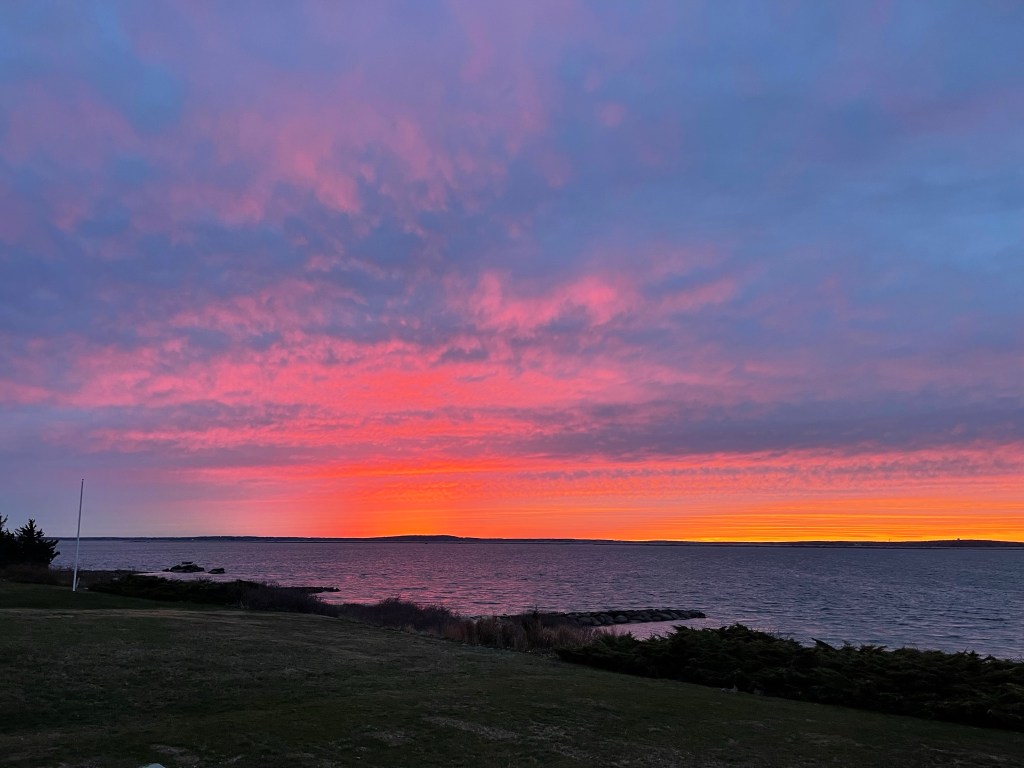
    For us, the nest is always being improved upon, even as we try to fly away from it. Sometimes we go, but we always return. Both the nest and the residents of it change over time. This is our eternal sunrise, as we are forever becoming something new, embracing change as it rises before us.

  • Be Whole

    To be great, be whole;
    Exclude nothing, exaggerate nothing that is not you.
    Be whole in everything. Put all you are
    Into the smallest thing you do.
    So, in each lake, the moon shines with splendor
    Because it blooms up above.
    — Fernando Pessoa, Poems of Fernando Pessoa

    An early morning. Out the door long before the dawn brought me deep into the heart of New York City commuter traffic. I still tell myself that this is the price of greatness, something I’ve told my children more than they want to hear, something I don’t always want to hear myself. Yet it still applies, and should for a lifetime. For don’t we owe it to ourselves to put all we are into everything we do?

    The price of greatness is consistently showing up and doing the things we know deep down that we must do. We might never reach greatness even paying the price, but we’ll surely get closer than we might otherwise. Mostly, we honor a commitment to ourselves to at least reach for it. Without this honor, we aren’t quite whole are we? We’re incomplete because we left something of ourselves out of our work. We owe ourselves something more. To be whole.

  • Simply Do

    “I want to be famous in the way a pulley is famous, or a buttonhole, not because it did anything spectacular, but because it never forgot what it could do.” — Naomi Shihab Nye (with a nod to @MayaCPopa for showing the way)

    Fame is overrated, contribution is where it’s at. We are utilitarian at the root of it, here to be productive in our time, whatever our calling, lighting the way until we pass the torch.

    We tend to lean into complicated. This is a distraction from the beautiful truth, a collective turn away from the briefness of being, a wish before the song fades and we blow out the candles. It’s contribution that lives beyond wishes.

    Poetry stares the truth in the eye, wanting nothing more than to face it. I wished somedays I was a better poet, a better writer. I’d forgotten what I could do. Now I simply do.

  • The Rest of Your Life

    This is the beginning of the rest of your life
    You better start movin’ like you’re running out of time
    The realization coming over your mind
    That it should be a canter
    If you could just find the answer
    You know it could be a canter
    If you were just a wee bit less of a wanker
    More than half ae’ the time
    — Gerry Cinnamon, Cantor

    An old friend pointed me towards Gerry Cinnamon recently. Thick Scottish brogue filled with energy and clever lyrics. That friend has navigated the darkest of tragedies in his life, and I listen when he points me towards the music and writers he’s using to process his life going forward. Most of us are lucky to have easier hurdles than he’s had, but we still have hurdles. We all must find a way forward from whatever lingers.

    The first thing that old friend asked me about was how the writing was going. Not the blog writing, mind you, but that other writing. Not as well, I told him. Wrestling with fiction hadn’t felt right. Maybe non-fiction would be best. Just write and let it sort itself out. And so I am.

    What possible advice can you give a friend who has navigated grief you shudder to contemplate? Nothing unsolicited. Instead, we talked of finding beauty in a dark world, which prompted the Cheryl Strayed quote, which seemed like just enough in the moment:

    There’s always a sunrise and always a sunset and it’s up to you to choose to be there for it,’ said my mother. ‘Put yourself in the way of beauty.
    — Cheryl Strayed, Wild: From Lost to Found

    Life is short. We’ve wasted enough time already, and we must be deliberate and emphatic in how we spend our days. Whatever we wrestle with, demons and darkness or a tendency to idle through our time, we must break free of our inertia and get moving. It should be a cantor. But remember to find the beautiful on the journey.

  • What to Do With Our Time

    you will never catch up.
    Walk around feeling like a leaf
    know you could tumble at any second.
    Then decide what to do with your time.

    ― Naomi Shihab Nye, The Art of Disappearing

    I’ve fallen in love with the bullet journal again. It’s not so much because of a love of organization, it’s more a need for organization that draws me deep into the pages of a blank notebook. Each X drawn through a bullet is uniquely satisfying, each habit represented as a filled in square that designates a day when I did what I told myself I was going to do fuels a desire to keep the streak alive one more day. As lines grow on paper day-after-day like a sideways bar graph, lies we tell ourselves become as apparent as the promises kept. How we reconcile each line tells us who we really are.

    If there’s one fatal flaw in the life of a busy soul, it’s following through on all that we want for ourselves. There’s only so many things we can say yes to, and endless things we must dismiss with a no. The yes’s seem so trivial stacked next to the no’s, but we forget that the collection of no’s is ours too. No’s matter a great deal in keeping us from tumbling. We aren’t leaves in the wind, to borrow Nye’s lovely analogy, we’re purposeful humans finding our way in the world.

    We must decide what we won’t be good at in this lifetime. We must see the path through the wilderness that carries us to a place where we might thrive. Breaking up is hard to do because we don’t want to let others down, but when we don’t break from things that don’t matter to us we’re letting ourselves down. Just who are we breaking up with? We must choose identity over misguided altruism. The world will ask for everything we’ve got. The best response in such moments is “Thank you, but that’s not for me”.

    Decide what to be and go be it. No isn’t fun, but it’s not ours to hold onto. The trade-off, becoming, is where the real fun is, for this is where we set our sights on big yes’s and watch them grow.

  • Selective Watering

    “Research increasingly shows that what is important doesn’t necessarily get our attention, but what gets our attention becomes important. This mirrors a concept in ancient Buddhist psychology that is often referred to as selective watering. In short, the mind contains a diverse variety of seeds: joy, integrity, anger, jealousy, greed, love, delusion, creativity, and so on. Buddhist psychology taught that we should think of ourselves as gardeners and our presence and attention as nourishment for the seeds. The seeds that we water are the seeds that grow. The seeds that grow shape the kind of person we become. In other words, the quality of our presence—its intensity and where we choose to channel it—determines the quality of our lives.” — Brad Stulberg, The Practice of Groundedness

    We know intuitively to focus on what is important in our lives, but focus can be challenging in this hyper-distracting world. The thing is, most of that hyper-distraction is self-created. We layer on all manner of apps and channels on top of the minutes that matter, and each promises something more fascinating, perhaps, than the sometimes tedious business of becoming we’re currently engaged in. We simmer in the stew of our own distractions while time relentlessly boils away.

    The concept of selective watering is a lovely way to consider what gets to grow in our lives and what we ought to let wither away. Writing this blog every day is selective watering, and so is my long-standing choice to eliminate broadcast news from my information diet. For each of us, our days begin with a series of habits selectively watered over time. We reinforce our identity as we follow through on these habits or eliminate others. Likewise, the beliefs we have about others are based as much on the way we look at the world, our biases, as they are from the acts of another. The seeds that we water are the seeds that grow.

    Knowing this, we can quickly see the breadcrumbs that brought us to this place in our lives. We are what we’ve repeatedly done, to hijack Aristotle, and so here we are; all that and a bag of chips. Assessing our current state, we may love who we’ve become or find that shell rather hollow inside. Either is an incomplete assessment, for we remain a work in progress to the end of our days. And this is our call to action! Active living is deciding what happens next. We ought to be very selective in our watering.

  • Something Meaningful

    Every day I die again, and again I’m reborn
    Every day I have to find the courage
    To walk out into the street
    With arms out
    Got a love you can’t defeat
    Neither down nor out
    There’s nothing you have that I need
    I can breathe
    Breathe now

    — U2, Breathe

    When you settle into a conversation about the best U2 songs, well, it’s best to have a comfortable chair and a full beverage to weigh the choices against. For me, the choices alternate based on my mood at the time, but top 3 includes Breathe and The Unforgettable Fire, and we can endlessly debate the order and the third from there. One could make a case that the album that Breathe came from (No Line on the Horizon) is their best album as well, but I write this knowing it’s a sure way to rise the passions of the fanbase. I’ve been known to shift favorite album based on my mood at the moment. The blessing of U2 is having such a rich catalog that it’s even worth discussing.

    Every day we are reborn, with an opportunity to make something of our time before the lights go out once again. The analogy of a lifetime in a day is nothing new, yet the lesson escapes us now and then. We woke up yesterday, we woke up today, and we expect to wake up tomorrow too. The trick is to do something meaningful with this stack of days, and accumulate our own catalog of mastery in our lifetime.

    What’s your soundtrack for doing bigger things? Play it loud. Sing your heart out.

  • One’s Way

    “The important thing is never to let oneself be guided by the opinion of one’s contemporaries; to continue steadfastly on one’s way without letting oneself be either defeated by failure or diverted by applause.” — Gustav Mahler

    Gustav Mahler was an Austrian composer who’s work is familiar to us whether we know it or not. His Symphony No. 1 in D is the basic tune of “Frère Jacques”, the nursery rhyme embedded in our brains as children. He built his legacy as a conductor and composer in Vienna, a place chock full of legendary conductors and composers, and navigated his career through both anti-semitism and general criticism of his work, which pushed boundaries many weren’t ready for. So in this context, his quote becomes illuminating.

    There’s a moment after we’ve tied a shoe or set a sail just so when we look up and begin going where we determined we’d go in our minds just a beat before. It’s that moment of beginning on one’s way, wherever it may bring us, that is transformative. Everything that comes after is a matter of resolve: Do we finish what we started or to let it fall by the wayside and try something else?

    Most likely, the worst criticism we face comes from within. Self-doubt, imposter syndrome and fear of failure have destroyed more art than all the critics and book-burning zealots combined. In such moments, we must keep going, one way or another. Easier said than done, of course, but pushing through has a way of building confidence and resilience. We simply learn to ignore the voice inside.

    “Most of us have two lives. The life we live, and the unlived life within us. Between the two stands Resistance.” — Steven Pressfield

    That moment of beginning, of breaking through that Resistance, is a big step in reaching our unlived life. But every step thereafter has its own subsequent Resistance. Put one foot in front of the other, and soon you’ll be walking across the floor, as the song goes. To reach our potential we must overcome all the external and internal noise that is distracting us from that voice in our head that is telling us quietly, persistently, what we ought to do.

    Today we’re beginning something, and continuing other things. Who we once were passed away in that beat. This blog post, like the 1,663 before this one, is another step for me across that proverbial floor, with the character who wrote each long gone. What remains is the sum of each, on the way to becoming something entirely new. Who we become is in so many ways up to us, determined by the choices one makes on one’s way and our steadfast resolve to arrive at what’s next.