Category: Hiking

  • A Visit to Fall of Song

    The Fall of Song is a popular place located on the grounds of Castle in the Clouds in Moultonborough, New Hampshire. The is a waterfall with infrastructure to support the masses, with a large parking lot a short walk from the walls and a boardwalk that runs right up to the waterfalls. These make it far more accessible than most of the waterfalls I visit, and likely ensures a lot of company when you visit at peak times. As is my nature, I visited off-peak and had the place to myself for a short time.

    The Fall of Song was once called Ossipee Falls, so named for the mountain range they’re in. I’m not sure exactly when the name changed to the medieval, lyrical Fall of Song. It may have been in the mid-19th century when the area was known for its mineral springs, or maybe later when BF Shaw came up from Lowell to build Ossipee Park mountain resort here. Or maybe it was when the property was sold to Tom Plant who built his Castle in the Clouds. Any of the characters from that time could have named it Fall of Song. It really doesn’t matter, I suppose. The falls have drawn visitors for generations because they’re simply beautiful.

    Fall of Song

    In the winter and early Spring the gates are closed but pedestrians are welcome. A quick half mile walk up the road offers beautiful views of Shannon Brook tumbling down to greet you. You soon reach The Pebble, a giant glacial erratic that stands watch between the brook and the road. I see a lot of glacial erratics in my walks through the woods, and this one is pretty impressive.

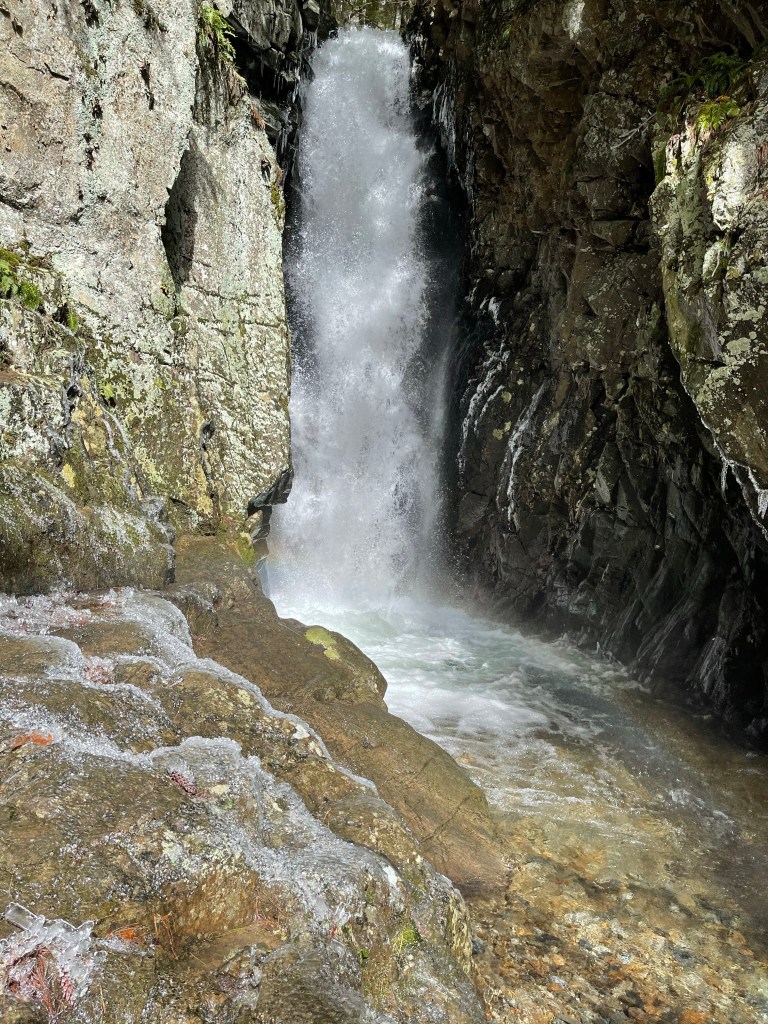
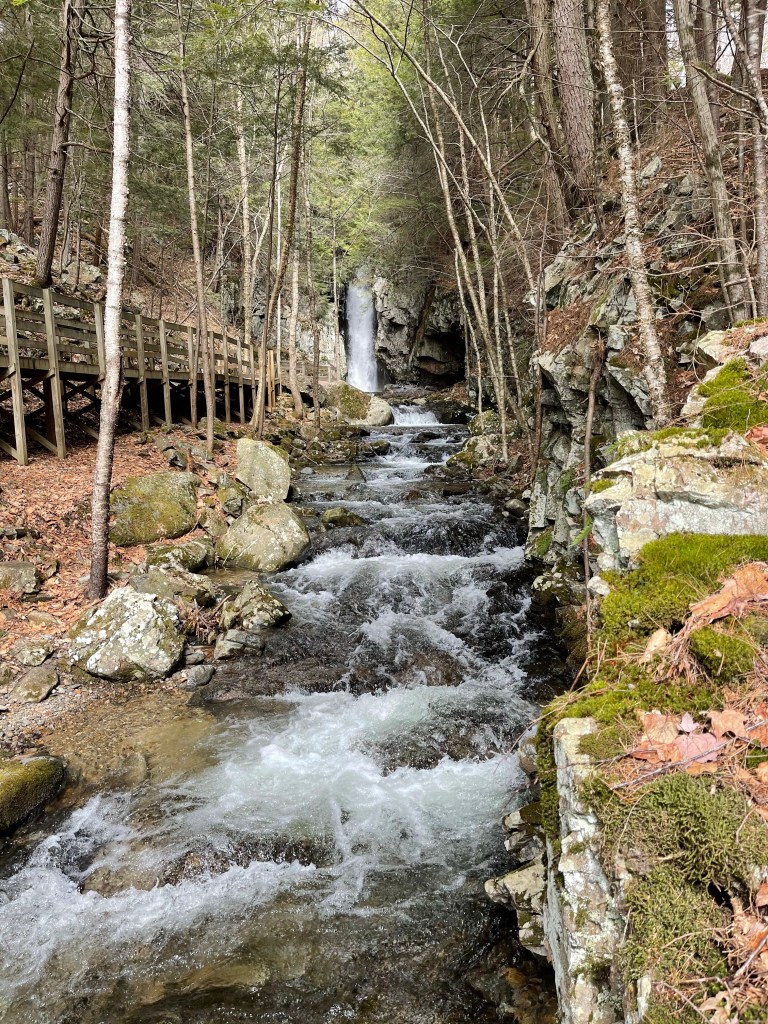
    The Fall of Song is an impressive 40 foot plunge through narrow granite walls. With recent rain they were singing with gusto, with an icy mist swirling into a rainbow in the afternoon sun. I appreciated the boardwalk for what it offers in accessibility for people who might not otherwise see Fall of Song, while thinking about how great the photo might have been without the boardwalk in the picture. So it goes.

    Fall of Song and Shannon Brook

    Not being one to settle for the easily accessible, I hiked up the trail above the falls to see them plunge from above, and then made my way up to Bridal Veil Falls just above Fall of Song. This second fall is one you have to earn, but in doing so you feel you’re in on a little secret that those who only visit Fall of Song never know. I tried several approaches to get to the best vantage point without being completely satisfied with any of them and have promised myself another visit to see them again.

    Shannon Brook, above Fall of Song with a glimpse of Bridal Veil Falls above

    There are several other falls above Fall of Song worth a look, with Bridal Veil being the prettiest. And you can spend a lot more time hiking this area beyond the waterfalls. For all my wandering further north in the White Mountains, the old volcano ring of the Ossipee Mountain range offers stunning vistas. This is a place worth returning to.

  • Good Soreness and Paying Dues

    This morning I stepped to the floor awash in good soreness after re-introducing kettle bell swings into my workouts. The workout started with a 5000 meter row, three sets of alternating two and one arm kettle bell swings, dead lifts and some dynamic stretching. Then a long, brisk walk on soft beach sand to really emphasize the legs workout.

    You know when your body needs a break, or at least you should know if you’re listening to it. Living with pain is a good indicator, signaling a need for adjustment to either your body or your routine. Pain is generally bad. But what do we make of sore? Exercise-induced soreness is the good kind of sore. It signals your body is adapting to change, flushing out lactic acid and repairing muscle fibers. And it signals dues paid towards a more vibrant tomorrow.

    Changing up exercise is a great way to keep the body guessing. Adding good stress to your body flushes out the bad stress, keeping that stack of organs and muscle you walk around with healthy. We intuitively know this, but most of us sit around too much anyway. If we know that sitting around too much is bad for the brain and the body, then we ought to get up and get moving more often, right? I tell this to myself all the time, but don’t always listen enough. I’ll present a convincing (if misguided) argument that I’ll get to it later. But later is just deferring our well-being. The body doesn’t care about your next meeting, it needs to move more often.

    “The more you move yourself by your own muscle power, no matter what form that movement takes, the surer you will be of the result.” – John Jerome, The Elements of Effort

    Jerome points towards the confidence that builds up inside of us when we do the work to build our better selves. Sports and nutrition guru Chris Carmichael calls people who are fit and vibrant as they age the defiant minority. We all know where we’re heading, but why not be fully alive when we get there? Adding a rigorous program of weight lifting or kettle bell swings to surprise the body offers day-after soreness but for-a-lifetime benefits. So embrace the soreness.

    “People who lead a physically active life have a lower risk of cognitive decline, and research is now emerging to show that greater fitness is correlated with maintaining better processing skills in aging brains.” – Sanjay Gupta, MD, Keep Sharp

    As I was finishing my workout yesterday I thought about the similarity between the kettle bell swing and a rock scramble in the White Mountains. The strength, endurance and mental toughness built through a workout like kettle bell swings translates well to other activities like hiking, offering yet another reason to add them to your routine. That soreness you feel the morning after a workout will translate well towards doing more, with less soreness, in those other activities you’ll do later. Pay me now or pay me later.

    And that pay me now or pay me later rule is really the point, isn’t it? If we continually defer our health and fitness through undisciplined exercise and nutrition choices now, we’ll pay for it with a shorter window of cognitive and physical well-being later. We’ll accomplish less in the time we have than we would if we’d simply invested in ourselves with exercise and disciplined consumption today.

    That soreness is yesterday’s glow of accomplishment. But today is a new day, requiring its own payment of dues. Keep the streak alive, pay today’s dues. Tomorrow will thank you.

  • Finding the Magic Behind the Ice

    There’s something uniquely foreign about the experience, akin to visiting an ice palace in a fantasy movie. Humans aren’t supposed to be in such places. At least that’s what we tell ourselves when we look at a waterfall from the front. And when it’s frozen in winter? Well, there’s something chillingly locked away in… there.

    Now, in case you’re wondering, this isn’t the first time I’ve been behind a waterfall. Like countless thousands, I’ve walked behind Niagara Falls and for the price of admission seen the roaring waters dropping away from the safety of a dim, well-engineered if soulless tunnel. Interesting, to be sure. But not magical.

    It’s clearly the ice. It forms a wall over the falls that announces, “sorry, closed for the season”. There’s beauty in the frozen stillness of a waterfall in winter, of course, but there’s a small part of you that feels betrayed by the ice. You hear the muted sound of water falling deep inside, and want for more.

    Enter Beede Falls in Sandwich, New Hampshire. In warmer months it’s a 35 foot horsetail of falling water with a popular swimming hole. In winter it’s an ice bulge, beautiful but seemingly as inaccessible as other frozen waterfalls. But this one offers a secret for those who dare. You can duck and crawl in behind the falls on the left or right side, and even crawl all the way through if you wanted to. For some less tall than me standing up is even possible.

    I wondered at the characters over the years who have crawled behind the falls in all seasons. I wasn’t the first on this day, and other hikers waited patiently for me to finish to have their own turn in the tight tunnel between granite, water and ice. How many humans have made this crawl over the thousands of years that this cave and waterfall have danced together? A lot, I suppose. But for a few minutes, there was only me and the ice and water.

    That’s where I finally saw the magic locked away behind that frozen blue skin. Deep behind the water is indeed falling, forming icicles and frozen bubbles successively grown upon each other to form otherworldly sculptures. And through it all that shower of water penetrates the center, surrounded by its icy shield and backlit by the daylight beyond. An incredible wonderland so foreign to me, so delightful, that I felt I’d gone to another world. And indeed I had.

    Beede Falls, behind her icy shield
  • Twice the Fun: Mount Israel & Beede Falls

    Not every amazing hike is over 4000 feet. In New Hampshire there are other lists besides the 4K list, lists like 52 with a view, which offers some beautiful views with a bit less effort than the 4000 footers. For a warm Sunday with snow melting into snowball-making consistency, a couple of friends invited me to join them on a hike of Mount Israel and for a bonus, a visit to Beede Falls, one of the waterfalls on my personal checklist to see in 2021.

    A bit of history is in order. Mount Israel is named for a settler named Israel Gilman, who lived near the trailhead for this mountain. There’s still an active farm near that trailhead, and it’s easy to imagine the land in the 1760’s when Gilman was walking around this place. Mount Israel is located in Sandwich, New Hampshire, which also has a bit of history in its name. The town of Sandwich is named for the 4th Earl of Sandwich, John Montagu, supposedly the inventor of the sandwich. Given that, I made a point of packing a sandwich for the hike, in honor of the Earl (or whomever it was, lost to history, who made sandwiches for him).

    The hike began at Mead Base in Sandwich, with a straightforward two mile hike up the Wentworth Trail. For those wondering about the name of the trail, a bit more history for you: Sandwich was founded in 1767 from a grant by Governor Benning Wentworth. Another name you’ll come to know is Daniel Beede, who was chosen to lead the settlement of Sandwich and granted 100 acres. Place names usually betray the history of that place, and if you look hard enough you’ll find Easter eggs like these on maps and street signs.

    I quickly fell in love with the Wentworth Trail. It winds through old growth oak and pine trees, with some tree trunks four feet in diameter – exceedingly rare around here. The snow cover acted as a spotlight on the biggest trees in the forest. I was smitten with one oak tree that had to be a witness to the transition from Native American land to English settlement. Further up, the trail wound around granite ledge and hemlocks, offering glimpses out to Squam Lake and the surrounding ridge line.

    The summit of Mount Israel is 2620 feet with 1900 feet of elevation. Despite its modest height relative to some of the other mountains in New Hampshire, it didn’t disappoint in views or the stunning beauty of the trail itself. Steep enough for a workout, short enough to give you time for other adventures. We made short work of the trail and before we knew it we were back at the trailhead at Mead Base and Act II.

    A half mile from the trailhead is another wonder worth visiting, Beede Falls, which is named after our friend Daniel Beede. The walk itself is wonderful, with granite ledge and scattered glacial erratics lining the edge of the trail. A large cave named Cow Cave offered a quick distraction. It was so named by some cows that decided to shelter inside the cave one day deep in the past. The cave was interesting, to be sure, but the real show was Beede Falls.

    In late February the falls were largely frozen, and we walked out on the ice that must be a lovely swimming hole on a hot summer day. The amazing part of Beede Falls in looking at them from behind. The falls froze solid in front, but you can access the back from the left and right side, and crawling behind them offered a magical trip into an icy palace. Water cascaded from the granite ledge, plunging between the icy wall you see on the outside and the cave formed behind. There’s just enough room to go all the way through it if you’re adventurous and don’t mind getting a little wet.

    In all our days on this earth, how often can you say that you got to see the world from the summit of a small mountain and from the crawlspace behind a waterfall in the space of a couple of hours? If you’re blessed with good health and mobility, then surely life is to be lived fully. Adventures like this one are within reach of most of us. All you’ve got to do is get out there.

    Frozen Beede Falls
    Ice wall in cave behind the falls
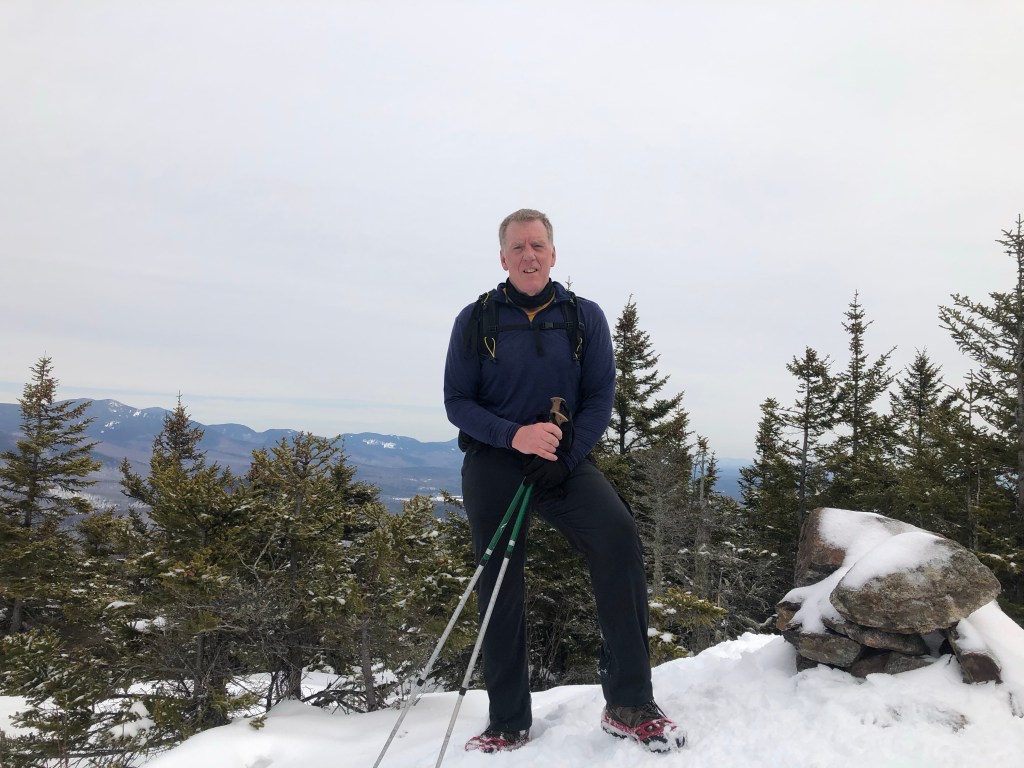
    Summit of Mount Israel
  • On New Paths

    What good is livin’ a life you’ve been given
    If all you do is stand in one place – Lord Huron, Ends of the Earth

    If snow transforms the landscape, then a walk in that snowy terrain transforms the winter walker. Add a new path and suddenly you’re seeing the world entirely differently than you had before. Add snowshoes and you’re suddenly set free to break off trail to see new places, explore animal tracks that run off into the woods, and to see what’s on top of a rise you might have walked by at another time of year.

    There’s a popular pursuit in hiking called red-lining, in which hikers hike every bit of every trail on a map or guide. A popular red-lining pursuit in New England is hiking the AMC White Mountain Guide. The whole point of red-lining is to explore new paths – to get off the crowded hiking trails and try something new. To do it, and to belong to a small group of hardcore hikers who have also done it. And add a measure of accomplishment and camaraderie in the world of hiking. I don’t see myself hiking every trail in the AMC White Mountain Guide, but I’m fully onboard with hiking new trails and seeing the previously (for me) unseen.

    On Valentine’s Day I explored trails previously unseen in a forest I’ve spent a lot of time in. Snowshoeing with friends, we walked a trail largely by ourselves to new places. When you’re on a new trail like that, every step is a discovery, every bend in the trail is a curiosity, and every trail junction is confirmation and validation of what the map was trying to tell you all along. There’s magic in taking that image on a map for a walk and making it real.

    The day after a long walk on new trails you start thinking about the trails at those junctions that you didn’t take. You wonder at what you might have missed down that way and begin to realize the allure of red-lining. For how do you want to spend your time in this world? Sticking with the familiar or exploring new places and challenging yourself in new ways? There are other paths that warrant exploration. I’ve seen them out there, if only on a map.

  • Hiking Cannon Mountain

    A flurry of texts over the work week from two directions with questions about hiking led to a decision to join forces for a hike of Cannon Mountain. On the one hand were the Perry’s, increasingly famous in the White Mountains for years of summiting mountains and red-lining trails. I don’t recall a hike in the last couple of years where they didn’t know at least one person on the trails. And a text from my niece Kellyn offered a nice treat, with her deciding to hike with us as well.

    Cannon Mountain is an old granite mound that’s famous for a sheer rock face that once held the Old Man of the Mountain until it collapsed in 2003, and for the tram built to promote tourism and skiing on the mountain in 1938, making it the first passenger tramway in the United States. The Old Man of the Mountain gave this granite mound its first name, Profile Mountain, but eventually its resemblance to a cannon from some vantage points let to what we’re familiar with now.

    So the stage was set for four hikers to set out on a cold February 13th morning for a hike from Lafayette Campground. We chose the Lonesome Lake Trail, with three of us starting in micro spikes on the snow-packed trail. Our fourth hiker stuck with snowshoes the entire time. The conditions on the popular trail made either option fine. As with other hikes, you quickly know when it’s time to put on the snowshoes. For us that was when we took the largely unbroken Dodge Cutoff Trail over to Hi-Cannon for the hike up to the summit.

    Lonesome Lake is a beautiful lake sitting in the bowl of Cannon and the neighboring mountains of the Kinsman Range. It’s a destination of its own, and plenty of people hike up to see it, walk on the frozen lake for the beautiful views it offers, and then hike back down. But you don’t summit mountains when you turn around halfway. We powered on, snowshoeing through a wonder of marshmallow trees up the steep trail. There’s one ice-caked ladder on Hi-Cannon that I’ll always remember for the limited footing options presented to us, but we all got past it with a little help and a dose of courage.

    The thing about summits is they tend to be much colder when you’re exposed to the wind and you stop moving. Sweaty gloves quickly freeze up, making a change a requirement to keep your fingers working. We considered the observation tower for a few minutes and opted to just hike down to the ski resort’s Mountain Station, where I’m told you can buy a beer at 4080 feet. I opted for hot chili and hot chocolate, with extra hot, thank you. It’s a rare day when you can summit a mountain and have hot chili waiting for you. We quickly warmed up and reached a point where if we didn’t get going we might choose to close out the place. Onward.

    Crossing a ski trail is akin to crossing a highway. You judge the oncoming traffic, decide whether your speed can overcome the approaching traffic’s speed and go. We quickly crossed over to the trail back to the summit observation deck, crowned the summit and began our descent using the Kinsman Ridge Snow Chute, er, Trail. On the map, 4/10’s of a mile of hiking, but a lot of squiggly elevation lines stacked up in a small space. We butt-slid down large sections, my snowshoes were more telemarking skis on other sections, and we all collected snowy memories that will make great tall tales someday.

    On one of the butt-sliding sections I lost a water bottle. It wasn’t until we’d snowshoed across Lonesome Lake and I changed to micro spikes that I realized it. My disappointment at losing it turned to delight when we got to the trailhead and someone who’d found it and beaten us down the trail while we lingered at the lake had left it sitting on a post waiting for me. Good hiking karma right there. It was hard to come away with anything but positive vibes after hiking Cannon Mountain on a pristine winter day. A solar halo signaled goodwill to all. A very good day indeed.

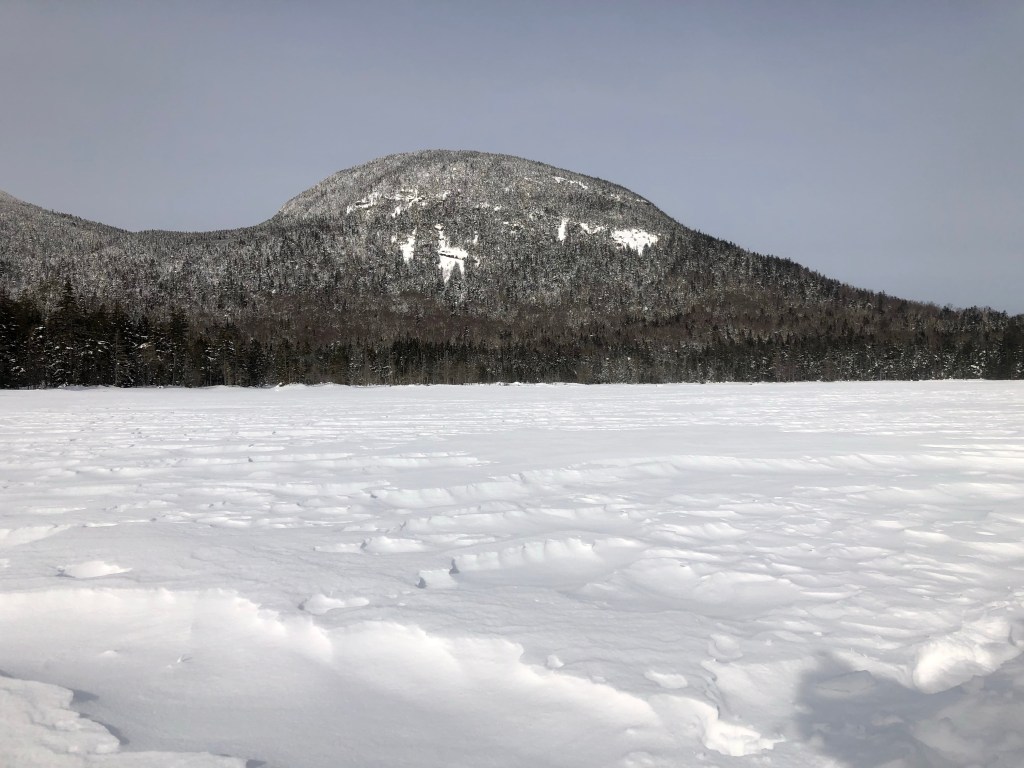
    Cannon Mountain from Lonesome Lake
    Solar halo through the frosty trees
    Lonesome Lake with Franconia Ridge beyond
  • Joyful Walks

    Now shall I walk
    Or shall I ride?
    “Ride”, Pleasure said;
    “Walk”, Joy replied.

    Now what shall I —
    Stay home or roam?
    “Roam”, Pleasure said;
    And Joy — “stay home.”

    Now shall I dance,
    Or sit for dreams?
    “Sit,” answers Joy;
    “Dance,” Pleasure screams.

    Which of ye two
    Will kindest be?
    Pleasure laughed sweet,
    But Joy kissed me.
    – William Henry Davies, The Best Friend

    Joy and pleasure sound similar, but joy is something you can build off of, while pleasure seems more, well, short term. In the forever competition between Pleasure and Joy it’s interesting to note that walking is solidly in the corner of Joy. I’m at my best walking, and fill with joy in those moments on a trail or in the quiet places in the world. I know I’m not alone in this respect.

    What makes walking so positive for the mind and soul? Something in the rhythm of walking long distances clears the fog. Reboots the brain. I don’t have a lot of eureka moments walking, but I’m always better for having done it.

    Today was filled with miles of joyful walking. A poem like the Davies poem above hits you differently when you’re blissfully tired and sore from miles on the trail. Don’t get me wrong, pleasure is nice too, but today belonged to joy. And it started with a long walk.

  • A Measure of Health

    “Nature says thou shalt keep the air, skate, swim, walk, ride, run. When you have worn out your shoes, the strength of the sole leather has passed into the fibre of your body. I measure your health by the number of shoes and hats and clothes you have worn out. He is the richest man who pays the largest debt to his shoemaker.” – Ralph Waldo Emerson

    Those Concord folks were walkers, weren’t they? Ralph and Henry wandered about, wearing out shoes and building big thoughts. There are a couple of versions of that Emerson quote above, but some online research makes me believe these were his words. I like the alternate quotes just fine, but when I start quoting people I’d like to have it right. I love the idea of transferring the strength of the shoes into the fiber of your body. It applies just as well with shoes as it does time and sweat equity invested in other worthwhile things.

    I’m wearing out shoes more quickly lately. My feet took a beating last year, ankles and knees too, but they merely paid it forward to my heart and soul. Over time the body adjusts and stops complaining about taking another step and just goes. It’s a bit like writing and washing dishes and making the calls, you just teach yourself that there’s joyful bits in every moment of doing.

    I’m a collector of joyful bits. On my deathbed I won’t regret not finishing Breaking Bad, but I’ll surely regret not seeing the Northern Lights or the Southern Cross should I not see each. The last year is a reminder to not take mobility for granted. Wearing out more shoes seems a great goal for our next normal. The correlation seems apparent. Wearing out your gear is an easy measure of your physical and mental health. So lace up; we have places to go.

  • Encountering Darshan

    “‘There’s a Sanskrit word, darshan,’ Jon said as we gazed up at Konka. ‘It suggests a face-to-face encounter with the sacred on earth; with a physical manifestation of the holy.’ I hadn’t known the word, but I was glad to have learnt it. Darshan seemed a good alternative to the wow! that I usually emitted on seeing a striking mountain.”Robert Macfarlane, The Old Ways

    Waterfalls and sunrises and mountains and ancient trees are a physical manifestation of the holy. And so is the ripple across a calmly rolling ocean betraying a puff of wind. And the Milky Way on an especially dark and clear night. The catch in my throat when I see these things is spiritual, more than any church I’ve ever walked into, and I go out of my way to seek them out. Admittedly, I haven’t been to the Sistine Chapel yet, but I’m not convinced you can’t find the same thing walking deep into the woods.

    I stumbled on the quote above from Macfarlane and immediately identified with darshan in this context. I read this book almost eight years ago and keep returning, skimming over magical phrases and bucket list places. But in the end the book is about standing up and walking out to find yourself in the world. To come face-to-face with the divine requires inspired effort. Sweat equity in your spiritual education. Getting out there and in it.

    And yet… One of the most beautiful waterfalls I’ve ever seen is She-Qua-Ga Falls in Montour Falls, NY. It felt like cheating when I arrived, because you essentially drive right up to them. The falls are framed by houses and a concrete lined basin below and an arched bridge above. Like Niagara Falls humanity encroaches on the beautiful, threatening to edge it out in the process. But truthfully I don’t see those things at all; I look at the timeless waterfall captured there, like a rose under glass. And I see darshan.

    There’s a tendency for people to see something beautiful and immediately try to put a stake in the ground there. The Eagles wrote about this in The Last Resort. Houses lined up on the edge of the beach grabbing a share of sunset and water views. Homes mounted atop mountains to maximize the view while killing it for those looking up at the mountain they’ve scarred with a box. I visit a house with a great sunset view as often as I can, and would be a hypocrite if I were to condemn those who build for the view. For all the beauty we see from that house by the bay, I know that the view from the water or from the other side of the street is a row of houses. So I take no issue with the people who built Montour Falls for edging up to the falls and wanting to linger there, but wish the land around the falls had been preserved in its original state. Then again, the falls are beautifully accessible for those who can’t hike deep into the woods. Darshan on display for everyone. And maybe that’s enough.

    The network of trails and rhumb lines that weave across the Earth like a tartan reveal the whispers of those who came before us. There’s very little that hasn’t been seen by someone before us except in the most remote corners of the planet. But who said encounters with darshan must be exclusive anyway? Each human making their way in this world looks for something greater than themselves. Encounters with darshan are uniquely ours alone, even when shared with others we internalize it differently. But what is darshan if not seen through the lens of our mortal human perspective? We seek it out, discover something in ourselves, and try to capture the divine with a few inadequate words and pictures. And honor it as best we can before leaving it for others to discover in their own time.

  • Traction and Comfort in Winter Hiking

    The last day of January felt like it should throw up challenging hiking in New Hampshire. In fact the temperature read a solid -4 degrees at the start. But the truth is that if you aren’t breaking the trail it’s comparatively easy. The snow pack on popular trails covers up a lot of the erosion and exposed granite ankle biters that are a normal part of hiking in the White Mountains. You simply trade the pounding on your lower extremities for a different pair of challenges: traction and hours of walking with your toes pointing up.

    Think about a groomed ski slope, all corduroy and pristine. Perfect for skiing down, but imagine walking to the summit straight up that slope. How do your feet grip? How does that angle feel on your ankles and calves after about an hour? That’s the dilemma of the hiker on a snow packed trail. Snowshoes and descending butt sliders press the snow down into a version of that groomed slope, albeit it two feet wide. Step six inches off trail and your foot plunges down two feet into the abyss.

    Overcoming such challenges requires mechanical assistance. On the one hand you have micro spikes; one of the best inventions ever for handling winter traction issues. I’ve gushed about micro spikes before and generally they’re perfect for frozen packed snow. They become more challenging when the snow softens and begins to ball up under your feet. Walking on snowballs is just as enjoyable as it sounds. Another consideration is ice. I feel comfortable walking on ice with micro spikes on, but not walking up a slide with them. Trusting rubber bands with your general well being has limits. And this is where an upgrade is in order.

    A step above micro spikes are crampons, which offer more traction with a deeper spike designed to linger in your nightmares. I see crampons and think about those times I accidentally kicked myself in the back of the leg hiking in tight terrain and shudder. But then I recall a story I read about a guy who stepped out of his tent to take a leak hiking Everest or some such place. He made the unfortunate decision to not put on his crampons and promptly slid down the mountain screaming to his death. Crampons are made for comfortable late night relief in such conditions. Truthfully, I tend to avoid most “icy slide nightmare” hiking, but sometimes you run into spots where it would be the better choice. On Mount Liberty a couple of days ago I wished I’d had them a few times as I kicked my micro spikes into frozen snow hoping for footing.

    And then there are snowshoes, used by generations of people trying to get from point A to point B without post-holing every step along the way. Snowshoes have come a long way, and the best of them have crampon-like steel spikes protruding from them and a wonder for the sloped uphill hiking conditions: the heel lift. A heel lift is a metal hinge that flips up to offer welcome support for your heel. It effectively levels your foot on a slope, creating a more comfortable hiking angle. Snowshoes come in different sizes based on your weight and the type of snow you’re hiking it. I have a great set of Tubbs snowshoes that are perfect for fluffy powder walks in open terrain. Being a tall clydesdale my shoes are 36″ long, which makes them a challenge on tight trail hiking. And with the trail compacted it’s simply easier to stick with the micro spikes or crampons. Using shorter snowshoes for compacted snow would offer the best of both worlds.

    There are times when you might put all three on in the same hike. I didn’t bring crampons on my last hike but wore the snowshoes for an hour during a steep ascent in packed powder. My hiking partner that day chose to stick with micro spikes on the ascent and flew up the hill with me gasping to keep up with the extra burn of snowshoes. When I conceded and switched back to micro spikes our hiking speed equalized again. He wore his crampons on the descent while I wore micro spikes. In softening snow broken down by many hikers at that time of the day it was a toss-up. Had it been frozen and compacted as it had been in the morning the crampons would have been better.

    Ultimately accessories are successful when you start with a great pair of boots, pick the right accessory for the terrain, and are willing to switch on the fly when things change. Another truth is that if you don’t get out there in it, none of this matters. Winter is meant to be lived in fully. Being shut up in the warm house might be comforting, but don’t we spend way too much time in our houses now? Step out there. Just wear the appropriate gear.