Category: Hiking

  • Encounter with a Snowshoe Hare

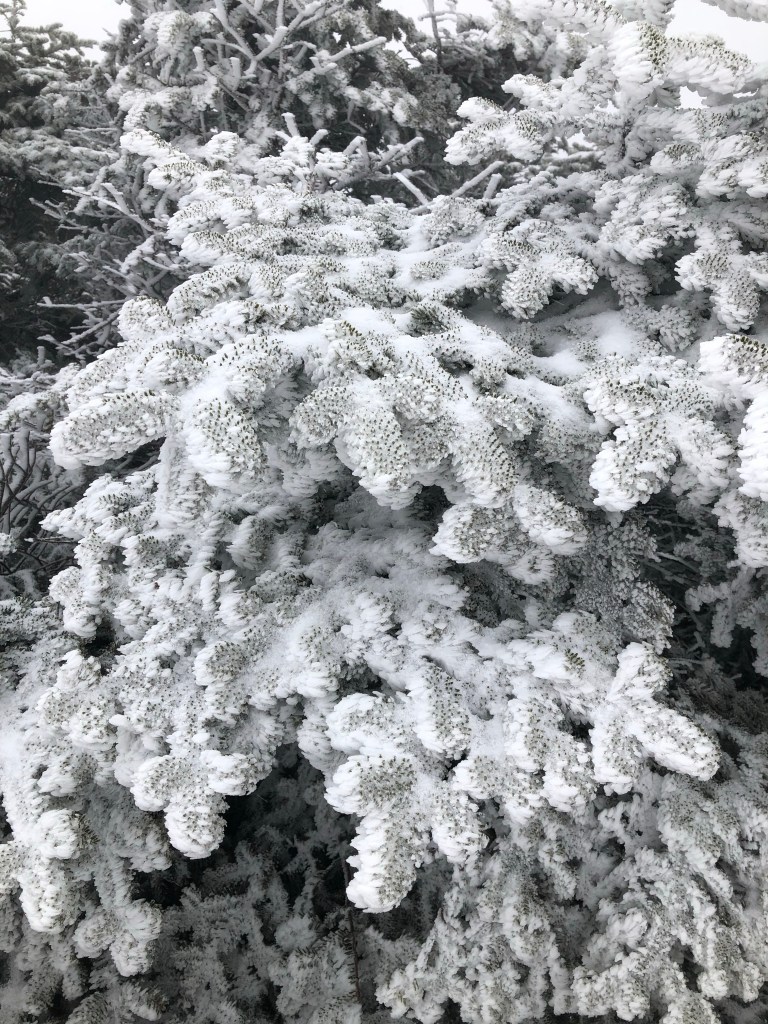
    The snowy and windy summit of Mount Moosilauke wasn’t a place to linger long. We’d summited and were about to head down below tree line to have lunch when I saw some rime ice building on a cairn and took my iPhone out to snap a couple of pictures of it. Just then I heard a shout from a couple of hikers nearby and a flash of motion. One of my hiking buddies shouted “It’s a Snowshoe Hare!” and a quick glance confirmed it was indeed. With the camera already on I was able to snap a few photos as the hare bounded around me and towards the cover of trees.

    Snowshoe Hare

    The Snowshoe Hare, with the excellent Latin name Lepus Americanus, is native to New Hampshire and loves throughout North America’s colder regions. Its hair turns from brown to white in the fall, triggered by the change in light just as leaves are. The hare I saw looked huge, but it was probably about 5 pounds, which is on the heavier side of their weight range. The distinctively huge rear paws act like snowshoes to launch the hare forward. It was literally born to run in snow.

    As we descended from the summit we wondered what the heck the Snowshoe Hare ate in winter. Looking around there just wasn’t much edible stuff around. According to a State of New Hampshire survey on the animals, they eat up to 2/3 of a pound of “woody browse” per day, and also re-ingest their soft droppings…. yum. May have been better to leave it a mystery.

    Seeing a Snowshoe Hare running through snow in the wild is absolutely thrilling. The only thing more thrilling would have been seeing a lynx or fox chasing after it in a high stakes race. Nothing like that today, just a bunch of appreciative hikers buzzing about the blur of white fur that graced us with a speedy show. And it proved that when you get out there you may just see something amazing.

  • Agamenticus Sunrise

    “It is a serious thing
    just to be alive
    on this fresh morning
    in this broken world.”
    – Mary Oliver, Invitation

    I woke up twenty minutes before the 4:30 wake-up call and contemplated skipping the planned sunrise hike. But I wouldn’t skip an early morning business flight, so why skip on this? With no good answer I got up and dressed in the dark.

    Driving an hour, it stuck me how many people were already up. Cars lined up at a traffic light heading to some job or other, while I drove the opposite way. I had work to do today as well. But first this. Arriving at the access road, I read the sign informing me the gate wouldn’t be open until 7 AM. I was the only car in the lot next to the gate to start this sunrise trek. Others would follow soon enough.

    I geared up and started hiking the half mile up the road. Hard to even call it a hike… a brisk walk up the hill? Semantics don’t matter, the destination did. It was already brightening enough that I could slip my headlamp into my coat pocket. This walk would be just enough to warm my core for the cold breeze at the summit.

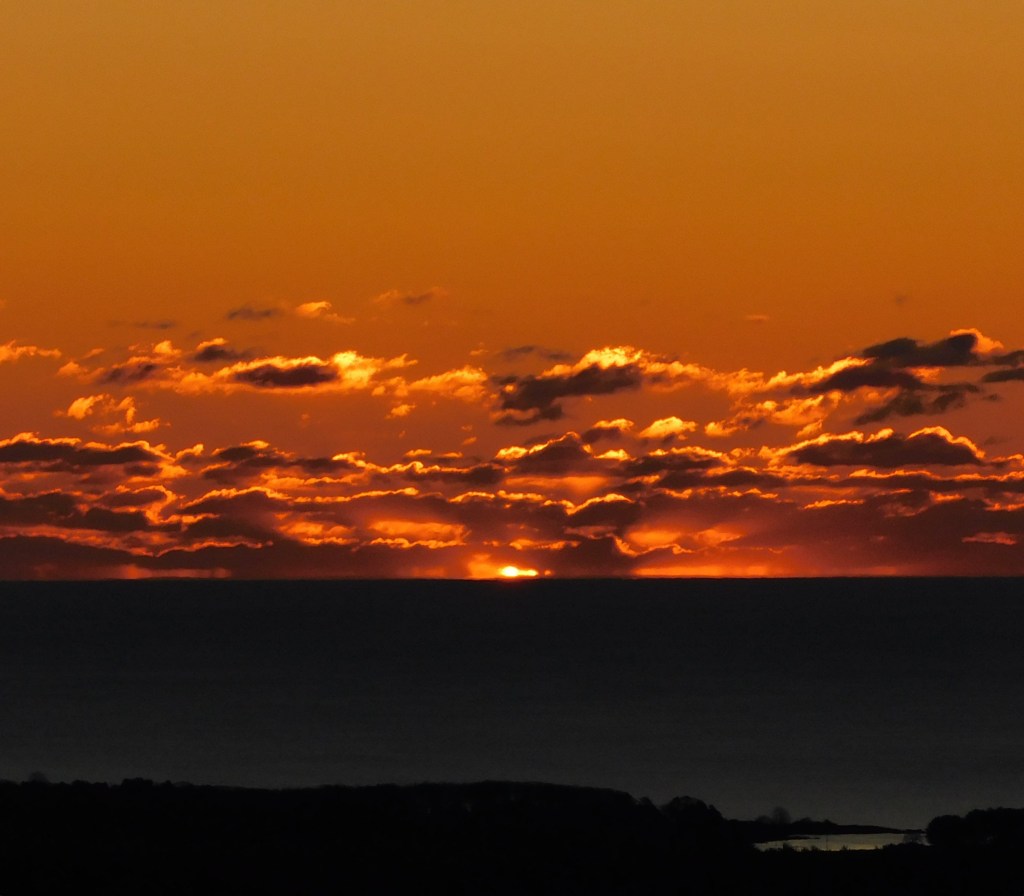
    Mount Agamenticus is an old mountain, worn down by time. It’s more of a hill now at 692 feet, but does have a prominence of 522 feet. But 220 million years ago it was part of a 20,000 foot tall volcano. They say it was once part of Africa. Now you look out and see the Atlantic Ocean and a long way to the continents that were once joined. A lot can happen in 220 million years; continents shift, mountains erode, people come and go. That’s what? Eight billion sunrises? For the sun and for this mountain it was one more in a long string of greeting each other.

    This morning it was my turn in a long succession of people standing atop this old volcano gazing out at the sun rising to begin another day. Billions of sunrises and this morning I got to share the reunion between the mountain, the ocean and the sun. And it was indeed a serious thing just to be alive to see it.

  • Beaver Paint and Population Growth

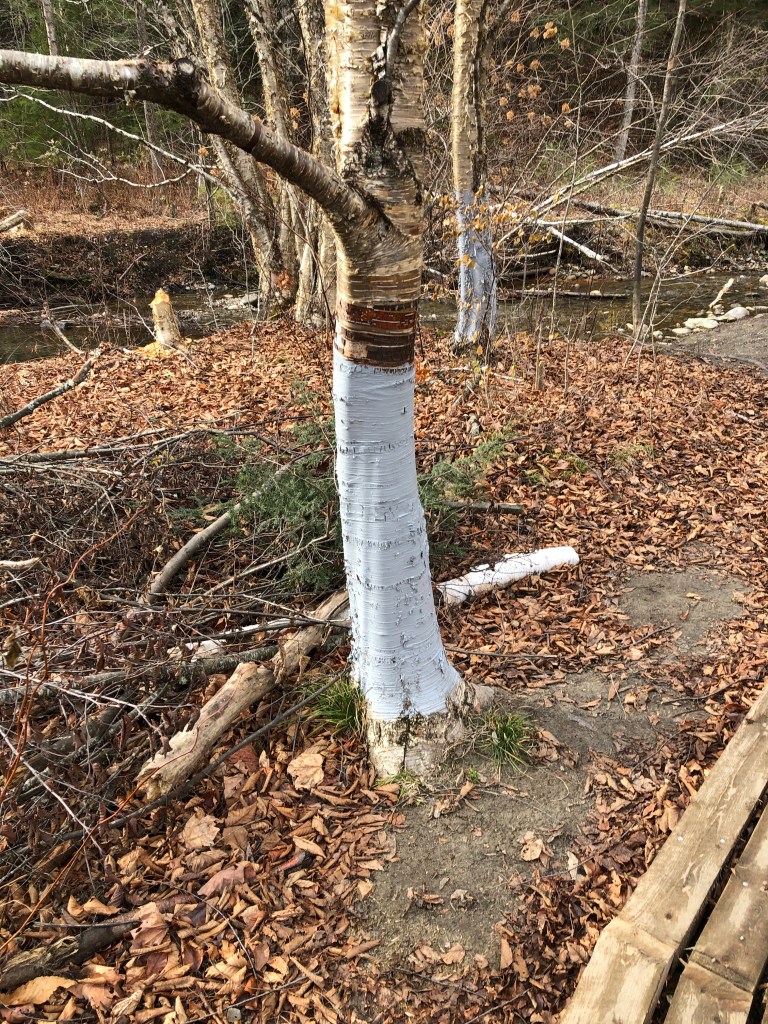
    You know right away when you see it. The trunk of a beech tree painted gray for the first four feet from the ground. But not every tree, just certain designated survivors. The rest are up to the whims of fancy. This is beaver country.

    The paint itself is latex paint, the color doesn’t matter to the beaver, but it does to us. Something that somewhat matches the tree is a nice touch, with enough contrast to recognize from afar that that’s the painted one. But paint alone doesn’t do enough to turn off the beaver, according to the Beaver Institute (!) you’ve got to mix in 20 ounces of mason sand per gallon of latex paint. That makes the bark an unpleasant sandpaper texture that even the hungriest beaver is going to turn their nose at. And in theory that saves the tree.

    Humans and beavers don’t always get along well. They were relentlessly hunted by Native Americans for trade with Europeans in the early 1600’s, and those Daniel Boone hats made a fashion statement even as they kept your head warm and dry. Beaver trappers and hunters wiped out the population in New England and New York over the next couple of centuries.

    According to an interview I read with Ben Goldfarb posted on NENC, there was a time in the early 1900’s when they tried to reintroduce the beaver to New England but simply couldn’t find any active colonies to build off of. They tried New York and they didn’t have enough either. So they acquired some Canadian beavers and some beaver from Yellowstone and relocated twenty of them to New York. Eleven years later they had 15,000 beaver and the population has skyrocketed since. Beavers can have 3-5 kits during the winter months, so that’s some serious beaver mating to achieve that kind of exponential growth.

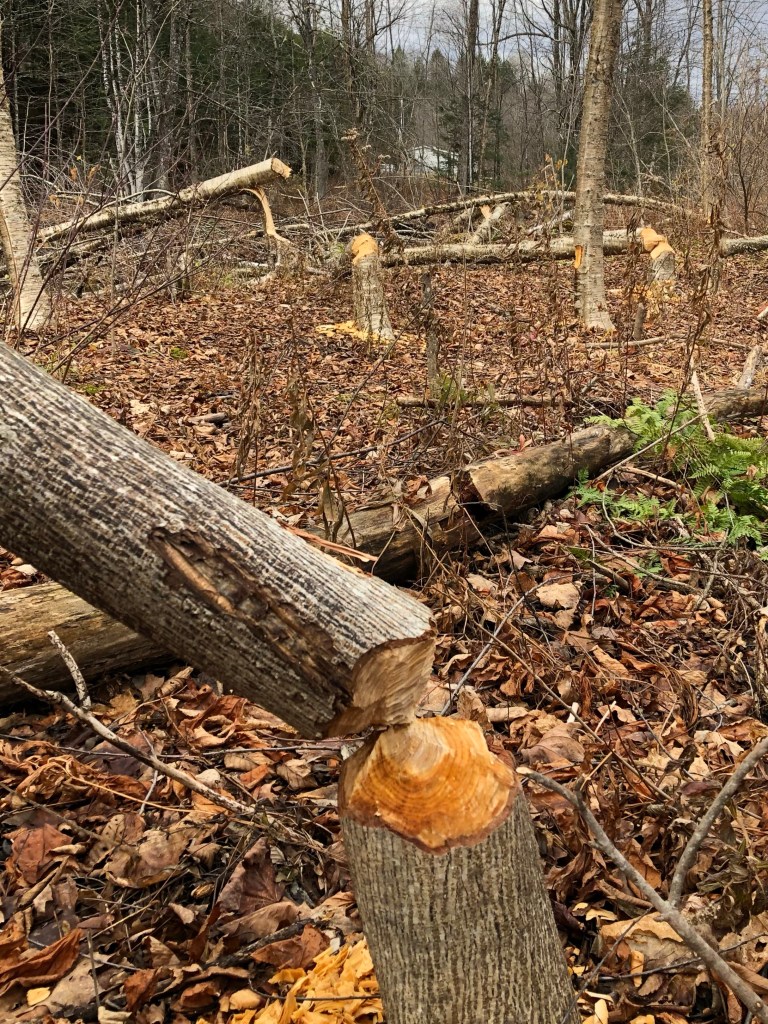
    They don’t just gnaw them down to make nests; this is their food source. Beaver range in size from 30-100 pounds, and they need to eat to keep that beach body. The average beaver eats about 200 trees per year, from saplings to the bigger trees. They prefer aspen, alder, willow and other soft wood deciduous trees. That’s a whole lotta trees. So proactively painting a few with that paint/sand mix is a good way to preserve a few of them while offering up the rest as sacrificial lambs.

    I wondered at this as I walked amongst the trees along the Moss Glen Brook in Vermont over the weekend. The beaver were clearly busy stocking up their food supply for winter, with several downed trees scattered about near the brook. And here amongst them were the designated survivors with gray paint and sand mix. A wonderful curiosity that demonstrated the health of the beaver population in this area. Welcome back.

    Designated Survivor
    Beaver Food
  • A Weekend at The Trapp Family Lodge

    The cow outweighed me by more than 1200 pounds and had long horns protruding menacingly to her right and left, but I edged closer anyway. Bob, the Activities Director at The Trapp Family Lodge, insisted that it was safe to walk out amongst the Highland Cows. He gave us instructions on what to do if they approached us looking for apples (fold your hands into your body and turn slowly away to show you don’t have food). And he told us when one of the cows was annoyed with us. Otherwise, we were turned out to explore the field. Turning around, I realized I was one of the few who took him up on the offer. But risk has its rewards, and being close to the cattle was thrilling.

    Highland Cow

    I’ve been to Stowe, Vermont many times over the years. Mostly I’d drive up for Heady Topper beer, look around a bit and dream of lingering awhile. I’d even stopped to visit the Trapp Family Lodge, walking into the lobby to see what all the fuss was about. Like most Americans I’ve seen The Sound of Music a few dozen times. This wasn’t the Austrian Alps, but you can definitely see why they sank their roots here. The hills are alive in Stowe too.

    The Trapp Family Lodge is a lovely place, with fires roaring and pilsner flowing freely from taps and a quiet elegance without pretense. Pictures of the family decorate the walls throughout the lodge along with art derived from the story of the family’s escape from Nazi Austria. The mountains surround the property in all directions, and the von Trapp family owns much of the land and has donated many more acres to a land trust, ensuring this view would remain largely as it’s always been.

    We’d explored some of that land on our first day at the Lodge, walking the trails to find the Chapel at the top of the hill, and circling back to check out the Kaffeehouse for a snack. There are hiking and snowshoe trails criss-crossing the woods at the resort, and we had plenty of options for getting to know the lay of the land. Mountain bikers had their own single track trails that offered challenging terrain to explore. And wide cross-country skiing trails waited patiently for the snow to arrive. This was an outdoor enthusiast’s paradise. The outdoor hot tub and spa is a great reward for having done the work.

    After meeting the Highland Cows we walked back up the hill to the Lodge, with massive ravens flying about us speaking a sophisticated language of their own. I wondered at the banter, and wished we had more time to get to know them better. But we had other places to explore, and a long hill to walk back up. It seemed the cows were on the furthest pasture from the Lodge, and we had to earn our visit. It worked out to be about a mile each way, and a good way to work off breakfast with a different vantage point.

    We made a quick trip to downtown Stowe to explore the shops and made a stop at The Alchemist to pick up our Heady Topper beer order curbside before returning to the Bierhouse for lunch and a pint. We made a point of saving room in the cooler for some von Trapp beer as well. The Alchemist helped make Stowe the heart of New England IPA country, but the von Trapp’s make a great case for pilsners with their brews. This wasn’t some mass-produced American lager, this was beer with substance.

    Brewing at von Trapp is serious business

    As luck would have it, the woman who seated us was Kristina von Trapp, the granddaughter of Maria and a Director of the resort. She was a gracious host, with a striking presence about her borne of her family celebrity but honed on an active life outdoors and running a successful business. She wasn’t quietly sitting in the corner office looking at spreadsheets, she was hands-on and engaged with the public. And that made the von Trapp experience all the more impressive.

    We resolved to come back here again in the other seasons. Stowe is beautiful year-round, even on a cold November morning when the trees are bare and the snow is just hinting that it might return again. Staying here in all four seasons seems a worthy goal. And it will help keep the refrigerator well-stocked too.

  • Mountains and Waterfalls

    A weekend in Vermont stirs the imagination, and Stowe is famously rich in beauty, romance and adventure. As with so many other places, the magic crackles and sparks here on the edges of the day. Days are filled with adventure, nights a starry dome. The edges in between are when the light dancers march across the mountains and leap and twirl in the sky. In the morning the mountains are jagged black walls that holds the rising dawn back from our eager eyes. At dusk the mountains turn ember-red as they reach for the last rays of light. My iPhone screen mocks my attempts to capture it, but try I must.

    We stayed at the Trapp Family Lodge to get the full Stowe experience. The lodge is lovely and full of the amenities you’d expect at such a place. For me the abundance of hiking trails just outside the door were a nice incentive to stay here. The spa, Bierhall and Kaffeehaus all spoil the senses. But if you’re in Stowe get your ass outside.

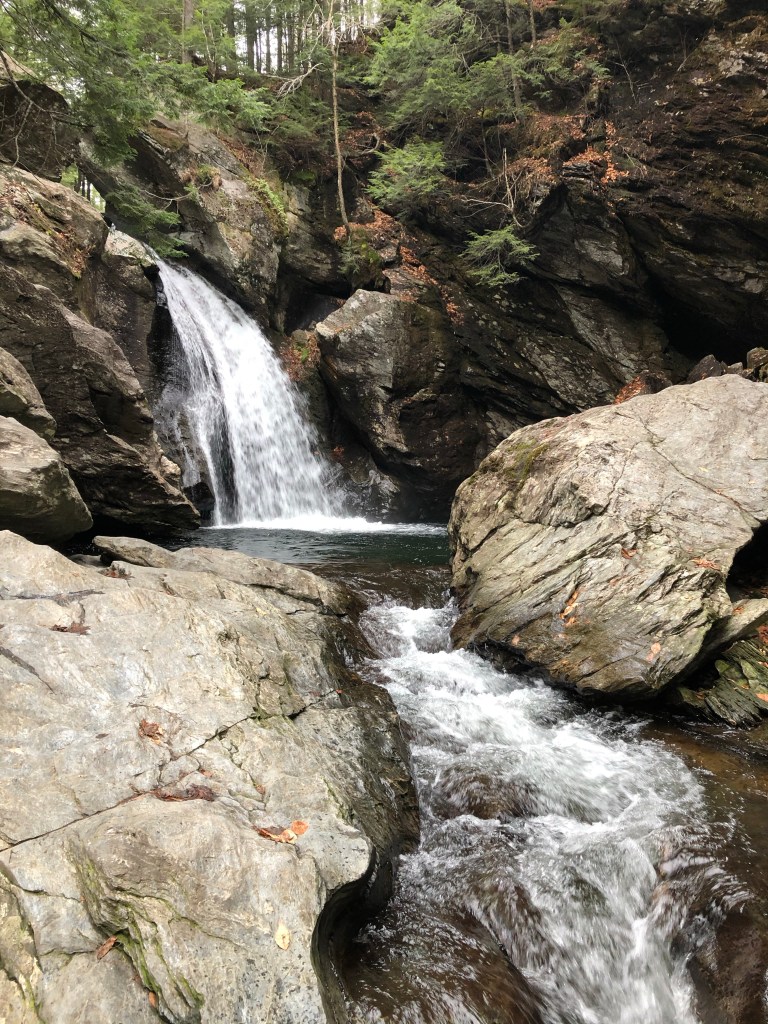
    Hiking options are everywhere here, but we wanted waterfalls on this trip. Stowe has a couple of waterfalls nearby that are well worth the quick hike to see. Moss Glen Falls are a tumbling cascade framed by hemlocks. It’s an easy ten minute hike from the car to the best viewing point, and I smiled at how over-prepared we were for a much longer trek. The falls are postcard perfect, and worth a visit on quiet days when the tourists are elsewhere.

    Bingham Falls are near Smugglers Notch with a beautiful waterfall falling into a pristine pool worth the descent. What goes down must go up, and the walk up isn’t as bad as you think it will be after descending a couple of steep, muddy stretches. A few people have died falling into the gorge here, and it’s easy to see how. Nothing separates you from a plunge into the gorge but your own awareness. Not a place for little kids to run unattended.

    Mountains and waterfalls pair well together, and I greedily seek out each. I often wonder why there aren’t more visitors when I come across beautiful places, but usually it’s because I go when the crush of visitors ebbs. Like the mountains at sunrise, waterfalls whisper to you when there’s nobody else around. But only if you’re there to listen.

    Moss Glen Falls
    Bingham Falls
  • Past Peak

    Normally this weekend in New Hampshire is peak foliage season. But a sustained drought has stressed the trees just enough to pull peak ahead by two weeks. So the thousands of people plugging up the roadways of the Mount Washington National Forest were seeing the forest muted in dynamic impact. And yet they came. And they saw enough. For the mountains offer their own ruggedly stunning backdrop. I considered the tourists on my afternoon commute home from a day of hiking. Clusters taking a photo next to the roadside sign announcing you were in the MWNF, picture-taking all around you. Cars parked in odd assortments along the sides of the road, as if clung together by magnets the way the metal dust would clump together in the old Wooly Willy toy would clump into beards and eyebrows with a magnetic stick. Funny what you think about when you observe tourists in the wild.

    To be amongst the mountains is relatively easy when you live in New Hampshire. Less so, I suppose, if one were to live in Florida. But they have that tropical water hugging them on three sides, and I suppose the amusement parks and fresh oranges to consider too. But you can’t swim in a pond in Florida without risk of being dragged down by an alligator. There are no alligators in the mountains of New Hampshire. Maybe the occasional bear or mountain lion, but they mostly want the food in your pack, not you as food. The bigger threat to your well-being are the damned rocks. New Hampshire is the granite state, and as if to hammer that point home every trail is worn down to ankle-bending, knee-twisting rock. And in October those land mines are covered over in a bed of beautiful leaves. So a descent becomes a shuffle of sorts, as you work to avoid catastrophic injury on remote yet well-traveled trails.

    I have a friend who points out my tendency to pick overindulgent goals for myself. Really though; all my friends point this out. Like rowing a million meters on an erg in three months, or taking my family on a hike up the toughest mile of the Appalachian Trail, or peak-bagging three out-and-back peaks in one day, as I did yesterday with Mounts Willey, Field and Tom. I might have taken a hint from my hiking pro friend who refers to these three as the WTF hike. I chose to experience it on my own, with an extra helping of previous injuries I was nursing. WTF indeed.

    The morning after a hike like the WTF hike, the first step is to get out of bed without incident. Plant your feet and gradually put weight on the ankles and knees that you abused so ruthlessly the day before. Assess how much they resent you, and then shuffle to the bathroom for relief and some Motrin. This isn’t a walk of shame as much as a recognition of all you’d done, in the form of some tender moving parts and sore muscles. And I wonder in those moments of truth, am I past peak myself? Or simply overindulgent? I’d like to think the latter. All I can do is keep moving. Perhaps with a bit of moderation next time. I suppose that’s a perfectly reasonable request.

    Past Peak
  • Hiking Mount Willey, Mount Field and Mount Tom (and Back)

    I didn’t think this one through enough. An out and back using the same trail to hike three 4000 footers necessarily means you’re actually hiking five 4000 footers in a day. Ambitious. A bit reckless. A bit exhausting.

    10 miles round trip, with 4400 feet of elevation gain seems easy on paper. In practice the rock scrambles and ladders bridging impossibly steep sections made it a test of willpower. Some of those rock scrambles were borderline ladder territory as well. As wake-up calls go climbing the Willey Range Trail served as a good one. My heart was racing and my layers were shedding in no time. My mood bounced between exhilaration, despair and frustration with myself for not planning this hike a little better. But it was a quickly drafted plan B, and in hindsight, a good hike. Even if I wasn’t mentally ready for it.

    Mount Willey is 4255 feet tall and named after Samuel Willey and his family, who were killed in a landslide in 1926. Mount Field is 4327 feet and named after Darby Field, who made the first known ascent of Mount Washington in 1642. Mount Tom is 4052 feet tall and named after Thomas Crawford of Crawford Notch fame. The three peaks are relatively tame, other than the hike up the Willey Range Trail to the summit of Mount Willey. Approaching from the south, Willey is a tough ascent. It also makes a challenging descent. Starting and ending my hike with this trail set me up for a tough day. But I finished relatively healthy. And healthy with three more 4K’s checked off is enough for me.

    If you go, consider an approach from Crawford Notch or Mount Hale. The people who I ran into didn’t seem to have the same endurance test of ascending the Willey Range trail. For views, Willey and Field have some good observation spots, Tom not so much. But views are only part of the story. Finishing this hike and summiting these three 4000 footers was its own reward.

  • Hiking The Beehive

    As hikes go, The Beehive is everything you’d want and wouldn’t want rolled into a quick hike. Looking for diverse terrain, stunning views and challenging but non-technical climbing? Beehive. Long lines cued up waiting for people to overcome personal fears of heights? Also Beehive. You either embrace them both and treat it like a Disney ride or you go elsewhere. But it’s a hike worth doing either way.

    Expecting large crowds is part of every Acadia National Park experience. As with Cadillac Mountain, Thunder Hole, Bass Harbor Head Light and Jordan Pond you know what to expect. And sure enough, there they are. But the place is worth the trade-off in breathing space, and there’s always a little corner of the park you can call your own, if only for a few minutes. On Beehive we paused on the pink granite summit for a snack and water in relative solitude. Like a picnic in Central Park on a warm Saturday solitude.

    As for logistics, one thing I never thought I’d say on a hike: bring hand sanitizer to use after summiting Beehive. Those iron rails get used all day and we are in a pandemic. Parking is tight at the trailhead, so get there early. And since you’re sharing the same parking lot with Sand Beach you might as well get out on the beach while you’re there. Beehive, even with the waiting in line, is a short hike. If you want to extend your hiking experience after summiting take the Gorham Mountain Trail, or do as we did and hike the Good Head Trail. Both are less crowded than Beehive, but you’ll still have company. Sand Beach is worth the stop, whether you swim or not is up to you but that ultra-soft sand is worth experiencing.

    Beehive stays with you well after you finish. The iron rungs, the scrambles up granite, the stunning views of foliage, Sand Beach and salt water all through a kaleidoscope of swirling fog. And yes, the shared experience of hiking with hundreds of people, like the millions before you, all winding your way on this Pilgrimage with the ancient mountain.

    Wait your turn
    Just do it
    Dad and daughter mid-climb
  • In Search of a Border Marker

    In 1622 Captain John Mason was granted the land between the Kennebec River and the Merrimack River and the territory was named New Hampshire. The border with Massachusetts wasn’t the middle of the river, but a distance three miles north of the river’s shore. This made for an interesting, zig-zagging border that meanders along as the Merrimack River has from long before settlement by the English. That’s 398 years of continuous service as the official border between two similar yet completely different states. Barring wholesale changes in the borders that virtual sharp point should remain forever.

    Today, instead of eating lunch like a normal person I drove over to find the sharpest point on the border between Massachusetts and New Hampshire at a spot that on a map looked to be accessible in two directions. Using Google I zoomed in on the satellite image and decided the easiest possible way to get to this point was to walk the maintenance “road” that ran under the power lines adjacent to Route 213 in Methuen, Massachusetts. This worked out well until I reached the place where I needed to head north to the border point and scanned a swampy mess overgrown with cattails and impenetrable brush. This hike turned into a dead end but a good education on the lay of the land.

    Next option was to drive to the town transfer station, which was the next closest public land, to see if I could get to the woods that the border ran through that way. I had a great conversation with the woman weighing trucks in at the entrance, and she was politely curious about the quest that I was on, but received a no-go from the decision-makers on the other end of the radio. Not to be on this day. And that leaves me two options. Find another way in, potentially across private land, or to simply wait for the heart of winter when the ground is frozen solid to attempt the power line route again. I suppose there’s a third option of just dropping this pursuit of a border marker that may not even be there, but tell me, what’s the fun in that?

  • Benchmarks

    For any GNSS survey campaign, a proper benchmark is essential to preserve measurement location and elevation. Historically, leveling field operations for second and third order geodetic leveling, provided in the topographic instructions of the USGS, distinguished survey benchmarks as either monumented or non-monumented benchmarks. Monumented benchmarks have a tablet consisting of identifying information surrounding a stamped center point. These marks are represented as a standard metal tablet, disk, cap, or steel rod used to describe the elevation. These tablets are commonly set in concrete, stone posts, firm rock outcroppings, masonry structures, and buildings (U.S. Geological Survey, 1966).– USGS, Methods of Practice and Guidelines for Using Survey-Grade Global Navigation Satellite Systems (GNSS) to Establish Vertical Datum in the United States Geological Survey

    If you get out in the middle of things enough you come across plenty of USGS benchmarks. And lately I’ve been coming across plenty, which is a good sign that I’m getting out there I suppose. Over the last couple of months I’ve come across benchmarks on islands, graveyards (revisiting Thoreau) and on mountain summits. And I’m always thrilled to see them. Benchmarks bear silent witness to facts. You are here, and this is where “here” is. It will remain there, stoic and frozen in time, informing whomever seeks it out.

    Many of the summits of New Hampshire feature USGS benchmarks that inform. These metal disk are stamped with the location name, the date of survey and either a triangle or an arrow. The arrows, as you might expect, point you towards the actual benchmark. The triangle lets you know you’ve arrived. Below are pictures of each from Mount Moriah yesterday.

    Summit benchmark, with triangle, date of survey and location name
    Benchmark used in triangulation. Note two dates of survey and the arrow pointing to summit location

    Survey benchmarks let you know you’ve arrived at a place that coincides with the squiggly lines and numbers on a topographic map. Those lines didn’t just write themselves, someone hiked up the mountain and surveyed that land. In the case of the summit of Mount Moriah, it was surveyed at least twice, in 1878 and again in 1958. Another New Hampshire mountain, Mount Tecumseh, was also surveyed at least twice. Like Pluto it suffered the indignity of being knocked down in status. Tecumseh went from just barely a 4000 footer to not quite a 4000 footer. Pluto went from a planet to not a planet to whatever they’ve settled on now. But I don’t believe either cares what we label them. If only humans would learn not to worry about labels as well.

    Benchmarks are typical in Civil Engineering, but of course the term has permeated other human activity as well. I suppose I could spend a few paragraphs writing about business-speak terms like benchmarking, but why ruin a perfectly good blog post about the outdoors with business-speak? Get out there and find your way, and celebrate the arrival. Thoreau was a surveyor himself, and like those benchmarks his words silently inform forever for those who would go out and find them. Seek adventure.