Oh, there was a time in this fair land when the railroad did not run When the wild majestic mountains stood alone against the sun Long before the white man and long before the wheel When the green dark forest was too silent to be real When the green dark forest was too silent to be real And many are the dead men Too silent to be real — Gordon Lightfoot, Canadian Railroad Trilogy
Isn’t it funny how a song firmly sticks in your head when it has no business being there at that particular moment in your life? I’m about as far from majestic mountains and silent dark forests as one can be, and yet this is my ear worm. I can think of far worse. Welcome to my head Gordon.
I subscribe to the theory that wherever we are, we ought to be there, and I’d like to believe I’m fully present where I am now, doing what I’m doing, no matter what the soundtrack is playing in the background. Presence is simply awareness and appreciation for the world as it unfolds. And here we are.
Presence (for me anyway) also demands that we are aware of and appreciate all that brought us here. The sacrifices of previous generations that built the world we currently live in, the people in our lives who have surrounded us with love and inordinate patience, the beauty of the natural environment and the courage of those who defend it against those who would exploit it.
For all the noise in this maddening world, there is still serenity to be found wherever we are. Writing this obscure little blog post that you’ve somehow finished reading (no doubt to figure out the connection between the lyrics and all that followed), I found the silence I’d been looking for. It was here all along, awaiting my attention. Real is what we focus our attention on. So be here, now.
You know what they say, “March comes in like a lion, and goes out like a lamb”. And this lion is eating me alive. Snow I can live with, but the frozen layers of sleet, snow and graupel that greeted me on the driveway made me question my choices in life. New Englanders everywhere are asking themselves the classic question of March, “should I just wait for it to melt?”
The alternative to waiting for it to melt with such a mix is to get to work. Snowblowers don’t work on such stuff. One must test the ticker scraping this crap off the pavement with a sturdy shovel inch by inch. Slow and steady wins the race. Happily the ticker is still ticking.
The thing is, we choose this lifestyle. What is it about me that believes that a clean driveway is all that important this time of year? It’s going to melt in a few days anyway. Right. Alas, I live by the philosophy of a tidy ship. And I wasn’t in the Navy.
It comes down to mindful work. I cannot control what is happening in the world, I cannot control the rapid physical or mental decline of people in my life, I cannot control much of anything in the universe, but sometimes I can control how clean my driveway is. And generally it looks pretty darn good for a driveway this far north in a legit tough winter. And then Mother Nature reminded us once again who the boss really is.
These are days when it helps to have perspective. We are gaining twenty minutes of daylight every week. Things are literally getting brighter. Focus on the beauty in the world, not the maddening setbacks to all that was right and good. For this too shall pass, and soon enough the daffodils will rise to greet us once again. Yes, it’s going to melt. Sooner or later… right?
The snow began in afternoon this time around. Each storm is unique and memorable, if we observe the weather for what it is—alive and vital in its day. We get so busy complaining about the weather that we forget to simply coexist with it. The weather simply is, as we ourselves are. We share this day together and nevermore.
We walked together, the pup and me. On snowy streets quietly tracked with tires and footprints of those who had ventured out before us. This winter the plows wait a while before facing their task. Why bother? The snow will just keep coming. The price they will pay is the heaviness of their burden. Our price is a slow shuffle through the clinging accumulation. The snow clings to boots and paws, and we feel ourselves rise higher with each step. The pup uses her teeth to pluck the clumps off her paws. I’m not that dexterous and simply kick off the clumpiness.
All of this makes for a slow go in the snow. But our nightly walk is our ritual, no matter the weather. A hush falls over the street, but for the soft tread of boots and paws, moving through time as the layers accumulate. Each step is heard. Each step is felt. Flake-by-flake and step-by-step, we mark time with progress. Snow and boots and paws. Tomorrow will tell its own tale. Tonight belongs to the three of us.
“The snow doesn’t give a soft white damn whom it touches.” — E.E. Cummings
Have a look around this winter day. How do you feel about snow? Remember, in answering, what we mean to the snow.
One’s relationship with snow often comes down to what one is prioritizing that particular day. When we focus only on the bleak reality of our day, snow tends to be nothing but a barrier. We want to get from here to there, but for the snow. We want to park there, but for the snow. Et cetera.
Alternatively, we may find all the truth in the universe buried like treasure in snow. When we seek council with it, we hear whispers in its silence. When we get out in the world with it gliding or tromping or rolling in it, we find delight revealed in ordinary. When we grab a handful and sculpt it into something alive in our imagination, we are transformed together into artist and form. Temporary and beautiful in this dance with infinity, before one day being transformed again into something else.
Do you see? Like life itself, snow is neutral and indifferent. It’s people who transform it with meaning. So again I ask, how do you feel about snow?
“I wonder if the snow loves the trees and fields, that it kisses them so gently? And then it covers them up snug, you know, with a white quilt; and perhaps it says, “Go to sleep, darlings, till the summer comes again.” ― Lewis Carroll, Alice’s Adventures in Wonderland
We are having a proper winter in New Hampshire this season. The cold is unrelenting and the snow consistent. It isn’t inclined to melt away when the days are frigid. Instead we have sublimation of the snowpack, and a sting on the skin. As we step into February, I write of the last day of January 2026, and a walk in the woods I’ll remember as particularly remarkable (so much so that I’m remarking on it).
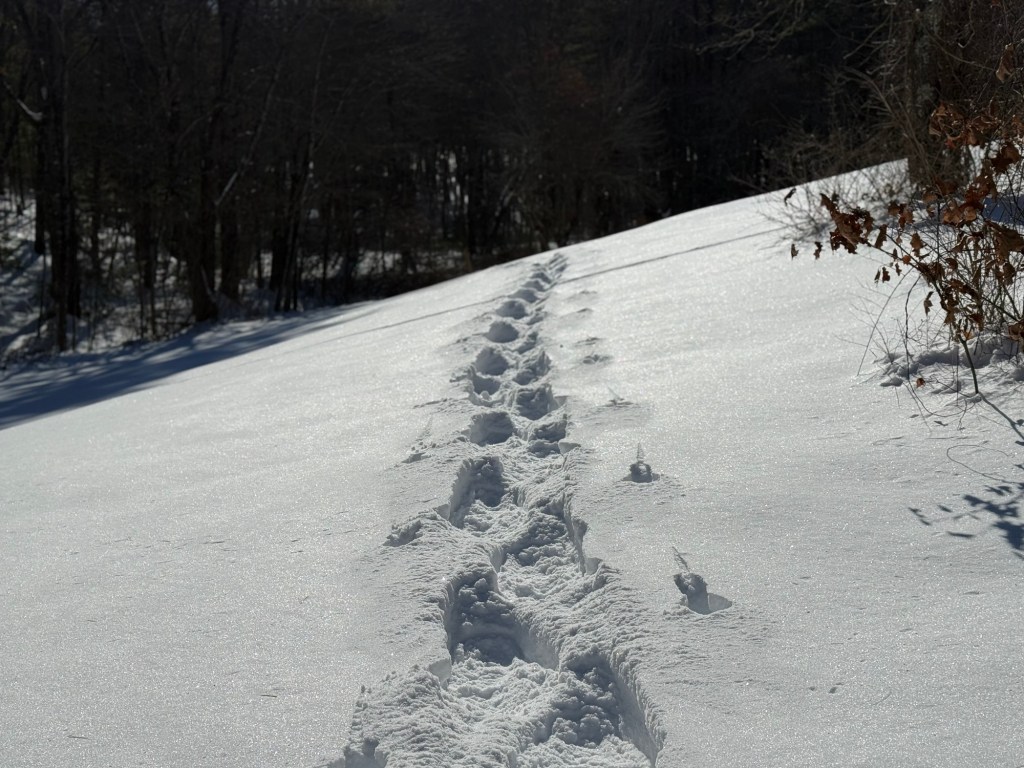
Almost a week after the region’s big snow, I finally had some time available to head to the local conservation area for a walk in the woods on my snowshoes. I went with trepidation, for I know the damage that can happen to a trail after a week of people and their pets post-holing through deep snow. But the parking lot was surprisingly empty for a Saturday morning, and the trails themselves were relatively clean. Post-holed for sure, but it’s been so cold and the snow so fluffy that it wasn’t the icy hellscape I thought it might be.
I still chose to break trail on pristine snow whenever the opportunity presented itself. Making a bee-line across steep terrain from one broken trail towards another. Some of the drifts were pretty deep, almost 4 feet of powder, but my snowshoes were up to the task. Thankfully, so was I!
Large portions of the conservation land’s trail network were completely unbroken. I smiled to myself at the lucky break and braced myself for the work ahead. Breaking trail on snowshoes is a great workout, and I’d gone out by myself with nobody to share the load. This is where being well-acquainted with working out comes in handy. I’m no Olympian, but I can break a trail for a few miles without passing out from the effort.
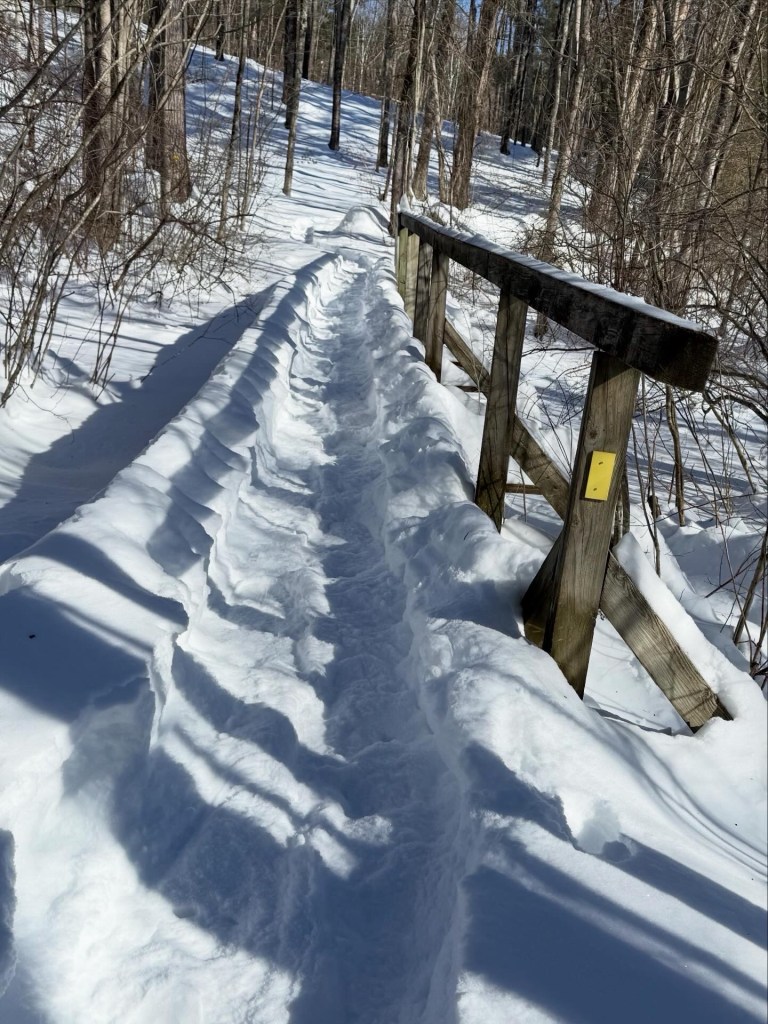
The larger trail network required an out and back over a bridge spanning wetland. On the way to it the bridge was untouched by anything but snow. On the return, I captured a picture of the trail I’d made on the out and back. It will be interesting to see what it looks like today, with a broken trail that others may have since walked.
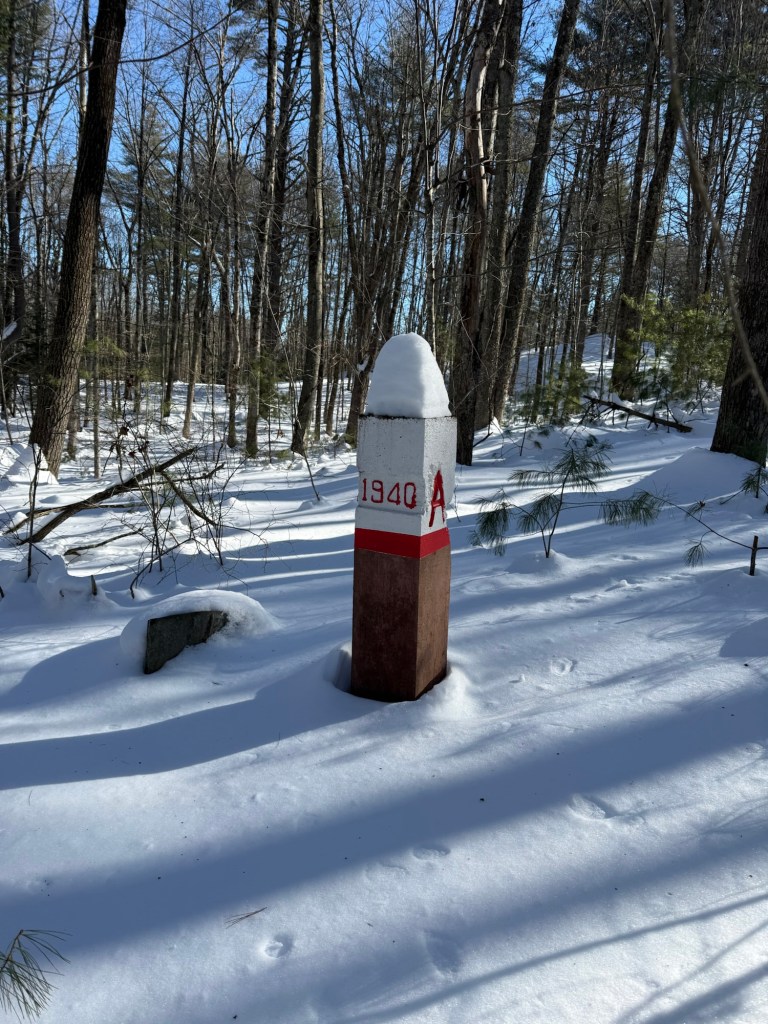
In one section, I revisited a town border marker that someone has since painted white with red lettering to make it more obvious to visitors. A is for Atkinson. There’s an H on the other side for Hampstead. Most of the trail network covers the latter town.
For all my time in nature on this snowshoe walk, I didn’t see much in the way of wildlife (It’s not like I’m sneaking up on anybody marching across the snow). Ironically, when I drove home afterwards, a neighbor excitedly told me he’d had three bald eagles in a tree in his yard not more than 30 minutes before. Now we’ve had a lot of wildlife moving through the neighborhood over the years, but none of us had ever seen a bald eagle, let alone three of them together. I’m sure that they’re hungry, and with the rivers frozen over they are scoping out the local valleys to expand their menu.
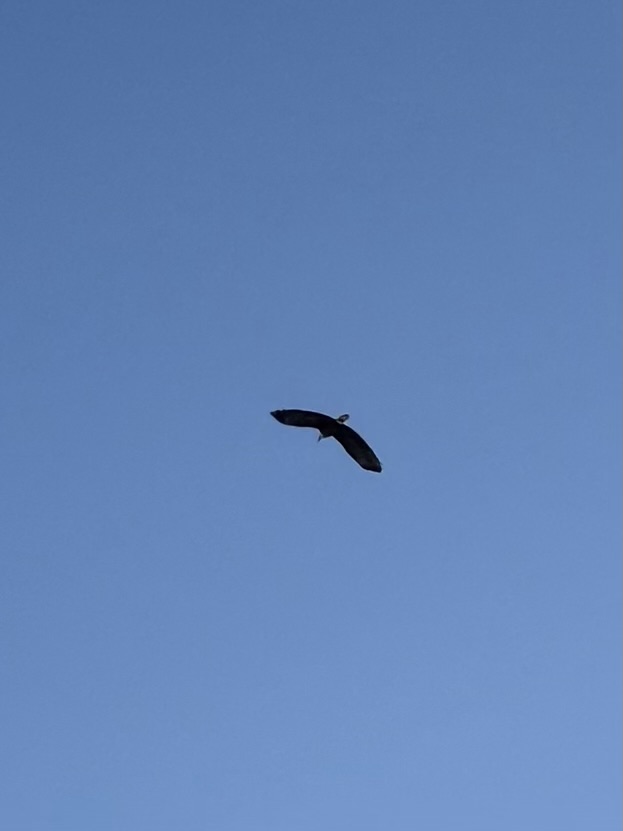
The odds were against seeing them still in the area, but I recruited the dog for a walk of the neighborhood to see if one would return. Sure enough, I was blessed with a fly-over by one of them. There’s no mistaking an eagle soaring over the landscape, and it was a thrill to see it. By the time I had my phone out to snap a picture it was already past me gliding towards open fields beyond the woods. It was a great way to cap a Saturday morning in snowy New Hampshire.
Some people are shark people. My bride is one. Shark people follow every shark sighting, have the Sharktivity app on their phones, watch Jaws every time it’s on and are completely locked in on Shark Week. The fact that there’s a week+ of programming dedicated to sharks tells you that there are a lot of shark people out there. I appreciate sharks, but I rarely think about them until the shark people mention them yet again. On Shark Week I sequester myself in the office with a good book.
Some people are sky people. I’m one of them. I have a ritual of walking the dog after dinner and spend most of the time looking up to see what the sky is doing. And it’s always doing something interesting. I have an Aurora app notifying me at all times of night. My favorite movie is Local Hero (if you know you know). Like any self-respecting sky-gazer, I follow things like meteor showers and eclipses and the occasional comet. And naturally I closely monitor solar activity that offers opportunities to see the aurora borealis.
We all have something we’re fascinated with. Call it a harmless pursuit of something that is larger than our particular niche. Those shark people are fascinated with the serial killers of the sea—mysterious creatures that emerge from the deep to challenge our belief that we are at the top of the food chain. Meanwhile, we sky people look up to the universe for perspective and enlightenment. Who’s to say which is the better pursuit? Do we draw inspiration from cold-blooded killers* or the heavens above?
* Of course I’m just kidding. I appreciate sharks too. It’s the shark people I’m poking fun at.
The Barred Owls have returned. There is a mating pair that moves through the trees, hooting it up to check in on each other while they each hunted in different places in the woods surrounding us. I’m told that Barred Owls hunt independent of each other, eat what they eat and catch up again later. “So how was work today?” “Fine, had hoped for a baby bunny but only caught a field mouse.” Romantic stuff.
Also developing in the neighborhood, a large beaver has moved in to the stream, wading about just after dusk above the bridge. It’s been a few years since I’d seen a beaver in the stream, and I’m wondering if the drought had dried up its previous nest. Beaver will move on when their food source is used up, not unlike the owls. We’ve all got to eat. While the owls are big talkers, the beaver works in silence most of the time.
We’re seeing yet another bumper crop of acorns this year, which explains the abundance of animals that feed on them moving back into the neighborhood (along with the animals that feed on the feeding animals). It’s been a hot dry summer after a wet spring. I wonder what that means for the fall foliage this autumn, but I don’t wonder enough to look it up. We all have the world at our fingertips, don’t we? We ought to let a few things simply unfold before us just to keep the magic in our lives.
I’m finally reading a paperback version of Niels Lyhne by Jens Peter Jacobsen, based entirely on the recommendation of Rainer Maria Rilke, mind you. I’m at a point in my life when I look around and find most talking heads haven’t got much to add to the conversation, so I dig deeper. Don’t just stop with the work of an author or poet or artist—seek out the works that influenced them. What challenges and transforms us, collectively?
Today’s world is unfolding exactly as I anticipated when the elections went the way they went a year ago. We are where we are because people believe what they want to believe, and feel emboldened to behave the way they behave because others do it so it must be okay. We too may choose how to react in such times. How do we want to navigate this world that we live in?
My advice, since you’ve read this far, is to seek out the timeless over the trend whenever possible. Things will come and go in a lifetime. We mustn’t forget that the lifetime in question is ours. We must do the best we can with what unfolds before us. There is more to this world than the madness swirling noisily on the platforms of choice. Go deeper and see what unfolds.
When despair for the world grows in me and I wake in the night at the least sound in fear of what my life and my children’s lives may be, I go and lie down where the wood drake rests in his beauty on the water, and the great heron feeds. I come into the peace of wild things who do not tax their lives with forethought of grief. I come into the presence of still water. And I feel above me the day-blind stars waiting with their light. For a time I rest in the grace of the world, and am free. — Wendell Berry, The Peace of Wild Things
There is reassurance to be found in witnessing the dignity with which so many who, seeing the darkness in the world, have chosen light instead. There is calm to be discovered in poetry spun from words magically sorted together in clarifying and entrancing ways. And surely—even now—there are still wild places far from the noise of life where we may find stillness.
If we are indeed what we consume, does it make sense to soak up the anger, fear and misery imposed by a world that wants us to buy in, or to shun it in favor of a more natural information diet? What liberates us from the shackles of a maddening world? With clarity and focus, we are better equipped to find what we seek. And even that which we aren’t fully aware we’re in need of. In moving away from the noise of the world, we may finally hear what was whispering for us all along.
Each of us has a reckoning with illusions of permanence. Things come and go from our lives with regularity. This is most obvious when we live in a place that faces a building boom. The field down the street or the woods that line the road are leveled for a development. The old farmhouse and barn are torn down and a building pops up in its place. The quiet country road is now lined with cars commuting through, and soon the road is widened and strung with traffic lights. And we mourn what was lost.
It’s similar when a friend we’ve bonded with becomes radically different from us politically. What we believed to be forever turned out to be nothing but an illusion of permanence. The person I thought you were is not who you turned out to be, and you think the same of me. Yet, like that field and stand of trees on that quiet country road, we each have memories of what one was. We each miss the person we thought the other was.
A plot of land might be viewed as an investment in the future of the community, but some folks feel that investment is conservation land and some think it’s a new hospital, grocery store and housing development. Both have value for a community to thrive, and both ought to be fought for. But we ought to consider carefully what will be forever lost when completing the transaction to make the change.
Some relationships are better as transactional. We can put aside our differences and work side-by-side with a teammate or a coworker, focused on the common goal. And we can nurture a deep bond built on common beliefs and a feeling that each person in the relationship is integral to the other. Consider the circle of trust and who we might want within it, and who should remain outside. Often it comes down to who will grow with us and who will erode the essence of who we are for want of some company. We should beware the company we keep, but when the right company is found invest deeply in keeping it.
The thing is, nothing is permanent, but some things have staying power. Everything will disappear one day, but we have agency in keeping that stand of trees or that person we care about in our lives. Or we can use that agency to drift away to do other things that feel important to us, expecting that what we remembered will still be there for us when we return. When we see the fragility of everything on our journey, we begin to prioritize the things that have staying power simply because we take the time to make them so. Ultimately, our legacy is built on what we took the time to care for beyond ourselves.
House on fire Leave it all behind you Dark as night Let the lightning guide you Step outside, time to step outside Time to step out — José González, Step Out
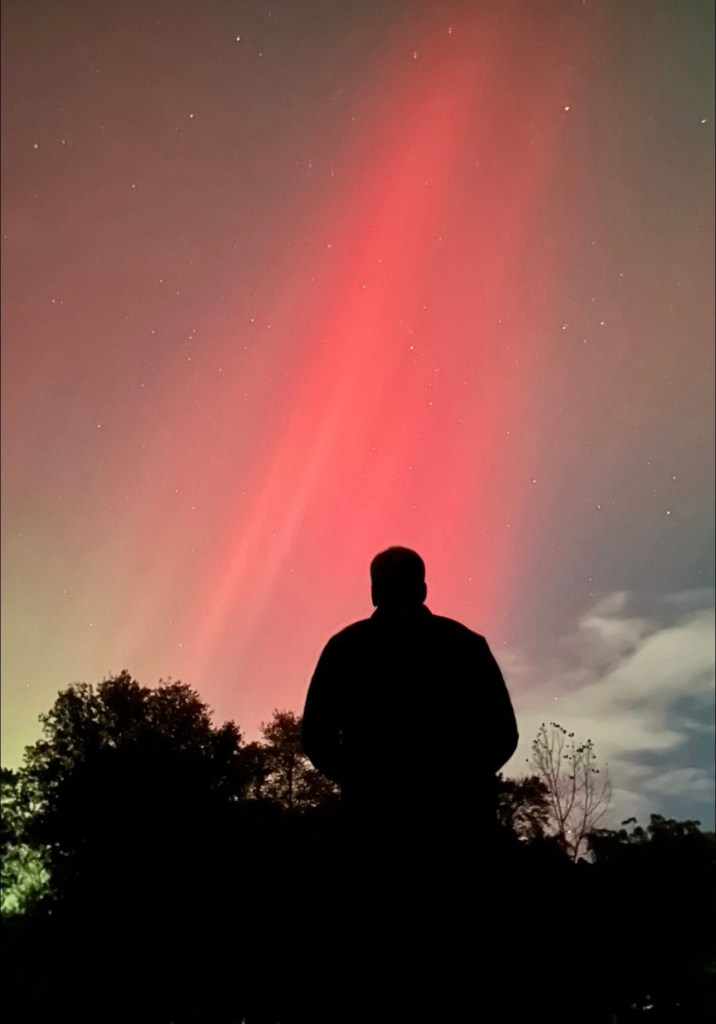
Yesterday was one of those epic days we’ll remember for the rest of our days. I picked up my daughter from a red eye flight, which meant I was up quite early myself, and capped the evening with the northern lights dancing brilliantly overhead late into the evening. Why does anyone stay inside when the universe wants to play with us just out the door? Just what call are we listening for instead?
Every other time I’ve chased the aurora borealis I’ve gone somewhere other than home. Most of the time I’ve come up empty. Scotland, Iceland, Maine, and northern New Hampshire have largely mocked me with overcast or a fickle aurora. But there’s something to that Cheryl Strayed quote about putting ourselves in the way of beauty that continues to whisper to me. Step out! Be patient…
What we seek often comes to us if we simply get out of our own way and put ourselves in the way of it. Last night I opted to stay put and see if Norðurljós wanted to dance. It turned out she did, and what a performance!
The thing is, we get wrapped up in what we miss, instead of simply stepping out of ourselves to find what is often right in front of us. Something like the northern lights is out of our control most of the time, but what is in our control is a willingness to dance with whatever comes our way. Amor fati: Love of fate. Fate brought my daughter home and a visit from Norðurljós in one memorable day.
Photo credit to my daughter for this oneVisible to the naked eye, but incredibly bright in night mode