Category: Discovery

  • What We Notice

    “Life is a garden, not a road. We enter and exit through the same gate. Wandering, where we go matters less than what we notice.” ― Kurt Vonnegut, Cat’s Cradle

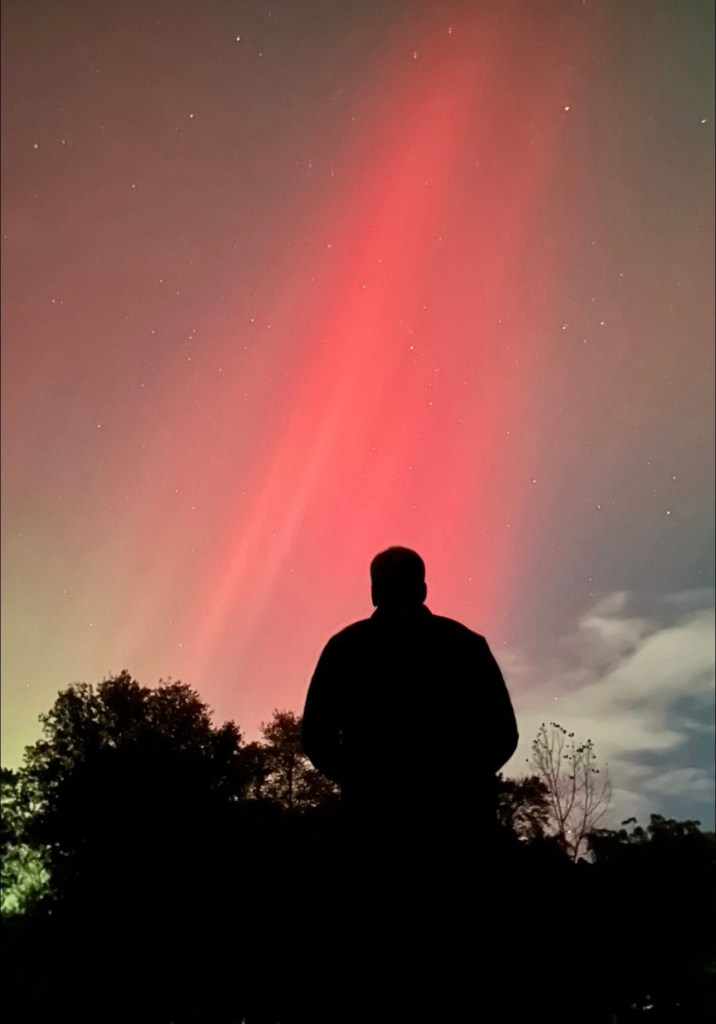
    After an unsuccessful hunt for the northern lights last night, I walked out into crisp early morning darkness for a just-in-case glance at the heavens. Alas, no aurora, but instead I caught the brilliant Jupiter and a blushing Mars, caught in the act of chasing Jupiter across the sky. Orion stood between them as guardian, forever distracted by the hunt for the bull. As a Taurus myself, I’m always rooting for Orion to miss the mark. It turns out Orion is never inclined to release anyway.

    I find myself uniquely aware of the garden as we wander through it. Some call me a wanderer, distracted by life, never inclined to release the arrow on the hunt for success. Success to me isn’t found in a C-suite, it’s found in a spark of connection between me and another. It’s found in a sliver of hope and direction given to another wanderer, who simply lost their way from here to there. We all do, eventually, lose our way—don’t we? Success is often disguised as a moment of clarity given to another, or found in our own reflection.

    If there is a road at all that we humans travel upon from here to there, it’s a winding road that often doubles back on itself. We are forever wandering through life, figuring out which way to turn next. The only secret adults know that children don’t is that adults are winging it too. We go through life accumulating experiences and apply that knowledge towards whatever we chance upon next. If we’re lucky we choose a path that favors us, if not we stumble eventually, pick ourselves up and figure out the next. It turns out that what we experience on the path matters a great deal more than where we thought we were going in the first place.

  • The Beautiful Present

    “Never look down to test the ground before taking your next step; only he who keeps his eye fixed on the far horizon will find the right road.” ― Dag Hammarskjold

    Oh Lord, how shining and festive is your gift to us, if we
    only look, and see.
    — Mary Oliver, Look and See

    For all my talk of stopping to smell the roses, I barely noticed a beautiful sugar maple turning towards peak foliage as we drove by it yesterday. Had my bride not commented on it, I’d have missed it entirely. There’s something to be said for being focused when driving a two-ton automobile, but there’s also something to not rushing through life with blinders on. The point is, we may still get from here to there while enjoying the passage of time.

    When I write about the necessity of savoring each moment I do so as a reminder to myself as much as any reader who stumbles upon this blog (Welcome, nonetheless. Or rather, especially). We ought to begin with the end in mind, as Covey once said, while still enjoying the things we chance upon as we march through our small piece of history. Hammarskjold is absolutely correct in pointing out that we ought to be aware of that far horizon, but the poet in me rejects the idea of never looking at your next step. Our next step is all we have. Have a look at all that is beautiful in it, while still glimpsing the future horizon that we may not lose our way. Put another way, all work and no play makes Jack a dull boy.

    I’m aware of the passing of time, and look towards that horizon with keen interest in how far down the path I might go before I tire and settle into an armchair to tell the same familiar stories to anyone who will listen again and again. But those stories are created today, with full awareness of all that happens in the now. We ought to savor the beautiful present flashing before our eyes instead of fixating on the next intersection. The journey will be all the more enjoyable. We’ll get there either way.

  • Developing a Voice

    “The voice which a poet forms is not any more something that a poet creates than it is something, over the years, that creates the poet. Throughout my life, unquestionably, I have made decisions one way or the other based on the influence of this inner voice—this authority with which I most intensely and willingly live.” —Mary Oliver, The Poet’s Voice

    Writing a blog is not the same as writing a novel, but it’s writing just the same. And as such, it ought to get one’s best effort. For otherwise, why do it at all? Isn’t life already too full of half-hearted pursuits? We can’t quiet-quit on our personal pursuits too and hope to have any reason to carry on in this world. We must do our best with the time and talent we have in the moment and allow it to carry us to the divine.

    Whatever the world thinks about blogging doesn’t matter a lick to me. I write to develop my voice, and once developed, refine it over and over again until it flows out of me like a Boston accent in unguarded moments. When I ask myself why I begin each day this way instead of simply taking a walk with the dog like a normal person, it often comes down to knowing I have something to say and finding a way to express it consistently, if not always eloquently.

    But what do we then do with a voice, once developed? Write more blog posts? Make the shift to long form essays and Substack? Or something <gasp> more? We can’t very well stuff our voice into the back row of the choir with the mimers, can we? We must sing our verse with passion and the skill honed through those ten thousand hours of chipping away at the marble. What emerges may just be magical. But magic doesn’t just appear out of thin air, it only seems that way to the casual observer.

    An acquaintance of mine wrote a few novels and published them as e-books just to give his children an example of doing what he said he was going to do. He’s also an active and talented podcaster with a silky smooth voice and the insightful questions that betray active intelligence. His voice may have been there all along but the full package took time and effort to develop. Whatever his motive for writing the novels and doing the podcast, the point is that he’s doing it. And so are we, at least if we have the inclination to see what emerges from that once quiet voice whispering to us in the back row.

  • Have a Look

    “Mountains should be climbed with as little effort as possible and without desire. The reality of your own nature should determine the speed. If you become restless, speed up. If you become winded, slow down. You climb the mountain in an equilibrium between restlessness and exhaustion. Then, when you’re no longer thinking ahead, each footstep isn’t just a means to an end but a unique event in itself. This leaf has jagged edges. This rock looks loose. From this place the snow is less visible, even though closer. These are things you should notice anyway. To live only for some future goal is shallow. It’s the sides of the mountain which sustain life, not the top. Here’s where things grow.
    But of course, without the top you can’t have any sides. It’s the top that defines the sides. So on we go—we have a long way—no hurry—just one step after the next.” — Robert Pirsig, Zen and the Art of Motorcycle Maintenance

    I see it in the pup when we get home. She bolts into the house, looks for our friends who’d been staying with us, and realizes the emptiness in a sad look back at me. Life is change, I want to tell her, but the beauty of being a dog is there’s always a chipmunk to chase down outside, and she’s soon forgotten her sadness and is out hunting instead.

    The thing is, it’s humans that really pay the price of change every day. It’s part of growing into who we may be next. Holding on to the past wastes today. And so the only answer is to savor more. Carpe diem is more than just seizing the day, it’s embracing all that it offers. In this way it pairs well with that other reminder from our stoic friends: Amor fati: Love of fate.

    We grow in the climb itself, even as we aspire for the summit. And so on we go. We ought to be careful what we wish for, for as Pirsig points out, we’ll miss all the good stuff charging ahead through life in hopes of reaching some imagined better place. Our place is simply where we’re standing now, friends, even as we’re poised for the next step. So have a look.

  • The Mask

    “Masked, I advance.” ― René Descartes

    Later today I’ll be presenting to a group of people I’ve never met before, like a thousand times before. There’s nothing unusual about speaking to strangers when you make a living building bridges and nurturing trust. More essential in that moment, the subject matter I’m presenting is very familiar to me, and not so much to them. I hope they surprise me with deep familiarity and the inclination to challenge every word I say, because that would indeed be interesting, but more than likely they’ll simply accept what I say for what it is. We tend to simply believe what we’re told, rarely questioning the validity of the statement unless it’s especially incendiary or directly challenges our worldview.

    We all know those characters who navigate word soup with the stage presence to pull it off. But to pull it off, we’ve got to believe it ourselves. We are all actors in the play, and stage presence matters a great deal, but so too does some underlying belief in why we’re up there on the stage in the first place. Every day we wake up with a collection of beliefs in who we are and why we’re here. To break away from those beliefs requires an assumption of faith that the gap between who that character we’re stepping into and the one we’re leaving behind isn’t so great that we plunge to our doom.

    But what is doom anyway? What’s the worst that could happen in putting on the mask and advancing into the unknown? We’re pushed back? We’re cut down? Parry and redouble, friend. Thankfully, few matches are fatal. We live to fight another day. When we believe in the mask we’re wearing we may advance with courage.

    Sounds easy, right? The thing is, false bravado is easy to unmask. The first person we have to convince is ourselves. Yet often we’re the last to know. Assuming a character often helps us find something in ourselves that was waiting to emerge. Small steps at first, then a little bolder, and there’s no telling where we might find ourselves next.

  • Character Development

    “How little we still commit ourselves to living. We should grow like a tree that likewise does not know its law. We tie ourselves up with intentions, not mindful of the fact that intention is the limitation, yes, the exclusion of life. We believe that we can illuminate the darkness with an intention, and in that way aim past the light. How can we presume to want to know in advance, from where the light will come to us?” — Carl Jung, The Red Book

    Admittedly, I’m impatient for a future lightness. These aren’t the darkest of days, but they could sure be brighter. When you set a course for a destination, you sometimes just want to get there instead of living with the reality of each phase of the journey. That’s like buying a book and reading the last pages first, that there are no surprises when read from the beginning. Knowing the ultimate ending already, we ought to put our energy instead into the character development possible today.

    When we work through the challenges life throws at us, we see how we react to each and find out something about ourselves. Sometimes we celebrate the character we’ve encountered, and sometimes we want to prune off that unruliness immediately. If you’ve ever been deep in the woods and seen the odd directions that sapplings take to reach for the light you’ll understand what I’m talking about. Life wants us to bide our time and grow our roots, but we grow impatient and lunge for any bit of light slipping through the canopy.

    We can’t follow every whim and hope it brings us to our happy ending. To chase everything is to be directionless. Intentions are nothing but dappled light in the forest, sapping our energy in distraction and folly. We must remind ourselves that the living is the thing, not the chasing. When we focus on the steady growth things seem to open up for us at the right time. At least that’s what we tell ourselves when we’re deep in the forest.

  • Time Enough

    “The butterfly counts not months but moments, and has time enough.” — Rabindranath Tagore

    We often get hung up on time and how quickly it all flies by. Yet we have more than enough for one lifetime when we use it well. We just waste so very much of it on things that aren’t all that essential. The moment is all that matters, we keep telling ourselves, and yet we measure time. The instant we recognize the fragility of the moment and our place in it, the more we begin to fully live. This is everything, all at once, and it’s a wonder to behold.

    This morning I reconciled myself to spending money and time on a problem that I inadvertently created several years ago. To spend money and time on things that I once thought were finished forever is frustrating, but instead of getting spun up in the error I’m finding joy in the resolution of the problem. With every decision we have the opportunity to set the future straight. We may celebrate this and move on to the next.

    As a rower I know the value of the current stroke in setting up the next one. Effort and recovery are forever linked in a quest for that elusive perfection. A life well spent isn’t all about the highlight reel stuff seen on Instagram, it’s the daily grind and the challenges we overcome that we may live to fight another day. Effort, recovery and setting ourselves up for the next—again and again. Stitch together enough such moments and we may build something meaningful that transcends the ordinary.

    We have time enough, even as we wish for more. Aspire to make more of the moment instead of wishing for more moments. Excellence is found here, awaiting our rise to meet it.

  • Thou Hast Thy Music Too

    “Give me books, fruit, French wine, fine weather and a little music.” — John Keats

    Where are the songs of spring? Ay, Where are they?
    Think not of them, thou hast thy music too
    — John Keats, To Autumn

    Keats only lived to 25, but his life was memorable because he had productive energy and talent and used it to churn out enough poetry to capture the world’s attention. Had he lived another few decades, I wonder where his voice might have taken him. Perhaps less flowery and more pointed? Our voices change with time, having lived beyond the illusions of our youth to a place more… earthbound.

    I’ve long ago abandoned any idea that writing a blog post every day would net a million followers. That’s Seth Godin territory. Blogging is a daily practice in writing, and thinking more deeply about consequential things. The idea of advertisements and diligently churning other platforms for clicks is not my game. Frankly, it’s not a game at all anymore, it’s simply the practice of writing every day. A steady climb to a better place.

    If life is short, but hopefully not as short as Keats’ life was, then to live it with joie de vivre seems vital. Ah, the poet has joie de vivre—but does the blogger? I think so, friend, but taking oneself less seriously and learning to enjoy the discoveries one makes about the universe along the way would surely carry us to a more joyful place than overanalyzing one’s key performance indicators (KPI’s) ever would. We don’t always have to know where we’re going or even why, but we ought to feel something stir deep within us when we move through our days. For ’tis true, thou hast thy music too.

  • Mine the Magic

    “Dumbo got airborne with the help of a magic feather; you may feel the urge to grasp a passive verb or one of those nasty adverbs for the same reason. Just remember before you do that Dumbo didn’t need the feather; the magic was in him.” ― Stephen King, On Writing: A Memoir of the Craft

    Earlier this morning, still before the sunrise, I sat out with a cup of coffee trying to determine what kind of bird was making a very unusual call when the pup decided I’d lingered long enough without throwing the frisbee and put me to task. That lengthy sentence alone indicates how blessed I am to have a moment like that, one that repeats regularly, despite all the madness in the world. There are plenty of people who would trade places and I’m not so wrapped up in my storm of minor problems that I don’t recognize that. Circumstances arise that change our trajectories, but we largely determine who we become. We mustn’t forget to savor such moments when we find ourselves living them.

    The question of next is always weighing on us, even as we tell ourselves to immerse ourselves in now. Humans are built to ponder the future, with hope or dread or maybe chagrin, but the future isn’t anything but a script that hasn’t been played out yet. We may yet sharpen the pencil and draft something clever for our future self. And isn’t that the hope for all of us creative types? We anchor ourselves to the moment while drafting the exciting, implausible next. Drafts are always rewritten as the editors in our universe play their part, but we may still influence the final scene.

    I never did figure out what that bird was. It flew away to sing its strange song somewhere else, and I was left with another missed opportunity. Life is full of such things, and yet we still have agency. Sometimes we have to remind ourselves to stop grasping for magic feathers and simply mine the magic within ourselves, that we may realize it one day. Don’t let that dream be another missed opportunity that flew away with time.

  • The Evasive There

    “The surface of the water is beautiful, but it is no good to sleep on.” — African proverb

    Lately I’ve been assessing next moves. Surely that’s been telegraphed in this blog for long enough now that none of you are floored by that statement. But next moves are tricky things. We don’t just say yes to every opportunity that comes our way, do we? Most opportunities are merely future problems with lipstick on. We ought to look hard before we leap.

    The future always looks beautiful and full of possibility for the optimist, and dark and treacherous for the pessimist. We’ve got to be objective in assessing which direction we’ll go in next to truly see what is in front of us for what it is. Our “there” will always be evasive if we won’t ever take the leap from “here” into the unknown. Then again, leaping is all fine and good so long as we know what we’re landing into. We must choose our leaps with the landing in mind.

    And so it is that most people keep looking for the next thing and never actually leaping into much of anything at all. We can easily find reasons to just keep doing what we’ve done for years, because things are working okay and why change now? It’s rather easy to talk about most people, but when you recognize that you’ve been one of them it’s a tough mirror to look into. And this is where philosophy and poetry and writing assist greatly in the journey from here to that evasive there. We all must sort out who we’re becoming in the most thoughtful and deliberate of ways. Just don’t forget to leap now and then.