Category: Poetry

  • Sipping Coffee, Reading Poetry

    He is seated in the first darkness
    of his body sitting in the lighter dark
    of the room,

    the greater light of day behind him,
    beyond the windows, where
    Time is the country.

    His body throws two shadows:
    One onto the table
    and the piece of paper before him,
    and one onto his mind.

    One makes it difficult for him to see
    the words he’s written and crossed out
    on the paper. The other
    keeps him from recognizing
    another master than Death. He squints.
    He reads: Does the first light hide
    inside the first dark?

    He reads: While all bodies share
    the same fate, all voices do not.
    — Li-Young Lee, In His Own Shadow

    Feeling reclusive lately, too reclusive for the part played in this life, I’ve grown weary of online planning meetings and year’s end introspection. I’ve begun to reach out to the world again in earnest, just to be sure it’s still there. I’m a social being trapped in an introvert’s mind, or is it the other way around? We humans are complex creatures.

    Amongst the pile of books crying for attention was a book of poetry, purchased eagerly, stacked deliberately, shuffled downward reluctantly. We prioritize finishing what we started, after all, and then some other pretty thing catches our attention, and soon that work of enchantment is put aside for weeks on end, biding its time while we squander our own. Until the moment of reckoning when it surfaces again.

    Sitting in the morning darkness, quietly shuffling with a fresh cup of coffee back to a reading chair, my mind rebelled against the non-fiction staples demanding my attention. Mind craving sustenance of a different kind, like vitamin A to help my vision, I find what’s been calling to me all along. In the growing ambient light of morning, sipping coffee and focusing my mind for the cadence of poetry, I’m quietly floored by a simple stack of words, set just so. And forgot I’d had coffee at all.

    While all bodies share the same fate, all voices do not. The spell cast upon us through poetry is in the way it slays you in these moments of truth, a mirror of words reflecting back at you. Recovering my senses, I set about finding my own voice again, knowing the steepness of the climb before me, feeling my own shadow and the lesson to the core.

  • Experience and Understanding

    “If I had to live my life again, I would have made a rule to read some poetry and listen to some music at least once every week; for perhaps the parts of my brain now atrophied would thus have been kept active through use. The loss of these tastes is a loss of happiness, and may possibly be injurious to the intellect, and more probably to the moral character, by enfeebling the emotional part of our nature.”Charles Darwin, The Autobiography of Charles Darwin, 1809–82

    I shall act as I now think—as a man who dares to waste one hour of time has not discovered the value of life.” ― Charles Darwin, The Life & Letters of Charles Darwin

    (Quick aside: I’ve posted a link to Darwin’s autobiography above, just know that the content is included in the Life & Letters link as well if you’re interested in reading online without purchasing.)

    I read these two quotes from Darwin as the reflections of a man who realizes that life is short and all work and no play makes Charles a dull boy. Darwin was anything but dull, of course, and lived an extraordinary life full of contribution to our understanding of evolution and humanity’s place in the universe. But it seems he couldn’t summon a verse of poetry off the top of his head. We all beat ourselves up over something, don’t we?

    The thing is, the accumulation of experience and seeking to understand it all are bold and beautiful acts, and transform us from soulless cogs in the machine into free-spirited humans actively engaged in living. This blog evolved from a travel blog to a living experience blog in which I process all that I encounter as best I can in the moment. Sure, I may lean in on philosophy and productivity more than the average bear, but it all counts, doesn’t it?

    Clever quotes inspire us by drawing on the magic derived from a few words written or spoken by someone we might admire. I generally see a quote and wonder where it came from, seeking out the books and poetry that the line was plucked from and trying to understand the larger meaning of those magical words. In each quote above, you’ll see I’ve done just that—going beyond the famous quote to add some meaning. You can do the same by clicking on the latter link and searching for some key words in the quote to find the original. Blame it on the researcher in me: One must get to the source to truly understand the subject matter.

    And here, friends, is our subject matter: Darwin understood what we all know deep down: this ride is a short one, and we ought to make the most of it. This living business is a deliberate act, and we are what we focus on. We must push aside the atrophy of a limited life and expand our experience and understanding. For that is where growth happens. We dare not waste an hour of our precious time.

  • Not Everything Dies

    Dear heart, I shall not altogether die.
    Something of my elusive scattered spirit
    shall within the line’s diaphanous urn
    by Poetry be piously preserved.
    — Samuel Beckett, Non Omnis Moriar

    Samuel Beckett’s first stanza is a mic drop precisely because we feel the truth in it. Non Omnis Moriar—not everything dies—because we create ripples that reverberate and live beyond our fragile bodies. Our lifetime contribution in relationships and in our work has the opportunity to outlast us. What will it say?

    It might say something of our spirit, our willingness to share and grow and offer something of consequence in a world fraught with characters with no such inclinations. Perhaps it will be that one line, read at the right time, that turns history towards hope. Too bold? Shouldn’t we be? Our work is our time capsule to a future without us, no doubt, but it might also be a time capsule to a future us, older and wiser (perhaps) and looking for evidence that we lived a life of purpose.

    As this is published, we’re a few days into the New Year, when bold plans for a larger life take hold in our imagination. Creating anything meaningful daily amplifies and extends this feeling to the rest of the year and the rest of our lives. When we look at our lives as a creative work, we move beyond the timidity of everyday living and tap into our unrealized potential. We figuratively raise the bar on what we expect of ourselves, and seek to exceed it on our next attempt. In this way our contribution grows even as we grow.

    The question, O me! so sad, recurring—What good amid these, O me, O life?
    Answer.
    That you are here—that life exists and identity,

    That the powerful play goes on, and you may contribute a verse.
    — Walt Whitman, O Me! O Life!

    If your mind immediately leaps to the Dead Poet’s Society follow-up question, then we share the same cultural influences. And isn’t it an example of not everything of the poet dying? Robin Williams, as John Keating, asks his class, “What will your verse be?” We ought to let the question linger a few beats longer. And then get down to the business of answering it for ourselves. It follows that we should be earnest in this pursuit, for it will take a lifetime. And, just maybe, then some.

  • We Begin Again

    You always have two options.
    You can push harder.
    You can remove friction.
    Greg McKeown

    We all know where we should push harder in our lives to reach personal goals. We also ought to think more about elimination. Shedding ourselves of artificial expectations and dreams that don’t resonate. Moving away from habits, tasks, people or careers that create tremendous friction in our path to a better life. Sometimes we can’t see the gaps because our way is jammed with trivial distractions. We must clear the gap to see how far we must leap.

    So it is that we begin again, reconciling accumulation (bad habits, weight, things, acquaintances, etc.) and the gap between where we are and where we wish to be. This shouldn’t be a once-a-year exercise, it should be a daily reflection. We have our stack of days ahead of us, and the gift of each should be measured and contemplated just the same. But how?

    Intentions are nothing, action is everything. Incremental improvement trumps grand plans, and each day, each bite or sip, each step, each page read, each meaningful conversation and each written word bring us closer to whatever compass heading we’ve set for ourselves. Alternatively, we can incrementally drift off course to a point where major changes are forced upon us. Don’t we owe it to ourselves to make the choice for ourselves instead of having it imposed on us?

    Tell me, what is it you plan to do
    with your one wild and precious life?
    —Mary Oliver, The Summer Day

    Mary Oliver’s words inspire bold dreams, and there’s nothing wrong with dreaming big. But to be attained we must break those dreams down into bite-sized habits. Today, like many of you, I will assess where things are, make a course adjustment and begin again. I won’t do this with bold, unattainable goals with unrealistic timeframes but with a few incremental changes I can track daily. I’ll take the shiny new calendar and map out the big trips and events that should be highlights for the year and identify time to add micro-adventures and brief flings with bolder living.

    Sailors have their log book, and so too should we. Log each day and reflect on it. My personal favorite is the line per day journal, which boils down each day into whatever notable thing you choose to write down. I’ve been doing this for a few years now and strongly recommend it. In fact I just gave each of my kids a LEUCHTTURM1917 Some Lines A Day 5 Year Memory Notebook to begin this habit themselves, but you don’t have to spend much to seed a habit — a simple notebook will do. The point is to begin doing it and never break the streak. Magic ensues.

    This year I’m doubling down on my line per day by adding a picture per day, using an iPhone and an album dedicated just to this. Combined, these habits should be fascinating for me (if perhaps exceedingly dull for the rest of the world). If nothing else, each forces us to add a spark to the moment at hand and wonder to our lives.

    If we don’t step out on the dance floor we’ll forever be wallflowers. You know what’s more fun than stepping out onto the dance floor? Dancing to the dance floor. Remove friction, work hard on what matters most and track progress. Find your groove thing and let it loose. That, friends, will make the New Year meaningful in the end.

  • The Beautiful Voyage

    When you set out on your journey to Ithaca,
    pray that the road is long,
    full of adventure, full of knowledge.
    The Lestrygonians and the Cyclops,
    the angry Poseidon – do not fear them:
    You will never find such as these on your path,
    if your thoughts remain lofty, if a fine
    emotion touches your spirit and your body.
    The Lestrygonians and the Cyclops,
    the fierce Poseidon you will never encounter,
    if you do not carry them within your soul,
    if your soul does not set them up before you.

    Pray that the road is long.
    That the summer mornings are many, when,
    with such pleasure, with such joy
    you will enter ports seen for the first time;
    stop at Phoenician markets,
    and purchase fine merchandise,
    mother-of-pearl and coral, amber and ebony,
    and sensual perfumes of all kinds,
    as many sensual perfumes as you can;
    visit many Egyptian cities,
    to learn and learn from scholars.

    Always keep Ithaca in your mind.
    To arrive there is your ultimate goal.
    But do not hurry the voyage at all.
    It is better to let it last for many years;
    and to anchor at the island when you are old,
    rich with all you have gained on the way,
    not expecting that Ithaca will offer you riches.

    Ithaca has given you the beautiful voyage.
    Without her you would have never set out on the road.
    She has nothing more to give you.

    And if you find her poor, Ithaca has not deceived you.
    Wise as you have become, with so much experience,
    you must already have understood what Ithaca means.
    — Constantine P. Cavafy, Ithaca

    There’s a special place in my heart for The Odyssey. It captured my attention in early adulthood and held on tight. I might have sailed away to the Greek Isles in my own odyssey had things gone differently. And so having a heart so set on travel doesn’t surprise me very much at all. In fact, what surprises me is the amount of time I’ve spent in my home port. When you find home you know it, even when the road calls you like a Siren.

    I didn’t have the heart to break up Cavafy’s poem, and offer it here in its entirety for my fellow travelers to celebrate (as travelers do). Perhaps the flow may seem off, as if the entire voyage is top-heavy, but so be it. We must break the rules now and then in our lives if we hope to see what’s outside our box.

    And that’s the point, isn’t it? To see what’s far outside of our comfortable box, and to live to tell the tale. The box will be there when we get back. But we’ll be different, won’t we? We’ll witness things we’d only believed as myth, and things we’d never known existed but will stay with us forever for having been there. We’ll carry the sparkle of faraway places in our hearts that escapes from our eyes as we tell of places we’ve been. Similar sparks escape from the eyes of fellow voyagers who have been to the same place, and a special fire burns brightly when the sparks are shared in other ports of call. There’s a club of understanding that is earned living dreams and encountering what is carried in our souls. If that sounds ridiculous, well, check your sparks for ignition. You may need a tune-up.

    Do you understand what Ithaca means? If not, give it time and room to grow. You’ll find it far from the comfortable routine, just waiting for you to go there. You just might come across me on that journey too, chasing Ithaca and learning more about this voyage every day. So tell me, do you see it now? Isn’t it beautiful?

  • Diligent Awareness (Life as a Poem)

    “The aim of life is to live, and to live means to be aware joyously, drunkenly, serenely, divinely aware. In this state of god-like awareness one sings; in this realm the world exists as poem.”
    ― Henry Miller, The Wisdom of the Heart

    “Imagine that you’re unwell and in a foul mood, and they’re taking you through some lovely countryside. The landscape is beautiful but you’re not in the mood to see anything. A few days later you pass the same place and you say, “Good heavens, where was I that I didn’t notice all of this?” Everything becomes beautiful when you change.” — Anthony De Mello, Awareness: The Perils and Opportunities of Reality

    It’s easy to say we should live with awareness, but harder in practice. This business of living demands attention, or rather, distracts our attention from much of the things we’d be focused on if we weren’t so damned busy with that other thing. We forget, sometimes, that life is merely what we pay attention to and everything becomes beautiful when we change. Most of us won’t change or become fully aware, but isn’t it pretty to think so?

    Most don’t want to change, they want to live with what they have, while wishing for more, and do it again tomorrow. When someone does we wonder at their boldness, but don’t connect the dots to doing it ourselves. If we are what we repeatedly do (Aristotle), then doing something completely different strikes at our very identity. No wonder so many refuse to cross that line in the sand.

    “How many people do you know who are obsessed with their work, who are type A or have stress related diseases and who can’t slow down? They can’t slow down because they use their routine to distract themselves, to reduce life to only its practical considerations. And they do this to avoid recalling how uncertain they are about why they live.” ― James Redfield, The Celestine Prophecy

    The thing is, awareness isn’t about turning our lives upside down, it’s being fully present in the moment. Being open to everything that surrounds us, not just those practical considerations. We aren’t quitting our jobs and living like a hermit in a hot tent when we’re aware, we’re simply inviting more of the universe into our present moment. It seems if we want a more fulfilling life then we ought to fill more of our life with beautiful things.

    I was once a closed young man who thought of poetry as frivolous. Something was missing within me that took years to fill. When you close yourself up the world simply cannot find its way in to fill you. Over time my awareness pendulum has swung wide open. Not coincidently, I write more, listen more, seek more and linger more with the world. When we realize the world exists as a poem, we’re more inclined to dance with its verse.

    “Butterflies don’t write books, neither do lilies or violets. Which doesn’t mean they don’t know, in their own way, what they are. That they don’t know they are alive—that they don’t feel, that action upon which all consciousness sits, lightly or heavily.” — Mary Oliver, Upstream

    We expand into the world we create for ourselves through diligent awareness. Knowing what we are, and who we are, is the job of a lifetime. When we open ourselves to everything, we discover more, and we live a bigger life.

  • Delicate Things

    “Why shouldn’t we, so generally addicted to the gigantic, at last have some small works of art, some short poems, short pieces of music […], some intimate, low-voiced, and delicate things in our mostly huge and roaring, glaring world?” — Elizabeth Bishop

    For all the big plans we make, most of our life is lived in routine. This blog is most often fueled by an early rise and a freshly ground cup of coffee. But when routine fails me and I really need to focus on writing or some other work, I put on my noise-cancelling headphones and play the same song on repeat until I’ve completed whatever it was that was getting overwhelmed by the gigantic. No surprise for readers that for me, that song is Wild Theme by Mark Knopfler. You can go right ahead and put it on my playlist when I pass.

    I’ve paired that song with a Scotch whiskey nosing glass filled with sand from Camusdarach Beach, sitting just out of reach of a certain curious cat who loves nothing more than knocking delicate things off of solid places. That beach is one of the stars of another work of art, Local Hero, that elicits eye rolls whenever I mention it to family and friends.

    I still have a water bottle filled with a bit of Walden Pond from a few weeks ago. I’m somewhere between boiling it for a cup of tea and pouring it in the pool, that I might have a bit of Walden around me every time I go for a swim. This might seem odd to the masses, and I respect that, but isn’t it just as odd to fixate on the lives of the Royal Family or to get a Mickey Mouse tattoo? Everyone has something that holds on to them through it all.

    A sprinkling of adventure does a soul good, but so too does the collection of delicate things that quietly surround us and makes us whole. These prove to be more important to us in our daily lives than the bucket list moments. That quiet inventory of art, music, prose and poetry lifts us up when we need them most, keeping us from drowning in the angry sea of everyday.

  • The Land of the Whispering Trees

    Let us live in the land of the whispering trees,
    Alder and aspen and poplar and birch,
    Singing our prayers in a pale, sea-green breeze,
    With star-flower rosaries and moss banks for church.
    All of our dreams will be clearer than glass,
    Clad in the water or sun, as you wish,
    We will watch the white feet of the young morning pass
    And dine upon honey and small shiny fish.

    — Elizabeth Bishop, Let Us Live (With nod to The Book Binder’s Daughter)

    I was describing the trails through nearby conservation land to a neighbor who sticks to running on pavement. She is reluctant to stray into the woods, blaming everything from the possibility of getting lost to hunting season. There are surely risks in the woods, but aren’t there also risks in never venturing into them? How do you find magic on pavement? Its only purpose is speed. Isn’t life fast enough already?

    Humans have chosen to be bound to the clock and calendar where speed is valued more than meandering. More than lingering. More than reverence. We ought to put aside our schedules and listen more. The trees in the forest live in a timeless world, rooted to their ancestral home and holding things together for future generations.

    We humans are rapidly closing out another year on the calendar. Did we meet our goals and realize our dreams? Are we making progress or slowly sliding backwards? Human lives are filled with such questions. We fill our lives with so much noise that it becomes hard to hear the answers.

    A forest is a choir, singing to the universe. We’d be wise to listen. They suggest that we might choose a different life, free from such human constraints as clocks and calendars, yet sustained and rooted just the same. The forest, timeless as it is, whispers only one question: Just what do we dream of anyway?

  • Begin Today With the End in Mind

    Not every man knows what he shall sing at the end,
    Watching the pier as the ship sails away, or what it will seem like
    When he’s held by the sea’s roar, motionless, there at the end,
    Or what he shall hope for once it is clear that he’ll never go back.

    When the time has passed to prune the rose or caress the cat,
    When the sunset torching the lawn and the full moon icing it down
    No longer appear, not every man knows what he’ll discover instead.
    When the weight of the past leans against nothing, and the sky

    Is no more than remembered light, and the stories of cirrus
    And cumulus come to a close, and all the birds are suspended in flight,
    Not every man knows what is waiting for him, or what he shall sing
    When the ship he is on slips into darkness, there at the end.
    — Mark Strand, The End

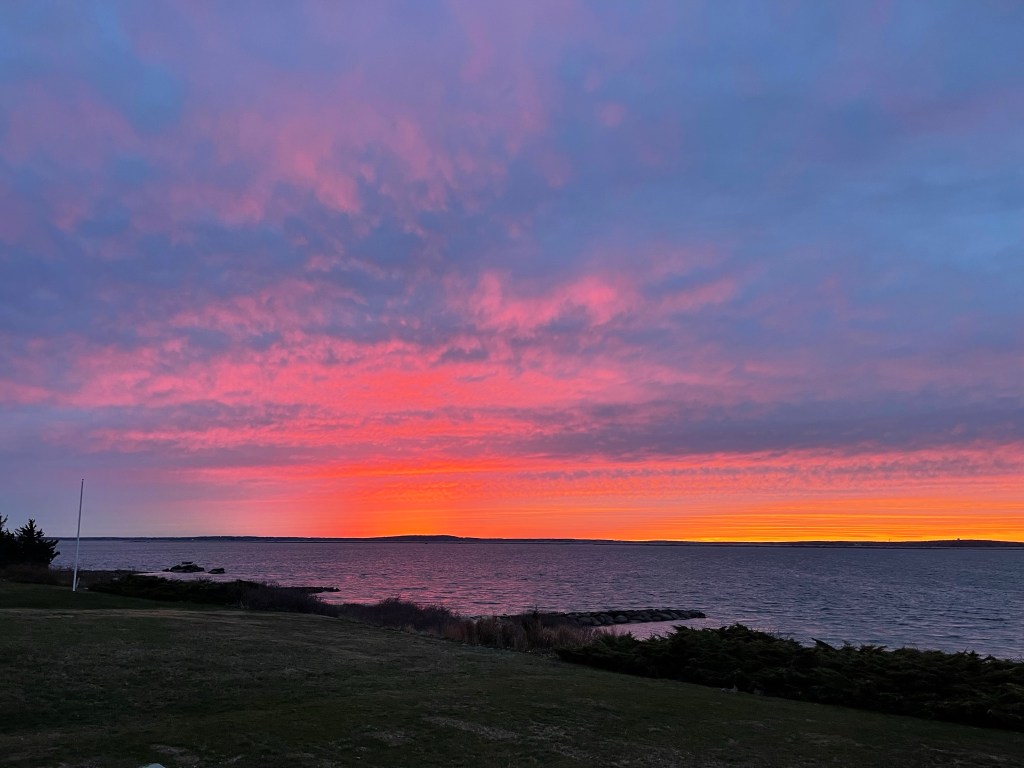
    When you think about the little joys in life, what comes immediately to mind? Are those joys as vivid as Strand describes in The End? As a collector of sunsets and stories told in clouds, and an avid gardener who coexists with felines, I confess this poem resonated with me. Or maybe it’s just the stoic in me. For we must collect our joyful bits begins today, always with the end in mind.

    Surely, life isn’t all joyful bits. We know this all too well, don’t we? But as Viktor Frankl said reflecting on days much darker than most of us will face, we choose how to react to the stimulus we encounter. We are what we focus on next. We ought to acknowledge the darkness but celebrate the light. Be the mirror that reflects beauty and generosity back at the world. We might just illuminate the life of someone else floundering in the dark.

    Knowing we reach the end one day ought to compel us to do more with this day. Be active with the day we’ve got. See and be engaged in the scene. And dance until the end.

  • The Beautiful Changes

    One wading a Fall meadow finds on all sides
    The Queen Anne’s Lace lying like lilies
    On water; it glides
    So from the walker, it turns
    Dry grass to a lake, as the slightest shade of you
    Valleys my mind in fabulous blue Lucernes.

    The beautiful changes as a forest is changed
    By a chameleon’s tuning his skin to it;
    As a mantis, arranged
    On a green leaf, grows
    Into it, makes the leaf leafier, and proves
    Any greenness is deeper than anyone knows.

    Your hands hold roses always in a way that says
    They are not only yours; the beautiful changes
    In such kind ways,
    Wishing ever to sunder
    Things and things’ selves for a second finding, to lose
    For a moment all that it touches back to wonder.
    — Richard Wilbur, The Beautiful Changes

    Emotionally, logically even, I’ve come back to my home recently. I never left, really, but it feels more like home as we’ve spruced up the place during the pandemic. We strayed in our minds a few times, seeking more adventurous living, yet we always return to this place. That blanket of familiar is comforting, even as it acts as a foundation for more adventurous acts. Blankets might feel suffocating at times, if we feel that our whole life is encumbered beneath. But isn’t that blanket simply our identity? We are what we surround ourselves with. That in turn and time either feels right or it doesn’t. The choice was ours all along. And so it will be.

    We each enter into long relationships that evolve over time. Live with someone for a few decades and you join the club of understanding. The same can be said for the very place we live as well. The landscape changes as the community changes. The very homes we live in change too, as things and people and pets come and go from our lives, and as we ourselves grow older. Life is change. Change can be untenable or wonderful, sometimes at the very same time.

    We each write our stories, choosing what to add or edit out of that hero’s journey. Characters come and go, the scenes change, so too does the author. Everything changes over time, and we live with these changes or reject them. To think we can control anything but our reaction to change is folly. But we can wrap ourselves in our identity, and let this be our guide as we face whatever comes next. Sometimes that next is beautiful.