Category: Poetry

  • What Shapes Us

    All that passes descends,
    and ascends again unseen
    into the light: the river
    coming down from sky
    to hills, from hills to sea,
    and carving as it moves,
    to rise invisible,
    gathered to light, to return
    again. “The river’s injury
    is its shape.” I’ve learned no more.
    We are what we are given
    and what is taken away;
    blessed be the name
    of the giver and taker.
    For everything that comes
    is a gift, the meaning always
    carried out of sight
    to renew our whereabouts,
    always a starting place.
    And every gift is perfect
    in its beginning, for it
    is “from above, and cometh down
    from the Father of lights.”
    Gravity is grace.

    – Wendell Berry, The Gift of Gravity

    Splitting firewood over the weekend, I swung the axe down upon a log with a previous split running partially down the oak fibers. The axe shattered the log into three pieces, one of which flew directly into my shin just below my right knee. Ouch! Of course it was the right leg–its never the left leg that gets injured. The list of “gifts” is long: Broken leg (car), sprained ankle (basalt), bruised heel (beach), torn calf (crosswalk) and a previous shin injury (steel pole on a wet deck) that looked like a second knee all assaulted the right leg. The left? Blissfully spared such assaults. By comparison this latest incident was just a small bruise and another story to tell.

    We all work to make sense of the gifts we’re given, welcome or not, they shape us. We’re molded by the world, branded by others, given a big break now and again, twisted by fate, fallen in love and gutted by loss. Our shape is our injury, accumulated over a lifetime.

    It’s not just injuries that shape us, but travel and poetry and great books and a song at just the right moment, by quiet persistence and chance encounters and dumb luck. In quiet moments I linger on conversations I had years ago with people I haven’t spoken with since. The way I see the world, phrases that I use to this day, all came as a gift from a place long ago, silt and debris carried in the current of my life and washing over others before continuing onward to eternity. We carry more than we ever realize, and reveal it to the world one small splash at a time.

    A blog is accretive. We observe the world and the gifts we receive–like a snippet from a long Wendell Berry poem–turn them in our minds and release them to wash over others. Some make an impact, most flow unobserved to eternity. Such is the way.

  • Night Dies For Day

    Day’s sweetest moments are at dawn;
    Refreshed by his long sleep, the Light
    Kisses the languid lips of Night,
    Ere she can rise and hasten on.
    All glowing from his dreamless rest
    He holds her closely to his breast,
    Warm lip to lip and limb to limb,
    Until she dies for love of him.

    – Ella Wheeler Wilcox, Dawn

    Sleeping in is relative to when you normally wake up. For me, 7 AM qualifies. I long ago stopped setting alarm clocks (except for those first flights of the day moments you can’t miss), mostly because I long ago stopped trying to burn the candle at both ends. When you go to bed at a decent hour, you wake up for the magic hours.

    This idea of sleeping in is seductive, but I know when I do it I’ll feel like I’ve missed out on something special—that lingering bliss of the world waking up around you, while you take stock of all that you’ve done with the day already. Call it satisfaction, maybe, or perhaps merely the confidence that comes with being ahead of the game.

    Then again, maybe you can call it overconfidence. Are we ever really ahead of the game? No, we do what we can to stay in the game in the best position possible. I used to wake up and check work email first thing in the morning, to be perceived as hustling because I was answering an email before 6 AM. That’s a game I don’t play now, a fool’s game of posturing and positioning. When you wake up to the world you see that we have no time for games, only living. Remember night gets her revenge on day all too soon.

    There was a time when I wouldn’t linger with a poem like Dawn. Feeling it frivolous and romantic, almost soft porn in its wordplay. Have I become frivolous and romantic? It’s not like I’m watching Hallmark movies here, just lingering in early light. The dawn brightens, and the world becomes more clear. Or maybe I just stopped looking inward enough to notice.

    All glowing from dreamless rest
  • Right Where You Are

    The sun set in the sea; the same odd sun
    rose from the sea,
    and there was one of it and one of me.
    – Elizabeth Bishop, Crusoe in England

    An old work acquaintance moved to the city, and walks to an embarrassment of great restaurants just down the street. I asked her about the noise and such things, being a country mouse like me. But all she talked of was the thrill of being in the heart of it. She was right where she wanted to be. And isn’t that a thrill?

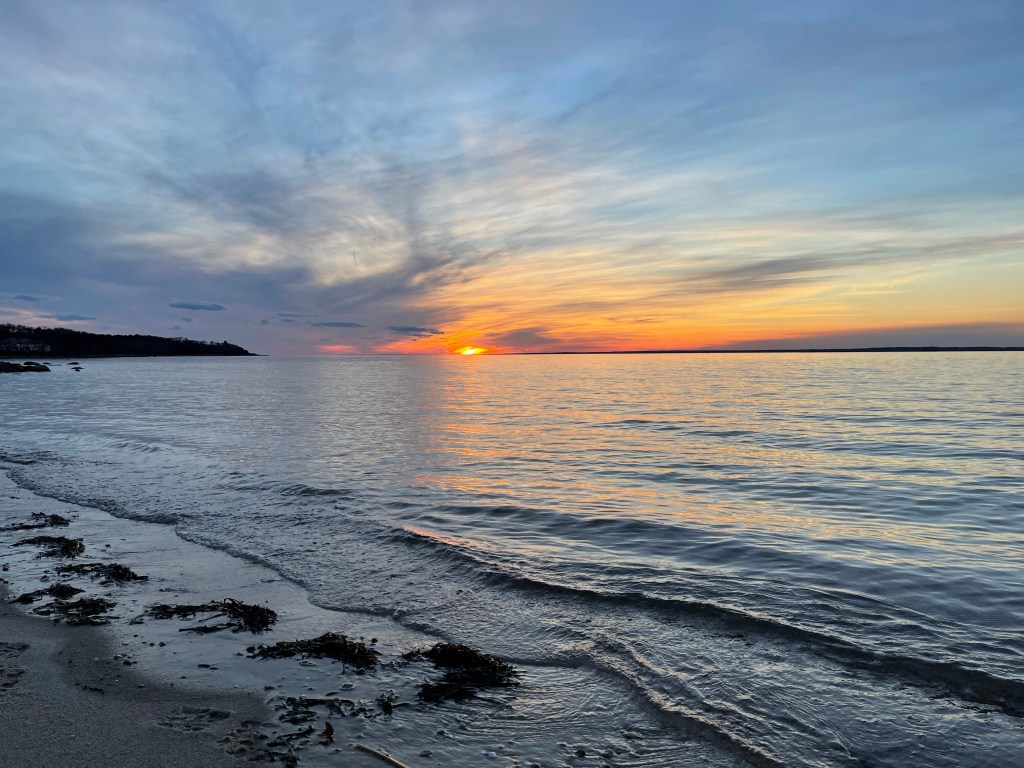
    I walked the short beach twice yesterday, to see what I was missing working with my back turned to it. I feel gratitude for the beach, but mostly for the bay that opens up the sky and the universe beyond. You don’t get quite so spun up about projects when you look at salt water. And I wondered again why I don’t live in such a place as this. Do you get tired of the infinite? I should think not. But our time with the infinite will come soon enough. Now we wrestle with deadlines and commitments and trivial pursuits.

    It’s different for each of us, this right where you ought to be feeling. The question might not be where you are at all, but what you’re doing that ought to be confronted. If you feel you’re right where you want to be in your work, in your life, then the world you walk out to meet will feel right no matter where you are. And when it’s not, well, even the divine feels a bit off.

    We are where we are, there’s no getting around that. We only have this one go around before the universe moves on to those who come after us. It’s not the place so much as how you fill it that matters. Otherwise it’s just a void, isn’t it?

  • Promises to Keep, Promises Kept

    Whose woods these are I think I know.
    His house is in the village though;
    He will not see me stopping here
    To watch his woods fill up with snow.

    My little horse must think it queer
    To stop without a farmhouse near
    Between the woods and frozen lake
    The darkest evening of the year.

    He gives his harness bells a shake
    To ask if there is some mistake.
    The only other sound’s the sweep
    Of easy wind and downy flake.

    The woods are lovely, dark and deep,
    But I have promises to keep,
    And miles to go before I sleep,
    And miles to go before I sleep.”
    — Robert Frost, Stopping by Woods on a Snowy Evening

    You can’t really live in New Hampshire without hearing the echo of Robert Frost in every stand of trees or old stone fence. I could drive to his old farm in fifteen minutes give or take, should I be inclined to. Some days I’m inclined to. But like so many things, not nearly enough.

    I woke up in the middle of the night with this poem running through my head. It’s been awhile since it’s lingered there, or if it had it didn’t bother to wake me from my slumber. Maybe it’s the cold days and the pleasant thought of woods silently filling with snow that seized my attention. But no, I should think it was the many promises to keep that are waking me in the middle of the night.

    That’s it: promises to keep. Big projects due this week that occupy my mind, and things left undone in my life that nag at me, so much more than the things done in my life that I don’t give myself enough credit for. It’s funny how the promises to keep are so much louder in our heads than the promises kept. We are our own worst critics, aren’t we? But after running through the promises I broke to myself that kept me awake I began listing the ones I kept, and eventually drifted back to sleep.

    To borrow from another Frost poem written in nearby woods, that made all the difference.

  • Writing to Schubert

    How many hours
    do I sit here
    aching to do


    what I do not do
    when, suddenly,
    he throws a single note


    higher than the others
    so that I feel
    the green field of hope,


    and then, descending,
    all this world’s sorrow,
    so deadly, so beautiful.
    – Mary Oliver, Schubert

    Today is the anniversary of the death of Franz Schubert, who passed away at the shockingly young age of 31 on the 19th of November 1828. It’s shocking because of how much he accomplished in such a short span of time. Not so shocking when you consider the state of modern medicine at the time: he was treated with mercury to cure what was believed to be syphilis. I’m grateful for a lot of things in my life — being born at a time where medical treatment is a bit less hit or miss is right up there on my list. But having better treatment options guarantees nothing. We still must produce while we can.

    The inspiration with Schubert is in the mastery he had reached in his last few years. It’s something we can draw from in our own creative lives, as Mary Oliver clearly did, and I regret not leveraging his soundtrack more often myself. But then again it all comes to us at different times, doesn’t it? We all reach that point of creative inspiration when we wake up and finally see the truth. If Schubert offers any warning from his grave, it’s that we shouldn’t wait. Memento Mori.

    Schubert’s brief and brilliant life informs: we can do a lot in a relatively brief amount of time. And surely, there’s still time to do it today. But maybe not tomorrow. Carpe diem. Now get to work.

  • Do That

    “Ask yourself: What is the best I can do? And then do that.” – Cheryl Strayed

    “The unifying theme is resilience and faith. The unifying theme is being a warrior and a motherfucker. It is not fragility. It’s strength. It’s nerve. And ‘if your Nerve deny you—,’ as Emily Dickinson wrote, ‘Go above your Nerve.’” – Cheryl Strayed

    Borrowing a couple of Cheryl Strayed quotes for this post. This ten hours late in the day post. This can’t get my head back into Eastern Standard Time post. This too busy and distracted to ship the work in the time you promised yourself you’d ship it in post. But perhaps I’m being too hard on myself. Despite it all, I publish every single day that I wake up on this planet with my head screwed on tight. Today will be no exception.

    I’ve recognized that I’m not doing enough, and I’m taking corrective action. Not just with this blog, but in a lot of things. Sometimes you need a bit of a kick in the ass from afar, and I’m grateful to the two ladies quoted above for providing that. I’ve used this Dickinson poem before, and delighted in Strayed quoting it in her own straight-to-the-point way. Her quote above was exactly what I needed to read to get my head out of the clouds and get the damned blog posted already. Save the excuses for another day, thank you.

    We all hear the call in their challenge, don’t we? It’s about the rest of the things we promise ourselves that we’ll do. Writing promises. Fitness promises. Work promises. Project promises. Relationship promises. Things deferred and neglected for too long. Be a warrior and grow beyond your fragility. Do what must be done. Have some nerve, or go above it.

    What’s the best you can do? It’s more than this. So do that.

  • Have Your Day

    Time drops in decay,
    Like a candle burnt out,
    And the mountains and woods
    Have their day, have their day;
    What one in the rout
    Of the fire-born moods
    Has fallen away?
    – WB Yeats, The Moods

    The Moods, as I understand it, are the messengers from God (God, in turn, is fire). Whatever your beliefs, there’s truth in the core message: time slips away drop by drop, and we all must pass. Whether a poet or philosopher or the woods or even the mountains themselves, all must “have their day”.

    Let us turn to old friend Henry and consider the phrase differently:

    The universe constantly and obediently answers to our conceptions; whether we travel fast or slow, the track is laid for us. Let us spend our lives in conceiving then. The poet or the artist never yet had so fair and noble a design but some of his posterity at least could accomplish it. Let us spend one day as deliberately as Nature, and not be thrown off the track by every nutshell and mosquito’s wing that falls on the rails. Let us rise early and fast, or break fast, gently and without perturbation; let company come and let company go, let the bells ring and the children cry—determined to make a day of it. Why should we knock under and go with the stream?” – Henry David Thoreau, Walden

    We get so caught up in life’s minor distractions that we lose track of the days slipping by. Shouldn’t we channel that inner fire and spend our lives in conceiving while we have this time? But wait! If even the mountains themselves eventually erode to sand, how can we be so bold as to expect a measure of immortality?

    This is why the concept of God and eternity hold so much meaning in our brief lives, we seek to understand the meaning of it all. Poets and philosophers and amateur bloggers each confront the brutal fact that we all must pass, and we don’t really have an answer for what lies beyond.

    So be it. But knowing that the track is indeed laid before us, shouldn’t we reach for our own measure of immortality, as fragile as it might be, and make a day of it? That, friends, seems to be the point all along. Have your day.

  • In the Dew of the Morn

    Out-worn heart, in a time out-worn,
    Come clear of the nets of wrong and right;
    Laugh, heart, again in the gray twilight;
    Sigh, heart, again in the dew of the morn.
    Thy mother Eire is always young,
    Dew ever shining and twilight gray,
    Though hope fall from thee or love decay
    Burning in fires of a slanderous tongue.
    Come, heart, where hill is heaped upon hill,
    For there the mystical brotherhood
    Of hollow wood and the hilly wood
    And the changing moon work out their will.
    And God stands winding his lonely horn;
    And Time and World are ever in flight,
    And love is less kind than the gray twilight,
    And hope is less dear than the dew of the morn.
    — WB Yeats, Into the Twilight

    The dew of the morn must be reckoned with. It dampens everything, especially your bottom if you should sit down without wiping the surface dry before you land. But I love it for all that it reminds me of; early morning rows, waking up in a tent in some remote place, the first, wet cleats soccer games of the day for the kids when they were cherubs. That damp start is a new beginning, a hope you can cling to until it dries with the rising sun.

    My heart belongs to the morning. For all the grief I get about going to bed early, I wouldn’t have it any other way. I listen to the sounds of the woods as the world wakes up around me and honor Sirius as the last holdout stubbornly fading in a brightening sky. I know we all must fade in our time but why not try for brilliance until the end?

    My heart also seeks faraway places, if only to see what’s there when I arrive. Yeats has recurring themes of time and mysticism in his work. Mother Eire is alive with faeries and magic, and he stirs a dormant but not distant longing to visit Ireland soon. Come heart, where hill is heaped upon hill… don’t worry, I’m already there!

    Wanderlust is nothing new for me, and I often celebrate it here, but you’ll never be happy in this world chasing your dreams elsewhere. Life is right here, where you are. In the dew of the morn, with the world stirring and a cuppa too soon gone. So dry yourself off and get after it. For there’s magic in the air.

  • Moments and Answers

    Aren’t there moments that are better than knowing something, and sweeter?

    At 4:30 in the morning, I realized I was unable to sleep any longer as I became increasingly aware of the fan tap-tap-tapping me to alertness. This wake-up hour is becoming a disturbing trend, and I fought it as long as I felt reasonable until I surrendered to the noise and got up well before the sun and read Mary Oliver’s poem Snowy Night, thinking it might draw me back to sleep.

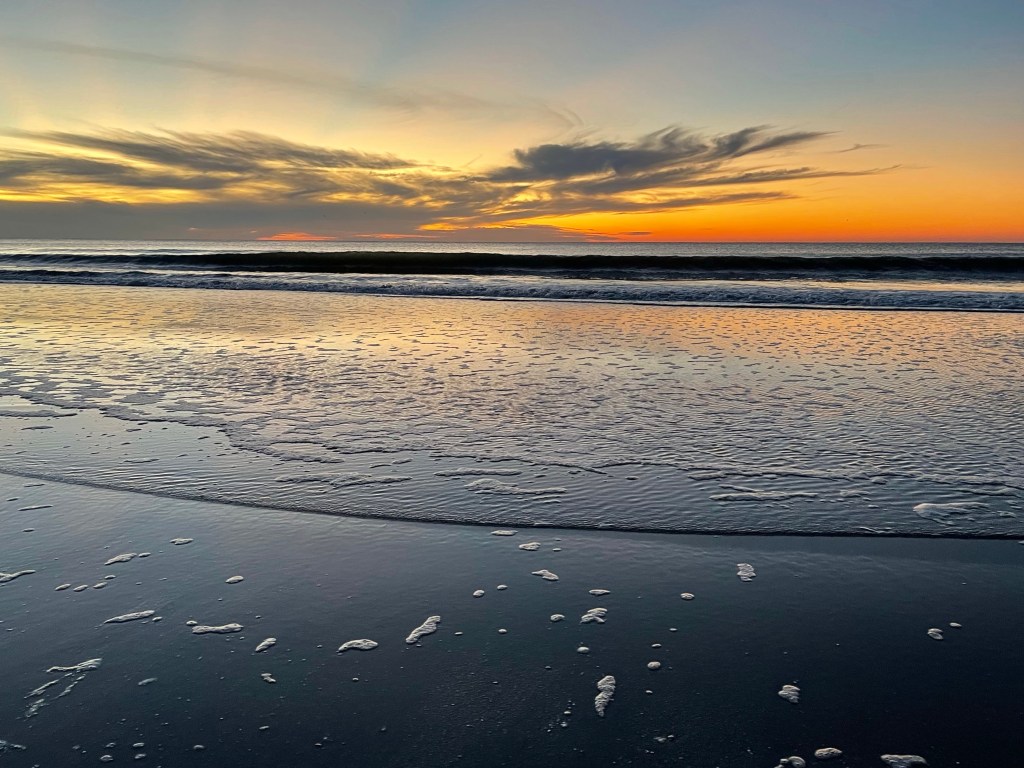
    Just the opposite, it turned out. So I decided to make the most of the unexpected time awake and drove to the sea to catch the rising sun meet the falling tide. The hope was to let the waves sweep away this bout of restlessness.

    I love this world, but not for its answers.

    I don’t understand the draw of inland places. Sure, they’re nice to visit for awhile, but I couldn’t live there. I’ve come to rely on salt water too much to be that far away from it. It draws something out of you. If not always answers, well, maybe moments.

    This post may not have all the answers (does any?), but I’ve hung on to it all day. I’ll take this moment to click publish. Cheers.

  • To Squander the Day

    We are reconciled, I think,
    to too much.
    Better to be a bird, like this one-

    An ornament of the eternal.
    As he came down once, to the nest of the grass,
    “Squander the day, but save the soul,”
    I heard him say.
    – Mary Oliver, The Lark

    We become especially adept at committing ourselves to activities with the least return on our time invested. What is an unproductive meeting but an agreement between two parties to squander time? As if we had the time to spend.

    This challenge by Mary Oliver, declaring that we reconcile to too much in our days, pokes deeply at that inner doubt we might have about how we’re spending our time. That (now) she’s challenging us from the grave amplifies the message. Jealously guard your time for that which is most important. Squander the day, if you must, but save your soul!

    We take stock of our calendars and see a growing trend back to the office, back to travel and meetings and getting things done. Some excites us, and some is a reconciliation to the mission at hand. This is the life of a professional, we do what we must to get where we want to be in our careers.

    But what if we saved our soul instead?