Category: reading

  • A Moment With Harold Evans

    “I appreciate engineers, I wrote a book about their achievements, but I deprecate what they and other techies do to English words. Hey, these nouns and verbs aren’t bits of silicon you can dope with chemicals (boron, phosphorus, and arsenic), drop into a kiln at 2,000 degrees Fahrenheit, and slice and dice. Words breathe. They need TLC—you know,”
    ― Harold Evans, Do I Make Myself Clear?: Why Writing Well Matters

    When the world seems to be looking too far inward, when everyone around you seems to be spun up into things that shouldn’t matter, when the conversation turns towards the latest scandal in Hollywood or Washington or Buckingham Palace… seek other voices. Because the only way you’ll grow is to rise up towards it. The larger conversations in the world are happening without you until you join the adult table. When you get to the adult table, by all means be ready to join the conversation.

    Sir Harold Evans passed away last week at the age of 92. In a wild case of six degrees of separation I once had Thanksgiving dinner with Harold Evans and his wife Tina Brown, putting me literally at the adult table with two of the most influential and brilliant people in the publishing industry. I was a college student who happened to be in the right place at the right time – they lived next door to the place we were for the long weekend and we invited them over. Simple. The parents were up to the conversation at hand, I wasn’t quite up to the task – a college kid who still thought he knew everything and not bothering to do the work needed to get closer to there. Harold Evans asked me a question about which candidate in the Republican Primary I liked, and without any thought to the matter I blurted out “Bob Dole” without explanation. It seemed like a safe answer at the time. He looked at me patiently and diverted to other topics with someone else, ending our conversation instead of trying to draw any logic out of my answer. He and I both knew I’d punted. I always regretted not being better prepared for a conversation like that.

    “His parents had taught him to make the most of himself, so he had. Though he kept a certain working-class deference and friendliness, did not shout, was “Harry” to everyone and would quite kindly tell reporters their copy was hopeless, he had taken on almost every part of the establishment and made it quake.” – Harold Evans’ Obituary, The Economist

    Reading about Evans’ life, I was struck by how hard he had worked to raise himself up and to demand the best from himself and others. I remember he was a voracious reader, and would often devour several books on the drive from New York City out to Quogue, New York. As the editor of Random House he needed to read quickly because he had an endless stream of books coming at him. I would try speed-reading a few times over the years attempting to get as much from it as people like Evans did. But I’ve found that speed-reading doesn’t work for me. I like to linger on words and sentences a bit too much. If I were to have that one conversation with him again I might ask how he approached reading. I suspect he did it two ways, for work and for pleasure, and the speed varied based on which it was. It would have been a better conversation than the Republican Primary of 1987-1988.

    “Running a newspaper gave him “a glorious opportunity of attacking the devil”. – Harold Evans’ Obituary, The Economist

    Harold Evans was fired from The Times by Rupert Murdoch, setting up his move to New York and his rise to the top of the publishing industry. Had he not been fired I would never have met him. He used it as fuel to rise up even higher, and it was surely a gift not having to cater to the whims and biases of Murdoch. Attacking the devil was a purpose, and I wondered sometimes what he thought of the nastiness of present-day politics. But there it was, an interview from 2017 where he called Boris ‘buoyantly reckless’, Trump dangerous and May ‘terrifically smart’. I believe he was on point with all three. No surprise for a man who did the work necessary to find the truth of the matter with the most evasive of characters. Thinking back, I was no match for him at the time. But he helped inspire me to try harder, as I suspect he did with many others over the years. I wish I’d had another conversation with the man, I was more prepared for the next one.

  • Every Day A New Fancy

    “We are carried along by our thoughts, “now gently, now violently, according as the water is angry or calm … every day a new fancy, and our humors shift with the shifts in the weather.” It is no wonder that the mind is like this, since even the apparently solid physical world exists in endless slow turmoil.“ – Sarah Bakewell, quoting Montaigne, who was quoting Heraclitus

    I’ve had the Montagnie’s Essays for some time now, but keep pushing it aside for other reading material. So when Bakewell’s book How To Live or A Life Of Montaigne was recommended by an author I follow closely I decided to dive in. While also reading the excellent Erik Larson book The Splendid And The Vile and Tristan Gooley’s How To Read Water and a business book recommended by the company President. So five books in various stages of completion, and a desire to complete them all. This happens now and then: every day a new fancy. I’m treating the business book like a homework assignment and read it for an hour then put it down for the day. But what of the others? You can’t read everything at once.

    The answer is you put aside the books that aren’t capturing your imagination at the moment. Get out and live, return and see where the mind settles. At the moment I’m settled on The Battle of Britain with Larson’s book. There’s only so much time for reading, just as there’s only so much time for anything else meaningful. We prioritize and complete what we can in this tumultuous world, and accept the day as it is when it ends.

    Being carried along by our thoughts is a very human condition. We all have the tendency to get distracted by the buzz around us, which has grown exponentially since Montaigne’s time. We do a disservice to ourselves having so much to consume, for we can’t possibly consume it all. Instead I’m trying to raise the bar. Consume, but make it nutrient-rich consumption. What are you getting out of this book? is as fair a question to ask as What are you getting following this person’s Twitter account? The price you pay to read it is time you’ll never get back and attention you could have spent on something else. So by all means make it worthwhile.

    In all the madness that is 2020 I forgot that this was a Leap Year. There are 366 days in 2020 – as if we needed another day added to this crazy year. Looking back on the last 250 days that have passed, I’ve managed to read 13 books so far, fewer than anticipated but overall a higher level of reading. I’m barely skating by on learning French and Portuguese, doing just enough to keep the streak alive. And of course I’ve recommitted to hiking and local travel. 2020 will go down as the most unusual year in my lifetime, but it won’t be a lost cause.

    “If you understand everything you consume, you’re probably going to be the same person 6 months from now.” – George Mack

    So there’s the challenge: stretch your limitations and grow. To turn Mack’s quote and look back six months ago when this pandemic really started locking things down, I can say I’ve accomplished a lot in spite of the pandemic (or because?). The time hasn’t been lost at all: filled with learning and family time and local travel I might have otherwise put aside in favor of the faraway. And so to turn that quote back around as a challenge to myself and look out six months from now, what will I have accomplished? When you ask this question of yourself and take it seriously it stills the tumult of the mind and lends focus to the march we’re on. Sure the stack of distractions remain, but the path becomes more defined. A tumultuous river and a still river both arrive at the same sea eventually. Which has the better journey?

  • The Light of Intellect

    “A man who lives an intellectual life is like a man who carries a lantern in front of him to light his way. Such a person will never come to a dark place, because the light of his intellect moves before him.“ – Leo Tolstoy

    I suppose I haven’t reached the intellectual level just yet, as I still stumble into dark places now and then. But on the whole the pursuit of an intellectual life, combined with a pursuit of the active outdoor life, and the family life have kept me above the darkest valleys I know some are struggling in. Feel overwhelmed at times? Tap into the Great Conversation and see what those who came before you thought and did with their own lives. We have it pretty good by comparison. But only if we fight for it.

    Leo Tolstoy was influenced by Henry David Thoreau (and each was an interesting character beyond his writing). He in turn strongly influenced the nonviolent direction that Mahatma Gandhi would take in his own life, and there was a handoff of sorts when the two corresponded for the last year of Tolstoy’s life when he offered insight and direction to Gandhi. Thoreau and Tolstoy and Gandhi in turn influenced Martin Luther King, Jr., who incorporated their wisdom into his own philosophy and referenced them often in his speeches. An intellectual life lights the way for more than just the original carrier of the lantern.

    A daily blog is the slow rising of the lantern. An attempt to light the way for yourself and perhaps for a few others now or someday. A way to balance the stream of consciousness and sound bite world we live in with deeper thought and contemplation. And a catalyst for probing deeper into the world – to travel more, to get outside more, to read more, to learn more, and to write better. The intellectual life is the life of pursuit. Its not a yawn-fest of casual reading in the study but a pursuit of understanding, both the self and the world. It’s a call to action. A call I’ve heard and pursue every day I wake up, which (thankfully) includes this one.

  • Creating the Moon

    “The moon itself may have been born of a great tidal wave of earthly substance, torn off into space. And remember that if the moon was formed in this fashion, the event may have had much to do with shaping the ocean basins and the continents as we know them.

    There were tides in the new earth, long before there was an ocean. In response to the pull of the sun the molten liquids of the earth’s whole surface rose in tides that rolled unhindered around the globe and only gradually slackened and diminished as the earthly shell cooled, congealed, and hardened. Those who believe that the moon is a child of Earth say that during an early stage of the earth’s development something happened that caused this rolling, viscid tide to gather speed and momentum and to rise to unimaginable heights.

    Physicists have calculated that, after 500 years of such monstrous, steadily increasing tides, those on the side toward the sun became too high for stability, and a great wave was torn away and hurled into space. But immediately, of course, the newly created satellite became subject to physical laws that sent it spinning in an orbit of its own about the earth. This is what we call the moon.

    There is to this day a great scar on the surface of the globe. This scar or depression holds the Pacific Ocean.” – Rachel Carson, The Sea Around Us

    Rachel Carson published The Sea Around Us 69 years ago, and it was a runaway best-seller at the time. I’ve known Carson as the author of Silent Spring, but was ignorant of this book that launched her into fame. As the name suggests, the book explores the sea and is filled with magically breathless wonder. The excerpt above filled me with awe and set the stage to position this book at the top of the stack. For who doesn’t look at the moon and wonder how it got there? And this theory of a massive wave of molten liquid rising up and ripping from the earth to form the moon, and the great scar of the Pacific basin makes as much sense to me as any other.

    Science is a funny thing. I ran away from science in school because the teachers were dispassionate bores. But when I read a passage that delivers a rightful sense of awe to the story, well, it becomes captivating. If the politicization of the pandemic and mask-wearing has demonstrated anything, its that the world needs more captivating story-tellers in science. Carson was a catalyst for a better understanding of our oceans and the environment with a page-turning writing style that betrayed her own wonder at the subject matter. Were her writing style technical and dry she never would have made the impact that she did, and the world may never have realized the threat of nuclear waste dumped into the ocean or of DDT on the food chain we are very much a part of. If she were alive today I expect she’d have a lot to say about plastic and climate change.

    Writing isn’t nearly as epic as creating a moon, but it can feel that way sometimes to the writer. I’m plugging away at the writing, both here and elsewhere, and feel that the words and characters are my own rolling, viscid tide moving unchecked through my mind. At some point maybe that momentum will spawn something awe-worthy. And that’s the challenge isn’t it? To produce something compelling and timeless. Watching the waxing crescent moon peaking through the forest last night as it dropped into the western sky was both an inspiration and a challenge to get it right. I imagine Rachel Carson looked up at the moon in a similar way, and she rose to that challenge. So why not us?

  • On Reading and Time

    “Sit in a room and read–and read and read. And read the right books by the right people. Your mind is brought onto that level, and you have a nice, mild, slow-burning rapture all the time.” – Joseph Campbell

    Over the last two weeks I’ve found myself reading less, and I feel the impact in my writing and in my overall mood.  It started with trying to get the blog done before I read, which is surely a noble pursuit, but a change of routine for me.  Then came the distraction of a complicated jigsaw puzzle that lured me in on vacation and as far as I know may never be completed.  And now I’m back and trying to crank out twice as much writing in the early morning hours when reading was an essential part of waking up my mind.  And the call of the writing distracts me when reading, which muddies up the whole works.

    Its not like I don’t have a cue of great books to read.  No, I’m particularly excited about a few of them and want to dive back in.  This is a disrupted habit loop that is still in a funk since vacation.  A habit loop that requires attention.  Normally I reset my reading by picking up a page-turner that spins my adrenaline up.  That worked quite well earlier in the summer.  Now not so much.  So how do you rectify the problem?  Schedule reading time after the writing and work?  That doesn’t feel like a slow-burn rapture to me.  It sounds like a chore. Reading for pleasure shouldn’t ever feel like assignment reading.  We’ve all lived the school assignment reading discipline.  Assignment reading gets the job done whether we like it or not.  After school there’s plenty of work-related assignment reading written strictly to inform that fills our days.

    So change the description from assignment reading to scheduled reading.  Scheduled reading time works for me.  I used it to work my way through some very dry reading in 2018 that bordered on assignment reading.  Scheduled reading time is a short burst of time carved into the day to prime the pump.  On a morning like today when I have a lot to do that might be ten minutes of quick reading, but even ten minutes will serve to reset the habit loop and leave me wanting just a bit more.  And when time allows I dive deeper.  Time is a funny thing, isn’t it?  We tend to find it again when we’re highly engaged.  And we wonder where the time went when we look up.  Good reading will do that.

    Look, I know the world is full of complicated problems and my reading habit doesn’t rise very high up on the things the world should be focused on.  But I do believe the world would be a much better place if more people carved out some time for some nice, mild, slow-burning rapture.  Whatever gets us off the news cycles and the click-baiting outrage and the constant stress of living in 2020 that seems to overwhelm so many people.  Reading great books drops you into another world – a world filled with wonder and discovery and empathy.  And when you step back into the “real” world maybe you’re just a bit better off for the journey you’ve been on.


  • The Four Chronometers of Greenwich

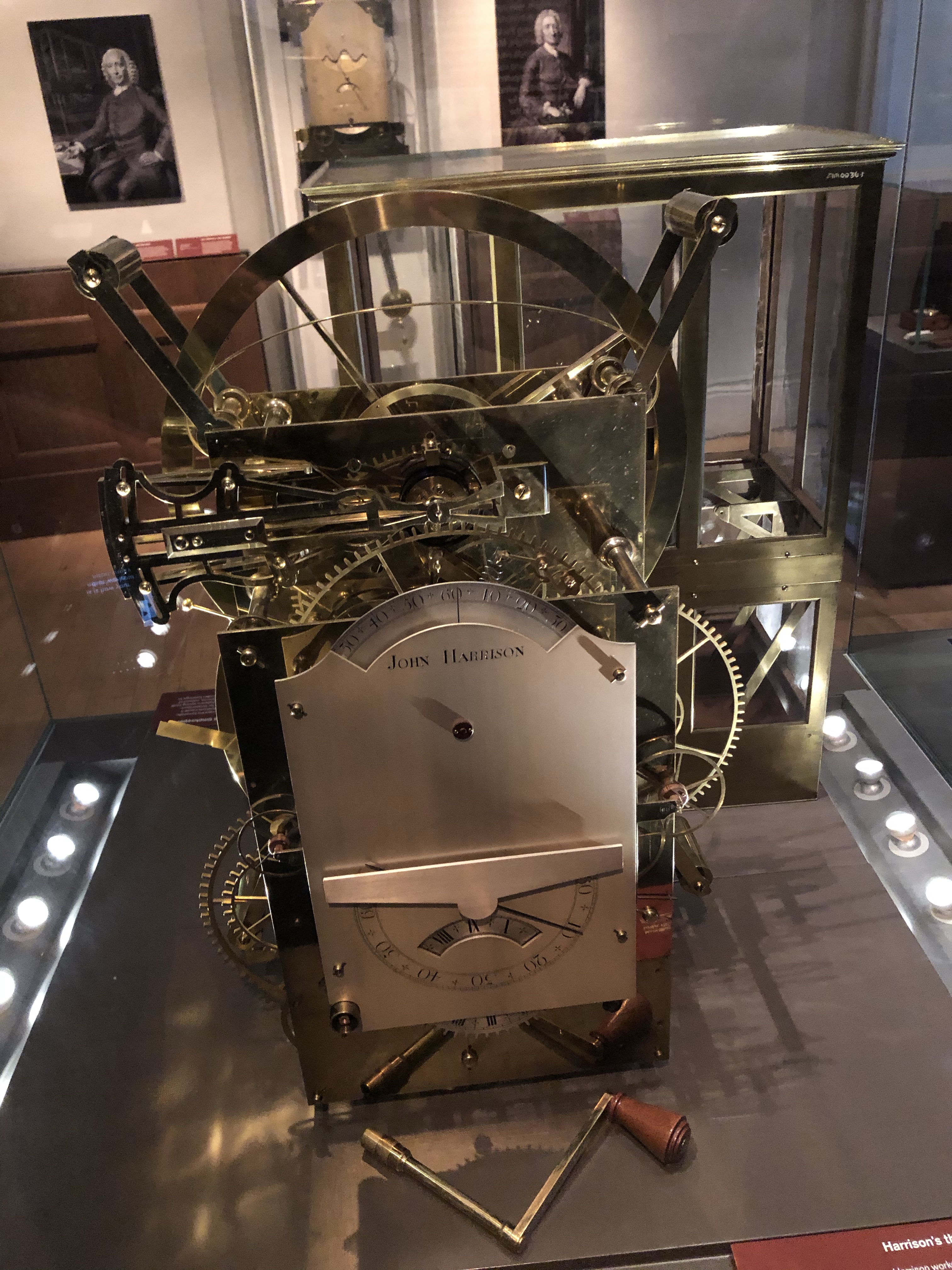
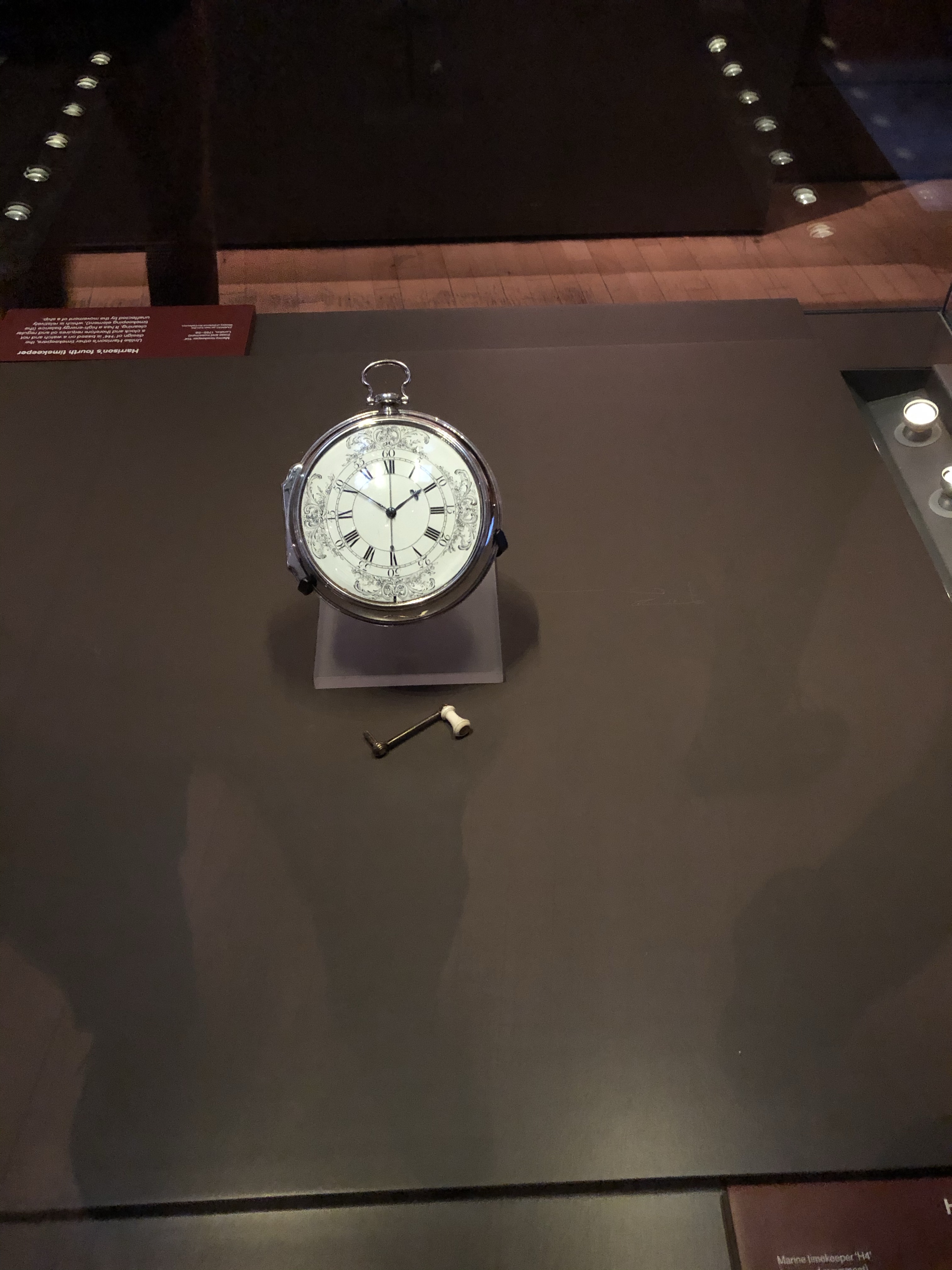
    I confess when I visited Greenwich my mind wasn’t on chronometers, it was on the Prime Meridian and Greenwich Mean Time.  But after the obligatory pictures at 0° along the famous line that dictates so much of our modern lives I spent the duration of my time exploring the Royal Observatory Greenwich, and listened intently as an exceptional guide detailed the story of the four clocks that changed the world.  That all four of the clocks were on display, and three of them were still running was a mind-blowing moment.

    John Harrison invented the first clock, H-1, in an attempt to solve the most perplexing problem of the day – determining longitude while at sea.  It was such a critical issue that Parliament passed The Longitude Act 1714 with a prize of £20,000 for anyone who came up with an accurate way to determine longitude.  Dava Sobel wrote an excellent book that details Harrison’s lifetime pursuit of a final solution.  H-1 was completed in 1735, but Harrison wasn’t completely satisfied with it and went about immediately to work on an improved chronometer.  H-2 never went to trial (tested at sea), H-3 was completed in 1759 but wasn’t trialed right away because of the Seven Years War.  While they waited to trial it Harrison invented the smaller H-4, which was the size of a very large pocket watch, which went on to win the prize money after a lifetime of work and refinement and continuous trouble with The Commissioners of Longitude (some of whom were biased towards an astronomical solution to the longitude riddle).

    Part of me wishes I’d read Sobel’s book before visiting Greenwich and seeing the four chronometers that changed the world.  But there’s another part of me that is grateful for discovering them unexpectedly.  I immediately purchased Longitude when I returned from the UK.  Having seen the four chronometers side-by-side in the museum, with all in working order (H-4 is deliberately kept unwound to preserve it), I felt an immediate affinity for the story when I began reading.  But another hero emerged from the book besides Harrison.  It was Rupert Gould, a Lieutenant-Commander in the British Royal Navy who was given permission to restore the four chronometers that had been sitting in a deteriorating state for almost a century.  Gould spent 13 years restoring the clocks to their original state, and in doing so returned four examples of timeless magic for visitors to the Flamsteed House and the Royal Observatory Greenwich.  He’s a quiet hero in history, and is rightfully remembered as such.  I was spellbound by H-1, H-2 and H-3 as they earnestly marked time 2 1/2 centuries after Harrison built them.  Now that I know their history, I look forward to a return visit someday, and will re-read Longitude and linger for a spell in the presence of history.

    H-2
    H-1

    H-4
    H-3
  • Really Only Words

    “All things are really only words
    in a tongue of endless gobbledygook
    that someone or something is writing in a book
    that is the history of the world. In herds,

    you, I, everyone, Carthage, Rome travel,
    and my unfathomable life too, and this stigma
    of having been an accident, a cipher, an enigma,
    of being all the unmelodious dialects of Babel.

    But behind every name is what has no name.
    Today, I felt its shadow flicker and take aim
    in the blue compass needle, lucid and light,

    that points far away across seas that gleam,
    something like a timepiece glimpsed in a dream,
    or the stirring of a bird in the middle of the night.
    – Jorge Luis Borges, The Compass

    This poem was originally written in Spanish, and I’ve read two versions of it that are completely different from each other, depending on the translation to English.  And such is the challenge of interpreting both language and poetry.  Words mean different things to different people, and I wonder sometimes at the words I’ve read that were interpreted by another and how close to the truth those words truly are.  The better path would be to invest the time to learn to speak Spanish fluently and read the poem as Borges intended.  Instead I rely on the interpretation of others.

    Isn’t that the way it is with the news?  We rely on the interpretation of facts by writers who put their own spin on it, often to feed people what they want to hear.  I’ve stopped watching the news so that I can hear my own voice instead.  And what of hearsay?  You hear a story about someone else from the viewpoint of the speaker and make up your mind about them based on what someone else said about them.  The question is how much do you trust the source of your information?

    The gist of this poem is the mystery of who we are, and our path to figuring that out.  Finding our true north in a jumble of lives and words and interpretation.  And that makes the different versions of this poem somehow appropriate, I suppose.  Brian Doyle called Borges one of the greatest writers in history, but with a limited grasp of Spanish, Borges’ brilliance is largely lost to me as I rely on others to provide meaning to his work.  If ever there was a reason to learn languages its to truly understand and to be understood by others.  I’m just scratching the surface with a writer like Borges in reading an English translation, and you could say the same thing about Homer or Nietzsche or Marcus Aurelius for that matter.  They’re really only words, but the way you put those words together matters.

    Doyle pointed me to Borges, who’s work is frustratingly just out of reach for me in its original form.  I have the same frustration with bird calls and plants in the forest and other such things I can’t figure out given the scope of my current knowledge.  But its all part of the journey, isn’t it?  The unknown is either a roadblock or a welcome sign, depending on your own interpretation.  And there’s that word again.  All forks in the road that lead us down the next path towards a greater understanding of the world and our place in it, should we be so bold as to keep moving forward.

  • Breathe

    I admit I didn’t think much about breathing until recently when my son strongly recommended a book for the family.  After some due diligence in listening to the author interviewed on a Joe Rogan podcast I was convinced I needed to read the book myself and quietly slid the stack of real and virtual books aside to read Breath: The New Science of a Lost Art before anything else. I’m well into it now, and can tell its one of those transformative books that influences the way you think about many things. And so it was that I hiked two 4000 footers yesterday with these thoughts in my head:

    In a single breath, more molecules of air will pass through your nose than all the grains of sand on all the world’s beaches—trillions and trillions of them.”

    “Nasal breathing alone can boost nitric oxide sixfold, which is one of the reasons we can absorb about 18 percent more oxygen than by just breathing through the mouth.”

    “The greatest indicator of life span wasn’t genetics, diet, or the amount of daily exercise, as many had suspected. It was lung capacity.”

    “Moderate exercise like walking or cycling has been shown to boost lung size by up to 15 percent.”

    “The most important aspect of breathing wasn’t just to take in air through the nose. Inhaling was the easy part. The key to breathing, lung expansion, and the long life that came with it was on the other end of respiration. It was in the transformative power of a full exhalation.”

    With apologies to author James Nestor, I wasn’t going to fully commit to nasal breathing hiking up Crawford Path yesterday. I gave it a try a few times but didn’t feel like I was getting enough air. Something to work on for sure, but I opted for the more familiar mouth breathing for the steepest stretches of the path and reserved the nasal breathing for the descent from Mount Eisenhower. I can tell I’ve got my work cut out for me, but anything worthwhile deserves putting the work in. What’s more worthwhile than breathing?

  • Setting the Tone

    I had a professor in college who pointed out that the greatest books in history had great opening lines that set the tone for the everything that followed.  He pointed out the Bible as the most unambiguous example of setting the tone for everything else that follows, but you can’t forget the brilliance of Homer or Dickens or Melville.  Consider:

    “In the beginning, God created heaven, and earth.” – The Book of Genesis, Holy Bible

    “Sing in me, Muse, and through me tell the story” – Homer, The Odyssey

    “It was the best of times, it was the worst of times…” – Charles Dickens, A Tale of Two Cities

    “Call me Ishmael” – Herman Melville, Moby Dick

    I’d humbly point out that great songs have a similar tendency.  And since most people seem to have shelved their discipline of reading the classics after graduation, it may be an easier example to illustrate.  Consider the following immortal songs and how the opening line sets the tone for all that comes after:

    “Mother, mother ocean, I have heard you call” – Jimmy Buffett, A Pirate Looks at Forty

    “If you could read my mind love” – Gordon Lightfoot, If You Could Read My Mind

    “Something in the way she moves” – The Beatles, Something

    “Out of the tree of life I just picked me a plum” – Carolyn Leigh, The Best is Yet To Come

    “Don’t worry about a thing” – Bob Marley, Three Little Birds

    “Imagine there’s no heaven” – John Lennon, Imagine

    “There must be some way out of here” – Bob Dylan, All Along the Watchtower

    And so it is that I think about the words that set the tone for this blog, and took the immortal words of Henry David Thoreau that grace the home page of this site and made them more prominent.  For his call to action is also my own, and set the tone for all that this blog aims to be:

    “Rise free from care before the dawn, and seek adventures.” – Henry David Thoreau

    I realized somewhere along the way that this is exactly the way I try to live; rising early, seeking adventure in this day, writing about it when it deserves consideration (and perhaps sometimes when it doesn’t), savoring the day and then putting it behind me, that I might rise from care once again tomorrow.  This isn’t head-in-the-sand optimism, it’s a calling, and some days are more adventurous and free from care than others.  But string them together and you set the tone for a life more interesting.  What sets the tone for your life?  Be bold in your selection.

  • Seeing Our Soul in Things

    Weeks just fly by, we remain in a pandemic, but the writing continues.  The writing must continue.  Some days the words come to me immediately, some days it’s a struggle, but I always attempt to get about 400 words into a legible and hopefully enjoyable blog post.  Prior to writing today I read 10-11 pages of thoughts from long-dead souls before turning back to my own thoughts.  When traveling is limited, there are always books to take you places.  So I went back to 1850’s Switzerland with Amiel’s Journal and 1910 Russia with Leo Tolstoy’s Calendar of Wisdom.  I know what you’re thinking: this guy must be a lot of fun at parties.  But there’s tremendous wealth to be mined from the masters, and these books largely stand the test of time:

    “Common sense is the measure of the possible, it is composed of experience and prevision; it is calculation applied to life.” – Henri Frédéric Amiel

    “We are all visionaries, and what we see is our soul in things.” – Henri Frédéric Amiel

    “Do not fear the lack of knowledge, fear false knowledge.  All evil in this world comes from false knowledge.  Knowledge born in argument and discussion is to be doubted.” – Leo Tolstoy

    So these guys, language and cultural barriers aside, might be interesting at a party after all.  I could see myself diving deep into a discussion on the use of common sense in measuring the possible with Amiel, or the rise in false knowledge with Tolstoy.  These guys might not recognize the players of 2020, but they’d surely recognize the character of the players.  Just as we recognize the character of historical figures from the past.  The more things change the more they stay the same.

    Like most books, I didn’t just fall upon Amiel’s Journal and Calendar of Wisdom.  Each was referenced multiple times by other writers I’ve read.  When someone you’ve mined for knowledge and timeless wisdom points you to the source of their own development of thoughts, doesn’t it make sense to go check out that source?  And so it is that reading leads to more reading, which influences my writing, which drives an appetite for more knowledge, which brings us right to this cocktail party with Amiel and Tolstoy and me trying to keep up my end of the conversation.  But the long-dead have infinite patience with rakish amateurs like me (thanks gents).

    So if there’s a take-away from all of this, it’s to do interesting things, and read interesting things, and it will in turn make you more interesting in your writing and at random cocktail parties with dead people.  But seriously, we’re all just participating in the Great Conversation, and skipping from source-to-source collecting a wealth of information and insight that we might, if we’re lucky, develop into a philosophy of our own. Do not fear the lack of knowledge, fear false knowledge.  Go find the truth in that which you observe.  We’re all visionaries, after all, and what we see is our soul in things like the truth.  You’ll know it when you see it.