Category: Stoicism

  • The Battle of Timidity and Boldness

    “Focus your attention on the link between you and your death, without remorse or sadness or worrying. Focus your attention on the fact you don’t have time and let your acts flow accordingly. Let each of your acts be your last battle on earth. Only under those conditions will your acts have their rightful power. Otherwise they will be, for as long as you live, the acts of a timid man…. Being timid prevents us from examining and exploiting our lot as men.” – Carlos Castaneda, Journey to Ixtlan

    I did the math, mentally adding 25 years to my current age and toyed with the idea of being that later age. There are no guarantees that I’ll ever reach that point in my life, of course. No guarantees for any of us marching through time on our annual trip around the sun. But I toyed with the idea of being an old man and wondered at the state of my mind and body. I wondered at the experiences I’d had in the interim, these years between now and then.

    This long sleep we have in store for ourselves is our future, whether a quarter century away or this afternoon, and we ought to live boldly instead of merely timidly existing. I won’t say I’ve mastered this, but I live a better life knowing that the whole dance could end on the next drum beat. But we can do so much more. Simply by living with urgency.

    This theme, the constant reminder of our imminent death, runs through Stoic philosophy. And it runs through this blog. I try, not always successfully, to use it as a cattle prod to my backside. A jolt of awareness that this could all end at any moment, so break free of that routine, break away from the timid existence and live a life of adventure and boldness. It’s the underlying theme of this blog, beginning on the home page with Thoreau’s call to action:

    “Rise free from care before the dawn and seek adventures.” – Henry David Thoreau

    If we accept that we must die, and as improbable as it might seem, at any moment, what might we do to live now? If this is our final act, what will it be? And, if blessed with another, what of the act to follow?

    The answer clearly must be to live the moment with urgency. Say what must be said. Do what must be done. Get out there and live boldly! Pursue the magic in the moment with vigor and a profound lust for life.

  • Making the Sun Run

    But at my back I always hear
    Time’s wingèd chariot hurrying near;
    And yonder all before us lie
    Deserts of vast eternity…

    Let us roll all our strength and all
    Our sweetness up into one ball,
    And tear our pleasures with rough strife
    Through the iron gates of life:
    Thus, though we cannot make our sun
    Stand still, yet we will make him run.
    – Andrew Marvell, To His Coy Mistress

    Spending time ought to come with a warning label. I’m revisiting this poem from Marvell. I’d first written about it before the pandemic, when the world seemed quite normal, if maddeningly out of sorts. Since then, well, we all know how things have gone.

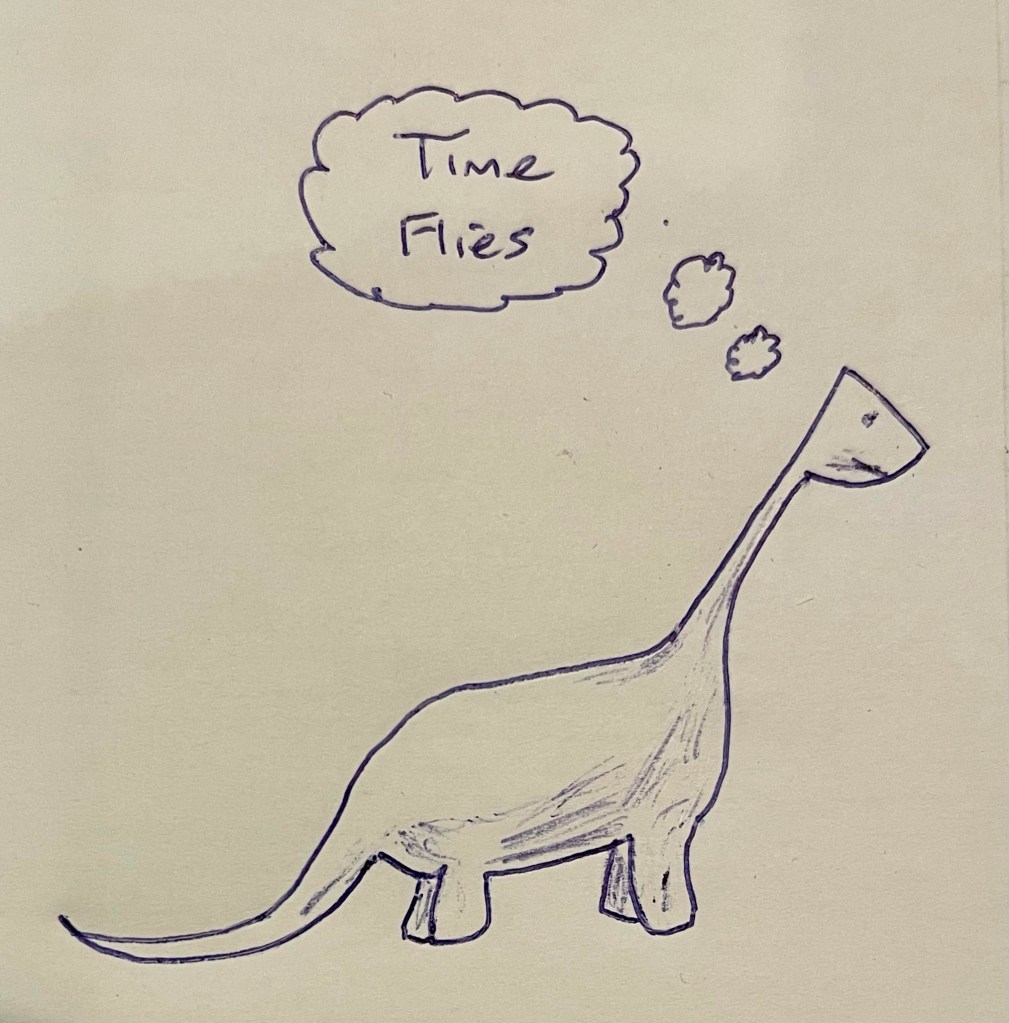
    So what do we do with this hard-won knowledge? We have our own time’s winged chariot hurrying near. Maybe we have a few years more or less than the average, but what’s it worth to you anyway? Another trip around the sun and vast eternity ahead for every last one of us. Make the most of life now, while there’s still some of that time for you.

    Today is the day before the promise of another year more. I’m getting a second dose of the Pfizer vaccine with a hopeful eye towards the future. A future where we might run with the sun, chasing every day to its extraordinary end. Sporting while we may. The sun doesn’t stand still. And neither should we.

  • Something More

    “The world always seems brighter when you’ve just made something that wasn’t there before.” Neil Gaiman

    This rather cheery quote by Gaiman prompts a challenge of sorts from me. For making something isn’t what makes the world brighter, making something you care about making is what brightens the world. For in the making of something in such a way you honor the world with your contribution.

    As Gaiman rightly points out, we’re lovingly placing something that wasn’t there before out in the world for it to embrace. Will it fly or get lost in the noise? It’s not up to us to decide. It’s up to us to create it and set it free. And then to get back to the business of building another beacon.

    The best of our work becomes accretive rather than reductive. Look around, there’s plenty of people creating hateful, mean-spirited work that divides and diminishes the world. But not us, no: we offer something more. Something that resonates across the table and across time. For the very best work becomes timeless.

    So what makes something timeless? I believe it’s the deep connection between two people that your work represents. Paint placed just so on canvas. Architecture that stirs the heart generations after the last stones were laid. Words that transcend the author or poet and connect one soul to another. This is what brightens the world. This is the shining soul beacon of the artist that keeps hope alive, like a Fresnel lens lights the distance in a turbulent dark sea:

    “If you have built castles in the air, your work need not be lost; that is where they should be. Now put the foundations under them.” – Henry David Thoreau, Walden

    “Dwell on the beauty of life. Watch the stars, and see yourself running with them.”
    – Marcus Aurelius, Meditations

    “Tell me, what is it you plan to do
    with your one wild and precious life?”
    – Mary Oliver, The Summer Day

    “If you dare nothing, then when the day is over, nothing is all you will have gained.”
    – Neil Gaiman, The Graveyard Book

    “This above all: to thine own self be true,
    And it must follow, as the night the day,
    Thou canst not then be false to any man.”
    – William Shakespeare, Hamlet

    All words across time, offering a path through the darkness in the world. Offering hope and direction and illumination. This is something more. And this is our opportunity too. Great artists are ambassadors to the world, bridge builders to the future, and infinite soul connectors. That’s something to aspire to.

  • A Year Like No Other

    “Man, like a bridge, was designed to carry the load of the moment , not the combined weight of a year all at once.” – William A. Ward

    I’m not going to run a postscript on what happened over the last year – plenty of people have already written about that. A year ago we were quietly celebrating St. Patrick’s Day in an empty bar owned by a friend bearing what we optimistically thought would be a temporary shutdown to flatten that curve. That friend has managed to stay in business despite the severe restrictions on their business, open a second location in the middle of a pandemic, and is in the middle of a second battle front with cancer. Who am I to complain about working from home for a year?

    Some of us have lost much more than others, but we’ve all lost something. Loved ones and graduations, sports seasons and jobs, trips of a lifetime and gathering with friends in busy places. We all have that Rolodex of losses we can pull out to share with the world. The profound losses mix with the simple. But something has to balance the losses out. The world doesn’t just tilt on its side without counterbalancing with something else. If we’re all walking that line between order and chaos, what have we gained?

    We know instinctively what has balanced the losses, if not completely at least enough to stay afloat. More time with immediate family, perhaps a little too much now and then but time we’ll reflect on fondly. More creative use of technology to find a smile in the darkness. More alive time with gardening and cooking and reading the books you were meaning to get to… and more time alone to think. Deep reflection on what is really important.

    There are heroes among us that did so much more than the average. We celebrate the essential workers who kept this thing going, but we should also give ourselves a small pat on the back. We may not be medical staff or law enforcement or supply chain workers, but we’re all collectively doing our part to bridge the madness of the last year, one day at a time.

    Of course, this bridge is still being built, still extending to some place in the future where it might set in the firmness of normal. And some are restless – we watch some tentatively gain footing on what they believe to be firm ground, celebrating together and shouting for the rest of us to join the party. But some of them are dancing in quicksand.

    No, we’re closer now, but like the soldiers in the last months of World War II, we know this isn’t the time to let up our guard. Don’t go frivolously burning that mask just yet folks, we’ve still got today to face, and tomorrow too. We’ve carried on this far, just hold on a bit longer. Almost there.

  • The Pull of Our Inclinations

    “A stone, because of its makeup, will return to earth if you throw it up in the air. Likewise, the more one pushes the intelligent person away from the life he was born for, the more he inclines towards it.” – Musonius Rufus

    What of our makeup? Are we drawn towards our inclinations, like gravity pulls a stone? Speaking as a sample size of one, I believe it to be true. Certainly the writing poured out of me in every job I’ve ever had, manifesting my own inclinations in quote-of-the-day emails, monthly newsletters and lengthy dissertations on topics lost forever in the ether of bits and bites.

    We often ignore our makeup in favor of the trade du jour. Who wouldn’t want the relative guarantees of a career in engineering or law or programming over the uncertainty of art or music or writing? Your parents certainly wanted the best for you when they reminded you to study hard. Our friends also influenced us, steering us to get the college degrees in fields where the jobs were. The pull of our makeup is in a tug o’ war with the well-intentioned advice of our circle of influence. And of course the anchor of the opposing tug o’ war team: that inner voice, Seth Godin’s Lizard Brain, Steve Pressfield’s Resistance, that quietly conspires against you.

    So whatever you pursue instead, you try to do it well. To honor your commitments, to build your nest egg and support your growing family. But that inclination quietly pulls at you, asking for more of your attention. And you slowly concede a bit here and there. Start selling things on Etsy, playing guitar in a band, writing a blog or creating an InstaGram site to display your photography. A hobby, really. Something to dabble in to keep the mind working.

    Over time you see incremental improvement; finding your stride, your style, your voice. And you find a bit of momentum. You’re still in that tug o’ war, but the flag is inching a bit closer to that line in the sand. And it’s a battle! One side pulls, the flag shifts away, the other gains strength and the flag draws closer to crossing over. Back and forth it goes. Which side wins?

    Well, that’s up to you.

  • To Live is to Function

    In this symposium my part is only to sit in silence. To express one’s feelings as the end draws near is too intimate a task. But one thought that comes to me as a listener-in. The riders in the race do not stop short when they reach the goal. There is a little finishing canter before coming to a standstill. There is time to hear the kind voice of friends and to say to oneself that the work is done.

    But just as one says that, the answer comes: The race is over, but the work never is done while the power to work remains. The canter that brings you to a standstill need not be only coming to rest. It cannot be while you still live, but to live is to function. That is all there is. And so I end with a line from a Latin poet, who uttered the message more than fifteen-hundred years ago, Death, death, plucks my ear, and says, ‘Live. I am coming.’”
    – Oliver Wendell Holmes (from a radio broadcast when he turned 90)

    This image Holmes painted of cantering after the race is over, living but not quite in the race anymore, lingers. I’ve seen a few people who’s cantering ended sooner than we all wanted, but bless them, they were cantering to the end. Their work was done, and they functioned as best they could until they left us. And whispered a reminder that soon our own race will end, so best run it well.

    The canter that brings you to a standstill need not be only coming to rest.

    My own race took me around a snowy loop in the woods again yesterday, snowshoeing in deep snow, following cross-country ski tracks in a quiet patch of woods that doesn’t see a lot of action from the conservation land walking crowd. Just me and a trusty map, making my way alone in the woods, working up a sweat with a brisk pace as I broke trail next to the ski tracks. This, the morning after, I stepped out of bed gingerly to test the legs and found myself doing okay. Looking back on February so far, I’ve gotten out to snowshoe or hike most days. For I’m still very much in the race, after all, and far be it from me to start cantering now.

    To live is to function – to be out there in the world doing. A challenge to us all from Holmes, all those years ago. To be engaged with those around you, to be charging around the track of life all frothy and full of joyous exuberance at full gallop. Holmes was a Civil War veteran, wounded in battle, a Harvard-educated lawyer who rose up to the Supreme Court and the oldest serving member of that court. A living link between Lincoln and Franklin Delano Roosevelt. He lived in Mattapoisett and Beverly, Massachusetts and by all accounts lived a rich, full life during his own time in the race.

    Death, death, plucks my ear, and says, ‘Live. I am coming.’

    How do you read these words spoken by Oliver Wendell Holmes nearly a hundred years ago? As a reminder to get out and live while you’re still in the race? Or as a dark reminder that death is coming for us all? To me the only choice is the former. To have Holmes quote the stoics near the end of his own life, well into his cantering years, is a wake-up call for the generations lining up for the races after his own. Fast forward to today and now it’s our race. So how shall we run it?

  • Getting Our It Together

    “Do not think that what is hard for you to master is humanly impossible; and if it is humanly possible, consider it to be within your reach.” – Marcus Aurelius

    Some days, when generally tapped out and the mind empty of original thought, I return to stoicism for a reset. I’m generally amazed at how quickly a few pages with Marcus Aurelius or Seneca can make all the difference in a day. Like old friends who know you better than you know yourself.

    I’ve been pondering the heavy lift that this year represents. There’s a lot to do, for me certainly, but for the country and the world. Clearing the COVID hurdle without losing too many more souls to it. Cleaning up the mess left behind by 2020: Mask refusers and conspiracy theorists and venom drinkers and climate deniers and the hoarders of Wall Street profits and Main Street toilet paper. By God, we have work to do.

    I read a quote like the one above and I think that maybe, maybe we’ll get it right. Maybe I’ll get my own “it” together. For if enough of us think it possible, it just might be within our reach. But it all begins with you and me.

    Now do the necessary work.

  • From This Moment

    “How quietly I
    begin again

    from this moment
    looking at the
    clock, I start over

    So much time has
    passed, and is equaled
    by whatever
    split-second is present

    from this
    moment this moment
    is the first”
    – Wendell Berry, Be Still In Haste

    Two weeks into the New Year. About as distracting a beginning to a New Year as I can ever recall. We know where we’ve been, where we’ve come from. But what comes next? We change from moment to moment with the ticking of the clock, but what do we do with that change?

    Start over. Again.

    “Time does not exist. There is only a small and infinite present, and it is only in this present that our life occurs. Therefore, a person should concentrate all his spiritual force only on this present.” – Leo Tolstoy

    Sometimes it feels like we’re marching on a treadmill, especially during a lockdown, but you look back and see progress despite the illusion. A pile of actions that didn’t work. A few, sifted through the remains, that did. What do we make of it? All that has passed, has passed. This moment is the one that counts. This moment is the first.

    Keep trying. Again. And again.


  • Quality Time

    “What is the state of things, then? It is this: I do not regard a man as poor, if the little which remains is enough for him. I advise you, however, to keep what is really yours; and you cannot begin too early. For, as our ancestors believed, it is too late to spare when you reach the dregs of the cask. Of that which remains at the bottom, the amount is slight, and the quality is vile.”
    – Lucius Annaeus Seneca, Letters from a Stoic

    Re-read that Seneca quote and measure your use of alive time against what you have left in the cask. If this year offered plenty of cause to question our use of time or the unfairness in the world, it also gave us time to think and to pivot towards better uses of time than we might have before. But the irony is that we can’t waste time dwelling on it, we can only use it as a guiding light for what we do next.

    Our current use of time is not rational. There is therefore no point in seeking marginal improvements in how we spend our time. We need to go back to the drawing board and overturn all our assumptions about time. There is no shortage of time. In fact, we are positively awash with it. We only make good use of 20 percent of our time. And for the most talented individuals, it is often tiny amounts of time that make all the difference.” – Richard Koch, The 80/20 Principle

    I got out and walked yesterday, pondering the narrow shoulders of the roads in my town and the number of cars driving on them in the busy stretches, and appreciating the quiet stretches with no cars where I could think. The takeaway was to remove the busy roads and walk in places where thinking is 80 percent of your walking time instead of simply surviving the experience. The time allocated to walking was always available to me this year, I just put it aside more often than I used it.

    I think back on the crazy year that was 2020, and wonder where the time went. Too much time on useless activities, chasing after opportunities that turned to vapor in the hard reality of the pandemic, and squandering time on social media, political debate, and watching entertainment of questionable quality. I spent more time with an iPhone in my hand than I should have, but tried to use that time reading the Kindle app, learning a bit of French and Portuguese, and taking pictures of the good moments.

    “The 80/20 Principle says that we should act less. Action drives out thought. It is because we have so much time that we squander it…. It is not shortage of time that should worry us, but the tendency for the majority of time to be spent in low-quality ways… If much greater work would benefit the most idle 20 percent of our people, much less work would benefit the hardest-working 20 percent; and such arbitrage would benefit society both ways. The quantity of work is much less important than its quality, and its quality depends on self-direction.– Richard Koch, The 80/20 Principle

    During those moments of thinking time while walking I turned over the key points of Koch’s book in my head, thinking about the the quality of the time spent and how to spend it better. We don’t really know what’s left in the cask, but we know it’s not as full as it once was. The 80/20 Principle is both obvious and widely ignored by most people. But why be most people? When applied to our use of time, the pursuit of quality becomes… imperative.

  • Developing Oneself

    “If by some fiat I had to restrict all this writing to one sentence, this is the one I would choose: The summit of Mt. Everest is marine limestone.” – John McPhee

    Now and then I re-read that quote to shake myself out of my own head. The implications of that McPhee sentence are profound enough on the merit of “marine limestone”, but wait; there’s more. There’s also the craft of forming a sentence so starkly beautiful, so elegant in its simplicity, that it inspires you to be a bit better at your own writing.

    “No one will ever write in just the way that you do, or in just the way that anyone else does. Because of this fact, there is no real competition between writers. What appears to be competition is actually nothing more than jealousy and gossip. Writing is a matter strictly of developing oneself. You compete only with yourself. You develop yourself by writing.”
    ― John McPhee, Draft No. 4: On the Writing Process

    I have this McPhee book, partially read, in my virtual stack of books to finish this year. I began reading it, was pulled towards some weighty books that demanded attention, and keep looking back at it wanting to finish what I’d started. Another case for reading one book at a time, as if it were required to build a case at all.

    Ryan Holiday writes about this time during the pandemic through a Stoic lens. He’s a prolific reader, and also a prolific writer. His mentor is another prolific writer in Robert Greene. What he said rings in my ears as this crazy year spirals towards an end:

    “I remembered a piece of advice I had gotten from the author Robert Greene many years earlier. He told me there are two types of time: alive time and dead time. One is when you sit around, when you wait until things happen to you. The other is when you are in control, when you make every second count, when you are learning and improving and growing.” – Ryan Holiday

    I note the challenge, and accept it. We’ve all wasted too many seconds in 2020, and the years that preceded it. Focused action, high agency, and discipline matter more than ever. You don’t get down the path if you keep detouring off to view every distraction along the way. To ship the work you must complete the work.

    Reading inspires action, but it also distracts. If you’re caught up in the greatness of the work of another you can get cavalier about your own work. Reading is alive time, but so is productive action towards a goal. There’s time enough for both in a day, should you use your day wisely, and with urgency. You develop yourself through the work. Embrace it.