Category: Travel

  • Onward, Lisbon

    “Perfection is the fulfillment implicit in art, and [James Joyce] achieved it. Imperfection is life. All forms in life are imperfect, but the function of art is to see the radiance through the imperfection.” — Joseph Campbell

    I returned to the scene of the crime today. For it was in Lisbon that I spent the last days working for a company I didn’t love, with some characters I didn’t like all that much, simply to prove to myself that I hadn’t made a mistake joining that company two years prior. The crime, as you may have guessed, was selling one’s soul for financial gain. Immediately after Lisbon we parted ways, I began blogging in earnest and choosing culture over money in my work. The rest is history (mine anyway). Lesson learned, and passions pursued.

    This time I’m not lingering in Lisbon, but I’m using the opportunity to assess where I am versus where I was. On the whole I’m better, and still a work in progress. We must never rest on our laurels or settle for something that isn’t us. I’m surprised by the blog in many ways, for it hasn’t been the journey I thought it would be, but I’m still at it, even as I’m no longer that person who departed Lisbon six years ago.

    I’ve learned to accept imperfection in my writing, But work towards improvement. Perfection is an audacious act reserved for the very best, but who says we can’t strive to get closer to it? Today, the journey continues, literally and figuratively. Onward, Lisbon. A lot has changed since we’ve been together.

  • The Places We Will Be From

    Closing time, you don’t have to go home
    But you can’t stay here

    — Semisonic, Closing Time

    There’s something comfortable about staying in place. Things feel more natural and familiar, after all, and this is where all our friends are. But life is change, and we too must embrace it. Even the farmer, seemingly always in the same place, changes with the seasons. Most of us aren’t farmers, but we ought to listen to the wind and watch the level of the sun and know our place in this world will not be what it once was. We must be change agents for progress to happen.

    Closing time, time for you to go out
    To the places you will be from

    It’s easy to think back about who we were then. It’s harder to imagine who we’ll be in the future, let alone to map the path from here to there very accurately. Surely, there will be unexpected twists and turns along the way. The future is not ours, any more than the past is us today. But we do have the present, such that it is, to do with it what we will. Someday this will be who we used to be too. So we ought to make it a great story.

    Closing time, every new beginning
    Comes from some other beginning’s end

    When one door closes, another is said to open. How many doors have closed already? No matter—not really. What matters is the door opening in front of us, and our willingness to step across the threshold to what’s next. Life is about reinvention, rebirth, renewal. It’s closing time on some older version of ourselves, isn’t it? We can’t stay here forever. But as with any great adventurer, we should develop a strong sense of what’s next.

  • To See What We See

    “The traveler sees what he sees. The tourist sees what he has come to see.”
    ― G.K. Chesterton

    I’m curious about the world, and so I wish to venture out into it to see what I might see. It’s the same reason I walk out into the backyard every morning, to see what the sky looks like, to see the progress of the garden, to feel the coolness of the breeze and realize the potential in the day. If I feel this way walking into the backyard, it follows that I’d be equally curious about any other place I might go to, don’t you think? So it is that simply traveling to check boxes is not nearly enough.

    We know the old expression; to live an interesting life, we must be interested. To be curious about the universe spinning around us is the opposite of being self-centered. Looking outward inquisitively draws the universe into our orbit, enriching us all as the walls between fall away. We rise to meet the moment in such interactions, and become something far more than an empty soul.

    In this moment, I’m standing lightly atop a stepping stone, having landed from back-to-back trips and gathering myself to launch into the next trip. By the time I’ve done the laundry I’ll be packing up once again. These are days you’ll remember, I tell myself, even as I look around at this place I’ve landed in (home) with a fresh set of eyes. Every day should offer something to remember, if we remain open to seeing what unfolds before us.

    The best way to savor anything is to realize that it’s all going to fall away one day. We may never pass this way again. So make the most of it when we’re in that moment. That goes for travel as much as parenting or gardening or eating a great meal. There is only now, and this. So what do we see?

  • Between There’s

    When we travel frequently, our sense of place is slightly askew. At the moment, fresh off a trip out west, I’m trying hard to immerse myself in the glorious spring days of home while focusing more and more attention to another big trip to come soon. It’s akin to waves rolling onto the beach: each worth of consideration on their own merit, each pulling at our feet as they recede away from us on their return to the sea. If we are to be present between there and there, we must naturally be here. Easier said than done sometimes.

    No matter how busy I feel myself to be, I stop and smell the roses. Alas, it’s not the season for roses just yet in New Hampshire, so I delight in the daffodils and purple hyacinth. My daughter used that expression when we were together on Sunday smelling roses in Los Angeles, and I thought of her as I stepped outside to smell the daffodils and hyacinth on a sunny Tuesday morning back at home. The expression fit both moments; locking in a memory of each place.

    One of the gifts to ourselves in gardening is to plant perennials that come back year-after-year. I planted those daffodils and hyacinth years ago, when the kids were home and life felt very different. Each spring I spend a few moments with each, a reunion of sorts, before moving on to the obligations of the day. Nothing is more “here” than a flower in bloom. They are forever grounded, often long after we ourselves move on to other things. We could learn a few things from them, I suppose, about the essential nature of here, and we scurry between there’s.

  • A Hike to the Hollywood Sign

    If there’s anything iconic in Los Angeles, it’s the Hollywood sign. It’s so deeply engrained in our cultural awareness that when you actually see if for the first time it doesn’t seem real. But there it is, atop Mount Lee, surrounded by chain link fencing, surveillance cameras and warning signs about trespassing. One should heed the warnings, if only to avoid the rattlesnakes and Mountain Lions said to roam the area.

    And that’s the irony of the Hollywood sign: for something so famously welcoming, it’s surrounded by signs telling you to stay the heck away from it. The neighbors don’t want you anywhere near it. The people who protect the sign from vandals take great measures to remind you to stay away from it too. What’s a hiker to do but press on in the face of all the dire warning signs? There are public trails leading to it, after all. The aim isn’t to get within arm’s length of the letters—it’s to be close enough to say you got there.

    We hiked up there early on a raw, wet Sunday morning. There were plenty of other hikers making the same trek, including a busload of tourists with umbrellas and a couple of small groups led by tour guides. The hike is roughly 5 miles round trip from the closest parking area, on terrain (access road) that is forgiving for the sneaker-wearers. Total elevation for our hike was 856 feet. So really, anyone healthy enough to walk it can make it to the summit of Mount Lee, just behind the sign. There are surely longer hikes, but in a land of mudslides those aren’t so fun in the rain.

    So why do it at all? Because it’s there, partly, but also because it’s got amazing views of Los Angeles on a clear day. And really, because it’s kind of cool to say that you’ve done it at least once. Hiking snobs may sniff at the elevation or the bands of tourists swarming around them, but who cares? Sometimes simply hiking for fun is more than enough of a reason to go.

    Los Angeles rising through the mist

    Access road signage designed to jolt the casual tourist to awareness

  • A Visit to the Getty Center’s Gardens

    “Always changing, never twice the same,” — Robert Irwin

    A day at the Getty must include a visit to the extensive collections exhibited in the museum buildings. Included in the collection are famous works like Vincent van Gogh’s “Irises” and Rembrandt’s self-portrait “Rembrandt Laughing“, along with significant works by Cézanne, Monet, Claudel and many more. One needs a full day at the Getty to see everything, and even then you feel compelled to return again as soon as possible.

    The gardens at the Getty Center are equally impressive and a must-see destination of their own. Robert Irwin’s Central Garden is a marvel in any season, and as with any magnificent garden, he practically demands that you see it in every season. In all honesty, I’d been wanting to see the museum for some time, but it was the gardens that really called to me. They don’t disappoint.

    Robert Irwin’s Central Garden is the star, with a stunning water feature, iron rod tree sculptures with bougainvillea rising through them, and an ever-changing flower-lined meandering path that leads you down to a central pond. It’s simply a must-see. Not to be undone, the Cactus Garden reaches out towards Los Angeles and the Pacific Ocean in a dramatic balcony seen from different levels. Other gardens fill the Getty as well: sculpture gardens, fountains and large rock gardens make wandering outside the museum as desirable as your time spent indoors.

    For me personally, it was time with my daughter in a magical place. She shares my love of art and the artistic process, and is pursuing her own dream to have a creative, expressive career. To share the Getty experience with her made the moment. For we too are always changing and never the same twice. And isn’t that also quite beautiful?

  • Only Us

    There is no them
    There’s only us
    — U2, Invisible

    Remember that feeling when we reached a point where we could safely gather with friends, family and colleagues again? After vaccinations and herd immunity overcame the underlying uncertainty of social gatherings? The feeling was connection: Face-to-face interaction, communication, a dance of ideas, hopes and dreams. There was no them, only us, once again.

    This week I’m at an industry event seeing people I’ve known for years and meeting some for the first time. The dynamic of collaborative exchange is positive and productive, and friendships are formed through mutual investment in the welfare of the other. The reunions have been profound. The introductions hopeful.

    The more we interact with others, the closer we approach our purpose. Could it be as simple as realizing and then acting upon the realization? Or are we tasked with forever discovery? Doesn’t it begin with an acceptance of who and where we are?

  • A Visit to Red Rock Canyon

    The region I live in was experiencing a total eclipse on April 8th. I was in Las Vegas, Nevada with an opportunity to see a partial eclipse. I might have been chagrined by this at another time in my life, but now? Amor fati friends. I watched the eclipse I had before me and made the most of the place and time I had available and visited Red Rock Canyon.

    Red Rock Canyon more than lives up to its name, but red is just one of the many colors in this desert environment. Calico might have been a better choice, and one section of the scenic drive does have that name. It’s a stunning departure from the ugliest parts of humanity you might find elsewhere in the city.

    The scenic drive is a one-way, 13 mile loop winding through the canyon. The one-way nature of it is a blessing as drivers are distracted enough already by the scenery without having to worry about cars coming at them head-on. But it does mean you should take the time to stop at every point of interest for there’s no going back.

    A drive is nice, but I was here to hike. There is a nice network of trails throughout the area, but we spent the bulk of our time at Calico Hills scrambling and hiking amongst the massive sandstone formations. It was similar to Joshua Tree National Park in many ways, without the scale of that place, but more than making up for it with convenient proximity to Las Vegas.

    The region is very popular with rock climbers and we watched dozens of them climbing the cliffs on our hike. Like gambling, rock climbing is not my game, but I can appreciate the skills of those who pursue it. Hiking and scrambling are enough for me, and in a place this beautiful this close to the Vegas Strip, I found the experience both exhilarating and immensely enjoyable.

  • To Shed, and Grow

    “We must be willing to get rid of
    the life we’ve planned, so as to have
    the life that is waiting for us.

    The old skin has to be shed
    before the new one can come.

    If we fix on the old, we get stuck.
    When we hang onto any form,
    we are in danger of putrefaction.

    Hell is life drying up.”
    ― Joseph Campbell, A Joseph Campbell Companion: Reflections on the Art of Living

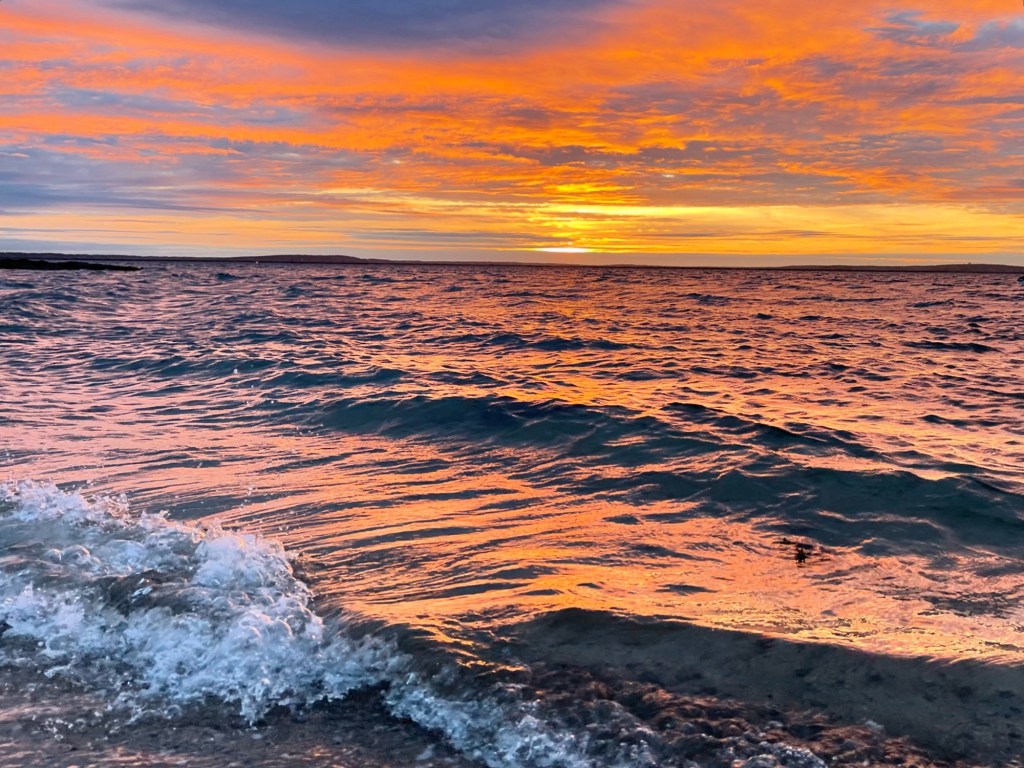
    Walking on the beach last week, I picked up two shells. One was tiny and in perfect shape, the other larger and more surf-beaten. Shell identification is not my game, but I like learning new games.. Based on a helpful shell identifier web site I found, we’ll call the small one a Threeline Mudsnail, the other a Shark Eye. I regret not holding on to the Shark Eye if only for the name… but I digress.

    We know that Hermit Crabs swap out old shells for new as they grow. We know that snakes do something similar with their skin thus making Campbell’s analogy resonate so well. Potted plants grow pot-bound and begin to fade if we don’t repot them into something bigger. So what of us? Why do we try to hold on to so much of our past instead of growing into the next version of ourselves? When we create a life for ourselves, parts of that life are going to fall away from us. People come and go. Favorite restaurants close. Developments are built in woods that used to speak to us. Everything changes and so too must we.

    Lately, a few friends have left the company I work for in favor of greater opportunity for themselves. In each case I cheer them on to do great things with their lives, even as I feel the loss of their contribution to the place where I still work. We must grow or risk drying up in the old shell we’ve built around ourselves. Like my kids growing into adulthood and moving to other places, these work friends will still be in my life, just not every day. It’s not a goodbye, it’s until we meet again.

    The trick, I believe, is to stop feeling so comfortable with the character we once were and begin feeling comfortable with the idea of a new identity. When we decide who we want to be and begin the process of becoming that person, we are shedding our old skin. We often wonder after we’ve left it why we held on so very long to something we were so ready to leave behind.

  • Still to Be Ours

    Last night
    the rain
    spoke to me
    slowly, saying,
    what joy
    to come falling
    out of the brisk cloud,
    to be happy again
    in a new way
    on the earth!
    That’s what it said
    as it dropped,
    smelling of iron,
    and vanished
    like a dream of the ocean
    into the branches
    and the grass below.
    Then it was over.
    The sky cleared.
    I was standing
    under a tree.
    The tree was a tree
    with happy leaves,
    and I was myself,
    and there were stars in the sky
    that were also themselves
    at the moment
    at which moment
    my right hand
    was holding my left hand
    which was holding the tree
    which was filled with stars
    and the soft rain –
    imagine! imagine!

    the long and wondrous journeys
    still to be ours.

    — Mary Oliver, Last Night the Rain Spoke to Me

    It seems to rain all the time now. Is that a function of climate change or spring in New England? If winter was a forever mud season, what are we to make of the regularly-scheduled mud season? Control what we can, let go of what we cannot, and celebrate the moments rain or shine; that’s what. The silver lining was that the rain that greeted me this morning inspired me to seek out an old friend.

    It’s been a while since Mary Oliver graced the blog, and honestly, I felt the void. If our quest is greater awareness of the moment we’re in, the whisper of a poet in our ear is as good a place to start as any. But then you read a poem like this one, with a look ahead to what’s still to be ours, and it’s easier to see the way. A great poet looks at who we are becoming as much as who we are. Poetry is life, after all.

    I’m not much for resolutions, but I love a great routine. Each day should include a bit of self-maintenance, a bit of movement, some honest effort applied to work that matters to us, a conversation with someone as deeply invested in us as we are in them, the pursuit of deeper knowledge and experience, and yes, a wee bit of poetry and song to complete the soundtrack. That to me is a successful day, and if we may string together enough of them in a row, one heck of a life.

    If I dwell too often in what’s to come, it’s merely a sense of hope and purpose betraying my intentions. Our present is built from the momentum of the past carrying us to this place, where we linger for a beat to feel the rain on our face before we turn again to what’s next. Our lives are forever lived with an eye on the path ahead, lest we stumble. To imagine what’s possible for ourselves and have the boldness to step towards it. This is the momentum for our tomorrow, greeting us today.